

By Marcos Eliades.
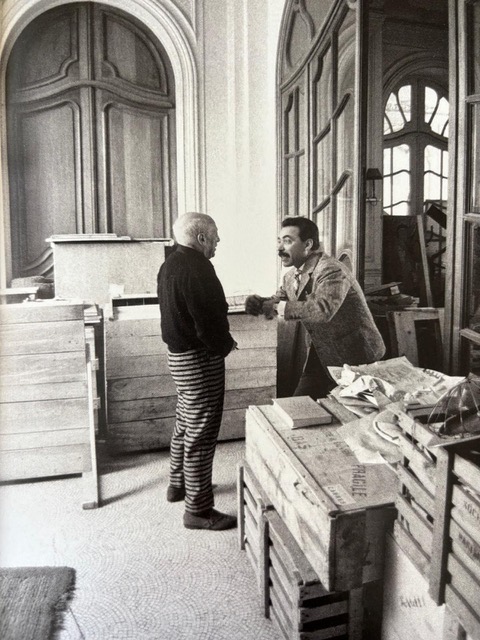
The story of Pablo Picasso’s tailor is a fascinating one. Long a fan of tailoring, Picasso eventually came to trust the Neapolitan tailor Michel Sapone completely, feeling he embodied the artist’s own eccentric and groundbreaking spirit. This led to bold, original designs, and the incorporation of new styles like a ‘Mao’ collar.
Sapone was a traditional tailor, originally from Bellona near Naples, and had worked in a tailor’s shop since he was a child. But he became an integral part of Picasso’s personal and creative world, and ensured that Picasso’s wardrobe was as distinctive as his art.
Picasso met Sapone in Nice in 1955 through a mutual friend, the artist and ceramicist Manfredo Borsi. Borsi was also the first client with whom Sapone traded a suit for a painting: a bronze-colored velvet suit paired with a hunting jacket. Borsi was won over, and Sapone’s career was launched.
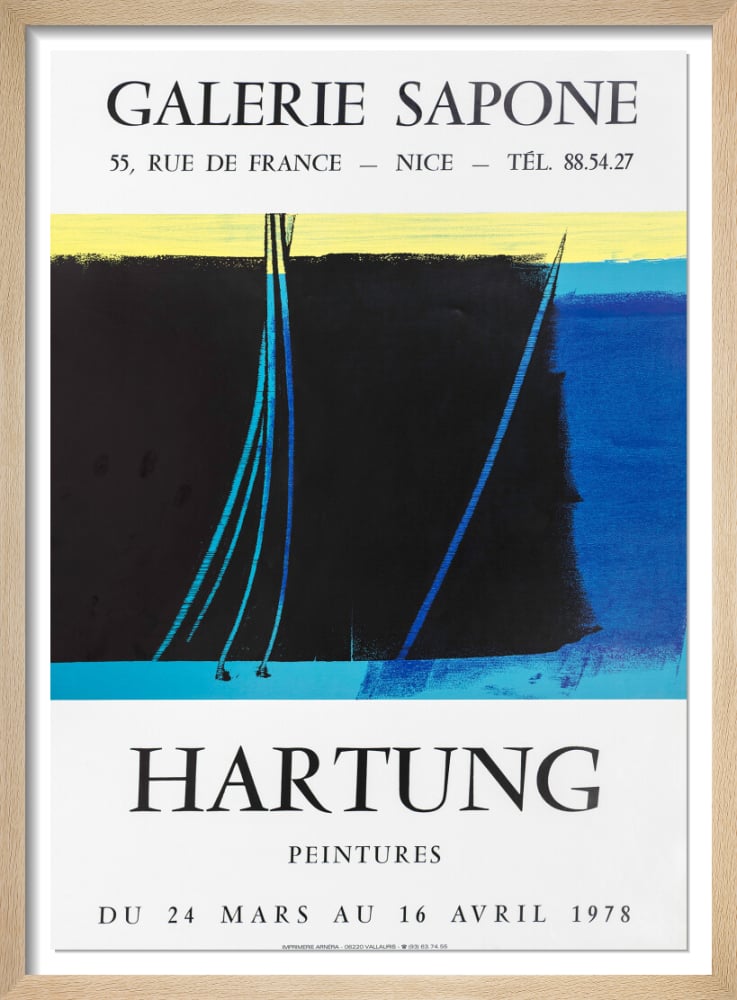
Over the following years, Sapone would dress artists including Miró, Giacometti, Hartung, Severini and Arp. Many of them would stop by his shop before heading to art openings, where he would dress them, he said, in his own style. Had he been born in the second half of the twentieth century, Sapone may well have become a fashion designer. Instead he was known as the tailor to Picasso - the artist who shaped modernity in art.
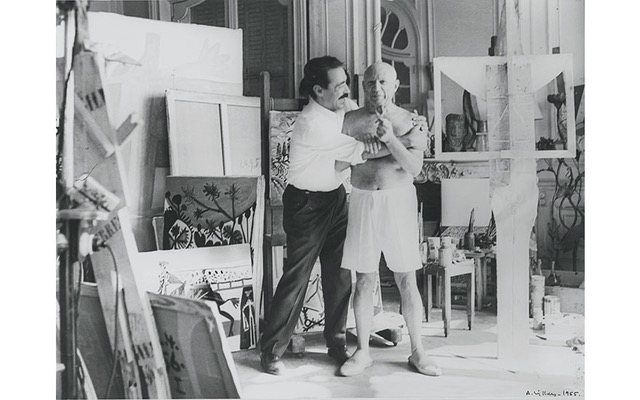
Artists didn’t come to Sapone, he went to their ateliers. So when Sapone first went to see Picasso, it was at La Californie, Picasso’s villa and studio in Cannes, where the artist lived from 1955 to 1961. At that time Picasso was experiencing a creative revival, thanks to his new companion Jacqueline Roque, whom he had met at the Madoura workshop in Vallauris - she worked there and it was where Picasso made his ceramics, highly sought after in today’s art market.
Driving through the gates of the neoclassical villa, Sapone would set up shop and discuss what was to be made. Over time the two became friends, and Sapone would make the journey regularly for 16 years, until the painter’s death in 1973.
In an interview that year with French newspaper Le Monde, Sapone discussed his approach: “Nobody ordered anything from me. I let myself be guided by inspiration.” This likely appealed to Picasso - owner of over 200 pairs of bespoke trousers. “He told me: ‘Will you work for me?’” Sapone accepted immediately.
But how does one dress an artist as unconventional as Picasso? “I came to see him with samples: Scottish plaids, Shetlands… we spread them all out on the floor, and Picasso said: ‘It’s like a painting; the people who make these fabrics aren’t stupid.’ He chose a pair of plaid trousers.”
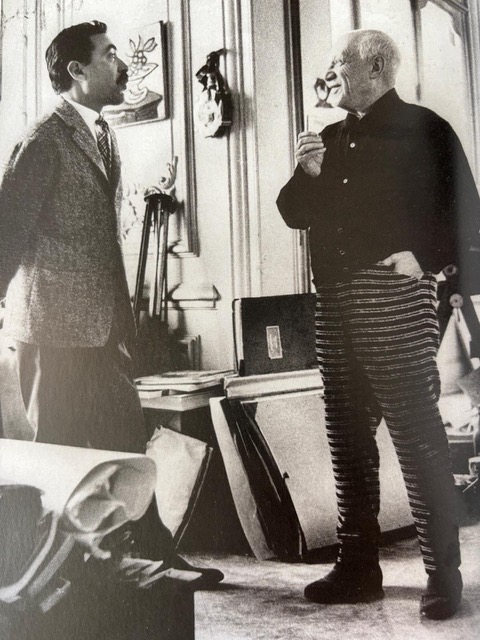
Like an artist, Michel Sapone took his time to find inspiration, traveling to fabric markets in France, Greece, Yugoslavia and Italy in search of unique materials. The tailor also later shared insights into Picasso’s tastes: “He loved velvets, with a preference for browns and beiges, but honestly, I made suits for him in every colour,” he said.
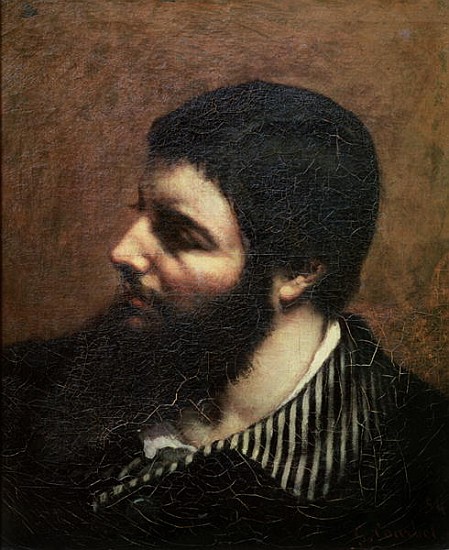
Picasso only wore natural fabrics, no synthetics, and he enjoyed dressing up, so avoided monotony. Initially he imagined himself an English lord, with a preference for heavy grey flannels, but with Sapone began to loosen up. One day, the tailor made him a pair of horizontally striped trousers that eventually he wore all the time, inspired by a similar pattern in Courbet’s Self-Portrait with a Striped Collar (above).
Picasso, a prolific artist, was equally insatiable when it came to clothing. Sapone reportedly made hundreds of pairs of trousers, over a hundred jackets and many coats. The suits were nearly as expensive as the art - one day, Picasso remarked, “these trousers are costing me a fortune!” while handing Sapone a painting and two drawings. Still, Sapone was always happy to take payment in artworks from his clients, never insisting on cash.
Picasso’s first order was a suit similar to André Verdet’s, a friend of the painter and a brilliant ceramic artist. Although it wasn’t exactly the same - Sapone, like an artist himself, never repeated his creations.
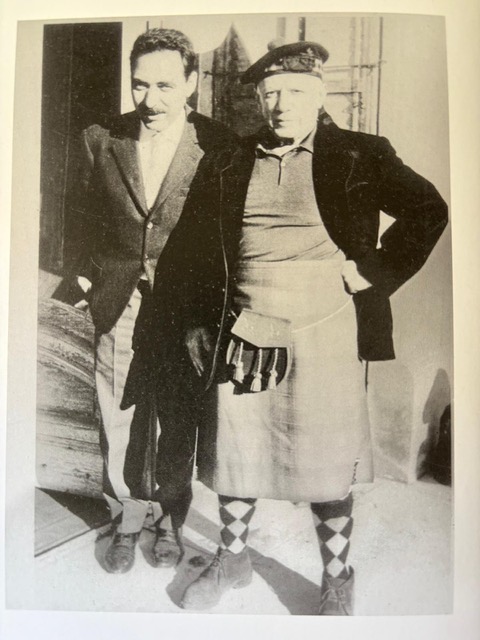
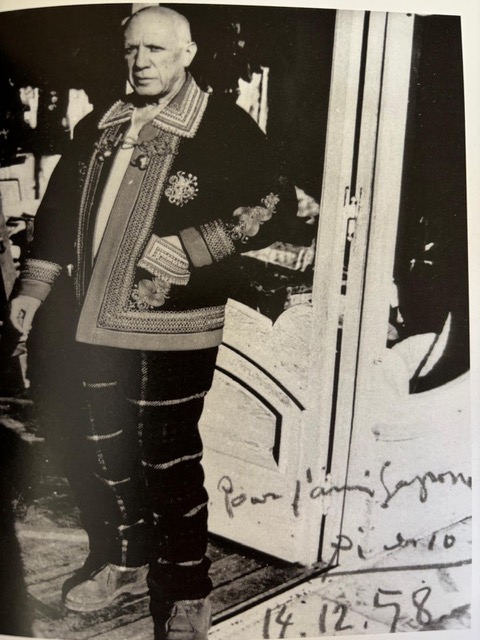
Sapone also made Picasso a simple wrap-around kilt, paired with a velvet jacket. The artist wore it with a sporran, tam o’ shanter, knitted shirt and argyle socks. Texture, and decorative details like these, featured in many of the creations. A subsequent commission was for a pair of velvet trousers in a large windowpane pattern, which Picasso wore with a traditional Yugoslovian jacket (above).
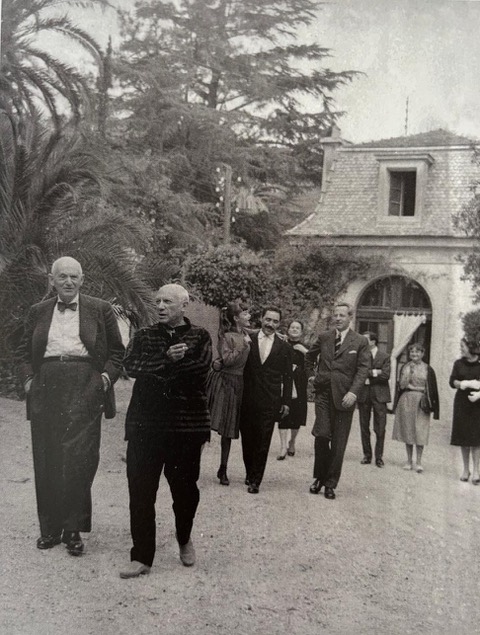
Picasso also loved surprises, and so his tailor often produced unexpected things. On October 25, 1956, Picasso turned 75. Sapone was invited to the villa along with other close friends to celebrate his birthday, and upon arrival, handed him a package. Inside, Picasso found a new creation: a brown and black striped velvet jacket, crafted from fabric similar to the one used for his first pair of trousers.
The painter put it on immediately and wore it all day. Its distinctive feature? A collar without lapels, with a small chest opening and no buttons. Sapone referred to it as a Mao collar, although he’d also drawn inspiration from his homeland, borrowing from the traditional shapes of the rustic jackets worn by Bellona’s farmers.
You can see him wearing it out with his party guests below - Picasso loved his tailoring, but he clearly stands out as the innovative artist among the group.
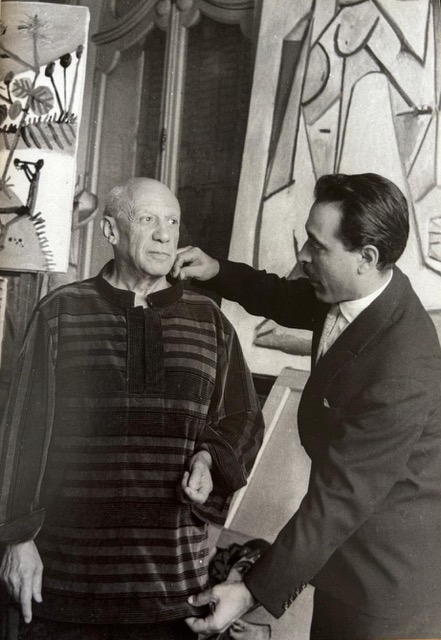
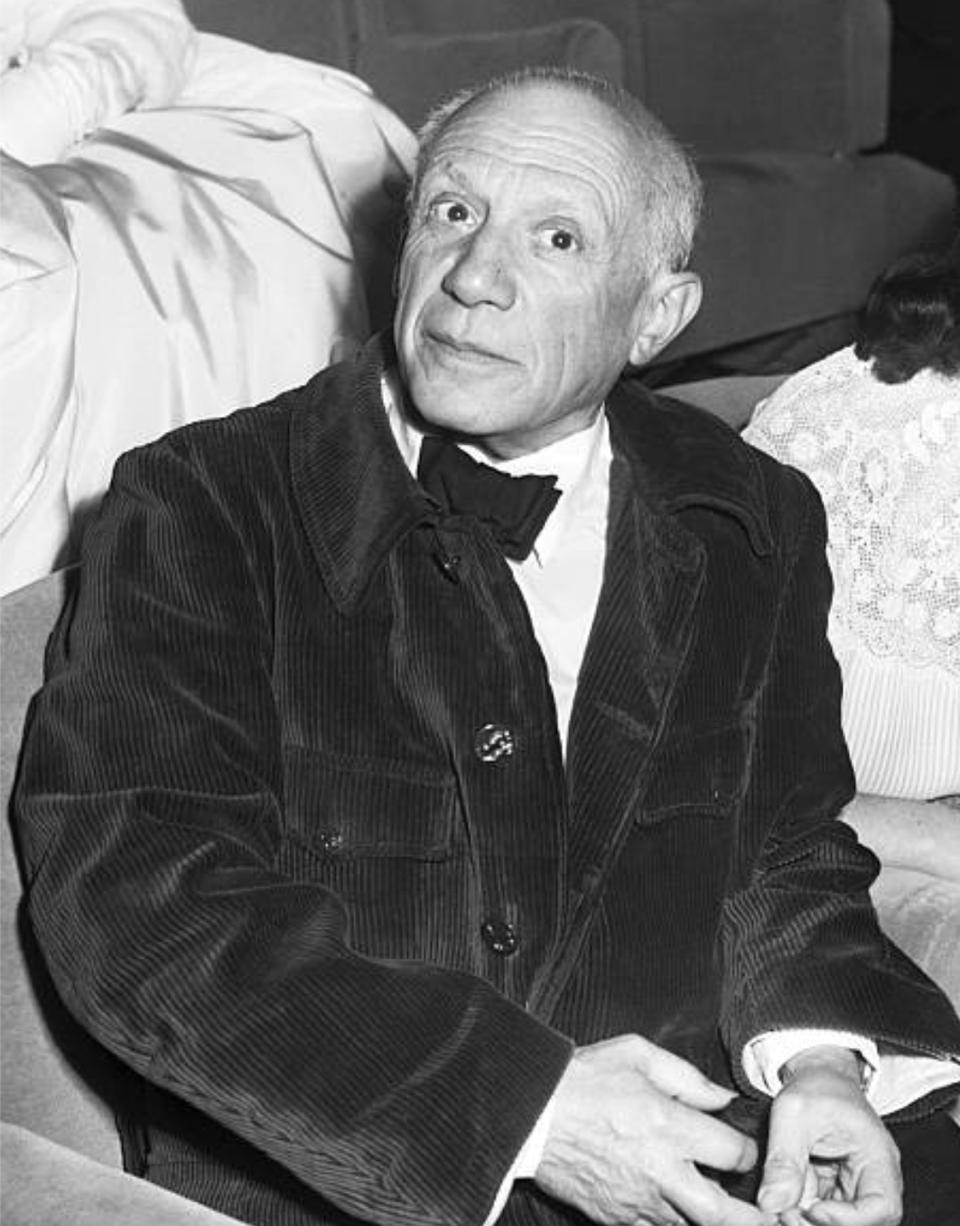
One of Picasso’s favorite garments was a corduroy hunting jacket (below). The world first saw it in 1953 at the Cannes Film Festival during the premiere of Henri-Georges Clouzot’s The Wages of Fear. It’s not hard to imagine how this rural jacket stood out among the dinner-jacket crowd of the day.
Sapone’s influence on Picasso’s style cannot be overstated. Through his innovative designs, he enabled Picasso to express his individuality and artistic identity in every aspect of his life, including his clothing.
These garments not only complemented Picasso’s artistic persona but also became part of his public image, immortalised in photographs and films of the era. Through that exposure, they also helped elevate the perception of tailoring as an art form. “It’s a Sapone! Yes… a real Sapone!” Jean Arp once proudly declared about his suit.
Sapone had an interesting coda later in life. In 1972 he opened his own art gallery: Galerie Sapone at 55 Rue de France, Nice. Of course, by this point he had a large art collection, but the gallery also made manifest the tailor’s bridging between the worlds of clothing and art.
The first major exhibition took place on May 19, entirely dedicated to Alberto Magnelli, a close friend of Sapone who had passed away the previous year and encouraged the tailor to open the gallery. Business flourished, but in April the following year Picasso died. Sapone paid tribute to him with an exhibition in his honour in May, setting the reputation of the Galerie Sapone.
In 1981, the gallery moved to 25 Boulevard Victor Hugo in Nice, to larger premises. A true artistic landmark on the Riviera, it eventually closed its doors on September 26, 2017.
Marcos is a Parisian auctioneer passionate about art and clothing. Surprisingly, his favorite artist is not Picasso but Matisse. His research included Luca Masia’s book, Picasso’s Tailor. Images courtesy of Edward Quinn archive, Getty Images and Bettman archives.










Love the Yugoslovian jacket!
It is indeed beautiful! While I chuckled a bit at the honest-mistake typo in the text and repeated in your comment (it should be Yugoslavian or Yugoslav), myself being from former Yugoslavia I do wonder from which part of the old country it is. I don’t recognise, but I can see the design cues. My guess is from somewhere in Croatia, Bosnia-Herzegovina, or Serbia, but would love to know!
My half educated guess is Montenegro
This is quite simply a wonderful article, and I feel better educated for having read it.
Great article. Definitely need to give some credit to Iain Trickett here, who has been championing Picasso as an overlooked style icon for years.
Excellent article… information on Sapone in English is incredibly rare to find.. thank you
Fascinating – love this Marcos! I’m very familiar with shots of Picasso in shorts, Breton tops and loose linens but have never seen any of these shots, or heard this story. I’d welcome more articles about how creative people wear/style clothing (I’m thinking of the potential inspiration boards of brands like Drake’s which no doubt look to the arts to bring a little looseness/loucheness to traditional menswear). I’ve yet to pick up Charlie Porter’s book What Artists Wear… maybe it’s all there?
Charlie’s book is great but it’s not quite what you might expect – less emphasis on the clothes and a bit more about the artist, their significance and take on things. Not really a menswear book
Lovely article – educational and inspirational!
Wow, what a piece! I knew Picasso was a dresser, but I always assumed it was due to him being a bold artist that he also wanted to present himself in bold outfits. But seeing that he was a menswear geek to the T is unexpected and makes him appear very charming in an unexpected way. I wonder if there was ever an exhibition of his wardrobe.
Signore Sapone is extremely well dressed in all of these photos.
Fascinating to see that even such an artist, who would perhaps be excused for having very strong opinions and set ways when it comes to style, still took advice from his tailor (quite an artist himself!) and let himself be surprised.
Precisely, that’s what impressed me most – it’s the thing that speaks most clearly to Sapone’s personal creativity
Thank you all for your kind words !
It’s always interesting to dive deep into an artist’s wardrobe, why would he choose this fabric instead of that one, an outfit over another but also who is the person/inspiration behind it.
Picasso was larger than life, he did not care for conventions or rules, he made his own, as he did with his art.
For more images, search « Picasso and Sapone » on the internet, you’re in for a treat.
Do let me know if you’d like for me to cover another similar topic, suggestions welcomed !
Cheers to all,
Marcos
Great work! This is one of my favourite articles.
The best thing I’ve read on PS
What happened to the art collection??