No, this is not a story about how I arrived fashionably late to the party of the season, the ball hosted by the dashing Lord Unley. It’s about shoes.
Last year Anglo-Italian introduced a new, unlined loafer in their shoe range - the Goodyear-welted part made with Crockett & Jones. We received quite a few questions about it in the subsequent months partly because it seemed like an alternative to the popular LHS loafer from Alden (also an unlined penny).
That Alden LHS (it stands for ‘leisure hand-sewn) has become both much more expensive and harder to get hold of outside the US. Recent versions have also removed the hand-sewn apron, which shifted the look slightly.
Understandably, readers also asked about the Unley’s similarity to the Harvard and Boston loafers from Crocketts, given they’re not dissimilar either, made by the same place, and I’ve covered the Harvard in the past.
I wasn’t able to answer those questions at the time because I hadn’t tried it (even tried it on) the Unley. I have now - in fact I own a pair - and what’s more during the recent pop-up I talked to three different readers about them. So it seemed like a good time to cover the shoes (and indeed talk a little about the Anglo shoe range in general).
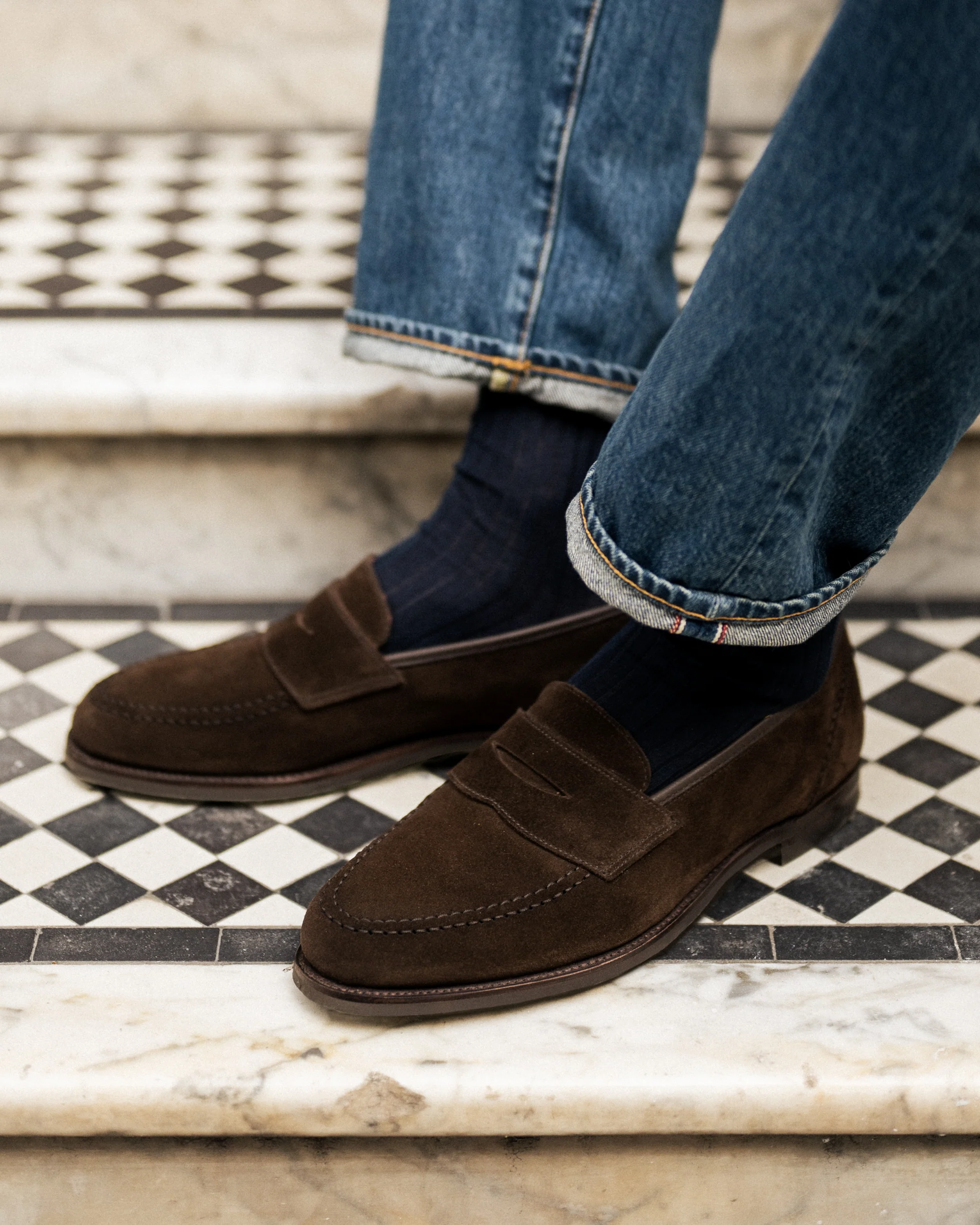
Jake Grantham (the Anglo founder) has very particular views when it comes to developing new products, and with the Crocketts shoes he wanted to bring back a last (the shape of the shoe) he had worn when he first worked on Savile Row.
This was the 72 last: Jake had bought a pair of suede Crockett loafers on that last with his first pay check, and resoled them repeatedly when he subsequently moved to Hong Kong to work for The Armoury. To the point - that end point we all talk about but rarely reach - where the holes simply could not be sewn through any more.
That last was the basis for the now quite distinctive Anglo shoe style, which in a loafer is characterised by three things: low vamp, low toe profile and a reduced toe spring. They are also the main things that separate Anglo loafers from the likes of the Harvard and to a lesser extent the LHS. (Shown below in that order.)
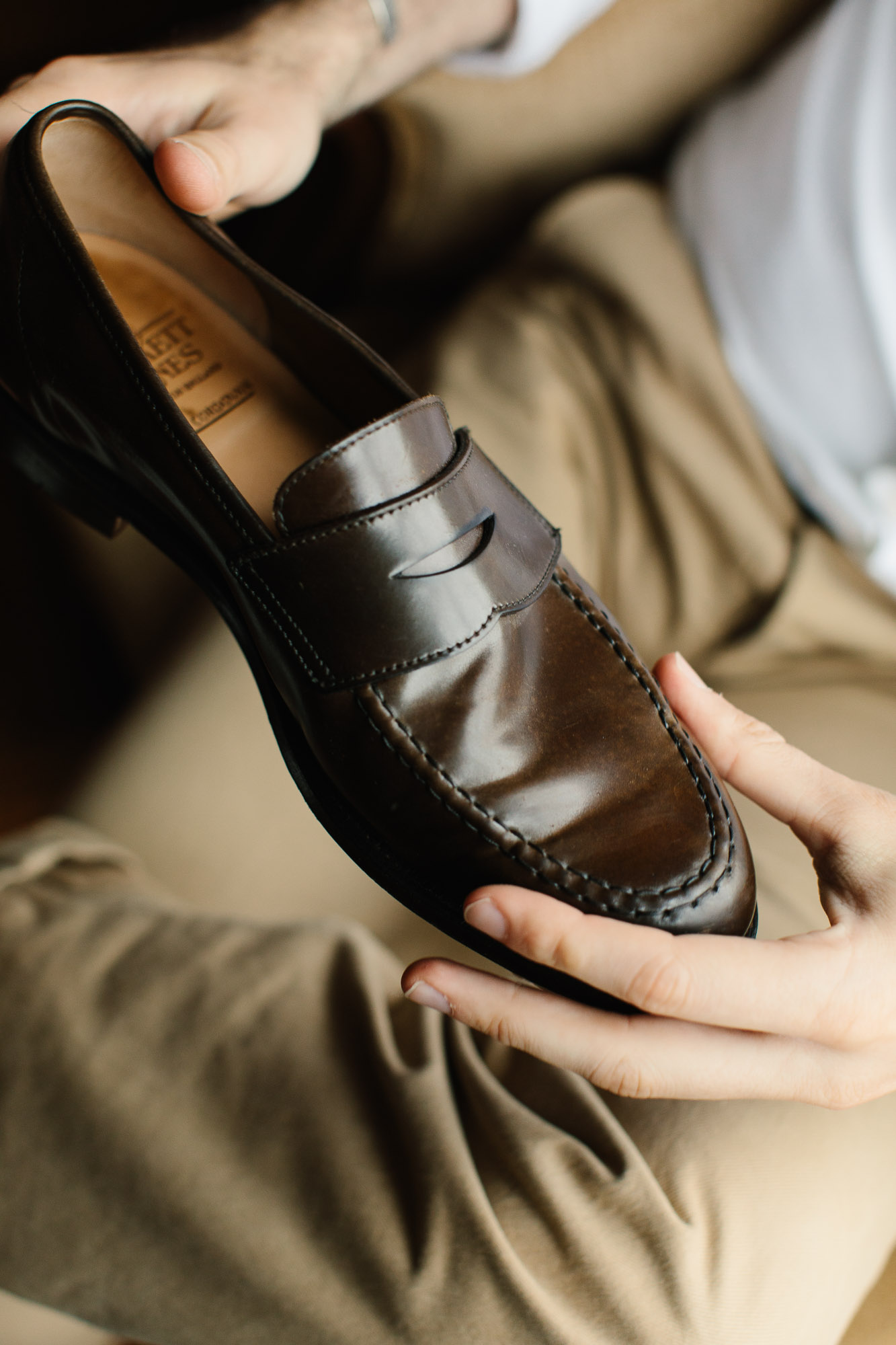
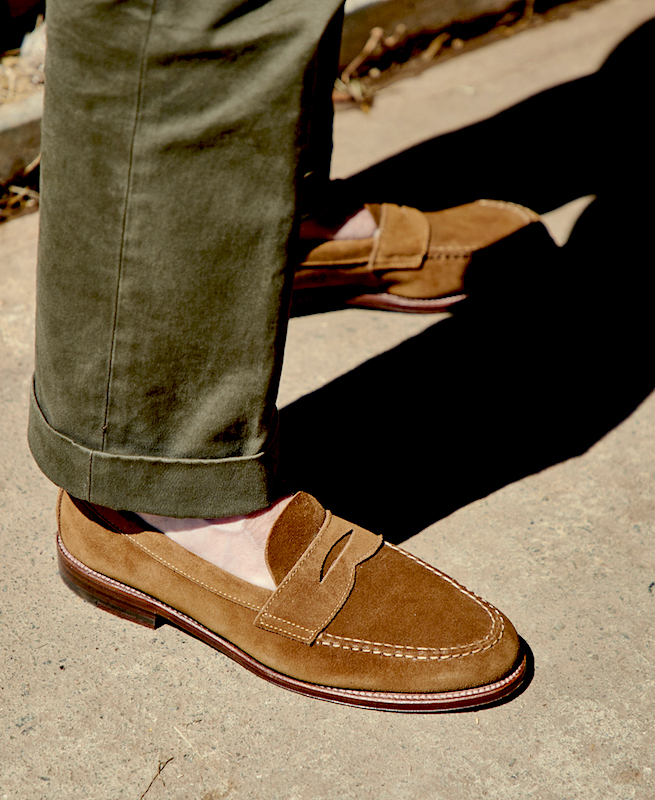
The vamp is where the strap sits across the top of the foot; lowering it so it’s closer to the front makes for a slightly more dainty, perhaps elegant loafer, but can make it harder to fit on some people. It’s a matter of millimetres, like most aspects of shoe design.
I like a low vamp. It’s one of the things that characterises a certain section of Ivy-inspired American footwear, and it’s the thing I like the most about my Alden full-strap loafers. I wish the vamp on the Harvard were lower.
The other comparison shoe here, the LHS, has a similarly low vamp to the Unley, but the latter has a lower toe profile and toe spring. The first means how tall the loafer is at the very end, the point. The second means how far that point naturally sits off the floor. Reduce both, and the end of the shoe looks downward-focused and perhaps a little stubby.
This is the look Jake (below) likes, and you can see why. It fits with the low profile, subdued, set-back, turned-down aesthetic of the brand. It’s why so many of the house cloths are matte, the tailoring soft and the colour palette muddy. The opposite shoe, spiritually speaking, would probably be a long, square-toed, high-shine shoe in English tan.

Personally I like a little more sharpness than that with tailoring. Somewhere in between. But I love the Anglo aesthetic, both for how distinct and authentic it is (in an era where so many start-ups seem to lack identity) and because it works so well for lots of people.
Those readers that came into the pop-up all looked great, and I can see good this kind of loafer is for them. It’s smart enough for that look with a suit, great with tailored trousers and a knit, and casual enough to wear with jeans as well.
In fact the way I’ve enjoyed wearing the Unley most is with black or blue jeans, as I don’t have a comfy, more casual loafer like that in brown suede. And it is very comfortable - the Unley is unlined, but actually not in the heel, where there is the usual heel structure. That helps hold the foot a little, while keeping the rest comfy.
Jake is particularly keen on stitching on the heel section, which is one reason the heel counter is there, as he thinks it balances with the detail of the stitching on the front. I’m not entirely sold on that, but the structure definitely helps keep my narrow heel in the shoe.

That is an issue with the LHS loafer for some people, though I find them very comfortable too. And just to finish off the comparison with the LHS (the second shoe above), I don’t think it works with tailoring for most people, at least in suede, both for the shape and because of the materials - the suede is coarser, the sole thicker.
But the LHS is one of the few loafers I’d wear with shorts - which I wouldn’t do with the Unley. So it’s basically further down the casual spectrum.
One thing the LHS and Unley have in common is that there’s no structure at all in the toe. This affects sizing. Most of the time, a shoe (particularly an unlined suede one) will stretch a little in the width if it needs to. But it won’t stretch in the length because the internal structure in the heel and toe prevents it.
But the Unley can a little, particularly over time. For that reason, when I found I was a little between sizes on the Unley, the Anglo team advised me to go for the smaller size and this has worked well.
It’s normal for me to have to make a compromise with loafers between toe room and heel slip. My feet are just too narrow at the back compared to the length and spread of the toes. But with the Unley I was able to take the smaller of the two sizes (8.5E) and while the toes felt tight to start with, that slowly relaxed. More than one reader has told me the same.
That’s why my LHS shoes look bigger in the picture above - they’re a full size up, 9.5 in American sizing. (American sizing usually means either a half or a full size up, depending on the relative lasts.)

I realise I’ve now written over 1000 words on just one pair of shoes, having intended to cover more of the range. Oh well, I'm pleased I joined the party on this one, even if I was a little late. In terms of the wider Anglo collection, there was a piece here a while ago on the desert boots - and that Italian range certainly deserves its own article at some point.
Also to be clear, the Unley is not on the 72 last, but a relatively new one called the 391. It’s a little wider in the toe box, and it generally had to be different to accommodate the lack of lining as well.
The Unley costs £560 (Crockett’s are a touch cheaper, a suede Harvard is £475). Full Anglo range here. All images from Anglo-Italian, except the below which is courtesy of Lorenzo Sodi. All the guys in this shot are wearing the Unley.