


It's rare to cover how versions of a product improve over time. Reviews usually happen soon after release, as does the hype and excitement. Permanent Style covers products years after their purchase, of course, but that's more about how they’ve aged through wear, rather than how the brand has refined them.
Brands themselves often don't talk about this product development either. For one thing it's dry and technical, particularly when the changes are small. But the other reason is you're basically telling existing customers that in the past they bought an inferior product.
As you might expect, all these are reasons why I find it an interesting area to cover. One I’m going to look at today is the Sagan shoe from Baudoin & Lange - because I've worn almost every iteration in that improvement process over the years, and because being a bigger brand now, they don’t talk about it much themselves.

In the nine years since it launched, the Sagan has changed the suede used for its upper; added structure inside that upper; changed the sole twice; created a different insole; and altered the last shape.
The changes I find the most interesting are the hidden ones. For example, the first Sagan deliberately had no structure in either the toe or the heel. This made it soft to wear, and in the early communications you often saw the two shoes pressed together - soles outwards - to show how the shoes could be squashed flat.
The problem with that of course, is that you sacrifice the benefits of structure - a cleaner looking shoe, a shoe that has more of a hold on the foot.
Three years ago the shoe was changed to add a latex-rubber layer around the heel counter, giving it more structure. The good thing about that rubber compound was that the shoe could still be squashed flat - the rubber just bounced back. Most shoes use leather, plastic or a kind of cellulose board.
Last November, the same layer was added to the toe. The early Sagans were great - a real step-change from other Belgian-type shoes - but over time they usually got a fold at the very front of the toe, which made them look worn and faded (visible in its early stages below).
The latex-rubber layer was added to stop this from happening, but it was also run a little way down the sides of the shoe, which lessened another effect - the wearer’s toes being visible pressing against the soft sides.
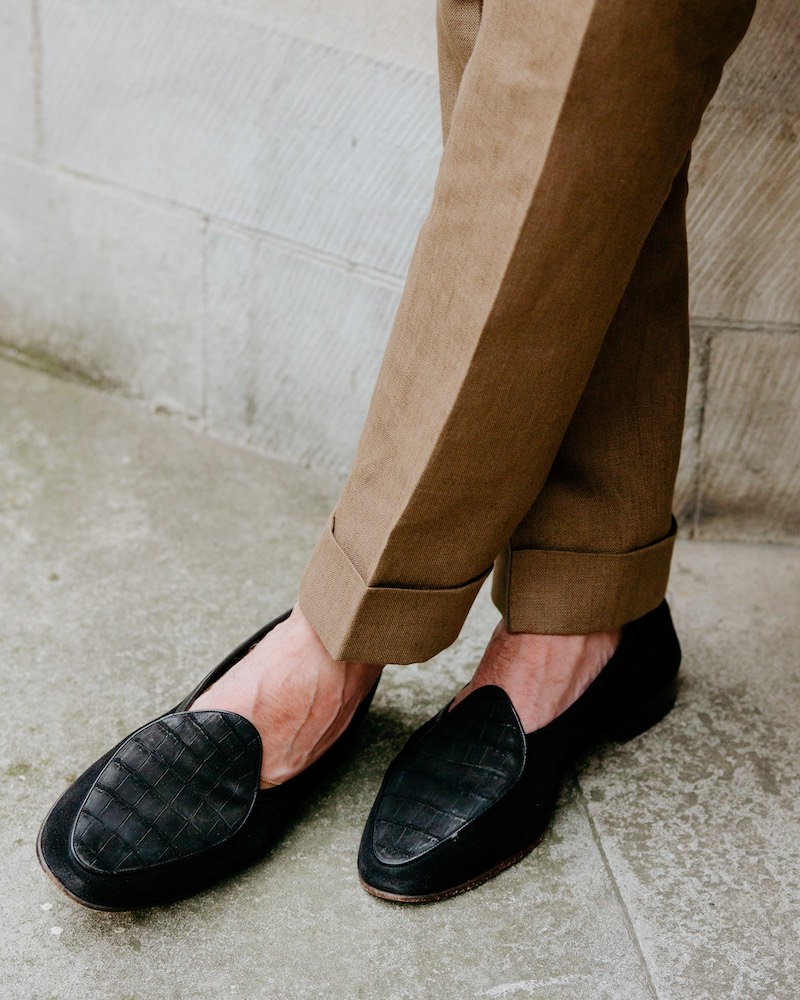
One issue with Sagans in the early years was that while lots of people liked them, they didn’t fit them. The last was narrow, and if you sized up the heel could slip off a little.
Actually it’s interesting, listing all these problems, how much I liked the shoes back then as did others. I think it shows how much development a product often needs, and makes me wonder about how other products I like could be improved.
Anyway, the fit was changed early last year when the last was altered, and quite substantially - almost 8mm was added across the widest part, around the ball. The heel was also narrowed.
It’s actually surprising how similar the current shoes look to the older versions, given that change. Shoe design like this is a fascinating area - always a matter of millimetres, and about balance and proportion, from every angle, back to front and side to side. I find it’s why bespoke makers sometimes struggle with it.

I got a new dark-brown pair of Sagans recently (above) and while the old ones fit me fine at the front, these are definitely an improvement. The heel holds better as well.
The other change I really notice is the insole. It’s now in two halves, with the back half leather and the front suede (below). That suede half is perforated.
The idea was to help the foot breathe and to slip around less when it got sweaty. The latter has not been a problem for me, but then I don’t sweat much. The suede certainly feels comfortable however, and I can see why it would work.
Interestingly, this kind of perforation and helping the foot breathe is important in the winter too - it’s when the foot gets wet that it’s most likely to feel cold.

There have been lots of other changes to the Sagans. The suede of the upper has been improved, to one with the same silky feel but less of a nap, which wears down less. The leather sole was changed to one with a smooth finish (and then, unlike the rest of these changes, switched back again).
The rubber sole version was added two years ago, probably the best one I’ve seen for its similarity (from the side) to leather. It’s sanded on the side to have a similar texture to leather, and the heel stack even has layers that are sanded and some that aren’t, to look like the layers of rubber and leather in a regular heel.
There have been small changes to the rest of the structure, though the important thing the Sagan had from the start is still there - the foam padding that is cut into the insole rather than being a separate layer, which is why the Sagans always looked sleeker than other Belgian-type shoes.

I feel quite personally connected to the Sagan, given Permanent Style was the first place to talk about them nine years ago, when Allan Baudoin was still operating from his sofa. As I said I’ve also worn them ever since.
But I genuinely think this kind of product development is one of the best things about them - and one that doesn’t really get talked about given they’re such a big company now. Many of the current designs aren’t my style, but they’re all iterated in this kind of way.
The broader question of changing products over the years is also an interesting one, and I’d be interested to hear readers’ opinions on it too - how do you feel if a brand changes something a year or two years after you’ve bought it? Do you like the fact it’s been improved, or do you feel swindled that you got an earlier version?










Incremental (even if tiny and invisible) improvements to long-lived product lines are indicative of a brand that will itself continue to survive and prosper. Rolex is the prime example of this (even if for the most part I prefer the aesthetics of vintage ones to the engineering excellence of modern).
What is the full name of your most recent dark brown Sagans as I don’t see it above if I were to visit B&L and purchase a pair?
What do you think of the Stride as an example which I actually tried on but didn’t purchase?
Their prices have went “far northwards”unfortunately which makes them expensive.
I feel that if a product evolves in a positive way, that’s great but some unfortunately do the opposite putting in cheaper and indeed inferior materials but that’s not always the case.
Hey. It’s the Lusitanias Dark Brown Asteria Suede.
The Stride I don’t really wear but that’s because I don’t wear pale rubber soles like that too much that contrast with the uppers.
I agree on the product development – those that care about quality go one direction with quality, others go the other way and cut costs out everywhere they can. It’s about the type of company really
Thanks indeed!
Have you tried the linen strides of the Calvi slippers? I am looking at both for a summer shoe.
The linen looks nice if you like that kind of paler colour in a shoe. I’d prefer them to the Calvi slippers as I prefer espadrille rope to be round the sole as well generally
I tried them in the suede this summer and they are wonderfully comfortable. However, the sole started to come off the heel after about 15 wears on both feet. Talking with them about replacing the shoes has been very slow, about a week for a reply. Sagans have held up for a few years, hopefully the Calvi is just a one-off.
Oh dear
Simon i was always very negative with this shoes but i think this time i like them more maybe cause you styled very nice and they dont look akward. May i ask something a bit irrelevant ? What brands would you suggest for a summer linen or other warm weather material trousers? i want to wear them mostly casual.
Thanks Georgios.
I’d look to the kinds of RTW tailoring brands we cover regularly – Anglo-Italian, Natalino, Kit Blake, Cavour etc. Manish did a good guide on the cuts from different brands here
I would also look to Rota or Besnard.
By contrast, my experience with Cavour was somewhat problematic as regards transparency where their products are made and the poor quality of their (former?) Chinese made mainline shirts (buttons kept coming off). I would only buy trousers at a 50 percent discount, which they always have on many products (just like Berg & Berg).
The Rota Sport summer linen trousers are really excellent, so comfortable and cool.
https://rota-pantaloni.com/collections/rota-sport
Hi Simon, would you happen to know where B&L produce their Sagans (and the rest of their offerings for that matter)? The website seems to be quite vague, saying they’re “made in our ateliers.” In addition to this, I’ve had conflicting results from a Google search.
On a similar note, you touched on the improvement of the heel clip. My question for this is a rather silly one: is there a reason why shoe brands don’t all have a narrow heel cup to begin with? Does it have to do with trying to accommodate those with larger heels? Is it a structural constraint? Is it harder to manufacture?
Hey Rowley – I don’t think it really matters where they’re made to be honest. It’s usually a bad idea to conclude that much from knowing that – people have a tendency to use it as a shorthand for quality when it isn’t necessarily.
Yes, a bigger heel cup can accommodate wider heels. Brands try to strike an average, and often err on the side of a little bigger in my experience because a narrow heel cup is very uncomfortable on someone with a wide heel, but wide heel cup is not uncomfortable on someone with a narrow heel
I will mention that for import tariff reasons, the country of origin could be important these days, unfortunately.
That’s a good point, yes
Hi Simon, I agree with Rowley. Transparency about where a product is made is always a positive thing for the consumer. Knowing how and where something is produced allows people to make more informed decisions and assess quality, ethics, and pricing more fairly. Vague phrases like “made in our ateliers” often act as smoke screens—used to sell products that might not live up to their image or justify a price that doesn’t reflect the actual value.
On that note, the article published on Permanent Style about affordable shoe brands (What are the best cheaper shoe brands?) makes this point quite clearly. It mentions country of manufacture as an important factor when evaluating brands, as it gives useful clues about craftsmanship and quality control.
Hi Delamo,
To be honest, having been to many factories around the world, and seen how things are made from the inside, I disagree.
Knowing how something is produced certainly helps make informed decisions, but knowing where is not something that can be relied upon. Yes, on average, something that is made in Italy will be made better than something made in India, but there are many exceptions, some of which we covered on PS. And you only have to visit one or two UK factories before you get a very different idea of the connection between quality and location.
Also, saying where something is made is often used as a smoke screen too – hence brands using Chinese workers in Italy to add a final stage of production, so the whole thing can be said to have been made in Italy.
Imagine Edward Green shoes being made in China though…
I know, but makers in China are increasing a lot in quality, often design and marketing is their biggest issue.
And, in some areas it may even be good for the survival of the craft for it to be done overseas. Eg the biggest issue with bespoke is only the very top of the market remains, because it’s now too expensive to produce anything cheaper in western countries.
I agree that the variation within countries may be so large that it is not enough to indicate higher quality or more skilled workers, and this bias favors Western countries. I too have read about the different ways ”Made in Italy” has been used.
However, some countries have higher base levels of work safety, workers rights, pollution and salaries than others. To me as a costumer, that is worth paying for.
If indeed the B&D shoes are made in their ”atelier” in e.g. China, they could elaborate and say that they make sure that their staff is highly skilled and have humane working conditions. Not even disclosing the country of origin makes it sound like each order is just placed in the cheapest available location, which may shift between orders. And I doubt that this is the case.
Good points RKM.
A big part of the issue is the relative education of different customers, or perhaps their willingness to learn about the product and understand it. PS readers might, but most will not look at the detail of the way things are made or the way workers are looked after
I agree that country of origin is not a good proxy for the quality of an item and that “made in” can also be a smoke screen given just finishing a product somewhere can be sufficient to legally say it was made there even if the bulk of the work was done elsewhere.
Not everyone is looking for where it’s made to be a proxy for quality though. Those concerned about working conditions will know those Chinese staff in the Italian finishing workshop will still be treated consistent with Italian employee protections not Chinese. Others may have more environmental concerns and the amount of “product miles” that have been racked up shipping materials and products around the globe rather than using local material, local employees and local distribution.
Blackhorse Lane do a great job of saying what materials are used and where they come from. It’s something that should be encouraged in others claiming to be craft producers as the transparency gives confidence. The fact that the questions been asked and only deflected by questioning the motivation unfortunately speaks volumes and destroys trust
I think it was a legitimate question and the answer seems defensive. Do you know where the shoes are made? Then why not share with us? We should be trusted with the information rather than lectured on what “really matters”.
To be fair, I do quite a bit of lecturing!
Quite happy to ask the Baudoin guys, I just know there is this issue with people using location as a short hand for quality, and it’s one worth discussing
Inevitably with 2m readers then some would conflate origin as a proxy for quality, but I lean towards thinking transparency is best and people can be trusted.
Thanks Chris, yes in general I’d be happy communicating that, I just wanted to raise the issue.
Interestingly, I think it’s less about ‘trust’ and more about time, effort, bandwidth. Eg I know a lot about where my clothes come from, but a lot less so my food. The thing stopping me there is largely time, forcing the use of short cuts
Where things are made like “Made in Italy” or other countries label… there is the tradition that could be handed down, but I agree it does not necessarily imply a certain standard.
Most of the Italian stuff shipped to America is pretty sketchy when its cheap. Since the 70’s, FIAT in America stands for “Fix It Again Tony” and I loved my Spider! When it ran….Italian manufacturing has been playing this weird High/Low since the year 1000 A.D. Made in Britain is the same. The Jaguar E-type, anybody? (“A handsome design!” “Yeah, I wish it ran!” – from the film the Gumball Rally, 1970 something – great movie!)
The city of Prato near Florence is a textile district (dating back centuries or longer) is now mostly Chinese owned firms with clandestine immigrant labor and horrid work conditions, yet supported by the local governments. A “Made in Italy” label lowers EU tariffs, but doesn’t guarantee quality.
It’s complicated, and some firms mentioned on PS do rise above the cheap garbage, but… the concept of where something is made is part of the lure, the genre and the emotion instilled in a product. Italians practically revere British made clothes… Guys stop me in Rome when I’m wearing one of the PS Donegal tweeds, and it always leads to “ooohs” and “aahs” when I talk about the cloth, the design and the manufacture. It has value.
Can we imagine a world where small government didn’t tax, regulate, ordain or just generally break balls about everything created? Could we imagine the UK, EU or US government applying zero tax and little regulation on manufacturing? Maybe get taxes from Consulting firms, Private Equity and Advisory services and especially NGO’s? Too “evil capitalist” and “climate foe” for everyone?
One of my friends used to work at the Burlington Arcade store, he told me that the Sagan Classics are made in Greece and Sagan Strides made in Portugal. The shoes have a decent quality overall.
Thank you! After looking at a few retailers’ web pages, some say that all of their shoes are made in Italy, some report individual models as being made in one of Italy, Greece or Portugal, and one website says that every slipper is made in their workshop in London (although the individual product pages say Italy or Portugal). My guess is that they scaled up production and found it necessary to use a range of makers in Europe, then decided it became messy to be specific about origin.
I think the real reason brands (think designer , high street etc) don’t mention the ‘ evolution’ of products is because, in the pursuit for more profit margin, they cheapen the quality.
What you’ve demonstrated above is a brand that has truly evolved and improved .
What do you think that impression is based on out of interest Robin?
As an avid eBay bargain hunter I’ve certainly noticed this trend for a few trademark products. Barbour, swandry (New Zealand), brooks brothers shirts, Alden (vintage is crazy solid). I think it comes from trying to keep the same price or price point point as inputs inflate. Cost disease (google for a good explanation) must be a big part of it – as quality tends to decrease as automation increases in menswear.
A couple of observations on your question at the end: I’ve never felt short-changed. The brands that resonate with me and I buy from, I believe, have intended to make the best product with the best design they can at a particular moment in time. The fact they have used that experience to iterate and create something better is part of the point, I would have thought? However I do think that really only works for most people when the changes are subtle. Had you not written this article, I would not have known B&L have made those changes – the shoes still look very much like the B&L shoes I purchased back in the day.
It reminds me of reading something about Volkswagen’s strategy over the years they were making the Beetle. Whilst from year to year they may have taken great steps forward technologically or mechanically, they deliberately kept the aesthetic changes to a minimum so that those buyers with an older model wouldn’t look or feel as though they were left behind.
Perhaps also a reason why ‘classic’ style has endured?
An interesting parallel, thank you Nick
Very different approach to that taken by eg apple on the iPhone or (perhaps more relevantly) football teams on their replica kit. There changes to the product are aggressively hyped.
I personally regret that my PS wax walker is not a couple of cm shorter since you made the change in length.
Thanks Alexander, yes that’s a good example of how this development can go both ways
Thanks, Simon, for an excellent piece. I’ve been wearing Sagans, in various colours, since I first read about them here on PS, so nearly nine years. My first pair wore out rather too quickly — wear and tear on the suede from the pressure of my little toe. But since then, they’ve all performed superbly and taken well to resoling; one pair is on its second resoling. I’ve tried both the bow-laced and penny loafer varieties, but they just don’t look as nice as the sleek classic version. Reading this piece, I think it’s time for a new pair — the small incremental improvements are just the thing, and I will certainly benefit from an added 8mm in the toe box. Prices are high, but for a product that has maintained, even improved, quality, that’s to be expected. And I agree with the emerging majority opinion in the comments: having older versions that can be improved upon is a perfectly normal process and one has no reason to feel ripped off!
Lovely to hear Michael
Hi Simon ,
I do admire the clothing and the sunglasses that you are wearing with the Sagans.
Can you please summarize the brands if you will?
The outfit with the sunglasses is described in this post on our hand-framed cotton crewnecks
The top outfit is my silk jacket from Pirozzi, worn with a PS Finest Polo shirt and brown high-twist trousers
Thank you very much for highlighting these positive changes. I’ve followed the brand over many years and assumed that, as they got bigger with more retail locations and higher price, that their quality would have decreased, just like many other apparel and non-apparel brands that have chased growth. Nice to know that’s not the case – at least for the original Sagan product.
I would love to find out for myself how nice the newest version of the Sagan is. My problem (if it can be called a problem) is that I’ve had my original version for 7.5 years now and they look as nice as ever even after wearing hard approximately once a week. I even bought a second spare version back in 2020 thinking that my first pair would inevitably break down soon, but that hasn’t happened and I’ve never even worn the second pair outside my house.
At this rate, I assume I’ll purchase my third pair in the mid 2030s. Here’s to hoping that Sagan iteration is even better.
While reading this lovely post, I found myself thinking about the PS shop and how you take care to note many of the changes made to individual items when they’re restocked. I feel it could be really interesting to have a post reflecting more broadly on your experiences relating to this topic. 🙂
Nice point Will, yes that would be good
Simon , i just bought your tapered Tee . Very comfy. Looking to buy another one. But they sold out super fast. Are any restocks ? When will the tapered tee be available again ?
Thnx
Hey Stanley,
Welcome to the club! Unfortunately they are very popular and we can only get deliveries every five months or so. But we will be reordering now…
So, the next delivery may be in September or October?
Yes
For me, when a company makes changes, it depends on how I perceive them. If I see the changes as improvement, I get excited about them. I probably won’t upgrade mine unless it’s broke, but I like to see the company keep improving. But changes that I see as corner cutting or decrease quality disappoint me. For instance RM Williams changing from traditional materials to cheaper feeling and less break in makes me feel like the product lost some of what made it popular in the first place.
Hello Mr Crampton
It is sadly often the case that businesses that make so many fundamental changes to the construction of their products over a relatively short period of time do so because they realise that they were of not very good quality in the first place.
Would you agree?
I think there can be a bit of a learning process with new brands, for example discovering new factories or methods, but they usually start with the intention of making high quality.
However, as I’ve said in the past it’s about the type of company – most we cover start with that ideal of high quality, passion and longevity. Many others start with the ideal of making money quickly, filling a hole in the market, and selling in five years if not before
Thanks for the timely article, as I was just considering getting a pair! Quick question, Simon — do Sagans provide decent support? I have flat feet and am curious if they’d be suitable for me
Not really, no
I bought my first two pairs in 2016. They’re still going strong and love the unstructured nature of the shoe. I remember that they were made from lamb but no longer think that is the case. Although I like my newer three pairs, the lamb were the best for my ultra-casual purposes.
I don’t mind the technical improvements. But as someone with less than mainstream measurements/proportions, it can be frustrating when you find a product that fits well and then they change the pattern to fit a more mainstream/average body. For instance, I really liked the original cut of the Tapered T-Shirt, but I believe rather quickly some length was added to the body. That instance wasn’t too bad. I will see how the Sagan changes workout. My favorite feature was being able to smash them into my luggage. And regarding size, they were kind enough to provide a second insole, and I added a heel pad, as I couldn’t size down due to length. Unfortunately, due to a carrier delay, the second pair I ordered did not make my summer move. I’m hoping the narrower heel helps, and that my foot isn’t swimming in the additional 8mm.
When you are measuring things in years then I think it would be harsh to be considered “swindled”, I have more sympathy when you buy something now and a couple of weeks later you get the email announcing the “new and improved” model which often comes with the double blow of the outgoing model being discounted at some point soon to liquidate residual stock.
Improved, outside of technical fabrics, is going to be highly subjective even if it’s the intent of the manufacturer. Assuming they’ve done their research right it probably will be an improvement to the majority but there will be the outliers who were explicitly buying the product because it was skinny etc rather than those buying it despite it being too skinny. Its somewhat lose lose though as the outliers will not regret their purchase but regret the lost future opportunity to purchase.
Personally dont track any clothing company close enough to notice year on year refinements/changes and there is always the other option of launching the new product under a different model name and retiring the old model either immediately or after a transition period.
Thanks Bob, good thoughts
Sometimes I feel uneasy when brands change or modify their USP — the very style that initially defined and marketed them — in response to customer feedback. It makes me feel as though I was part of an experiment.
Take Rubato, for example. In their early days, their knitwear had a distinctly short length and a generous body, which admittedly made it difficult for many people to wear. But their target was clear: individuals who wear high-rise trousers and seek unusual, vintage-inspired knitwear. Although I can see they’re trying to maintain the original fit as much as possible, they’ve been gradually lengthening the garments and narrowing the body. I can’t help but wonder if, over time, their designs will eventually become just like any other knitwear. While this may attract a different group of customers, it also risks abandoning what set them apart in the first place.
I also have the first iteration (bought on Allan’s sofa) and I am quite precious about them.
My first iteration sagans held their shape on the heel and fit perfectly for approximately 2mins. Then they slipped off constantly. I haven’t worn them much since. I even tried putting tissue at the front of the shoe to force the heel forward. All that did was stretch the heel even more and make it sloppier. The first iteration should never have been sold imo. I won’t be going back.
Sorry if I’ve missed it. But do I need to get resized now with these changes – I don’t live in London so would usually just order online. I have three pairs of B&L, in order of most favourite:
– classic brown suede Sagan with leather sole
– black leather tassel loafer with rubber sole
– brown leather stride penny loafer with black rubber sole.
All bought over a year ago
Sagans for the best but only with an insole, I must be between sizes
I wouldn’t say so, in my personal experience. Length hasn’t changed, just width. So I’d say it would only affect you unless you had very narrow feet
“Brands themselves often don’t talk about this product development either. For one thing it’s dry and technical… particularly when the changes are small ” –
I think there’s a massive blind-spot here in how men think. And I mean particularly men, not women. Anyone who has watched car reviews or ever chatted to other men about cars or motorbikes, or even fishing reels for those into fishing, will know that men, when they are into something, are really interested in the smallest of changes and whether or not they are actual improvements. Only recently I was chatting with a colleague about a particular sports shoe model and how it changed 2 years running after it’s initial release, why some of the changes were improvements and how the change of sole in the third years iteration made the evolution of a great shoe suddenly decline in performance.
I’m always wary about products as they evolve as to whether they are actually improving or not. This goes for clothes, cars & bikes, tools and gadgets. I like how you described the evolution of the Sagan, I get alot of value knowing the small details and as others have said, there’s always the worry that changes are simply to cut costs and not improve the product.
Simon, it might be worth exploring how companies expand beyond their original product line, when it works, when it doesn’t. Eg, B&L have expanded to a number of other shoe styles since launching their Sagans. I bought their shearling lined Chelsea boots which are quite nice, although they’re not as recognizably B&L.
At least B&L is sticking to shoes. I have a nice Mont Blanc pen that I like, but can’t imagine spending a lot of money on a Mont Blanc branded wallet.
Yes, that kind of brand extension is an interesting one. Brands often get it wrong
Very interesting topic, Simon!
The older some of us get, the more we think about this, actually.
Since you asked about how we feel about changes shortly after purchase, I’d be curious to see how you relate this back to certain manufacturers – at least the ones that care!
And this is a hot button for all those I know who care about what they purchase from the food they eat to the clothes they wear. Some obsess over the millimeter on the lapel width others are more relaxed, but everybody I know here in Italy has this “non è come una volta!” feeling. Roughly, “not as good as it used to be!”
The issue is brands eventually cut corners to maintain or improve their margins in a forever changing market that just keeps going to lowest common denominator. Naturally, as the customer ages, we feel a decline in quality everywhere. Younger people – if they are even into some of these brands, or craftsmen, would be more excited about just acquiring the brand name assuming that’s all it is, rather than all the esoteric knowledge involved in evaluating quality. Pretty basic – old people just don’t drive the market like young people do.
In a post about Levis Jeans a while back, you mentioned this exact point as I went off on a tirade about how ridiculous a pair of denim jeans has become – like I woke up from a coma and used jeans on ebay had become the clothing piece that trades like the Dutch Tulip bulbs.
You said it above, you feel “personally connected” to not just your Sagans, but I am sure, the brand itself as a whole! If brands could create that connection more consistently, more effectively ? I know very few could, or would even if they could…because they are no longer connected to their customers. Memory of those early sales, the individuals acquired the work of someone with a passion, the early growth of the company as a brand…are now long gone. I think if they “care” the market will always sustain them. Maybe they wont become a corporate target for private equity (Creed, Sperry, Allen Edmonds, Florsheim … so many once admired and loved brands come to mind in US and UK brands too), but the brand and its work will be cherished for a long time.
A piece of advice to the younger crowd that I once heard but hardly heeded: if you find a pair of shoes you absolutely love, get two!
The newer Sagans look much improved.
As a predominantly online shopper (there’s little to buy in person in New Zealand), I find these little unannounced changes a nightmare for sizing. I tend to hunt for cheap options (stained, torn, moth-eaten) on eBay to get sizing and then order new once I’ve zeroed in. LEJ’s Plage coat was my recent tragic and sorrowful story. I snagged a 38 in black cotton on marrkt, was happy with the size and the ordered a new green one (to continue in my quest to look exactly like Manish). It was a size too big! They’d added and inch or two in pretty much every dimension. I thought perhaps my first one had shrunk- so I tried soaking it in hot water. Garment dyed! Colour loss! No shrinking. Deep sorrow.
Anyway, small changes are a minefield (exchanges from NZ add an extra 100 pounds in shipping).
Blimey. Thanks for relating Aaron, useful for everyone else even if it has been so frustrating for you
Will there be any “How to dress like” articles in the near future? You always manage to bring forth guys who never fail to provide one with a veritable cornucopia of inspiration.
Someone like Nicola Radano or the Asseraf brothers (Nathaniel’s styling in the Casatlantic campagins are outstanding) would’ve been cool to see, if I may say so!
Thanks Gustav, yes I’ve been working on one for a while. The issue is often that the industry people are rather busy, but I am pushing it!
Second casatlantic styling.
I purchased my first pair of Sagans in Bark Grey back in 2023 and my second pair in black earlier this year and noticed the feel/shape was different but didn’t bother to really inspect until this article. Wow! I’ve experienced many things you mentioned with the ’23 pair such as sole slippage (not great for long walks) and the toe crease, but I still wear my first pair more than any other shoe. Maybe I should consider buying the Bark Grey again in their updated version? Or going for a color variation in Dark Brown?
I’d think perhaps dark brown, as that would also be very versatile
I don’t feel swindled if a brand changes something. If I purchased it, then it means I liked that product at that price enough to part with my hard earned cash. Fair deal.
Much like computers, for example Apple. I’ve owned several iMacs over the years. Every time I buy one, Apple comes out with an incrementally better one, sometimes within a year but sometimes longer. The upgrade could be just about anything. Better screen. Faster, more powerful processor. More RAM. A bigger hard drive. It’s a better computer usually at the same price that I paid for mine.
That’s just the way it goes. I do try to buy early into a current version, but if I waited for a new release I could be waiting a while.
The important thing to remember is that just because Apple comes out with a better computer doesn’t make my current computer bad.
Same is true for shoes, imho. If I like the pair I purchased, i.e., the comfort and the look, then I’m happy no matter what future improvements are made.
Keep up the good work, Simon. I’ll be in London in mid-September for two days. Anything going on at Permanent Style HQ during that time frame?
Nice example Downing.
Assisi will be here in September, though we don’t have the dates confirmed yet
Hi Simon,
Do you think a tan suede sagan could work with a suit (without tie) in an office? Or would it be too casual?
Perhaps too casual, and really best with quite a pale suit
Wonderful article, Simon, and quite a welcome development that you explain, at least from my point of view. While I personally don’t own any Sagan’s (not available in my city, risky to purchase online), I do love their design. While I have found an alternative suitable for me, I do still consider getting them when I get the chance. In that sense, the development you explain is quite welcome – to know that the maker is constantly working to refine, improve, adjust a thing, even if it is very popular and beloved. I personally wouldn’t feel ‘swindled,’ and would rather welcome that there are changes. I am sure they did the best they could at the time, and the changes come from them observing real-life use and getting feedback. While there may be things that have been made perfect in form for their purpose and require no changing (I actually can’t think of one?), working to improve things is a sign of humility and commitment. DISCLAIMER: I have no relation to Baudoin & Lange 😀
As a huge fan of the brand B&L (7 pairs) and Belgian style loafers in general, I have to admit that whilst I agree there have been many new improvements with the new iteration of the Sagan, there are also downsides. I have found that the new iteration of the Sagans show creases quite visibly where the previous Sagans with less structure did not have deep creases, even after heavy use. I am actually wearing my new bark grey sagans for the second time and there are very visible creases on the vamp which look very deep. Additionally, whilst incremental improvements are a great thing, too many in a short span implies inconsistency. All in all though it’s my shoe brand for life and my suggestion to Allan and the B&L team would be to consider opening a store in Dubai, loafers are basically the go to shoe here and there is a huge void for a new popular loafer style after what I call the “Loro Piana Summer Walk fatigue”.
Hi Simon
Having only become aware of B&L a little over 2 years ago, I have become a fan. As mentioned in your article the shape of the heel has been a challenge for me, although that has been solved by adding heel pads. With the new, narrower, shape of the heel on the Sagan Gingko that issue no longer exists. The use of a rubber sole that looks very similar to a leather one is also a great call. At least for me, the leather sole versions have not had the longevity I would like and a thick rubber sole would not have been aesthetically pleasing. So, the increased use of a thinner rubber sole is a great choice.
How snug should a pair of suede Belgians fit lengthwise: Like a pair of loafers or like a pair of furlanes?
Thanks
It depends a little on the brand, Razz, but with B&L there is a little structure in the toe so it won’t stretch that much there, and therefore I’d say like a pair of loafers
Hi Simon,
Do you recommend the rubber over the leather soled version of the sagan? I’v seen a few comments that the leather soles don’t last that long on the sagans but would be great to hear from your experience.
Cheers!
Yes, generally I do
Hi Simon,
I’m considering purchasing the Sagan but not sure on sizing. I’m usually an 8.5 UK which unfortunately they do not produce, do you advise to size up or down?
I’d say up probably. They should be a touch loose and easy, and give I’ve sized up and found I preferred it
Your advise is highly appreciated
Do you wear black Sagan with smart jeans, e.g. black or ecru jeans?
Yes I do, though not very much. The trend is a little away from longer Belgians like that and towards boat shoes, a little shorter. They fit better with jeans to my eye now, and I’d wear Sagans more just with tailoring
Are Belgian shoes more casual than Baudoin & Lange? I’m curious because I always notice the Rubato guys wearing Belgian shoes as their default choice, whether they’re styling beaten-up jeans, chinos, or suits.
In a way, yes, in that they’re not so elongated. But they’re also fancier, a little showier, with the bow and everything. The style comes quite a lot from mixing up the fanciness with other things.
Any reasons why you don’t fancy one yourself?
The bow felt a bit too fussy for me, and it’s also less my style to contrast things like that with jeans, for example. I tend to prefer a little more harmony and understatement
I see what you mean. I already own the Sagan in black suede. Do you think buying the Belgian Shoes in black suede would be overkill, or do you think they could serve different purposes?
I don’t think they would to be honest Daniel, I’d get another material or colour if I was going to have both
Any thoughts on the Madras Silk version? Versatility? Casual wear?
I don’t think that would be very easy to wear casually or that versatile – it feels more like an unusual piece for special occasions