It would be easy to walk past Cilento in Naples. I know because I've done so myself, several times.
There’s a good chance your eye will be caught by a silk tie in the window, or a bottle of perfume sitting there, expectantly. But then you’ll also notice women's handbags, and a rather bright silk scarf. Perhaps it's not your style - and is it even open?
It is, and it's worth entering. Even if parts of Cilento feel more like a museum than a shop, and it’s not entirely clear what’s on sale, go in and have a proper rummage.

There is everything in here from kidskin shoes to thick alligator belts, Loden coats to pyjamas. There’s a stack of discontinued Alden styles in one corner, and a small rack of suede blousons that must be at least 20 years old - no one is making unlined leather like that any more.
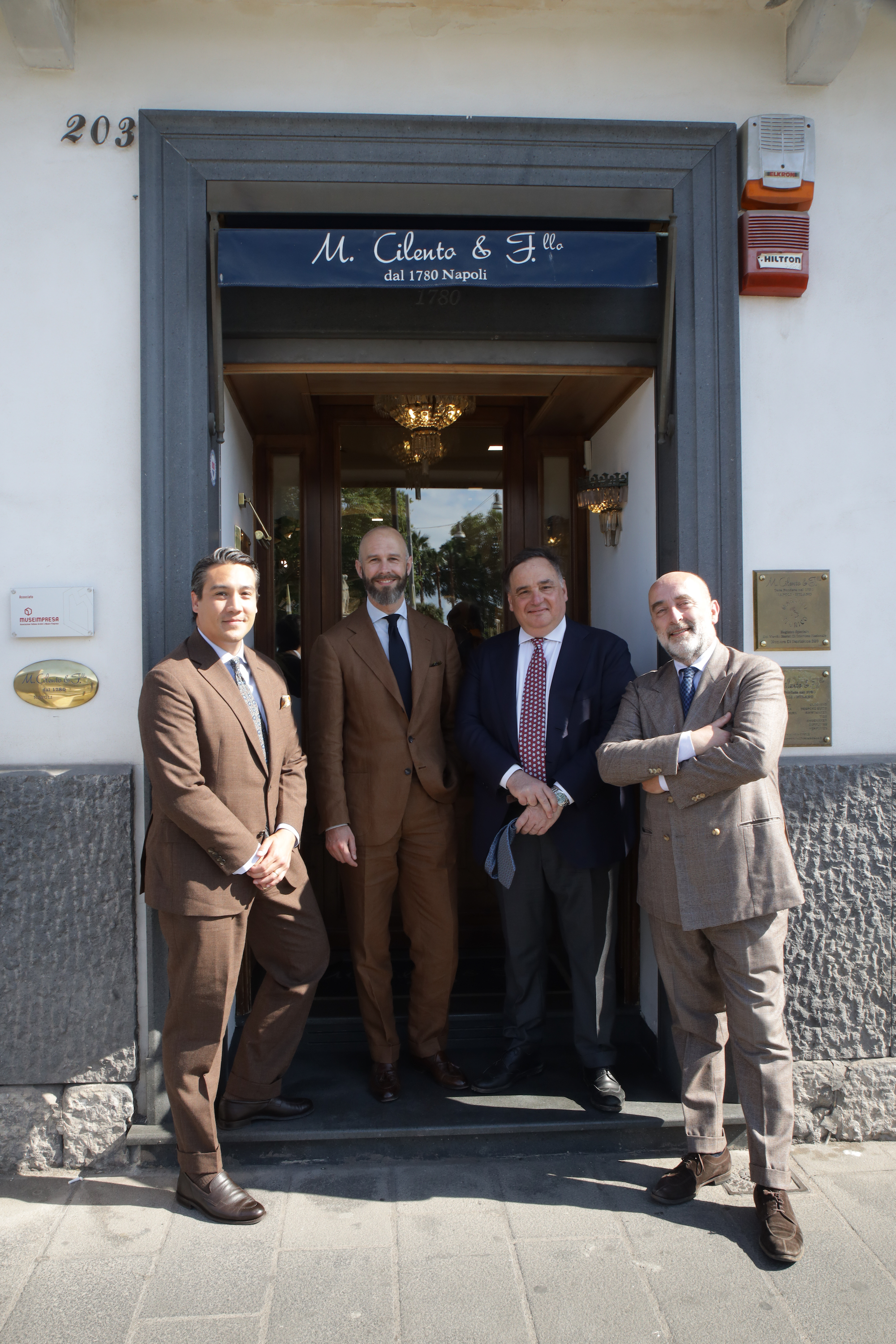
Ugo Cilento, the owner, is a pure enthusiast, and the shop has that magpie feel of a collection of things that are simply loved. He has perfume from Creed, Floris and others, but says the quality has decreased, so he’s now developing his own.There’s a little range in handmade bottles, inspired by old Neapolitan recipes.
Still, although there are many things to catch the eye, the thing Cilento is most known for is ties, and the thing it’s most worth going for is cloth.

Cilento achieved a certain amount of fame for producing ties featuring the Italian flag. The flag was deliberately off centre, meant to appear to flutter from the edge of the tie rather than being plonked in the centre.
They were gifted to Italian ministers, and eventually became standard issue in Italian embassies. A series followed with one for every country in the world, and President Macron of France is proudly pictured in the shop wearing one with the French tricolour.
Find your way to the very back room of the shop, and you’ll discover drawers and drawers of ties with different designs. There’s one for pretty much every country, and dozens for clubs, universities and professions. The latter usually feature a small repeated motif (eg a pen for a writer) and then a more detailed message on the back blade. Thanks to the lawyer’s one, I now know the Italian for ‘blah, blah, blah’. They come in three and seven-fold.
If nothing else, the collection an interesting reflection on how conservative Italian business dress used to be, with navy ties - plain or with some little device like this - so dominant.

Now the cloth. This is the heart of Cilento. The shop dates itself back to 1780 because that’s when the family company was founded, but it was a shipping company, albeit one that traded in some cloth and raw materials, and in the early nineteenth century established spinning mills.
It wasn’t until the early twentieth century that the Cilento family started selling clothing, and even then it was sometimes a sideline, with Ugo’s father a well-known accountant rather than a shopowner.
“It was when I had to decide what to do with my life, then that I went to my father and told him the shop was my passion - everything we had and produced, the beautiful things and their crafts. That was what I wanted to do,” says Ugo (below, centre).
Ugo was smart - and respectful - in spending a lot of time talking to the staff, some of whom had been there for 40 years. This was the 1990s, so some of them had seen what business was like in the 1950s, and how all the suppliers had evolved since.

The cloth collection at Cilento is unusual because it is large (much more in storage than in the shop) and because it is old. There is a range of tweeds, flannels and worsteds, plus linens, silks and much else, and while some of it is current, most goes back 10, 20 or 30 years.
Why is vintage cloth interesting? Well, partly because it’s great to browse bolts rather than swatches, and you see a greater range of patterns and qualities than you would with a contemporary selection.
But more attractive is that vintage cloth is often unique, in a quality you can’t get any more. Partly that’s a question of changing taste - older fabrics were denser, with more picks to the inch, because durability was prized and weight more tolerated. Modern mills tend to produce lighter, finer airier cloths because they’re sometimes cheaper, but also because they sell.
But often vintage cloth is unique because raw fibres are no longer available, or processes have become impossible. We covered one, flyer-spun yarns, in the article on mohair. Stefan Brandt talked about Peruvian Pima cotton disappearing. And sometimes processes were toxic for the producers and so have become illegal (we’re seeing something similar now with fluorocarbons).

Spotting these fabrics is not easy though. I’m not sure I would have bought anything had I not had Giovanni and Patrick from Fox with me (above in the centre, left and right respectively). Patrick is the global sales director at Fox and Giovanni the Italian agent, and between them they have decades of experience in cloth.
One fabric Giovanni loves is a six-ply worsted from the old English mill Edwin Woodhouse. It’s a high twist, a little like the six ply you get from Drapers and others, but smoother and thicker - very dense, very sharp. He has some at home, and pointed out a bolt of that.
Another thing that jumps out is overcoatings, because they were simply so dense. We saw two bolts of original Italian navy cloth, and a tweedy green one that had that lovely smell of lanolin. There was also an unusual ‘cellular’ summer cloth, a cream silk/linen and much more.
This is when I make this more relevant by saying that we bought a handful of bolts (usually enough for one or two jackets or suits each) and they will be in the Permanent Style showroom later this summer. Readers coming to see The Anthology, Assisi or any other tailors will be able to see, try and buy them. It might become a regular thing we do in London.

I also ended up buying one of those suede blousons (I’m such a sucker for suede), Patrick bought a tie (which tied a very nice knot) and we all got bottles of Ugo’s in-house Amaro. My wife has since expressed interest in one of the simpler handbags. They are very well made.
If anyone is going to Milan soon, rather than Naples, I’m told the Cilento branch there is also special - Ugo bought an old pharmacy in Brera and did it up while retaining the original features. He also started selling traditional breath mints that the shop used to retail. Which tracks.
Perhaps surprisingly, a lot of stock in the Naples store is shown on the Cilento website. You can’t actually buy anything, merely express an interest, but it’s still more than you might expect from Italian e-commerce.
Readers, please do visit Cilento next time you’re in Naples, and venture down every corridor. You’ll come across travel slippers, old Carlo Riva stock, and in one alcove in the wall, the wooden chest Cilento first imported linen from Belfast in, a hundred years ago (above).