

By Robbie Collin.
Move over, American Gigolo. Make room, The Talented Mr Ripley. There’s a new menswear movie in town.
I say new. In fact the film in question has been around for a decade, but despite attracting a sizeable cult following in that time – no less than Quentin Tarantino placed it in his annual top 10 – it’s yet to catch the eye or imagination of the male style community at large.
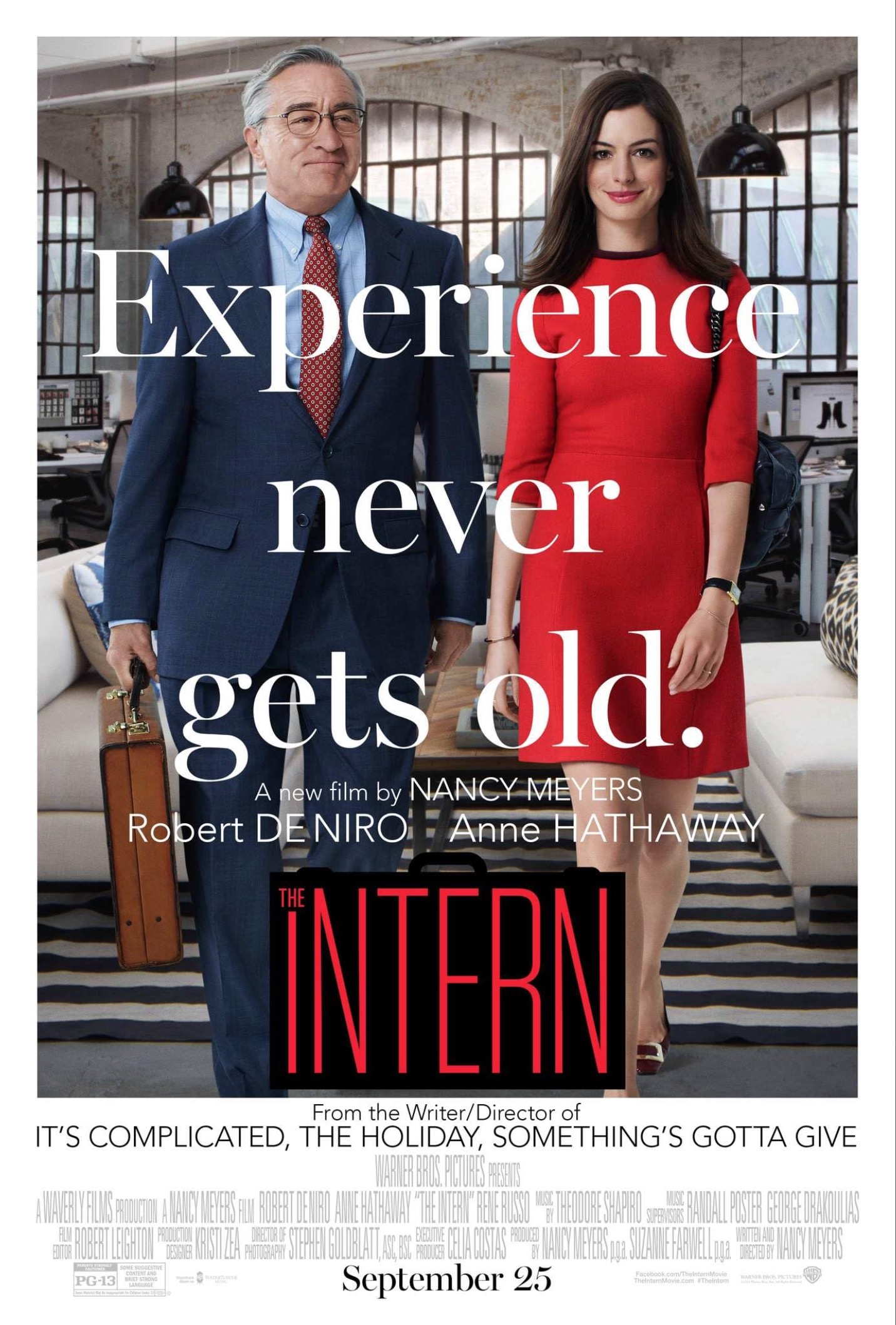
And that’s probably because the film is The Intern: a frothy comedy in which Anne Hathaway’s e-fashion startup founder grants a work experience placement to Robert De Niro’s amiable 70-year-old retiree. Directed by Nancy Meyers, of The Holiday and Something’s Gotta Give, it was marketed squarely at a female audience, and little about its marketing campaign screamed “epic men’s fits”.
Yet on the tenth anniversary of its release, the film is worth seeking out: not only because said epic fits are there in abundance, but also because the film is one of the smartest I’ve seen about the way men dress, and why it matters.


Meyers has always been fascinated by this sort of stuff, but usually it’s her interiors, rather than the costumes, that end up plastered across viewers’ moodboards. As a filmmaker she’s obsessed with the spaces – particularly kitchens – in which her characters nest.
These spaces are always styled to magazine-spread perfection, but also reflect their stylers’ values, aspirations and desires, as well as the audience’s. (Watch Meryl Streep flirtatiously prepare pains au chocolat with Steve Martin in It’s Complicated and you’ll see what I mean.) Her films delight in materials and craftsmanship. She loves to see a look pulled off.
The kitchen of De Niro’s Brooklyn brownstone in The Intern is a beauty – and that his life is orderly enough for him to have a cold roast chicken at the ready in the fridge for weekday dinners is a nicely revealing (and very Meyersian) detail. But more impressive is his wardrobe.


De Niro’s character, Ben Whittaker, once worked at the old telephone-book printing plant now occupied by Hathaway’s burgeoning business – and when offered a placement there as part of a community enterprise, it’s all the excuse he needs to get his suits back into rotation.
And not just any suits – but delectable, classically tailored tropical wool numbers in warm grey and calming navy, typically in what looks like an airy hopsack weave. The cuts are timeless, with unobtrusive notched labels; the fit is structured but never stiff.
The shirts are crisp cotton with button-down collars – and in one instance, short sleeves. The watch is an understated Omega Seamaster; the ties quietly stylish foulards and repp stripes.


He carries a sturdy leather attaché case and a handkerchief: the latter because you never know when a female acquaintance may need to dry her eyes. “The reason for carrying a handkerchief is to lend it,” he later explains to a younger colleague. “One of the last vestiges of the chivalrous gent.”
Note, however, that this is folded neatly in an inside pocket: there’s no sprezzatura, no flamboyance. Ben’s outfits radiate dependability and composure – that even goes for his pyjamas, of which we see three pairs over the course of the film.
In a callback to (of all things) Taxi Driver, Meyers has De Niro stare at himself in the mirror one morning while wearing a fetching blue, white and navy striped set with white piping, and practice his office repartee. “Hi, howdy, what do you need?”, he says: a far cry from “You talkin’ to me?”
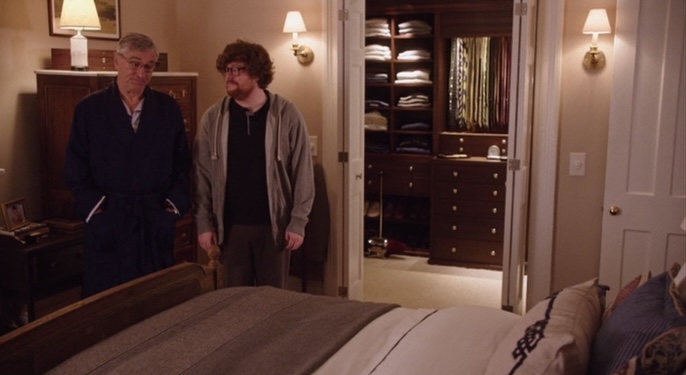
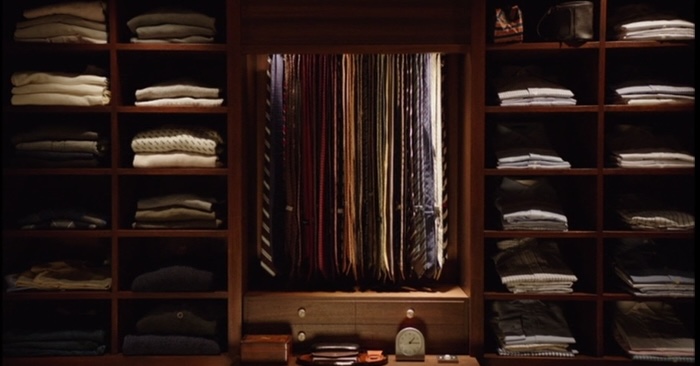
This matters because in the millennial workplace – or at least Hathaway’s frantic corner of it – composure and dependability are in short supply. And as the film progresses, all the problems faced by Hathaway’s Jules can be navigated, one way or another, with Ben’s old-school approach.
The same goes for Ben’s younger, yet more senior, male colleagues. Their unofficial uniform of open work shirts over uncoordinated ringer tees makes them look like the work-experience kids, floundering out of their depth. But the Ben Effect starts to rub off, and when one of them later asks to borrow a tie, it feels like a minor moral triumph.
“Nobody calls men men any more,” Jules points out over post-work tequilas one night, neatly ventriloquising The Intern’s underlying thesis. “Women went from girls to women; men went from men to boys. This is a problem in the big picture.”

While Jules’s generation of women benefited from the maturing influence of initiatives like Take Your Daughter to Work Day, their male counterparts “still seem to be trying to figure it out,” she goes on. “They’re still dressing like little boys, they’re playing video games.
“How in one generation have men gone from guys like Jack Nicholson and Harrison Ford to…” (Her other male employees glance at one another guiltily here.) “Look and learn, boys,” she concludes, pointing at their older colleague. “Because if you ask me, this is what cool is.”
That’s cool in bearing, but also disposition. Ben’s clothes are an expression of his broader life philosophy: what he does, like what he wears, matters enough to make it worth getting right. Crucially, Meyers doesn’t frame this attitude as one whose time has passed.
When Ben arrives at the office for the first time, it’s the contemporary period details – Meghan Trainor’s All About That Bass wittering away on the stereo; the receptionist directing him to “talent acquisition” – that are played for comic effect.
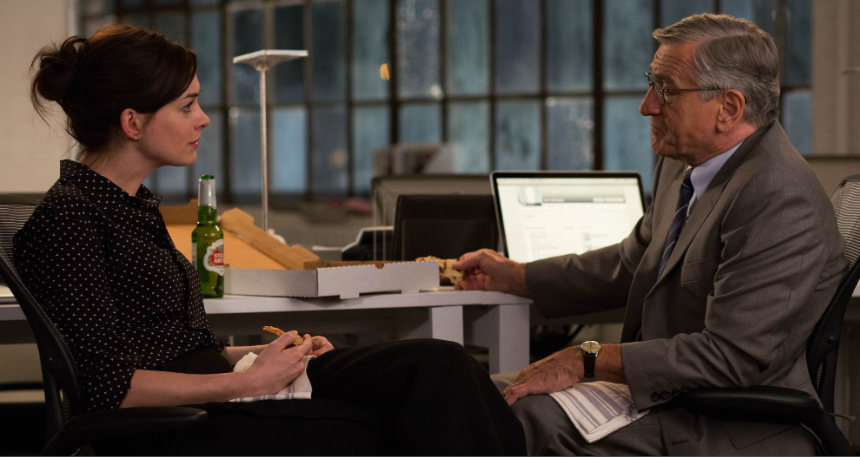

The Intern’s costume designer was Jacqueline Demeterio, though De Niro’s suits were selected by the actor’s longtime collaborator Aude Bronson-Howard, who has been dressing his characters on and off since the mid-1980s. Perhaps that’s why he looks so comfortable in them – but then, the sheer ease of Ben’s personal style is also Meyers’ rebuke to the modern myth of men's tailoring as outmoded, formal and stiff.
Yet The Intern’s importance as a menswear film has little to do with whether or not your taste aligns with Ben’s. Rather, like those widely heralded classics mentioned above, it's about the codes within clothing – that the things we wear always express certain values, whether we intended them to or not.
It’s just that for once, those values don’t lead to, say, a dissolute existence seducing rich married women in Los Angeles, or passing oneself off as the shipbuilding heir you recently bludgeoned to death with an oar. It’s not a lesson you'd expect to be taught by Robert De Niro, but you can dress well and also be a thoroughly decent chap.
Robbie is the chief film critic for The Telegraph, a PS reader and a menswear enthusiast. See his previous article on white suits here.











Very enjoyable read on a Monday morning. Thanks, Robbie.
A really enjoyable and profound article.
Robert de Niro was great in this! With calm composure and conviction he navigated through modern start-up culture. I like how some of his habits rubbed off on his peers. Is the loss of a uniform a loss for men?
The electric rotating necktie rack was a nice touch.
Hollywood has an obsession with making the most evil character a well-dressed caricature … the more rakish, the more despicable… Gordon Gekko, Patrick Bateman or Satan’s son in Constantine …
So, now if you’re walking in downtown San Francisco wearing a suit and tie, you gotta be careful you’re not accosted and spit on. Great, thanks…
Good point CG – something Robbie covered a bit last time. Also interesting how this is done especially in children’s stories – something I covered a little many years ago
“Accosted and spit on”? Lolllllllll come on man. You know Derek Guy and IIRC Peter Zottolo both live in San Fran, right?
I know… but they’re not strolling the streets in downtown dressed in a suit… guess that’s why they’re doing “street wear”.
And the zombies do rush toward you…
You clearly don’t know who either of them are, because “street wear” is the literal last thing they would be associated with. And yeah, they are OFTEN strolling the downtown streets dressed in a suit
Incredible that this got a “Good point” from Simon and not the “touch grass” it deserves.
Wall Street came out nearly 40 years ago; you really think there haven’t been well dressed folks in Hollywood films who haven’t been villains in the interim?
I lived in SF for a couple of years prior to the pandemic. While I generally worked from home, I often went to various coffee shops to get out of the house while getting work done.
I always dressed in a suit or jacket and trousers and never got spit on. In which neighborhood does that happen?
A great article and wish we had more about the clothes in the cinema. There is a lot to observe outside of the iconic films that we all know. Movies like ‘Spy Game’ for example, in which Redford delivers a sartorial masterclass and completely out flaneurs Pitt the younger. Or, the more recent ‘All The Old Knives’ that featured Chris Pine showing that you don’t have to dress badly to be a spy. I love these pieces showing clothes in action rather than on some Pitti peacock who watches himself go by in shop windows !
Indeed. Well, Robbie is signed up for more so it will be a regular thing. And I love his take on these films – his knowledge is deep, he knows the industry, and he highlights films like this which I hadn’t even heard of. Like you said, not just the iconic ones.
Excellent, will look forward to more from him like this.
The writing roster is looking good Simon!
Cheers Mark, pleased you like it
And Black Bag! Steven Soderbergh’s films are always stylish but the wardrobe in BB was outstanding.
That’s a definite second on Spy Game. I think it must be part of Redford’s tradecraft to dress the way he does – always approachable and never flashy.
An absolutely wonderful piece!
Interesting, but let’s not forget that he looks good in those suits because he is over 60. Dress a 25yo like that in that kind of office and the effect would be completely different. Jarring, even.
I’d argue the contrary! Young men are missing out completely… counter culture is no longer nose rings and face-tattoos. A well fitting suit and tie with fit and proportion dialed in, and a young man can command a room.
I disagree. For me, the epitome of being well dressed, as Simon put it, is being a little more thoughtfully dressed than most other people around you. This completely depends on the situation.
If a man in his 20s or 30s dressed like De Niro in this movie, he would stand out and come across as trying to hard, a little strange, perhaps even arrogant and even slightly costumey. In my humble opinion, this is not dressing well, but rather an indicator of someone who cannot assess its surrounding well.
Markus – just to underscore your point, a legal colleague turned up to work dressed impeccably in traditional black tie. When asked why by colleagues, he explained he had a black tie event in the evening. He looked very smart, but by dressing without context it reduced rather than enhanced his credibility.
In my opinion the converse is also true, if you are over 60 you look silly wearing T shirts and hoodies to work dressed like a 25yo
I agree, to a certain extent. Since more older people wear T-shirts and hoodies to work than 20-year-olds wear suits and ties, the latter probably looks stranger, which imho is an indicator that you are not dressed for the situation and therefore not well dressed.
That’s an excellent roll on De Niro’s shirt collar – Brooks Brothers perhaps? There’s a couple of great ties too. However, I would have preferred an Ivy “sack” suit. You can still get the “real McCoy”, at reasonable prices, from J Press and O’Connell’s, e.g. made by Samuelsohn, or Southwick.
I don’t think they are from Brooks looking at them. The collars look too firm, and the points too long. More likely Mercer in my view.
as Yogi Berra said: “You can observe a lot by just watching.” Great post to start the week.
Really enjoyed that – nice work Robbie
Nice article!
This movie seems to be a nice comfort watch. Who doesn’t love sage, good-natured dependability and reliability?
I’m drawn to the image of DeNiro in the elevator, which brings to mind Daniel Craig as Bond, funnily enough. The era in which this film was made coincides with Craig’s descent into shrunken suits, which makes for a good contemporary contrast.
Nice point Mike. Age is probably a factor, as mentioned above, but still those two examples make for a stark contrast
Very interesting article. Another director with a great sense of style is Lawrence Kasdan, especially in his films from the eighties like The Accidental Tourist.
Hello Simon,
I don’t mean to pester, but if you’ve got less on your hands right now.
do you think you could send me the picture
thanks!
No worries Alan, here you go.
Great read, and a reminder that you can often find inspiration in unexpected places. I especially resonated with the line: “Ben’s clothes are an expression of his broader life philosophy: what he does, like what he wears, matters enough to make it worth getting right.” Amen
My wife told me I’d enjoy the film, for the reasons mentioned above.
She was right!
Great article.
The challenge with more casual office dressing is to not carry that over into an equally casual approach to the work itself.
An athlete often uses the ritual of putting on the game gear and uniform to get in the right mindset for playing. I think the same thing applies when clothes worn to work are different than our other clothes. Getting dressed in business clothes can get you into a business mindset.
Don’t forget to mention Leonard Logsdail, who tailored the suits! https://www.imdb.com/name/nm2473588/
Did he really? Ha, thanks James, that’s great
A very enjoyable piece but I hate the premise. The association between a certain sort of menswear and moral superiority has lurked in the minds of too many clothes guys for too long. It’s ugly and wrongheaded but more importantly it makes dressing well harder and not easier. If people think you are wearing a suit to assert your moral superiority they will think you are a prat.
I choose my clothes to look good and nothing else. If someone wears a fleece and bad jeans, I might think I LOOK better than them but I don’t think I am better than them or even that my life is more sorted. Experience of life ought to teach us that if nothing else.
Clothes tell us nothing about the man beyond the superficial. Discuss.
I agree with you on the whole – dressing ‘well’ (used to mean more formally and traditionally) does not indicate any moral superiority and those who think it does are wrong. Especially nowadays when by and large it costs a lot of money to wear the kind of clothes such a look requires. (of course you can do it on a budget, but it is a lot harder. Most people don’t earn a lot of money – 50% of people in the UK earn less than 31k.)
I don’t know if I agree that clothes tell you nothing beyond the superficial though. As with the example of someone dressing out of a sense of (or aspiration for?) moral superiority, they give you a sense of someone’s character. If someone is very into clothes and chooses to dress a certain way, it is interesting to consider what they are communicating in doing so, and what that reveals about how they think. If someone doesn’t care about clothes, they can still telegraph things about them through their choices. What does it tell you about a man if he only wears clothes his wife has bought for him? What does it tell you about a man if he isn’t wearing clean clothes? What does it tell you about a man if he has a uniform? All these things can be interesting in a way that isn’t just superficial, but doesn’t amount to a judgement of morality, IMO!
I once had to visit the psychiatric wing of a hospital in which people deemed a risk to themselves or others were held pending further handling by the court system. It was a sad case involving a relative of a close friend. I was accosted by nearly every patient, and asked to help secure their release. It became abundantly clear that a man in a suit and tie could only be one of three things: a doctor, a detective, or a lawyer. I am none of those things. My heart ached for these people, but I remember vividly their reaction to me. These were not poor, uneducated, or otherwised dispossessed people. This was in the early 1990s. We see ourselves a certain way, but so do others.
Hey Simon. I had to watch this last night to find out what all the fuss was about. What did you think of De Niro’s attaché case in this day and age?
I think it works OK for him, but something more like a briefcase would probably be easier, and anyone younger/more casual would do better with something closer to a tote style I think
De Niro played a 70 year old retired executive in a film that was released 20 years ago. Say he’d been retired for 10 years, that brings it back to 2005.
An executive in that era would almost certainly have carried an attaché case. Part of the uniform.
Fun article, and brings back some happy memories as I was living round the corner from Ben’s brownstone in Brooklyn at the time and Robert de Niro’s trailer was located in front of a friend’s place a few streets away.
Almost crashed my bicycle as I cycled past Mr de Niro crossing the street from our local Italian bakery, Mazzola’s – probably picking up one of their renowned lard breads…
He was looking very dapper, dressed in pyjamas and dressing gown at the time.
Nice read. I’ve never got round to watching this – I think I’d dismissed it as one of DeNiro’s later years stinkers. Will check it out.
In related news, the Stephen King adaptation, Sometimes They Come Back (1991), is an (I think) unheralded menswear gem. The main character wears OCBDs, denim, sports jackets, country coats – giving, to my eye, at least, sort-of a rugged Anglo-Italian look.
Ten years on, The Intern deserves its place in the menswear hall of fame. I think De Niro’s Ben Whittaker is a quiet style icon—his wardrobe is a masterclass in timeless tailoring, understated accessories, and the kind of composure that modern menswear often forgets. The ensembles go beyond aesthetics—they reflect values: care, dignity, and quiet confidence. This film shows, how we dress can still speak volumes.
I must have seen this movie at least half a dozen times and will pull it out when I need to watch something familiar and comfortable.
The other reason is that I am in a similar circumstance – I am one of the oldest employees in my company and have been told that I dress better than most in the office (think elevated business casual – jackets, polo neck long sleeve shirts and sweaters, suede loafers – rather than suits).
The movie is relatable to me as I am Robert De Niro’s character where I am.
Deja vu all over again. Ben’s style is an exactly what New York bankers wore in the 1980s to mid-2000s before business casual took over. I was one of those clones sporting Norman Hilton 3 button suits, Brooks OCBD, Repp tie and a pair of Aldens. There were so many great trad clothiers back then – FR Tripler, Chipp, Gorsart. Brooks is still around, but a shell of its former self selling mostly junk.
In the corporate world, a suit (or sportcoat), button front shirt, conservative necktie and proper shoes shows the world the wearer means business. I dress this way and when I show up, they don’t think I have arrived to repair the copier.
As for menswear in film, The Omen (’76) is unbeatable. Every PS reader envies his wardrobe – pinstripe suits, a classic tan balmacaan, at least two separate shawl collar cardigans, and a fantastic wool and shearling walking coat. You won’t be scared by the story line once you’re in tune with Gregory Peck’s impeccable wardrobe.
Good reference! Thanks Carey
Just a question. Isn’t it somewhat of a style faux-pas to wear a button-down shirt with a business suit and tie (and to not wear a poplin-shirt with a classic or moderate cut-away collar)? Or is this my very continental European perspective where button-down shirts are more seldom.
More European Markus. It’s much more common in the US (which also, to an extent, shows us we shouldn’t be absolutist with rules necessarily)
Hello Simon. Is this a US thing where the button down shirt is a poplin?
In one of your articles about offices you wore a chambray shirt with a tie which I rather like – would this with a tie be unusual in Europe or does the change in fabric change everything?
Thank you.
The more casual the fabric the generally easier it is to do, so yes. It would be unusual in Europe but I think it’s up to you to work out how unusual, as per the office piece
Went and watched it immediately. Fantastic recommendation. It spells out deliberately the old saying of being a gentlemen is to put others around you at ease. His clothes, albeit irritating at this office at first, in the long run add to the comfort Ben is radiating. Loved it.
I came across your articles just today and can I say that I am completely enthralled by your writing. All wonderful points! Ben is definitely an icon.
Writing this in April 2026, the movie is currently available free with ads on YouTube.