


I’ve long had an issue with sourcing buttons for my bespoke suits, which is that the dusty, unpolished horn I fell in love with when I first had suits made on Savile Row isn’t available in other parts of the world.
The buttons, I knew, were made in Italy, and yet the Italian tailors couldn’t source them. The Asian tailors in Hong Kong or Korea couldn’t get them either. So I ended up buying sets myself, at retail, and giving them to the tailors when I saw them.
Trying to find out what was going on here sent me down a rabbit hole of button manufacturing, sourcing, and market dynamics. Fortunately, unlike similar rabbit holes I’ve gone down in the past, these days I have friends in the industry that I can ask and get connections to the people involved.


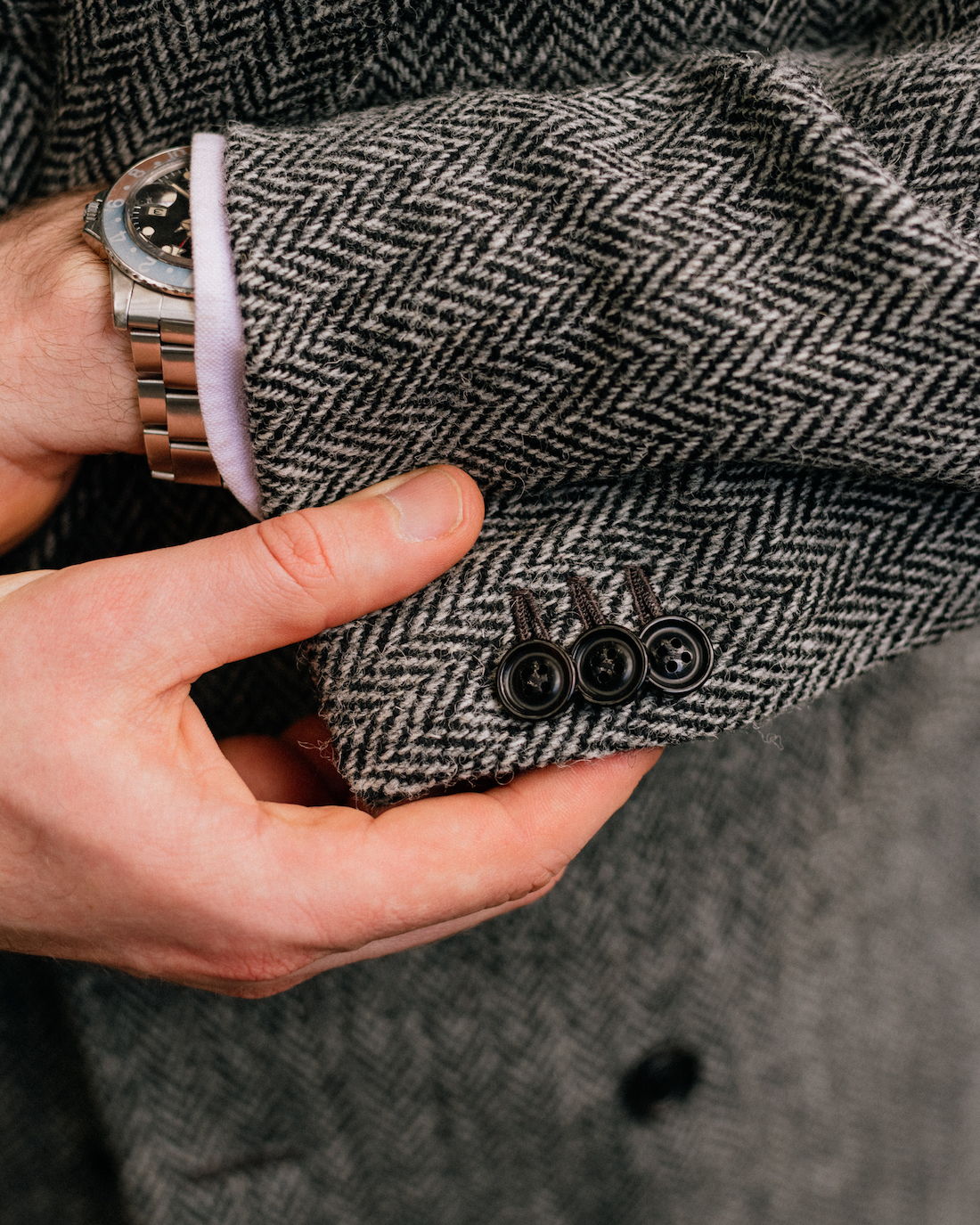
Water buffalo horn, which is the horn we know and love from bespoke, comes from India (top image). There’s also ox horn, which some tailors and ready-to-wear brands use and simply describe as ‘horn’, but that’s not as hard and sometimes less subtle in colour. When you see buttons with a simple pattern of stronger yellow against black or dark brown, that’s usually ox (above).
The raw material is sold in auction markets in India, but is a nigh-on monopoly. This makes it expensive, and more expensive recently because of the way India is changing - more meat is being consumed, and as a result more water buffalo killed at a younger age.
Horn for buttons is usually better from older animals, when the horn has had time to grow and harden. If the animals are killed younger, there’s less available and that affects the price (depending on the colour, it’s gone up by two to three times since Covid). Horn suffers from being a byproduct of another industry, as quite a few other menswear materials do.
That’s one reason good buttons have become more expensive - and one more that good clothes as a whole have. But it’s not why I can’t get my dusty buttons outside the UK.

That’s down to the supply chain. Horn comes from India to the various places buttons are manufactured, usually as blank disks (above). These are cut, shaped and finished in different ways to achieve various looks.
Most high-end horn is made in Italy still - there are about a dozen manufacturers, few elsewhere in Europe and only one still in the UK (Courtney & Co, which is small). Those manufacturers make hundreds or thousands of buttons at a time. One of the best in Italy, Padano, can make about a million a week for example and has a minimum of a thousand per colour, size and shape.
So they can’t easily supply tailors, who might need a dozen or so for a suit. They supply ready-to-wear brands directly, and supply merchants who in turn sell to tailors. The two major merchants in the UK are Bernstein & Banleys and Richard James Weldon - since James Grove (a manufacturer as well as a merchant) went bust in 2012.
The agency business for buttons is similar to the one for cloth: you spend a lot of money buying stock of the material, and then have to gradually sell it to the end consumer, a little bit at a time. The capital investment and stock risk makes it a naturally conservative business.
UK merchants can survive because they get lots of regular orders from the UK tailors. They also sell trimmings - linings, canvas, thread and so on. But in Italy, not many people want the unpolished horn used on Savile Row. They use corozo (a nut, only sourced from Ecuador) and polished or semi-polished horn (above).
As discussed in the past, there is an interesting dynamic here that Italians like their bespoke to look like ready-to-wear in some respects, possibly because RTW is more desirable; so they like similar buttons. English bespoke customers have historically wanted the opposite - to not look like ready-to-wear - and so like different buttons too.
Either way, the problem for me is that the demand for unpolished horn is not big enough in Italy for there to be an Italian merchant willing to buying thousands of them and sell them to tailors. Even though the buttons themselves are made there. There are some buttons that come close, but they’re usually slightly polished and not in the normal ‘Grove’ shape.

One last, final wrinkle. The most beautiful buffalo-horn buttons, at least to my eye, are the ones sometimes referred to as ‘Tiger’s Eye’ (above) - Bernstein colours 7 and 7½.
These are more of a mid-brown, and so used more on my tweed jackets and lighter coloured coats. They’re particularly beautiful because they have so many colours swirling through them - honey and chocolate, patches of very dark brown and often a stab of chalky white.
These more variegated buttons only come from close to the tip of the horn, and make up about 5% of supply. This makes them about twice as expensive as the rest, and twice as hard for a supplier to buy in bulk - particularly given they won’t be used as much as darker buttons.
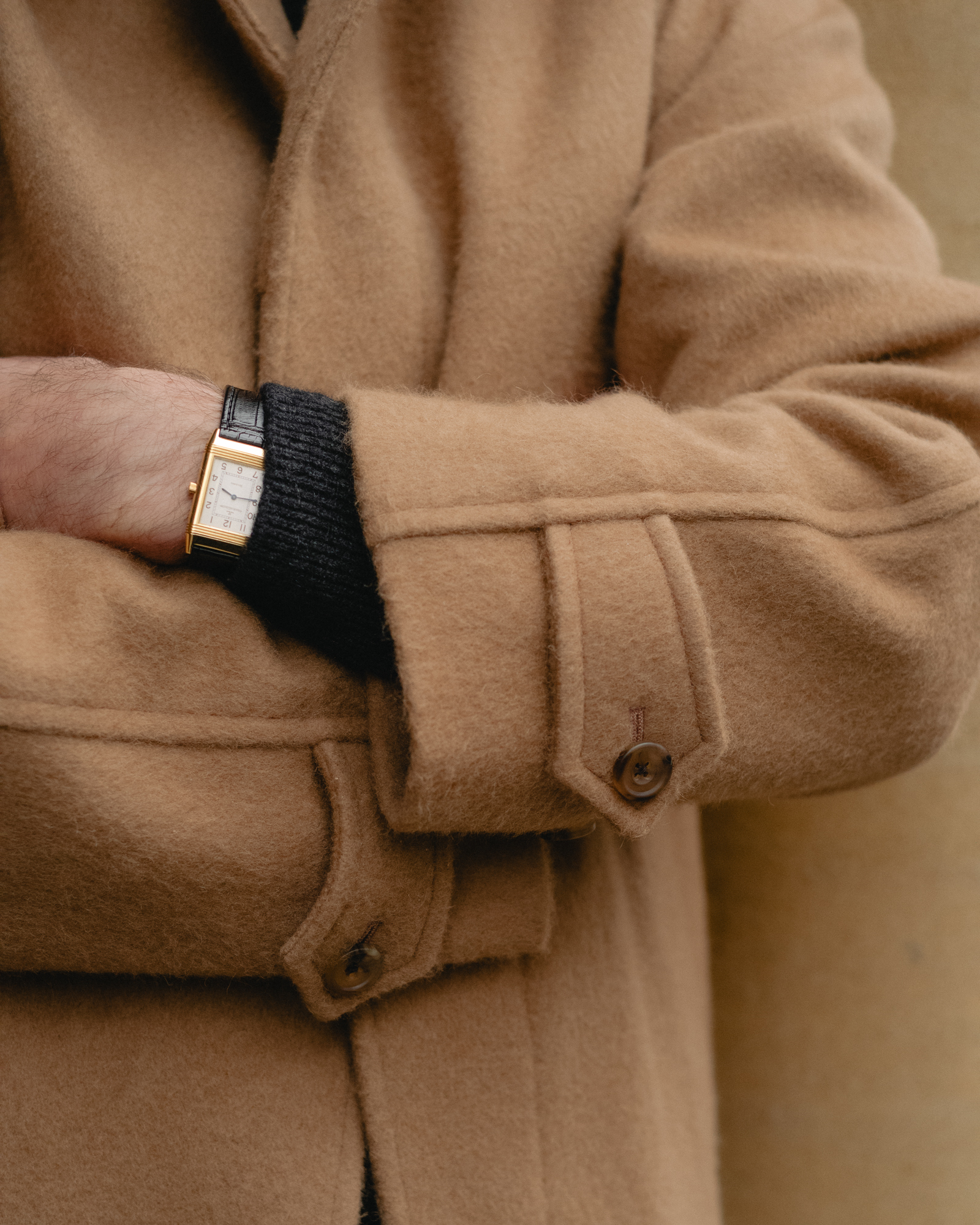
These are the buttons we used on our recent camel coat in the Donegal pre-order programme (below), and it made a surprising difference to the cost. But given the cloth was already the best camel available, it seemed worth it.
So where does this leave me? In search of a button supplier in Italy or Asia. I may try to connect suppliers with merchants in different countries, just in case it’s lack of information that has been the problem, rather that the local market.
And I might start working with Courtney & Co (above) to get my own button supply, given their minimums are lower. That may also help with the merchants, and at the very least, I’ll buy a couple of jars of buttons to keep in the showroom, so there’s a ready supply for my suits and any tailors that come through.
As we all know, these little things make all the difference.










I sometimes buy terrible old ragged, moth eaten Savile Row jackets on Vinted for £5 -£20ish just because they have a good set of horn buttons on them.
I have also purchased jackets from thrift stores just to harvest the buttons. A decent set of 9 blazer buttons can cost at least $25. You can find vintage blazers with very good metal buttons for around $10.
Just FYI, if you happen ever to be in Los Angeles, there’s a shop called “International Silk and Woolens” which has an INCREDIBLE selection across all men’s buttons. No idea why they do given the lack of bespoke tailors in Beverly Hills!
Nigh on every time I see, read or think about horn buttons a line from one of your old articles about how some buttons are so nice you could eat them goes through my head.
Ha! Love it, yes that’s exactly how I feel
I’ve never thought this much about buttons before, but I’m glad I did. The PS Button coming soon?
Ha! No plans given the ones I want are available here in the UK online, but we’ll definitely get them in the showroom
So when will these great buttons appear in the PS shop? Matte, mid brown or dark brown, two holes, as a set with 10 (12) small and 5 (8) large ones. Please do it!
Bjorn the two hole button is really made to fit lighter weigh fabrics, shirts in particular. Four holes allow for a stronger shank to be sewn, thus better for heavier cloth.
I agree James, although I’ve used two hole for coats and lots of heavier jackets and never had issues
And IIRC Anderson & Sheppard (and Stephen Hitchcock) use two-hole buttons on everything.
Indeed
A&S use both two and four hole buttons, as a quick look through their galleries will attest. Not sure about Stephen.
They do James, though two-hole was always described to me as the house stamdard
Very nice and timely article as I just wanted to buy some horn buttons to have them replace the whacky plastic ones on my PRL Polo Coat (why the heck do they hesitate to put good quality horn buttons on a $2500 coat?)
But searching is hard, especially for the bigger sizes and if one has some taste or aesthetic he‘d after… it‘s quite hard to find good ones. My best bet was Etsy until now…
Thing is, with a Polo coat not that much is being spend on the production, sadly.
Yes the value is so off but they nail the style of it. Glad I got mine NWT far from the retail price. Compared to the english tweed overcoat of my roommate and the value is much much better. I’d argue finding a better made coat at the price of the english tweed overcoat is a close to impossible task!
Have great time in Florence Simon!
Thank you!
Love this article, Simon. I spent a long time looking for shirt sized horn buttons as I wanted something low contrast to replace the MoP ones that came on an olive shirt. Tried many Etsy suppliers purporting to have good horn buttons, but to no avail. If anybody has suggestions as to the best buttons for an olive shirt I’m open to ideas.
Corozo buttons tend to be used on casual shirts and are easily available.
I presume you mean suits Charles?
Yes they are
I’ve used Corozo buttons for some dress shirts which looked really great. I also once had a supplier of shirt button made from different type of stones, like Jasper. Made for a really unique look!
I share your fascination of buttons.
Nice article! I have experienced this problematic for years. Once I sourced buttons on my own from the Internet to use for a Neapolitan jacket, but I don’t remember how and where.
I must have missed the previous discussion but why do Italians prefer their bespoke to resemble ready to wear? Is it because big name brands marketing makes a certain look desirable and bespoke can deviate from that and seem unusual in contrast or is there something else?
I’ve never shopped for buttons myself. Out of curiosity, if you have the figure in head, around how much does Bernstein colour 7 run for a private customer per piece?
It’s the first point, RTW brands and marketing.
Bernstein prices are all on their website
hi Simon
Having discussed with Nicoletta and Andrea Caraceni (separately) why neither use horn buttons very frequently, I wouldn’t agree with you it is because Italians prefer bespoke to look like RTW. Indeed if you look at pictures of elegant Italians taken before the boom of RTW, you will see their suits mainly have Corozo buttons. (You can often tell because Corozo fades to a sort of greyish beige color over time, which is not a color you would see horn in.)
The reason both said they don’t use horn on suits is because to their eyes it looks too rustic for a suit (or any other garment like a more formal overcoat or cashmere jacket) that is mainly meant to be worn in the city and often in professional settings. They do for example use horn on tweed jackets, where they feel like the rustic nature of horn matches the rustic cloth of the jacket.
Best Regards
Andrew
Thank you Andrew, very interesting and useful.
On the RTW point I meant more polished horn vs matte but my observation is based on a couple of conversations with tailors so also very anecdotal
hi Simon, I thought you meant corozo (more like RTW) vs horn (more like English bespoke). Apologies. My question to the Caracenis was why they prefer corozo rather than horn on suits, and the response was what I wrote above.
I never asked either about polished vs matte horn.
No problem at all, I thought it applies a little to corozo as well, but perhaps not
Knowing how little regard the two Caraceni’s have for RTW designinga, I sincerely doubt it is the case for them. I can’t speak for other Italian tailors.
I also don’t expect it is for cost savings. Given the level of these two, the amount of money saved by using Corozo (which is also a natural product, though maybe less expensive than horn) would be so little that it would make no difference at all to them.
Having a closet full of suits with Corozo buttons “in tinta” with the fabric of the suit (ie the color of the buttons match the color of the fabric), I can see why they think it is preferable for city suits. The buttons certainly stand out less than brown horn, even if it isn’t very mottled.
My impression is that this is one of those regional tailoring “rules” that probably has some logic behind it but can also be broken if you aware of what you are doing and why. A bit like the English no brown in town: there is a reason for it, and if you understand why that “rule” exists you can also break it more easily.
On polished vs matte horn, it may be that their suppliers have polished so that is what they buy. If no client ever asked for matte, they never bothered to source it.
Thanks Andrew, and yes you’re probably right on the rule.
I do remember asking Nicoletta at one point about sourcing matte horn, but as you’d expect given her, she rather turned her nose up at it!
Typo, designers not designinga
Interesting article! Forgive my ignorance, how is the “water buffalo horn” sourced? I’m assuming it’s harvested ethically and there’s no poaching or animal cruelty issue which would be a concern?
I don’t know details that upstream I’m afraid Rich
I have been told by a supplier (who I won’t name or defame) before that the horns actually fall off the animals naturally, I am not sure if that is true of ox and water buffalo, or just ox (the subject of conversation at the time), and that a animal fully allowed to mature may grow a few pairs in its lifetime, and then they can of course also be harvested post-mortem (whether naturally occurring or for meat/leather industry). However I just looked it up, and it seems that was at best a white lie and at worst a very black one, so here’s to hoping there was nothing more insidious to hide.
Reindeer and elk antlers fall off naturally, but afaik that’s the case with any animal with horns and definitely not ox/cattle.
… that’s NOT the case with any animal with horns.
Sorry, wrote the comment in a rush.
Hi Rich,
I can’t answer for animal cruelty. I don’t think so but it might depends on farms (and your threshold for cruelty)
However it certainly don’t come from poaching. Water buffaloes are rather exotic in Europe (even though we milk them for mozzarella di buffala) however they are everywhere in Asia. They are what our cows are, except due to poverty and rice culture being segmented and with big inclines, most farmers don’t have machines to harvest and stil use the millennia old water buffalo for it. When it dies, nothing is lost.
At the heart of Hong Kong might be harder, but if I go visit my family in rural Viet Nam, I’d find buffalo horn hand carved object, like combs, for 2 to 3 euros… Would probably struggle way more to source ox horn.
And yes, as far as I know, antlers fall every years, but horns don’t.
Love it🍸
I bought a pair of Freenote Deck pants. Kind of themed like military chinos, but more in a vintage sporting way. The tags on the pants are really great.
But when I was washing them, I noticed how good looking the buttons were. I looked on the website and they are horn buttons hand made in Italy. Its such a small detail, but really stand out if you pay attention to them.
I absolutely love the detailed thought that Freenote puts into their products. While I find that some of their products are more western styled that I would personally wear, their quality is fantastic!
I second (or third) this, it’s one of my favorite brands. They’re quite western but with a good taste (not too cosplay and no novelty stuff). I have been considering the deck pants but ultimately decided I didn’t need them. My favorite is the Waxed Canvas Riders Jacket, it’s the best waxed jacket I have encountered in terms of cut, weight, quality and style. Of course it’s a completely different style than the British country style jackets (which I also like but I didn’t want for myself because here in Spain they’re traditionally associated with the far right voters).
Wow, all the articles this week have been absolute bangers. Super happy to see it.
Thank you
Great post, one of my favourites in a good while.
I recently purchase some horn buttons from Bernstein & Banleys , just a set for a Ralph L Purple label jacket I bought on eBay and some spares. The buttons are very good quality and a good choice of colours, the price of the postage was a little bit heavy in relation to such a small order but really pleased with the overall quality and speed of service.
Agree. Courier so expensive I’m looking elsewhere. Honestly don’t understand why a small order can’t be popped in an envelope and posted, as other suppliers do.
Wonderful article Simon, I really enjoyed this.
Regards
I have a 16 year old MTM Zegna SB navy blazer in the most beautiful cashmere. It cost me a veritable arm and a leg back in the day and although the style isn’t exactly what I wear today, I love the cloth and completely relaunched it with a set of unpolished horn buttons. It makes all the difference. I’m in love with it again and forgive it its ticket pocket !
Simon this is slightly off-topic, but would you be willing to share the source for the antiqued MOP buttons on the PS shirts you make with Luca Avitabile? They’re superb. Sorry to say, but I do own some non-PS shirts (I know, embarrassing) and would happily replace the buttons on many of them if I could get my hands on more of yours/Luca’s. Thanks!
No worries K. That’s not really an option, for some of the structural reasons in this article – buttons are generally supplied in bulk, and even when you’re a bespoke shirtmaker, you need to have a certain volume often to get regular one-off supplies. Makers don’t really sell to end customers
Thanks, Simon. I sometimes buy buttons from The Lining Company to supply to tailors who are making things for me, but I recognize Bernstein & Banleys is the exception in this sector in that they sell in small quantities DTC (I’m very glad they do!). I just thought it worth asking on the off-chance that Luca’s supplier might be a similarly structured company. It’s surprisingly hard to find shirt buttons as nice as those (as I’m sure you know). I’ll keep looking.
Cheers K. Do let me know if you find anything
You are 100% correct…shirts need seashell buttons and suits horn ones…all the rest are fake, and totally inconsistent with quality garments…its a joke buying expensive ready made clothing with 2cent buttons…
Hi Dimitrios.
See my comment above on why Italian tailors use corozo than horn on suits. If you google any stylish Italian or client of Italian tailor from the pre RTW age (Agnelli, Caracciolo, etc) you will see plenty of pictures where they are wearing suits with Corozo buttons.
These men were incredibly wealthy and their tailors certainly didn’t choose the buttons to save a few cents. They did it because many Italian tailors find that horn or too rustic or “country” to use Nicoletta Caraceni’s description to use on a suit meant to be worn in the city. (It isn’t too dissimilar to the English no brown in town idea).
hey simon: and the coat you’re wearing in the first image is from? thanks.
From us, Permanent Style, Howie. It was the camel hair version of the donegal coat that we did as a pre-order last year
Articles about inside workings of the trade our so interesting! May I ask you if there are quiality horn shirt buttons? I’d like to try them on very casual linen or flannel shirts in earthy colours. Can horn buttons take waching machine, or am I better off with mock horn? Going back from natural materials to plastic/resin is not something I love doing. Thank you.
Good question. I think there are, I’ve had shirts with them and they seem like real horn. I couldn’t say where to get any from though
Thank you. I wonder if others can help with information about sourcing them. Rob had a related comment.,
I’ve replaced all the buttons on my Barbour jackets with unpolished horn – the beacon sports jacket and another button up one that was a collaboration with Engineered garments. (I really don’t like zips)
I’ve also tried it with a few bits and pieces where the cloth and design were great, but the buttons just made the whole thing feel cheap. It’s such an easy thing to change and really makes a surprising difference.
The think you can’t change easily, that bothers me a surprising amount, is nasty polyester thread, colour matched to cotton cloth, so you get more and more contrast over time as the cotton fades and the thread doesn’t. How irritating it is depends to a degree on construction and how prominent the stitching is. It’s even worse on leather goods – nylon or polyester instead of linen thread is unforgivable.
Can you share a ballark of how expensive a single horn button is? I’m curous of the ballpark.
If you keep them in the showroom, that would be a great way for PS readers to potentially access them.
The prices are all on the Bernstein website – showroom prices would be pretty similar
It’s about £4.5 per piece for the expensive ones like colour 7 highlighted in the article and about half of that for more common ones. Not really a factor for an average bespoke customer but probably something to consider for entry level to mid tier menswear brand.
Funny this subject came up just now. I just finished a round of garments with my tailor (showroom in New York, plant in Hong Kong). I wasn’t a big fan of the plastic buttons on his previous things so I got some horn buttons from Amazon and/or Etsy. The buttons were nothing out of the ordinary but even these run of the mill horn buttons add a bit of dash to the garments. A variegated brownish horn button improves even a gray or blue suit coat, or a sport coat of almost any color.
One could choose light, medium, or dark. It was tough keeping straight, with my slightly geriatric tailor, which set of buttons went on which coat, but we managed. 🙂
Permit me to think outside the box with a wild idea, somewhat in the spirit of your article about stretching/blocking your sweaters to get a better fit in the sleeves.
Is there a possible DIY solution that starts with the readily available polished horn buttons and then carefully roughs them up a bit?
What I have in mind is one of those rock tumbling kits whereby one’s tumbles rocks with successively finer grades of polishing grit into a high polish is achieved on a handful of stones.
With some experimentation, could one identify the appropriate grit and tumbling time to effectively “un-polish” a handful of buttons uniformly?
Unorthodox, to be sure. But an idea that popped into my head while reading your excellent article. Cheers!
It’s an interesting idea Robert. It would probably be hard to get the right effect, but I’m sure possible. Buttons are polished in essentially the same way as the stones you describe are
Great article, I will never look at a pair of cow horns in the same way again.
Sadly, as with most things, it’s all about volume, so most companies won’t consider sales in small numbers.
Yes, older, long established companies have mostly fallen by the wayside (I do personally remember James Grove, based in Halesowen), a sad demise. Their expertise at heating with pressure to flatten the natural horn into blanks, then machining to shape, followed by polishing and then finally chemical dying to an unending range of colourways was an art form in itself, skills now sadly lost from the UK.
I am aware of the Birmingham based company Firmin and sons that still manufacture regalia for service uniforms, maybe they could supply suitable buttons in small quantities.
Another possible source could be the Irish company Magee, their clothing is not only beautiful but also uses buttons that must have been sourced in a recent time period.
My own way of establishing a small stock of attractive buttons is to remove them from clothing that has passed its own lifetime, but, this is something that needed to be commenced many years ago (showing my age here!).
I don’t think Firmin do horn, but yes great to include still. Not sure why Magee would supply buttons to end customers?
I’ve picked up some vintage bespoke coats from Italian tailors (and seen many others while shopping for them), and noticed they often used plastic buttons. These are nicely made pieces with hand work to rival the best, and yet the buttons are terrible. I’ve never understood why.
Very interesting topic Simon.
Curious if anyone has tried to rough-up polished buttons? Seems a simple enough idea, with a jar and some sand perhaps?
Going to such lengths for other aspects of a garment to just plonk on something mass produced is a bit odd when you think about it.
On the topic of buttons, I’ve always thought fabric covered buttons in the same cloth as the jacket are too rare – very prominent in historical tailoring and sadly now mostly seen in black tie.
Thanks Zachary. Not sure I agree on fabric-covered buttons, but that is more of a personal one.
I wouldn’t say any of these buttons lack anything from being produced in bulk.
Re cloth (or leather) buttons, absolutely personal taste, and perhaps a bit archaic looking, but on larger more dramatic outerwear I find it appealing.
Sexton greatcoats being a good example (AI mockup attached as food for thought).
Dusty buttons – of course! One of those things you notice without noticing until someone points it out. Incidentally, after months of searching for an affordable overcoat, I just pulled the trigger on one from the Berg & Berg sale, with the buttons proudly advertised as ‘horn’. Never thought that there were gradations, but of course there are. So apparently now I need to find an affordable buffalo…
As a longtime reader and recent graduate on a tight budget, I was inspired by your appreciation for the subtlety of unpolished horn buttons, but I struggled to find suitable supplies with my limited resources.
Most of the buttons I came across looked similar to the yellow ones shown in the article but in a darker brown and with the same overly polished, “showy” finish.
One day, out of pure curiosity, I tried sanding them down with sandpaper to remove the polish. To my surprise, it worked far better than I expected.
Now, whenever I buy a garment with plastic buttons, I can’t resist picking up a set of buttons, sanding them down, and replacing the originals.
Wonderful, thanks Tzumu, lovely to hear how that has worked for you
Simon, great article. What’s the standard button ligne size for button fly and rear pocket? Thx
I’d have to check my trousers, though I don’t really have button flies. If you’re replacing buttons on a pair of yours, I’d go off that size though, as the buttonholes will be made for them. (You can just measure and then look online to convert mm into ligne)
What a wonderful article! I was coincidentally mentioning this to my tailor and remarking just how expensive buttons have become, almost 30E for a suiting set!
On the subject of buttons, is there anywhere in London that I can buy nice MoP shirt buttons?
Not that I know of for sets. There are some haberdashers, but they’re not usually set up to supply sets for shirts, horn for suits etc.
Good article, it makes me think back to my first visits to the Row and Jermyn St many years ago. I will not mention names of houses, but two incidents stick in my mind.
I was having my first fitting for a suit, and I recall being surprised (actually, shocked) to find plastic buttons everywhere. The tailor quickly agreed to swap them for horn, but I would have expected horn as the default or standard.
I also visited one of the leading haberdashers and asked for madder silk ties. The salesman took out some ties, but they were not madder silk. And I told the salesman that, very clearly, and left.
(I later found lovely madder silk at Budd, a very pleasant discovery.)
I have wondered about this — whether a tailor (or salesman) would identify someone as young and, therefore, probably does not know much of anything, so they can do what they want? Get a little extra margin on plastic buttons? I would suggest that is penny-wise and pound-foolish.
Even if I had not known about the difference between plastic and horn buttons, someone would have told me. In other words, when I was wearing my new suit, someone would point out that I had plastic buttons. And I would no doubt feel like I had been cheated, in the sense that the tailor had taken advantage of my inexperience to make some extra margin by flogging plastic buttons.
And the same with the ties — even if I did not know what madder silk was, someone would have told me that I was in error. And I would have felt cheated.
If tailoring is a relationship, then it has to work both ways. Any comment?
I’d agree Maurice, I can only imagine that perhaps the tailor found that no one did complain, because no one pointed out the buttons or the tie material, as knowledge was just not at that level (or indeed men talking to each other about clothes)
Equally, it’s rare today that people really have that relationship with a tailor – they want to try them all, and don’t need that much. It’s hard for the tailor to feel it’s worse investing in a relationship. But I would not have expected that to be the case back when you were first visiting them
Yes — at that time in the 1980s, I would have expected a comment about plastic buttons to be made by a woman at a party!
Although at that time some of in NYC used to swap plastic buttons for horn on RTW from Brooks or Press. It was a nice upgrade on a suit. It is now closed, but there was a button shop called Tenders in the 60s off Lex. It was a specialist button shop that doubled as an artists-cum-antiques hangout, people like Jasper Johns etc.
For sure, there’s probably taking advantage of younger, inexperienced customers by some. I’ve certainly felt that on occasion.
Not necessarily to do with tailoring, but in my experience, with customised work or repairs, very often smaller operators simply do not understand the customer’s perspective. Often, they will offer the cheapest options simply because that’s what they themselves choose when making buying decisions. It’s something I’ve noticed over the years and something I found myself guilty of in the past. A bespoke tailor, or a mechanic who works on Maserati’s, may never be able to afford the very thing they are making or repairing. They may also make an incorrect judgment of what the customer might be able to afford based on how he/she is dressed. In the past, this usually worked. These days, someone dressed very casually could be a billionaire.
The best approach for all is for the salesperson to offer the cheaper option and also the most expensive option with all the bells and whistles. Maybe a mid-range option also. And advise that the plastic buttons can be swapped for horn buttons in the future if desired. I’ve learned that if I’m not offered this to ask “What are my/the options”? The answer is usually “Well, that depends on how much you want to spend” ..and take it from there.
If it is rare nowadays for a tailor to develop a customer relationship just doing this puts him head and shoulders above others as there’s a dearth of trustworthiness and excellent customer service out there.
Yes, but this was an established house on the Row where one expects to pay for quality.
In the US, bias bespoke (https://www.biasbespoke.com/) has quite a few horn and corozo buttons (as well as mostly nautical themed metal buttons!). Some of the horn buttons are described as “matte”.
Thank you David, they look like they could possibly work. Perhaps a little thick, it’s hard to tell, but a good range of sizes and what looks like a nice matte finish. Not quite the Groves design I like but very close. Cheers
In the beginning, I had unpolished horn buttons provided by the tailor. However over time, they looked in the literal sense, unpolished, like hazelnut chocolate. Instead of this, matte polished buttons was my personal choice and I have this over several years. I previously also sourced from Berstein but Bias Bespoke NYC was far easier and they have many varieties.