

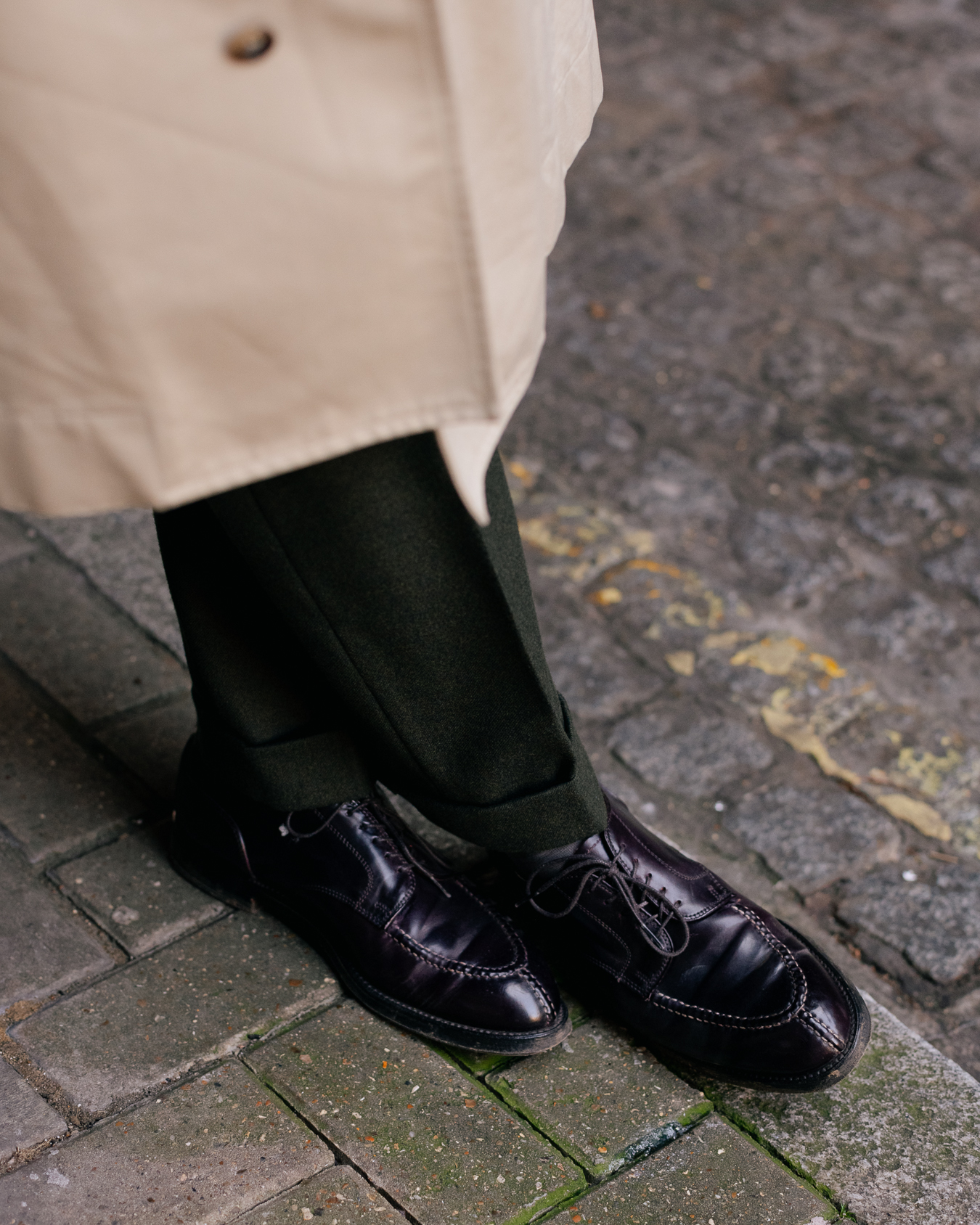
As we’ve had storms and generally bad weather in recent weeks, I’ve had requests from readers for a list of my favourite shoes for the rain and cold.
Now, the principles of what makes a good shoe for the rain in particular were laid out in this article. For more general guidance I’d read that first - it makes the argument for suede being more useful than you think for example. There’s also an accompanying piece on how to deal with the effects of bad weather.
But those don’t mention specific brands, or get into which ones would suit different outfits - different styles, different levels of formality. So here are my personal favourites, divided up into three levels of formality. Each has some brief notes, but if you would like any more advice, just let me know in the comments.


Smart (suits, sports jackets, tailored trousers)
1. Edward Green ‘Dover’ in black London Grain
Slim derbies like the EG Dover can be a good option with tailoring. Yes, it’s a split-toe derby so not that smart, but in a black leather, with a slim welt, slim last and slim sole, it’s smart enough, very comfortable and weather-resistant. Also one that can be worn into the next category, smart casual.
- Alternative: Rubato ‘Navvy cut’ in black pigskin
2. Alden full-strap loafer in Color-8 cordovan
The Dover was in a London Grain leather, and weather resistance is mostly about materials - grains, waxes, cordovan and to an extent, suede. Color-8 cordovan from Alden is something I wear a lot of, and while a loafer style is not as weather resistant, I still wear these a lot in the winter. I rarely have issues with my feet being cold though.
- Alternative: Crockett & Jones Harvard in dark-brown cordovan
3. Crockett & Jones ‘Chukka’ in dark-brown suede
Suede is good because you can spray it and, unlike regular calf leather, it doesn’t get salt stains easily, which is the biggest thing that kills shoes in wet weather. Boots are hard to work with tailoring, but the slimmer and more refined in every respect (last, welt, sole etc) the more suitable it will be. All of these are easier with more casual tailoring of course - flannel suits and sports jackets rather then fine worsteds and blazers.
- Alternative: August Special ‘Voyager’ boot in chocolate suede


Smart/casual (cords, chinos, jeans, with knitwear/coats/smarter shoes)
1. RM Williams ‘Turnout’ boot in chestnut yearling leather
A great smart/casual outfit is leather boots, good jeans, a knit, and then outerwear to suit the weather. At a slightly lower price point, RM does good options here, often in waxy or weather-resistant leathers, and in chelsea-boot styles with fairly slim shapes and welts. The Turnout is a semi-round toe and a little smarter.
- Alternative: The same in the Gardener style, which is rounder and more casual. A popular one at Trunk.
2. Tod’s ‘Gommino’ boot in black suede
This is a slightly specialist one, as I have a pre-owned pair that I bought on eBay a couple of years ago that has a slimmer, more in-line sole than the current model sold by Tod’s. I love wearing it with smart-casual things, and with tailoring as a slightly alternative option (and of course, Agnelli-referencing one).
- Alternative: Although the sole is also chunkier, Anglo-Italian do a nice version of their own.
3. Alden NST in Color-8 cordovan
I’m trying to avoid repeating Edward Green and Alden, suede and cordovan, as it would be a pretty boring list, but they are my favourites. I have a pair of these ‘Norwegian split toes’ in the modified last from Moulded Shoe in New York and they are very comfortable, basically a slightly more casual version of the Dover mentioned above.
- Alternative: A derby like the Colbo x Sperry collab we covered recently fits into this category, as does something like the Paraboot Avignon. Different price points and quality, but as soon as it’s an actual leather shoe and not too chunky, it's not hard to slot into this smart/casual area.
4. Edward Green ‘Cranleigh’ boot in dark-brown suede
This is my default, my go-to. Storm welt and a Dainite sole, but slim enough to retain some elegance. These have been worn everywhere and bashed up, but unlike a smarter shape actually look better for it.
- Alternative: The Bibury from Crocketts. A nice new style with an apron that gives it the feel of some of the derbies mentioned above.


Casual (jeans, chinos, with sweats and casual jackets/coats)
1. Viberg ‘Service Boot’ in chromexcel leather
Once you get into really casual shoes, there are lots and lots of options for bad weather. It’s the smarter stuff that’s trickier. My first choice here would be my Service Boots from Viberg, and the waxy chromexcel leather has been great in all conditions for me.
- Alternative: Red Wing moc-toe boot. A boot I associate a lot with a particular look in the 2010s, but looks better now with a wider jean, and ages really nicely.
The rough-and-ready, simple-construction desert boot is a good option here, with its stitchdown construction and crepe sole. Anglo-Italian does a nice one - I don’t wear it with tailoring in the way they style it, but it’s a nice upgrade on the normal crepe-soled boots like this.
- Alternative: Astorflex desert boot. The classic, simple and rough but good value.
3. August Special ‘Rambler’ hiking boot
Hiking boots are popular because they’re strong, warm, and frankly have been pretty fashionable in recent years. The August Special version is very comfortable - as you’d expect from them - and in good colours.
- Alternative: Roper boot from Parker Boot Co (below), or La Botte Gardiane. Another one good for bad weather, where the main selling point is the particular style.










A great and much needed article, Simon!
My own bad-weather material is Alden’s “reverse earth chamois,” I have both indy boots (casual) and aberdeen-lasted narrover boots (for a bit smarter look) in that material. No matter what are the conditions, after brushing them they always look the same again. I just apply some mink oil once a year or so.
Then for really wet conditions (walking the dogs after the rain when it’s really muddy), I have Camper gore-tex boots that I bought from a shopping mall store before I got into higher-level footwear. They remain one of my best purchases ever, because they’re the only footwear I have that are completely waterproof and keep my socks dry even after walking in mud (except for rubber boots, which I don’t tend to wear except for gardening).
Nice, thanks JMA, great recommendations
Funny—I actually posted earlier this morning (pending approval) asking about Alden’s “Reverse Earth Chamois.” There’s a U.S. shop with an exclusive Alden chukka in that color, and it really caught my eye. The color and texture look intriguing and seem like they’d hold up well in bad weather. My only hesitation was the sole, which looked a bit lower quality compared to a Crockett & Jones city sole. It’s good to hear you’re a fan of the Reverse Earth Chamois!
Hi! To me those look great, the sole is of course different style (mine are both with the commando sole). I am pretty sure they’re great for foul weather. I have had mine 2-3 years and the leather still looks exactly the same. Let me just specify that I use them as my normal shoes in bad weather (walking on streets etc), they’re not Wellington boots or duck boots so I haven’t been hiking through swamps with them.
The other aspect I really like is the look. It looks black but at the same time earthy, with some brownish and even green shades. Very different from black calf or cordovan. I wear them with jeans but also with dark brown and black pants. When combined with dark brown, it looks nicer than normal black leather shoes. Of course the material will always be casual, but can be dressed up a bit. I use my indys as more casual work boots and then the boots with the narrower Aberdeen last for slightly smarter outfits (I think they go well with tweed and smart denim). That chukka style also looks like a nice sweet spot between rugged and semi-smart. To me the sole looks good. It won’t be like a work boot’s vibram sole but probably pretty good for urban bad weather (in my experience Alden’s soles tend to be pretty good). The leather itself is extremely weatherproof and easy to maintain. However, as you’re in the US, you might want to have a look at other styles of reverse earth chamois as well, I think several stores have various models (even if it isn’t the most common material).
hi Simon, a very well timed article for a cold and rainy day here in Zurich. My bad-weather shoes are EG dovers in dark brown suede with double leather sole, a very old pair of Florsheim Imperial brogues in No. 8 Cordovan with an even thicker leather sole, and EG Galway boots in brown suede with dianite soles. I find that this combination of three pairs covers everything from flannel suits to jeans over the weekend.
Thanks for sharing your experience Andrew. Out of curiosity, which shoes and soles do you use with a suit when Zurich gets covered with snow? This of course assuming that you must do some walking outside of the office.
When it is wet and there isn’t too much show, I wear the Galway boots. The dianite sole keeps water from getting in, though I find it is a bit slippery when it gets warn down. (I should have mine resoled as mine is now rather worn.)
If it is really snowy, I wear either LL Bean duck boots or Ludwig Reiter Dachstein boots and I change when I get to the office. I can’t say that I would recommend either as a fashion statement: I find the flannel suit-duck boot combination a step too far in hi-low dressing.
How about a broader last derby, like the Crockett & Jones Pembroke (instead of the EG Dover), for flannel suits and below on the formality scale? I know these questions come up repeatedly, Simon, but as a PS reader you want to avoid costly ‘mistakes’, instead you want to nail it with as few buys as possible. Thanks for your understanding and advice as always.
No worries DS, and yes I completely understand.
Something like the Pembroke with that storm welt and wider shape can work with flannel suits, but it’s not the smartest so I’d say it would have to be part of a different style to how I normally dress – wider fits, more casual fabrics elsewhere
Dear Simon! What do you think about a derby like this for flannels and more casual tailoring: https://www.tlbmallorca.com/products/derby-madison-suede-brown-678
Thanks!
That looks like it could work actually – comfortable size but a slim welt. The style overall is not what I’d go for, a little clompy potentially. But it looks smart enough for those things
Most of them seem to be for English bad weather. Looking outside my window, where it has -5 degrees and I had to go to work on ice and snow, a bad weather shoe / boot has to have at least a Vibram sole.
Yes you’re right Markus. As I said, these are my personal favourites
Yes! Below the freezing point, absolutely no use for leather soles and even Dainite can be almost as slippery on snow or ice. Good rubber soles (Vibram etc.) are the way to go when the weather turns for the worse. Which, in where I live, is several months through the winter.
I’d also say leather soles, for me nowadays, are strictly for dry weather. Ruined far too many shoe soles, at least to some extent, for using them in the rain.
100% agree on the Dianite sole — it is great if all you need is water resistance, but as soon as it starts to get worn down a bit it is nearly as slippery at leather on snow.
Leather soles in wet weather ?
Nope, you can mitigate problems to some degree, but rubber is a fundamentally better way to go.
I find it depends on the weather – wet is fine, absolutely chucking it down is different. Nice to have a couple of options
Hmm.
I have even had problems with leather that has been primed – worn in dry weather and picked up grit.
i have some santoni black chuckas in cordovan with a Norwegian welt and triple leather sole – I’d risk those, and some Tod’s loafers that I had a rubber sole put on. For dressy I’d wear some of my EGs or GGs with rubber.
Its a shame that these Alden Ripple Sole Brutes are not available any more.
Hi Simon, what do you think about the Alden Plain Toe Blucher? Smart enough? Kind regards, Michael
Smart enough for what Michael?
pardon, smart enough to be worn with suits or sports jackets/tailored trousers?
I wouldn’t, it’s quite chunky. Perhaps with a more relaxed casual cut and fabrics, but even then only at a push
Simon, I understand your perspective on this issue — but here we are discussing shoes for bad weather. The Alden plain toe and long wing blucher with double leather sole and storm welt are chunky shoes. But for bad weather, let us appreciate and even embrace the chunkiness. Like a Botero!
Hear hear. I have gradually come to embrace chunkiness and comfort in footwear. When Simon praises a shoe for its “slim welt, slim last and slim sole”, I now know from painful and expensive experience it is not for me. Thankfully PS has also introduced me to Alden’s modified last and August Special. More like this, please.
Simon
Always thought EG Galways offered versatility for both smart and casual appearance. Any thoughts?
Regards
Yes I have Galways and really like them – they’re a little casual for tailoring though, certainly a smart suit or jacket, and a little smart for the most casual looks. I’d say they’re solidly in the smart/casual category, with the ability to extend up and down with different styles
Good call on Astorflex. If anyone’s interested, the Monteflex is, as far as I can tell, more or less identical to Drakes desert boots. And is probably made for them by Astorflex in fact.
it seems to me that the drakes ones are a bit more curved regards the last.
I own both the Montflex and Drakes and if there is a last difference, it is very small indeed. However other Astorflex desert boots, including the ones linked in the article above, are much more noticeably different to Drake’s. I know all this from trial and error!
Astorflex is fine, but one extremely annoying thing about them is that the insole is not properly attached to anything, so it tends to crease uncomfortably under my feet. I had to have it glued by a cobbler.
Suede ? In bad , wet weather ?
In a similar vain I wear trainers/ sneakers a lot on weekends and I’m always puzzled why there’s hardly any waterproof trainers ?
Yes, you can buy hiking ‘trainers’ but I don’t want to look like a hiker on the high street .
Would be interested to hear from others about waterproof trainers / sneakers .
Crockett and Jones treat their suede shoes with Scotch Guard as part of the tanning process and perform well in the rain. I’m sure others will do the same.
A few companies make waterproof goretex trainers – I’ve had the from On Running and Mizuno I’m sure there are more too
Yes, I mostly wear suede in the snow and rain. Just spray it with a protective spray.
Trail running shoes are more likely to use waterproof materials like GoreTex.
Yes , correction , I meant to say trail running instead of hiking .
Unfortunately , walking down the high street they look abit over the top .
Robin, I have some gore tex running shoes from On. I always take them traveling as rain shoes and they are fantastic. Comfortable, light, good grip, nicely cushioned, and waterproof unless the water gets in around the ankles. In black, they even look fairly decent with nice clothes. I have worn them in London rain and day after day on long distance paths in Scotland. They are one of my best footwear purchases ever.
Would you mind posting a link to the pair you have?
Mine are several years old. I looked on the On site and it looks like the new version is called the Cloud 6 Waterproof.
I’ve completely abandoned leather soles in the wet. Shortens the lifespan and the modern city sole seems a good alternative more durable. longer lasting and better traction. As for crepe in the wet might as well be on ice skates!
Does anyone have good recommendations for a shearling lined slim(ish) winter boot that could still work with flannels, tweed sport coat and Permanent Style Rider’s raincoat or wool raglan? After -10°C here in Finland and walking on sheer ice one needs some heavy duty boots but I would prefer to do the dancing on ice more elegantly.
Have you tried sizing up, adding a shearling insole and wearing very thick socks?
I haven’t sized up but I do use shearling insoles with my C&J Coniston boots and Paraboot Avignon’s when the temperature drops below zero. And a bit thicker over-the-calf wool socks if there is still room. But after -10°C (it can go down up to -30°C here) I really need more insulation and cover my ankles. For the extreme weather I have Mephisto Leonardo shearling lined boots but those start to be too massive with flannel trousers. Those work better with, for example, Bryceland’s corduroy army chinos and jeans.
I was going to mention the Avignons as well as a surprisingly capable alternative in the snow. The rubber stays soft even when quite cold, and the thread also grips well on hard packed snow, and even performs better than my vibram soled shoes in some conditions. They also have some room in the toe box to wear with thicker socks, and a (thin) wool insole. The limit though, as you mention is probably -10. And need something that is taller when the snow gets deeper.
I have a pair of shearling lined boots, but went a little on the small side on the sizing, so not that much warmer than other boots I have when considering I have to wear thinner socks. I also have a pair of mountaineering boots in suede, and they work quite well in the cold. I suspect the nap traps some air as insulation.
For example Carmina do shearling lining through their made to order program. You may have to ask for it specifically, however («off the menu»).
I live in Norway and recently bought a pair of Ludwig Reiter Apres Ski boots. Wasn`t 100% shure about the model at first – but found that they work excellently with my Ulster Coat!
How about the shearling-lined version of Ludwig Reiter’s “Touring” boots? A good compromise between elegance and winter practicality. Perhaps not slim enough for some, but great for those of us with slightly wider feet.
Hi,
Lots of options. I see a number of people mentioned L Reiter, very good.
There is also https://www.cheaney.co.uk/search/shearling
Edward Green will line Galway boots with shearling in a custom order, probably so will Crocketts.
And the Hungarians, there are a number of shoemakers, for shearling winter boots I would try,
https://lovaglocsizma.hu/en/home/
Thanks for the article Simon! I really like the Tod’s boots you mentioned, but I’m unsure how to size them. Do you have any recommendations? Their size chart makes me think they run a little big. I normally wear 9.5 UK which is like 10.5 US but their size chart says 9.5 UK is like 11 US.
I was my usual one size down from US sizing, not more
Useful article – particularly for shoes to wear with suits. As I drive these days I tend to only be out in the rain for 10-15 minutes in my suit so I don’t feel quite the same need for myself as I did in the past but I think I shall try and save for something like those grain derbies anyway.
Hi Simon, glad to see this post 🙂 One question did come up for me. How does waxed suede performs regard salt? Is it better than suede alone?
Kind regards
Yes it is
I think it depends a lot on where, and how, you live.
Closer to the Alps, where the pavement in winter often is wet, sometimes icy, or covered by snow (yay!) soon turning into grey-brown salty slush (nay!), I go for rubber soles. If salty slush, I wear leather hiking boots which are sacrificial compared to something from C&J, EG etc. Even when the pavement is dry, it’s covered by finely crushed rock strewn during the last ice. Then I might use (suede or leather) boots with Dainite, which wear less and sound less horrible than leather on crushed rock. I wish Dainite wasn’t so dangerously slippery, already on wet surfaces, and am a bit surprised Andrew B manages with them in Zurich.
Depending upon the boots I wore, I change for shoes in the office or at the venue, should I be somewhere where other people actually care. In the venues I frequent, most people go for practical, at least in winter.
Fred
hi Fred, I manage the dianite in the winter because, for the last couple of years at least, snowy days with any significant accumulation are not very common anymore in the city center.
Wet days are common and I find dianite is OK for the wet, but it isn’t for when it is snowy and slippery. On those days, i wear other shoes with a vibram sole or LL Bean duck boots.
Hi Fred,
vibram make something called arctic grip – it’s a kind of rubber infused with abrasive particles.
some winter footwear manufacturers use it as inserts in their soles. I have some from LaDolomite. It’s not intrusive, and the next best thing to spikes!
Yes, the August Special hiker boots have that
Indeed – that kind of sole is the best for arctic conditions!
when facing long periods of constant rain… you’ll need several pairs of shoes to go through in a week… and single leather sole shoes should be left at home… think about a dedicated bad weather shoe wardrobe.
I walk like 10k everyday to work and back. You really get to know your dress shoes when doing long distances daily and you’re in a suit and tie. While casual shoes for bad weather are more abundant, you might want to rethink wearing those EG. Berkeley’s with a leather sole with constant rain, wet leaves, huge puddles and rivers to traverse (the hills of Rome, a city that never clears their drains so you’ll need Moses to help you cross the street!) I’d suggest other smart shoes you can dedicate for inclement weather which will last you many years:
TLB Artistas oxfords with their city rubber sole in hatch grain are my current favorite. I have three pairs in full and half brogues in black. They are formal with a good wax job and look great walking in from rain to the board room.
Crockett & Jones.with their version of the city sole is good too (my favorite leather), I love how C&J age- more than 20 years old, but they should get more than full week to dry out before wearing them again if they got soaked.
Alden Cordovan derby in black with double sole. Cordovan is more expensive but it’s the best for bad weather. Double leather sole is key. Dedicated for business wear, I got two pairs in black more than 30 years ago in SF, and they are my go to winter shoes. Not as bulky as Alden’s chunkier styles, they do work with smarter suits, and they last forever. I could run a half marathon in them! They’re about to go for their second resoling.
There are other brands of course that can fill a dedicated role. These are just the ones I have for long rainy periods. For those who find Edward Green (great shoes) a little on the expensive side to slog through the elements in a suit everyday… my EG soles crack the minute they see water …
The article on PS mentioned above is full of great info ! How to dry out your shoes, apply cream as soon as you can… worth the time to read!
Cheers CG, and thanks for the personal recommendations, really good to add to my ones
Hi Simon, Have you seen the EG Dover on the rounder toe 303 last, if so, your thoughts with jeans/casual? Thank you.
Yes I have, and it’s really nice – the difference is quite small visually
Simón, excuse me, Between the Edward Green Dover on the 202 last (dark brown London grain) and the Dover on the 303 last (dark brown Delapré) — both unlined with double rubber soles — which one pairs better with medium to dark jeans? Do both work, or is one clearly more casual and better suited to denim?
Thank you very much!
The grain will be better with jeans, I’d say. The last difference is not a big thing once the material is this casual
Thank you very much Simon, as always, your thoughts are very useful.
Hi Simon. New follower here from Norway. I recently bought the black London Grain Dover on the 303 last with Ridgeway soles to have as a hybrid shoe (commute and office) for bad weather, including snow. I chose a configuration with the Ridgeway soles since these soles on a pair of EG Halifax I own, have proven to provide excellent grip on snow, slush and ice.
Just curious to know what you typically wear with your London Grain Dovers when dressing smart casual?
Thanks!
Lovely to have you Marius, and sounds like a good choice.
My default for smart casual with them would be something like:
– Charcoal flannels
– Dark brown or cream sweater
– White shirt if that sweater isn’t already collared
– Raglan overcoat
Thank you, Simon. I appreciate your generosity in sharing this advise.
Does the August Special hiking boot have a real norwegian / bentivegna welt? I’d tend to prefer this kind of construction for a real hiking boot, Paraboot and Heschung both make good versions of it, as does the Italian maker Marmolada.
So, the factory call it a Tirolese construction, which is an evolution of the Norwegese. Without getting into diagrams, I believe it is a type of Norwegian construction that uses a leather strip as well as the welt. One advantage is the sole is easier to replace this way, as the upper isn’t stitched to the midsole
Wait, so like White’s boots ?!
I don’t know the White’s construction Velahrn
It is explained here:
https://www.styleforum.net/threads/custom-whites-boots-thoughts.219173/page-1676
“The leather welt is stitched through the upper, which is turned out as in a standard stitchdown construction, then through the insole with the hand-sewn welt stitch. This welt is then rolled over the turned-out upper leather, and then a machine rapid stitches through the welt, the turned-out upper leather, the midsole, and the outsole. You can see how labour-intensive this is, so these boots are all over $600 now.”
Is that a good suprise or a bad suprise…
I’ve always considered Whites (and Nicks, Willie’s etc – typical american work boot makers) to be both well made and good value. But, maybe im mistaken? happy to hear from anyone on this. Never owned any, just my impressions from Online.
A good surprise, if it is true. White’s so called “hand stitch” is probably the most rugged and durable way to make footwear.
Interesting, thank you!
I’ve owned both whites and nick’s when I was a first responder. For the job they were intended to do they are great. I didn’t find the stitch down construction particularly water proof without using a lot of wax to try to add protection. In the city they can take on weather. The whites mp is passable in winter with chinos and a nice jacket on. One thing to point out is the break in time is not for the faint of heart. I wore a pair casually and it took me two years of steady use. If you are in the mountains working they will bed in faster. But your feet won’t love it at first.
I have a pair of RMs and they do keep dry but they’re so cold. Couldn’t wear them in the frost last week, I had to go full hiking boot
I feel like a nice brogue boot is conspicuous by its absence here – is there a reason you avoid them Simon? Associations? I’ve got a pair of scotch grain C&J Islays that I love this time of year with flannels and a jacket. They’ve got to be the archetypal British wet weather shoe surely?
I cycle through those, Alden Indy boots in colour 8 shell, church Ryder III in dark brown suede, (with you on the suede, if it’s dark, you don’t really need to spray it even) and some C&J Moultons (which are also suede really but slathered in wax/grease – I think it’s a CF Stead leather – waxy commander. They might be the absolute perfect wet weather shoe).
The loafers go away (even the city soles – not so much because of cold as the wet and wanting more grip, or rather wanting my foot to feel held securely so I can use the grip I have). I’d avoid crepe soles too, especially if there’s any risk of ice (we’ve had a bit up north already).
Sounds great Luke.
I find brogue boots like those a bit too casual for tailoring, but as with a few of these suggestions, it is dependent on the style they’re worn – the chunkier and looser the tailoring, the better they will work.
Bear in mind that as mentioned these are my personal favourites, so there will be an inevitable contrast with people who dress in different styles, as well as some big gaps just because I personally don’t like them as much. I wouldn’t wear a boot like that Islay even with jeans and a knit myself, but that’s because I prefer slimmer things generally
Makes sense. My jackets are all soft and I don’t think I actually have one without patch pockets at the hip. I tend to wear brown too, which I think helps. The Crocketts are also slimmer than most I think.
I think with footwear there’s a sort of unique restriction with proportions and formality too. If you size up or down in a shoe to get the look you want, it’s usually uncomfortable, so you can’t play around with proportions within the same style in the same way you can with say knitwear or a jacket.
I think my feet are smaller relative to the rest of me and wide, so a chunkier shoe sort of looks more balanced as well as more comfortable, but I have to lean more casual to achieve that.
Surely Trickers’s Country shoes should be on the list as they are useful in terms of what they can be worn with and are fantastically well made.
See my reply to Luke above in regards to that one Jeremy
Very helpful, thanks as always Simon! My only surprise inclusion are the desert boots. I’d expect them to leak like an old faucet and the crepe soles to be like ice skates in wet conditions. However, I base this on my experience with some old, tan Clarks that were dedicated to summer use and have since been retired. Curious if the AI version are different in material ways?
True Paul, they’re not the most waterproof compared to other constructions – they’re comfortable and they’re good for protecting the socks etc, but for worse weather the more robust boots are better. I find crepe soles ok and there are different levels of quality definitely, but I’d say the same in that soles with more grip will be better. One thing this conversation makes me realise is that my shoes/boots don’t have to cope with the worst wet weather really
That helps, thanks for clarifying! By the by, recently placed an order for Danners (Yank that I am) in the style of the August Special Ramblers for the upcoming season. I appreciate the style validation 😎. Here’s hoping they work out!
Sounds nice Paul, let me know how you get on
I use a pair of Enzo Bonafe Hatchgrain Chukka boots from Skoak. Simon, do you not find the endless expanse of clear texture less shiny leather across the vamp of a chelsea-boot like the turnout boot a little much and not very casual? It always seems too clean and in a way inimical to a casual look. Maybe that’s just me but these seem to look better in suede or some kind of textured leather.
I think if you want a casual look in a chelsea, you want a leather that’s going to wear in and really show its age – most of the RM range are good for that, as is a calf in a mid-brown or lighter leather
Thanks, that makes sense.
Good timing. It’s been pouring in LA for the last week.
And great list. The Cranleigh in mink is also my weather default and I believe an extremely underrated shoe in the shadow of the Galway. And the Dover in London Grain is supremely comfortable on the rubber sole you linked. I actually made a second pair of Dover on the Ridgeway sole for a Cranleigh alternative sans shaft for warmer bad weather.
Btw, I’ve found that it’s in unusual combos like these where quality and the elegant EG lasts really shine; such chunky derby styles exist aplenty and are even trendy from more contemporary or fashion-oriented makers but the Dover just looks like something else altogether, and I don’t worry that they’ll look dated or “cooked” when the chunky derby trend passes. The Rubato version of this looks very nicely done.
I tend to invert the formality of your hierarchy for a little edge: the boot with flannels and the slim derby with wide jeans and a tshirt. It’s been said a million times about Agnelli and the Tod’s boots, but the inverse (slim derby with trashed jeans) is harder to pull off, and can look less affected if done right.
I’m curious about the shape of the Crockett chukka. Is it rounder and easier to wear casually than the Shanklin?
Yes I’d say so David
Hi Simon and others –
You mentioned that the E&G Cranleigh performs well in weather. Do you have any concerns of the suede version in snow/rain/salt? I am a West Coaster in the US that works back East often and need a boot that can handle the elements.
Thanks.
I think look at the article linked to at the top, Reggie. That has more on materials.
But in brief, suede is better than calf in those conditions, but other materials are better still – cordovan, rough-out suede, waxed leathers etc
Andrew Borda’s reader profile featured Galways in Mink Suede that were beaten up and looked great. That inspired me to let go of my Cranelighs and let them age and bald freely. I’ve been happier for it.
Thanks David
Slightly off topic! The selvedge denim in the second photo from the top, worn with the Alden full strap loafers. D’you know what particular fit the denim is, or the dimensions of the cuff? They look reasonably slim and very good. I had some correspondence with Manish in the comments section under his post featuring Illya Sobtchak about how I’m moving away from (and feeling self-conscious in) slim fits but have paid handsomely for Japanese denim that does not deserve to be hidden away! And for me suede brogues, protected with Saphir spray protector and a dainite/commando sole does the job in the rain perfectly! My Grensons so far have never let me down.
Those are from Blackhorse Lane, but to be honest they’re slimmer than they look and I don’t wear them anymore
Thanks for the honest reply Simon, I’m not sure I’ll be wearing mine much more now either.
My Church Ryder III shoes have seen an impossible amount of rain and still look great. For more formal occasions, I use an older pair of black C&J Westbournes (Adelaide style). Honestly, this is something you might add to the piece: the value of holding on to older gear.
Back in 2019, I was in London with my boss. He wanted to shop for something, and we ended up walking for miles in the rain. It’s hard to tell your boss you’re worried about your shoes getting wet. After that ordeal — and maybe some poor maintenance on my part (too much shoe cream, not enough brushing) — those Westbournes developed cracks in the vamp. They’re not ruined, but they’ve become my go-to bad-weather shoes.
Having multiple pairs of black shoes, including older or more worn pairs for different situations, is a perfectly valid way to use your gear to the fullest.
Not sure if you’ve tried the Rubato Navy in pigskin yet, but they really are a fantastic option for bad weather. Plus, the last is comfortable. How smart do you think the outfit can be with these shoes?
Yes I have Jason, and they’re in the list above. Personally I’d wear them with jeans and a tweed jacket at the smartest
Why not with something like cords and flannels?
With a jacket, because I think the clothes could be a touch smart for the shoes. But those trousers on their own with a knit or coat would be nice
I live in Scandinavia and deal with ice, snow, salt, sand, slush and lots of wet weather. I mostly wear boots throgh the winter season, and only with rubber soles. My best boots for adverse conditions (except from dedicated hiking boots) are rough-out suede with Vibram commando soles. Hatch grain and suede is also acceptable in most conditions. Danite soles ar too hard and almost as bad as leather soles in slippey conditions; I find that most city rubber soles are better.
Thanks for this post- you bring up salt stains but is this something thats common in london? I live in south london and commute into central by train and am yet to experience these- have i just been lucky or is the weather not cold enough to regularly have to grit the roads
It’s not dependent on grit – if your leather shoes get soaking wet, it’s the white marks you see at the edges of where the water soaked up the shoe
Hello Simon,
Really glad to see this article as a followup to the previous article about shoes in the rain.
I have spent more time than I’d like to admit researching what works best in the rain for a commute outdoors while wearing flannel or khaki trousers and a mac coat.
I landed on the Paraboot Chambord in the Cafe color. Rubber sole, storm welt, waxy leather. Has worked well in the rain and seems to pair nicely with flannel trousers and khakis. I recall reading that the design language is borrowed from a 1920s golf shoe (wet grass).
Nice, thanks for the contribution
Douglas Cordeaux wears his brown London grain Dovers with suits, and it looks great. Admittedly he is wearing them with tweed suits though.
Great series of articles, Simon. The first one, especially, confirmed my decision to rely on good-quality suede in wet weather. I now have three pairs – oxford, derby, and loafer (I’m not a boot person) – all on thin rubber soles. (The added comfort is a bonus, particularly when travelling and walking around all day).
I’ve even put my smartest shoes – black calf oxfords – on a rubber sole. I no longer wear suits to the office, so these are now reserved for weddings, funerals, and black-tie events… occasions where it seems to rain more often than not! Perhaps a useful idea for other readers, too.
Interesting that you feel rubber sole so much more comfortable than leather. I also perceive rubber soles more comfortable in general, but since I have started middle range quality leather sole shoes (e.g. C&J) I don’t feel that the leather soles are so much worse than rubber. IMHO
One time, I gave a pair of suede chukka boots their first wearing, having applied some kind of weather-proofing spray, as recommended, on a day when gentle dizzle was forecast in London.
The forecast was wrong and it absolutely chucked it down. I didn’t have the luxury of being able to take shelter and wait for it to pass. I had no option but to press on in order to arrive at my office on time on that particular day. I can’t remember the details as this was a good while ago. I just remember trudging across London Bridge from the station onto the city, which as you probably know is a totally unsheltered journey, in driving torrential rain, cursing my luck.
I arrived at work relatively unscathed thanks to my hooded waterproof jacket but the shoes were totally ruined. They had soaked through. The water-resisting spray, like the famous Simpsons (or was it Futurama?) protective goggles, did nothing. The suede took on a wrinkled, chequered texture, rendering them wearable for any situation where wearing a basically destroyed article of clothing might be seen as in any way inappropriate. Luckily they weren’t expensive but I have been highly distrustful of attempts to persuade me that suede is water-resistant since.
Oh dear, sorry Rowan.
I guess the only thing to suggest is that if they weren’t expensive, they might have been a cheap split of suede or glued in a way that made them suffer more
Great article and very timely.
In my experience desert boots are pretty lethal in the wet though.
You can slide on almost anything, leaves and manhole covers are among the worst. The crepe just seems to aquaplane.
Ah, but what to wear when the snow is a foot deep and it’s -20 C? Perhaps that’s not your use case but it’s a not-insignificant number of wears in Canada and elsewhere, I’m sure.
It’s nice to have something compatible with a nice thick wool coat, like a British Warm, while remaining warm and practical (like easy to slip on/off). The Sorel Caribou seems to be a popular option but I don’t think the quality is what it once was. My grandpa had what I called “Santa Boots” with fur trim and no laces but I don’t know what they were made of…
Another category for you to explore someday?
Yes, though I won’t personally have that much experience to relate! There are some recommendations from other readers in here which may help – I feel like this post is bringing out all the people that live in the frostiest places!
Honestly when it gets to that kind of inclement weather the priority just becomes utility. As a New Yorker who’s travelled into Canada winters as well as regularly done winter hikes/camps, best bet would be specified boots. The closest you’d get on this list just in terms of temperature and snow would be the August Special hiking boots. I tried them on during the NYC pop-up and those things are TANKS. Shearling lined and substantial. Otherwise, if you’re going to the office, pack your work shoes in your bag and trek it out in some Merrells haha. (Or Timbs if you’re from NYC)
Yes, technical gear is probably best and easier/more practical, but part of the fun is indulging in the more elegant solutions!
I have some Alden leather chukka boots with the commando sole, a light, thin vibram sole. They are not as stylish as a nice shoe or boot but when the weather’s bad they work really well. I’m okay losing a few style points in exchange for warm, dry feet.
The Wirecutter, of all places, recently published a “How great things age”-style article about a 38 year old pair of LL Bean boots.
Like a few others, I was surprised by the inclusion of crepe-soled desert boots. I avoid wearing my Astorflex ones in any kind of rain because I’ve slipped (but not fallen!) several times on barely wet pavement.
Exactly this!
I also used to wear my suede Astorflex desert boots in the rain but slipping due to the crepe sole caused me to look for another foul weather shoe. I settled on the Paraboot Chambord after a lengthy search and they have been excellent.
During my search I also considered the Alden All Weather Walker until I realized that it also used a crepe sole.
Crepe in the rain causes pain!
“Crepe in the rain causes pain!”
Unless, of course, you’re eating one in a warm, cosy café.
In the winter months in Oslo I would say 90% of guys have an appropriate outdoor shoe to wear during their commute, and then change into suitable indoor shoes when they arrive.
Simple.
I don’t think Belgian winters require quite that level of preparation, as any sole with a medium amount of tread should be enough.
And doesn’t this bring on extra headaches? Now you need a stylish bag to carry the shoes that goes well with your stylish and painstakingly-researched work bag…
My experience of RM Williams was they got trashed in wet weather…
Although not as elegant as RMs, I find the Aussie workwear Blundstone boots an excellent commuting shoe in foul weather. Either in stout brown or black. Good grip and keeps me dry in the wet.
Brilliant stuff, thank you Simon. Waking up in winter Berlin this morning, this was just what I was thinking about. I must say my dark brown C&J suede oxfords with a city rubber sole also work nicely. Especially since these days I get to combine tailoring a bit more with slightly less formal trousers such as a chino. Yet they are smart enough that I can also wear it with a suit or a mix between flannel trousers and a tailored jacket.
Hovering now between getting a pair of boots that are more sleek and formal, or a Chelsea boot that is slightly rougher in make / profile that also go well with more casual clothing. Part of the joy of ‘decision agony’ I suppose. Ah well
I have Crocket’s Chepstow boots for foul weather. Not pretty but oiled leather, a membrane and Vibram soles.
In reality the latter is the main point. I have EG boots with Ridgeway soles. It is a mystery why a firm which prides itself on the finest materials and obsessive attention to detail chooses those soles. Even in London there can often be a light frost in winter and the merest touch of ice will have you on your back wearing them. The Vibram’s are vastly superior, I’ve used them in truly icy conditions, and look pretty much the same.
Thanks, Simon – may I ask which hiking boot (casual, 3) colour option you’d choose or suggest – would it be the black, brown, tan?
Any of those would be great, it depends really on your casual wardrobe – eg tan is best when you wear mid-blue jeans, some olives and beiges. Black is better with darker things
Simon,
May I suggest Edward Green’s Lanark waxed suede chukka?
Perfect against the elements, and so well made.
For bad weather, I would get something with a scotch grain or Zug grain.
Trickers still does Zug grain, perhaps a modern version, and Crocketts has https://us.crockettandjones.com/products/grasmere-oxblood-zug-grain.
Edward Green also does grained leather.
Hello Simon and readers — I’m wondering if anyone has experience with the Alden unlined chukka in Earth Reverse Chamois (Horween). The leather appears similar to roughout, and this particular make-up is an exclusive for a small U.S. shop. It struck me as a potentially excellent bad-weather option.
I’m also considering how the color and texture would sit within my current rotation: Alden Color 8 cordovan loafers, C&J Harvard 2 snuff loafers, and the C&J Chelsea 5 in dark brown wax calf, which have also been reliable in poor weather.
As the year comes to an end, thank you for another round of insightful and enjoyable articles.
Our pleasure!
Sounds like that would fit well into your wardrobe. I guess one issue will be it’s a leather sole right? So less weather resistance there
Thanks. The sole is described as a “Leisure 3 Rubber Outsole,” but from the photos it doesn’t look quite as nice as the City Sole on my C&J Harvard 2 loafers. Hopefully this rubber sole holds up well.
Yes that looks a little more basic, but then you’d expect that from Alden
Hi Simon, In the above, under the category of smart casual does the footwear listed include the classic menswear uniform of flannels and a sports jacket/blazer combo.
No, that’s in the smart category (it does mention sports jackets in the description of it)
Simon could you suggest some bouts with zipper that look a bit more formal than the la botte Gardiane ? I havent seen them live but from the photos they look super chunky.
They are a little chunky, it is a more casual style. The Freddi at John Lobb is a very cool zipped smart version
Georgios – grant stone recently came out with a side zip model called the Elias. Also, J Fitzpatrick does a side zip with a chisel toe, so a bit more formal.
Crockett’s Rough-Out Suede Collection is the perfect bad weather option for me.
Hi Simon,
How do you find the sizing in the August Special Ramblers? What size did you take compared to your Alden full strap loafers or a Crockett and Jones loafer (if you own any of those).
They’re pretty true to size for me – I wear 9.5 US in them, which is what I also wear in Alden (Crocketts is more a 9 usually)
You’ve thrown a spanner in the works there now Simon!
I wear a UK 8 in C&J but the team at Trunk told me my size in the Alden loafers was 8.5 (which I’m pretty sure is US). Which now sounds odd compared to your sizing.
I’ve been emailing Joseph @ August Special who thinks a US9.5 would be right – “The 9.5 recommendation in the boots was to reflect the length of the foot and not wanting to have toes cramped on any downhill descent. There is also the fact that the shearling lining occupies some of the interior volume, plus the thickness of a likely heavier sock. Maybe start with the 9 if you’d prefer, especially if this is a street boot rather than a Scafell Pike boot.”
I don’t intend on doing crazy amounts of hiking in these, more of a bad weather shoe as per this article. Do you have any suggestions as I’m very conscious on trying to get this right first time given the cost of shipping and taxes to get them into the UK.
Thanks in advance.
The C&J / Alden comparison seems the same as me, but I’m surprised at a 9.5 in the AS. I’d suggest a 9 in that, I think a little bit of room would only be helpful there.
Bear in mind always that people’s feet are different shapes, as well as obviously different widths, so these comparisons are only useful up to a point
I was just wondering if you knew how a storm welt compares to the stitch down construction, such as with the Vibergs, in terms of weather resistance?
My hunch is the stitch down will offer better run off, but would the storm welt offer a bit better resistance to water soaking in from the sides?
It’s a good point Jonathan, I don’t know actually. I’ll see if anyone else on here does – I’m sure there’ll be opinions if nothing else!
Many thanks Simon, and I hope you had a pleasant Christmas. Perhaps for our English winters, around town and for short country walks down, either are fine, with technical footwear when proper waterproofing is needed. It would be interesting know none-the-less.
I’d also be interested if you knew whether you knew anything about Horween’s Aspen Horsehide? I was looking at these boots potentially
https://www.afinepairofshoes.co.uk/products/trickers-bernwood-dark-brown-aspen?keyword=aspen
It looks like a characterful leather that will age nicely, but I’m not sure how well it’d hold up to rain/puddles. Internet searches suggest it’s quite waxy so could be up to the job, but I want to avoid the dreaded swelling and white stains in a winter boot
From what I know, it is quite waxy and would be good. Quite an unusual texture to the leather though, and it’s quite a chunky style with that big natural storm welt. So both those have to be things you like
That’s a good point on the chunkiness and texture, I hadn’t fully considered. I think I am still trying to work out what I like, and the problem is that doesn’t often become apparent until I have worn something a while!
I was also trying to avoid the Dainite studded sole as I find them too slippery around town, which has limited my options somewhat. to commando, Vibram and Ridgeway soles.
Rivet and Hide do a version of that boot in a brown hydro-nubuck with a dark welt, which is a lot more discreet. I do have a fair bit of brown suede though and I thought they were perhaps a bit too muted.
Other than that I am down to a C&J Grizedale (which a bit like your Carreduckers from a while back I think) but they are obviously much more chunky and a very different look.
I also found an interesting boot on the Skolyx website (Midas x Skolyx x Dr. Sole Cap toe service boot dark brown pullup | Skolyx), by Midas, who are an Indonesian boot maker. Apparently there is a big workwear boot heritage in Indonesia, which I had no idea about. I don’t know if you have come across them before but apparently they are a very small hand maker, with only employ about 8nemployees. I thought you might find that interesting.
And incidentally, with reference to the original question, Nick’s website suggests that the stitch down construction offers better weather resistance than a storm welt as there’s no gap so that potentially answers that!
Thanks Jonathan!
Actually, might I enquire as to your thoughts on the Midas boot I linked above? Especially compared to the Trickers (Tricker’s Bernwood Boot – Chocolate Hydro Nubuck – 4497) as I am still struggling to decide between the two (yes I have been thinking about this for a fair ole while, probably too long in all honesty!).
Obviously quite different boots, if both very much in the casual realm, the Midas slimmer but a bit more showy perhaps? I guess I am still trying to work out my personal style, and probably don’t really have the budget to buy both and see which I end up wearing more of unfortunately, so another perspective would be appreciated.
Yes, I think they’re a bit showy – the Trickers will be better
Many thanks for the response Simon, that’s clarified things.
I had previously bought the Tricker’s but they have been sitting in the box as my mind kept wandering back to the others… sometimes hard not get drawn to more showy things, like the tan brogues I couldn’t help buying when first getting nicer shoes years ago!
Yes I know that feeling!
Thanks Simon.
I thought I’d make a pitch for Cleverley’s Jason boot MTO offering. Mine are in a rough-out suede with a dainite sole and I probably wear them too frequently as they’re so comfortable and versatile. I prefer Gaziano and Girling’s wensum sole to the dainite (I have a pair of Wigmores with the wensum sole) but the Cleverleys were about half the price, from memory. Boots are such lovely things!
Indeed! Thanks TOS
Thanks for this Simon.
I thought it may be useful to add, based on my own experience, that the following make-ups of the Edward Green Gallway can cover all bases really well while looking fantastic in each case:
If I’m not mistaken, the picture of the EG Dover is the unlined version. Is this your preferred option over the lined on, and in that case, why?
Yes it is, essentially just for comfort. There’s a little trade off potentially in longevity, but if you have a few pairs of shoes that’s much less of a concern
This is very useful Simon, thank you.
A few questions:
Where would you include the Crockett and Jones Chiltern in say dark brown suede, likely category 2?
Same for the RM Williams craftsman?
for the Anglo Italian boot, do you prefer the crepe or Vibram sole for foul weather?
Would you find the Alden Indy boot to differ substantially from the Viberg in terms of position here or overall style in terms of workwear vs smart casual?
No I’d probably put the Crocketts still in category 1, but the RMW in 2.
I’d prefer the Vibram sole for wet weather.
No I’d put it roughly on a par with the Viberg
Thank you
Would things change for the color 8 cordovan Indy?
Could the Chiltern and Rubato pigskin navvy both be worn in the next tier down ie smart casual?
Could a color 8 shell Indy be worn in the next tier up ie smart casual?
Yes on the first two, probably. But no on the Indy I would have thought
In general, James, it’s worth treating these categorisations as a way to understand the shoes and see the things that make them smart or casual, in order to make your own decisions. Because there are always going to be too many variations in a shoe to categorise effectively, and even within the categories there will always be more of a spectrum than a clear division.
Does that make sense?
Yes it does, thanks
To clarify a bit, it seems like for foul weather you don’t seem to mind a leather sole as long as the shoe itself is suede or cordovan?
Yes that’s fair, or sometimes a grain leather too
Hi Simon, I’m considering ordering the Cranleigh in dark brown London grain with commando soles or the Shetlands in Cotswold grain with Dainite soles. I’m looking for something to get me through the New York rain and snow. Do you think they’d be equally adept at handing the winter weather?
Yes I would have thought so
Very nice article.
As I live in pretty rainy cities and this is challenging for the shoes.
After years of having only shoes with a leather sole, I changed the soles of 2 of my bespoke pairs to rubber and this improved their survivability on the wet streets considerably. Apparently much of the moisture was sucked through the soles, so now they get less damage in the rain than before.