


By Nico Lazaro (above).
At first glance, cowboy boots seem an unlikely candidate for the classic men’s wardrobe. They’re bold, regional and carry with them a strong cultural identity – one that can feel unfamiliar, especially to readers outside the American Southwest.
But beneath the surface, cowboy boots share many of the qualities that define the clothes we so often celebrate: honest construction, historical purpose and a slow, considered beauty that comes with wear.
Like penny loafers, khakis or denim, cowboy boots have become a distinct and timeless American garment. And while they may not have the universality of English benchmade shoes or Italian loafers, they offer something different: a grounded and more democratic elegance, particularly when styled with care and restraint.
I believe, and will attempt to make the case, that cowboy boots – when chosen thoughtfully – can integrate seamlessly into a modern wardrobe, regardless of geography. Not as a novelty or a costume, but as a serious and enduring piece of craftsmanship.

Design and intent
Originally designed for horseback, cowboy boots were developed for function: the high shaft protected the legs from brush, while the angled heel helped secure the foot in the stirrup. Decorative details – contrast stitching, inlays, the ‘toe bug’ – evolved from functional reinforcement and became iconic motifs.
The toe bug, or toe flower (above), is one of the most enduring. Among aficionados, the most famous version is credited to Ray Jones, a mid-century maker whose stitch pattern became instantly recognisable – a sort of logo or signature that collectors admired for its individuality.
What’s remarkable is how little the core design of boots has changed. Most today fall into two camps: the traditional Western boot, with a tall heel and pronounced shape; and the roper boot, developed for on-the-ground rodeo work, with a lower heel and more forgiving profile.
The latter is often easier to wear, especially for those new to the style, as it behaves more like a Chelsea boot and can disappear into a well-cut trouser. (See Simon's coverage of a pair here.)

Wearing cowboy boots today
The challenge isn’t finding a pair, but figuring out how to wear them without looking like you’re in costume.
When I first tried cowboy boots with a full suit, I thought it would be easy – the formality of the suit would offset the boots’ ruggedness. It didn’t work. The proportions felt off. The energy wasn’t right.
What eventually clicked was that every cultural icon I loved – young Dylan, Springsteen, Redford, Ralph Lauren, Kevin Bacon at a 1990s airport, even Anthony Bourdain – wore the boots casually, with worn denim or loose tailoring in a muted color palette.
John Mayer in Visvim ropers with jeans and a tee, and Austin Butler in a chore coat and vintage Levi’s, were more contemporary cues that affirmed this. I just needed to bring it down to earth.

These days, I wear honey-suede Tecovas Johnny boots with 1950s US Army chinos or my straight-leg High Slim jeans from There There, usually with a Buck Mason Toughknit tee (above). My Gardian boots from La Botte Gardiane (a waxed crust roughout leather roper) are more everyday-friendly for sport coats and denim, where a true cowboy boot might push the look too far.
My go-to layers are military jackets, chore coats, denim jackets or softly structured sport coats with textures and silhouettes that match the rugged elegance of a cowboy boot.
William Yan of No Man Walks Alone had a similar evolution. “If you told me 10 years ago I’d be wearing cowboy boots, I would’ve laughed,” he told me. But now they’re in daily rotation. His entry point was a pair of suede ropers from Wythe: “The rounder toe and low heel made them feel like a familiar desert boot or Chelsea.”
From there, he graduated to a snuff-suede Western pair. “At first, the heel took some getting used to, but now it feels like second nature.” He styles them with pearl snaps, ribbed tanks and denim – 501s, 517s, Wranglers and even five-pocket cords. “You want the leg opening wide enough to go over the shaft. If it’s too tight and you see the imprint, that’s not a good look.”


Ethan Wong (above) takes a more conceptual approach. “When you’re wearing Americana pieces – sawtooth shirts, chore coats, leather jackets – cowboy boots are like the final word,” he said. “They affirm the theme.”
Ethan often wears boots with tailoring, but only when there’s already a Western or workwear anchor: a denim shirt, a textured tie or casual trousers. “It’s no longer a ‘menswear fit with Western elements’. It’s a Western fit that happens to include tailoring.”
That’s the trick, as hatmaker Cody Wellema of Altadena in California illustrates (below). Boots should affirm the point of view of the outfit, not challenge it. When the pieces already speak the same language – earthy colours, tough fabrics, relaxed proportions – the boots feel like they belong.

Makers and craft
Unlike many other footwear traditions, cowboy boots are still largely handmade in small workshops throughout Texas, Oklahoma, Mexico and beyond. While a handful of factories have industrialised, many makers still make every pair by hand.
Zephan Parker’s bespoke tier at Parker Boot Company is one of those. Crafted one at a time, the brand promises lifelong repairs and resoling for every custom pair. “We want them to last through every mile of wear,” Zephan told me.

Graham Ebner, an Austin-based maker, views his boots as “translating cowboy boots into modern language – more Bourdain than Tom Mix”. He works one-on-one with clients to understand how they’ll wear the boots.
“If you’re working in a courtroom every day, maybe that means kangaroo leather and a higher pull, so nothing shows when you’re seated. Or maybe we do the opposite – something special hidden low, just visible when you sit.”
Graham’s top priorities are design and construction: “I want the boot to look beautiful, but also function perfectly. If the straps rip after a year or the fit is off, what’s the point?”
He added that while there are fewer traditional makers each year, the next generation is strong: independent bootmakers across the US – many women, notably – are continuing the craft with new perspectives and remarkable skill. Here’s who he recommends keeping an eye on:
- Flora Knight (Guthrie, Oklahoma) — @floraknightbootmaker on Instagram
- Jarret Van Curen (Pittsburg, Texas) - @van_curen_leather
- Holly Henry (Parker, Colorado) - @hollyhenry_custom
- Sarah Guerin (Salem, Massachusetts) - @saboteusebespoke
- Joseph Willis (Beggs, Oklahoma) - @blucherbootco

A place in the wardrobe
I’ll concede that cowboy boots aren’t for everyone. They ask for confidence, and sometimes a bit of humility. But for those drawn to garments with cultural weight and integrity, they can be a surprisingly satisfying addition.
In Texas and other parts of the West, it’s common to own two pairs—one for ranch work, one for dinner. In my own wardrobe, my La Botte Gardiane and Tecovas boots are all-arounders, though I tend to forego boots entirely when formality is required. When I want character, posture and presence, I reach for cowboy boots.
To me, they are a piece of working heritage that, in the right context, can stand proudly next to any Northampton brogue or Neapolitan loafer. All it takes is confidence, good trousers and the willingness to stand a little taller.

WHERE TO BUY COWBOY BOOTS
Here are some trusted names across tiers:
Entry-level and ready-to-wear
- Tecovas (Austin, Texas/León, Mexico): Clean design, great price point, ideal for first-timers. The Timex of cowboy boots, designed in Austin and made in León.
- Wythe (New York/León, Mexico): Faithful vintage-inspired silhouettes at accessible prices. Great gateway option with plenty of clothing options to match.
- Lucchese (El Paso, Texas): The Heritage line is refined and quality-driven. A household name for good reason.
- Anderson Bean (Mercedes, Texas): Known for bold, functional boots with authentic flair.
- Chisos (Austin, Texas): Excellent build quality and comfort. A step up from most direct-to-consumer brands.
- Zerrows, Clinch, Rolling Dub Trio (Japan): Zerrows offers a tasteful reinterpretation of Red Wing’s now-defunct Pecos – a roper-style work boot; Clinch offers their own simplified cowboy boot; and Rolling Dub Trio’s Loro is somewhere in between with a modern side-zip option available.
Made-to-order and custom
- Rios of Mercedes (Texas): RTW maker with a deep archive of leathers and patterns, and a reliable MTO programme.
- Zephan Parker (Houston, Texas): The MTO line from Parker Boot Company offers clean, classic styles made entirely by hand.
- Houston Boot Company (Nevada/León, Mexico): Custom options alongside a limited RTW selection made in León, with good quality for the price.
Bespoke
- Parker Boot Company (Houston, Texas): Fully bespoke with lifetime service and refined, minimalist designs. (Below.)
- Graham Ebner (Austin, Texas): Elegant hand-welted boots with a sharp eye for proportion and wearability.
- Texas Traditions / Lee Miller (Austin, Texas): Legendary boots, revered for traditional handwork.
- Lisa Sorrell (Oklahoma): Sculptural, highly detailed boots made with artistic vision and obsessive craft.
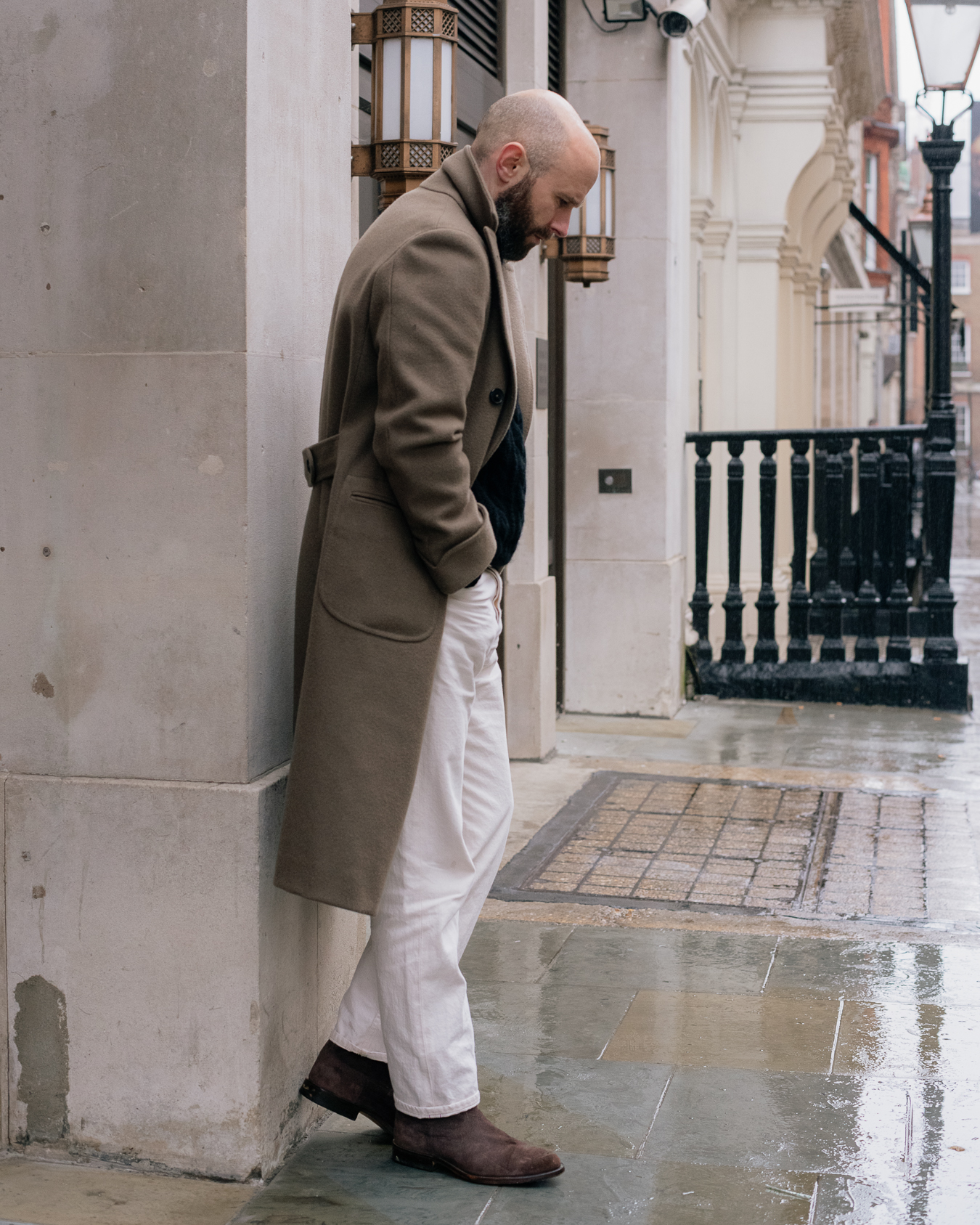
Nico Lazaro is a writer based in Los Angeles. He is @nickelcobalt on Instagram










Not really my thing, but I respect anyone who likes clothes and gets enjoyment out of the process of owning and wearing nice well made garments or shoes. I’ll admit the warm toned brown suede pair looks really nice, I’d wear them if I got them for free
As a big fan of the show Justified and boots in general, I have been circling a pair of cowboy boots for a while.
My concern though has always been how to integrate them into my wardrobe, fit and the cosplay perception. Admittedly I haven’t tried on many pairs of cowboy boots but, being in the UK, the vast majority of the manufacturers are in the US and I don’t particularly fancy the costs and faff of ordering a pair online, only to potentially return them.
Are there any particular brands that have a narrower fit around the ankle? For example, C&J loafers fit me well because they are snug at the ankle as mine are narrow. As much as I like the idea of wearing some roper boots, I also don’t want my feet to feel as though they are sloshing around in the boots without them feeling properly secured. It would really impact my work as a deputy US Marshal.
Nico and/or Simon I would welcome your input.
I haven’t had the issue of feet sloshing around in ropers, but I get what you’re saying. Ropers are generally better for more casual outfits and work best with denim and chinos.
Most cowboy boots from the list above have slimmer shafts and will fit under tailored trousers when properly sized. My best advice would be to find a bootmaker or retailer that can advise on fit and style for your preferences. From the list, I would highly recommend Rios of Mercedes, Zephan Parker, and Graham Ebner to steer you right.
I am not so much into the tailoring covered here, I look for the cues and the stories. What I am all about is luxury casual wear.
I have long been drawn to western themes, with RRL, Freewheelers and Joe McCoy dominating my wardrobe. I’ve had and still have many a pair of cowboy boots.
Being in the UK it is easy to feel self conscious about it feeling like costume or fancy dress, but as long as you skip the bolo tie and Stetson, you’re broadly okay.
The boots I love the most are Rio’s of Mercedes. None of the pretensions that plague Lucchese, and better made than many of the RTW “mass produced” boots. More interesting leathers too.
My favourite are my waxy Kudu roper boots in buckwheat. I’ve just added some more wax and the patina and changes in them is fascinating.
You need a bit of confidence to wear cowboy boots, but I find wearing them gives me confidence. Makes me stand up straight and feel the two inches taller that I am.
Freddy,
I have the exact same pair of boots, and wear them the exact same way. Just throw on a pair of jeans and then whatever else I would normally wear. They’re just another option for a casual boot and I try not to overthink it.
Also, that’s a great leather (I believe it’s from CF Stead). There’s a great example of it really worn in on patinaproject too.
https://www.patinaproject.com/items/rios-of-mercedes-roper-cf-stead-wheatbuck-waxy-commander-suede/gzAq9MU
I’ve just added more wax today, because I wanted to. Incredible boots.
These are BEAUTIFUL, and have the added effect of making cowboy/roper boots in general easier to visualize adding to my wardrobe. I can’t do the sharp heel of other cowboy boots, but these look just about perfect. Great buy!
Feels like a solution thats trying to find a problem to fix.
I get the comment from Ethan, though it flies in the face of the rest of the article, that if you are in costume you may as well keep the footwear appropriate too. I also get that under trousers they can look like a Chelsea boot or such. What I dont get, assuming you arent in costume, is why you would want to try and make them fit rather than wearing the Chelsea boot that you already own?
Sure if you are from the south west then its part of your culture, similarly if you fetishise that culture and want to play dress up, if you find a pair that you fall in love with ok, but dont see why you’d spend the time and effort to seek them out and then make them work with your non-southwestern outfits otherwise.
I think the linked article from Simon probably sums it up best, as something simply for a change, like wearing a black beret instead of a watch cap. I suspect the rate of beret wearing is probably similar outside of its cultural home.
This is just my personal experience but I think there is a degree of costume to every outfit I wear. This could be something uniquely American, but there isn’t a set codified wardrobe here besides some of the Ivy staples which themselves have become a sort of costume these days. In that sense, I find that every outfit is a solution to the problem of developing your own sense of style based on personal influences. There is a significant precedence for wearing cowboy boots both with tailoring and casual wear here in Los Angeles, which has inspired how I wear the boots myself.
Great article, more from Nico please!
I must confess that I am still not tempted by Cowboy boots. But the article gave me a lot of inspiration for how to wear my Chelsea boots and I think Nico offers something distinctive to the usual set of writers.
As I had recently discussed with Manish in another comment section on different silhouetts, I am not sure anyone else on the team would currently write a sentence like this: “These days, I wear honey-suede Tecovas Johnny boots with 1950s US Army chinos or my straight-leg High Slim jeans from There There,“
Thanks for the kind words, Liam! I tend to find that (within reason) the more varied your influences, the more it contextualizes and broadens your sense of style. I much prefer to explore that rather than keep a rigid set of constraints.
Total linen.
They work surprisingly well with linen! I wouldn’t have expected that.
As an Oklahoman and an oil and gas landman, cowboy boots are essentially part of the “uniform” here. That being said, I think that cowboy boots add a certain amount of attitude to an otherwise basic look. For instance, jeans and a plain t-shirt under a sport coat look very different with loafers or sneakers than they do with a pair of boots. In my opinion, the boots can add a little more gravity.
There’s an iconic photo of Ralph Lauren sitting on a kitchen counter in jeans and a tee with cowboy boots and a cowboy hat that seems to prove the point that they add gravity to any look you pair them with.
Hi,
Interesting article. Unfortunately they are not a good fit with the shape of my foot.
I think they can also look great on women. My wife used to wear them with a dress when we first started hanging out together on the Kings Road (London), in the 70s. So cool, no wonder I fell in love!
I agree, they look even better on women, as nearly everything does. Fran Lebowitz was my inspiration for how to wear them with jeans and tailored clothing, and I imagine she picked up this affectation around the same time as your wife.
I’m a Texan, and I never thought I’d see cowboy boots worn with a beret, double breasted, or cuffed trousers. Well, here we are.
I’m a New Yorker who never thought I’d ever seriously consider wearing them. Times are a’changing and I’m glad that styles like these are democratized, and the bootmakers I spoke to all seemed to agree. I wouldn’t personally wear the beret, but I know a good many people who would wear cowboy boots with a double breasted suit and cuffed trousers, myself included.
As a fellow Texan, I agree and I don’t like where “here” is.
I don’t think it’s helpful to include Lisa Sorrell or Texas Traditions in these lists for bespoke makers since it’s basically impossible for new customers to get in with them. They’re absolutely legends, but it would make more sense to feature people you can buy a pair of boots with in a reasonable time and without having an intro.
I dig the ropper thing, 20 years ago I showed up to my dream job interview wearing a tweed neapolitan jacket and straight-cut officer’s chinos with Stivania
Wish there were more stockists in the UK outside of vintage – East West Apparel are doing good work. Unmarked boots made in Mexico look a good entry option.
Great article! I’ve been wearing western boots for about three years now, both with suits and jeans. I’ve also started wearing other boots with Cuban heels, for example 1960s-style zip boots. Boots give you great posture, and they’re surprisingly easy to style. Come to think of it, I don’t think I’ve ever seen someone wearing western boots and thought, “that looks strange” – if anything, they almost always look a little cool.
If you live in Europe (I live in Stockholm), though, my impression is that they’re incredibly hard to find. I’d almost say there’s a gap in the market. I can highly recommend the Italian brand Barbanera. It’s probably the only place I know that has a permanent collection of genuinely good and stylish boots.
I’ll start by saying that as a Texan born and raised in the country, cowboy boots have always been such a practical everyday essential that I’ve never given them much thought. There’s such a rugged masculine lineage behind cowboy boots that for me personally, wearing anything besides boots with jeans would make me feel affected. Ironically, I’m as hesitant to wear something like loafers with jeans as others are to wear cowboy boots. I’m not an expert by any means but would like to offer a few suggestions as a frequent cowboy boot wearer.
I think ropers are a great compromise and conservative entry into cowboy boots. They’re easier on the knees and comfortable enough to run in (I’ve done a tough mudder race in ropers), offer a great degree of protection, and as pointed out by the author, look a lot like Chelsea boots at a glance. I have a pair of buffalo bullhide ropers that I’ve worn everywhere from London to South America and the Middle East and the usually go unnoticed when covered by the pant leg. They’re rugged and reserved. It wasn’t until I bought my first pair of English made Chelsea boots that I realized how similar they were. I’ve been trying to talk one of my British tailors into buying a pair of ropers next time he comes to Texas but to no avail as of yet.
The next level of cowboy boot I’d recommend is the black dress boot. They’re a staple. In Texas they cover the entire spectrum of formality and can be worn with everything from jeans (like Tom Cruise in “Top Gun Maverick”) to suits, and of course, the “Texas Tuxedo”(regular black tie with black cowboy boots). While there are many materials ranging from calfskin to exotics, I personally find black ostrich to be the most versatile.
I’ll finish with this. I’m not trying to put anyone down, but I implore you. If you’re going to wear cowboy boots, please stick with the traditional style. I know that there are manufacturers who make half boots for those who are hesitant. Please leave the zip ups and low cut cowboy booties for the ladies. They’re best suited to show off long legs in skirts and daisy dukes. On men they’re a sure fire way to guarantee to look like a tourist in a costume. Other than that, wear your boots with confidence!
eBay is a good place to look for Texas made black label Tony Lamas and other high quality boots. Of course it’s a gamble with fitting. but one can get lucky. I happened to acquire a pristine pair of M.L. Leddy boots that fit great. They have a shorter riding heel so not too bad to walk in.
Those look nice. M.L. Leddy makes great boots. My wife bought a pair of white boots for our wedding reception from their store in Ft. Worth. Sometimes consignment stores have really good bargains. On a lark I stopped at a consignment store in Colorado and found a beat up pair of brown alligator boots that must have come from a monster of a gator judging by the scales. They fit absolutely perfectly. Whoever wore them before had the exact same foot contours. I had them resoled and reheeled before restoring the skin myself. They came out looking amazing and I’ve been told by several bootmakers that you can’t find skins like that nowadays. Best $120 I’ve ever spent!
I bought a pair at Luskeys in Fort Worth. I think the store is now part of Cavenders. I had a great experience, including selecting the skins. The boots take a bit of wearing in, and probably work best under boot cut jeans
I wore cowboy boots with denim jeans in the 70’s. From memory a lot of guys did. My girlfriend at the time wore them with denim mini skirts. That was a look!
Ciao Nico,
an interesting topic for sure.
For me, the variety of styles and pairing with the boots looks slightly odd.
The beret situation in particular above, is for me, very strange.
This is the type of boot, I feel, only certain gentlemen can truly ” wear “.
It is not a style ” staple “, the partnering needs some thought and honest reflection.
If I look at Yul Brynner in the original Magnificent Seven, this is where it is at.
You do not need the hat of course but you need the swagger and clothes, to match the boots.
It is a rugged, dusty, hard working and quite superb look.
But again, not for everyone.
These boots, I feel, are polarising like few other clothing items.
Grazie, JR.
As an American who has kept Cowboy Boots in the rotation for quite some time, I would urge those not riding and outside of the American SW and South to stick to Ropers (which if plain enough, are just leather Wellingtons with a shorter shaft – but with traditional Cowboy Boot heel slip). There’s an argument also that there’s a more limited range of construction methods as well, so when you use a higher end maker, it’s more for the decorative leather work anyway. I would add BlackJack boot company to the already very good list here; BlackJack is ex-Lucchese people who do OTR and semi-custom boots.
The Spanish brand Tony Mora also makes some decent entry-level boots. That being said, my plain roper boots still felt like a costume and I gave them away after one season 🙁
I live in the south, which has a long history of wearing cowboy boots with suits. I don’t do it personally, but I see it all the time. I see how there might be a struggle in a place where cowboy boots are novel.
For those new to them, square toed boots look bad with suits (they do their best work in the field), and boots with substantial designs on the vamp and toe are probably not best with anything but the most “casual” suits. I’d stick to the basics and would probably avoid wearing cowboy boots with navy pinstripes and the like.
I don’t know how really leaning in to the look (denim shirt, yoked suit) would translate to someone in New York or London. Probably fine but a tad costumey. I’d probably just play around with it to see what feels right.
I have three pairs. I wear them with jeans and chinos. I have worn them with flannel and tweed trousers before, but I didn’t like the way it looked.
The key to making Western boots work with fine wardrobe is the heel.
Avoid boots with excessively high heels. Unless you are really a cowboy, you’ll look ridiculous walking in those heels.
Find boots which have DRESS SHOE HEELS. Normal height heels, in other words. These can be Cuban heels, if you wish.
Great article – and as you point out, geographical and cultural context means everything. In Texas, cowboy boots are such a common sight that it’s not at all jarring to see them with tailoring. In politics (and courtrooms), I would even say it’s expected. And there’s a lot being communicated there by the leather selected, whether ostrich (always full quill, not smooth belly or leg), croc (big difference between Caiman or Nile) or alligator.
Personally I enjoy wearing boots with tailoring. For a more professional look, I generally prefer calfskin without a toe bug and a french (chiseled) toe (which I believe Lucchese made popular), so that it reads more as a dress boot with a taller, slanted heel. When I wear the more classic cowboy boot, with a toe bug and/or a more distinct leather, I tend to go with a more Texan/Americana approach as the author notes.
I will point out that another great source of very good, RTW boots, is Heritage Bootmaker out of Austin (and online as everything is now). They have one of the best shaped vamps outside of bespoke.
Bruce Boyer has a nice chapter on cowboy boots in one of his books. I love mine, but with light and medium denim only (so far).
Are cowboyboots and the like more airy hence better to wear in warmer weather than boots that are laced like dr marten style boots and the like ?
I have both and I wouldn’t say they are much cooler. Perhaps a little, especially if your feet get hot easily, but it’s marginal
Is it recommended to wear bootcut jeans / pants with such boots, cowboyboots or will standard jeans & pants work ?
I find my standard ones work, but of course it depends how wide your trousers are
a mention should be made for someone who always wears these boots: Fran Lebowitz, great wit, writer and has impeccable taste in menswear. In fact she wears mens clothing.
Heritage boots in Austin have my absolute favorite cowboy boot. french toe with that sharp heel. pricey tho. I need to get a roper eventually tho