


By Dr John Potvin - the author of the book Giorgio Armani: Empire of the Senses and curator of the Instagram account @myarmaniarchive.
A jacket can be very sensual if it has certain characteristics.
Maybe a wider shoulder, a certain length,
a fitted waist, or no waist at all.
Giorgio Armani
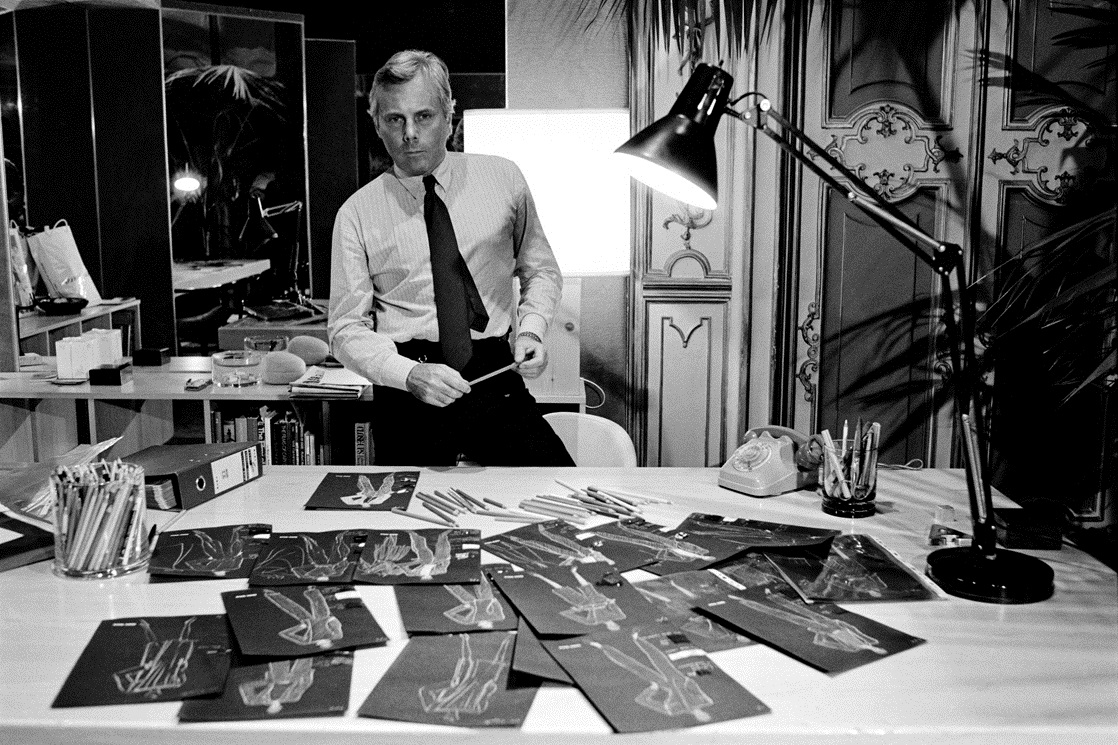
I must confess to feeling rather at a loss to summarise the legacy that Giorgio Armani has left behind in menswear and tailoring, when his significant contributions are so many. After all, what other designer is responsible for the creation of an entirely new colour, such as the now iconic greige (grey and beige combined)? The daunting task is equally due to the fact I long believed him to be immortal.
Mr Armani is responsible for taking the stuffing out of men’s jackets, providing us with a garment suitable for modern life, regardless of body type; a jacket that moves with the body not only because of the cut but because of the generosity of the textiles.
His menswear sits very comfortably between Italian and British tailoring traditions, while heeding the more fashion-conscious needs of a forward-leaning man.

The perennial success of his collections resides at the intersection of cut and silhouette as much as colour and textile innovation. Too often overlooked, Mr Armani was masterfully adept at textile development, while creating sumptuous fabrics that made the wearer’s skin feel luxuriously cared for.
An alchemist of sorts, he honoured long-respected craft traditions while recognising the necessities of industrial production. This balancing act had its roots in the now well-rehearsed origin story when he worked for Nino Cerruti (1930-2022), first in the textile factories and eventually as designer for the family business’s Hitman menswear collection.
Textile know-how thus came well before he took the stiffness out of men’s jackets. He famously created a silhouette with bolder shoulders, looser throughout the body, with a low gorge paired with a narrower lapel.
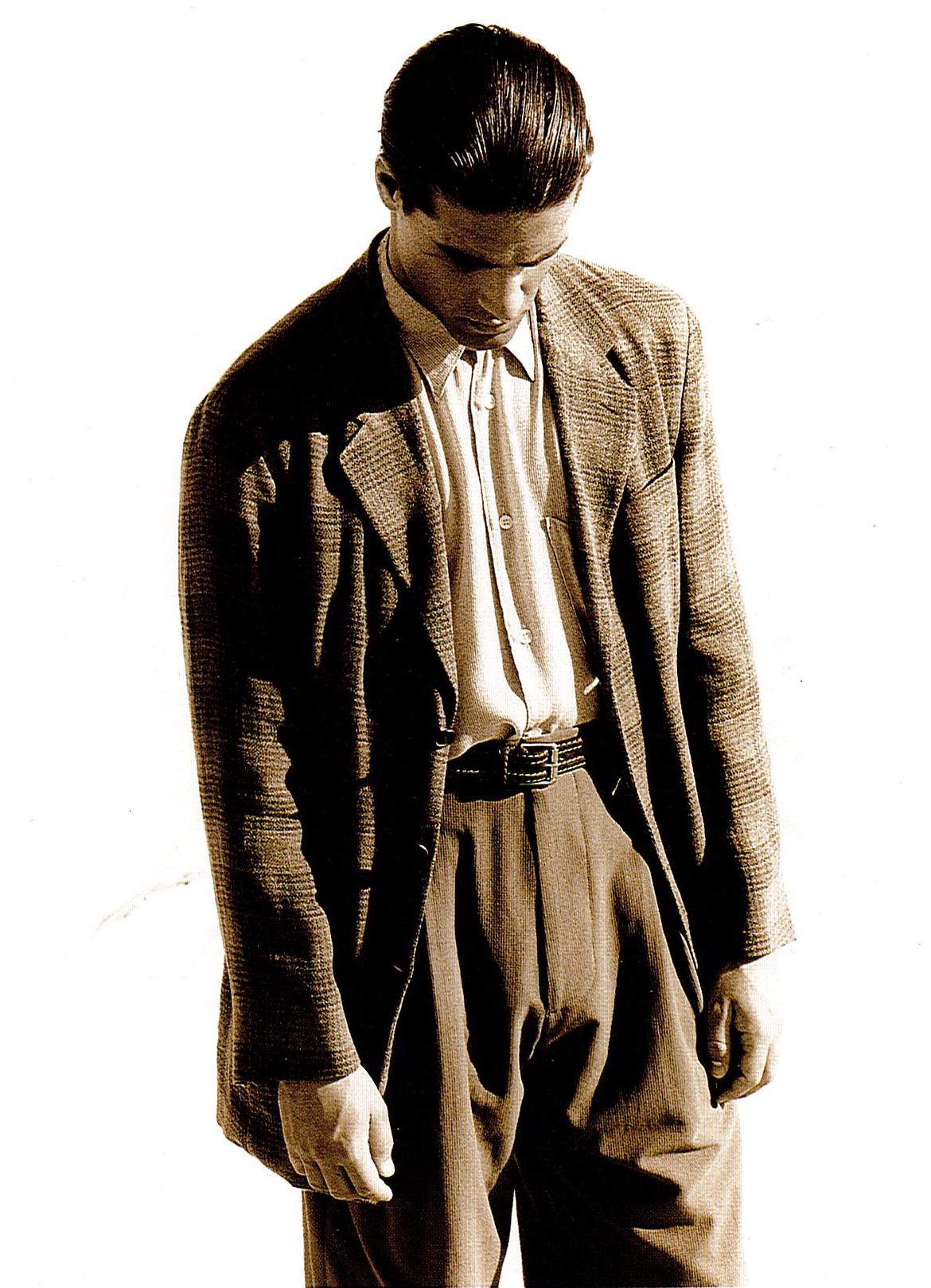
Throughout the 1980s and 90s, the size of the lapels shifted continuously, so much so that, by the 1990 to 1994 seasons, they often disappeared altogether, and took inspiration from sartorial traditions from around the world (below, from my own collection).
As lapels vanished, buttons increased and so too did the length of the jackets. Although the same period witnessed constant innovation and development in menswear, it was also a time when the designer fully solidified his aesthetic and design ethos; as a result, it is the period to which many return when they speak of the ‘Armani style’.


To wear Armani suggested one had arrived. It was a powerful, sartorial sign of self-assurance and personal achievement unburdened by pedigree, class affiliation or education. Buying an Armani jacket was a rite of passage.
At the same time an Armani jacket eschewed flashy statements or loud self-promotion. It embodied a quiet, private and yet seemingly indulgent luxury for the self. Jackets and suits were meant to enhance rather than subsume the wearer’s personality.
But there was also another revolutionary element to his jackets, for Mr Armani used textiles usually destined for womenswear. Wool crepe, linen blended with acetate, rag-effect Indian cotton, jacquards and viscose, for example, quickly became staples. Already in the early 80s, his English tweeds felt like pyjamas; not a look or feel men were used to.


As a result, men were given a softer, more vulnerable appearance all the while remaining self-assured and in command of their presence. He never shied away from allowing men to expose their more feminine side, sending models down the runway in brightly coloured sarongs coupled with unlined ties for his spring 1995 collection, for example.
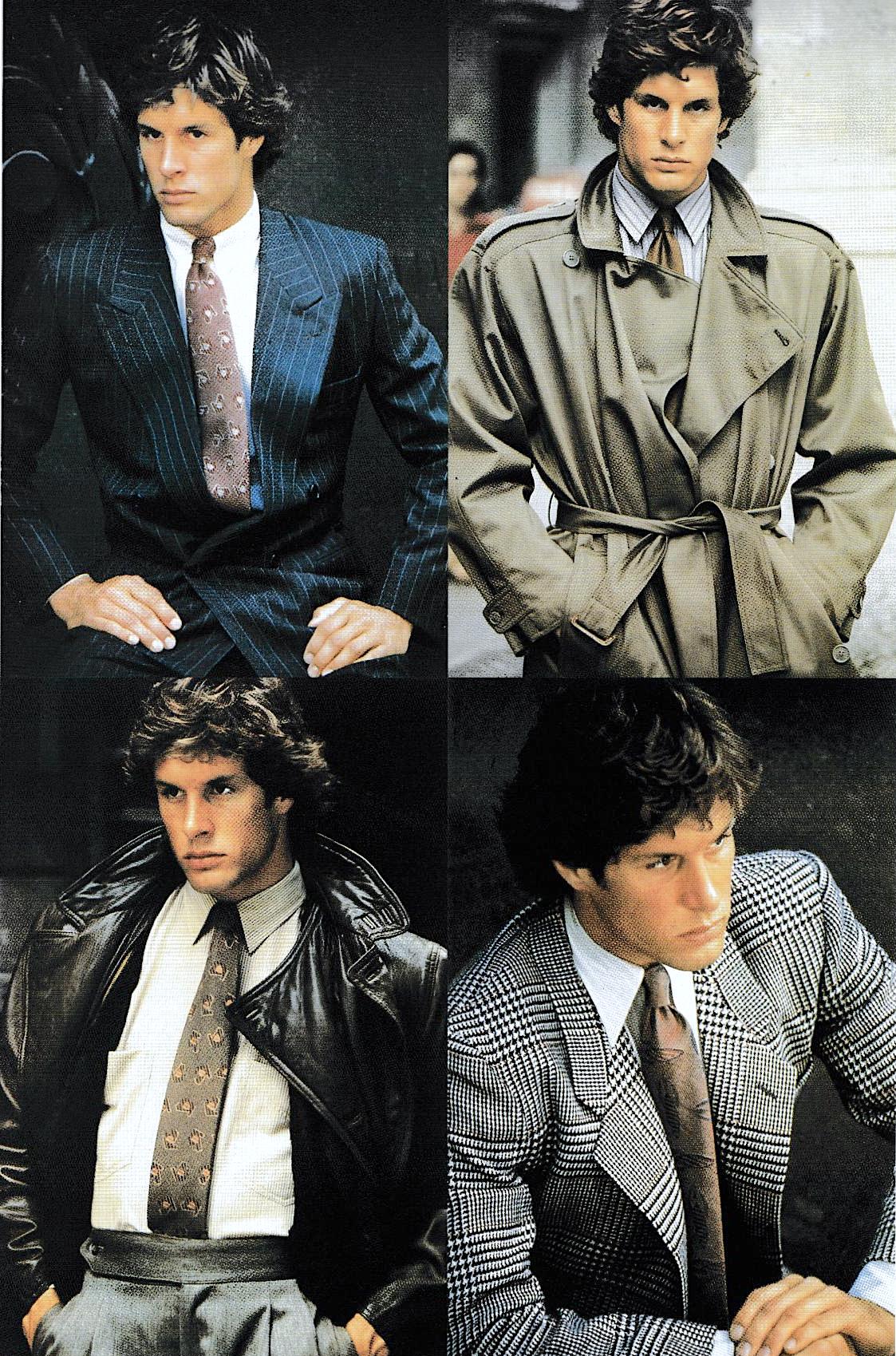
In contrast the following year, Mr Armani inaugurated Giorgio Armani Classico, part of his ‘black label’ mainline. The now-defunct, more sober capsule collection targeted serious businessmen, financiers and professionals and featured pinstripes, Prince of Wale checks and houndstooth prominently. Through the collection he offered conservative, timeless tailored pieces as wardrobe staples.
Conscious of offering a diversity of looks that all seamlessly fit within the Armani man’s wardrobe, his Autumn/Winter 1990 collection, titled ‘Tutti Gli Uomomini Armani’ (All Men) showcased three different Armani types.
The first, ‘The Traditionalist’, wedded traditional tailoring with traditional menswear fabrics in neutral tones of navy, grey and putty, while ‘The Professional’ moved away from double-breasted suits into three-button single-breasted examples in camel and other equally rich and luxurious textiles. Finally, ‘The Avant-garde Man’ celebrated his bohemian attitude with shawl vcollars on double-breasted suits in velvet, corduroy, chenille and wool bouclé.
This man showed the rules with one part of the collection, then broke it with another.
By subtracting rather than adding, Mr Armani throughout offered a jacket that felt as though it had already been lived in, as if it had already been hanging in a man’s closet for some time. With every subsequent year, particularly in the early 90s his jackets, devoid of any of the shoulder padding of the 80s, moulded around the shoulder, soft, seamless and contoured.
He created a work uniform that was at once respectfully formal and impeccably tailored, while at the same time so effortless that it made dressing for work an easy and pleasurable endeavour.


American Gigolo (1980, above), featuring a very alluring Ricard Gere in the lead role, occupies a top rung within the pantheon of fashion films. However, it marks only one of the over 100 collaboration credits to Mr Armani’s name.
At the heart of the film’s significance was how it set the stage for a tailoring and menswear aesthetic programme premised on providing a seductive quality to cut and textiles; they were meant to enhance a newly fit and healthy body underneath, spurred on by the nascent gym craze.
In short, Mr Armani welcomed men to celebrate their bodies through seductive sartorial choices rather than concealing them in rigid, stiff and unflattering suits.


Paul Shrader’s 1980 cult classic is by no means the only significant film of the decade in which the designer flexed his sartorial might. In 1987, he was invited to create the wardrobe for most of the characters in Brian De Palma’s The Untouchables (above).
Lush suede jackets paired with wool flannel trousers or crisp, fluid three-piece linen suits were as much at ease in 1930s gangster-ridden Chicago conjured in the film as they were in the late 1980s when they were designed, and whose doppelgängers were made available in Giorgio Armani boutiques around the world.
Mr Armani once said: “I like to create clothing for people who work, and that includes actors and actresses, inasmuch as they are people who work, and not just as stars.” Through cinema, ‘Armani’ quickly became a household name.
As a long-time collector, scholar and fan, it has become nearly impossible for me to look at a jacket and not either compare it to an Armani or see how it is influenced by him.
In our current obsession with vintage and nostalgia, Mr Armani’s evergreen designs from the 80s and 90s, in particular, have been experiencing a deep resurgence of interest. Younger generations seeking out Armani clearly understand his attention to detail, quality fabrics and timeless design.
Recently, Mr Armani’s legacy and influence has also been evidenced on the runways and was celebrated by Japanese designer Soshi Otsuki, the recipient of the 2025 LVMH Prize (below).


Designed with a Japanese twist, Otsuki’s menswear is a respectful and modernised homage to 80s and 90s Giorgio Armani, apparent in the louche and full proportions, greige palette and even the colour and font choice of his label.
With the passing of Mr Armani on 4 September 2025, in the same year the company celebrates its 50th anniversary, collectors and consumers alike may take solace in the knowledge that he has put in place a strong menswear design team headed by the talented Pantello (Leo) dell’Orco who is now charged with the Herculean task of carrying on a label steeped in heritage and excellence.
Dr John Potvin is Professor at Concordia University, a design historian and author of the book Giorgio Armani: Empire of the Senses (Ashgate/Routledge, 2012) and curator of the Instagram account @myarmaniarchive.
For an overview of Armani’s influence, including on modern menswear brands, see Tony Sylvester’s article on Permanent Style here. For a very in-depth look at The Untouchables, see also the ‘A Little Bit of Rest’ article here.
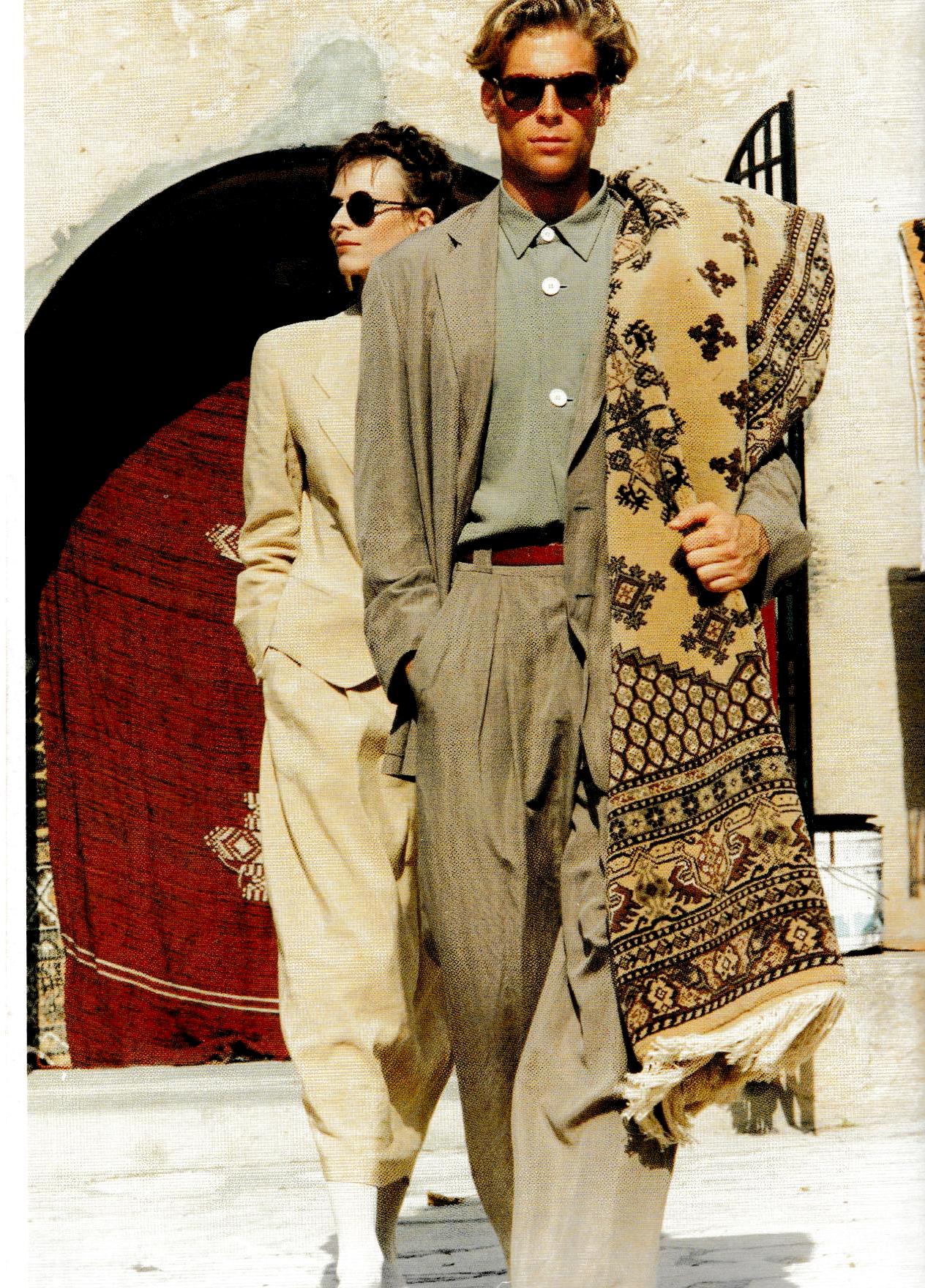










The 80s/90s Armani are truly legendary, but two questions are begged tobe answered. What about contemporary Armani (is it still any good? worthy of being talked about?) and where can one get something akin to the Armani of old now?
Good point Nico, and that sounds like a potential future article. My general impression on the first is that no, it hasn’t been good for a while, but they have been trying to get back to some of the earlier feel recently. Lucas might have more to contribute there.
In terms of something akin today, I’d go to a tailor with a natural larger style, like an Assisi for example, and push the proportions a little
I had no idea the wardrobe in the Untouchables was designed by Armani. The bad guy in the white suit is iconic and really adds to his character. Thanks for sharing!
Simon – do you own any Armani beyond those horse bit loafers?
Not sure I even own those! Let me know what you’re referring to if you remember.
I don’t. I did buy a suit on eBay earlier this year but I found the style too exaggerated for me. I can see how the look works well on others – Lucas, Shun – but on me I need it moderated, so more akin to the Luca Museo suit for example
Apologies, it was Lucas and they were Gucci!
Ha! That makes more sense
Lovely article. One of the things that struck me from this article is the virtues of a longer sport jacket as mentioned in the opening quote and elsewhere. The photo of the sport jacket worn by the model in the fourth photo illustrates this very well. There is a maddening tendency today to cut men’s sport jackets short in the manner of a ladies’ riding jacket which pointlessly accentuates the hips and seat and makes the easy casualness illustrated impossible. Instead, the wearer looks uptight and ill at ease.
I know what you mean Richard. I think it’s particularly bad when the jacket is buttoned high and the fit rather close. If it’s a soft jacket, not that tight, and often worn open, I think the issue is less
After decades of longer and larger jackets from the 70’s to the 90’s, a young designer, Heidi Slimane working for Dior decided around 2000 to move back to the 60’s shorter and thiner design. At the same time bands like The Stoke brought back XXS leather jacket worn on skinny jeans… Even Karl Lagerfeld decided to start a severe diet to be able to wear Slimane’s design. And suits started to dangerously shrink… for 20 years! Hopefully we are in a kind of very nice period of time when many people understand that ultimately style works with your body type: if you are tall and skinny, Slimane’s style may still work for you, if you are a bit short and overweight, forget forever about it and go to 80’s or 90’s Armani. And if you look like Richard Gere in American Gigolo, then select whatever you want..
Yes I think there’s more awareness of that now, as well as more microtrends, fewer big ones. I’m not sure we’ll ever see trends as big as those over the 50 years from 1960 to 2010
Armani made you look good and allowed you to move clothes with a colour that you could wear.
Even today men’s clothes are made without enough function . In an Armani suit you could wear it , sleep in it and work in it .
Grazie Giorgio
This is the most fascinating text I’ve read about Armani, thanks! Just a little correction: the director of American Gigolo is Paul Schrader (not Ian).
Thanks JMA, correcting now…
I agree with others, a lovely article. The Armani ‘look’ is a little too louche for me these days, but in the past clothing I owned definitely leant that way (late 80s / early 90s), and I still have at least two favourite Armani items, a navy spread collar Giorgio Armani shirt and a navy tie that just has something special about it . But I still aspire to the relaxed elegance he created.
Simon,
In regard to men’s clothing in movies, and how well those fashions translate over the years/generations, would you say that 1968 Thomas Crown Affair has one of the more enduring men’s style?
Best,
Robert
Yes I would, that’s a great film for that. I hear they’re about to do it a third time…
A lovely article, that brought back memories of clothes and films. I remember buying my first Armani suit in the mid nineties from the shop in or around Knightsbridge – probably gone now. As mentioned in the lovely homage from John, it did feel in hindsight a sort of right of passage, as it was the first time I could sensibly afford something that expensive. I felt great at the time and looked not at all like anyone in the pictures but felt like them! That’s the magic I suppose, it’s how you feel.
Hopefully there will be some exhibitions in the coming years (eg V&A museum, if you hear of one please do let readers know) which will be part of his enduring legacy.
Will do Stephen
I still have a few items from Armani that I purchased in the 1980’s and 1990’s. The design and fabrics were interesting. The fabrication quality of his made in Italy mainline collection was just OK. Prices were very expensive. The diffusion lines like Armani Exchange made offshore were not great quality.
Batman Begin’s Armani is subpar to say the least. Soulless.
This is a very welcome article, and I was rather hoping PS would publish something when news of Armani’s death was announced last week. One thing I’m still unclear about – and acknowledging the role of Cerutti – is how Armani’s innovations are understood in relation to Italian tailoring more generally. It seems that all the things he is celebrated for – removing padding, loosening the structure, making suits wear more like knitwear – is also found in Italian, and particularly Neapolitan, tailoring. Is it simply that he took these innovations from bespoke tailoring and applied them to ready-to-wear – or is there something else I’m missing here?
Also found in Ivy League jackets/blazers. I think the key Armani innovation was cloth and particularly bias cut.
An evocative article and beautiful clothes – brought back memories of a simpler era. The only downside being that I’ve had Jan Hammer’s Crockett’s Theme from Miami Vice running through my head on a continuous loop since I read the article this morning!
I question the claim that Armani’s designs uniquely invited men to “celebrate their bodies through seductive sartorial choices.” That his suits were unstructured doesn’t mean that they showed off “a newly fit and healthy body underneath.” In contrast, the appeal of Armani’s tailoring was precisely that they created through drape and exaggerated proportions a silhouette of their own, regardless of the wearer’s proportions. Of course, he relied on sex appeal to sell his designs, but that’s a marketing strategy adopted by designers of silhouettes of all dimensions.
A great article that made me try the old armani suits since i rarely wear tailoring. I could imagine 80-90 Armani could fit well with clothes from brands like Adret or Saman Amel. How do you find these ? Only from ebay? what collections should i look at ?
Hi Georgios, I tend to find most of my pieces through Ebay or Vinted, I tend to look for Armani Collezioni or Black label as these tend to be the best mix interesting/ wearable. I would agree that the drape will work nicely with those brands. I would say a lot of the suits have surprisingly strong shoulders. Just a note.
As a corporate exec in the late 80’s and early 90’s, I invested heavily in Mr. Armani’s styling.
Travelling the world and attending meetings et al, it was pleasing to graciously accept many a compliment.
The ladies especially, would comment ” Wow, you guys have great clothes in Europe ! ”
The loose, sexy silhouettes and simple tailoring were at odds with the stiff, boxy suits that were
being adorned.
It was a great time to dress well and feel good doing it without being chalked by a tailor.
Oh and not to mention a bottle of the original Giorgio Armani Pour Homme tossed in the dopp kit …
Riposa in pace, Signore Armani.
What a fabulous article this is and bravo to whoever wrote it.
I wore a lot of Armani in the ‘80s. I also wore a lot from Giorgio’s previous employer, Cerruti.. They were both ploughing a similar furrow and were at the top of their game – it really was their time and they captured the zeitgeist perfectly. Both also maximised their prestige via great Hollywood relationships.
Although they lost my sartorial custom as they diffused, it was Armani who left the biggest impression on my own look as I continued to sport a ‘softer look’ going forward.
Ironically my employer held the fragrance licences for both Ralph Lauren and Armani and those responsible told me that Ralph was insanely jealous of Armani’s sales and could never understand his success in the perfume business. The truth was Giorgio was a real creative, was a much nicer guy and was easier to work with. What a great legacy to have.
Salute Giorgio and RIP.
I have always loved the costumes Armani made for The Untouchables. Other than De Niro’s suits (which were based on patterns from Al Capone’s real tailor), they aren’t really period accurate but neither is the story particularly historically accurate. But it’s still an entertaining film and the costumes are part of what makes it good by perfectly suiting each of the characters, from Frank Nitty’s flashy white suits, Ness’ no-nonsense dark suits, to Stone’s louche suede blouson.
Loved this article. I’ve always felt that discussions of classic menswear that end in the 50s or 60s really miss the boat. Armani represented a sea change in classic styling; I struggle to think of a more recent designer making suits *someone would actually wear* with that big an impact on the genre.
As with every other style, that earlier iterations ain’t for everybody The shoulders feel big enough to comfortably park an aircraft carrier, the button point is low, the jacket can look like a long even when it isn’t, the lapels can get a bit lost in the shuffle, and the back can feel not clean but dated. On the right frame, though, it’s a real, no joke looker.
I’m not an expert, but IIRC, Armani had a couple of lines, in descending order of quality: Black Label, Georgi Armani Le Collezioni, and Mani. Mani was the diffusion line, and that’s probably the only one not worth looking at.
It’s not hard to find inexpensive, gently used Le Collezioni sport coats from the early 80s on eBay in just about every size. The prices are low (as they are with other forgotten classics like Pendletons). I’ve bought two or three over the years. The last one was from Collezioni, and it was something like $70 plus shipping. Came in fine shape.
Everyone’s mileage may vary, of course, but I suspect the bulk of people reading Simon’s stuff will find that investment not to be a break-the-bank investment.
OK, I thought Mr. Armani was a very interesting and likeable man. His exploration of different fabrics in menswear was admirable, and when he dressed a film, he did a superb job. But I have to scratch my head with regard to heaping this much praise on a designer who popularized jackets with massive shoulders that just happened to be unconstructed elsewhere. I guess I just don’t “get it”. I also am puzzled by Tony’s dismissive that structured mens tailoring is unflattering; it is almost axiomatic that it is the MOST flattering, but that it is not as comfortable as unstructured tailoring.
Hi Simon, I recently inherited a beautiful late 80s vintage Armani DB suit jacket, but it feels a bit long (though it fits at the shoulders perfectly). What is the correct length for this style? Is the usual rule about the jacket finishing when you make a fist/cupping your fingers underneath the hem still the right one, or should the Armani jackets be left longer? Would it be sacrilege if I had a tailor shorten the jacket slightly, by an inch or two? I’m aware the width of the 80s lapels may need extra length to provide ‘balance’ to the proportions.
The issue is, the style varied among Armani collections as well, so it’s hard to say. I think ideas of balance are key and that is what you should keep in mind when you’re trying to assess it yourself or with a tailor. Also, I wouldn’t alter by two inches on almost anything like this, that will pretty much always alter the balance too much. Stay closer to an inch
Thanks Simon – sage advice. The wide lapels, 4-2 configuration and lower button position all make me reluctant to do too much to the jacket’s length, though at the moment it feels comically long. Perhaps an inch and embrace the extra length as part of the style.
The width and flair of the lapels aren’t dissimilar from some of Anglo Italian’s house designs, but their structure and tendency for the 6-3 configuration might favour a tighter silhouette when compared to Armani.
Yes, I’d agree JJ.
Overall, you may find the style isn’t for you, but I don’t think trying to force it to be something else will be a good idea