

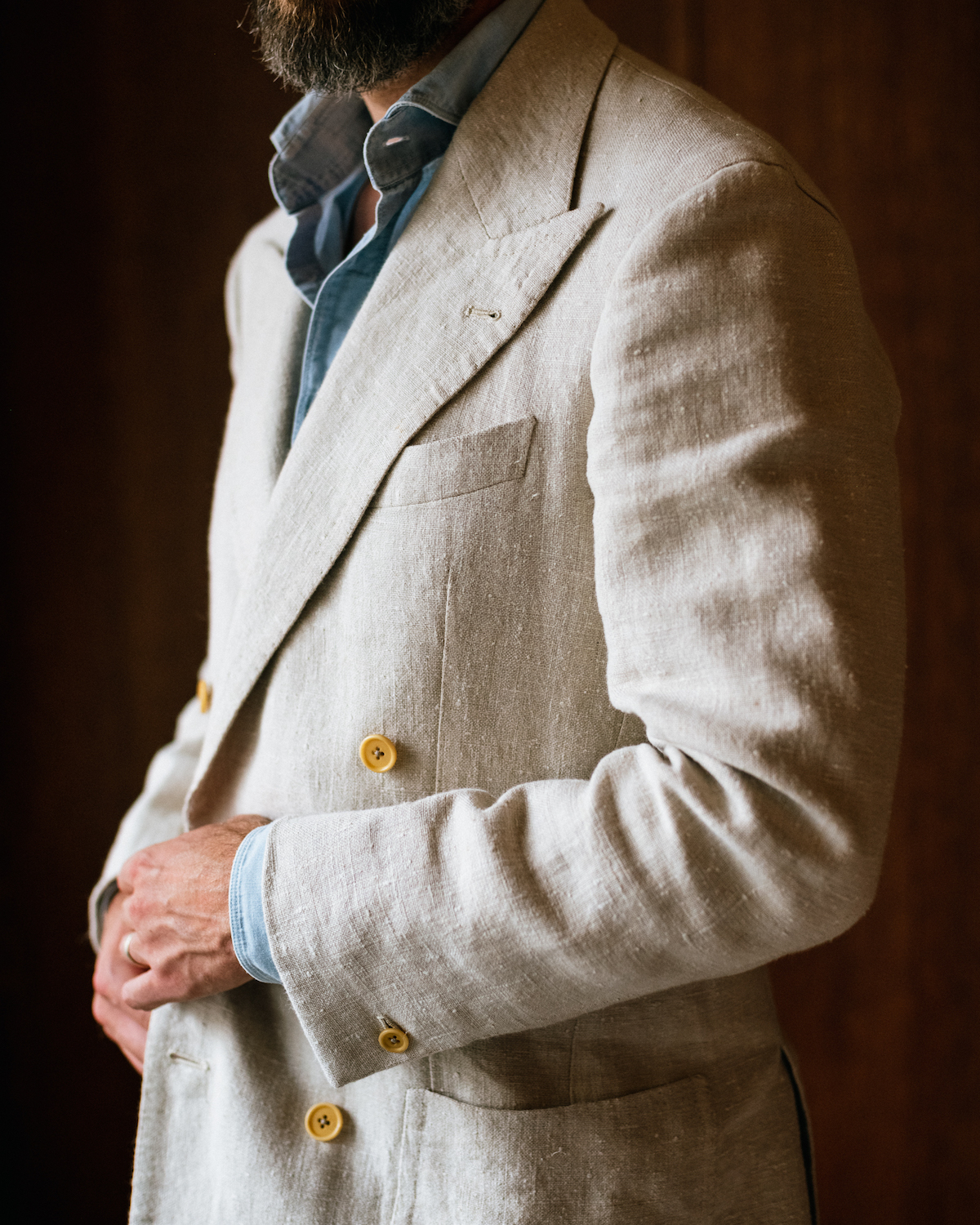
We’re used to saying on Permanent Style that clothes are a matter of self-expression. That you have no choice but to say something by the clothes you wear - but that’s also an opportunity to express yourself, to make active, enjoyable choices.
This line of argument works for those who are more expressive, perhaps more artistic, and enjoy that creative exercise. But I’m not sure it appeals so much to the average reader that wants to be simply well dressed.
So here’s a different way to look at it.
One of the richest aspects of clothing, I’ve come to realise, is that it shows, it illustrates, how you change as a person. You wear different things at different stages in life - dating, parenthood, retirement; various jobs; activities and passions; your developing taste; caring more or less about the trends around you, which are of course themselves a factor - and this history of clothing is a history of yourself, of your personality.
I used to say that clothing was a lot like cooking. You have to eat something just as you have to wear something, so you might as well understand and enjoy it.
But clothing is actually much richer than that, because it changes more with your journey through life. What food you like and what you cook will evolve as well, but it’s less expressive and less personal.

When I was 23 years old, and first getting into suits (because everyone around me wore one) I wanted things that were obviously different, that stood out. My first designer purchase was a grey Prince-of-Wales suit from Etro, and I thought it was beautiful. But it was completely inappropriate for my job.
When I had my first suits made on Savile Row, they weren’t as lairy as that, but they were still loud. The worst was probably a rich-blue double-breasted flannel suit. I got it because Karl, the salesman, had one and looked amazing. But then he worked in a menswear shop.
It’s easy to see this history as simply a litany of mistakes, but I think at every stage the choices revealed something about who I was at that age. It’s not that I’d buy better suits that stand out at my age now; it’s that I don’t want to stand out in that way at all. Those suits were just as personal and expressive as the Wildhearts or Pearl Jam T-shirts I wore when I was 15 years old.
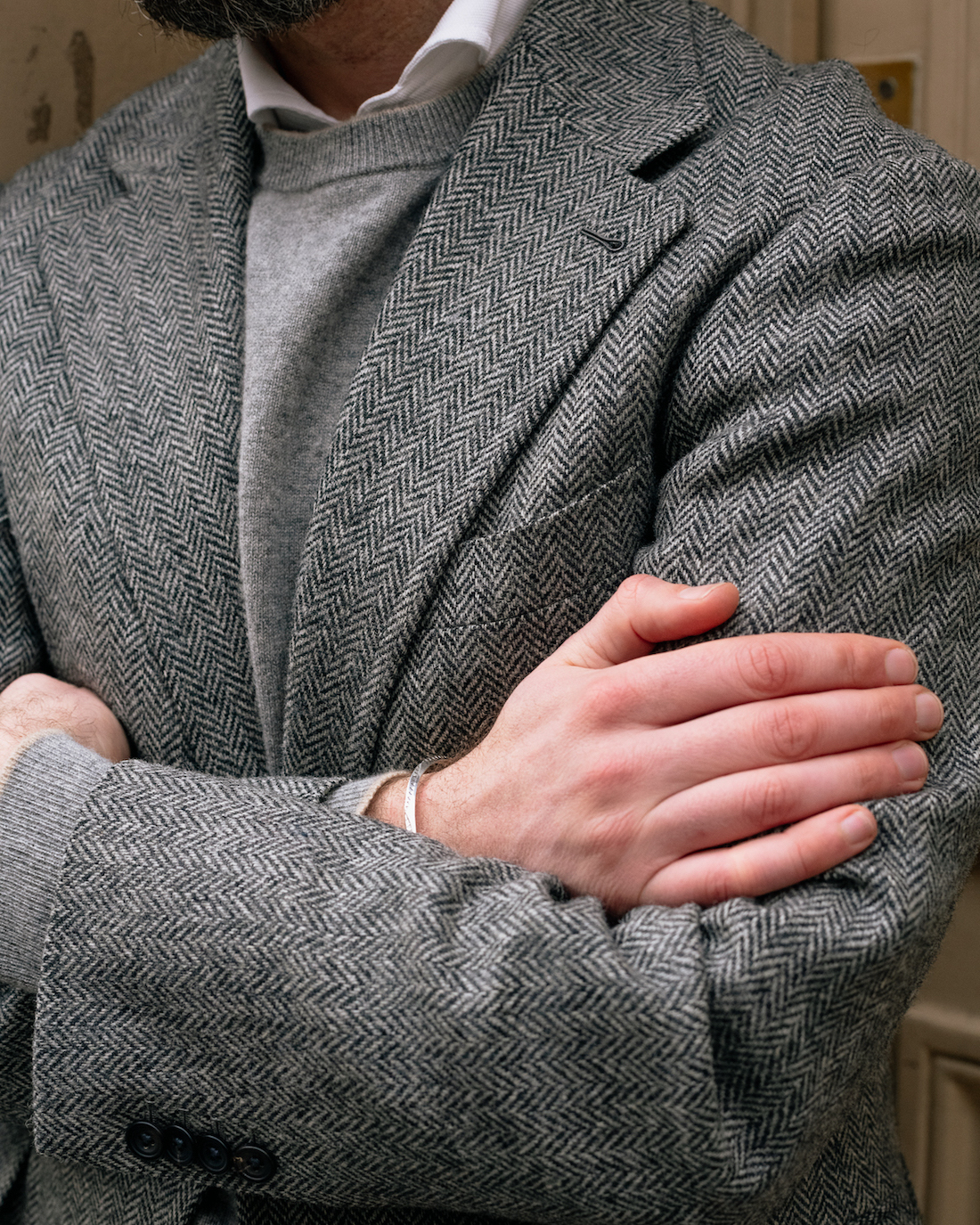
My taste has sobered - and I think improved - over time. Much of my favourite tailoring from the intervening years illustrates this, such as my grey herringbone jacket from The Anthology (below).
But interestingly, I’ve now also found that I can dress a little more unusually than those office days, because I work in menswear. For me, that is usually nothing more than a double-breasted jacket or a western shirt, but it’s a point between the Etro and the grey herringbone, and I think it says something different about who I am.
I did another episode of Jeremy’s podcast Blamo! earlier this year, when the two of us were in Florence, and he brought up this point.
When he started working at The Armoury in New York, many years ago now, it was at an exciting time for menswear. It felt like there was a new freedom in how ordinary men dressed, in how the average guy was permitted to think about clothes.
“But over time that seems to have morphed into sites that obsess over stitch count on shoes, or the best value knitwear,” he said. “The point for all of us at the start was that dressing well was about enabling you to do other things in life - understanding what clothing said about you, how to use that to express who you were. It was purposeful and personal.”
For Jeremy, clothes have definitely reflected who he has been over time, and they became very invested emotionally. My favourite example is an old oxford shirt he wears with frayed collars and cuffs - plus a hole in elbow that was patched by his mum.
There are a few other interesting things in that podcast, including how AI affects sites like PS. It makes such a difference when chatting to someone like that you know really well.

Returning to life’s journey, I don’t think it’s as simple as saying you just wear different things at different ages because you have to, or because fashions change. There’s always a bit of agency in there (albeit far more the more you’re into clothing).
Perhaps the clothes I wear today are kind of a reflection of two interdependent things: the fact that I understand clothes now more than I used to, so I can express myself better; and the fact that I want to appear a certain way, which has varied over the years.
So, for example, I am more comfortable today than I ever have been at appearing a little sexy - at leaving one more shirt button undone in the summer, perhaps. (I’m an Englishman remember, these are baby steps.) I wanted to appear good in the past, stylish and I guess attractive, but not really sexy in that way.
Just as importantly, I know enough about clothing today to know the best ways to achieve that effect, in a personal and subtle way, rather than brash and cocky. I know it’s sexier to be relaxed and comfortable in whatever the clothes are, rather than clearly trying very hard. That’s the problem with all those super-tight suits.
Clothes are a way in which, over the past 20 years, I’ve got to know myself. And at the same time, they are a key way in which I’ve been able to express it.
I’m sure many readers have felt the same. I’d love to hear some of them.










An enjoyable and thought-provoking article. One thing that occurs to me on reading this is that sometimes in menswear commentary there is a sort of false dichotomy between dressing for others and dressing for ourselves. Some think that it is either or. I think there is a sort of dialogue between the two reasons for dressing well and over time we tend to dress less for others than we formerly did and more for ourselves while not entirely forgetting the impact on others.
My experience is that I have also tended to stop buying colors that I formerly did (like bordeaux) and moved towards more earthy/greige colors (think Rubato or Stoffa) or neutral. I think your grey and white outfit illustrates that type of dressing very well.
In the horseracing world people ask of a horse where you cannot pinpoint where the speed comes from: “where does the power lie?” to which the usual response is “where does the power not lie?” I suppose that the place we might all want to arrive at is that people recognize that we dress well without being able to say why. Dressing for ourselves as we evolve helps get to that point.
Lovely metaphor and yes I agree Richard
Hey Richard I wanted to chime in merely to say what a lovely, well written, and succinct addition that was. Best!
Many thanks!
Well put, Richard. I would only add that audiences are layered. There are those for whom a well cut and composed outfit will register, but others whose notions of fit and composition are wildly different. Not being able to please everyone, dressing for oneself is the only logical path. Easier said than done, of course, but it does seem to get easier as one gets older.
Thank you Simon; only a fool would disagree. Perhaps this speaks to my own hubris, but I had not realized how extraordinarily analytical and literate you are!
This is excellent, and hits 50% of my experience with menswear. Weightloss gave me the freedom to choose a little better, easier. I went on a fast journey through a variety of styles, facilitated by Vinted and Marrkt.
I have now settled on what I love and I’m embracing it. Americana has always been part of who I am when it comes to taste in most things.
An exploration from reproductions from Real McCoy’s and Buzz Rickson left me cold, but the more playful, rugged, luxury from the likes of RRL, Freewheelers and Mister Freedom bring me joy.
That joy is almost entirely my own, I live a quiet rural English life, with a wife who rolls her eyes. But I get the joy from deciding an outfit. Barely anyone sees what I wear, but I get immense pleasure from it.
Plus luxury is comfortable.
Honestly, I think there’s a circularity. I inherited a bunch of very conservative stuff from posh grandparents / godparents from Savile Row in the 60s, thought it was boring, tried more flashy things and then, 20 years later, find myself having those same things I inherited made bespoke for me(!)
I’m in my early 40s and enjoying clothing and dressing more than ever. Admittedly, working in the industry means I live in a bit of a bubble, but much of the enjoyment comes from exactly what you described – being comfortable in my own skin, knowing what works, and not trying too hard (but just enough).
Interestingly, I find myself taking more risks these days, yet I’ve settled into a groove that feels authentically me. My approach to clothing and style has evolved immensely over the past 5–10 years, and I’m excited to see how it continues to shift in the years ahead. The creativity and self-expression keep it endlessly interesting and the ongoing sense of self-discovery is what keeps me truly engaged.
Thank you for giving voice to this. Clothing isn’t just how we choose to express ourselves to the world; it’s who we want to be, and if we’re self-aware and lucky, it’s who we truly are. So of course it’s a journey because life is a journey. And even icons who wear one unique uniform for decades are telling a story about themselves (often to themselves, as well). The detachment you’re talking about—being able to chart deeper, internal changes in how your style changed—is profound. The irony is that some of the best dressers seem so effortless, as if they never doubt who they are or what they wish to communicate through their clothing. I often find myself wanting to meet them because I suspect they have things to teach beyond how to put outfits together.
Brilliant piece, Simon! A very interesting reflection that I have not had myself, but I can definitely see myself in – especially looking back over the decades. There is both consistency and development in the clothes I wear as well as in my personality
One sign of growth that has been reflected in my increasingly subtle clothing is that social connections are more important to me than looking flashy, and I therefore prefer clothing that facilitates these connections (or at least doesn’t get in the way of them). On the other hand, I have more confidence in my personality and no longer feel that clothing needs to emphasize it—at most, it should complement it.
So now I wear a lot of stuff that other people wear too, like jeans (no one needs to know they’re from Japan).
I just want to say that I love your self-observation regarding sexiness. It’s so sweet and beautiful!
Interesting article. I share some of your thoughts but not all of them. I really became interested in style as an expression of character in the mid ‘60s. It happened thru’ music and the associated ‘mod’ movement which I loved.That held firm until the end of that decade when the ‘Hippy’ trends usurped modernism and I was left sartorially homeless. I had zero interest in dressing in a style that many bands embraced. To me they just looked ridiculous. Happily my Jazz heroes continued to dress well but there was no doubt I was at a stylistic crossroad.
Happily I was brought in from the cold and reinvigorated by the 1969 McQueen movie ‘Bullit’. That film honed my style like no other as it showed me how to evolve my dress for the new era in a permanent way and in the weeks that followed I bought just about every single item showcased in that movie. My choices served me well – I could rub shoulders with the Hippy fraternity whilst not being out of place in other walks of life. I just felt cool and comfortable.
Of course, sadly McQueen died in 1980 at 50 years of age but one of his enduring legacies is a style aesthetic that is as relevant today as it was back then and it’s a stylistic furrow that I’ve been ploughing ever since. Have I made mistakes on route ? Yes, but comparatively few and they’ve invariably occurred when I have deviated.
I say all of this because I don’t think you go thru’ different stylistic stages or you can avoid it by finding the right icon for you. In fact I once asked a very famous musician who is equally noted for his dress sense if he had a style icon ? Without hesitation he replied – ‘Yes. Cary Grant. He’s served me well and every time I buy something I ask myself – seriously would Cary wear this ?’
PS: William Caxton’s photographic book on McQueen is a must for every self respecting flaneur’s shelf .
David – was it Brian Ferry? I was re-reminded quite how consistently stylish he has been when I stumbled upon a “hits from 1975” to programme last night.
I love how you observe yourself and share your thoughts with us. And I discover my past in your ETRO detail (which I also had, … decades ago). Just a year ago, I changed my style without thinking about it: from crisp navy blue blazers with exclusively white shirts to the relaxed style of Cohèrence, which makes me feel like an old Japanese gentleman (without being Japanese). The change felt completely natural, although everything is completely different now in my wardrobe.
Looks like Yukio Akamine’s vibe, with Novesta/star master shoes)
I love this article.
I think environment plays a large role as well. With cooking, I can make what ever I want at home and enjoy with out feeling embarrassed or awkward. With clothes, where you live and what you’re surrounded by has an impact. I love the look of tailoring and Belgian shoes. And guys in NYC look fantastic in them. But out west in Colorado, it can feel like I’m over dressed in an OCBD and tassel loafers, when everyone around me is wearing hiking clothing and trail running shoes. So wearing something like a Belgian would be more bold than I want to be.
I liked your thoughts about how clothing shows how we change over time. It’s true that what we wear reflects our life stages, roles, and how we see ourselves.
But I think it’s also important to remember that not everyone has the same freedom to express themselves through clothing. Many people are limited by work, work rules, social expectations, or simply by money. For them, clothes are more about function and practicality than personal expression. Still, even small choices can say something about who they are.
That mix of personal growth, social pressure, and economic reality is what makes clothing such an interesting and human topic.
Yes that’s a good point Kamikar, it is easy to assume others have the same freedom as us
As someone who recently decided to get out of the Covid dressing rut, and was forced to rebuild a wardrobe from scratch (the moths had five years of feasting, after all!), I couldn’t agree more with the sentiments here.
Even something as simple as a collared shirt, tucked in, can feel like rebellion at the school gates. What was once standard dressing can feel radical in the right context, given how much expectations have shifted.
There’s also a kind of magic when the right outfit clicks, when you catch yourself in the mirror and think, yes, I like this version of me, this feels right! Your posture and outlook shift alongside it. I like to think of this as the opposite of obsessing over stitch counts: that kind of detail-chasing often feels like a search for certainty, which you see in every creative industry.
Your “Learning to dress my body better” piece makes a good precursor to this one. The way I’d characterise my own experience is learning to distinguish between appreciating great pieces and fits worn by others, and knowing what’s actually right for me to be wearing. Dressing as yourself vs cosplaying as someone else.
Context is also a factor of course – in a time where budgets are tight and good clothes are expensive, finding refinement in rugged durability, feels so right – particularly if your workplace is a coworking space in an old London factory or warehouse.
True Jim. That piece is here by the way, anyone that wants it
I once wore a tight fitting pink and purple shirt with a lace collar to a young farmer’s dance in mid Wales.Not only did I get to kiss the girl but 13 years later I married her.
Best comment ever
When I first got into menswear, I was trapped in a flat, prescriptive approach. “You’re short, so you should wear slim trousers to gain visual height. You want a wardrobe that will all match together, so stock up on navy blue blazers and olive green trousers.” For a long time, these sort of rules led my around by the nose; I learned things dressing this way, but I wound up with clothes that didn’t feel good to wear and didn’t excite me.
Three years into my Great Wardrobe Upheaval, my approach has completely changed. The joy comes from building looks that feel me, ensembles that give that peculiar and exhilarating sense of satisfaction. I’m looking for confidence in textile form.
When I laid that aside my rule-based way of dressing and focused on how the clothes felt—emotionally and on my body—I learned that the list of rules didn’t always match what I most enjoyed wearing. My tasteful menswear-slim trousers have made way for heavy, lovely wide-straight chinos. The versatile navy blues and olive greens have lost closet-share to more electrifying blacks, creams, and earth tones. I’m still learning how to execute the looks I’m attracted to; but it feels like wonderful progress to know what I’m attracted to in the first place.
I have a number of thoughts on this interesting topic. I hope to write a longer, more personal response later (I really should get my own blog)…
For now, a few sweeping notions.
One thing that comes to mind is demographic shifts and trends. I’d be curious to know if what was marketed to 40-year olds in 2005 would have appealed to 20-somethings at the time (perhaps only the precocious ones). Then, would the same things appeal to those same 20-somethings, 20 years later, when they are now the “target demographic” for those things?
Along those lines, I have a feeling that people who coveted a certain thing (or things) at a certain age, but are only able to fulfill that desire later in life (perhaps due to availability, financial means, etc.), may still be drawn to those same things, or an equivalent. Perhaps that’s why trends seem to recycle. And then there are the ‘status’ items that never seem to go out of style.
Additional points to consider are evolving taste (as you’ve noted), the desire for novelty, changes in lifestyle/shifting priorities (life!), and interest (i.e., if/when a person gets more interested in clothes).
One could also approach this subject as one might ruminate on other hobbies of theirs [e.g. cycling, music (listening), music (playing), photography, culinary, craft wine/beer/spirits, automotive… and so on]. I have a feeling there are a lot of parallels.
I feel like much of the above is just marketing… But it’s nice for personal/individual perspectives. it’s great that the readership here spans so many generations and experiences so as to get different perspectives from all stages of life.
Regarding this, the values of late 90s cars are picking up pretty significantly at the minute as the people who coveted them at 17 get over 40 and find themselves with some spare money floating around. In fact I reckon that there’s a fairly consistent uplift in car prices as they hit 25 years old because the people who wanted them when they were teenagers can now afford them.
Yes, that was always a trope in the fashion industry too, that trends come around every 20-30 years because it’s the people at the top of the organisations reflecting on their youth
Thank you for a wonderful article and for an excellent value proposition. Your work has brought me to both Anthology and Anglo Italian, a graduation of my style certainly and I owe that much to you. I don’t post, this being my first one, but don’t take that to mean I don’t enjoy your craft thoroughly, I am sure there are thousands that like me, enjoy your product silently. A question, the linen jacket in the first picture, it’s fantastic. Where did you have it made? Thanks again and best regards / Martin
Hi Martin,
Yes absolutely. Usually 8-10,000 people read each article, but less than 100 will comment.
The first jacket is from Ciardi in an upholstery linen – article on it here
Hello Simon. I really enjoy these thoughtful articles which go beyond product, and will read this a few more times.
Likewise I have enjoyed watching your style evolve. You just look so much more at ease compared to the past (eg attached).
Thanks for the inspiration!
Thanks Alexander, and yes I agree. In that outfit it was mostly the glasses – I wanted that colour to work so much, but they just didn’t
Thanks for a thought-provoking, and personal article Simon. Buttoning a shirt lower on the body – is – for you – an intentional decision. Isn’t a good life about choices, experiments, noticing and reflecting?
Choosing clothing is communicating with ourselves and with others. Doing such things intentionally sounds like a form of therapy to me!
Thanks for the thought-provoking piece, Simon, which prompted me to reflect on half a century of clothing acquisitions (I am now 70). Perhaps the most surprising revelation was how relatively little has changed over such a long span, from my days as a young academic in Paris to three decades as an American diplomat to twelve years in retirement. There were two decisive moments in the definition of my style. The first was Paris in the 1970s and 80s, which was the epitome of elegance, and that notion resonated immediately with me. My first – and for awhile my only – suit was a three-piece grey flannel; most of the suits I have acquired since have also been three-piece, simply because I enjoyed wearing them (on the other hand, nearly every piece of clothing I have ever bought because I thought I “ought to” has been a disappointment). I learned to distinguish formality from conservatism, a particularly important distinction during my long diplomatic career, by creating a tasteful but individual look through accessories (even in retirement, I own nearly a hundred ties, a dozen ascots, and several dozen pocket squares). A quick look through my wardrobe revealed that the items I have owned the longest – all well over forty years – are: an ancient madder dressing gown, an Aran Island cotton-linen jumper, a silk and wool scarf, three silk paisley pocket squares, and two paisley ascots. Colours have also remained remarkably constant: blue-grey, brown, olive green. The only addition in recent years has been violet, which pairs remarkably well with a white beard. The second major influence on my style was the Italo-American tailor Michele Savoia. Savoia – and he was always just Savoia – used to say he wanted to live in an eternal 1937, the last time men looked truly terrific. This line, which I read in a magazine article before ever meeting him (he was at the time living, or at least sleeping, in his Cadillac) struck a chord with me, and I realized that I, too, longed for this look of 30s elegance. I visited vintage shops, but was quickly put off by moth holes and a dearth of clothing in my size. Eventually, I mustered the courage (and the cash) to contact Savoia, and when my first bespoke suit, a blue-grey chalk stripe, arrived in the autumn of 2010, I felt on top of the world. The fifth and last of my Savoia suits, in cream-coloured linen, is the one I wore to your Huntsman dinner in 2018. Since Savoia’s untimely death in 2014, I’ve been fortunate to find a Berlin-based Austrian tailor, Egon Branstetter, who has continued providing me with suits on the Savoia model, albeit in somewhat more relaxed fabrics, such as Fox Tweed. I may be retired, but I see no reason to look less elegant.
Yes, there is no reason to look and dress less elegantly. Chapeau — you put it together very well. I fully understand your proposition.
Ilike the sound of that. would love to see some pictures.
I just turned 31 and am trying to make the professional transition from being a university student to being an academic. I stumbled onto your site while searching for advice on how to reflect this transition through my wardrobe. I’ve found some great advice already but this article especially resonates with me, because I hadn’t imagined how dressing better would actually make me feel better equipped to take on new challenges at work.
Lovely to hear Naren
This kind of left me wanting more –
If clothes can be a journey of self discovery, what did you discover about yourself through clothes?
Maybe I’m too literal minded, or I’m prying, but genuinely, I’d be interested is specific examples.
Perhaps I didn’t make that explicit enough in the piece, and there are certainly a lot more I could have included. But some in there were the way I wanted to stand out as a 20-something in an office, and have changed away from that slowly over time, and how I’ve come to think about sexiness and what it can mean to me
I feel like no one truly practices the “buy it for life mantra,” especially for those just starting with their wardrobes.
I’d wager that we have all researched something then bought it thinking that “wow, this is something that I will cherish forever” only for the infatuation to fade over time and you end up hating it and letting it rot away.
Very true Joshua. It’s something we touch on a lot – you need to be realistic about how you and society as a whole will slowly change
Simon,
Have you written about that dark brown DB suit before?
Best,
Rand
Yes, it’s my Sexton offshore bespoke
Thought provoking and well expressed. I can’t help feel though that the role of individual discovery is overstated here. The trajectory you describe as having undergone in the last 15 years is basically just a description of the trajectory of menswear’s macro trends, moving from effusive colour and pattern – the apex of the Pitti #menswear moment – to understated, sober colours, and more relaxed fits. If you were saying that now you wear MORE three piece Prince of Wales check suits and blue suede shoes then I’d more willingly accept the personal journey narrative.
Interesting. I know what you mean, and the two are certainly closely connected – that’s why the latter is unlikely to be true. But at the same time, I also feel like I have a distinctive style (perhaps a good subject for another article) and I know a lot of younger people that still chase the more crazy or unusual fits and pieces – it just might be really big fits, for example
A very nice read! I recently had my “ten year birthday” of being down the menswear rabbit hole and I can see how I changed during this time. In my case I have embraced more and more standing out, as I found out that people don’t really care. Because if I had to blend in in my line of work, that would mean wearing things I don’t like.
Simon, the link supposed to go to the anthology’s herringbone jacket is going to an article about a the anthology’s shirt.
Ah, thanks Dario, I’ll fix that
Simon,
So glad I learned from your early suit/jacket experiences. Especially your bespoke choices that you shared with PS. When it was time for me to purchase the three MTM suits I currently have – I couldn’t afford to make a wrong step. It was my one shot at the expenditure. I applied everything from your lessons on color, cut, fabric, style, fit, etc.
Charcoal first, then Navy then mid grey. All single-breasted, conservative, unremarkable, classic. Linings same color as the exterior. No contrasting stitching or trendy aspects. So glad I strived for boring/sensible! 🙂 For 10 yrs I’ve been wearing them frequently and they make me feel great every time. When I see 10 yr old photos of me wearing those suits I feel relieved and happy.
Thanks Simon.
Best,
Robert
Amazing!
Hi simon, your blog has accompanied me through several of my life stages and job changes. As time progresses, i find myself being less particular about clothes and also less excited about new releases by brands etc because i realise alot of the essentials can be had for a fraction of the cost through the second hand market or vintage. I’m also not sure if its because ive been looking at menswear for a long time or that social media has made looks very homogenous but it seems new releases by brands these days are somewhat boring unlike the hey days of the armoury and when bryceland was first launched back in 2016-2017. Perhaps the only thing i buy these days, once every few years is a MTM sport jacket and maybe a tailored trouser to keep my relationship with my tailor somewhat going. Do you feel you’re still as excited or particular about clothing over the years you think, and do you think your relationship with clothing may have been different if you were not in menswear as a job?
It certainly would have been different, yes, though it’s hard to imagine how exactly. I do find I’m more like a customer still than most people I know in menswear though, perhaps because I’m always writing for readers/customers and seeing things through their eyes.
I know what you mean about brands, it does feel like there haven’t been as many really interesting start-ups or new brands recently. Then again, the plus side is that when you have a brand you really like, you see how they mature and offer different things over time. It doesn’t have to be a new brand to be new
sei bravissimo , scrivi di cazzate che non stanno nè in cielo nè in terra ma hai un seguito che ti permette di guadagnare dei bei soldi , sei STRA BRAVO , complimenti
Interesting story. In my evolution, colors seem to take an unreasonable amount of effort. I have blonde hair and considered “spring” according to the various books on dressing for your seasonal type. Navy blazers are very dark on me, gray pants are so, so. Of course, I have a navy blazer and gray trousers. Does it make me happy to wear them? Not really. A medium blue linen suit, on the other hand, is precious to me. A beige linen suit makes me feel better than my navy blue suit. Then there are the materials and textures. Cold is cold and warm is warm and hot is definitely hot in the Midwest USA.
Good article. Handsome devil!
Dear Simon,
Having quietly followed your blog for years, I’ve found this discussion on self-discovery so compelling that I felt inspired to share my own thoughts.
As a person, I’ve always been sensitive to waste and try to be mindful of our finite resources.
When I was younger, I was drawn to art, design, and filmmaking — creative fields that celebrate imagination. But I quickly became disillusioned by how much waste the process often produced in the pursuit of something extraordinary.
My relationship with clothes began from a similar place. Shortly after getting married, I moved to a new town with my wife and decided to donate most of my old clothes. My in-laws, being businesspeople, generously replaced them with formal pieces — expensive business wear that didn’t suit my lifestyle at the time (and still doesn’t, though I’ve since learned to weave them into my daily rotation).
I found myself in a dilemma: on one hand, it felt wrong to discard perfectly good clothing; on the other hand, I had no real use for them.
And that’s how I started my journey of self-discovery through clothing.
Through your blog and countless others, I learned about fabrics, fits, and styles that resonate with my personality and daily needs. The most valuable outcome of this journey is how closely it aligns with my core values of mindful consumption. My learning and awareness have shielded me from the lure of trends and the impulse to buy something “just because.” I’ve become intentional about every purchase, thoughtful about what I truly need.
Today, I’ve built a wardrobe that feels complete — a small capsule of pieces that form my personal uniform. I look forward to wearing them for the next twenty years, letting them age gracefully and develop character alongside me.
People sometimes say that those who care about their appearance are vain or shallow. But as you wrote, clothing is a form of expression — and I’d add that it also generates respectability. Think of an athlete entering a tournament: if they appear sloppy, it’s a missed opportunity. When someone takes care with their appearance, they naturally exude a sense of presence and respectability that can influence how others respond, often in ways that go unnoticed.
I’d like to combine this with Marie Kondo’s philosophy: wearing what sparks joy. When you wear clothes you love, that joy radiates outward — subtly lifting those around you. Clothes have taken on an entirely new meaning.
All in all, this journey has helped me establish my uniform. My clothes will age with me, mould to my body, and develop patina over time. I have become a cautious shopper, and because I only fill my wardrobe with what works for me, it may bring a quiet sense of effortlessness. That’s three birds with one stone.
Thank you for reading.
Juan.
P.S. I also want to say how much I enjoyed your use of dashes and semicolons in the piece.
One of the conundrum of enjoying clothing is how hard it is to part with them.
That’s always been a genuine internal battle
i found the comments here really interesting. It would be great to see some pictures of the outfits you all describe
Hi Simon, would you recommend a suit cut by Dario (from Kent and Haste now) or Campbell (at Hunstman)? Kind regards.
I don’t have enough experience of either to compare I’m afraid Gabriel
I was an early convert to mid 80’s formal- Duffer of St George, JPG suits from Jones etc which was all at the time hard to get and expensive. Moved to Japan and it was Romeo Gigli suits or Commes de garcon..all of which the Japanese thought of as “shibui”. Much later in life, that stage reveals itself as a “please speak to me, I am shy” sort of move. Now it is more like the cooking matter..one mostly needs to dress so why not make it fun and a matter for attention, just like furnishing a home. With both, money helps in so many ways, but it can be one’s own entertainment. I am now 65, live in Bangkok, where adaptations to heat challenge the temperate quirks of fashion. But I am vacationing in Norway and the UK in 2 weeks, exhuming Smedley knits, a JPG long Raglan coat,John Pearse suits and lace up shoes, all for the fun of dressing with travel. The top note will be formal, very unlike my daywear here.
A journey of self discovery, well that couldn’t be more timely or accurate. I’m about to turn 60 and after a lifetime spent living in workwear and with not enough money or opportunity to buy much more than what was necessary, I’m finally coming to a point where I have both a little spare money and the desire to try to age gracefully in a more dapper style.
The articles here on PS are being a wonderful starting point and with the purchase of a couple of PS shirts and a length of the wonderful PS Harris Tweed, I’m now exploring how to choose a tailor and have a jacket made to start this journey and to celebrate making it into my 7th decade.
Thank you Simon for such a wonderful resource and inspiration.
You’re very welcome Justin
Those personal reflections are amazing!. The article goes beyond style and deep into the why. I could relate to so much of what you said Simon.
Hello Simon! Will this https://www.atemporubato.com/products/explorers-roll-neck-in-graphite work under your Wool Tweed Sport Jacket – Grey Herringbone.
No, I think that would be too thick
Great. I’m a size XS in The Tapered T-shirts & size S in the PS White Oxford – shirts. What size would you recommend me in The Cashmere Crewneck to wear it on its own or best under a Sports Jacket. Thank you Simon!
I’d say an S probably
Ciao Simon,
Interesting read.
I believe much of a man’s journey with clothes is highly dependent on both the company he keeps and travel.
These two things shape a man’s needs ; as he grows, both change and this affects our style.
From Hermes ties to no ties.
From Church’s brogues to suede loafers and ankle boots.
This is how I reflect, it brings a huge smile.
JR.