


When we visited Johnston’s of Elgin earlier this year, their archive room was a pleasant surprise. As well as old cloth books and ledgers, it included a display on the history of tweed, and going through this with the archivist reminded me of all the pleasing details of the cloth I had absorbed years ago.
Given many readers won’t be familiar with it, I thought it would be nice to use the display to revisit some of the more relevant points - they make you appreciate things like estate tweeds, shepherd checks and gun-club checks, putting them into context. I also find it charming how so many of the checks evolved from one pattern to the next, adding elements or changing colours.


The oldest pattern is the shepherd’s check, which was used for the ‘maud’ or plaid that workers wore for centuries. It’s a simple crossweave of dark and light squares, with the light being the creamy yellow of untreated wool, and the dark either a darker breed or the light one darkened with various natural dyes.
You can actually see echoes of it in our English Tweed coat, as the white, brown and black in there are the natural colours of the cheviot sheep, the same breed that was traditionally used in those old shepherd’s checks.
Above is the poet and novelist James Hogg, wearing a shepherd’s maud.


That basic pattern provided the basis in the nineteenth century for the first district check, or estate tweed. These were developed as Scotland became a popular destination during the Victorian era, and families renting estates developed them to uniform their staff. Unlike many Scottish families, these visitors had no link to a local tartan.
Janie Ellice designed the first when she wanted a uniform for her staff while renting the Invereshie side of Glen Feshie. She took the traditional shepherd’s check and added a scarlet overcheck, giving it the name Glen Feshie.
Over the years the idea of creating a tweed for a particular estate proved a fruitful one, with hundreds gradually being designed and adopted on different estates. Johnston’s wove many of them, and they still publish a book that was first developed in 1968 by a member of family, detailing them all.

A few years into this trend for estate tweeds, the most famous tailoring one was created - the Glen Urquhart. This had been woven locally for a while by an Elizabeth MacDougall, but became the official tweed for Balmacaan Estate in the Glen when the Countess of Seafield adopted it. (And yes, the estate is also where the coat comes from.)
This particular tweed went through a few different and high profile versions.
Edward VII visited the estate when he was Prince of Wales and adapted his own version, in brown and cream. He later shrunk it down, creating the small-scale version we see today in tailoring. And Edward VIII, later Duke of Windsor, later added overchecks in red and blue (and made it particularly popular it in the US).
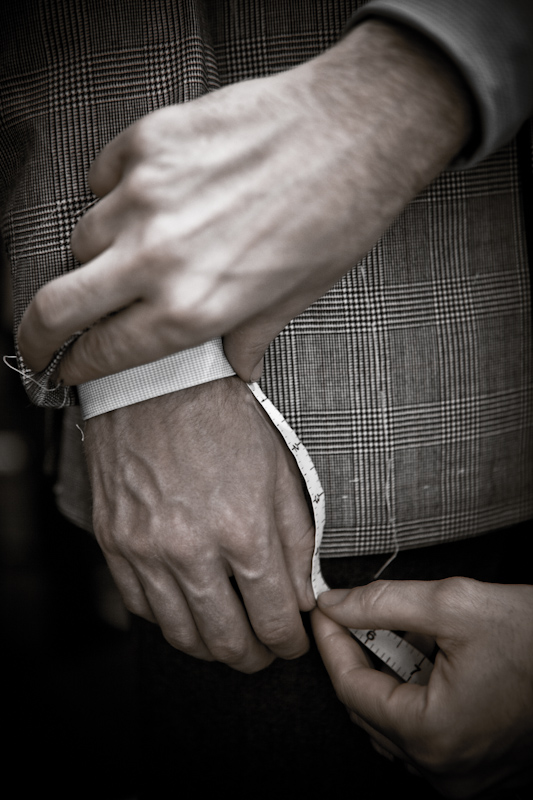
Today, a version without a coloured overcheck is usually referred to as a glen check, while one with an overcheck is known as a Prince of Wales. This is one part of the story I have specifically written before - when I had a suit made by Henry Poole in their version (a burgundy overcheck - top image above).


Returning to the shepherd’s check pattern, one step on was Coigach tweed (pronounced ‘coo-yach’) which later became the Gun Club check.
This was first woven by Johnstons in 1846. Its variation on the shepherd’s check was a pretty simple one - just turning the dark lines into two or more different colours. Estate tweeds often worked in this manner, creating small variations on each other.
The Coigach was navy and brown (second image above), with the same cream colour as a shepherd’s check behind them. Other variations introduced other colours, but there is usually at least one dark, one medium and one light, to retain contrast. Often if there is a fourth colour it is used as a larger check, a windowpane. My Ciardi jacket isn't a traditional gun club, but you see the use of an orange overcheck.
The modern name for the check came when an American gun club created their own version in 1874. The dominance of that name today is probably partly down to the size of the US market, partly the fact that Coigach is so hard to pronounce…


The next real change in estate tweeds was created by the 12th Lord Lovat, who designed one based on the colours of flora around Loch Morar - primroses, bluebells, sand, bracken and birch.
This was an homage to the landscape, but was also intended to be effective camouflage. The old shepherd’s checks had been pretty good in this regard, as their organic colours and small checks meant they blurred into the landscape. But Lord Lovat wanted to take it a step further, blending the colours into a single melange yarn - so there’s no real pattern, just a melange of colours.
The significant thing about this, at least from a menswear perspective, was that the lovat tweed birthed many of the browns and greens we now associate with country clothing. From a historical perspective, it was probably more significant that it became the forerunner for khaki uniforms in the the British military, with Scottish soldiers being the first to wear it instead of the normal bright red. And versions of khaki have been used by armies around the world since.

I sometimes forget how history like this can affect the way you feel about clothing.
A connection to the way it was used in the past gives clothing an immediate authenticity, which is nice. But it can also inform how you wear it - you think differently about urban vs rural colours, for example, when you learn about how they were developed for that environment.
Learning how to dress isn’t just about standing in front of a mirror and trying combinations. It’s also about the culture around the clothes, which informs how they work, what impression they have on others, and at some level also how they look to you.
Thank you to Sarah Wilcock, the Archivist and Records Manager at Johnston’s, for her assistance and research.













I find these articles so fascinating, the origins of cloths etc, why they were developed and how they were used.
It will help me navigate what tweed I eventually select…
Wonderful article, thank you! I find it interesting how very recent the development of these cloths seem to be, quite different from how I imagine it. Is there potential for an article covering the more distant past perhaps?
Sure, though most definable tweeds are quite recent. Even tartans are more recent than most people think – some patterns existed for a long time, but they only became vaguely associated with weaving areas in the 17th century and then became what we know today in the 19th century, like these tweeds
Thanks Simon – I really enjoyed the article and was perhaps also a little surprised with quite how recent some of the more widely known designs are. This probably isn’t helped by inaccurate historical depictions – the most infamous being of course Braveheart (directed by an Australian, shot in Ireland) where they are shown marauding in tartan in the 13th century……………sacrilege!
Can we do a best/worst of 2025 thread/article?
Sure – was thinking just today about whether we should do our usual Awards again actually.
Best/worst of what things? Brands, products, looks?
Hi Simon. Yes, Best brands. Looks, products. One of the things that I loved about this in the past is the smaller guys that have been introduced by that thread, people I have grown to admire, buy from and become friends with, all because of the great work that you, and the PS staff have done. So maybe some awards for smaller people. Last year, I mentioned Joe Holsgrove in London, Dan Levy in Paris and I would add the legendary Malcolm Plews to that list.
OK, thanks Andres. Yes we’ll definitely plan to do it some time in January
Lovely article, thanks!
I also appreciate learning about the historical context and development of patterns and cloths. Educational and inspirational!
I have the book mentioned in the article. Do you know where such tweeds can be sourced? The usual suspects seem to have a very similar offering and I’ve never seen Johnstons tweed offered for bespoke
No, they’re looking to bring it back but even then there probably won’t be much offered by the cut length. It’s just such a hard market to start offering a new range in.
Most of those tweeds aren’t available by the cut length either, as they’re just woven by special order in bulk, for the estates.
Best article you’ve done in the last several months!
Agreed!
From what I’ve seen online and traveling it appears to me that simple shepherds check isn’t as popular as houndstooth and glen check these days. Is it used more in the UK countryside? I’ve considered for a while to order either houndstooth or shepherds check jacket but haven’t quite figured out which one would serve me better. There’s this photo of an upstanding gentleman in shepherds check jacket from the 1940’s that I think really demonstrates how timeless a sport coat really is.
I think a shepherd’s check is a little more unusual these days, and a little plainer in that there’s so little going on. But if it’s just two colours then there’s not much difference between that and a houndstooth, and as long as the shepherd’s check is small it could also be quite subtle, quite modern and versatile. I particularly like the kind of natural colours here – basically a light cream and a very dark brown, rather than black and white
M, hilarious, yes, I believe that is the gangster Bugsy Siegel. For what it’s worth, I had a three open patch jacket made from one of the W. Bill Vintage Shetland Tweeds–I think it would be considered more of a gun club check rather than a shepherd’s check–but no matter. It reads similarly. It isn’t classic black-and-white, it’s sort of ecru and maroon and green, but mostly it just looks like Bugsy’s jacket. I thought my choice might be too bold, but it is really more classic than anything. I enjoy wearing it and I’ve gotten many compliments from strangers. I think people are just not used to seeing stuff like this anymore. I say dive in. I don’t think you’ll be sorry.
Thanks Rogey. Good to hear you don’t find it too bold, that was one of my concerns. I know I’m comfortable with donegal herringbone and windowpane so it should work. Something in me just wants to experiment with shepherds check even if small houndstooth would be bit more predictable for me. I think I’ll go for light cream/dark brown like Simon suggested to take the edge off and make it more versatile.
So you can get a sense of it, the swatch is WB12472 on the Harrison’s of Edinburgh site. It’s basically the same scale as the Coigach.
A fascinating article, Simon. I was totally unaware of the reason khaki became the normal choice for army uniforms. so that was particularly interesting.
On a totally unrelated subject, I recently bought a new navy overcoat (the British Warm from Cordings), and the lovely fresh colour is showing up my navy reefer, which looks quite faded beside it, although it’s otherwise in very good condition. Is it possible to refresh the colour by dying it, or should I just give up and buy a new reefer. If it’s possible, do you have any recommendations regarding who could carry this out? Many thanks.
Oh good Ian, lovely to hear.
I think it’s unlikely that could work well on the reefer I’m afraid. I think you’re better off finding a new home for it and getting a new one. I presume you’ve tried brushing it and having it cleaned? Often keeping a material like that clean and brushed makes quite a big difference to the colour
Thanks Simon, I’ll give the cleaning a go, and then depending on the results, maybe decide whether to give myself a late Christmas present!
I love Tweed. It would be interesting to have a more in-depth discussion of tweed patterns. Their origins, and so forth.
Understandably, tweed designs are likely limitless, but it’s nice to think about when one isn’t doing the laborious research necessary for such a feat and expecting others to do it.
Great intro for a very storied wool.
Any insight on houndstooth patterns?
So these are mostly actually houndstooths – if you look at that image of the shepherd’s check, you can see that the twill weave of the intersecting lines creates that houndstooth shape every time there is an overlap.
Houndstooth on a larger scale, more as a piece of fashion, came rather later. The Prince of Wales made in popular in the 1930s and fashion brands started using it in the 40s, particularly Dior I believe.
A really enjoyable read. On your last point, as to how the history of a cloth or garment might affect our feelings towards it, I wonder if you have listened to the most recent ‘articles of interest’ series from Avery Trufleman? It reaches a similarly aligned conclusion, albeit connected to the role of the military in shaping contemporary fashion. Worth a listen for any interested PS reader, I would think.
Thanks Morgan. I listed to Avery’s podcast quite often but no I haven’t listened to that one, I’ll check it out
Hi Simon –
Do you know who makes Johnston’s balmacaan coats? I assume they use their fabrics but outsource the production to another company.
I don’t I’m afraid, no, though as ever I’d caution against concluding too much about quality etc if you did know the maker
“The oldest pattern is the shepherd’s check, which was used for the ‘maud’ or plaid that workers wore for centuries”
Very interesting. Do you know which garments the workers wore in shepherd’s check?
The main one was the maud, as shown in that image of Hogg – a long and wide scarf that was wrapped around the waist and shoulders, but could also be a multi-use garment to use as a cloak, or cover the head and provide shelter. I don’t know what other garments the check was commonly used for
The forerunner for Khaki actually came from the sub-continent. The word itself is derived from Urdu, meaning dust and refers to the brown color. Was adopted by the British-Indian army fighting in the Afghan Frontier after their redcoats were easily picked up by sharpshooters. The first regiment to do so was the Corp of Guides, a regiment that fought regularly there. It soon spread to and was adopted by other regiments, including British ones.
Thanks Kali. Yes I’m aware of that origin too. The two things seem to have happened at almost the same time in the 1840s and 1850s. The creation of the lovat tweed predates the adoption of khaki in India (1845 as opposed to 1846-8) but the lovat version wasn’t used in the army until 1859. Perhaps Sir Harry Lumsden in India was aware of lovat and that influenced his move. Perhaps Lord Elcho was aware of khaki being used in India when he brought lovat to South Africa, replacing red uniforms there. These things are often more complicated than a single story. Elcho does seem to be credited for making that colour compulsory across the whole army by 1902, starting with his London Scottish Rifle Volunteers wearing lovat.
Anyway, if you know more or there’s a historian out there that can untangle it a bit more, do let us know!
Fascinating!! Thanks, Simon.
I want to add my appreciation of articles like this. The how and why of how we got to enjoy the pleasures available to us only enhances the experience.
Hello Simon,
This is a very informative article and an excellent read.
Although not a traditional color combination, the most appealing gun-club fabric I have come across is the jacket shown by Manish in several articles. What likely enhances its appeal is Manish’s charisma, combined with the fact that the jacket fits him exceptionally well.
https://www.permanentstyle.com/2024/02/manishs-bespoke-lessons-picking-cloth.html
Wishing you all the best for the New Year.
Pleasure Adrian. Yes, we can’t all have Manish’s charisma! I do like that jacket, and it works very well on him
Great article indeed, thank you. Maybe an article on the relationship between tweed and tartan (if any…) would be very interesting?
Happy New Year everyone!
Yes, sure. Briefly though, tartan is older in terms of its development into types and patterns like this, but was mostly associated with regions of weaving rather than clans – that came later when Scotland became fashionable under Queen Victoria.
Tartans are also much less tied to a type, a quality of material, though they are still usually wool. They’re done more in worsted than woollens though (and tweed is woollen)
Thank you!
Thank you for this wonderful piece on Scottish tweeds. I do own the Scottish Estate Tweeds book published by the Johnstons. It has many colour photographs and is very educational for those interested in the subject.
Being a military history buff, I do have one question, though: The origins of khaki, as I have read about it in multiple forums and books, are in northern India, where the colour provided camouflage for the Indian Army against tribesmen during the frontier wars of the 19th century. Tea, as well as the mazari plant, have been implicated in the first dyeing process, where white cotton drill was dipped and stained to create a dirt-coloured cloth that was named khaki, after the Persian/Urdu word for mud or dust (khak).
Whether the Scots simultaneously decided to outfit their regiments with the Loch Morar style tweed is perhaps an open question. I’d be curious about the connection between the adoption in the UK and the nineteenth century invention of khaki in India. My information is that the Indian Army adopted khaki officially for the Corps of Guides in 1846, whereas Lord Lovat, developed the tweed that bears his name in 1854. So it’s close. But I may, of course, be wrong in this.
Hi – this is discussed in comments above, please have a look
Dear Simon Crompton,
thank you for this wonderful post! It ist very interesting for someone like me who is a fan of the traditional british clothing/stile (maybe with a modern twist). I appriciate your great blog a lot, although I’m just an poor second-hand-shopper in southern germany (Freiburg).
Claus from Freiburg/Germany