

Imagine how delighted I was, dear reader, to find that a subject I wanted to write on - etiquette in clothing behaviour - exists on a sliding scale of commonality.
I love a sliding scale. Whether it's formality, colour or craft, I love explaining how a question that is often treated as binary is better understood as a gently shaded spectrum, on which we all sit at different points at different times.
Etiquette is similar, because manners are all about being considerate and respectful to those around you, so what’s considered good manners depends on those people. (Just like the question of whether you dress for yourself or others.)
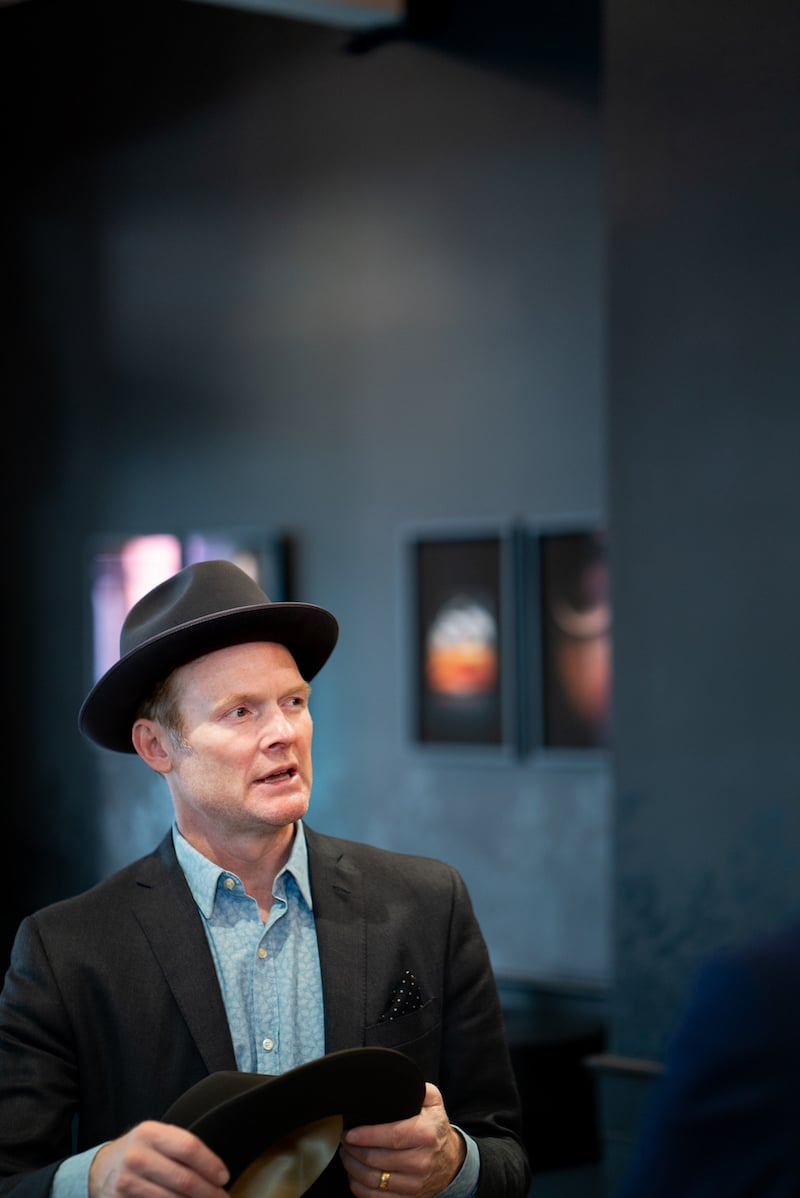
Personally, I hate it when people don’t take their hat off indoors. It partially obscures their face, making it harder to talk to them; it feels like they've still got on a piece of outerwear, and so might get up and leave at any moment; and it just feels odd, out of place.
As you have now been primed to notice, some of those reasons are objective, some very subjective, and some depend very much on the society around us.
It’s a matter of our era. I think most people today would notice if someone kept their hat on at the dinner table, but they would have cared much more in the past.
And it’s a matter of location. A friend in New Mexico told me recently that where he is, western hats are definitely kept on during meals such as Sunday lunch. In fact the more formal the occasion, the more it’s required.

Still, removing your hat off indoors is a fairly universal point of etiquette. Most readers will probably agree with it - it sits towards the common end of the sliding scale.
What’s at the other end? Well, a reader once castigated me for carrying my brimmed hat with the crown pointing inwards, rather than outwards. I was holding it at my side, and because the crown was pointing towards my thigh, the inside of the hat was exposed.
The scandal.
I had never heard of this as a rule, and so I’m fairly confident it’s rare and rather antiquated. I guess I can see the logic - most of our clothes hide the lining and don’t deliberately expose it, in the same way shirt fronts used to be considered underwear and would be hidden by a waistcoat and jacket. That kind of thing could apply to a hat; but it’s a stretch.

If those two might be the extremes, what sits in the middle?
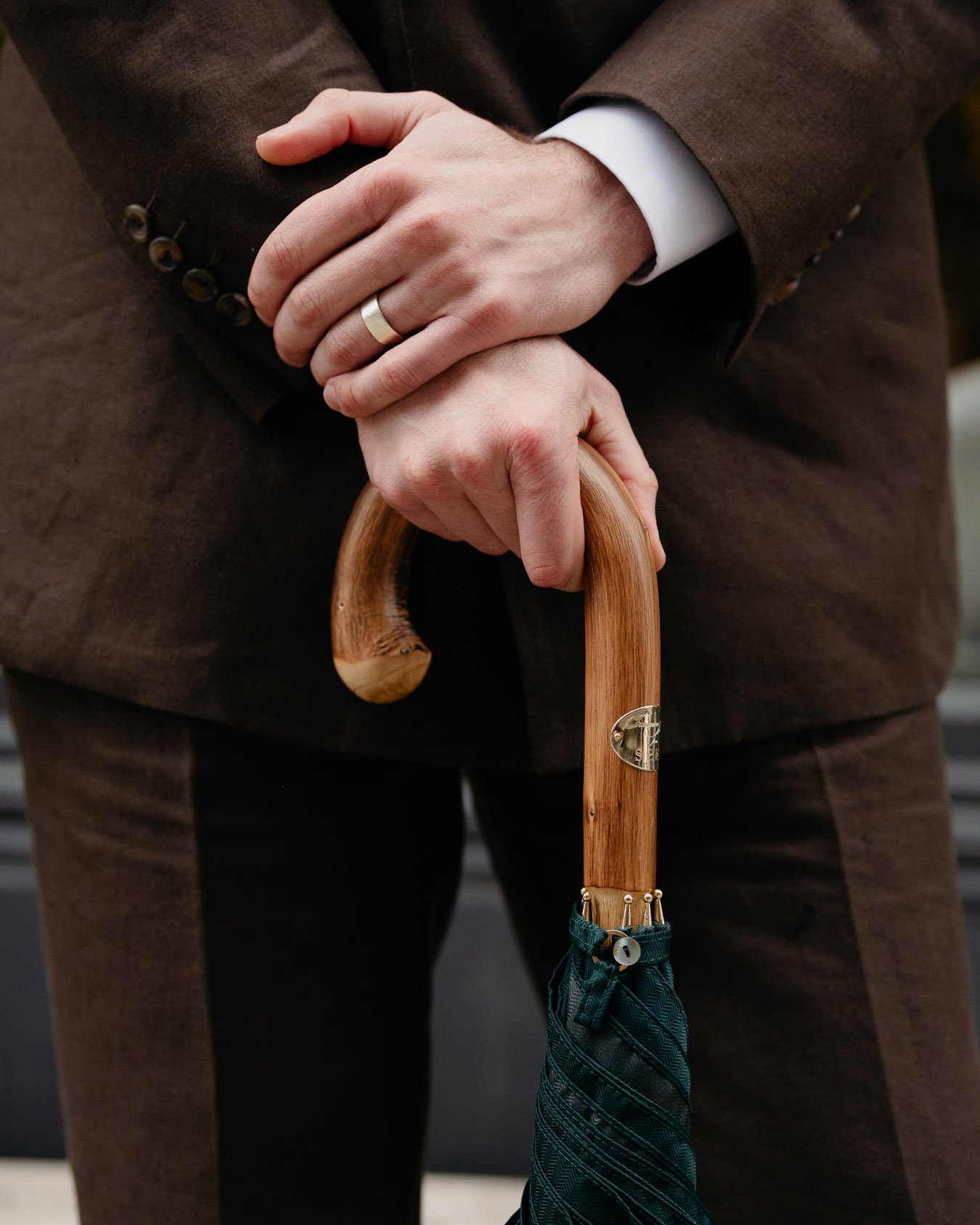
I know there’s one rule than an umbrella should be held by the handle, particularly when walking. I can see how this is more elegant and more practical - your hands are less likely to get wet from a damp canopy.
But, it’s something I rarely do because if I carry an umbrella like that, I feel formal and old-fashioned, as if I should also be wearing a bowler hat.
Much as I love tailoring, I try to wear it in a fairly casual way in order to make it less showy in a society where few wear a suit and tie. For the same reason, I try to avoid accessories (such as an attaché case) that would hinder this. An umbrella carried like a walking stick is in that vein.
So I don’t follow that rule, practical as it might be.
There aren’t actually many rules about the way you wear clothing (as opposed to what clothes you wear - lots there). So it’s hard to string enough together to make a continuous scale.
But I think readers will know what I mean. Manners at the dining table are similar in a way.
When I tell my children not to talk with their mouth full, it seems reasonable, as the sight of half-chewed food is so disagreeable. But it’s harder to convince them that you should never put your elbows on the table. And impossible to argue that soup should be scooped from the far side of the bowl rather than the near. There's a sliding scale there from more instinctive and universal, to less.
Perhaps like the rules about what clothes to wear, the key is understanding why the rule exists and then deciding whether to follow it. Keeping your elbows off the table will usually improve your posture - how you sit - but it’s probably more effective to keep that in mind rather than just focus on the elbows.
As ever, I’m interested in what readers have to say on the subject, but I’m particularly interested in what rules of etiquette you follow and how much you think that’s dependent on where (and when) you live.










I always take my hat off when going indoors. No matter the type (formal hat, beanie, cap etc) The same goes for sunglasses
Makes sense for sunglasses, because otherwise people can’t look you in the eyes while talking to you (and you might walk into a doorframe due to poor vision). But “take off your hat indoors” is easy to say for someone with no hair; if I wear a baseball cap for more than an hour, especially in summer, then my hair is probably sweaty and messy underneath said cap, so I’d rather just keep it on.
But presumably you might feel a little different if you thought it appeared a little rude to others?
I do get your point. However, I do have hair, and truely hat hair is not the most flattering, so I always quickly check that the hair is not too messy
I think this is valid. Manners (as opposed to etiquette) is about behaving in ways that are respectful to others, and this is a subjective thing, dependent on personal circumstances and situations. Manners trumps etiquette, IMO, in situations where rigidly following rules might lead to others being uncomfortable.
Great topic!
I’ll be in London in May and I’m struggling between the wider extremes of a fedora and a more modest racing trilby, both in brown. I want to. be able to snap the brim down, racing style. My coat is dark navy but could be brown covert (CORDINGS)
Do I opt for a trilby then?
Would a charcoal colour hat be better.
Bates or Lock hatters?
I’m sure you’ll be aware that it’s a fairly modest difference to most people, but to those that care it is a dilemma when you’re not going to bring more than one hat. I’d suggest brown might be more versatile, and perhaps a trilby. But of course it depends on the formality of what else you’re wearing too
Between the brands I’d say try Lock
Lock & Co. Every time.
Personally I go by taking my hat or cap off in private spaces. I’m not going to take it off when I enter a shop to browse just as I wouldn’t remove my coat etc. If I’m in a café or restaurant unless they have a coat/hat rack (and the only café that I went to had had one decided to remove it during covid and never bring it back!) I’ll remove it at the table.
Exactly. I once had to explain the rules for chapeaux wearing to a lady maitre’d who (rather rudely) requested I remove my hat before guiding me to our table. A restaurant is a public space; a dining table is a private one.
I remember reading a book about the US in the 20’s that mentioned that you took off your hat inside an elevator when there were women present, but not if it was an elevator inside an office building.
In the US (where I reside), yes, the rule once was to remove one’s hat in an elevator when women were present. There is a scene in the series Mad Men showing such a custom. However, Mad Men was set in the 1960’s, during which the habit of men wearing hats–I mean dress hats, compatible with suits–was fading, and rapidly. Now, 98 percent of men wearing hats are wearing ball caps, or feed caps, as we call them in the midwest. These hats remain stubbornly in place outside, inside, at almost any type of occasion. I have seen men wearing feed caps in exclusive restaurants, in churches, at weddings, christenings, in offices, law courts, you name it–and of course, elevators. Never doffed in the presence of women,
By the way, what elevators are NOT inside of an office building? Never heard of that distinction.
Hello!
I understand that it was generally considered polite in western culture to wear a hat out of doors, and, to coincide with this, polite to remove it in most indoor settings.
It surely follows then that the only people who have any basis to complain about people not removing their hats indoors are those who always wear hats when they are outdoors.
Thanks Sean. Do you not think it looks odd at all indoors, or makes a functional difference to how you interact with people indoors?
Personally, I wouldn’t wear a hat/cap when eating in someone else’s house or at a restaurant. But I won’t remove it necessarily in a pub or cafe or if I stop at someone’s house for a short period of time. I agree that it can show disrespect to other people in certain circumstances, but so can a number of other things (shorts when you’re not at the beach or exercising, t-shirts in restaurants, etc).
My point is meant to highlight the arbitrary ways these rules endure or don’t. And how it’s irrational the way this rule in particular gets people going, when others which seem egregious ( t-shirt, which are basically underwear are fine it seems in pretty much every circumstance) don’t.
I know what you mean Sean. I guess I think it is only slightly arbitrary, as it does get in the way a little bit and is also a little more obviously outerwear.
I’d say a T-shirt doesn’t really look like underwear today to anyone, by contrast. But shorts would be more noticeable
My personal red-line is… restaurants that require a dress-code. I rarely break this rule, it must be for something important (like a Roast Grouse), or if I’m someone’s guest.
It’s just completely unnecessary nowadays, and as the brilliant restaurateur Jeremy King recently observed, “80% of the troublesome customers I’ve ever had to deal with have been men in suits and ties. So what purpose does a dress-code serve?”
I couldn’t agree more.
And there, Tim, lies the dilemma. I have never seen Jeremy not wearing a suit and tie in one of his restaurants!
Mr King is always beautifully dressed. His observation has been widely repeated. If true, I wonder if it’s because a larger proportion of his patrons are better dressed than in many other London restaurants. Perhaps his establishments–both current and past– both inspire one to dress well and attract men who dress well. I write this as I’m sitting in the Ritz lobby about to walk down the street to Arlington for an early dinner. I’m a big King fan–I have reservations at Simpsons in a few days. (I just arrived in London from Los Angeles, where men who should know better routinely show up at the best restaurants–restaurants with unenforced dress codes–wearing baseball caps and tee shirts while their wives are dressed to the nines. A Hollywood wife I know thinks it’s a form of oneupmanship: dressing badly is a way of announcing that one is important and rich enough to say to the world, “I don’t care what the rules are.”)
Thomas, I hope you enjoyed the London restaurants. I really like Arlington, but the tables are far too close together. And your Hollywood wife friend is at least part right, although I think there’s more to it than a simple power play.
I have to disagree with you on this one.
Consistent with I believe the theme of PS one should always dress for the occasion. It would look odd to be in a flannel three piece by the pool as much as I feel it is inappropriate to wear shorts, sandals and some tatty colourful polo to a “fine dining” indoor restaurant setting.
How one behaves is to a degree irrelevant – I’ve been as guilty of being an obnoxious (read drunken and troublesome) guest in a t shirt and jeans as I have been in a suit and tie but that doesn’t result in an acceptance to gaze upon other’s slouchy attire when I’m out for a decent meal.
I had lunch at the Ritz once. As I approached the dining room, a gentlemen was being turned around and led towards the cloakrooms, with the discreet invitation to “choose which jacket you would like to wear for lunch, sir.”
Another time I was at a cafe in Monaco which happened to be opposite the Hotel de Paris. Some guy from another table, dressed in big shorts and a “holiday” type shirt decided he was going to “go and have a look around the hotel.” He climbed the steps, was immediately and bluntly refused entry by the doorman, came back and sat down.
We had it at the races once, we’d been told our enclosure was jacket and ties required for gentlemen and the one chap (normally very flamboyantly dressed) had decided not to. He was equally taken to lost property to select appropriate items. He said he’d ultimately selected on which smelt the least of vagrant.
Once in the enclosure most took them off without any issues being raised.
Personally I like it on occasion and do get slightly irked by the fine dining event with the guys in flip flops, t-shirts and shorts (often talking about how much they’ve spent – bragging not complaining)
The only time I’ve dined at Rules Restaurant in Covent Garden I observed a young man in shorts returning from the toilets carrying a pair of trousers. He handed them to a member of staff and left. I asked about this and was informed that their dress code does not allow shorts, so they keep some pairs for people to wear while dining.
People wear hats so rarely now that I suppose that the rules have somewhat been forgotten. With that the normal habits have been lost that automatically reflect and enforce the rule. If you look at older movies or read books from past times the convention was for people to offer to take your hat, or you put it on the rack, or you handed it to the hat check girl. Now you just get to stand there awkwardly like a living anachronism surprised by the passage of time or like you are trying to cover a stain on your trousers.
I suggest that another reason for not showing the inside is perhaps one you have not considered and is not simply related the lining as such. In olden times hats would have been worn daily and the rim would have likely been greasy from hair product or long use and the lining and rim would no doubt be somewhat worn and unsightly. There would have been good reason to hide this as one would hide a dirty collar.
What bugs me is when people don’t follow sunglass etiquette and remove their glasses so that you can read their expression and don’t feel like you are conversing with a botoxed fly.
Lovely image Richard. And yes I can see that on a hat’s inside
An opinion I hear a lot (not in clothes-loving circles I hasten to add) is that wearing a flat cap is somehow pretentious. A lot of this can be avoided by taking it off when you go inside. The kind of “characters” who make a flat cap part of their identity never take them off at all.
True
This topic is quite pertinent to me. In my late twenties I was diagnosed with Alopecia Areata. It started off with patches on my beard and then spread to my scalp. It was quite devastating at the time and I struggled with my self confidence. Losing hair or having it thinning can be traumatic for a lot of men but having patches carries a stigma that you’ve somehow suffered some mental health crisis or something.
I worked as a delivery driver at the time so I had no formal dress code to follow for work. I took to wearing a baker boy hat as I felt it was a style that suited me. I now work as a tour guide and continue to wear the hat, though ten years on from my diagnosis my patches have blended into a more ” normal ” look of male pattern baldness. With a wife and two young kids I also dont have the time to worry so much and a lot of the vanity I had in my twenties and thirties has gone. I do still have insecurities though and a short while ago I was chastised in a Cathedral by an elderly volunteer who mentioned something about removing my had in the house of god. I got it. But part of me thought would god be that bothered…are there not bigger issues. I did take my hat off though but left the Cathedral a few minutes later whacking my cap back on my head with a feeling of comfort and familiarity.
One thing I do sometimes get is people suggesting I’m trying to look like a wide boy or a peaky blinders character. I deflect from this by reminding people that in Wales where I am from a flat cap or “Dai” cap was worn by most men for generations and I do feel a nice moleskin, tweed or linen/cotton cap is smarter than a lot of other alternatives.
I’m aware this is a long post. Thanks for the opportunity to speak about it.
Wearing socks by default! This is is an extension of the point Simon brought up previously about wearing a socks when you have a tie on.
I would actually go a step further and say that we should be wearing the appropriate socks, dressy & fine or casual & sporty in most instances.
Choosing to go sockless or wearing invisible socks should be a much more deliberate and conscious decision, where the rest of the outfit is both 1) inherently summer/hot-weather focused AND 2) casual.
Gosh, this is a topic! Yes, my children and their refusal to follow table manners and especially not holding a knife like a pen (for some reasons triggers me!) along with no elbows (or screens or phones) on tables at meal times.
Taking sunglasses off when you first start talking to someone, taking a glove off to shake hands, no chewing gum, taking your empty glasses/coffee cups back to the bar…
Would folk still be offended by turn-ups on trousers in a formal setting? I rarely go to formal events so can’t speak from experience.
I doubt it Rich
I suppose if wearing a casual hat in casual surroundings, say a coffee shop, it may well be best to keep it on since you are far more likely to leave with it. However, aside from that the usual reasons for wearing a hat have everything to do with being outside and almost nothing to do with being inside.
True GH. Though I feel if we go down that route we’d probably have to keep our coat on and grip our umbrella throughout as well!
Remember, the rules on hat wearing come from the days when men commonly wore hats with suits, no coat required!
When one leaves the table, even temporarily, one should always push the chair back in. As a restarateur, I’m seeing less and less of this.
HI Simon,
I have never been one for swearing, at least not in public, and it’s never been something I’ve had to consciously avoid. While I like to think of myself as fairly progressive in many respects, this is one area where I’ve remained (old fashioned?). It’s a personal choice,
That said, I do sometimes find myself taken aback by the casual use of strong (in the 1970’s it was called “coarse”) language , particularly on public transport. On a Saturday morning journey into London, for instance, hearing the harshest expletives spoken within earshot of families and children does make me recoil a little.
Perhaps it’s simply a matter of habit, but I know that if I were ever to start swearing in company, those who have known me for any length of time would assume, correctly, I’d been taken over by an alien being..
I absolutely love swearing, but also wince when someone does it in front of young children, or elderly people. There’s a weird class element to it that runs opposite to most etiquette – someone more working class is usually more likely to find it offensive.
For me the rules are:
1. Never swear directly at someone, unless they’re a close friend.
2. The C word should never be used about women.
3. (I read this in a Cathy Rentzenbrink book): “you diminish its (swearing’s) power if you use it too much. Get rid of the bloodys and the damns and treat yourself to the occasional c***”
The more pressing question is: Is it still possible to wear a hat, indoors or outdoors, without looking somewhat maladroit?
My attempts at wearing a Panama hat, a flat cap and a baker’s cap were met by my teenage daughters with incredulous looks and comments such as “Please take that off”, “Don’t do that in front of my friends”, “Are you serious?” and “You look like your grandad”.
They are not entirely wrong. With everything except a baseball cap and a beanie in winter, I feel very self aware and costumey, not comfortable. At an Italian beach bar, a pool or on the beach in summer, I might also be able to get away with a very worn straw hat, but I haven’t yet found one that’s casual and ‘cool’ enough (my panama hat is too formal)… same with a watch-cap in winter probably. But that is probably about it.
It’s certainly a bigger and harder topic Markus. We have talked about it a little over the years, but perhaps we need a dedicated article
I’d appreciate that. I’m going bald and need a hat in winter for warmth and in summer for sun protection. But I have a relatively small head and very few hats look good on me.
I wear a relatively small hat size (68 1/2), and have a collection of dozens of hats in many styles, including fedoras, trilby’s. various flat caps, baseball caps, fishermen’s caps, outback hats, Panama hats, even a Ushanka. (The only hats I don’t do are Western hats, and boating hats.) I’ve had more compliments wearing them than I can count, from all types of people. Consequently, I don’t think head size has much to do with whether a hat looks good on the wearer, any more than shoe size or jacket size would. What does matter is matching the style of hat to the rest of the outfit and the occasion.
[Sorry, head size should read 56 1/2, not 68 1/2.]
I’d appreciate a dedicated article. I recently bought a 1960s straw hat, and I’m experimenting wearing it in different situations. However, especially as a young guy, I think it can easily come across as anachronistic or costume-y. It’s a topic I’d like to read more about
Ok, good to know Ryan
Just wear it. It will soon become a part of your normal wardrobe and the self-consciousness will pass.
Thank you, Simon.
On a related note: as my hair is blond and thinning, a hat has become a functional necessity in summer to avoid sunburn—whether at a beach club, a Viennese rooftop bar, a garden / park gathering. So I do not necessarily want to wear a hat / cap, but I have to. This is a challenge that possibly resonates with many Permanent Style readers who find themselves needing protection without wanting to compromise their aesthetic.
My typical attire for such occasions is understated casual-chic: linen shirts from Luca Faloni or Frescobol Carioca, knitted polos, sometimes even knitted t-shirts, casual linen trousers from The Anthology or Rotasport and casual suede loafers, espadrilles or even cotton sneakers (e.g. Doek). My objective is to be well-dressed in a way that is felt rather than overtly noticed, avoiding any sense of being ‘over the top’ or having jumped out of a fashion-magazine.
This leads to my hat dilemma. A standard baseball cap is stylistically rather incompatible, going to much into the direction workwear, yet traditional Panama hats or flat caps often feel dated or like a costume. Similarly, Trilbys and small-cramped Fedoras do not bridge the gap even if menswear magazines write that they are more modern; for me they are in the same category. Conversely, tailored bucket hats strike me as too fashion-forward; while they may suit a thirty-year-old in London or Paris, they feel out of place on a fifty-year-old professional.
An article addressing this specific low-key ‘middle ground’ of headwear would be extremely valuable. Though, I am not sure that there is a solution. I have not found one so far.
Thank you Markus
A well made, quality Trilby or Panama seldom looks out of place with tailoring, i/m/h/o.
I tend to disagree. When paired with tailoring, a hat straw-hat looks even more dated for me than it does with casual-chic outfits. In fact, my favorite looks with a straw-hat as found on the internet are those where a guy wears shorts with a long-sleeved, untucked linen shirt—perhaps with a band collar.
Hi Markus, given the other items you listed, I personally think your best bet is some kind of straw hat. I am in my mid-thirties and still have a good amount of dark curly hair, so wearing a hat is still a choice for me. But I have a wonderful old Panama that used to be my dad’s and it’s exactly the right level of thrashed to look great with a pair of olive The Anthology drawstring linen trousers and various shirts/knitwear options on top (at the moment I am really looking forward to pairing it with my new washed black LEJ quick release plage coat this summer). I would recommend you to take a look at this post https://putthison.com/the-easiest-to-wear-of-traditional-hats-a-lot-has/ Especially the last image near the lake in the series of images is the kind of look I would try to go for based on what you are describing. I also agree with Derek Guy that it helps if the hat is slightly darker, as I also have a slighty lighter Panama and it looks a lot smarter. The man in the image I am referencing (I think it might be George Wang) is also using subtle tricks like turning the brim down in the front to make it look more casual (I tend to do the same with the back brim). A true Panama feels really “wide” at the beginning. But the effect tends to go away as soon as you wear it for a bit (though I think the rest of the look should also be rather “loose” to balance the proportions – no slim chinos/polos). I hope that helps!
Thank you very much. That sounds helpful.
I find hats tricky, inasmuch as very minor details in size and shape seem to make a huge difference to how they look on me. The flip side is that a hat in a style I think “doesn’t suit me” might actually look great, so whenever possible I’d always try and buy in person, or be prepared to return online purchases.
For the kind of smarter informal territory you describe I’d still in the first instance look for a straw hat – as mentioned in other comments, rougher and in darker straw helps it look less formal, but even smarter panamas work well once they’ve been knocked about a bit. IMO flat caps look less costumey than baker boy styles – I’ve had them in nice slubby cottons or linens before.
Another option to try would be something like the AWMS correspondent’s hat, which I guess is not a bucket hat but more of a pork pie style (in a cotton herringbone twill)? Possibly a bit on the workwear side of things, but it works well with ivy style outfits – and survives being stuffed in a pocket or bag better than most straw hats.
I’m a 60 year old baldie and huge hat enthusiast.
I wear hats of all types all year round for warmth in winter and sun protection in summer (Melbourne Australia).
I say absolutely go for it – in winter a nice oversized baker boy cap in tweed or wool is an elegant accompaniment to an overcoat and a far better option than the multitudes that wear beanies with their coats here in Australia.
If you like workwear or denim fits for casual a stetson open road or it’s akubra camp down equivalent look fantastic.
Embrace it.
I don’t see why wearing a hat should be considered “maladroit”, as hats are supremely practical, providing protection from rain, sun and cold. Wearing the wrong hat for one’s attire or the occasion is a different matter: ball caps are just wrong with tailoring, as are fedoras with shorts. But that’s no different from other, basic style rules.
Hats are indeed very practical, but whether they appear odd or not is mostly a question of those around us, not something we control.
I agree the right hat looks great and is very useful, but wearing one is not simple and while I think it is good to push people to try things, and indeed try for longer, just telling them to do so isn’t particularly helpful I don’t think, and can be a little condescending too
Hi Simon, Fascinating reading.
Whilst some things seem a little eccentric or an anachronism I would suggest at the macro level it’s about being polite and having good manners and cascades from that behaviour. For me, standing when a woman enters the room for the first time and definitely when joining you at the dining table. 100% agree on children’s dining habits.
A big no for me is baseball caps worn backwards unless you’re a sniper or hunting (where I think the practice arose) or below the age of 15, otherwise it’s just silly.
As always interesting.
Btw following from the Stone Island piece from Tony I am pondering a CP Company jacket on Vinted.
All the Best
Why would you stand when a woman enters the room? She might think you’re about to attack her. Very anachronistic
I wouldn’t think so. You don’t jump up! Just gently stand. And to be clearer, only on first meeting. It’s a gentle form of politeness.
I think that’s the point of the discussion exploring differences.
“A big no for me is baseball caps worn backwards unless you’re a sniper or hunting (where I think the practice arose) or below the age of 15, otherwise it’s just silly.”
Well said.
I’ve just taken up photography and have found myself flipping a baseball cap backwards to take a shot because the peak interferes with the camera.
I wonder what the real menswear photographers’ take on that is – an acceptable extension of the rule applied to snipers and hunters?
What you describe is a practical approach, like hunting. I’m sure there are others. I meant just people on the streets trying to be ‘cool’.
Another example may be wearing a beanie hat indoors if one is cold a practical application rather than an affectation.
One of my biggest pet peeves is having a hat on indoors, especially if it’s in a restaurant. A few weeks ago my wife and I were in a restaurant and I counted 20 men with hats on and one young woman with her feet on the table. In a restaurant. Maybe I’m just old but I feel that it’s a sign of disrespect.
Thats sounds wild, haha 😀
Here in Rome, a man wearing a hat in a restaurant is how we identify Americans. A woman who removes her hat in a church is how we identify non-Catholics.
My favourite “Americans in Rome” moment was overhearing one in the Forum explaining loudly to her friend that it was built “in the Romanesque style”
Brilliant
Hello Simon,
I didn’t knew about the rule of towards where a hat crown should point, but that’s definitely something I would be doing naturally.
It’s not just the lining (that isn’t meant to be shown, unlike the felt) but the sweatband, probably brownish from grime and age. Not something very polite to display to others….
Great point!
I agree; it’s just part of basic hat etiquette, like never placing a hat on a dining table.
When I enter a room, I usually take off of everything BUT my hat.
Pictures please
Nooooooo! lol
I’ll take the opposing side on this one – I wear a hat all day and am delighted that in the main no-one cares anymore. Primarily for comfort/warmth, being bald. Something soft and light in cashmere like the PS watch cap, is perfect.
On etiquette more generally though, I’d have to agree – everyone that’s a stickler for it (particularly table manners and dress) is breaking many rules they don’t know about; so if there isn’t any aesthetic or functional value that everyone at least recognises if not agrees on, it’s often reactionary and silly. Like showing up to a hotel in a tie just because that used to be the norm. Etc.
Proper hat etiquette has more to do with basic politeness than with aesthetics or functionality.
There seems to be 3 main reasons for etiquette I’d say
1) It’s considerate / kind / respectful – e.g. holding a door open for someone, standing up when someone arrives at the table.
2) Tradition – it’s the “done thing” for some reason and people like to respect that, or it’s fun to keep to tradition – e.g. passing the port, toasting etc.
3) A social language to potentially exclude – the least worthy of all. Those “in the know” or of a certain social class can keep to the (often impenetrable and illogical) rules and anyone who doesn’t can be recognised and looked down upon as not part of that “set”.
I’ve certainly seen all of those rules in practice over the years.
A very thought-provoking post! I’m also curious about how menswear etiquette translates (or doesn’t) across cultures. For example in many regions (South and East Asia), removing one’s shoes is the norm when entering a home or a place of worship. Wearing visibly battered socks, however, is considered poor etiquette.
Another etiquette question: I was raised to believe that gloves must be removed when shaking hands. I still do this and understand the principle, but I wonder how relevant this still is?
Oo, that’s an interesting one, thanks Rob. Yes, I don’t think people really do that with shaking hands at all
I do that when shaking hands and I would even put it on par with taking your sunglasses off when meeting someone.
I always remove gloves for shaking hands but dont always remove my shirt for a hug.
Spoken as a Canadian, I wouldn’t recommend either when outdoors and it’s twenty below.
I usually take a glove off when shaking someones hand, unless I’m surprised and the other party is offering a gloved hand. Shaking hands is a ritual and if it’s worth doing, it’s worth doing properly. Aside from that it feels empathetically wrong for me to offer a gloved hand, like I’m showing lack of respect or that I’m not valuing the other party. On the other side I don’t feel offended if a gloved hand is presented to me as long as there are is no other dismissive body language accompanying it.
Personally I love showing small signs of consideration and I do feel they are well received, for example holding a door often gets a positive feedback. I think it’s important though not to go overboard and be too stiff about them. It’s about showing the other person that they are being seen, respected and appreciated.
On a slightly different note. A cigar smoking friend who used to work in the cigar business told me it’s bad form to leave the band on the cigar in the company of other cigar smokers as it’s considered competitive.
Haven’t read the comments yet. This is a topic in which former military men are well acquainted. Though common sense rules, military men learn early in their journey how instantly executed punishment for breaking these attire rules is wonderful for lifelong adherence. In a school environment we get corrected by our peers, junior and seniors alike for what are obvious infractions. We end up being thankful for being held to account, and the mistake doesn’t happen again.
Then we look at other grown men (non military background) breaking these common sense rules and we’re mystified how they could be mature adults and make such basic mistakes.
Best,
Robert
The acceptability of wearing hat indoor will depend on the circumstances. For instance, if you are shopping in a shopping mall, I don’t see it a problem that a hat is worn. Obviously, wearing a hat inside somebody’s house at a dinner party would be discourteous.
The type of hat is also of relevance to this discussion. If it is a kippah or turban, I would say it is inappropriate to suggest that such hat should be taken off indoor.
Yes, good points both
Also, some “indoor” spaces are different than others. I think it’s acceptable to wear a hat in a train station or even on a subway car, but I don’t feel comfortable wearing one in a shop or cafe unless I’m only in there for the briefest of moments. A grocery store? I’m not sure. In the courthouse where I practice, men are allowed to wear hats in the elevators and hallways, but not in the courtrooms themselves, unless it is religious or cultural attire.
Well put and couldn’t agree more: “a question that is often treated as binary is better understood as a gently shaded spectrum, on which we all sit at different points at different times.”
Great article.
For hat etiquette, I’d suggest it’s also a spectrum with some caviats. Falling into:
At one end – public spaces (i.e. shopping malls, outdoors) – hats on are acceptable.
Middle – third spaces. For example, indoor sporting events like hockey or basketball where hats are encouraged and other more institutional spaces where hats are discouraged (i.e. schools, City Halls, etc.). Mostly the balance for the hats off requirement is a matter of respect and / or intimacy.
Private spaces – homes. No hats.
There are some overall exceptions such as hats off for a national anthem and other occurances to show respect.
Elbows on the table, I thought, was rooted in practicality around not wobbling a table and knocking food off (which still is a consideration in some cafes and patios). I was taught, after and between courses elbows are acceptable.
Shoes off in homes is personal preference but I’ve noticed that the American tradition is that clean shoes in the house is okay but the more European tradition is shoes off but curious for other observations.
I’m sure like several others that have spent time in the military, even many years later I still automatically take off a hat as I step through a doorway.
It’s a Pavlovian reaction – less etiquette than self-preservation. Somewhere deep down I’m still fearful that a red-faced Sergeant Major the size of King Kong is just around the corner and ready to bellow admonishments at the first glimpse of a covered head indoors.
The funny thing is, this is so ingrained that even now when I see someone wearing a hat indoors, I get a momentary knot in the stomach on their behalf – only to quickly remember that we’re in Pret, it’s a baseball cap, and they’re probably safe from being yelled at.
What’s also interesting is how different units have different rules on this. I served in two regiments where there was no requirement to remove headdress indoors and the etiquette of saluting continued indoors.
Simon, have you ever seen the movie, The Philadelphia Story?
In an early scene, Jimmy Stewart, playing a journalist (and wearing a hat indoors), asks Cary Grant’s character, in regard to the Katherine Hepburn character, his erstwhile subject, “What’s her leading characteristic?” Grant says, in his way, “She has a horror of men who wear their hats in the house.”
Love it!
I adore that movie but haven’t seen it for years. Can’t believe I had forgotten that line
I read your post and thought of this immediately. It’s one of my favorite movies.
We Muslims don’t take our headgear (cap, turban, etc) off indoors or when eating. Actually it is part of ettiquette to have your head covered.
Sometimes we take it off when at home among family, relaxing.
While writing this comment from home I have a turban cap on, without a turban around it.
I suppose when discussing “hats” here, we’re not talking about the ubiquitous baseball cap? It seems nobody ever takes those off inside.
Oh no, we are Tim. That’s the main problem!
There is a video that occasionally does the rounds on social media which displays sub-conscious “hat etiquette”. It’s Ian Wright (ex-Premier League footballer) who removes his cap when he unexpectedly meets an old, well-respected teacher. It’s quite touching.
I’ve seen (strangers) remove their hats and bow their heads when a funeral car with a coffin goes past and concluded the act of removing a hat can carry great respect.
Dear Simon, there is an exception to this rule when the hat is an integral or even iconic part of an artist’s image. Joseph Beuys is one example. But Lemmy Kilmister of Motörhead and the German rock singer Udo Lindenberg also fall into this category. A hat by Mayser was even named after him. They are allowed to keep their hats on indoors.
I see what you mean Gerald, but I’m not sure I agree. They would still seem to be tied to whatever the social norms are, for me
I agree but it also applies to the hatmaker in the article. I for one don’t know the guy and should he keep his hat on in a place where everyone is taking it off, my first reaction would probably not be “oh, he must be a hatmaker, that’s so fine”.
Holding the umbrella by the handle is objectively practical, but also situational: in a crowded city, holding the handle keeps the tip pointed downward, making it almost impossible to accidentally harpoon one of your fellow pedestrians.
Also—at least as concerning for a person aspiring to sophistication—holding an umbrella by the shaft subconsciously registers as carrying a tool or brandishing a weapon. too workmanlike for a city gent (i imagine).
Interestinly, in east asian traditional cultures such as china and korea, before mens clothing got westernized, taking hats off indoors is actually disrespectful
Really? That is interesting, thank you
This may not have been obvious, but sometimes health concerns can necessitate a “violation” of some rules. I am 75, and my circulation isn’t great. What’s more, strong medication I take for late stage cancer has left me anemic and this means that I have to dress warmly in winter even when I am indoors. I wear a sweater on top of a shirt on top of a T shirt and I keep a flat cap on because I don’t have much hair left!. Occasionally, at dinner with friends, I mention the reason — since many of them know of my health situation, they are perfectly fine with my hat etiquette, or lack thereof. One must adjust to life’s little inequities, I imagine.
“Remove your cap in the Officer’s Club Major.”
“That’s regulations?”
IYKYK
I was once told that in the officer’s mess, if an officer walked for breakfast/lunch/dinner and kept his hat on when he took his seat to eat, it signalled that he wanted to be left alone. Not sure of its veracity, but I like the idea!
I have lived it Texas all my life, and there is no occasion here in which it is acceptable to wear a hat (cowboy hat or otherwise) indoors, and especially not at a meal indoors. It might be overlooked at an outdoor picnic or barbeque. I question where New Mexico is different.
Just one anecdote Jim. Perhaps a specific group or place or occasion
One other rule, and it’s a rule not guidance, is that in golf, you take your hat off to shake hands at the end of the match. No exceptions.
Nice
And watch Rory 2025 and 2026
This topic reads as if it could be the subject of one of Harry Graham’s ‘Ruthless Rhymes for Heartless Homes’ if you or any of your readers can remember them. If not, I recommend ‘Mr Jones’ (very different from the Counting Crows song).
I get really annoyed when I see the way that (often young) people hold a knife and fork. It’s like they’re crippled with arthritis or are going out of their way to demonstrate how awkwardly it is possible to hold cutlery.
Still can’t wear brown shoes in London. Sad I know…
I occasionally wear a Herbert Johnson trilby given to me by my late mother-in-law, a very elegant lady in her day, who suggested I needed this very hat to complete my wardrobe. My brother says I look like my father even tho he died many decades ago, when I was 9 and my brother was seven, but we remember certain things about him. That aside, I do enjoy wearing this hat, and I tip the brim with my first finger and nod when I see somebody I know, raising my hat to a lady. Simple etiquette from a bygone age. If I say IYKYK I don’t mean to sound snooty or in the know in some quasi-Masonic way, but it is a wonderful way to present oneself to others
My Nanna used to say that there are only two kinds of people who wear sunglasses indoors: blind people… and assholes. 🤣
When I did my national service in a particularly conservative part of the Norwegian Army, they were incredibly strict about any sort of headwear being removed immediately when indoors (and put on immediately when going outside)
An interesting case is hats in golf clubs. The custom of removing ones golf cap on entering clubs has largely disappeared, at least in the US, except in the most elite clubs where a hat wearer may be confronted and corrected by staff or members (recipient of the correction may consider this a snobbish put-down).
One reason people keep their hat on when entering a golf club is that people who go into a locker room or a pro shop often need free hands for reasons including also taking off sunglasses, etc. Another reason for lowered observance of that hats off rule may be the examples of touring professionals wearing their hats indoors during press conferences to serve sponsors paying them to wear hats with their names and logos.
There may be two standards today–one for going into pro shops or locker rooms, and another for going to the bar or grill, where the case for removing the hat is much stronger. If the rule is hats off, this raises the further question of where to put the hat. Is it acceptable to put the hat on the table (probably not)? An open chair–OK if there is an open chair, but what if there is no open chair? Perhaps in an earlier age there would be hooks on the hall to help people conform to the hats off indoors rule.
In an earlier era I believe Arnold Palmer would stop another pro entering a club wth a hat on and insist that he remove it. If done today, would such a blunt correction be considered socially acceptable?
I learned the rules for hat-doffing at an early age. The distinction isn’t between indoors and outdoors, it’s between public and private space.
A hat is worn on the head in a public space, whether that be indoors or outdoors. In a public, indoors space, such as a bank, a train station or a large shop, the hat remains on the head. The hat is removed when one approaches a private space, such as a sales counter (the salesperson’s workplace), a ticket window, or a clerk’s station. This is why a hat is traditionally removed when entering an elevator; all elevators were once operated by an elevator operator, so entering the elevator was to enter into their workspace.
A hat is doffed when in a private space, be that indoors or outdoors. For example, a hat worn during a stroll in a park is doffed when encountering an acquaintance and a private conversation ensues.
Wonderful, thank you
Dear Simon,
Why on earth would you accept someone from Texas saying that it is proper to wear a hat indoors- cowboy or not? I knew Stanley Marcus, Bob Sakowitz, and I have many friends who are 8th and 9th generation Texans (about as far back as you can go), and none of them wore (or wear) any hat indoors-. Hats serve a functional purpose. I vaguely recall a PS story on my own collection. I wore a straw one today whilst in the sun for 4 hours to keep cooler. I love wearing my 40+ year old Borsalino Texas ranchers felt hat on cooler days. I still need to replace the Johnny Depp-style hat Cody was making for me in his Alameda, CA shop before the fire destroyed everything. Cheers,
I’m seventh generation Oklahoman, my family were all ranchers. The thought of wearing a cowboy hat at the table is just crazy. I’ve never heard of this being acceptable. We never wore our hats in the house, and if I’d sat down for supper with my hat on, I’d probably have been tossed out of the house.
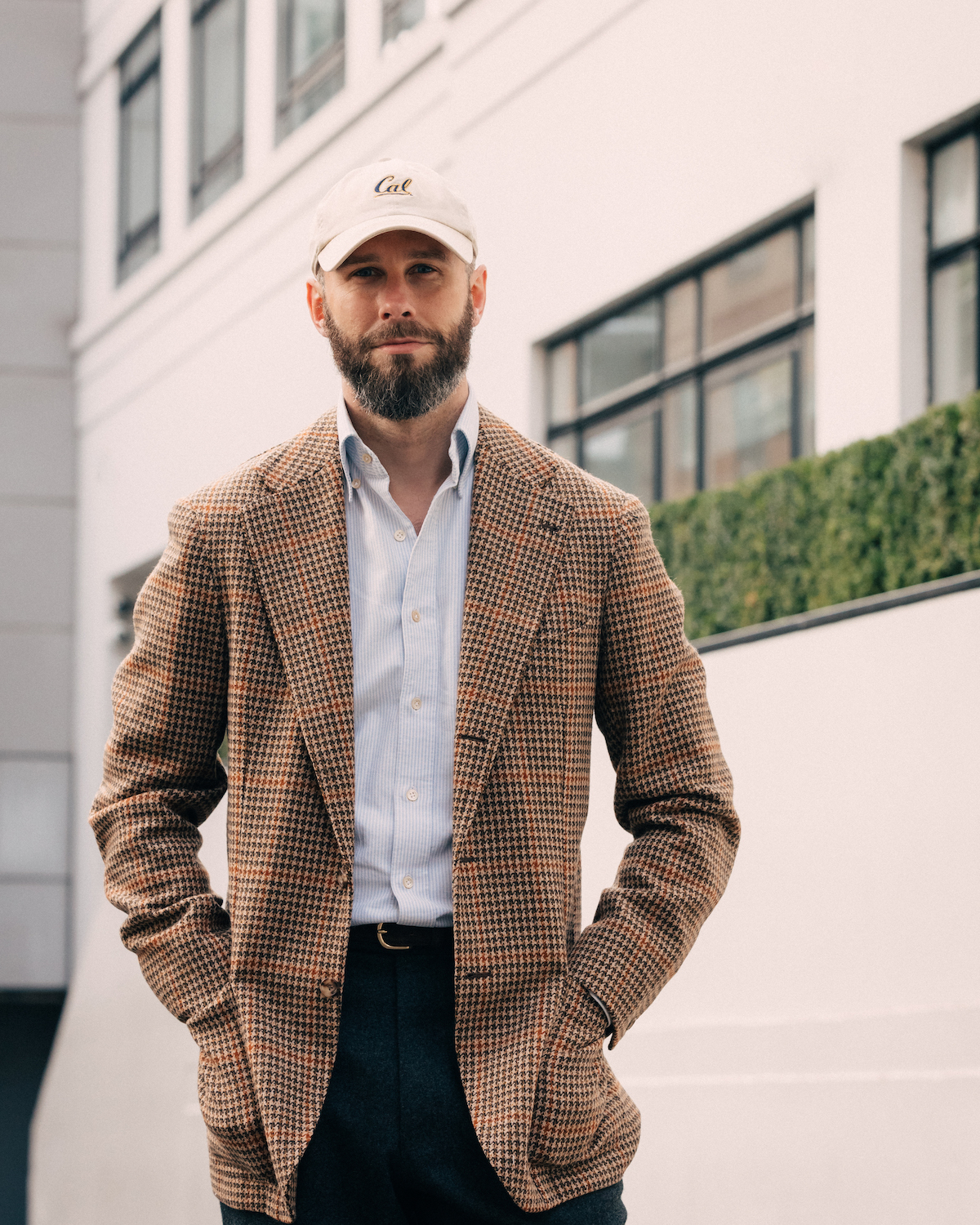
Love the coat from the first photo. Where is it from?
That checked jacket? It’s made by Ciardi in a vintage cloth – covered here
That’s the one. Thanks Simon!
Add to the list (in no particular order of vestigial contemporary relevance):
– Letting a woman exit an elevator first
– Not standing with your hands in your pants pockets
– Keeping your (suit) jacket on at all times in social situations
– Lowering your voice indoors
– Excusing yourself when inconveniencing someone else (lost on the headphone generation)
So many of the things mentioned above and in other comments, like removing your hat and sunglasses, or dressing for an event vs showing up in sweats, are about the ritual of showing mutual respect. It is maybe a little sad that this is getting lost as our culture has become more and more individualistic and people no longer feel the need to prize respect and ritual above personal animal comfort (medical/religious reasons excepted.). Something to think about.
As to keeping your jacket on in social situations, I have had complaints on that point. I live in south Florida. It’s famously hot and humid for 11 of the 12 months. I like tailoring, though, so I fight the good fight. Linen, linen blends, hopsacks, minimal construction. Nonetheless, I’ve had numerous occasions where a host has virtually insisted that I remove my blazer/sportcoat as though it was outerwear. Sometimes, it’s because the host is concerned for my comfort. I try to demur with as much tact as I can muster, but I’ve experienced some significant pushback. I suppose I should acquiesce, but I seldom do. As far as the people who seem to think my failing to remove my sportcoat in their living room is something akin to keeping my raincoat on, I’m at a complete loss.
Has anyone else had this experience? Should I always comply and remove my jacket in the spirit of congeniality?
A few thoughts :
Often these forms of etiquette are so well rooted they’re almost subconscious. I remember working in a pub many years ago – a very traditional, local spot, but one manned by young folk such as myself. A (non-regular) chap was having a drink and generally keeping to himself. We couldn’t put our finger on it exactly, but the consensus was that he was slightly rude, aloof, generally disagreeable. It was only when he took his hat off that we realised we’d all been treating it’s presence on his head as emblematic of his seemingly disrespectful attitude but not one of us had recognised it consciously. From that point on he became the quiet chap having a quiet pint he’d been the whole time.
M
The most important time to take your cap off is when you’re in one of Tony Soprano’s favourite restaurants. https://www.youtube.com/watch?v=Hqp1bGuiHHs
It feels like hat wearers are more or less excluded from the calculation. In restaurants or cafés I sometimes find it hard to find somewhere to put my hat, except for on my head.
As a relatively recently (mostly) bald man, I now wear a lot of hats. Wool beanies in winter, baseball caps the remainder of the time. I much, much prefer the look of my face in a hat and often I’m oh so tempted to keep the cap on indoors. Never at work, never at dinner, never with older relatives or at an event – but in more informal settings (coffee shop, lunch with a friend, in shops etc) i sometimes keep it on. Maybe I’m just still coming to terms with the hair loss, not sure.. Also, i regularly forget it and lose it!
An enormous and culturally bound topic with therefore an infinite opportunity for debate and disagreement. “Common sense” might drive some choices (spilling soup in one’s lap; outerwear left on indoors suggests perhaps that the wearer has no intention to remain long; large hats might just get in the way in a crowded space- do Mexicans apart from Mariachi bands wear Sombreos indoors etc etc etc) but others are perhaps just culturally hard wired for other reasons than practicality. Some might be offended by no socks in a shoes off venue but a sockless loafer look is preferable to many. Hats are the mini tip of the iceberg I think as they seem not to be de rigeur in so many cultures unlike in the past, when even the type denoted class or profession.
Amen!
As an Etiquette expert, Im always curious why so may seem to find etiquette to be not only outdated, but snobbish.
Basically it’s should just be considered, equivalent to the traffic code – it makes us avoid bumping into eachother, in all social circumstances…
Sadly, being considerate is no longer in vogue. We see it on the roads: fewer and fewer people using a turn signal to change lanes or turn, for example. Even though it’s always safer to do it. Equally, adults dressing like children because “I like to be comfortable and I really don’t care about what I wear”. Well you do, we all care about what we wear; it’s really a case that many don’t care what others think about how they present themselves to those around them. Its an “FU” mentality, in the end.
I was brought up to not put my elbows on the table but that seems to be an etiquette point that’s faded during our lifetimes as most (including me these days) don’t follow it. I’ve raised it a few times and even searched online for an official statement on the matter from someone with authority on the matter. No one seems to think it’s still important.
Regarding the hat advice you were given, perhaps it was meant purely as an aesthetic tip rather than an etiquette tip?
Thanks Rowan. No it was clear it was a matter of proper behaviour
Rowan, this is interesting. In Vienna, traditional table manners remain by and large unchanged and are, more or less, followed by our daughters and most of their friends. The basics are (they might be different elsewhere):
+ Keep elbows off the table. (largely followed)
+ Bring the fork/spoon to your mouth and not the other way around. (followed sloppily)
+ Keep the fork in the left hand and the knife in the right throughout the meal. Do not switch hands. (followed)
+ Place the napkin on your lap. (somewhat followed)
+ Place cutlery in an inverted “V” (tips not touching) to signal you are still eating. (needs reminding)
+ Place the knife and fork parallel, to signal you have stopped. (needs reminding)
Oh and as we’re talking etiquette, perhaps this is a place to get thoughts on another thing I’ve thought about recently.
In restaurants, I was taught by my parents that if you want to get the waiter’s attention you don’t call out to them, or put your hand up to them. The waiter should be attentive to when customers need help, and all that’s required is a look in their direction.
This doesn’t seem to work any more. I always try it and 90 percent of the time if I just make eye contact but don’t explicitly call them over, I will be ignored.
So I’ve started to wonder if this was ever really even a thing or just a funny idea my mum had about how servers should behave.
Bear in mind I’m not talking about the Ritz or London fine dining here, just the sort of places I go day-to-day which might be anything from a greasy spoon or Nandos to a nice local brasserie.
Also (last comment I promise) like others here I’ve got slack specifically around wearing a baseball cap. Plenty of times I’ve found myself half way through a meal in a very casual place (Nandos maybe) and realised that something feels a little odd, and that it’s because I’m wearing my cap still. Which goes against what I was taught to do but now just seems totally normal.
I wouldn’t do it anywhere even slightly fancy as I would be too worried that a big scary Italian American mob boss would come and glower at me until I took it off.
“I love a sliding scale. Whether it’s formality, colour or craft, I love explaining how a question that is often treated as binary is better understood as a gently shaded spectrum, on which we all sit at different points at different times.”
Bravo. And amen.
I just think it’s weird to wear a hat indoors, it’s a fairly sensible rule. You can watch countless old films where men arrive at people’s homes and leave their hat at the door, usually together with their coat, gloves and cane as well.
The exceptions to this are of course public spaces, so it’s perfectly acceptable to keep your hat on in hotel lobbies, railway stations, etc.
The hat rule comes from earlier centuries, Simon. I’m a musketeer in the Lord Mayor of the City of London’s ceremonial guard (the Company of Pikemen & Musketeers of the Honourable Artillery Company). We wear uniforms dating from the 1640’s. When we do a formal salute, as the final move we remove and bow with our plumed hats, and the brim must always be pointed towards the person we are saluting. We were told that it comes from the etiquette of not showing the lice and other infestations that lived inside the hat in the seventeenth century.
I learned that hats need not come off for all indoor environments. For example, hats can remain on in train stations, lobbies, and while seated at the bar. For me, the relative intimacy of the space dictates the level of deference required and, thus, whether one must remove their hat.
Taking the hat off is only half the battle; where it goes next is the real test. Putting it on the table is hygiene faux paux on par with showing one’s lining.
The real tragedy for me, though, is the ‘bowl-clutcher.’ There’s something deeply unsettling about watching someone warm up a chilled drink with their bare hands—it’s the quickest way to turn a fine beverage into a lukewarm soup.
On the subject of hats, Simon, mine is due a tip – both to you, and to Jean-Manuel and Nicolas: to you for recommending them, and to them for their exemplary service.
Following your recommendation, I’ve now had two suits made with JMM and Nicolas, and both have been superb. What impressed me most was their commitment to really getting things right. On the second suit, there was a slight issue with the chest – nothing dramatic, but enough to prompt a gently raised eyebrow. Their response? They remade the entire jacket from scratch and nailed it.
It’s rare to see that kind of commitment and integrity nowadays. Absolute class. Couldn’t be happier.
Thanks again for the recommendation, Simon.
Alexander.
Ha, this feels oddly tailored (no pun) to me! I feel a little called out – not only do I have an attaché case (and use it regularly – perfect as a weekend suitcase!), I also have (and have worn today) a bowler hat! No umbrella, however.
Fascinating, however, that while I’ve never heard of the far side soup thing (and am regularly guilty of elbows on tables), I’ve always carried my hats with the crown facing out, without even thinking about it. I had the misfortune of having to attend a funeral recently and inside the church, I took my hat off, naturally, and just stuck it under my arm, lining facing inwards, completely subconsciously.
It’s quite interesting what rules we absorb without noticing!
As for wearing a hat indoors or not, while I take it off i.e. at a friend’s place or in a restaurant, I tend to keep it on if I just pop into a shop for two minutes to buy cigarettes, or for grocery shopping (hands full). Not least because it hides my hair when it’s been messed up by the wind, in all honesty.
With regards to “clothes wearing” (instead of just clothing) there are a number of good rules that I love and respect. Never take your suit jacket off while sitting at a table; if you are wearing a tie, button up the top button; if it has belt loops, wear a belt; I personally struggle with ties on a button-down shirt, but maybe this is style more than etiquette – discuss!; long trousers in the evening, always, no exceptions.
One that I’m increasingly conflicted is shoes indoors. For decades I have avoided shoes indoors, and anyone visiting my home is requested to politely take their shoes off when they come visit. I’m very aware that this is not normal in western societies, but I think is a beautiful habit that we should embrace. This should be, however, met with nice guest slippers or equivalent. People still get shocked sometimes when asked to leave their shoes at the door – so there’s an etiquette about the “asking” as there is about always (ALWAYS) wear good socks!
Another pet peeve is ironing. I really believe most clothes should be ironed properly. Even linen needs ironing; not starched (this rule expired I would say) but nicely ironed clothes is a sign of respect. Then the normal wearing during the day would give it the natural creases that “make” an outfit.
I do believe certain etiquette points regarding clothing “of others” are also important: wear (but don’t necessarily show) a handkerchief to lend to a lady in need; the woman always walks on the inside of a street (not the side to the street, to avoid cars and being stained by traffic over puddles); offer an arm for your walking companion – regardless of weather they are your partner or not; mirrors are essential items to have around the house, even if you don’t use them yourself – specially full length mirrors in a bathroom / restroom so people can check their attire before they go back to the main room.
These are just a few top of mind. I do enjoy a good rule of etiquette, and thoroughly respect those who follow them without announcing them.
Interesting to have other perspectives.
In Austria, it is a strict rule to remove one’s shoes immediately upon entering a private home. This practice is primarily driven by hygiene. Even when a host explicitly allows shoes to remain on, guests typically still remove them, because that is still the expectation. This starts in your childhood. I can still remember my mother repeating, never leave the shoes on indoors.
Furthermore, from me a tie and a button-down shirt are somewhat incompatible. This likely stems from a continental European perspective, where button-down collars are considered too casual for formal neckwear (and not so popular anyway).
In Denmark it is also a rule, in many cases it also comes from the fact that if you walk in shoes inside an old building, the neigbour below will hear everything.
For something that is so widespread, I am still baffled by the amount of people that enforce this rule but at the same time don’t have a place by the entrance where you can sit to lace up your shoes, or even a shoe horn at hand, something that is especially problematic when you had dinner and your feet have swollen.
Reading this article, I was struck by how cowboy hats (as part of western wear resurgence) have had such a moment recently, relative to other hat styles. Chase could wander around Soho, walk into a cool ad agency or art gallery, and I think most would consider him very fashionable. I’m struggling to think of any other hat (baseball caps and bucket hats aside) that has felt genuinely current for the past couple of decades.
I wonder what is it about the cowboy hat that has been able to cross over into serious fashion circles, when styles like the baker boy, trilby, and fedora remain so stuck in their connotations. If anything, cowboy hats and western wear in general seem more loud than say a suit with a trilby.
I suppose it could be something to do with the fact western wear can be quite casual, and so you don’t give off the impression you’ve overdressed in the formality sense. But even then something like a tweed cap is pretty casual and definitely isn’t “cool”.
Yes, interesting point C. I think the casual element is definitely part of it. Perhaps the influence of America too – the tweed cap was made cooler by Peaky Blinders for instance, but not to the extent American culture has had influence
Your friend in New Mexico must be a young man. The keeping your hat on indoors is a recent thing. Relatively recent that is; I’m 73 years old and in the Southwest you took your hat off indoors. I still do here in Arizona and cannot get used to or agree with other men not doing so. My friend in the neighboring ranch had a couple of sons and if they came to table with there hats on he would admonish them with “what’s the matter; your head cold?”
”I think the value of the hat on this occasion is not in it being worn, but in its being removed”. (“The crown” s2 ep3)
Hear hear! It’s just common courtesy. In the American South, men are frequently reminded to remove their hats at restaurants, etc. (and do so). Elsewhere they just seem to leave them on, especially if they are younger and seem to feel like their hat is a ticket to the hipster in-circle.
The soup scooping toward the far side rather the near is to diminish risk of splashing on your or your neighbour’s clothes while scooping. It also gives some time for the droplet under the spoon to fall back in the plate, not elsewhere.
The elbow thing isn’t just posture, it also reduces the weight you naturally put with your arms at the table’s edge, which on less stable tables with a central foot can send your vis-a-vis plate flying if the table isn’t quite stable. Overtime time, it can also damage such tables or those with unsupported prolongations.
Not that I respect those all the time myself nor would chastise anyone about those, but here’s some explanation if you want to let your kids know 😉
As I get older and the more I read of your blog, Simon, the more I think that there is (perhaps unsurprisingly) a historic and common boundary between religion and fashion, e.g., the removing of your hat is a deferential act and is expected, for example, when you enter a church. Have you read any Montaigne or Castiglione? I am sure they have something to say on the moral effects of clothes.
Castiglione yes, though not for years. Yes I can see that would be interesting
Interesting topic. I find the elbows on the table to be especially funny. I am making my family a dining room table, and have completed the top. It is currently sitting on (but not bolted to) our old base. When I was explaining that to a friend they told me the origin of “no elbows on the table” actually comes from mid-evil times where there weren’t formal dining tables. The tables were mostly boards sat upon (essentially) saw horses; people didn’t put their elbows on the table because the pressure could flip the table. With regards to other table manners, we are currently teaching our 6 year old the basics like no talking while there is food in your mouth and when a female leaves the table you stop eating until she returns. I don’t know that I will insist on spooning soup away from you as I don’t know why we do it in the first place.
Outside of the dining room, I used to work for Davidoff and some of the etiquette I learned was that it is good manners to remove the cigar band when you begin smoking it. When I asked why the belief was that it was so your company doesn’t think you are smoking something of finer or lesser quality than they are. I have seen that line of logic for a few of the etiquette rules I have been taught. (Side note, I think that might be the idea behind facing your hat inwards while carrying it; it is not showing off the brand of your hat). When in doubt if there is a rule or not, I try to stick to this idea of ‘not showing off your brand’. I think a lot of PS readers probably follow this line of thought too, I don’t imagine many of us have bomber jackets in the LV canvas print.
For my life it’s a bit of a guiding ‘when-in-doubt’ mindset, that said I had a friend that took it to an impressive extreme. My friend lived about 2 hours from me and I was invited to visit him for the weekend. My friend had means and offered to put me up in the local grand hotel, as his house was situated to his bachelor lifestyle and not ideal for hosting. When I got to the hotel I found out he had taken a room for himself of the same class; he didn’t want me thinking he was sleeping in better or worse accomodations than I was while I was his guest for the weekend. I found that very impressive.
Ciao Simon,
another great topic.
Regarding the hat pointing, always in.
Good hats last for a long time, people do not feel inclined to replace worn insides so
it is better to keep the condition private.
Also, always take off inside. if at friends, but something soft from Borsalino , fold and place in
your jacket.or place on a nearby chair.
A must to consider – socks. Please, wear nice clean socks if visiting friends.
If you are asked to remove your shoes and your socks look like the rats have attacked them , no matter how well you are dressed above the ankles, you will always be remembered for your horrible socks.
Finally, men make the mistake of wearing a hat without the composure to carry it off easily.
Too stiff and you look like a mannequin ; too lazy and someone will ask you what is the name you have given your skateboard.
If you look at one of the posters for The Untouchables, you can see that Connery & Co. have that
that one serious quality – balls or cazzimma.
Grazie, JR.
My son refuses to take his cowboy hat off indoors – appalling, I know, but he is only 2.
Based on my own experience I guess that’s better than your son refusing to put a hat on….
I would very much like to know who made that jacket in the first photo, please.
It’s Sartoria Ciardi – more details here
Coming from the southern part of the U.S. I’ve noticed I do have forms of etiquette that my northern compadre have all but abandoned.
I still take my hat off indoors, button my jacket if I’m not sitting, stand when a woman leaves a table we are all sitting at, walk on the part of the sidewalk closest to the traffic to protect the elderly and children, etc.
I still keep two hankies when I leave the house; one for me and one for my wife should she need it.
It’s something I’ve always been a little proud of I suppose; as if I’m carrying a little bit of my heritage with me everywhere I go.
By the way, your quip about teaching your kids not to put their elbows on the table brought back vivid memories of my mother chastising me for the same thing. Lol
Cheers
Speaking of “rules” for wearing hats, can one wear a edora or trilby in the summer months? I am coming to London in June and worry about rain destroying my usual panama worn here in Washington, DC. Generally in dressy mode in the city, suit and tie. Thinking maybe lightweight felt or wool in a medium brown or a lighter color?
You can if it’s grey and any chance of rain I think Mark, yes. Some purists may disagree, but if it looks functional like that then I don’t think there will be any issues really
Thanks Simon.
For some reason, the inside of my hat, when not on my head was towards me. I thought it was so as to not impress/brag. ( my hat is better than yours ). You’ll notice me on the far right in my Father’s wholesale grocery warehouse. March 1963. I was15 almost 16. One of the guys got a Polaroid back in the 1960’s and we took turns snapping one another. The hat/cap stayed on my head except in the office.
I live in Minneapolis, Minnesota, but also have a cabin in a more rural part of the center of the state. While I always take my hat off indoors and when seated at a table, I noticed over the weekend (recalling this article) that the locals at the cabin generally do neither.
I do not think this is simply explained by saying country folk are unsophisticated or low class. While dress codes are certainly more relaxed compared to the city, and while there are different cultural pressures at anywhere you go, I think a big part of this is that there are simply less opportunities for men to buy unique or interesting clothing outside of metropolitan areas, and so guys in these parts tend to express themselves more via their accessories.
The fewer places there are for you to buy clothing in your area, the more likely you are to end up wearing the same clothes as everyone else, and the more likely you are too weigh more heavily on your accessories to show the world your taste, and why you’re unique. In this case, it’s a little more understandable to want to keep your hat.
I came to my own little epiphany over the weekend that rather than judge these guys for wearing their hats while sitting at the dinner table, perhaps I should view them as kindred spirits, trying to express themselves through clothing, just the same as me.