

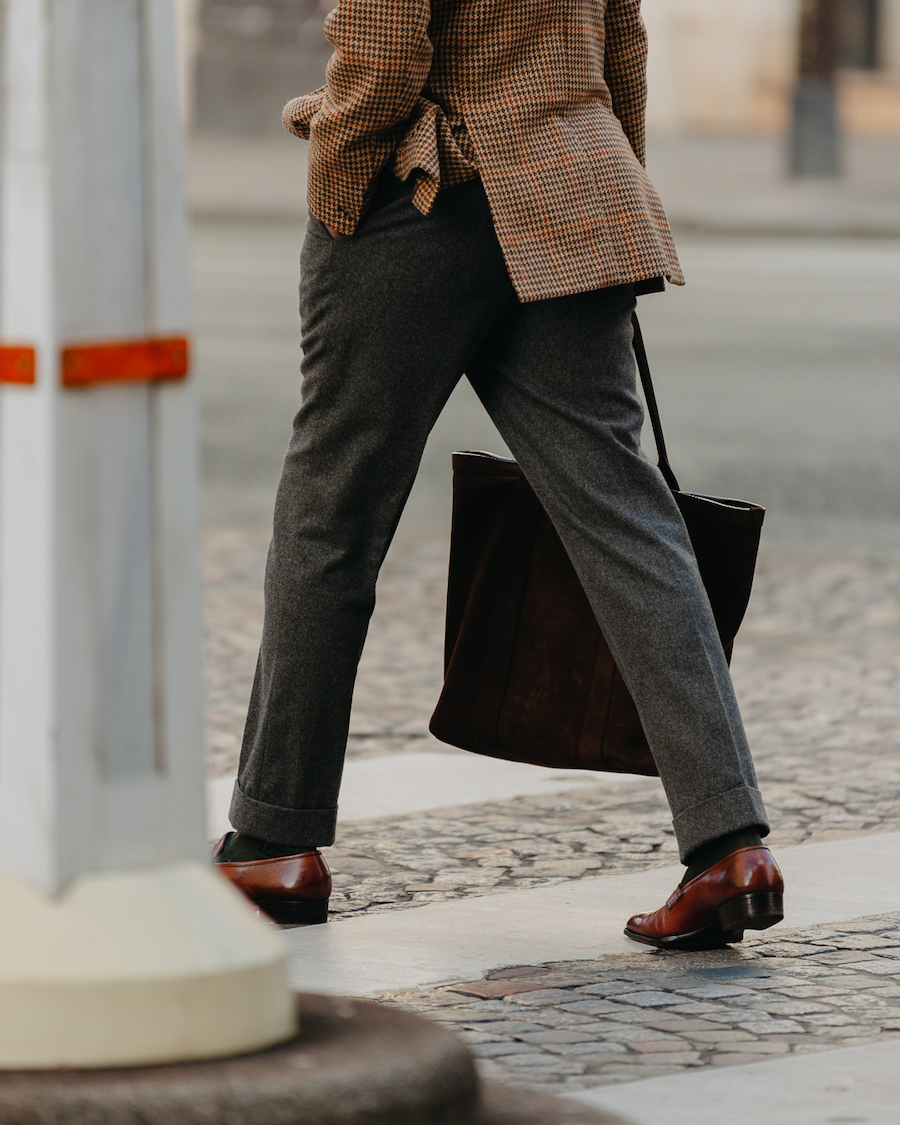
I was reading a piece in The Times last month which hailed the flannel trouser as the new trend in menswear. It’s funny how the mainstream can sometimes take a long time to catch up - it must be 15 years since the growth of ‘classic menswear’ led to guys embracing flannel as the perfect smart/casual material, halfway between suits and chinos. Or maybe the trend is just going round again.
Of course, many of the brands featured in that article were also ruining the flannel trouser, with elasticated waists and too-light materials. But in the grand scheme of things it’s probably good - it’s all education. Apparently Paul Smith and Corneliani think suits are back too.
It did remind me - more importantly - of a question readers ask about flannel trousers, which is how robust they are: how strong and long-lasting. Every week or two there’s a comment from someone who’s busted through the crotch of theirs, and wants to know if there’s anything they can do about it.

Flannel is not the strongest material in the world. It’s certainly not as strong a denim or most chinos. It’s often not as strong as suit trousers either - the fact they’re worsted rather than woollen helps, although they will often go shiny before they wear through, which is not a great look either.
But if cared for properly, flannel trousers should be a great servant in your wardrobe, able to be worn for many years. So let’s look at the different issues in turn, beginning with what we mean by ‘cared for properly’.
Care and wear
This is basic stuff really, that applies to most tailoring. But it’s particularly relevant if you’re trying to find ways to protect soft materials.
- Rotation. All wool trousers benefit from not being worn every day. Wool is much weaker when it is damp, and your perspiration can take more than a night to dry out. Wear them every other day at the most.
- After care. Look after your flannels. Hang them up when you take them off in the evening, give them a press every now and again. Don’t leave them scrumpled in the corner. It will keep them looking good and steam helps clean them too. An occasional brush down is also good.
- Dry clean as little as possible. An extension of this brushing and steaming point is that it should allow you to dry clean the trousers as little as possible, as that will prematurely age the fabric.
- Activity. Smart trousers are not meant for cycling in. Some heavier, tougher materials can be used for that (they were used for riding back in the day, after all) but flannels usually can’t be. If you wear them for active pursuits, it will shorten their life.
Fabric and fit
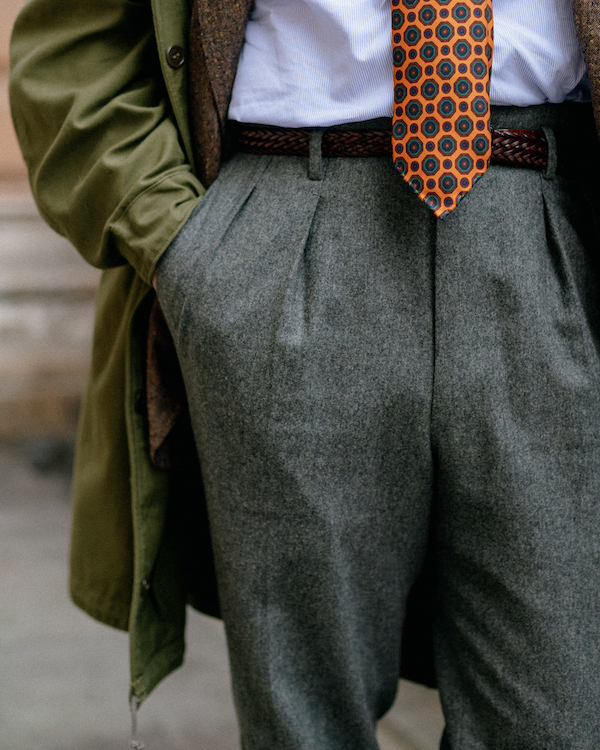
The flannels you actually buy, in terms of fabric and cut and how they fit, will make just as big a difference as how they are worn. All these points will also stop flannels bagging out or losing shape.
- Denser fabric. Flannels that are woven more densely, unsurprisingly, will be stronger. In general, English flannels are woven in this way whereas Italian ones are softer and not as dense.
- Heavier fabric. To an extent, heavier weights are also better. However, there is a point where heavy fabrics create more friction and can even wear out faster. You see this with some heavy denims. So 13-15oz is better than 9-10oz in flannels, but don’t push much heavier.
- Looser fit. I remember one reader asking about flannels wearing fast, but admitted they were tight on the thighs and he wore them cycling. Tight fits put materials under more pressure (though as with all these things, you don’t want super loose either).
Alternatives
If you follow this advice and your flannel trousers still don’t last very long, you might need to look at alternative materials. In general, what you sacrifice is the fuzzy texture (‘nap’), which is thing that makes them more casual. But there’s a sliding scale. It runs something like this:
- Worsted flannel. The first step is going for a flannel that uses worsted yarn rather than woollen. Often worsted yarn is used for lighter weights, but it doesn’t have to be. I like Fox’s 12/13oz worsted flannel but there is a small sacrifice in terms of the texture.
- Shooting tweeds. Tweeds made for shooting are dense and hardy, and often smoother than normal tweed. Something like Thornproof can be a flannel substitute, in shades of grey, but it is rough and heavy.
- Heavy high-twists. High-twist materials naturally have more texture - different to flannel, but still a texture that separates them from regular suit trousers. The issue is they’re mostly for spring/summer as they’re so breathable, and people mostly wear flannels for autumn/winter. Still, in a heavier weight or warmer location they can be a good option. The best greys for me are in the Spring Ram bunch.
- Whipcords. Materials like whipcord, cavalry twill and covert are among the toughest out there and not as heavy as the shooting tweeds. They are smoother though, and sometimes have a bit of a sheen, taking them further away from flannel. Something like this from Holland & Sherry for instance.
- Heavy worsteds. If the nap of flannel really isn’t a priority, suit trousers that are heavier and slightly coarser will have more more texture than ones that are lighter and finer. We covered this in detail here, and among those I’d recommend the Universal bunch.

Repairs
If all else fails and your flannels need repairing, this is possible, though they’ll never be quite the same. The key is to:
- Catch it early. Repairs are a lot easier when the material is thinning but not actually holed through. That way similar flannel can be placed on the inside of the trousers, rather than the outside, making the repair less visible.
- Use an experienced alterations tailor. If there is a hole, a piece of flannel can be stitched on the outside and on a hidden area like the crotch, it won’t necessarily be that noticeable. But use a good tailor - ones we recommend in London here and New York here.
- Even reinforce in advance. If you know wearing is going to be a problem, or the trousers are precious, patches like this can even be done on the inside in anticipation of future issues. The material will always be a little thicker and perhaps not quite as comfortable though.

A lot of these points have been mentioned over the years in different posts, but it’s good to gather them together.
I should re-emphasise that most of them apply to all tailoring as well - patching might be harder on lighter or patterned materials, and you won’t want double thickness on heavier cloths, but the care points should all be kept in mind.
And to finish, here’s some close-ups of the flannel alternatives.










A really useful and current article. One thing to note is that whipcord, cavalry twill and covert are less of a direct substitute as they wear “cold” compared to flannel. I believe that’s because the fluffy (sorry for the technical term) texture captures the body heat better compared to the hard finish of those fabrics. They are still wonderful and wearing cold can be an advantage in a heated office, but less so in a cold street.
P.S. maybe “nap” is the correct term.
Yes, good point Richard. That also goes for some of the other worsted options here, less so for the shooting tweeds, though even there there is less nap, more a less dense hairiness
Agreed on this point. I have a pair in such fabric and have even worn them in late spring. It also helps that the fit is generous (22cm leg opening on size 48/waist 32”) with not much tapering so with the stiffness of the material they hang quite away from my legs. The downside though, and I think Simon has noted it, is that there is more friction in the crotch that may lead to some thinning, which for me was counterintuitive with the weight and sharpness of the fabric. They do not rumple at all and the creases are razor sharp without any ironing.
Thanks, interesting discussion. I agree with you that the Cucinelli trousers in the article are horrible, but I don’t think an elasticated waist necessarily ruins a pair of wool trousers. I think I am more open to styles that are more ‘fashion’ than classic menswear, though I think the distinction isn’t necessarily black and white and some more consciously ‘designed’ pieces can still live long and happy lives in a wardrobe.
Couple of examples currently available are the Margaret Howell relaxed trousers, which are in a navy flannel this season. And for a more out there style for PS, the Sono snowpant in navy wool – it is drawstring rather than elasticated, but a really interesting silhouette from a team who used to work at Lemaire.
Thanks Alex. Yes I agree, and I am being deliberately a little flippant there. The issue with some of those fashion trousers is the combination of a drawstring/elastic, a tight fit, and a flimsy material
Useful article, thank you.
Where does the wear on a trouser’s crotch originate? Is it skin against cloth (inside) or the two legs rubbing together (outside)? I always assumed the latter but if the former then your suggestion of a pre-emptive patch on the inside seems good sense.
More the latter and the cloth rubbing against other objects, like seats etc. However, a patch on the inside also helps with things like the material becoming damp through sweat etc, and wearing down faster as a result.
Chub rub has been the death of virtually all my trousers, a few 13oz trousers have managed to last a few years but a light weight pair of Drakes cotton trousers were through in under a year with wear less than once a week, never on consecutive days etc.
Some have suggested a “saddle piece” as a preventative measure, a pill shaped piece of lining across the seam of the trousers. Works in a similar way as the pre-emptive patch.
Some tailors however have strongly recommended against it though, saying the extra bulk will mean the trousers will rub harder against each other and so fail quicker than had you not added an extra layer. Russ (of GB) was more on the fence on the matter
I think it depends on that saddle piece a little – you don’t want it thick, even though longevity is the point. Even just a thicker piece of lining is helpful, as some trousers already have to an extent
Surely, this is the one occasion when a cloth should incorporate a man-made fibre with the flannel to add strength and durability ?
P.S. the chalk stripe double breasted appears to be the suit / cloth of the moment .
A classic that’s made a return and I’m seeing being worn casually . Beautiful !
Yes I can see that, though you would always compromise a little of the feel and performance of the flannel, and if looked after well, pure wool should be fine
Hi Simon, Your mention Paul Smith and I can recollect a full page 1980’s Daily Telegraph menswear piece featuring a pair of dusky-pink high-waisted trousers with a Hilditch & Key ticking-stripe shirt. Funny how certain images stick with you for decades. I had a couple of popover shirts from him, back then, bought from Jones in Covent Garden.
Whether or not he’s to everyone’s taste or especially “PS”, he has been one of the most recognisable British designers for the past 50 years, and his influence — particularly overseas — is, I think, significant. Even the phrase “classic with a twist” seems to have entered the language largely because of him.
It could make for an interesting PS piece either by yourself, or commissioned, not as a fan letter, but how he helped shape menswear,It feels like the sort of profile PS sometimes does, where the aim is simply to understand the impact rather than to endorse everything.
That’s a nice idea Daniel, yes. It would be an interesting one to explore – in some ways more interesting when it isn’t naturally a brand PS would cover
I’d second that request. (I wonder if Paul Smith is to the 1990s what Armani was to the 1980s – something of a gateway drug…)
I agree about 1990s Paul Smith…. a good friend (Ian who now owns the Shopkeeper Store in Norwich) worked there mid 90s and as a result I bought way too many lovely items of clothing from Floral Street.
Interestingly most of the RTW suits and shirts were still made in UK, the shoes were mainly Crockett & Jones, and some of the knitwear was by John Smedley and some of the swcoks were by Corgi. All British made. And I still have most of it and it is all still in great condition!
I obviously mean socks now swcoks!
I love flannel but am notoriously heavy on trousers and no matter the cloth have to wear them sparingly. Shame really as they are cozy, comfortable and stylish. A good cavalry twill is my go to smart trouser these days – they are super durable , hold a great crease and still have some visual texture/interest.
This is a brilliant article on flannel and its properties and sorts some of the issues around this fabric.
In a similar vain, at the opposite end of the spectrum , it would be nice to see an article specifically focused on the virtues of Whipcord and cavalry twill and SPECIFICALLY the differences between these two fabrics.
I adore them and they are not overly too warm either as some may fear eg. My W.BILL whipcords are fantastic at around 12oz, keep a crease beautifully and are very very strong.
We have written on them before – eg cavalry twill here. Cavalry twill just has a double twill line
For me the fit thing is the biggest contributor to longevity, particularly in the thighs. Thighs change shape so much as you move (getting in and out of cars is the killer for me) and the stretching forces sort of sum at the crotch, which by unhappy coincidence is the point most exposed to friction, as well as the most exposing point for them to blow out.
The game changer for me (never had the budget for bespoke trousers) has been sizing up at the waist to make absolutely sure that the fit is generous through the thighs, and then having them taken in or just hauling on side adjusters or belting up (side adjusters work better than a belt – a belt always gathers the waistband uncomfortably at the back if I take this too far). Pleats also seem to help, although I need a pretty generous cut for them to stay flat when standing.
I have similar problems and the same solution with jeans, although I also wash them a bit hotter (or even tumble dry) and then let the fabric relax where it needs to. I’m not opposed to having the waist on them taken in too.
Finally, and least easily – losing weight helps. My thighs rub together if I gain too much weight (possibly because the fat is layered on quite muscular thighs from years of bike racing).
Just as a separate point, to a degree, all of this is the price you pay for textured cloth: texture = friction.
Here’s a tip for lightweight flannel that I’ve used successfully before: Reinforce the fork from the inside with lightweight fusing. Either invisible below the cortch guard or visible from the inside. (Noone will know, I swear. 😉 )
<< It did remind me – more importantly – of a question readers ask about flannel trousers, which is how robust they are: how strong and long-lasting. >>
I felt found out while reading this. Very thankful for this article. I have a charcoal flannel suit and a light grey flannel trouser and absolutley love them. Their texture and the feeling of wearing substantial wool in chillier temperatures really is a pleasure. (Grey) Flannel is the perfect background for other colours, great for a minimalistic wardrobe with its ability to bridge smart casual and business.
Regarding durability: I would just recommend to not care too much. Just wear it and enjoy its features and establish a habit of brushing, hanging and (if necessary) ironing. [-> Simon, what do you think about ironing tailored garments? I found when my suits get wet they wrinkle, and a bit of ironing helps there.]
Every now and then I browse through the Permanent Style active threads and check on new comments regarding “flannel”, this is how much it captures me.
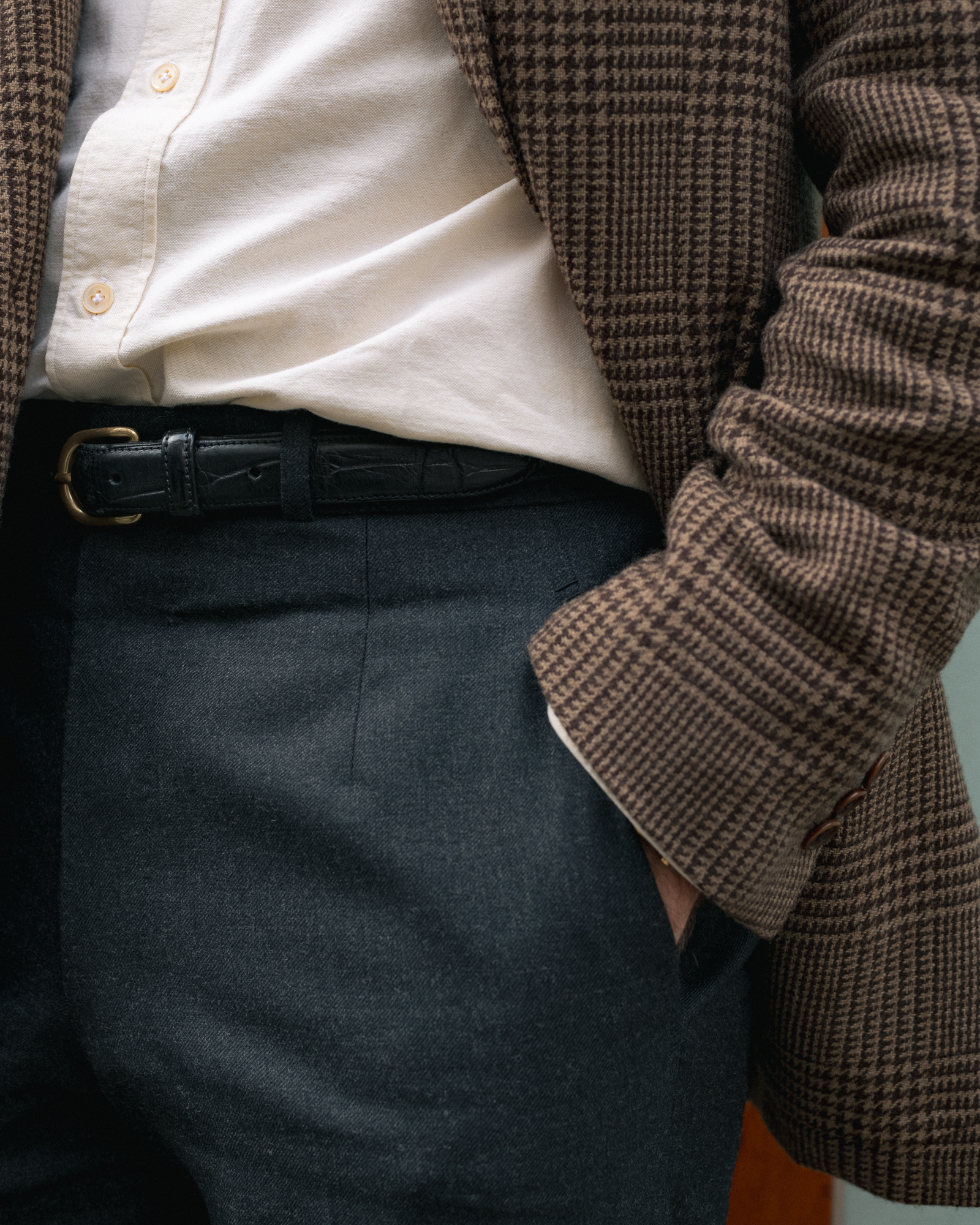
Is the trousers on the 3rd photo bespoke or ready to wear? Nice proportions.
They’re bespoke, from Whitcomb – they belong to reader Sebastian
And what about the flat fronted trousers in the following (4th) photo?
Thanks malcolm
Those are mine, again from Whitcomb, in Universal cloth and so a reference for that point in the piece. Discussed and pictured here
with your beautiful navy pinstripe flannel in mind – would you say flannel is the material to go for two trousers – not withstanding the problem of colour altering for the jacket faster?
Perhaps yes, and I don’t think you’d see much of a difference in colour change, especially if you swapped the trousers round now and again
I love the idea of a Thornproof suit – the practicality and pointedly non-business feel. Which colour might you go for Simon from that Porter and Harding book if seeking a city/urban suitable option?
I’d probably go with the grey shown in the bottom, which I have trousers out of.
Very useful guide Simon.
More of an aside of historical curiosity but I read that cream flannels were worn for tennis in the past – were these actually flannels or another fabric, if you happen to know?
I think they were flannels, yes. Tennis was rather less strenuous of course, and people had multiple pairs, all looked after well as described here and pretty dense
Simon, I once knew a man who had a “saddle” as he termed it installed after market by an alterations tailor in all his woollen business trousers. I think it was made of silk. He maintained this vastly – reduced daily wear and tear and extended the life of the trousers considerably. Have you any experience of adding such a “saddle” and if so how effective are they? Thank you.
I haven’t, but they are sometimes included as standard in trousers too, though they’re not always that big. It can be very useful I’m told
Great article.
I think I know the answer to my question but I’ll ask anyway.
My flannels (dark grey and charcoal) are RTW from Cavour and I’m thinking about adding a lighter grey pair as they might work with a wider range of colours.
Cavour flannel is 330g at around £210 each.
They also have a 400g pair made from Fox flannel at £520.
Would the Fox cloth be worth the extra as they are expensive for RTW?
That’s a hard one Peter, it’s about that exponential increase in price sometimes for a linear increase in quality. And with Fox, a little bit for the name. You will get more but you’re having to pay a lot more. I guess the best way to think about it is the question of how much that increase means to you, how much you will value it. In the context of your budget of course.
Thank you Simon, that’s a good way to look at it.
It doesn’t help that I can’t compare the two either. The online images are good but nothing compares to seeing/touching the fabric.
I’ll stress over the decision for a while longer.
For the cost of the better flannel + alterations I could have MTM and my alterations tailor offers bespoke at a point a little above that.
I find trousers are the hardest clothes to get right.
I have a couple of the Cavour British flannel and recently also got a pair of Fox flannel trousers and for me it was worth the investment. I didn’t go for the Cavour Fox ones, as i bought mine from Kit Blake a week before Cavour released theirs. The Kit Blake ones I got are similar in price but use the heavy weight 560g fabric.
Quite expensive for sure, but I am now at a point were it might just be the one pair of trousers I buy this year, and it checks all the boxes in this article with plenty of room (even though slimming it slightly from knee to hem), heavyweight fabric, and I give them a few days to rest, hang them up and occasionally give them a brush.
On the Cavour ones. I am a novice when it comes to difference in flannel fabrics but to me they seem to be a worsted flannel. That’s not a bad thing as it should mean they are a bit more hard wearing, but with the oldest pair I have experienced the nap disappearing and now looking more like a soft heavy worsted twill. It was my first pair of flannels so may have been over used and not give proper rest. Any way to get the nap back again?
Thanks Chris, great info
Are the Kit Blake ones a lot bigger in the thigh than Cavour?
I didn’t say but I’ve bought mod2 which I believe are slimmer fitting than Mod3
Hi Peter,
I added a picture for reference, but you are right, and the Kit Blake ones are indeed bigger than the Cavour Mod 2. The Mod (on top) is the flat front version in size 52, while the Kit Blake Alex below is in size 34, so 50in comparable sizes, and as you can see about 2cm to 1 inch on the half measure at the upper thigh. Both pants have been altered however so measurements below mid thigh will not be comparable to either model at the store.
The Kit Blake one is also a little wider than the Mod 3 (size 52), but do not feel so, perhaps because of the thicker fabric.
it’s honestly better to buy two pairs for 420 and rotate them between wears to reduce tear rather than dropping 520 on a pair made in FB.
fox is fantastic but the prices they command is insane.
One might have to accept the fact that flannel just will not wear as long as smooth finish tighter woven wools. It’s the tradeoff for the nice warm nap. They get glossy as the nap wears.
Different point. When choosing your flannel cloth, note that worsting straightens out fibers. Un-worsted flannels have a different look. It’s especially noticeable on chalk stripe types. I like the ‘rougher’ look better.
And, last different point. today’s flannels are much softer than 30-40 years ago. Almost cashmere soft. It must be the sheep breeding. Thanks Farmer Hoggett! (IYKYK).
That’ll do, Pig
I love flannel but I have large legs. All my flannel suits have trousers with holes and pristine jackets. The master Neapolitan tailor Angelo Panico told me a while ago that I should use “dry fabric” (this is the expression he used in Italian) like sharksking (grisaglia) and not “combed fabrics”. I like a lot birdseye which seems be quite strong but it is not elegant as flannel.
Simon,
This article prompts another thank you for suggesting Fox Brothers Flannel 13oz (greys) which are proving bulletproof. Also the heavy high twist suggestion of Drapers 4-play (also in greys). As you mentioned, simply hang directly after use and 90% of wrinkles fall out by the next time I wear them.
Best,
Robert
Amazing, pleased they’re working well for you Robert
The one thing you haven’t mentioned at all, is the individual wearer’s anatomy, whether or not there is a ‘thigh gap’ present (google it). In recent years there has been a lot of fuss about thigh gaps in females, but males too have them (or not, as the case may be).
Quoted from google: A thigh gap is the space between the inner thighs when a person stands with their feet together. It is a result of a combination of genetics, bone structure, and fat distribution
If your inner thighs touch each other, there will be friction with every step as fabric rubs over fabric, which eventually will result in holes. I know, I had this problem throughout my young years, even on heavy denim. My anatomy has changed and it is a problem no longer.
There is one solution for the problem, but it is certainly not a nice one: wear trousers with a low-hanging crotch, several inches below your natural one, to avoid fabric rubbing over fabric in the section where it’s really tight.
I find that airing out a pair of trousers inside out after each wear, using a little steam if the crotch is wrinkled and then using a Corby trouser press greatly decreases the need for dry cleaning which increases the lifespan of wool trousers. We all hate the dreaded fabric shine caused by over pressing at the dry cleaners.
Good point RTK, I should have mentioned minimising dry cleaning. I’ll add it now
Agree with a lot of the points in the article and comments.
I think fit is one of the main issues for wear, I always try to sit down during fitting/trying on trousers to see if there are any tight patches or stretches. And move about whilst sitting down, open your legs etc
Could I possibly drill down into the last ‘for many years’? Some ‘if wearing X times per week, normal usage then a pair of chinos/denim/flannel can be expected to last Y years’ would be useful for me. Actually the same for shirts. I don’t really have a personal sense of that.
I seem to have gone on a bit of a binge on both and am wondering how many decades of very limited buying I have ahead of me 🙁
I always find this hard GH, because it is so heavily dependent on lots of different factors. But I would actually say for chinos and denim, I have never had a pair wear out. I’ve worn the longest for probably 10 years, but in the end it’s my changing style or body shape that kills them, not them wearing out.
Same with shirts, it’s changing shape or things like stains (which is more random) not simple wearing out of material.
Flannels have worn out on me, but they’ve lasted 8-10 years certainly
Very kind. Thanks for coming back.
It’s indeed dependent on other factors, I wear through a pair of denim within a year without a problem, and they get worn on weekends only.
I commissioned some flannels via luxire some years back, they called it E Thomas classic flannel. It’s the best fabric I’ve ever tried, drapes beautifully and while I see wear at the crotch I’ve had them for 5-6 years at least in heavy rotation and they’re far from needing repair. I think they were about 15oz.
However a similar weight dugdale worsted flannels didn’t last even a season.
This is a nice return to the kind of informative articles that are my personal favorites on PS. I wear a lot of flannels and haven’t had wear issues but I appreciate the tips nonetheless and particularly so the comparison and links/pictures of alternative cloths.
It is very difficult to find heavier weight flannel trousers.
I would love to hear reccomendations for brands that make flannel trousers in the 13-15 oz weight range as PS has recommended in various articles.
9-11 oz seems to be what is sold for off the rack and they don’t cut it in the cold.
You’ve seen both ranges from Fox presumably?
Not specifically about flannel but about the dashing picture of Manish. I’ve always button a jacket, I’m sure remeber articles of old praising it’s necessity to allow the shape of jacket to shine.
I feel like increasingly on PS I’m seeing undone jackets….is it a fashion change?….personal choice I’ve just noticed?….was it never that big of a deal and I’m just set in my ways?
I’d say there’s a few things going on:
– It makes more sense the smarter the jacket is. The more casual the jacket, the less it’s a big thing. Also the less structured the jacket is
– In parallel with that, things have become more casual, so more of the jackets are less structured and in more casual materials
– It’s always going to be a big amount about personal style. Yes, you see the shape more, but it looks more formal and that might not be your style. Consider the advantages and disadvantages and make up your own mind
Having said all that, not enough men in worsted suits realise how much better they’d look if they buttoned their jacket
Weight and loose fit are definitely key. Due to not being particularly well off, I almost exclusively thrift, and those are the two things I look out for most. I have very few pieces that are “slim fit” and most would qualify as baggy by modern uber-slim trends, but most of what I own is from the 80s and just keeps going strong. There’s just no substitute for a >350g/m² fabric in a decently loose fit.
I took a stroll through a large department store’s suit department a while back, having to kill some time, and it was disastrous. Not only was everything synthetic (some of those fabrics felt like condoms), everything was absurdly shrunken fit. I found one, one item whose size was as advertised (I know my measurements and what those sizes are supposed to be), and out of perhaps 100 shirts and jackets I looked at, only two were not “skinny fit”, “slim fit”, “extra slim”, “shape fit”, or other euphemisms for undersized. Some of the stuff I tried on was so tight, I was scared to move my arms around lest I tear a sleeve off.
Not only is that going to wear out ridiculously fast, it’s also depressing to think that undersized plastic suits are going to give entire generations of men the impression that suits are uncomfortable…
As odd as this may sound, I’ve had more issues with jeans wearing out around the crotch area (even good-quality ones, like Full Count) than flannel. It’s not a perfectly fair comparison, as I do cycle with jeans but not with flannels. I think part of the explanation is that flannels are slightly looser, so there’s less friction between the legs.
Good post. I would add a recommendation for “extra” trousers with a flannel suit. Also the cut: either fishtail back for braces, Sexton’s Oxford Bags. Pleats, high-waisted, and definitely not tight.
Thanks, Simon. Love flannel, it’s so versatile.
Slightly annoyingly, one of my flannel trousers has started to collapse inwards on the shin a little, they’re from Cordings. It’s not terrible, but affects the side profile.
Any idea why that might happen when it didn’t before? They’ve been dry cleaned a few times.
Could you describe it a little more Charlie? I’m not quite sure what collapsing inwards on the shin means
Sorry yes, so if you imagine viewing someone’s side profile, the trouser leg should run straight down uninterrupted from the top of the leg down to just shy of the break on the foot. However one pair I have kinks inwards at my shin, well above where the break should be. It’s not really noticeable from the front, but from the side it spoils the silhouette of the trouser. Does that make sense? Not currently at home so unfortunately can’t take a picture!
I think so. It sounds like it’s just to do with the drape of the trouser, the angle it’s dropping at, and so something to do with the hips etc.
Excellent overview. You mention that one shouldn’t push beyond 15oz flannels. In my own experience there is a lot to be gained in terms of durability by opting for 17-18oz flannels. They drape very well and seem to recover more quickly. In fact on a number of trips I was able to wear the same pair of trousers on consecutive days (the creases also relaxed over night). The tradeoff is of course increased warmth but at least in New York you could comfortably wear that weight between mid-November to mid-March.
I am wondering to what extent the bad reputation flannel has is connected to the fact that the vast majority of flannel suits and trousers are made from lightweight soft Italian fabrics.
Also very much agree that leaving ample room in the trouser fork will reduce abrasion and increase the longevity of the fabric- and this advice is actually applicable to many additional fabrics.
I have a pair of Fox archive flannel which is 19/20oz and they seem indestructible. The crease lasts a lot longer than Fox’s standard 14oz flannel.
Incidentally Simon, a good middle ground might be Standeven’s Oxbridge flannel that has a woollen warp and a worsted weft (or the other way round).
Yes, great shout Noel
Simon, thank you for this great and helpful article! May I kindly ask your opinion on two Italian flannels? What do think of Drago‘s Rugby Flannel (300g) and the VBC/Draper‘s wollen Flannel (340g)?
I haven’t tried the Drago, but I have the VBC, and I find it too light and soft for me personally. I’d think the Drago would be similar, given it’s lighter still
Thank you so much! How would you rate the robustness and durability of the VBC Flannel? Best
It’s similar to other Italian flannels, so not that great – it’s lighter and softer
The only winter pants I find more comfortable (and comforting) than flannel are moleskins. They both feel wonderful.
Hello Simon,
Every time I collect these vbc 6 ply trousers from the dry cleaners, the left crease is always off centre.
Chatgpt claims that the left trouser leg is ‘slightly torqued from mid thigh downwards.’ Apparently it means it’s impossible for left leg to ever have an aligned crease. Is this nonsense?
Well, it does look a bit twisted, yes, and that will stop it being ironed with a completely central crease probably (you can move the crease a bit, but not a lot, as it lines up with the pleat and needs to be proportional to the seams)
Hello Simon,
Is there anything that can a tailor can do to fix it?
Not really. It would be worth asking a tailor to repress them though potentially, just in case that makes a difference. Or someone specialist like the Valet
Thank you very much for the very interesting article. I am currently considering having a pair of trousers made from Fox Twill Tweed (https://foxflannel.com/collections/fox-tweed/products/dark-olive-twill-tweed) as an alternative to flannel. I would be very grateful if you could let me know your opinion on this fabric.
I’ve used that for jackets and a coat but never for trousers. I think it would be OK for trousers, a little soft but better than most tweeds
While I have a good selection of trousers, I usually have this one pair of favourites that I use daily for tasks like walking to the gym or grocery store. So the use case is very often but not too long at a time. These wear out at the crotch no matter what the material is, lightweight linen in summer or heavy cotton in fall/winter. For example I just had the crotch patched on ~400g 5 pocket cotton trousers that are generously roomy, they basically lasted for one season.
I am delighted with both the appearance and durability (so far) of 12.5oz. worsted flannels from Fox and Harrison’s.
I have avoided getting a flannel suit for this reason. I imagine that even with two pairs of trousers, the trousers will wear out faster than the jacket. It makes me think of this once-ordinary suit as a true luxury for this reason. A navy flannel suit could be good for this reason, as the jacket could be worn as a navy blazer when the trousers wear out, but navy flannel doesn’t have the beauty of grey flannel. A grey flannel jacket could possibly be worn on its own if the shade is light enough, but I fear it would still look like a suit jacket.
Great article, thank you. This is very timely for me, as not long ago I transitioned from a workplace in which wearing a suit was not required but was certainly acceptable to one that has a more casual culture. This has posed some challenges as a suit just makes dressing so uncomplicated (nobody believes this unless they wear them often, but it’s absolutely been true for me…) Anyway, the challenge has been sorting out mixes of odd trousers with sport coats and blazers, and flannel has been a great option, especially now that pleated cuts, which work well with the movement of flannels, are becoming popular again.
My one issue is with sheen on the seat. I find this very frustrating, and have tried sponging and hanging them a little, which seems to help. In the meantime, I’m rotating with corduroys, which are not as smart — I find can be a little more raffish and work best with tweed. I feel like I’m missing something, however.
I use tailoring among other things to dance tango in places that can be packed, hot and humid, so I don’t really buy flannel. But because of this use, trousers wearing through is an issue that I have with all kinds of fabrics.
The only real “solution”, which is just a way to slow down its demise, is to have more and space their use more. With my current wardrobe, I usually can let a suit I wore to the office rest for a week, but a suit that I used to go out dancing will probably not be touched for the next two weeks at least.
Looking at mtm or rtw mid grey flannel trousers. Does anyone have existence with both Cavour and Besnard? Besnard gives a ton of options online and seem reputable. If there are other similar shops please let me know.