

Why I’m wearing more belts
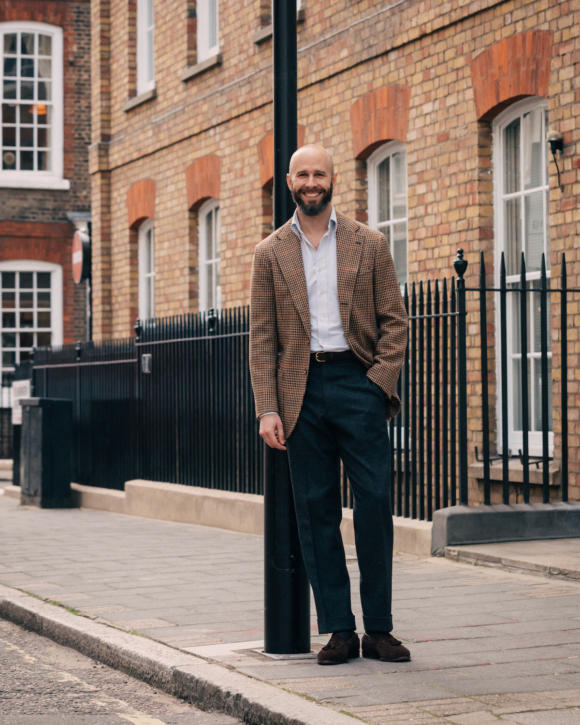
In recent months I’ve been wearing belts more often, after years of hardly doing so at all.
I never wore them with tailoring, preferring the clean, elegant look of an unfettered waistband with side adjustors.
And I didn’t even wear them with jeans, as I felt it looked more chic and relaxed. In fact, a woman once made the mistake of telling me it looked sexier, which as many readers will know is more powerful than any menswear rationale.
My view on jeans hasn’t changed (fortunate, as I actually had the loops taken off some pairs) and I’m not sure I will ever wear them with suits; why so many Italians in otherwise elegant suiting cut themselves in half with a thick piece of leather is beyond me.
But I increasingly like belts with sports jackets and trousers, which like many others I’m wearing a lot more these days. (We touched on why in this article.)
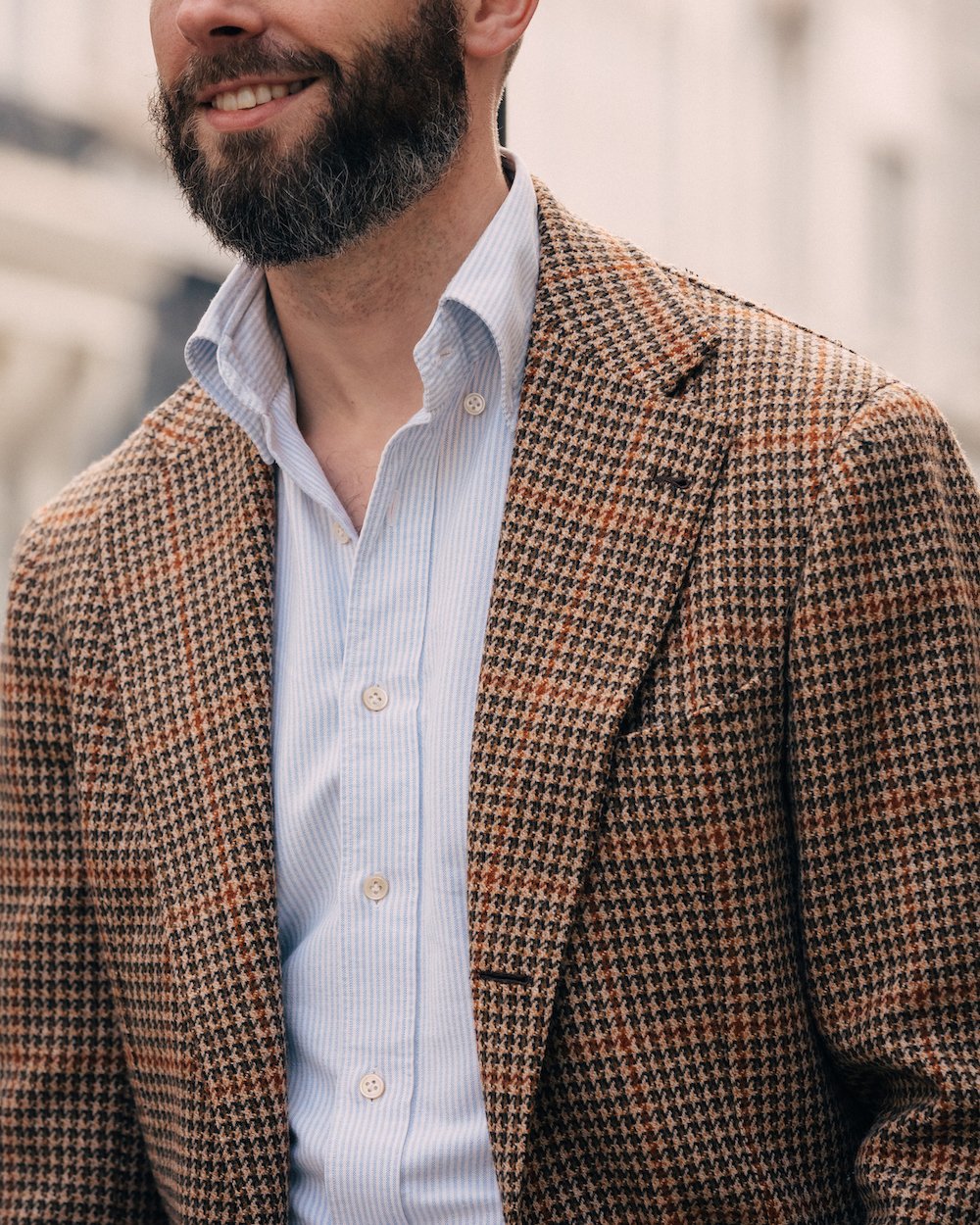
So why the change? Well, because otherwise with a jacket and trousers there is often not much else going on.
It rarely feels appropriate to wear a pocket handkerchief anymore (article on that here) and a tie feels increasingly formal. In their absence, a belt is a useful option.
You’re not going to wear a belt in the same colours or patterns as a tie. Something is still lost there. But a belt does give a jacket-and-trousers a focal point, and gives you the ability to play with different materials and textures.
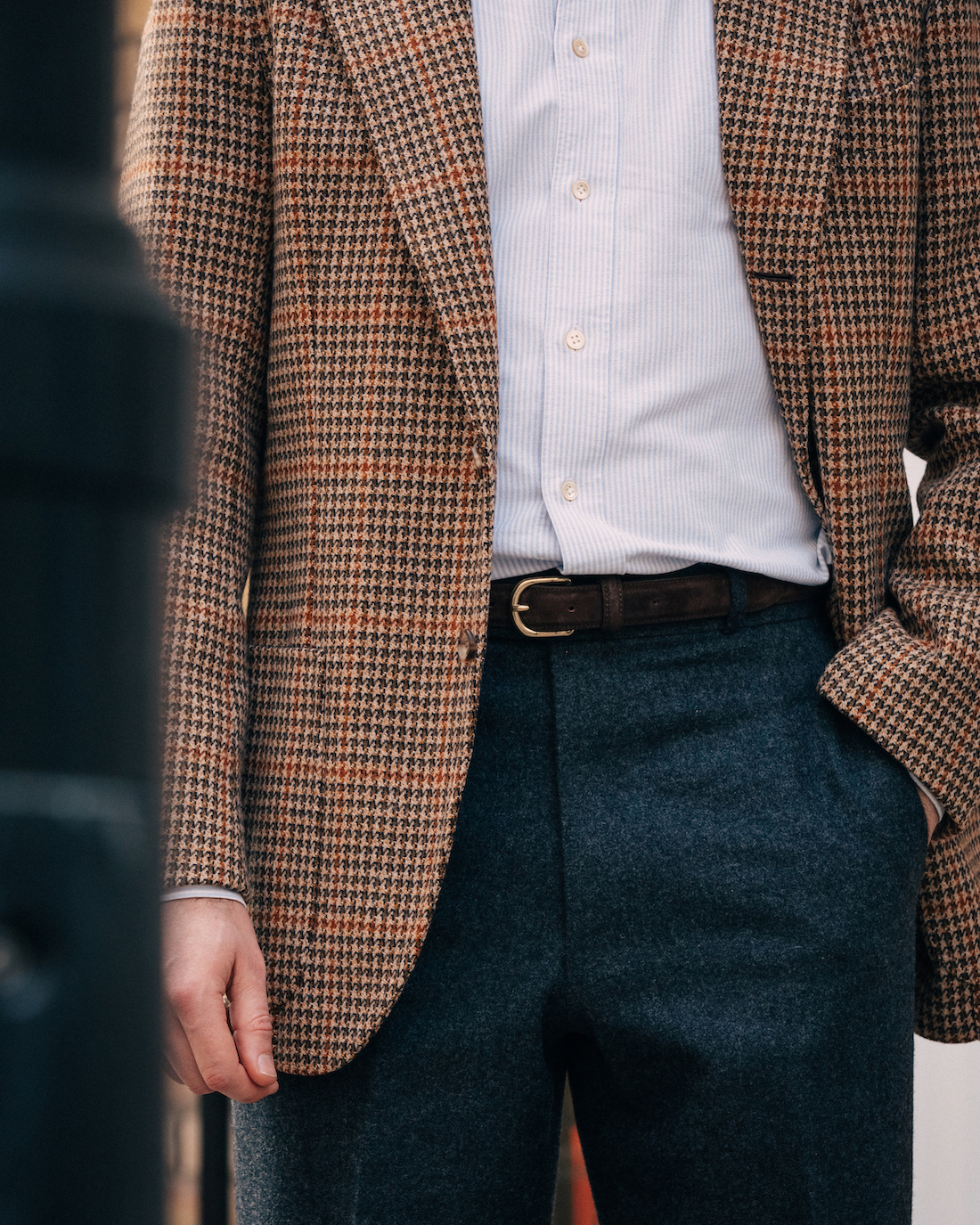
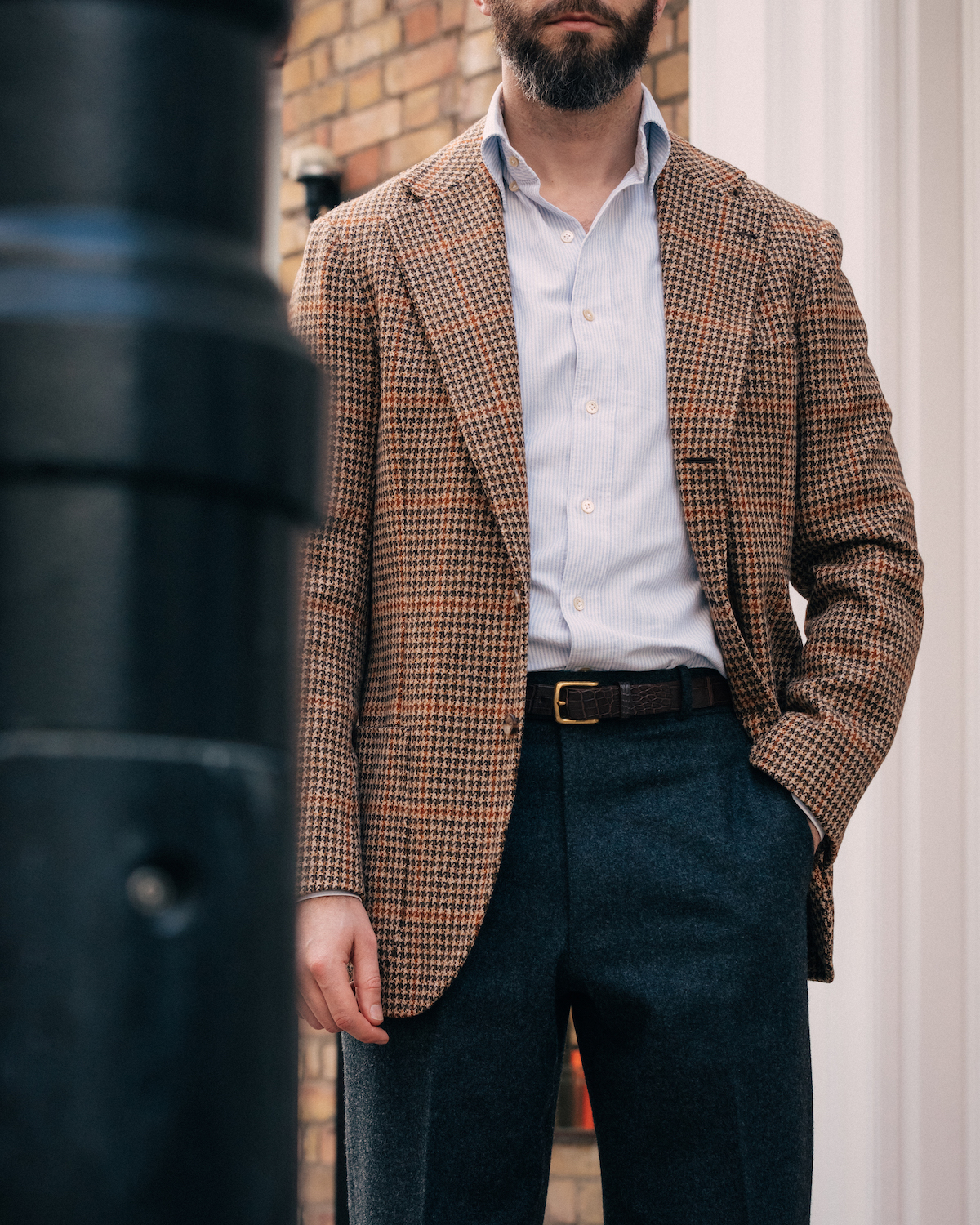
I’ve used the outfit here to show that even when an outfit has a fair amount going on, a belt adds significantly to it.
This is my gun-club check from Ciardi, with a striped PS Oxford button down. You'd rarely have much more pattern in an outfit, but still the suede belt (from Rubato) is a nice touch. You could even say it ties the outfit together.
It’s also pleasing that the belt is central, rather than off-centre - more like a tie than a handkerchief. (Although I won’t talk about what it encourages the viewer to focus on, given a tie is meant to lead the eye towards the face…)
If the outfit is plainer - say a twill oatmeal jacket and a white shirt - the effect of the belt is greater still. And it’s also nice with just knitwear and tailored trousers.
I’ll show more outfits like that in the coming weeks.
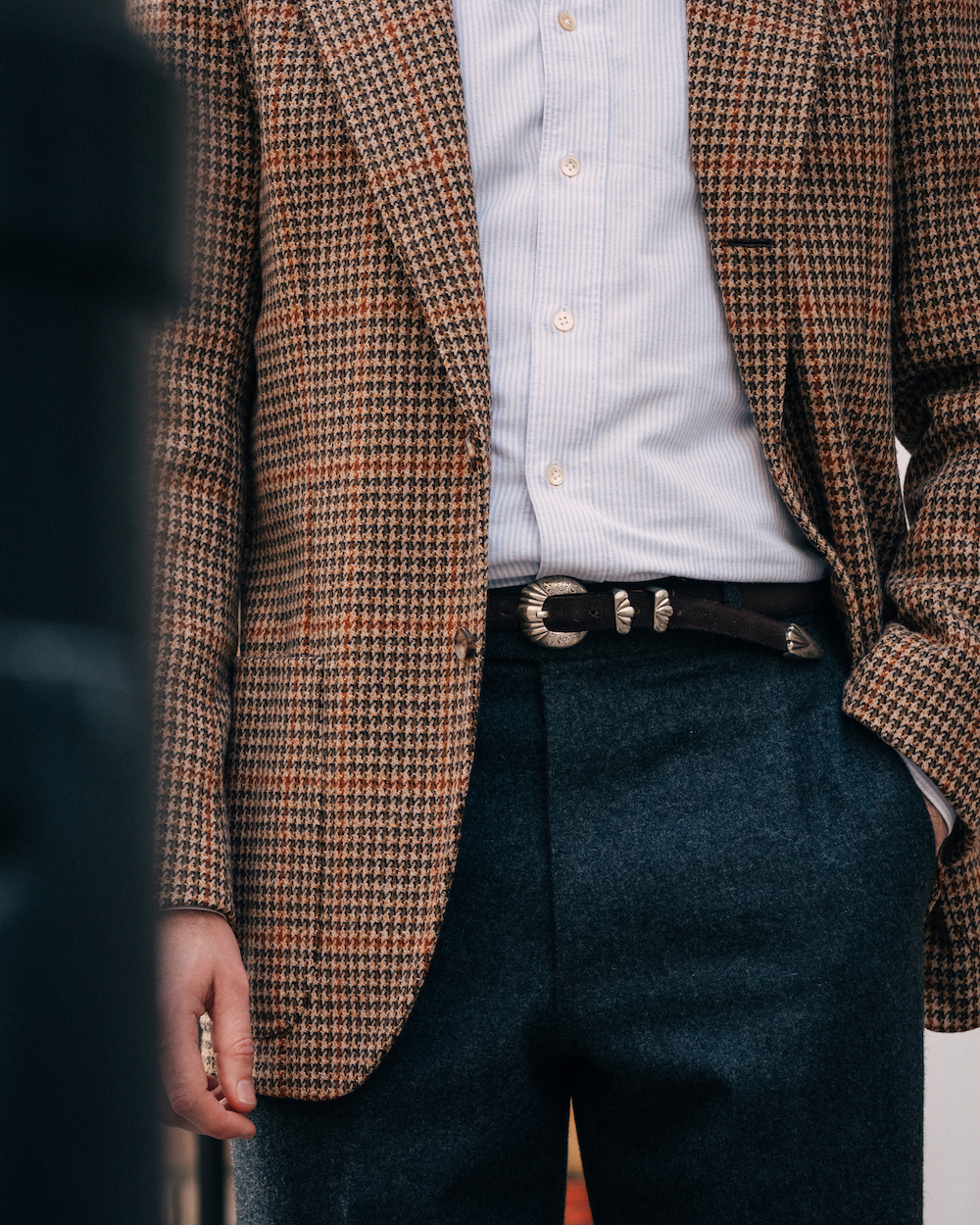
To illustrate how different belts can change an outfit, I’ve shown a few different options here.
Above is a brown suede belt from Silver Ostrich. It's the same leather as the Rubato, but very different due to the Western-style buckle. It’s less formal than the simple suede, perhaps younger, and certainly more of a look.
With the Rubato, by the way, I like that the belt is slim (one inch), has a stitched edge (making it look slimmer still) and has a simple, small buckle. All those make it look more formal and more contemporary. Thick belts with thick buckles are better with denim, if anywhere at all.
The next option, below, is an alligator belt - made by Equus in the UK. Actually, Charlie salvaged this one for me from a much thicker, wider belt I was given by Zilli years ago.
It’s nicer as a one-inch belt, although in retrospect I should have asked Charlie to stitch the edge too, rather than just ink it.
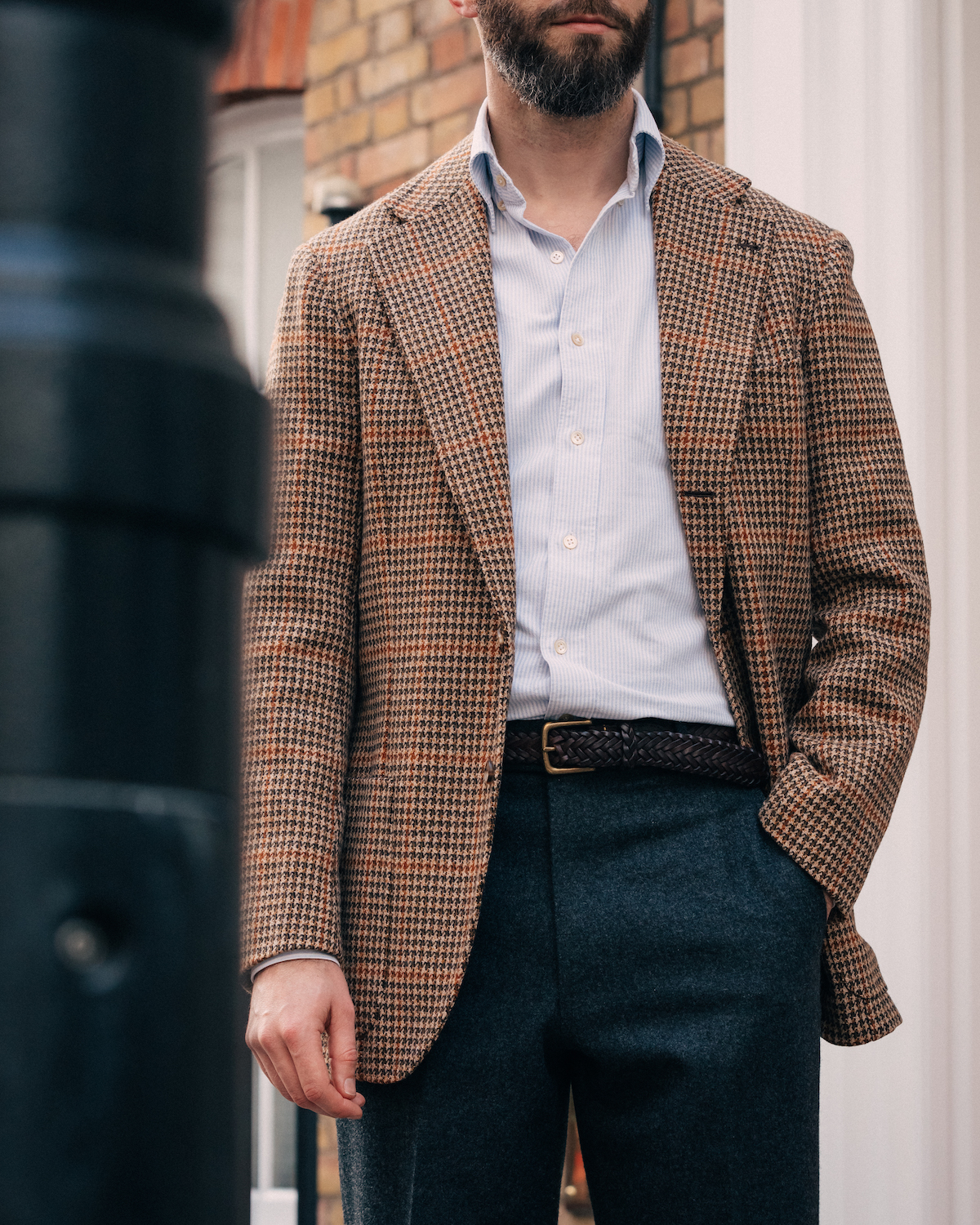
The last option, below, is probably the most common: a leather braided belt.
Braided belts are very practical, given they can be fastened at any point in the braid. They’re also often softer than solid suedes or leathers.
The only disadvantage, I think, is they can seem a little old fashioned - the kind of thing Drake’s would have fun with, undermining those associations with playful textures and colours.
I know some people dislike braided belts for this reason, and if you’re one of them, I’d recommend a plain, slim suede like the Rubato for a smart look, or a braided suede for a casual one (article on my one from Sergey @tightly_stitched coming soon).
The point of these different combinations, though, is that a belt can change a look.
All of these are dark brown, all fairly plain, but they range from standard-to-the-point-of-stodgy (braided leather) through simple-but-elegant (suede) to definitely-going-to-be-noticed (Western).
However, what if none of your dress trousers have belt loops? Well, I had loops added to these flannels by Whitcomb & Shaftesbury. It wasn’t hard, it just requires the same fabric to be available from the mill.
Of course, sometimes the same fabric is theoretically available, but it’s a new piece (batch) and the colour is slightly different.
So far I’ve haven't found this has mattered. Not just with dark greys like the flannels here, but with lighter ones too. I can imagine, though, that it could be a problem with very pale colours or much stronger ones.
The real issue I’ve had is deciding which trousers to add belt loops to, and which to keep with side adjustors.
Ideally I'd like a belt to be optional decoration, like wearing a tie or a handkerchief. But once you have belt loops, it looks much better if they’re used. And unless the fit is absolutely right, you’ll probably need the belt to keep the trousers up too.
I have seen some trousers with loops and adjustors, but it looks messy - and doesn’t avoid the issue of the unused loops. There are some complicated ways to have removable loops, but they're very fussy.
So I need to decide if I’m basically going to wear belts with all my trousers, or just keep it as an option with one or two pairs. It would be far too indulgent to have two versions of everything.
At the moment, I’ve made the switch on these dark-grey flannels, my mid-grey ones and a dark-brown pair. Time will tell whether this becomes a fundamental part of how I dress, and I end up changing all of them.
Photography: Milad Abedi










Side-adjusters: another unwitting victim of the COVID pandemic?
When I was refreshing my wardrobe I went for side-adjusters on all my new trousers… with your previous pieces playing a key role in persuading me that was the way to go!
I’m having a quiet chuckle to myself now; I wonder if I will swing back to belts in the near future?
However, I’ve rather gone the other way and dressing up rather than down for work – and very much enjoying it, too! The pandemic reinforced to me that my prized tailored pieces made to be worn rather than cosseted….
Sounds a great move Flynn.
I’m not sure if belts rather than side adjusters is fashion related. When I do see tailoring on normal people these days it is pretty dressed up. But then perhaps there are fewer of these big swings today anyway.
Gun club check coat, flannel trousers, OCBD, belt. Classic but nothing new.
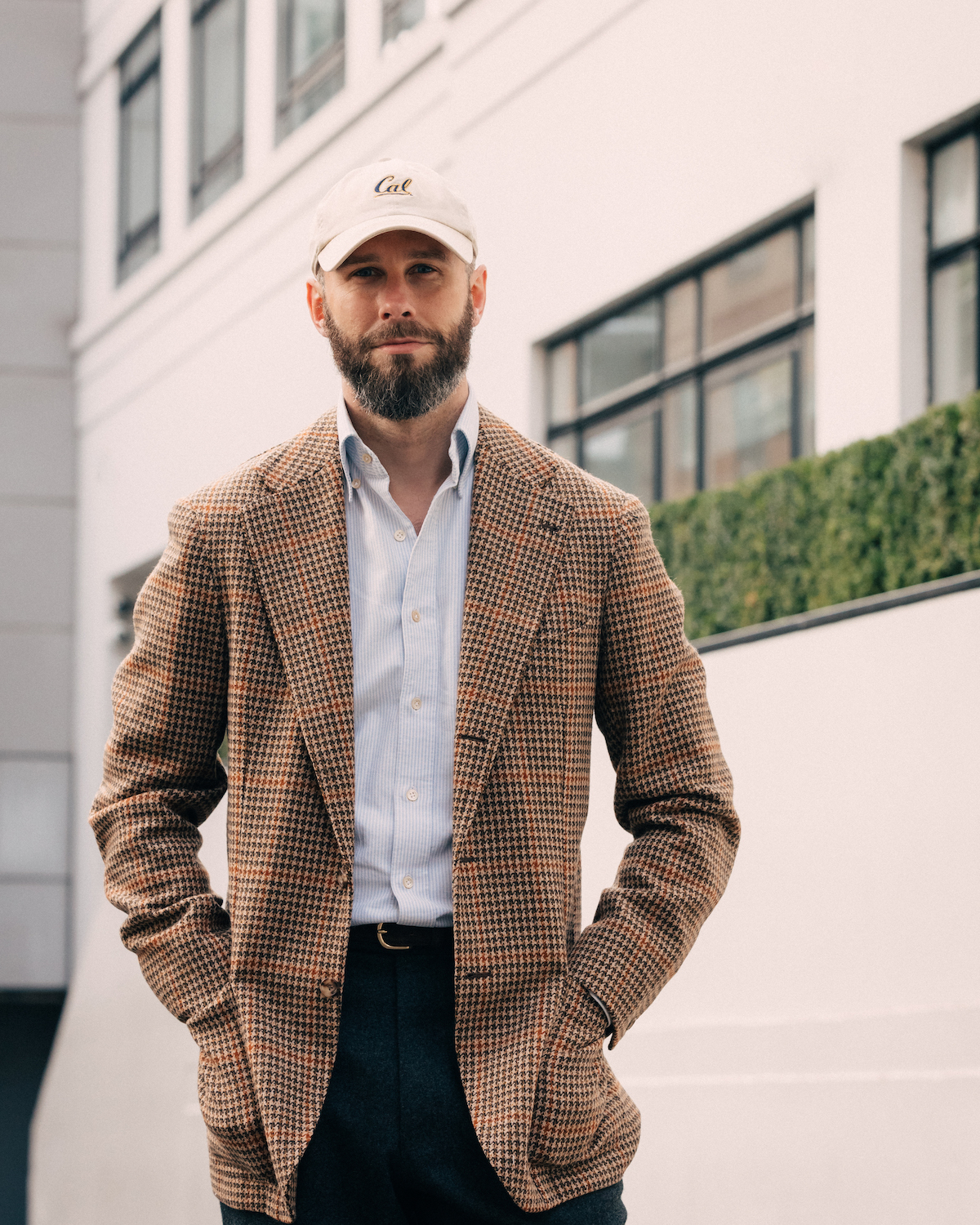
All of the above with added baseball cap?
Descending into cartoon caricature for me I’m afraid.
Not for everyone I guess. I’d like to see that cartoon though…
I see myself staying with side adjusters for the foreseeable future, mainly because it’s a point of difference style-wise, albeit understated (the best kind!).
Even in my quite conservative workplace setting where most of my colleagues wear a jacket/blazer, I’ve only ever noticed one other who wears trousers with side adjusters.
Hi Simon
As a wearer of belts with all my trousers (including suits but not formal wear), I thought I’d share two thoughts on why I do so:
I think there may be a British cultural connotation based on Savile Row’s use of side adjusters that belts are inappropriate for tailored trousers. Having grown up in America and preferring Northern Italian tailoring, where wearing belts with all types of trousers is the norm, I don’t share that point of view. If anything, given my cultural background and preferences, beltless trousers with side adjusters look a little funny to me, a bit like trousers with only one back pocket, no pleats or no cuffs. Almost as if they are incomplete.
The second is very practical: belts hold up my trousers better than side adjusters. I have tried side adjusters from every tailor I’ve been to and ended up having them removed and beltloops put on. I decided that trousers falling down is less elegant than wearing a belt. I never tried braces because they look a bit anachronistic to me even if they work best of all
All the best, Andrew
Thanks Andrew, very interesting. If anything I found the opposite with staying up, but it’s a minor thing
I’m Team Belt in this regard! I’ve found some side adjusters much better than others in keeping the trousers up whereas that’s the bare minimum you’d expect of a belt!
Hi Simon. Maybe it’s body shape or maybe it’s execution, I’m not sure. I really did give side adjusters a try for trousers with more formal suits but they just didn’t work out for me so I ended up back with belts.
Hi Andrew,
Well if you’ve tried then you know. Particularly with great tailors making for you.
I’ve got to agree, I really like the look of belts, including an elegant 1 inch one with suits. I feel not quite dressed without one in fact.
with jeans – well mine give a little as I wear them after a wash, so a belt is essential to take up the little bit of slack that develops.
Last but not least – I really dislike the “dangling end” look on the western belt, I like mine tucked into the belt loops.
cheers
I have the same problem – side adjusters just don’t hold up my trousers. So it’s belts for outfits where I might take off the jacket and braces otherwise.
The next question is how many belt loops? (I favour 7)
This does seem to vary considerably among individuals, which to be honest I’d never considered before. Even when I’m race-fit and trim, I do not find that belts hold up my trousers particularly well; and if they do, it’s when they’re very tight, which I find very uncomfortable; also a poor idea given that I suffer with chronic acid reflux. Side adjusters work pretty well, but I find braces the best, not to mention supremely comfortable. I’d never want them to be visible, though, and I’m not aware of any RTW options that are made for braces but aren’t in a nostalgic, Oxford bag-ish cut, which I wouldn’t want to wear.
Interestingly, on my pants the use of side adjustors or belt loops rather comes from the cut : high-waisted pants all have side adjustors, while low and mid-rise rather have belt loops, as I consider them more casual and usually wear them with a cardigan or an overshirt, not a jacket.
Also, maybe you’ve touched this topic elsewhere, but what are your views on the material and colour of the belt vs that of the shoes ? Would similar colour, regardless of material always be fine ?
You’re right, we’ve covered that before. See here
I’m similar in that the cut determines whether I have belt loops, but I only wear a belt really when it’s decorative (shirt, no jacket or knitwear). It feels odd to me to have an exposed waistband of jeans or chinos, yet not for wool trousers. I appreciate that is inconsistent
Although wearing a jacket means your waistband is far less likely to be exposed so perhaps not that inconsistent?
I agree with Hugh and Chris: cut and formality tend to push me one way or the other. I nearly always wear a belt with casual trousers, never with a suit and sometimes with blazer and slacks (my work attire when I’m teaching in school)
I’m with Simon that wide belts with big buckles are fairly unwearable. Just before Christmas I bought a Hadston x BLA 1 1/4″ brown belt which is about as wide as I’d go and sits very nicely on my BLA E8s. I tend to go for plain brown belts though I have a nice 3/4″ black Loewe belt with a top opening clasp that I grabbed out of a bargain bin at Retro Man in Notting Hill decades ago, not knowing the brand back then. (When I was in a band, I used to wear a white monstrosity with black jeans and often white brothel creepers but that’s another story!)
I just wanted to reach out to as much avenues as possible. Equus Leather. I ordered a wallet from the in May 2022 and have not received it yet. No correspondence at all. Just to make sure buyers beware of this name out there.
As with many of us, I never wear a belt with a suit but generally I do with trousers or chinos but like you I do prefer jeans sans belts…. They, belts, are however a necessary evil sometime to hang things off and carry the required accessories of my world. Unlike you though I do wear braces a lot (with suits)
Interesting, funny how tastes evolve sometimes.
I personnaly love belts, and never wear a chino, a pair of jeans or shorts without a belt.
However, for dress trousers, i always prefer side tabs.
I’m the same: I feel casual trousers look unfinished without a belt somehow.
I never wear a belt with a suit though I think they can look good with more casual suits. My dad wears a belt with his cord and linen suits now he’s retired.
I leave a belt out of casual trousers because I specifically like that unfinished look, ha!
Looking at the pictures above, I see that you are positioning the belt buckle over the button/zip of the trousers. On some trousers I have noticed that the distance between the belt loops on either side can be small. If the belt loops are tight, then in order to wear a belt, the keeper (if the belt has one) needs to be taken off the belt and threaded on after the belt goes through the belt loop nearest the centre – which can look a little odd. If the keeper is sewn in place (some of bigger belts have this) then the buckle must be off-centre.
Have you had these problems? I have been told that repositioning belt loops can be difficult, particularly on denim
I haven’t to be honest. Perhaps I’ve just been lucky
I have to poke the keeper through the belt loop with some belt/jean combos if that makes sense? I wear slim belts so. fortunately it’s manageable.
I actually prefer belts to odd trousers. Even if I rarely use them for suits. I actually think that it looks strange to not have belts with jeans. Even if I get your point.
The Gun Club Check jacket is great. I see you wear it often, so it must be one of your favorites.
I still remember your loopless jeans. They never looked right to me given the heavy blue collar roots of jeans.
It is, definitely. Always manages to be interesting but not showy. Also a great cut.
I know what you mean about taking the loops off. It didn’t look wrong to me, but at the same time it’s not something I’ve been bothered about repeating with all my jeans
Hi Simon, how do you think about the relationship between shoe leather and belt leather, if at all?
That’s something we’ve covered before James – see post here
With pleated trousers is it ‘better’ to have side adjusters or belt loops ?
Likewise with flat fronts …. are they better with belt loops ?
I would have thought pleated , being more formal , deserve side adjusters and thereby flat fronts warrant belt loops .
Interested to hear your thoughts.
I can see that argument, but I don’t think the correlation is that close. I’d be happy either way round – but, it matters more with the formality of the trouser created by the material. That’s why I wouldn’t wear a belt with a suit
Interesting to read in this and other posts how some of your ideas have changed over time (which is, of course, perfectly natural) so what do you consider to be permanent in Permanent Style and if you were starting the site today with all you have learned would you choose a different adjective?
Good question. I might reconsider it, because it can suggest that style is completely unchanging, and that isn’t true.
But on the other hand, what we’re talking about is very small changes over decades, so it is a much MORE permanent style.
Also, I think there’s a sense in which you can have a permanent style in the way you dress, that comes through small considered changes over time, and little explorations and influences. But that last point needs more thinking through
do you sometimes feel being the blogger behind PS, you somehow have to stick to that ideology? in other words, do you feel your own blog sometimes hinders you from experimenting?
No not really to be honest. It’s still very much how I dress.
I think it’s been interesting to see that in how we’ve featured more casual clothes in recent months. Someone said to me recently that it was smart how we’d become more casual and followed the trend, but that’s not what happened – I just carried on writing about what I was wearing. Which was more casual, because no one was going to an office, or anywhere else for that matter!
That’s why its Permanent ‘Style’ not Permanent ‘Fashion’ 🙂
Nicely put!
Even if the style has changed, it’s remained permanently stylish!
Yes!
IAN F presumes the relationship between word and meaning is permanent, he might read Owen Barfield, History in English Words. Simon Crompton is not aware he might very well be responsible for a new i.e. additional meaning.
I prefer belts in trousers where the fabric is so thick that side adjusters are hard to adjust, like heavy corduroy. But this is a practical consideration, not a stylistic one. While I don’t dislike belts nearly as much as flat-front trousers, in general I prefer the beltless look more, and fine it more comfortable, though only slightly so. It isn’t enough to get me to remove the belt loops on a pair of RTW trousers that I like, I don’t think I’d ever get a pair of trousers made up with belt loops, unless it’s very thick, casual material, as noted.
Stoffa’s self-belted trousers, where the belt is made form the same fabric as the trousers, is a nice compromise and I find I like them as much as my beltless trousers. It’s a unusual but subtle look.
I find the opposite true re fabric. side adjusters on heavy twills etc are difficult to adjust but they also stay put. adjusters on finer, worsted trousers just keep slipping back.
Totally agree. The self belt was a big surprise to me, I was expecting it to be a gimmick that doesn’t actually solve anything, but flipping through a couple photos quickly convinced me it actually works pretty well, for the intended purpose of not breaking the silhouette.
Did your lady friend elaborate as to why she thought it more sexy to not wear a belt? I’m struggling to see the rationale. It seems to me and in my experience that someone’s perceived sexiness is more overarching or all encompassing. I would never base it on such specific and dare is say trivial points such as wearing or indeed not wearing a belt.
Sexiness is a subject i think lots of readers might shy away from or dismiss as being un-gentlemanly, crude or perhaps below them in some way but it think it rather interesting – and subjective of course. My wife says she finds me most attractive in a white crew neck t-shirt. Tailoring and other expensive and traditional clothing seems to me to be first and foremost for the wearer. If i were to always dress in a manner that is perceived to be the most sexy i could save a fortune. I think an article on this theme would be good. What do you feel most sexy in Simon and does your wife agree? Your statement that it be ‘more powerful than any menswear rationale’ would suggest it deserves more air time and discussion.
I think you’re right Johnny.
On your questions, no the lady in question didn’t say why, but then I don’t think anyone usually does – it’s more instinctive.
However, I suspect the reason would be that it looks more relaxed, easy, even confident for those reasons.
And that is why women often prefer men in more casual clothing – the biggest turn-off is fussiness, and the opposite is attractive, being confident and at ease.
There’s a bit more on this from women in our article here.
There’s a US-specific dimension to what a woman thinks of a man without a belt IMO. As a European having lived in the US for many years, I was surprised to hear someone once ask (tongue-in-cheek) “did you forget your belt?”. I think the US sensibility is that a man is sloppily undressed without a belt – I’ve seldom seen anyone not wear one here. Even including on shorts – it’s certainly a “look” to see in the dog days of summer, quite often, men with impeccable polo short tucked into shorts (sometimes ironed)…with belt.
Nothing provides more encouragement for a man to make an effort with his wardrobe than a woman giving him a compliment. I realized this back in the misty dawn of my youth. Nice to know I’m not the only man to discover this basic truth.
I have mostly side adjusters on my tailored trousers. I think the looks is cleaner and somewhat more unusual yet understated (a PS objective I’d volunteer to add). I also find belts heavier and less practical when travelling. I still think your flannels look better without the belt. The jacket adds enough interest. I wouldn’t go and change all your trousers Simon. As you tend to say, better to wait and see how you feel about them. There are other accessories, like scarves or even the PS watch cap that can add to an outfit.
However, when it comes to jeans and chinos, I do think the belt can add to the look in the way you’ve described.
Thanks Noel.
Just to be clear, the reason I used this outfit was to show that a belt adds something even with this much going on.
But if the outfit were plainer – say one colour in the jacket and a plain shirt – the belt would be even more helpful.
Thanks for the clarification Simon. I agree that the plainer the outfit the more a belt adds.
If ties and pocket squares are on the way out for all but the most formal occasions, perhaps more distinctive (yet far from unusual) jackets such as this one, will be more useful than more plain ones?
I’d like to think so, but I suspect they’ll still stand out, because everything else is that much more casual
Well yes, they’ll stand out in so far as tailoring stands out, but I wouldn’t say this jacket of yours looks unusual to the point that it can only be used infrequently like your purple liverano jacket.
Yes, that’s certainly true
Interesting article, Simon. I often wear similar outfits to those you present here with no belt and also fee the texture of a belt could add something.
Though I presume the added loops will narrow your options to wear them more formally. I think the belt looks great in that tieless outfit but perhaps would be less successful if you dressed the trousers up a bit more (I’m thinking flannels, navy jacket, OCBD, and a tie)?
True, though I wear a tie so rarely with sports jackets that it’s not really an issue
Hi Simon,
What do you think of the silver ostrich belt quality? Also, the tweed is epic and I would buy a length in a heartbeat if you ever brought it back.
Good to know.
The quality was OK. Small issue with a second belt, but this first one was good
Hi Simon! I saw a pair of black tassel loafers on your IG story today, can you please tell me who the maker is? Are they a recent purchase? Thanks!
No I’ve had them for a while. It’s the Belgravia from Edward Green
I see, doesn’t the Belgrade’s usually include the braided details though?
Belgravia*
Sorry, yes it’s the Greenwich without the braiding isn’t it
Is wearing a belt going to give so much interest to the outfit if one wears their sports jackets buttoned? I tend to always keep my jackets buttoned, unless I am sitting down.
Good point, that does limit it, and I do button mine most of the time. But certainly not always
Interesting article Simon and very relevant to me as I have been trying to decide whether I should go beltless or have a belt with my odd trousers. I have, up until this point, been a suit guy only at the office, and have settled in on no belts with suits.
I haven’t made a decision with odd trousers and this article gives me something to think about. Covid has made my once very formal office less so. I’m leaning towards using a belt with trousers. Although, unlike you, I will frequently wear a tie with an odd jacket and trousers, there may be times when I go just shirt and trousers. I feel in that situation especially, with no belt, the outfit would look very plain, considering I generally wear shirts and trousers with little to no pattern.
It also (sort of) brings up a formality question I have for you. I’m an attorney who frequently has to appear in court. I always wear a tie when I go to a courtroom of course, but I was at the courthouse seeing a court reporter not too long ago, and was chided by a judge friend for not having a tie on. Now I wasn’t appearing in court itself, just in a back office and had on my grey serge suit, so was pretty formal except not having a tie. The judge was lamenting the lack of ties he sees now especially on younger attorneys, and I took the chance to point out that throwing a tie on his outfit consisting of an OCBD and cotton chinos did not make his ensemble formal. Who was right in the situation? Does just throwing a tie on what would otherwise be sport clothes make it more formal than my my dress suit and shirt without a tie? Thanks as always.
Good point on wearing just a shirt and trousers – a belt makes even more of a difference there.
On the comparative formality, you were probably smarter, but it also sounds like expectations are a lot to do with the particular environment and who essentially determines propriety there
“Good point on wearing just a shirt and trousers – a belt makes even more of a difference there.”
How come one doesn’t see this kind of outfit on PS and similiar blogs? This is what I wear 70% of the time, yet never do I see it in the sartorial realm of the Internet. Your thoughts?
I think it’s because most guys that like tailoring, want to wear a jacket at every opportunity. It doesn’t mean they wear one all the time indoors, but it’s what they like the most, and so show.
It might be nice to show some options without though, to reflect a little bit of what people actually wear for most of the day. Do you think?
Yes, definetly. And the details / styling of the trousers, their choice of footwear and the issue of collars (non-buttondown) collapsing when not wearing a tie.
I wear a jacket whenever I can without looking out of place. Unfortunately, in Dallas, Tx, I would look out of place most of the time outside of the work environment. I think, in general, those of us who live in hotter climates dress less formally by necessity almost. So church, certain restaurants, and certain social events a jacket is appropriate, but most other occasions I would look out of place.
And I do agree Simon that it would be nice to do something that shows what people actually wear. I followed your blog mainly for insights on business dress. Most of the other stuff, which is probably most of it, I find interesting and from time to time inspirational, but it is far less relevant to me personally. Its just not stuff I wear.
For example, your “How to Dress Like” series features some interesting guys but I have never seen anyone, in person, dress like most of those individuals. They seem like the type of guys you find at Pitti Uomo but nowhere else on earth. For the record this is no criticism of the blog at all, it is one of my favorites and I follow it religiously, just giving a reader’s perspective…
No that’s really useful, thank you. Hopefully the reader profile series is a bit more useful in that regard then.
On the ‘How to dress like’ guys, I know I’ve said this before, but it really is worth bearing in mind that you can just take one element from an outfit of theirs. That’s what they’ll advise their customers in their shops to do often.
There’s a certain fetishistic relationship to ties in American culture, where people understand “tie” as “formal” regardless of everything else about the outfit. Especially in the legal profession.
The relaxation of dress codes during COVID has been pretty weird – .on one occasion a prosecutor showed up in a Hawaiian shirt, which I think is really pushing it. I would not want a guy in a Hawaiian shirt saying that I should go to prison.
Formality is contextual. At least in American courts, the convention is for men to wear a tie. Whether a suit without a tie would be considered more formal than chinos with button down shirt and tie by people in menswear circles is irrelevant. Also, as a practical matter, the judge is the master of the courtroom so I would go by the dictum “the judge is right”…
You also have to keep in mind that most people don’t notice details such as a shirt is button-down or not. In contrast, whether a man is wearing a tie is obvious and can be noticed even at a distance of 100 feet.
Finally, although wearing chinos definitely makes the judge’s outfit relatively casual, I wouldn’t dwell to much on the fact that the shirt was an OCBD. OCBDs are ubiquitous in America and although they are technically considered more casual, it’s common to see them in all sorts of settings.
As for who was dressed more formally, I would call it a wash. A suit sans tie strikes me as an after hours or happy hour look whereas chinos and tie is more of a daytime look.
Very late to the comments: I am also an attorney, although in Vienna, Austria. I wear a charcoal or grey suit in court, always with a white or light blue shirt plus tie. Wearing a suit without a tie would also be okay, but wearing chinos with a tie, possibly even without a jacket, that would be considered a big fashion faux pas. As I see it, and as it is common in Vienna, a tie is the most formal element in an outfit reserved for a suit, looking out of place or at least very oldfashioned with everything else.
Simon,
An interesting thread here but one that is missing a key component of the three ways to hold up one’s pants: one’s actually body shape and the changes as one ages. Side-adjusters work well on a trim, youthful figure, belts too, but as one’s waist disappears (even with keeping in shape) braces become far better than either. The line around a man’s middle does shift and sometimes should be disguised by clothing. Celebrate your youthful figure while you can and prepare for the time when high-waisted pants with braces provide the best solution.
Jack
Thanks Jack. I can see the practicality but I’m never going to wear braces. There’s a post on why here if you’re interested.
I’m sure I’ll change as I get older, but my father has managed to do without braces, so hopefully I will be able to as well.
I think I will always keep side adjustors on all my tailored trousers. Apart from style I think they are very practical. For example: When I have to sit down for longer (meeting, train etc.) I can open up the adjusters discreetly. This is really comfortable. And opening and closing a belt in public doesn´t seem like an alternative to me.
I think it was Tommaso Capozzoli who said in one of the PS-youtube-videos, that side adjustors are useless on bespoke trousers. I never understood what he means by that.
On the other side: my instagram feed is annoying me lately with those horrible pictures of denim trousers with pleats, creases, side adjustors or gurka closings. I have no idea who is buying this stuff.
I think Tom meant that bespoke trousers should fit perfectly anyway. Which is true, but it doesn’t account for changing shape over time.
Yes, I’ve never understood making tailored trousers in denim-coloured (not denim) material. Particularly with all the fussy fastenings.
I’m pretty sure people are (also) making them in actual denim materials. I’ve seen several online.
 ?v=1640770735
This one is from collaro.co
Is that the right link And?
Anyway, even when they are closer to denim, they’re never actually as coarse or tight enough to be real denim and behave like that – simple because denim doesn’t drape in the way they want, or sit well with a sharp pleat. There’s nearly always some compromise
It is, the image is the correct one. At least it is for me? Do you not see off white denim trousers?
I saw off-white trousers, but they didn’t look anything like denim so I assumed the link was wrong!
I can’t tell from just an image, and not zoomed in, but that doesn’t look much like denim to me.
I’d have to disagree with Tommaso Capozzoli: your waist is never exactly the same in the morning when you get up as in the evening, especially after a substantial meal. So (for me at least), side adjusters are better than most belts because you can fine-tune how tight you want the waist to be. Braided belts offer the same benefit, as Simon writes.
Dear Simon
A great article and a lively discussion in the comments section. I have a question related to the color of the belt buckle: How do you think about coordinating it with other metals, in particular your wrist watch? I mostly wear a steel watch and somehow find that it clashes with brass buckles, as opposed to gold or bronze. Less with informal outfits and more when wearing sports jackets and trousers.
I don’t mind about whether buckles match with my watch. I would care about rings and watch, but the other two are too far apart from it to look strange
Simon seems to have overlooked cowboy and Wild West and other excentric buckles which might be beautiful. Charlie Trevor hasn’t to my knowledge offered cowboy buckles. Elvis was from Mississippi and wore various unusual buckles, but most were for show business and require a good voice as well.
Not really overlooking them Peter, I just wouldn’t wear a style that big with a tailored outfit like this. Or in general actually, just not my style, always looks a little flash
PS: Charlie is after all Oxbridge, located in UK, not “home on the range” ? ??
Can people suggest some belt brands? I have a small waist, and nice, stylish belts are difficult to find in my size. Rubato is a good call. Ostrich, too expensive. Don’t like the styles at Anderson’s as they’re too broad. Any other?
Berg & Berg? If you like slim.
Berg & Berg, perhaps?
I searched for *months* for a style such as the Rubato shown here, which I actually had seen first on Berg & Berg (out of stock in brown): suede, slim (2.5cm/1”), small rounded buckle (I strongly dislike rectangular and bulky buckles).
The Rubato one is great, btw, just way too expensive for me (as everything Rubato does).
Happy to say that I finally found it on the polish shop Poszetca. Seems it’s already out of stock, but a lighter brown, silver-colored buckle one is still available for anyone on a similar difficult quest:
On a funny note, I saw some belts from Scuola del Cuoio in Florence, and while the women had nice super-slim models (probably too much for men, less than 1”), all belts for man were huge. Were it not for Poszetca I’d probably be looking in the women sections for slim belts, at this point.
I recently bought a brown one of these in the 1 1/4″ width: https://blackhorselane.com/products/brown-bla-x-hadston-leather-belt
Beautifully crafted and goes well with jeans and heavy chinos. Might be a bit heavy/rugged for anything finer or more tailored.
Macrostie up in Scotland, wonderful quality, well priced, made to measure.
Morjas sells 30mm belts, which is approx 1 1/6 inches
https://www.morjas.com/product/the-belt-brown-suede-1/
https://kreis-ledermanufaktur.de/belts
Kreis offers a belt configurater. Never tried their belts but other products are of great quality.
cheers guys, some good recommendations here.
I agree with Andrew that the preference for side adjustors may be partly a British phenomenon. As an American who lived for 7 years in England (first in Oxford for university and then in London for work), I couldn’t help noticing that side adjustors are the norm in England in the way they aren’t in America.
In America, belts are ubiquitous, thanks in large party to the influence of the “Ivy” look. Additionally, you’re seeing more influence from the Western US on the East Coast, with many people wearing “Western”-styled belts. In fact, as far as I can tell, Americans generally tend to wear belts under suit jackets. (Unfortunately, you also see a lot of people wearing suit trousers with belt loops without belts, which looks rather messy). In contrast, until recently, wearing trousers with side adjustors under a sports jacket was a bit of a look, at least outside NYC. That said, with RTW sellers like Suit Supply marketing trousers with side adjustors, these are becoming more common and no longer look so effete or “sartorial.”
Mr Abbott is a good observer of USA trends because my impression was Wild West belt buckles are more popular – they do express phantasy
I wonder if belts are especially suited to fall/winter tailoring. Maybe substantial and textured cloths stand up better to a strip of leather.
I can see how some people might find they feel hot, but I don’t think most tailoring materials like a good cotton or linen have any problem being belted
Thanks!
Ha!
Never really thought it was an “either/or” argument and I don’t think that is what you are suggesting.
Like many others above, I wear a belt for jeans and chinos but side adjusters for tailored trousers. Force of habit for the former if anything. If people find trousers with side adjusters slipping down one would suggest a smaller waistband as Simon as mentioned before. If that fails, then rearrange your EDC so your pockets’ contents are better balanced.
Two last points:
Side adjusters make much more sense in really hot weather. Humid Asian summers do not lend themselves to leather belts.
Working in academia where conservative views tend to persist for longer, ties are still very much de rigueur especially for meetings whereas pocket squares hardly ever make an appearance (myself excluded). Tieless “business casual” works in the summer but winter offices often hark back to the 1980s or beyond.
Simon, not sure if you know or have heard of Mickael Benarroch from Duret Paris. I ordered a beautiful suede belt from him at his truck show at Leffot in NY three years ago. His work is incredible. His revamped website allows you to construct your own belt, from a wide selection of leathers, suedes etc, choosing the buckle material and style as well as thread colors. I like the more classic simple styles but he also does exotic skins which are not for me for various reasons. On top of that Mickael is an amazing artisan. Warm and charming, someone who may even become a friend if I see him more often. Worth following him on Instagram, some of the videos of his work are impressive.
Hi Thomas,
I haven’t met Mickael but I have seen his work, and to be honest it didn’t look like my style. Bright colours, exotics, double prongs. It’s all a bit too gimmicky for me personally, and in many ways typical of French makers too unfortunately. Good to know the quality is excellent though.
Oooh Matron!
Dear Simon,
I was excited to see your theme was belts because my double fold-leather Equus belt got unstitched by daily brutal use, forcing me to use my Bree braided, and I wanted to see your view on braided belts. You wear a belt with two rings for belt end fastening, I prefer to avoid that, but if the belt length is too long it’s necessary. Charlie Trevor repaired the stitching of my belt the first time without charge, but now he recommends the single leather fold as replacement. You don’t discuss the braid end if braided or capped.
I like braided belts, just with the issue mentioned that they can look a little older. If slimmer, and perhaps suede, it can be better.
I prefer not to have two rings, and uncapped.
Simon – great post as I too have shifted to much of the clothing (and belts) featured. Regarding braided belts, as their made up of individual strands or woven leather, do the tend to stretch? Any advise on sizing? Like in your picture I’ve seen these softer belts often worn a little longer on the tail. At what point does it just look too long?
I haven’t found most ready-made ones will stretch. But I have had a handmade one which did – article coming soon.
I would size in the same way as a regular belt, knowing that if it does stretch a little bit, it also looks fine if it’s a bit longer.
Personally, I think the end is too long if it’s dropping straight down, because of its weight, rather than at more of an angle
Dear Simon,
Charlie Trevor was right to correct my initial request for a single hole in my belt and insist on three esp because I got fat. Your anti-pocket hankerchief position is not advocated by Charles Windsor, who appears since Trump’s visit in single breasted jackets.
Dear Simon,
I don’t think Charlie Trevor offers braided belts, correct?
I don’t think so, no
Hi Simon,
Eventually, I’ve got around to wishing you a happy new year, which I hope will have us leave Covid 19 behind us once and for all!
Happy new year to all PS readers too!
First, a brief comment on your post dedicated to “cocktail attire”.This was a great idea! This topic is poentially going to gain traction in the post-covid world. I’m delighted that it was raised on this blog. The question worth considering now is how to keep it in the readers’ mind.
As to today’s post, I would just say that I’ve always been a little bit puzzled by the trend toward the ubiquity of the side adjusters, whereas it should remain an option.
I’m not even sure whether side adjusters are good for all fabrics.
John
Hi Simon, thanks for covering this! Having mentioned more than once that you weren’t a belt guy, I wasn’t sure if you’d venture to address them. But now that you have, maybe there’s another opportunity to examine some of the important design considerations? Along with material, width and stitching (which you did mention above), the buckle, color, texture and finishing all seem to imply different levels of formality and different paradigm associations, which make shopping and matching items a little complicated. A bridle belt seems to work in some contexts but not others, as does a dressy calf belt, for example. You’re so great at providing a reasoned approach to these things, I’d be interested to hear more of your thoughts.
I will try to soon James, yes
Hi Simon,
I think the photos illustrate very well the way that tailoring is mostly worn. Open-neck shirt. Jacket unbuttoned. It reminds me a bit of the fashion when I was a kid to leave shoe laces undone. It looked very casual, but wasn’t very attractive or practical.
It seems to me that with the sides of the jacket hanging down, the swoop and shaping of the jacket (much of why we pay for bespoke, surely) is lost. The shirt, with flapping collar and visible buttons, cries out for something to cover it and pull it together.
I wonder if this style of wearing jacket and tie can really last. If it does, I think it must harm tailoring – because what’s the point? Better to wear something that we’re allowed to wear in the way it was intended! I wonder if we’re like road runner – off the edge of the cliff but haven’t realised we’re about to fall. We haven’t ditched jackets yet because we wore them when we were younger, and because we know (remember) that nothing looks as good as a jacket.
But I’m not sure this way of wearing jackets will commend tailoring to the next generation. The whole things is so clearly missing something (and not just a belt, I fear). Whilst ties are hard to wear at the moment, I’ve had a go with roll-necks – but they risk looking affected in a different way. I’ve not even had a go with a cravat! I’ve seen jewellery used, but rarely to good effect. But I suppose all these attempts that people make highlight the problem. (And, as an aside, some TV presenters who wear open-necked shirts are told to shave their chest hair…)
Maybe our / my / tailoring’s hope rests with some new music group taking up the style. I saw that BTS wore suits (with ties) in some recent performances. I don’t know whether they were being ironic.
Apologies for a long message. Thank you for trying to give a way forward for wearing jackets. I’m just not convinced it will work yet – until there’s a replacement for the tie / the shirt, I think we’re heading down a route that will ultimately lose us the jacket.
JC
Hi John,
I appreciate your points, and your concern.
To be honest, I don’t think wearing a jacket open is anything new. I also think it’s a long way from being the biggest thing tailoring has to worry about.
But, I do wear mine closed most of the time – and that doesn’t stop me appreciating the addition of a belt, as it will still reveal itself when I use my trouser pockets (given I don’t wear high-waisted trousers) and whenever I’m sitting.
On bespoke, absolutely it removes a large part of the point, but not all. A bespoke jacket hangs in such a better way having been made by hand and made for you. I tried on a ready-made jacket recently, and it’s easy to forget how poor those two things are.
Thanks again
Simon
Thanks Simon.
It’s interesting you say you mostly wear your jacket closed. I do too. And I find a belt gets in the way of the shape. It’s as though I’d gained a few pounds in a place my tailor didn’t expect. My jackets aren’t tight – they’re very English (more structured than I think you favour – but it was looking at your images many years ago that convinced me that structured jackets were the way to go – we have similar heights, colouring, sloping shoulders and prominent behinds – as well as being nearly exactly the same age) – but the belt is exactly where the tailor is cutting the jacket at it’s slimmest.
But I note you side-stepped (probably sensibly) my biggest concern. With open-necked shirts, the whole thing looks like shoes with their laces undone. If ties, roll-necks, jewellery and cravats are off-limits for most of us, how do we pull the thing together? I can’t figure this one out. I do what others do and wear my shirt unbuttoned, but it looks ugly on me (and not as good on you as a tie does…)
Thank you again for your response. And for the site. I’ve gained a lot from it and appreciate your (written) style. If I’m writing long comments it’s because I’ve been saving them up!
JC
Thanks John.
I don’t find the belt gets in the way when the jacket is closed, but perhaps my cut is a little looser there. And it might happen with summer-weight fabrics perhaps, but I haven’t tried it in the summer yet.
On wearing the shirt undone, I think that is rather personal and perhaps cultural too. I don’t think it looks bad on me, on others, and I suspect I wouldn’t think it looks bad on you either. In terms of pulling it together, I think that goes to my point about wearing more interest elsewhere – colour and pattern in shirt, jacket, and then an accessory like a belt. It won’t look the same as wearing a tie, but I honestly think both looks have their own separate appeal, rather than tieless necessarily being worse.
And no worries on the comments, they’re great!
I’m right now changing my wardrobe and the suits. I am throwing away the old ones and replacing them. I don’t wear suits every day so I will actually only have two good suits. 1 navy and 1 grey (both from saman amel). I think grey is a difficult color to wear in general. I often look pale and feel like an accountant in grey… 🙂 what do you have for advice in terms of color and texture? Somewhere between mid grey and charcoal, a pin head for example? Or is it a better choice to go with a brown suit instead of grey? I want to be able to wear it to work with shirt and tie and also dress it down with a cashmere sweater. A really dark grey flannel suit? Of course I’ll discuss with the people at saman but always interesting to hear your thoughts.
If you want to dress it down, then yes I’d go with flannel. If you stick with worsteds, it won’t make much difference even if it has some texture in it, like nailhead
Hi Simon,
Technical question what is the difference (if any) between a gun club and dogtooth check? I thought the former a simple check where the different colours of the pattern cross over and latter has a ‘tick’ akin to a tooth – apologies I haven’t explained that very well!
No worries.
A houndstooth check is not really a traditional term, just a description. It would be anything with with that houndstooth-style twill weave (creating those ‘ticks’) and a check over the top.
A gun-club check used to have a particular meaning, in terms of colours (black, brown, gold and green) and widths of check, but it’s broader today. It basically means a check with two or more colours, where each check line is quite wide and the same width. It can be on a houndstooth pattern, or it can not. Where it is, the check is usually the same width as that houndstooth.
Thank you Simon
I never liked belts because I was constantly pulling them up. I discovered braces and have always used them instead because them held my trousers up naturally.
When I was looking for a wallet, I saw in the Equus Leather websites belts. I saw a belt that looked interesting: The Countryman’s Belt.
The leather is British Racing Green , 1″, Lichen thread color with blind embossing. I like the concept of having a lot of holes in it so that I can fit a better length fitting.
I have not receive it yet which I ordered seven months ago with my black crocodile Lloyd Billfold (which I received recently) when I do, I will wear it with jeans, chinos and corduroys but always wear braces when wearing suit or blazer with trousers.
I imagine side adjusters replaced braces in the days of three piece suits and belts, and for obvious reasons, belts cannot be comfortably or aesthetically worn with waistcoats. But today in London is very cold and I’m enjoying the additional warmth provided by a burgundy velvet waistcoat (contrasting with my blue jacket) from Favourbrook. So I shall not be adding belt loops to any of my side-adjuster trousers. In fact I find a contrasting waistcoat and its two little pockets ) to be a very useful fashion addition for summer (often without a jacket) and a provider of additional warmth in winter (with or without a jacket). Waistcoats need to make a comeback as they can tie the look of upper and lower garments together without the bulk or horizontal body division of a belt.
Nice point Russ. I wouldn’t wear a waistcoat like that, but it’s certainly a case where a belt wouldn’t look good
Perhaps one thing to add here is also the style of the trousers, much like the Hollywood type particularly when Sexton does it. I just love the trim waist and dramatic sweep of the fabric in such cuts and while some also work with side adjusters, there are at least a few patterns on the casual end which work well only when you wear them a little loose with a tightly belted waist.
Oh, and one belt-ward indulgence I made during the pandemic era is commission a special piece from Il Micio. Their linked style is as statement artisanal as it gets for a more adventurous casual look. Pictured here is one from Heddels but I ordered the same with some differences and works somewhat similar to braided belts. They also seem to make the same in plainer colours and it’s a good time to support small artisanal operations ☺️
Simon
I find it great that while this is a source of information, it is also somewhat of a personal style journal for you. Seeing you “break” some of the rules old you would gasp at is fun to read. I may be bias though because I love casual tailoring and neo prep. I think the hat and belt looks great with the flannels and jacket. If you haven’t, I think you should look into Brycelands alligator belt. It would rock with your outfit.
I also have a question for yeah. For someone who’s just getting into tailoring and about to buy their first pair of flannels. Do you think having belt loops would be smart for the first pair? I see you added loops to your mid greys but you also have suits and other trousers if you needed something smarter.
Jacob
Thanks Jacob. And good point on Brycelands – I actually have a western hand-tooled leather one with a similar buckle, and an alligator one from Rubato in a similar vein.
On the flannels, I think it’s a question of how you would wear them mostly – how smart – and how much you like belts as a style option. The more casual and the more you like them, the more I’d say go with belt loops.
And if you have them made, keep some of the cloth so you can always add loops later.
I can see why this works with the way you dress now, and you’ve made some really nice choices here. Since you’ve covered Ivy a number of times recently, how do you feel about the classic surcingle type belts with colourful webbing etc?
They have never really appealed to me that much. I have one, which is vintage and very faded cotton webbing, which I quite like. But the only time I really wear it is with very casual chinos, or perhaps with shorts.
I tend to agree with that, really. I’ve yet to find a belt I really love the look of. The idea of having a strip of smooth, smart bridle leather around my middle just doesn’t appeal to me much – it needs to have some textural interest, but without being showy in the way that some reptile belts are. And then there’s the issue of buckles, and width…
Do you think brown suede belts go well with brown suede loafers, or is there too much matching there?
Yes they do – read about belt and shoe matching here
I’ve always worn belts as all of my trousers have had belt loops and I’ve never been skinny enough to pull off the jeans with no belt look. Love the sport coat. The pattern, style and fit – perfect.
I have to chip in on the “wear belt” group. My reasons are not aesthetics but rather just practical. I would love to always just use side adjusters, but my waist simply vary too much during the year
The cut of the trousers is beautiful! May I ask what the hem width and front rise of these are?
Hem width is 8 inches, front rise is 12 inches
Cuff width, too?
2 inches
Hi Simon,
what do you think about reviewing something made by Maximilian Mogg?
im sure many readers can appreciate his style
Hi Henry,
I wouldn’t really cover the RTW, so the offering is a little limited really. He would need to be doing regular trunk shows here for it to probably be worth covering?
As far as I’m aware most of his business is in fact MTM but he does offer ‘bespoke’ which is Made in England.
I’m sure it would be very interesting to the continental readership of PS. I myself am living in Germany right now and I think it would be an interesting company to review.
In the current menswear space Mogg does offer a very unique style, I particularly like three piece, three button silhouette he makes.
That’s certainly true on the style. It’s hard to prioritise tailors that don’t travel, or aren’t in places where most PS readers are I’m afraid. Otherwise it’s relevant to only a small number. But still, if I can ever visit it would be nice to add
Any reader experiences with Maximilian Mogg would also be interesting and appreciated!
Hi, Simon. What is the cloth of that jacket?
It’s a vintage piece I’m afraid – bought at Lafayette Saltiel in Paris. Details on this previous article
Thanks.
Do you think that chinos would look incomplete if I do not wear belt when the belt loops have been given?
Most of the days i am just wearing a shirt and chinos and mostly avoid wearing a belt. I feel the incompleteness kinds of add a bit of a sprezzatura to my outfit and even if it doesn’t I really do not like wearing a belt.
Would love to hear your advice on it.
I’m a little split on chinos to be honest, but on balance I think you should use the loops probably, if worn with something tucked in like a shirt. But it’s also more a personal choice, less a faux pas, compared to for example tailored trousers with empty loops
Would you consider it to be sprezzatura?
Perhaps, yes, though not to the degree that I would do it for that reason
Is a silver buckle more formal than a brass one? Or is it just me?
Yes, it probably is, though it’s marginal and other things like the leather and slimness of the belt, and the shape of the buckle, probably make just as much of a difference
Thanks!
Hi Simon,
a question on the flannel color: I think you mostly recommend a mid grey as a more versatile color, but I really like this dark grey/charcoal. I think would be easily to combine the charcoal trousers with a lot of shirt/knitwear colors but my imagination struggles a bit when it comes to sports jackets. What other sports jackets would you combine with these flannels?
Many thanks in advance
J
Yes, mid-grey is much easier from that point of view, basically because you usually need a jacket that is lighter in colour, but not too colourful either. I find colours like oatmeal and lighter browns or olives are nice
Simon, what is your take on wearing a matte alligator belt with a raw brass buckle with jeans, chinos, etc? I have a fetish for alligator but, as you with the paisley, I’ve managed to stay away except for my cardholder. But your alligator belt here is reigniting the flame…
I like alligator with jeans and with tailoring if worn in a Western vibe – see Ethan and Kenji at Brycelands for examples. But I’d have another as a more normal day-to-day belt, like a plain suede
Perhaps too much of a hassle or hard to get, but what about the idea of interchangable belt loops? My idea is you’d add very discrete button holes on each end of the waistband, where you can slip through loops like a cuff link. Or have buttons for them on the inside of the waistband, like you would for braces, and have them sewn inside a coin pocket on each side so you could flip them out and close them.
You’d probably have regular ones on the side and in the back, with the assumption they wouldn’t really be seen much with jacket or knitwear.
Just a random thought.
Thanks – yes I did refer to this in the piece, there are ways of doing it, but it is very fussy. I’m just not sure I’d sit down and do it for 10m when I wanted to change them. And the loops would never look quite right
Thank you for the suggestions you have been giving me and many others for dressing better.
In my office we do not wear jackets, I wear a normal button down shirt with tailored tropical wool trousers(mostly charcoal grey or olive). I have always preferred side adjusters with it.
1)Do you think it’s much better that I have belt loops added to it?
2) What is your opinion on black suede belts with black oxfords?
1) No, not necessarily. They’re just different looks: what you have now is smarter and more unusual probably. A belt is a little more casual and gives you another way to add decoration, that’s all.
2) Fine. As said here, just keep them in the same ball park.
Thank you for this article. What type/color of belt do you wear with your Alden LHS in Snuff?
Anything that’s a mid- to light brown. Or indeed anything that’s not a leather at all, and not that dark. Such as a webbing or ribbon belt
Hello Simon,
Do you know anyone in London that can shorten a belt that is too long? I.e., Chop the end off and reshape the curve.
Many thanks,
Henry
It might be easier to shorten from the other end, taking the buckle off, particularly if the belt is sewn.
I would suggest asking Equus leather, I don’t know anyone in London
Thank you I’ll give Equus a go.
Simon, maybe this article kind of functions as one but would you consider doing a ‘If you only had five belts’ or capsule collection-type article? I’d be interested to hear your thoughts on where guys should start, what thickness/material/colour is most versatile, buckle, etc. For example, I don’t own any suede belts, just leather, but from reading your piece and the comments a brown suede might be just about the most versatile you can have.
Sure, can do Joe.
Thanks, Simon.
Sorry, a couple of follow-up questions if that’s not too annoying. If you were wearing a belt with jeans would the Rubato work, or is it too refined? Something like this Anglo might be better; a bit rougher? https://angloitalian.com/collections/accessories-1/products/suede-belt
And what do you wear if you’re wearing a pale colour shoe, such as your EG Shanklins (is the colour ‘milkshake’?). At that point can a simple dark brown work or is it a clash?
Thanks again, as ever.
Yes, it’s marginal but I would say that would be better. Or a woven belt
A pale colour is hard to get anything close to, so yes I normally just wear a brown then. Helps that I rarely wear belts with jeans though. They usually look better without
Simon, what size of Rubato belt do you wear (you’re a waist 32 if read elsewhere)? Thanks
Correct. I wear a 90
Hey Simon, Can i just check if you got the same in the gator leather vs suede? Only reason i ask because i’ve recently bought a deerskin one but it’s different in sizing to my older suede one even though both 90cm.
Many thanks,
Chris
I did, yes
Out of interest, the Rubato website suggests size 90 for a 33 and 85 for a 32. Does that mean you sized up just a touch? I only ask as I bought the 90 as I am a 33, and found it looked maybe a little short (just reaching past the first belt loop by a few cm). Thanks
Perhaps a touch, perhaps I’m a little in between those two
I decided to check out the website of the Leffot shoe store in NYC and they stock leather belts made in Paris by a firm called Duret. Have you heard of them. I then checked their webpage where you can design your own leather belt. They even include Pony Leather, which I found very disconcerting. They are found at 29 Rue Duret, 75116 Paris.
I have heard of them, but I haven’t tried them.
Pony leather is often a name for just hair-on-hide cow leather.
Dear Simon, I was wondering who would you go for today, if you had to buy an alligator/crocodile belt? (Needed for a gift)
Thanks in advance
I’m not sure to be honest. I like the slim ones Rubato was doing, but they don’t seem to be available currently.
There are a fair number of other retailers offering alligator, but I have yet to find one doing it that nice slim look (1 inch)
Hi Simon,
What do you think of Edward Green belts including this dark brown suede?
https://www.edwardgreen.com/shop/-185650.html
Do you think the buckle (brass) would be versatile and go well with a wide range of outfits, including from sports coats to more casual outfits?
And if choosing another belt with silver buckle, would you favor a more matte or shiny buckle?
Thank you.
They’re nice belts, solid make. Yes, brass would be versatile enough, depends a little on other metals and the outfits you were which might look nicer, but it’s a small thing.
I tend to prefer more matte finishes, but then many of these with tarnish/oxidise over time too which I like
That sounds great, thank you.
I was also looking at Equus Bakers bridle leather belts:
https://www.equusleather.co.uk/belts/bridle-leather-belts/bakers-bridle-leather-belt.html
Do you think they might be too casual for sports coats? Maybe ok if narrower, something like 1 1/8” and with a dark brown color?
Thank you so much again.
That would certainly help, but still a little casual I think. Bridle is a pretty thick leather
I’ve tried this recently and find it works quite well! https://beltbro.com/?utm_source=adwords&utm_medium=youtube.com&utm_campaign=19246071318_148108211247&utm_content=641292759490&utm_term=&utm_site_source_name=ytv&gclid=Cj0KCQiA-oqdBhDfARIsAO0TrGGDbICDCyWgSCcEVtkQsvmpXGWiSCiWlFzhLyhMm3GMkdh_03b_VUQaAjD1EALw_wcB
But it looks pretty ugly surely Paul?
Well certainly not as sleek as a belt but I find if I match my shirt to my beltbro it can look pretty good!
I’ll have to remain sceptical about that one Paul, but do send me a picture any time if you want to. I’d always think an actual belt or no belt at all would look better
In need of some advice. I’m an older guy with a pot. I feel like my gut is always pushing my pants down and the belt doesn’t seem to help much. What is my best bet? Suspenders?
Thanks,
Gary
There’s no easy solution unfortunately Gary. I’d suggest trying your trousers higher, so they’re more near the belly button, but suspenders would also be a good option. In the end it’s always going to be a difficult figure to fit with trousers.
Hi Simon,
How long should a belt be relative to your waist? Put differently, how much of the excess belt should push past the first trouser loop?
I mean there’s no rule BC, it’s just what looks natural to your eye. A little bit, but not so much that it gets in the way or starts drooping down.
There can’t be a hard rule as you may want to change the size at some point anyway
For several years now I only bought trousers with side adjusters. But now I wanted to try cream trousers with tailoring. (Only have ecru denim so far.) My goal was that the trousers should not look too flamboyant. So I tried heavy (400g, English) cotton from B&B with belt loops and flat front, instead of my default wool trousers with one pleat and side adjusters. I think the flat front and the belt will tone down the trousers, so I will probably wear them a lot more than the more elegant version. Any thoughts on that Simon? https://bergbergstore.com/products/alf-cotton-trousers-cream-1
I think that can be nice Alexander, but the flamboyant aspect will depend mostly on the material and shade of cream. Cotton is easier, and that Berg cream doesn’t look too bright, which is the main thing
Any ideas what happened to Equus? See they went into voluntary liquidation in February 2023. Dont want to hassle Charlie as clearly these things are hard decisions but thought you may know? The Liquidators report doesn’t show the normal level of issues beyond director’s loans
I don’t know, sorry Bob
It is a pity and a shame. So many PS readers have lost thousands of pounds. Irresponsible that Charlie asked for 100% of the price (and not 1/3 or 1/2). Never again!
I’ve been mulling this since you wrote it. The trouble I’m facing is finding belts! Any chance of a piece surveying the belt landscape? There’s nothing good here in New Zealand so I’m having to shop online, and keep buying ‘duds’. Knowing a little about the maker hierarchy in terms of cost/quality would be so helpful.
Thanks Aaron. I’ll try, although it’s a very big market – mostly brands that offer belts, rather than specialists – so I find the best thing is just to know what design you’re after and then look for that. Eg one inch, stitching on the edge, dark brown suede, discreet brass buckle
Hi Simon, do you think Irish linen tailored trousers in dark brown would also work well with the belt? if I would only wear them as odd trousers?
Many thanks,
Jack
Yes, that would be nice Jack. Why wouldn’t it be? Seems fairly safe
In case when I would like to wear dark brown shoes with matching belts, do you think there would there be too many browns?
No
Hi Simon what size of the Rubato belts did you take? Thanks
Surely it’s only dependent on your waist size Gede?
If i am wearing a casual outfit of denim shirt, workwear chinos and ecru canvas sneakers then i was thinking that going beltless feels more at home but now i am a bit confused when you say that used belt loops looks better than unused belt loops. Could going beltless for such a casual outfit work or a belt would look more appropriate?
Either could work. With workwear chinos the point about unused loops doesn’t apply anywhere near as much, and doesn’t really at all with jeans
Has anyone experience re the new seemingy very tasteful collection of Natalino belts? All a perfect 1″ in width, Solid brass buckles, Italian made and somewhat cheaper than Rubato’s. Simon or other readers any idea if their quality is likely to be comporable to Rubato or The Anderson’s belts available from Trunk? Is the quality of Natalino’s belts suede/leather and hardware likely reflected in their lower price point? Any other retailer recommedations for good quality slim (1″ – 1 1/8″ in width) timeless classic belts e.g. dark brown suede, dark brown braided suede, dark brown braided leather etc. Thank You.
Hi, this may be a little late but possibly a good resource for other readers and viewers of comments.
I own some belts from silver ostrich and rubato and recently bought a black embossed belt from Natalino. It’s made in Italy I thought it compared really favourably with the rubato. Nice solid quality, same 2.5 width with a stitched edge, and the buckle is a nice tasteful shape and not too shiny. Yet to see how it ages.
I noticed another PS thread where a reader complained about the quality of the woven belts from Natalino so maybe a word of warning there. But from my experience for £120/130 I was pleased with my belt from Natalino.
Further can anyone comment on the quality of 1″ belts Sid Mashburn sells on line and in store – most made in the US with the suede ones in Italy.
I’ve had Sid’s 1″ chocolate oil pull-up belt for a few years and have worn it more than any of my other belts — probably hundreds of times by now — and it’s still in very good condition. I wear it with jeans and chinos. I think its quality is maybe a small notch below the suede (and more elegant) Rubato belt I own.
Hi Simon,
I really like this article. I completely agree that belts add something when ties and pocket squares have all but disappeared.
I’m on the hunt for a smart, dark brown 1in leather belt, with brass buckle. Effectively the Rubato suede one, but in leather. This would be for the smarter Jacket/Trousers/Polished Shoes combinations. For the life of me I can’t find anything appropriate.
Do you know any brands that might offer such a belt?
Second question – of the rubato belts, which would you say is smarter and more appropriate with smart trousers and polished leather shoes, the suede or braided leather?
Thanks in advance!
Ben
With leather shoes I wouldn’t wear a suede belt, so I’d go with the braided leather. The formality is about the same.
I don’t know a leather one, but I had one made by Tightly Stitched (reviewed on PS) if you have a search
If not with leather shoes, then what do you wear suede belts with? Let’s say a wider more casual suede belt, then a narrower, slightly more formal one?
Thanks
Well, with suede shoes and boots?
How about color 8 cordovan loafers? Would they be too contrasting with brown suede belts?
And what.do you think about canvas trainers with suede bets and chinos?
Thanks
I think they would be too contrasting, yes. Canvas trainers can be worn with most things, as you’re not going to have a similar belt. But something more casual is often good
What belts do you recommend to go with color 8 cordovan loafers? Maybe either black or brown belts, and either solid or braided?
Thanks!
It’s hard, nothing is quite right, but I usually go with dark brown leather rather than black. Anything that is not black is so obviously different – brown less so.
Either solid or braided is fine
peace, may i ask where those pants are from please? elite outfit architecture going on in those pictures, salute!
Thanks. They were made bespoke by Whitcomb & Shaftesbury
My whipcords came back from Steed yesterday with added belt loops, yet retaining the brace buttons and combined with my Tim Hardy belt, the look and comfort are absolutely fantastic. It’s very dark brown, almost black, darker than your Rubato suede belt in picture three. That should work under charcoal as well as all the greys.
Also it’s slim at one inch. The 3.5mm thickness of the bridle hide also, I believe contributes to the extreme comfort of the belt.
The only small issue was my choice of buckle. A “C” style of buckle would have been more stylish, rather than a standard square one.
What’s your opinion on the buckle style?
I’ll add some photos to this post shortly.
Another image
At long last I now have my grey whipcord trousers back from Steed altered from side-adjusters to belt loops. I was surprised to see that the braces buttons have been retained. Do belts AND braces work? I should think not.
What do you think Simon?
The fit with my new Tim Hardy belt is supreme. What’s that thrill when something bespoke fits perfectly? It’s pure bliss!
Now the belt.
It is called the Hanbury. It’s in Bridle Leather from the Sedgwick Tannery. The other supplier is the historic J & FJ Baker tannery in Devon which supplies the Oak Bark leather for a special and I’d say unique range of mote casual and some special belts.
The colour is in Dark Havana which will work well with darker greys and even charcoal.
Dimensions are 3.5 mm thick wnich ,I believe accounts in part for the superb comfort of this belt. Width is 25mm, nice for a suit or separates seen here .Size is 44.5” to second hole of 7×1” spacing. The buckle is nickel plated solid brass. The buckles are made in Walsall near Birmingham.
My one minor gripe was the choice of square buckle. I think that a C shaped buckle would have bee better., as in their Worcester model at 1 1/4” width.
The trousers are by Steed in the W.BILL Whipcords bunch.
Here are some images.
Please tell me what you think?
Thanks ever so much for sharing, Lindsay.
It looks very nice, but I do see what you’re saying a bit a C-shaped buckle being a nice choice here. Perhaps because it’s just that little bit more unusual.
Many thanks Manish!
Main photo
Sorry sending these separately
Lindsay
Shame they didn’t dye the holes.
Just got my hubby a fabulous oak bark tanned belt with a C shaped buckle from Morgan + Wells in York for Christmas and he loves it. It’s very well made (and they dye the holes).
I’ve just discovered a beautiful range of leather belts by the Italian firm Anderson’s which are stocked at Son of a Stag up to size 44” which is pretty good.
Worth a look Simon!
How important do you think it is to match the color (brass, silver) of the buckle with your watch and other metals?
Not as important as, say, matching a watch and ring, as they’re further apart, but still generally I would match them
Hi, I am looking to update my belts and/or shorten the ones I own (due to weight loss). In most “menswear guides” the optimal width of a formal belt are described as 1,25 to 1,5 inch. But I see that a lot of the newer models (like your from Rubato) are only 1 inch. I am used to wider belts and are afraid (not that afraid) that they look a bit “feminine”. What is your thoughts about belt width?
I really like a 1-inch belt, I think it’s elegant and not feminine. But, if I’m right you’re a larger guy, right Carl? In that case a 1.25 inch might work well and have the same overall effect.
I would take all the guides with a pinch of salt, as these things vary a little with fashion like everything else
Thanks, yes I think 1,25 inch/3 cm is better for me.
You have written before that you are a fan of deerskin. How is deerskin on a belt, like Rubato do currently? Can I expect it to be durable and age well? Thanks!
Deerskin is prized for its softness combined with strength. It would be durable and age well I think, the only thing is it might not get the same patina as calf or alligator would
With charcoal trousers and black loafers what would be your ideal colour choice for the belt?
Well, black?
Hey Simon,
I have a smaller waist, around 27 inches, and I’ve been struggling to find any belts that fit me. I was wondering if you might be able to recommend anywhere that sells smaller belts or if it might be better going bespoke?
Thanks.
I don’t know any I’m afraid, no. I haven’t looked for that kind of size but perhaps bespoke is the only option. Or women’s belts perhaps? Often there’s no difference
Thank you Simon, that’s not something I had considered. I don’t suppose there is anyone you could point me to for bespoke belts out of interest? I don’t have that much experience in that regard.
Have you seen Sergei at Tightly Stitched?
I have not actually, thank you for bringing this to my attention. Looks excellent!
Had a bit of a revelation the other day (though perhaps many will find it obvious): One of my all-time favorite outfits is a brown checked jacket, a chambray button-down shirt, and grey flannels. But I’ve struggled to find a spring/summer version. A wool/silk/linen blend will do for the jacket. And chambray works well in the warmer months. But what about the trousers? Finally it dawned on me: grey frescos, but with flat fronts and belt loops instead of pleats and side adjusters. The main problem with substituting flannel with fresco is supplanting flannel’s texture and character with fresco’s sharpness and perhaps sterility. Ditching the fussy pleats and side adjusters and adding a belt helps to make frescos less refined and more at ease and at home with summer tweed. So while I too have gravitated more toward belts as a general matter, I’ve found this transition especially helpful in tackling the bedeviling problem of the lack of a spring/summer alternative to flannel.
This is a fantastic article, thank you. I would really value your opinion on something I’m considering.
What is your take on the Argentinian Pampeano polo belt – specifically the multicoloured version? I’m unsure whether it leans too casual or if it can be worked into a smart-casual wardrobe without looking like I’m trying too hard.
Would love to hear your thoughts, and any styling tips you might have if you think it’s a yes.
I like them in isolation, but unfortunately I associate them too strongly with a certain kind of rich west-end lad, and see them everywhere worn with fairly smart clothing that doesn’t really suit them.
I’d wear them casually really, like a braided leather belt or similar, not as something dressier