

The Real McCoy’s chinos: Review
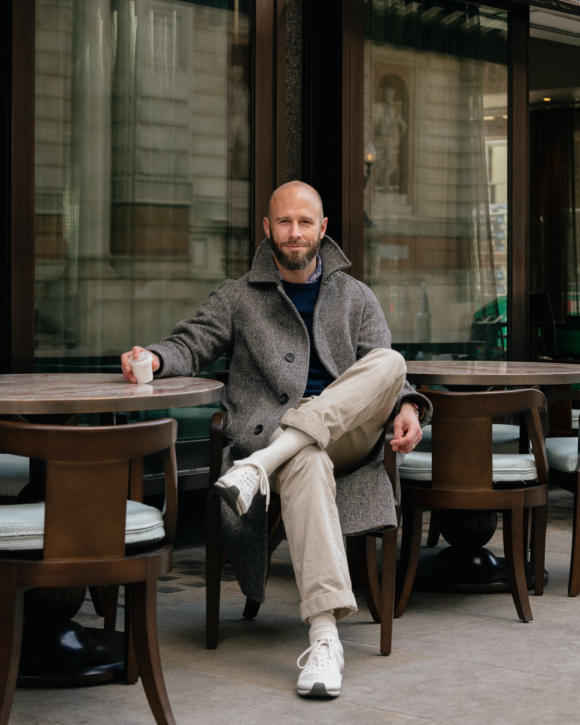
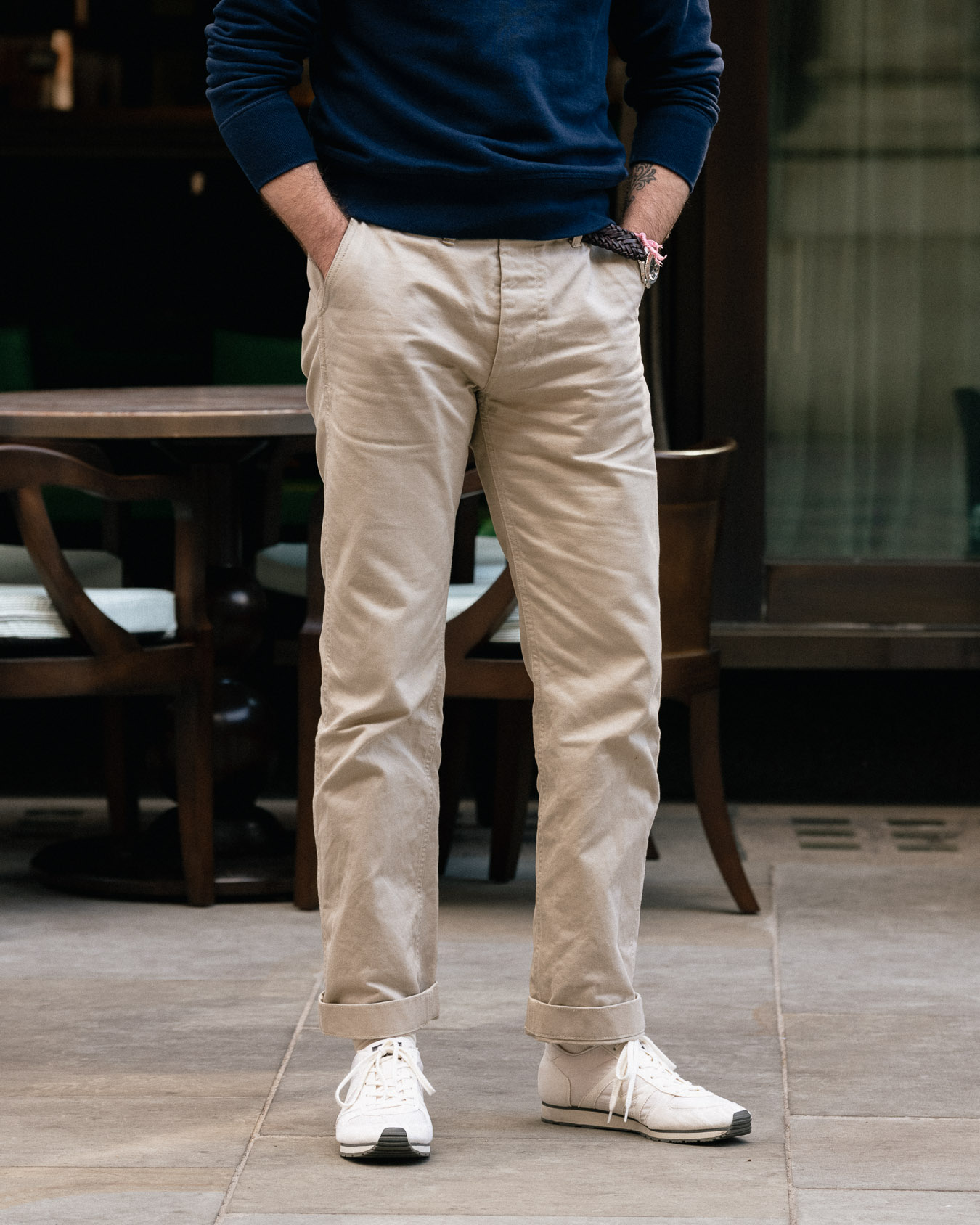
If the last chinos we reviewed in this series were a little more unusual (from Casatlantic) then today we’re back with a very good, very everyday pair.
Similar in that respect to the first brand we covered - Rubato - just more on the workwear end of the spectrum.
These are the Joe McCoy chino trousers from Japanese brand The Real McCoy’s.
As regular readers will know, I’m a big fan of The Real McCoy’s because they generally have the same aim as I’ve always had with tailoring: the highest quality, with pretty subtle, classic style.
Although they are essentially a repro brand - faithfully reproducing American clothing from the 1940s and 50s - the pieces they reproduce are mostly quite understated and wearable.
They aren’t cheap. That focus on quality and precise reproduction means they have to order very small runs of material and hardware, often getting a mill to produce something entirely new. These chinos are £265.
I don’t really care whether the reproduction is precise or not, but I do care deeply about quality. And I’m usually prepared to pay a little more if those two have to come together.

So what makes these chinos so useful, so everyday?
The first is the colour. This pale beige is a standard American military shade, but it’s also an civilian classic. It's the one you wore from Gap when you were a kid, or perhaps from Ralph Lauren when you were a little older.
It goes with everything: navy and black, brown and green, cold and warm. The only possible exception is mid- to light grey tops, like a grey sweatshirt. But even then it can work if there’s some contrast elsewhere, like a white T-shirt or a dark belt.
When I was a teenager, and wearing baggy versions of these from Gap, I’d have a black, long-sleeved Pearl Jam T-shirt on top. (I still wear an old favourite now and again, though usually for housepainting or similar.)
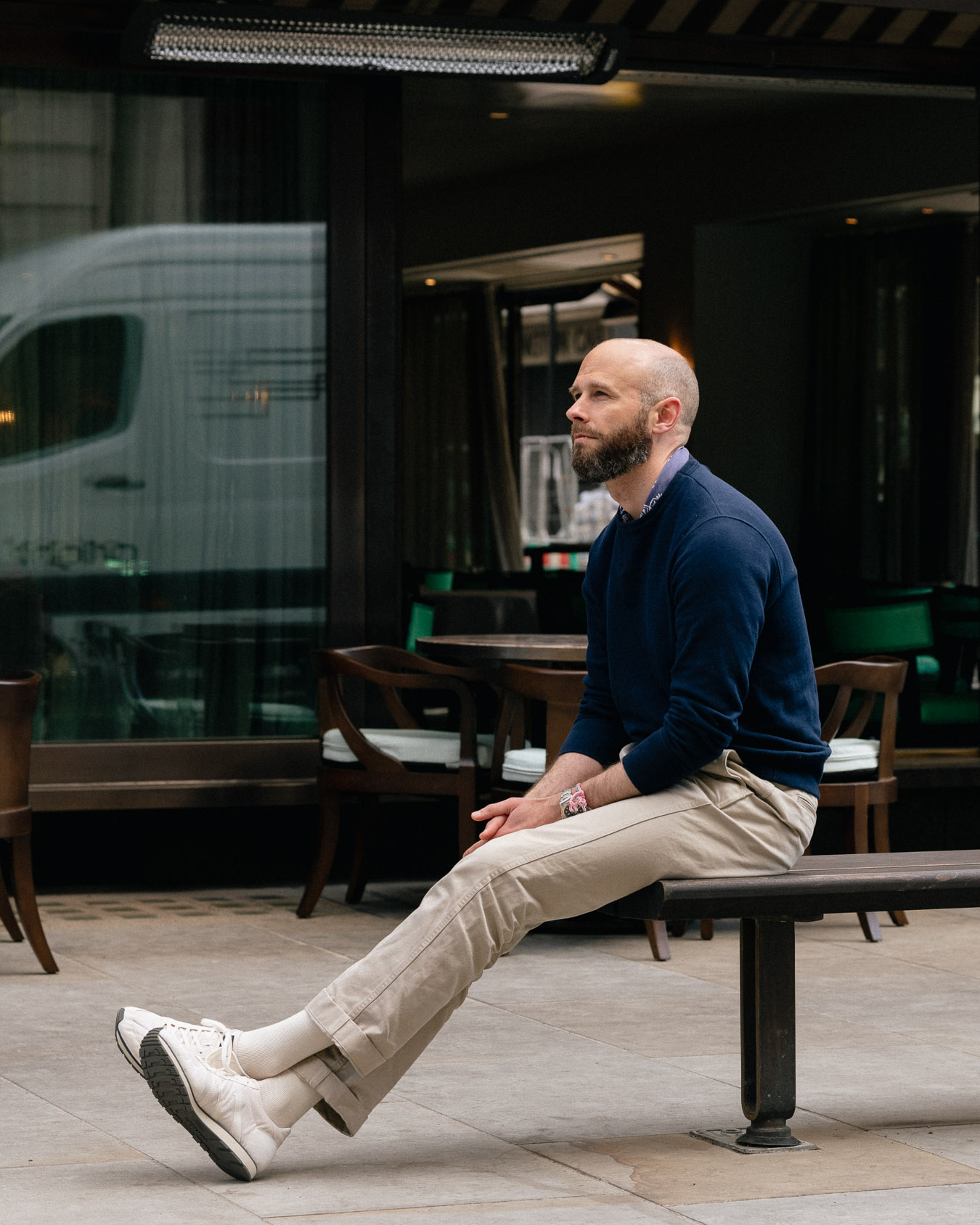
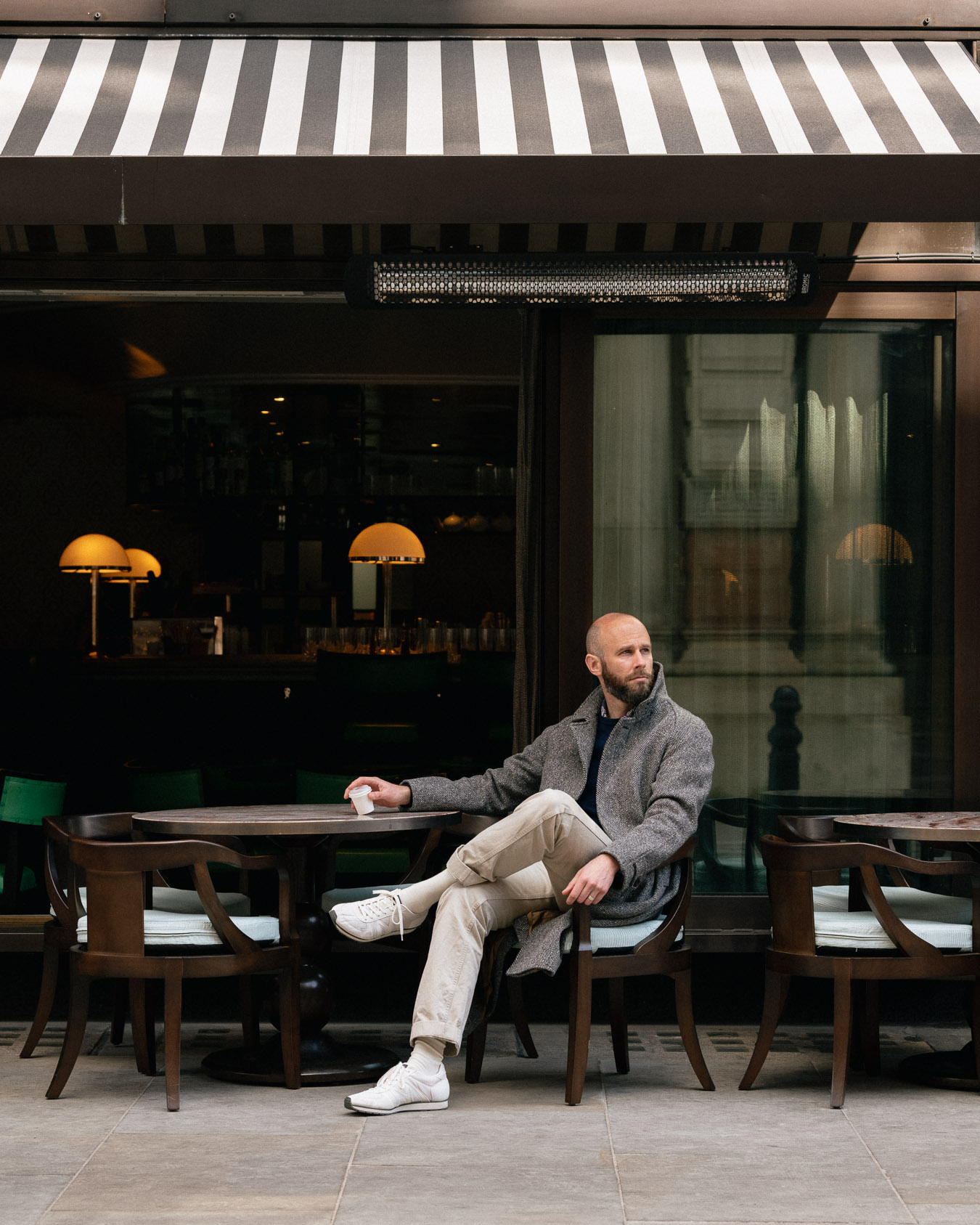
Today, my favourite accompaniments are a white-oxford button-down shirt, or a blue sweatshirt like the one from Merz b Schwanen (via Trunk) shown here. That’s a size 5, worn with an old blue cotton bandana.
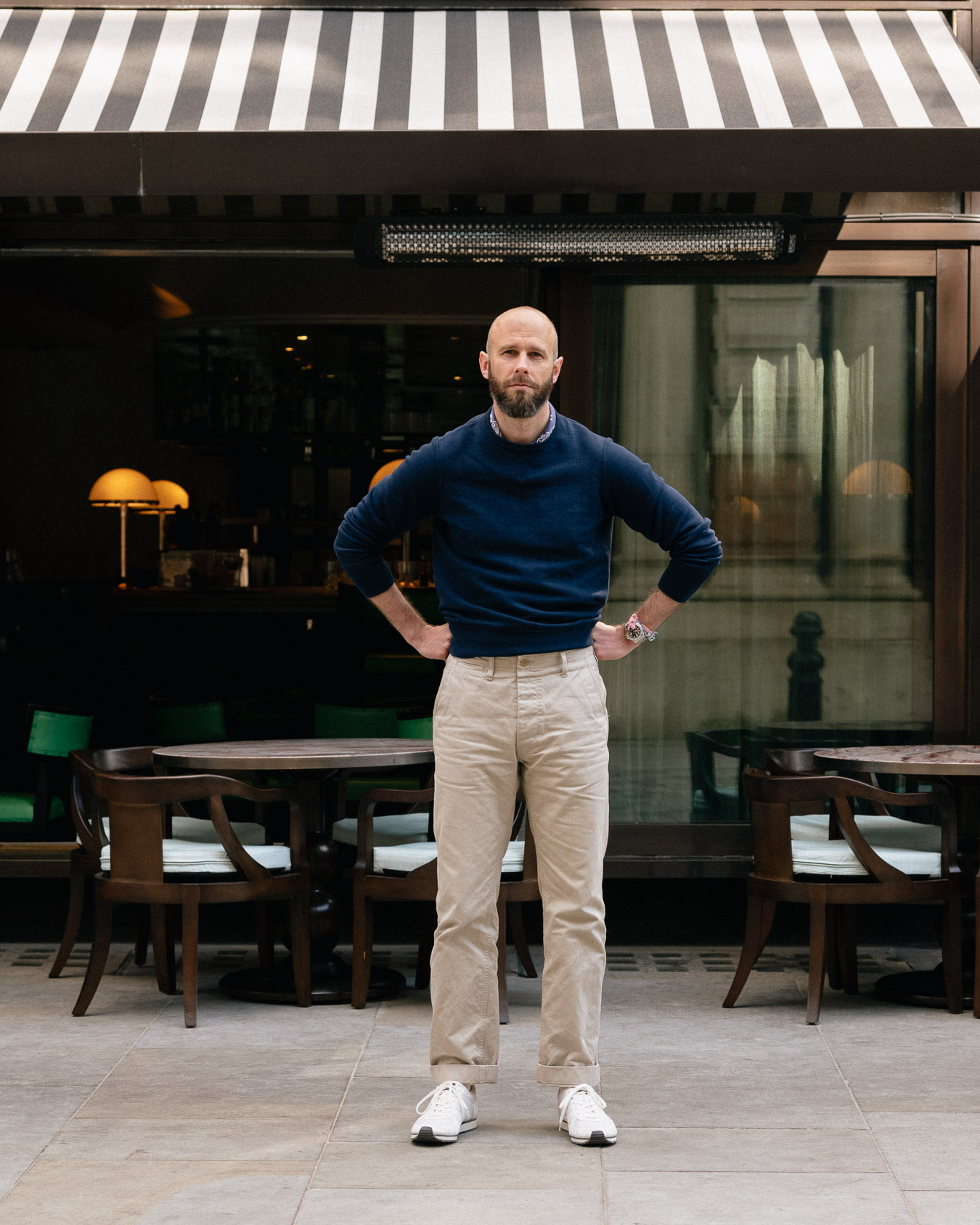
The other thing that makes the McCoy chinos so everyday is the cut.
These are not original military wide-legged or high-rise chinos. They have a hem measurement of 20.5cm and 29.5cm at the thigh (in this, a size 32). They are slim, though not skinny.
Compare that to the more common shape of classic menswear chinos, like the Armoury Army style, which has a hem of 23.5cm and a thigh measurement of 31cm.
McCoy’s does do a wider-leg chino too, the US Army 41. But this Joe McCoy pair is specifically inspired by the ones Steve McQueen used to wear. Often with a sweatshirt, and most famously in The Great Escape.
Interestingly, The Real McCoy’s doesn’t have the licence to use the McQueen name, but another Japanese company called Toys McCoy does. The two used to be part of the same outfit, along with Freewheelers, but the three split into different labels years ago.
Son of a Stag in London stocks Toys McCoy and I have tried their official version, but prefer this pair.
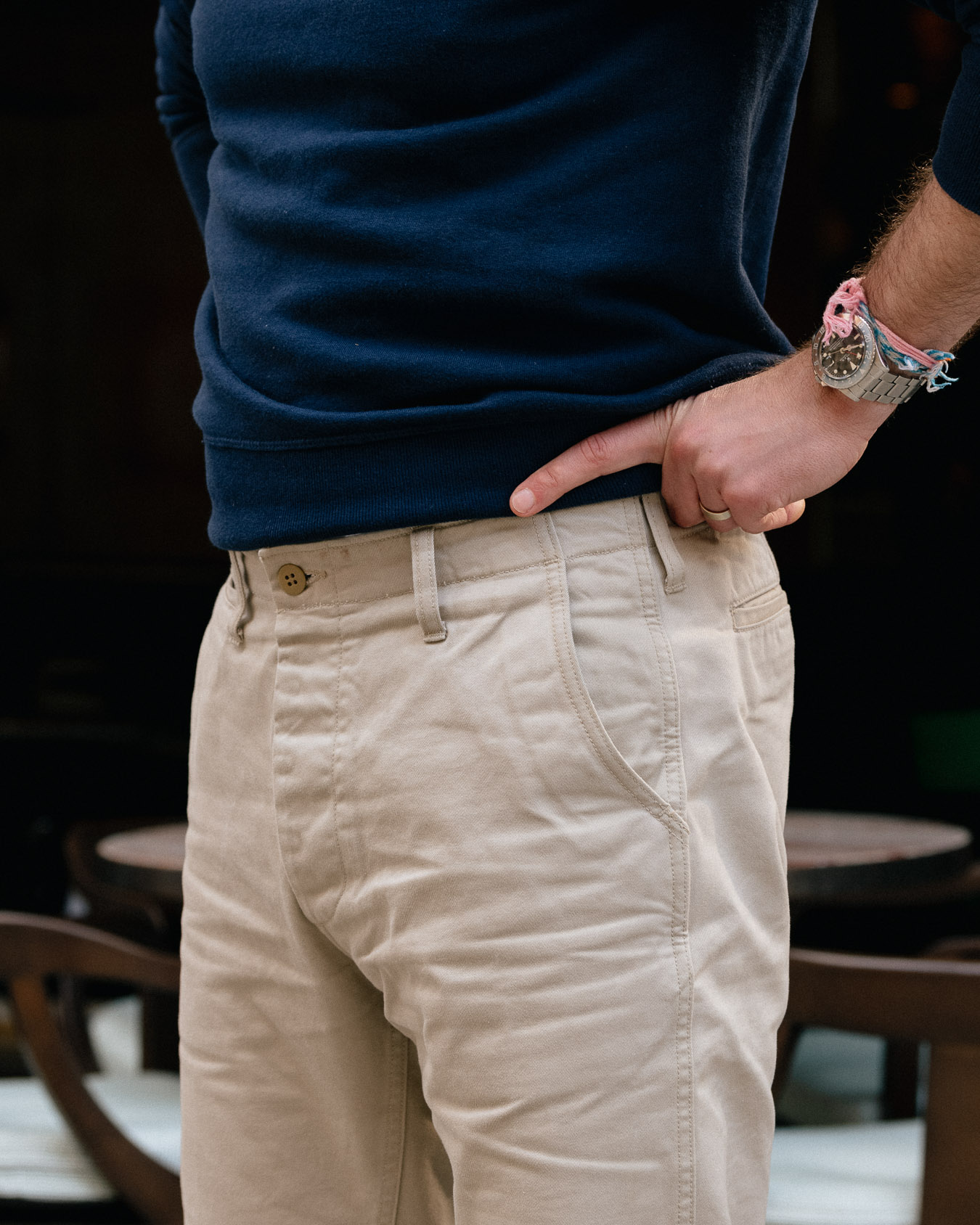
The rise on these chinos is also quite mainstream: I measure the front rise as 28cm inches, although the size guide says they should be 29. They did lose at least a centimetre from the original raw state, as the guide predicted.
That’s definitely a mid-rise, and lower than more Army-inspired pairs. It’s the same as the Rubato pair covered previously, though those are a little higher at the back.
The biggest difference from that Rubato pair and any mainstream chino is the weight and strength of the cloth. It is dense and tough. More so than any other chino I’ve worn or covered.
It’s still nothing compared to heavy denims, like my 21oz pair from Blackhorse Lane. And it has softened nicely after a few washes. But it's that toughness that makes it feel like a workwear chino.
One thing we haven’t talked about in our coverage of chinos is whether the material is a left or a right-hand twill.
In general, most dress trousers are a right-hand twill and most mainstream, casual chinos are a left-hand twill. You can spot it from the direction the twill of the cloth runs down the trousers (top right to bottom left, or top left to bottom right).
What’s the difference? Well, in general a right-hand twill tends to be denser and sharper, while a left-hand twill is more open and softer.
The reason is that the yarn gets twisted in a different direction as it’s woven - often referred to as an ‘S’ or a ‘Z’ twill, illustrating the direction as a letter. A right-hand or Z twill gets twisted more in the weave, and so produces a harder and smoother material.
Below: Real McCoys on the left, with a right-hand twill; Incotex on the right with a left-hand.
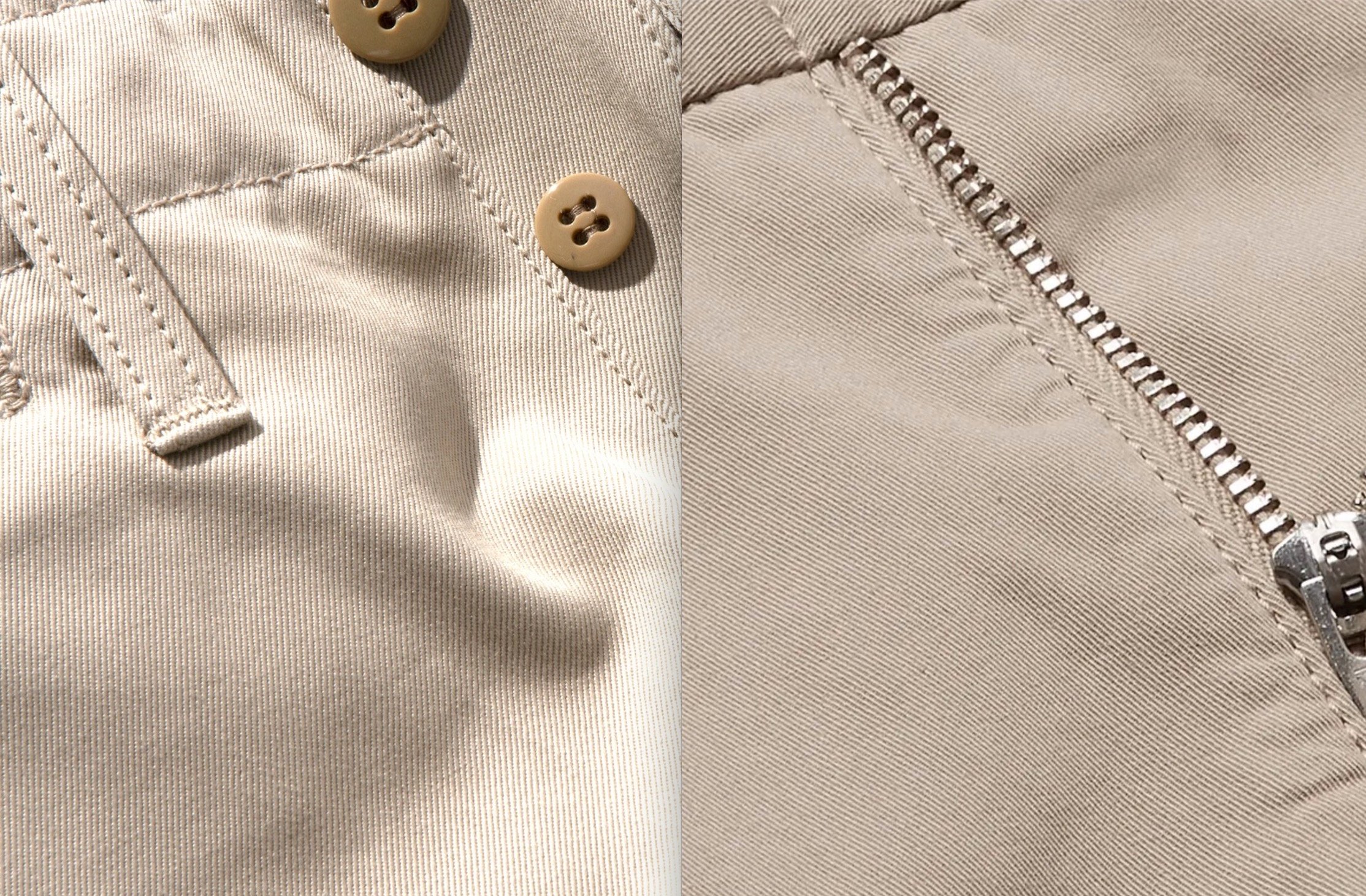
As I said, dress cottons are right-hand, and so are chinos we’ve covered before like the Rubato pair, the original Armoury Army chinos, and this Real McCoy’s pair.
By contrast, the newer Armoury Army chinos are left-hand weave, as are mainstream chinos like Incotex.
When The Real McCoy’s calls its cotton a ‘West Point’ cloth, this is what it’s referring to. Army officers - from West Point military academy - tended to have smarter chinos, with a right-hand twill.
Neither is necessarily better, and as with all cloth, it's only one factor alongside weight, fibre, finish and so on.
In general left-hand tends to feel softer, but there’s also a particular softness about a dense cloth like right-hand cotton which has been worn and washed a lot. Right-hand also tends to look a little shiny before it’s washed a couple of times.
Elsewhere, these Real McCoy’s chinos are finely made, with all reproduction points all picked up as you'd expect, including urea buttons on the fly and pockets.
Often a good sign of a quality make on chinos is the way the back pockets - usually uncovered and unfastened, at least on one side - keep a straight line over time. They are sufficiently reinforced and closely stitched to keep their shape. These do that well, as do my old Armoury ones.
Overall, I think these McCoys chinos are a great everyday option. They’d suit any guy that wants something to chuck on with a sweatshirt at the weekend, and perhaps spend half his day on the floor playing with the kids. They only get better the more they’re worn like that, then washed and worn, washed and worn.
The only issues are inevitably the price, and perhaps the rise. Ideally I’d have that a couple of centimetres higher, at least on the back.
But then, this is really comparing the trousers to bespoke, where you can everything you want. And that’s something I’m trying to get out of the habit with. It rarely happens with RTW.
Other clothes:
- Navy sweatshirt from Merz B Schwanen via Trunk (size 5)
- Vintage blue cotton bandana from The Vintage Showroom
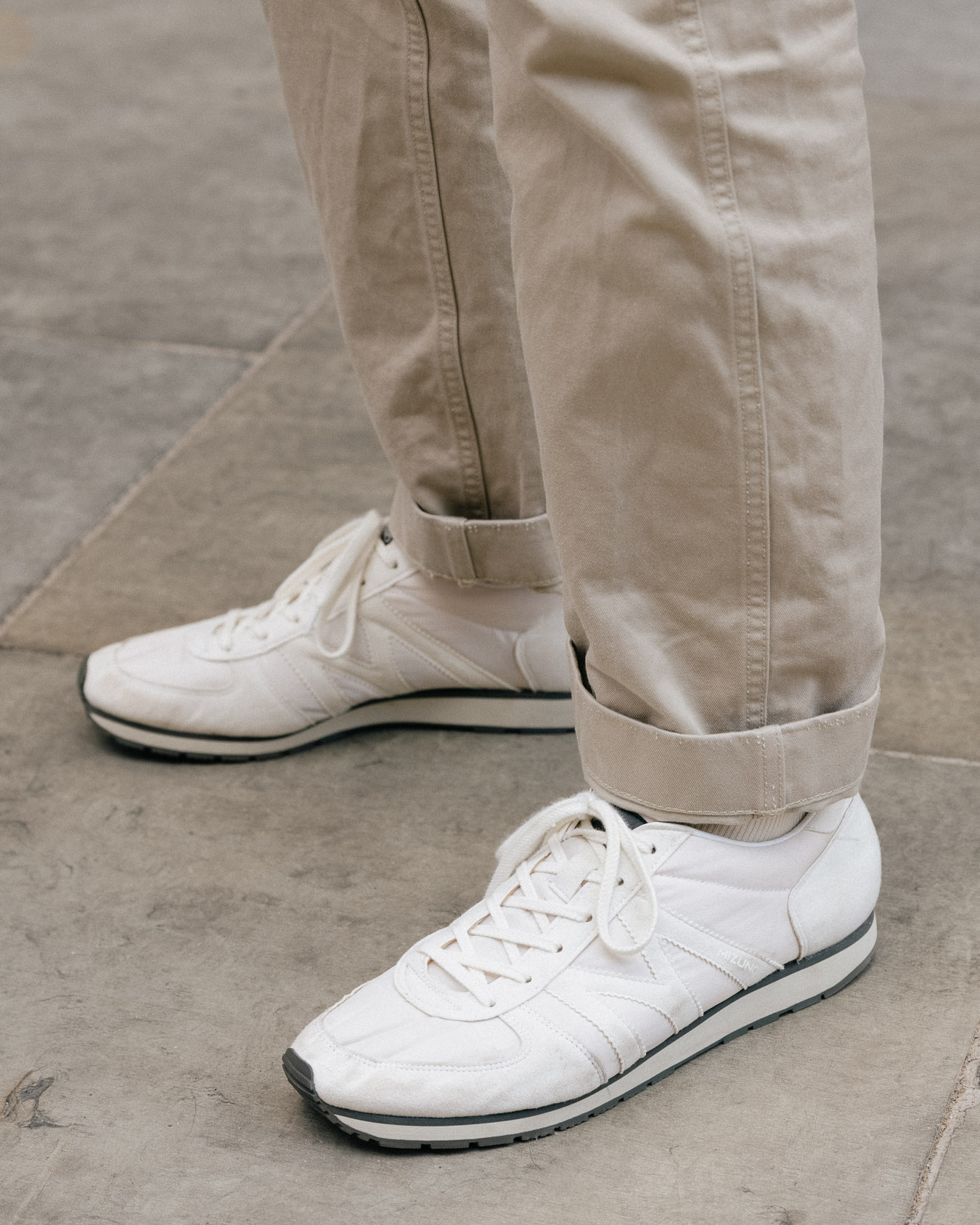
- White trainers from Margaret Howell/Mizuno
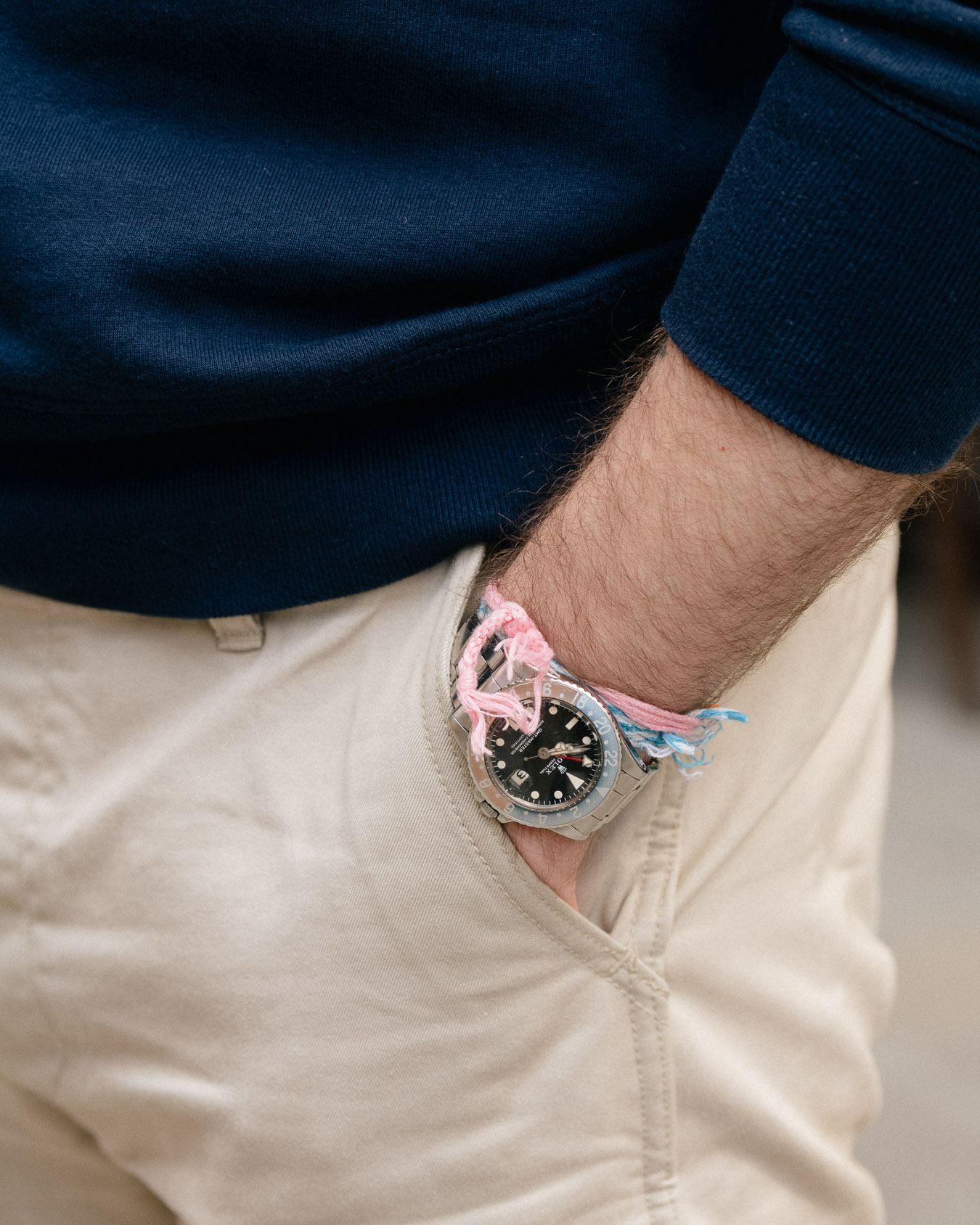
- Rolex watch, GMT Master Ref. 1675 with faded bezel
- Donegal coat, Permanent Style sample
Feel free to ask about any of the clothes in the comments. Most have also been covered previously, but I'm happy to supply the link.
Joe McCoy chino trousers in beige, size 32 waist, cost £265.
Photography: Alex Natt @adnatt










Hi Simon
this isn’t really a question about the chinos im afraid but the coat!
I was just about to buy the ps Donegal cost online. I’ve wanted it for a couple of years and now have a job that would facilitate these sort of purchases. However! The coat in the photos I must say I almost prefer. Will such a thing be for sale any time soon?
Is it as heavy weight as the one in your shop?
Many thanks
Hi Jackson,
No worries. That is one of the samples for the version of the PS Donegal coat we will be doing this Autumn (we do a new one every year). The final one is unlikely to be exactly the same, but it will be a grey herringbone. The weight isn’t decided yet either I’m afraid, but it will either be the same as last year, or between that and the previous year (which was lighter).
Thanks
Thanks a lot, Simon. Interesting!
Here’s a slightly awkward question for you. Would you recommend the Donegal (the one currently listed in the PS shop) to function as a man’s only overcoat?
I hope to get a bespoke coat made, but probably not for a few more years at least and all of my current coats are, well, quite rubbish. Except for one nice dark green unlined coat from Caruso with big patch pockets and a belt. Looks nice, but is so thin that it’s basically no more than a long autumnal layer. I’d be wearing the PS Donegal with jeans and knitwear, but also with tailoring to the office. What do you think? Would I be better off going for something more structured? I can never tell, really, whether the effect of raglan sleeves is a wonderful one or a slightly strange one. Both perhaps.
Jackson
Hey Jackson,
Yes you’ll have to make up your own mind about how much you like raglan sleeves. But they do have the advantage of making a more casual coat that can work with jeans – most more structured coats would not.
If it’s your only coat, I think I’d probably not recommend the current iteration – the dark brown. I love that colour, but it’s not as versatile as the charcoal from two years ago, or the mid-grey that’s coming this Winter. So depending on what you decide about raglans, I’d wait and get the mid-grey one.
It would be a little casual for suits, but nothing is really going to cover every level of formality. And this probably comes closest.
S
Hey Simon
Certainly food for thought. I’ll have to have a think about raglans. Kind of like the re-adjusting of your eyes when looking at an optical illusion, on the one hand I think they look rather louche, effortless and simultaneously dramatic yet on the other, a bit anachronistic and ‘old-manny.’ It’s a hard call that I’m probably too indecisive to make!
I’d likely not wear it with a suit since I very, very rarely wear them. More likely occasionally with flannels, jacket and tie at the smartest end of the spectrum for me. I may well wait for the mid-grey to arrive!
As ever, thanks a lot for the advice. It’s much appreciated.
Jackson
No worries Jackson.
Sometimes with a Donegal, by the way, it can be the way you wear them.
Put the collar up, fasten with the top one or two buttons, plunge your hands in the pockets. Tie a bright scarf at the neck to let it flow out loose
around the neck.
Things like this are often described as ‘attitude’ but it’s more about little ways of wearing.
Many thanks, Simon. Agreed!
Final question for you, if that’s ok. Would you wear a grey herringbone sports jacket under the PS brown Donegal? Or is that too much of a texture overload?
No I would, I think that would be fine. You can’t really see any pattern in the brown donegal
Interesting! Might have swayed me there then. Thanks again
The only other piece I could recommend for total coat coverage is a Loden. I have one from Cordings and whilst not super fine make it can do everything. Isn’t Uber warm but I run v hot
Hi Simon, very excited about this iteration of the donegal coat! FWIW, I would personally vote for a fabric equally as heavy as last year’s. I know there are many other considerations, of course.
OK, thanks Alex
So will the sample Donegal coat turn into a PS offering? It looks great.
Hi Haack,
As mentioned above, it isn’t decided yet. The new model will be a grey herringbone, but this is only one of a few samples we’re looking at, with variety in both the colour and thickness of the yarn, for example. But thank you.
Hello Simon
I missed the brown donegal from last year and can hardly get over it (;-)
Any chance of finding one anywhere ? Is it definitely not going to restock ?
Although i am a big fan of herringbone, i lean towards browns much more than greys.
And thanks for your enlighting posts as always. I own a kaki Chino from the real mccoys and love them. Quality and feel are amazing and get better with wear.
Cheers Alain.
No, I’m afraid there are no current plans to restock it. Sorry.
Very excited to hear that the new model will be in a grey herringbone! I’m sure you have plenty of input already, but I’d prefer a heavier fabric to a lighter one.
Noted Andrew, thanks
Whilst recognising that there are clearly a lot of readers to whom chinos are important, I personaly find it very difficult to get excited about them. To me they seem the most pedestrian and least interesting trousers this side of jogger bottoms! Too ‘petty corporate’, perhaps too puritan. Nevertheless another comprehensive review in what is always an interesting read.
I can see that Darryl. To a lot of people, perhaps more in Europe than the US, they seem quite dull and ordinary.
I think there is more attraction when you like aspects of Ivy style – where they can really come alive, as a base for colours, shirts and accessories. And when you’re dressing down more, and want an alternative to denim.
Interesting comment from Darryl but I agree with Simon. I’m increasingly drawn to chinos. To be sure, I associate some chinos with “petty corporate”–mainly those from J Crew or Banana Republic (I don’t mean to be disparaging, but that’s the association I draw). But high-quality, well-cut chinos are another beast entirely. They’re probably the most versatile pant around. They tone down a tailored outfit without sacrificing too much elegance, since a well-cut chino will still drape and move beautifully. They’re a useful spring/summer analogue to flannels, as frescos can sometimes be a little too smart, sharp, and crisp, which makes them less charming than flannels and chinos. And chinos are a great denim alternative. They’re just a little smarter and more interesting than jeans (particularly when chinos take on that washed, worn patina), making you look just a little more put-together and well-dressed. And they look great with canvas sneakers. Interestingly, I don’t like canvas sneakers with jeans–I prefer to offset the casual-ness of jeans with a slightly smarter shoe like a suede loafer or chukka. But with chinos, I prefer “grounding” the outfit with casual canvas sneakers. (I recognize my discussion may be equivocating between “chinos” and “cotton trousers”–that’s because there’s ambiguity there and, as this article illustrates, the line between the two isn’t always clear. Still, I mean to endorse both).
All of that is to say, there’s much to love about chinos, including this chino series on PS.
Cordings, New & Lingwood and Charles Tyrwhitt etc. in London for example are not American and feature as casual trousers chinos, so I don’t understand the objection? Or is the objection based on Savile Row, bespoke horizon?
Hi Simon,
I have two pairs of the Joe McCoy chinos and as you mentioned they are expensive but worth the investment. I have had lots of compliments about them.
Regards,
Andrew
Interestingly, seems like Mr Porter now carries a small selection of The Real Mccoy’s as well. This A2 jacket in suede should prove popular, as it’s arguably more versatile than their normal horsehide version.
https://www.mrporter.com/en-gb/mens/product/the-real-mccoys/clothing/leather-jackets/type-a-2-suede-jacket/11452292646805281
Agree. It looks lovely
Did you hem them or just roll up ? I have a pair and have double rolled until now… I think it is too alte to hem as there is a bit of a line on the rolls!
I just rolled, or rather folded up once. I’m not sure if I’d like a double fold or not. It might seem a bit chunky?
Does it matter whether there’s a line on the rolls, given you’ll be cutting those off or tucking it inside, once hemmed?
Another insightful review Simon, much appreciated.
Having just invested in a couple of pairs of Black Horse Lane chinos, your comments regarding feeling more everyday in the case of this offering from The Real McCoy’s resonated with me. Something about the mid-rise and slightly slimmer leg does achieve this, also the case on the BHLA ones (I’m sure you’ll attest). Which at first, I was left longing a bit for the higher rise, wider leg I was used to seeing from the likes of the Armoury etc. but in reality, I find these easier to wear across the board, without feeling I’m coming to close to playing military dress up (much as I appreciate the more traditional style, I’m just aiming for versatility). Particularly when I’m really aiming for a capsule wardrobe as such. I just want well made, robust chinos that outside of a jacket, can wear with pretty much anything. Whether that’s with a leather bomber, a Valstarino, denim jacket, an overshirt, or with a beautiful raglan, which you have beautifully demonstrated here. And on that note.
Of course I have to ask about the Raglan, given how you’ve very smoothly dropped the hint in this post. Over the past 3 years, I’ve told myself every time I’m going to invest but this year I’m committing. The grey looks fantastic, and very versatile but of course my question is, is it as versatile as last years brown? I know I’m jumping the gun a bit here, but you’ve got me asking questions already. The only tricky situation I can see, is of course grey flannel trousers. Outside that, no issues. And I’m sure you may present an argument to counter that.
Ck
Thanks Chris.
I certainly think grey herringbone will be as versatile as last year’s brown. If anything, I think it might be the most useful colour we’ve done, as it brings in some more casual clothing too.
As you say, it wouldn’t be as good with grey flannels, but actually a dark grey is fine. And it is the best of the three we’ve done for wearing with jeans, chinos etc. I think that’s where it’s strength lies – in the same way as my grey herringbone tweed jacket looks so good with those things, jeans in particular.
Thanks Simon,
Very good points. I think that’s what’s settled it in my mind, it just looks so at home in an outfit like the one above. Much as I love the previous two iterations, their dark tone hints at the smarter side of things, which of course I love, but wearing denim and chinos everyday, of the three, this is without doubt the most suited to my current lifestyle. The grey herringbone is a different beast. The moment I saw it, in my mind I thought “That coat will look amazing with denim”.
Good point regarding the darker grey on the bottom for smarter occasions, I can see that working well.
Time for a waiting list request I think.
Ck
Respectfully, I think the charcoal herringbone was clearly the best Donegal. Charcoal donegal is so pleasing, with the white/cream flecks—it’s my favorite Donegal combo. Looks great with grey flannels. And I’ve always loved charcoal knitwear with denim. Losing grey flannels with the new Donegal would be a big loss. While I understand the appeal of trying out new colors each year, I hope the charcoal Donegal becomes available again.
Thanks. I do still love it, can see the appeal. It’s more just a move of the spectrum – this is a touch more casual, so good with tailoring but not as smart as the charcoal; but on the other hand better than the charcoal with jeans, chinos, cords etc.
Ii I had to have one coat, I’d go with the navy bridge coat. I’ve worn my PS version with jeans, with a navy suit, and everything in between. I wouldn’t wear it with a dinner jacket, but otherwise covers the full spectrum as far as I’m concerned.
Simon,
Having read the wonderful and informative articles on Chinos, and as someone who is looking for a nice pair that I can wear in a business casual setting (potentially with a Neopolitan Jacket), it would seem to me that Stoffa tend to be at the highest end of the offering whereby one could get them M2M with Rubato a close second..? Would that be a fair assessment..?
Yes, I think that’s bang on Joe.
Also, if you want to wear them just in that business casual setting, and less with trainers etc as shown here, then tailored cotton trousers work well too. Something like Stoffa’s cotton twill is more in that line, where the basketweave I have is not quite as smart.
I really feel this review Simon, the colour and the overall style of these Joe McCoy chinos are so pleasingly simple and versatile. Add the fact that TRM’s quality is nothing to scoff at, and this certainly falls under the category of foundational piece.
They’re in the exact same dimensions and proportions as my own trousers, cotton or otherwise. None of those are as easy to put on as they used to be just a year ago, so I’m likely not imagining that I’m out of shape. I should be more consistent in my attempts to break my current sedentary pandemic lifestyle if I want to wear these chinos. Ha!
Oh, I forgot to ask Simon. When you measure the thighs of your trousers, do you do it at the fork or at a specific point mid-thigh?
At the fork
Copy that, thanks!
As an alternative i would recommend the chinos from TELLASON, similar but for me the better fit, quality about the same level in my opinion. I think Real McCoys is a decent brand, but a little overpriced for what they offer.
Cheers Dieter.
I think with The Real McCoys there is always that authentic repro element you’re paying for, plus getting from Japan of course. Nice to have another recommendation.
Yes i agree, i also like their sweatshirts. I think Real McCoys is probably the best of these kind of repro brands from Japan. I have an older chino from Studio D’Artisan which are also very nice, for me perfect for this kind of chino. To me these kind of chinos are perfect as casual trousers as an alternative to jeans, i do not see them as dull, but there are always different opinions. As you say they are very versatile, very easy to combine and wear with many other items, very uncomplicated.
If we’re suggesting great casual alternatives, as a huge The Real McCoy’s fanboy, I’d also put out there Rogue Territory’s Officer Trousers.
Hi Simon,
Great article, as usual. Specially now that the new normal appears to be going in a much smart casual, or casual chic as you named it, direction.
One question regarding the sweatshirt. How does Merz’s loopwheeled sweatshirt compare with the Japanese ones? Any difference? Have you tried their loopwheeled tees?
The Merz sweatshirts are great, really nice staples. But I’d put them in the bracket of a Smedley polo or a Sunspel tee – great staples but not the finest quality in the world. I definitely prefer the high-end Japanese ones.
I think the Merz sweatshirts are well made but with a weird fit. Did anyone here tried the new Sunspel sweatshirt in Sea Island cotton? Could be good. To me Smedley polos are among the best i know, i think they are great.
These might be details you don’t care so much about Dieter, but if you want a comparison of Smedley make with the finest there is, check out the examples on our cardigan here and knitwear here.
Thank you Simon, i will read it. The Smedley polos are certainly not the most durable, i think the main reason is that they are thinner and finer than many other polos. You are right, i generally dress more casual than you (being semi-retired) and do not care for details so much, i mean a bit less. But i still like to read your blog, you keep a high level & style in my opinion.
Thanks Dieter, that’s nice to know.
The reason the Smedley polos aren’t as robust, by the way, is that they are made like knitwear, not like a T-shirt (as a regular polo is). They need to be washed and treated in the same way you would do a thin sweater.
Apologies if that was obvious!
Yes i know (made like knitwear). I think it’s not a problem, just washing at 30 degrees and inside out in laundry net, never had problems that way. They just wear out a bit earlier than some other more robust polos. Of course one should also air dry them. I treat regular polos the same and they keep their shape and condition longer that way. What do you think of Zanone polos (in their so called ice cotton)? I like them.
Oh good.
I’ve had Zanone ones in the past in that material. They’re not bad, and I like the material, but it’s still that soft small collar, which I don’t like.
What do you mean by „weird fit“?
@Simon: anything unusual that you noticed yourself?
Thanks
Not especially, no
I was just about to press the order button on the Incotex chinos-although I really wanted a heavy, military pair so was demurring. Do you expect the colour to fade over time or just to soften?
Many years ago, I owned an original pair of these(summer service trouser iirc) and these seem to be very accurate.
Not sure on the colour actually. It might fade slightly, but probably only slightly
Hi Simon
Big fan of the blog, in terms of chinos there is a lot of hype around Spoke , which offer more detailed sizes ie waist sizes in odd numbers and three choices of builds in terms of wideness of the leg ,not sure if they use left or right hand twill,but in my mind it is sorta like a pseudo made to measure.
I’m not sure what you would make of this if it worth the hype or just marketing?
I did try Spoke a few years ago. It’s a really interesting business model, and good to be able to offer all those variations. But the quality is way off any of the trousers we cover.
I’ve tried Spoke and find their chinos to be ok. I can rarely find any RTW trousers to fit. I have a slim waste but larger, athletic legs so thought they would be ideal as they offer 3 leg widths to accommodate.
The main issues are durability and shrinkage. The chinos fit me perfectly until they are washed at which point they become tighter in the lower leg leading to bunching around the knee as well as in the waist. This does not loosen again with further wear. A larger size would not solve the issue as that would throw the overall proportions out, especially in the seat.
However, their customer service is fantastic and they replaced a pair of chinos that developed a more significant fault after more than a year. But overall, sadly I won’t be buying anything more from them.
Thanks SL. Yes that doesn’t sound great from a performance point if view over time.
I can understand why some people find chinos pedestrian. However, it is really difficult to find stylish RTW chinos and knitwear.Yesterday I ordered some heavily discounted chinos from Cordings,down from £145 to £50.Assuming they fit I know they will have to be slimmed down to fit my aesthetic. That said,the alterations will cost me nothing (I will do it myself).It’s such a pity that high street stores offer such unstylish products.
I didn’t see any Cordings sale £50 chinos, maybe you mean needlecords. By the way, just about two years ago Cordings added 2% stretch to their otherwise 100% cotton chinos to advantage.
They were only on sale for a day(part of the khaki drill suit)at that price then the sum increased to £125.I guess somebody at Cordings made a mistake over the original sale tag at £50.
Simon,
apologies for the double post on this article, but it’s been a stimulating one on a number of levels, chinos, the outfit and of course the donegal.
My last question is regarding wearing bandanas. I don’t think I’ve seen a single outfit you’ve worn that hasn’t been slightly (and subtly) elevated by the inclusion of a bandana under a crew neck (Merz B. sweat in this case, but also knitwear). And this particularly hits a note when you consider how much more casually many of us are dressing. I know you have your reasons for wearing one, but those aside, to my eyes it just adds a certain something, making the outfit complete. Clutch Cafe’s offerings are tempting me.
I think I asked this recently, can’t remember where but can we expect a ‘wearing bandanas’ related post at some point soon? Perhaps just as importantly, the occasions you wouldn’t wear one. would be very helpful.
Ck
Thanks Chris, and please don’t apologize about commenting more than once!
One of the nicest things about PS is the intelligent, informed and civil conversations we have in the comments, so please always add to them if you have anything to say, or to ask. I know all readers benefit from them.
On bandanas, yes I’m planning an article on them. I’m pleased you think they work so well.
Could you squeeze in ascots in the same piece,Simon?
I don’t really wear them Peter. Unless you mean just a way of wearing either a bandana or a silk scarf
Ascots seem favored by German students at Heidelberg.
I have a couple for autumn. Just for a splash of colour.
Thanks Simon.
Amen! Truly, there’s no where else that facilitates such conversation. You don’t need me to tell you about the value of that!
Fantastic, I look forward to that one.
Ck
Hi Simon: Are you still planning an article on bandanas and ways to wear them? I think this would be very useful in a time where opportunities for wearing other decorative cloths (like ties or pocket squares) have diminished.
Ah damn, good point, that one had slipped right down the list! Sorry I’ll get back on it.
I’ve been waiting for this review for a little bit now. Glad it is finally here and it doesn’t appear they disappoint. As someone who lives in a very hot part of the U.S. (Texas), I’m wondering would you consider these for year round wear, or would they be more of a cool weather chino. I generally “run cold” (skinny arms and legs I guess), but I would like to know if these would be appropriate for a hot summer as well as our cool, mild winters. Thanks as always.
I think they might struggle a bit in a hot Summer. Even now in the UK, when it’s touching 30 degrees, I’d think twice. But then it’s rarely like that here for long.
Simon,
Two follow up questions:
1. Is there a similarly styled chino you would recommend for summer?
2. In US sizes I typically wear 32-33. Now obviously that varies based on the brand. I have in the past worn 31-34 based on the particular brand. Cheaper brands I generally wear a 32 while brands that fit more true to size I wear a 33. Would you have a guess based on how this brand fits?
1. Not that I know, no
2. I’d say this is fairly true to size, it certainly was for me. But the best way to tell is to check the measurements against other chinos you own
I’ve never been to the SW – Texas (where cowboy style is at home), NM, AR, but I thought it was too hot to exist without air conditioning?
Hi Simon, great review, and I really love this chinos series. Quick question, with all your passion and pursue for the right pair of chinos, do you have any plans to bring out your own design in the spirit of PS?
No, no plans. I am working on an interesting chino project with a tailor, but that won’t be to offer something RTW
Simon, do you still prefer your old Armoury military chinos over these? If yes and the model is no longer offered (as you mentioned before, there have been several changes since), why not consider some kind of PS collaboration to effectively reissue that model? I am sure you will find good reception for it.
Mark and I have talked about it. We’ve had issues getting the same cloth and a good maker, but if might still happen some day.
In terms of preferring them to these, yes overall I probably do, but these are a more useful colour – the old Armoury ones are more of a brown beige
Relatedly, Simon, what do you think of The Armoury’s sport chino? I love ’em. A little slimmer than the army chino, and good pale/cold shades of beige and olive. Work well with tailored and casual ensembles.
I haven’t tried them in a long time. If I remember, the rise was pretty high for me?
When you talk colour and colour difference, do you ever consider Pantone labels?
Nice idea Peter. I’m not sure everyone knows the Pantone colours enough for that to be a helpful reference without looking them up every time. But it would certainly be consistent
I naively presume the colour dyes of cloth and clothes manufacturers fit Pantone system and identification.
No, they don’t at all Peter. Everyone comes up with their own shades and colours, and often vary them from year to year, even very slightly.
For a geeky example, see article here with M Colban of Charvet, where we discussed how shades of white have changed over his time.
Is the Armoury`s brown beige similar to the colour of the ones from Black Horse Lane?
Yes, pretty similar
Hi Simon,
Have really been enjoying this series of articles. Thank you.
I purchased a pair of the Armoury Army chinos based off your recommendation. I know they aren’t the same as yours but was curious if you tapered the ones you got? And if so, by what dimensions. I much prefer the way yours look but not sure if it was a tailoring choice or if the model changed that much.
Thanks again,
I didn’t taper my ones, but the leg line was different to the current version.
The dimensions of my ones are:
– Thigh 13″
– Knee 9.5
– Hem 8
It’s a shame that most sizes appear to be sold out on their website. I was considering a trip to their store in Covent Garden to try a pair, but as they don’t have my size online I imagine the shop won’t have them either.
I think they must have sold quite a few. They had most sizes yesterday!
The shop in Covent Garden has been closed for more than a year by the way. They’re opening a new one on Sackville Street
Ah, thanks for letting me know. I thought they might have closed, but wasn’t sure if it was due to COVID and that they had re-opened since shops were permitted to do so. Sackville Street’s a definite improvement over Covent Garden.
The new store, is that one opened yet? Im traveling to London in September and would love to see their goods live
It’s not open yet, no. There have been delays because they need to get people over from Japan
Hi Simon,
You can count me in for the PS Donegal this year. I hope it’s going to be sufficient stock and not happen like The finest polo , they went really fast.
We will be buying quite a lot, Michael. But as ever you should be fine if you put your name on the waiting list and so get first access.
It’s always trickier with completely new products, because there’s no waiting list and because we don’t know how they’ll sell
Simon,
Thank you for another great review. Can you talk about sizing for these chinos? Per TRM’s website it seems like sizing up is appropriate.
Best,
I took my regular size (32) and that worked for me. Why did you think of sizing up?
I wear a size 32 in 45RPM and other of the rack pants/jeans but when I measure the waist on my pants they are closer to 35 inches. So unsure what size to take here.
Go off the measurements rather than the size you normally take. (Bearing in mind what their sizing says about shrinkage)
Hi Simon – how would you look after these chinos? Is it a dry clean job or home washing and ironing?
Home washing and ironing – they’re pretty tough. I wouldn’t even iron them much. Only very basically
Dear Simon,
So left-hand means from left down to right, right-hand means from right down to left?
West Point is equivalent to Sandhurst, right? Any military
academy of U.S. government its students are to my knowledge not called officers, rather cadets. It is true West Point is to train future officers. If you refer to officers at West Point, you refer not to its students, but to that part of its faculty which have this rank.
It’s not referring to those that are studying there Peter, but those that have.
I have these chinos in both the beige and brown. They are incredibly study and my default trousers for weekends on my hands and knees with my son. The sturdiness is also very comforting. They are very thick which, in the UK at least, extends use to mild winter days. Definitely not for hot weather, but that is when the linens come out. The beige is extremely versatile and definitely the capsule option. But I have found the browns to be great for getting messy and, in my experience, lighten quite substantially and with really distinctive fade marks from washing drying. The one caveat is that they do shrink hugely in the first couple of washes so if they fit perfectly out of the box then I would definitely recommend upsizing.
Thanks RSH. Are you tumble drying as well?
Yes I am tumble drying. Was that a mistake?
Usually, yes. I believe the care label says not to, and it’s generally a bad idea with finer clothes. It wears down the cloth faster, and accentuates any shrinking.
Wow the athletic trainer debuts on Permanent Style!
Yeah, I was surprised no one picked that up earlier!
I have actually shown things like that before – eg the Weekend Capsule here. But these ones from Margaret Howell are much nicer – they have that 70s slimness that you get with things like the current Nike Challenger as well, which sits better with a lot of the clothes we talk about
I’m slightly surprised at the lack of comments on the trainers as well!
This is something I’ve been giving some thought to recently as during lockdown I’ve started walking much more (everywhere, and not purely for exercise; for example a nine mile round trip for dinner a few days ago), to the point where I feel the need for something more comfortable than Common Projects or Converse.
I’m loathe to go full-on modern sports trainer even with non-sportswear (lest I end up looking like an American tourist!) so had been considering the Nike Tailwind 79 but will have a look at the Challengers and Margaret Howell’s; just wondering if you’ve done any longer walks in the latter?
Yes I have Alex, and they work well. Great support as well as being comfortable.
Simon, thanks for this. These look like the ones I’ve been after but can you comment on the weight? Is it like a 3 or 4 season? I live in UAE and overly heavy Chinos dont work well
Also, would love an article on the rise of trousers. I confess to not understanding it but know it makes an enormous difference
Hey Andrew,
Yes I wouldn’t really recommend them for the UAE. Fine inside obviously, but very heavy for outside.
There is an article here on trouser rise, in case you missed it?
Hey Andrew, I’m also in the UAE. I’ve been struggling to find chinos that are tolerable for the climate. Luca Faloni has some lightweight options I’m considering. Not sure where these would fall on the smart/casual spectrum.
Thanks for a great series on chinos! One question regarding the sweatshirt. Do you normally take size M in knitwear? I think we are roughly the same size, and I am M in almost all knitwear. Was planning to order size 5 (like you), but Trunk writes that they highly recommend sizing up. What is your experience?
I normally take an M, yes, and this was fine for me
the colour and the cut of these is brilliant, but i really get put off by that double stitched seam on the outside of the leg (pocket downwards, im sure theres a term for it). prefer a cleaner ‘folded-over’ seam. its a peeve that i cannot explain.
Interestingly, double seams like that are one thing that separates military-style chinos from tailored cotton trousers. Sometimes they’re on the outside of the leg only, sometimes only the inside, sometimes both. But not having them at all would look a little odd in a chino like this, I find.
Great piece, Simon. I love the colour and the cut. I have quite a few vintage US Military Surplus trousers in both heavy wool and cotton, as well as wool/poly blends in USAF issue. I really like the high rise and snug, flat front fit around the waist and hips.
However, I would love to know the weight of the cloth used in these McCoy trousers. I am wondering how they might compare to the heaviest trousers put out by Bill’s Khakis here in the US. My favourite is the 10.2oz Bullard Field Pants, of which I have half a dozen in pleated and flat front models and in khaki, stone and olive drab. They wear like iron. The 15th anniversary Signature model and the Bremerton twills are also fine trousers. They are all made in the US. Are the McCoys made in the UK?
Hi,
No, the McCoys are made in Japan and use Japanese cloth – it’s where the brand is based.
I don’t know the weight of the cloth I’m afraid.
Hello Simon,
Thanks for a great article – I’ve enjoyed the whole series on chinos.
Have you had the chance to try on Berg & Berg’s chinos? They recently updated their flat front model to be slightly higher rise and wider in the thighs. I understand these are dressier than the Real McCoy’s featured here, but how would you consider the B&B ones as a slightly dressier option?
Thanks
Hi Nils,
I’m afraid I haven’t tried them. I have tried their cords, which were nice albeit – in the same way as all things I’ve tried from B&B – obviously not the same quality as most things we cover.
How do you think the B&B would compare to Rubato’s chinos that you reviewed previously in this article series? In terms of design as well as quality (although I appreciate it may be hard for you to say given you haven’t tried them).
For reference, these are the B&B chinos I am referring to, which I think are the most comparable ones: https://bergbergstore.com/products/alf-cotton-trousers-khaki
Thanks Simon.
It’s really hard to say much given I haven’t tried one of them. I’d be confident the quality of the Rubato would be higher, and the Berg ones look a little more like a tailoring cotton to me, but again, very hard to say
Of course, I understand that given you haven’t tried them. Apologies for creating such a long thread, but I thought it’d be interesting to hear what you mean by ‘quality’ in this regard. E.g. in your complete capsule article, you mention B&B in the ‘Level A’ category as a good make. What is it that makes you say Rubato would be at a higher quality than B&B?
For someone like myself, as a student with a rather limited budget, I try to find the items at the intersection of good quality and good value. What I mean by quality is mostly quality in the fabrics, which should mean that the item lasts longer. But I imagine that for you ‘quality’ may mean something else, with more focus on the finer details, for example.
I suppose this relates more to the discussion on quality/value you wrote on in the B&B article, so apologies for bringing up an old topic!
Yes Nils, I don’t think we’ll really cover much that wasn’t in that article. But with trousers like this, it’s not really about finer details like handwork, because there isn’t any. It’s more about the materials themselves, then a little about hardware and precision of machine work. On all those points I’ve found Rubato to be better, though B&B is still very good value.
Doubtless the ubiquitous chino has a role in many a man’s wardrobe – Personally I wear my Officine Generale fisherman’s to walk my dogs and on the boat.
It also pays to have a good, well cut pair and these look to be those.
That said, as an item per se, I don’t think they do much to enhance any man’s appearance and the chino, plimsols and crew neck look does nothing to elevate the glum sartorial situation evident on our streets.
On a positive note, the V3 Donegal Coat looks great. I have the V1 and have never looked back !
I feel there’s a disconnect between these sorts of comments and the real world. If people where I live dressed in chinos, a crewneck and clean plimsolls as a matter of course, instead of chunky trainers, poorly fitting jeans/sweats and label-festooned t shirts then it would instantly elevate the area’s style
Well said Alex
Hi Simon, so your email arrived just now, I read your Real McCoy review, I thought yes, the ideal chinos. Straight to the website… SOLD OUT. Frustrating. Might they restock or is that the end of the story?
I’m afraid I don’t know Nick, you’d have to ask them.
They are a small company, so there’s rarely deep stock. But their emails are good at keeping people up to date with restocks.
I know it can be frustrating with small companies like this, but keep in mind that deeper stock means more waste, clothes put on discount or in some other way gotten rid of. It adds expense and waste.
Hey Simon,
I’m 6’5” and so leg length is often an issue for me with off the rack trousers (I’m about 33 – 34 inch waist, but about 37 inch length). Do you have any advice for me on where I should look for chinos of this quality?
Richard
Hi Richard,
Not really I’m afraid. It’s particularly hard with small companies that can’t afford to have a wide range of widths and lengths.
Watch out for companies that sell trousers unhemmed though – that makes it much more likely there’ll be more potential length
Hi Richard, obviously it’s been a few months, but I just managed to try these Joe McCoy’s on and buy them in size 34. I’m almost 6’5″ myself and struggle to find long enough chinos, but these have plenty of length. You should give them a try.
Thanks Simon: another great review. I’ll definitely consider these: I’ve got several pairs of lightweight summer and midweight spring-autumn chinos and cotton trousers but a heavier pair for colder days is definitely a gap in my wardrobe.
I can understand why some people find chinos bland or dislike the association with US business-casualwear, certainly I’d never wear a baggy Dockers-style pair but a good, well-fitting pair are one of the most versatile pairs of trousers a man can own.
Iron Heart also make excellent chinos, very much in the same vein as yours from TRM. High-quality fabric, slim but not skinny cut and the classic light color that goes with everything. And the price…similarly high, but worth it if you appreciate the quality and plan to enjoy breaking them in over many wears.
Simon, do you take a 32 in RTW usually? Would you say they fit ‘true to size’? Thank you
Yes I do, and yes I think so
If this was already discussed, I apologize (I’ve been scanning through the story), but I was curious what you thought about chinos and the often slightly wrinkled affair that they give off. Take for example the shot of your shoes and lower legs. I often try to pair chinos with nice shoes (and not sneakers), as well as button down shirts and cashmere sweaters. Sometimes I throw on a knit tie for the professorial look (that’s what I do). My chinos are always wrinkled after about an hour unless they’re the baggy kind that drape (I prefer a slightly slimmer look). What are your thoughts on this? Should I be concerned about getting something less wrinkle-prone or am I fussing over something I can relax more about?
I think the issue is, Paul, there are different types of chinos, some much smarter than others.
If you have a pair of cotton trousers from a tailoring brand, they will be much smarter than this, and look fine with smart shoes. If you have something like the Rubato pair we covered, they will wrinkle a bit but hold better shape and still look good with smart shoes. But ones like these Real McC ones are the most casual category and won’t drape in anywhere near the same way. They suit more casual shoes as a result.
Have a look at the Rubato article for a discussion of these different types of chinos. Keep in mind that we’re basically just talking about cotton trousers. And you would never think all wool trousers would be the same (worsted, flannel, tweed) so why would cotton ones be all the same?
Where do you consider Bills Chinos in the hierarchy of Chinos? It has been years since I’ve owned a pair and I believe that the company changed owners. Will you be doing a review of them?
I’m not currently planning to Anthony, no. To be honest the styling rather puts me off. But other readers have recommend them, so I will take a look.
Hi Simon, thank you for this interesting article. Please, let me ask you some questions:
1. Would you wear these chinos with boots, full brogue derbies or lofers (the last two in suede)?
2. I guess you wouldn’t wear these chinos with a jacket (even Neapolitan). But what about a shawl cardigan? What about a Valstarino or similar? Or perhaps these chinos are more appropriated to wear with overshirts or M-65 jackets?
3. Can you iron the crease in these chinos? Or you shouldn’t like you neither do with your chinos from Rubato?
Thank you for your help
1. Yes, but I’d err towards the casual end on styles with the last two. Eg an Alden LHS in suede
2. I’d wear them with a shawl and a Valstarino, but you’re right they are more suited to more casual things, like a field jacket, or a horsehide
On the issue of left v. right-handed twills. Is it possible to take one of the twills and cut it at 90 degrees to get the look of the opposite twill, but keep the performance? E.g. rotate a left-handed twill 90 degrees and cut and make the trousers with it pointed that way?
Similarly, is it possible to rotate twill 45 degrees (cut on the bias?) so that it runs up-down or left-right?
On another note, if one wants a high-rise chino that leans as smart as possible, which of the brands we’ve covered would best fulfill that?
No, it doesn’t make any difference what angle you cut it at. You’re then trying to turn the weft into the warp, when they perform different functions in the weave.
It’s not about the look, but about the performance of the material. That isn’t affected by how the cloth is then cut and sewn.
The most you could do is make a garment sideways on the cloth, and make something that looks like a left twill but performs like a right. But I don’t know why you’d do that, and it would have to be a garment with pretty short legs or sleeves, given the width of the cloth. Perhaps a pair of shorts.
If you want chinos that are as smart as possible, get tailored cottons from a tailor or MTM place. If you actually want chinos, then Rubato definitely, though they’re not quite real high rise.
Just to chime in, it would be a very quick purchase from me if you did go for this fabric in the end. The shade looks just right for casual wear.
Thanks
Are you able to provide the detail on the cloth?
I’m afraid not. I did ask the Real McCoys team, but they wouldn’t say anything other than what’s public on their site
Hi Simon,
Very interesting article as usual,keen to find your opinion about Brycelands chinos.
Keep safe.
Catalin
The Brycelands ones are great, just a more vintage style of a very high rise and wide leg, which isn’t my style.
Simon, two questions on loopwheel sweatshirts, if i may:
1) Did you try The Real McCoy’s raglan loopwheel sweater (https://therealmccoys.com/collections/tops/products/loopwheel-raglan-sleeve-sweatshirt-ash-grey)? I think it is a crewneck version of the milk hoodie you have from them. It’s much more boxy than the Merz one you wear here.
2) The Merz and Real McCoy’s loopwheels seem to have a low/wide neckline; do you find they work with your PS Oxford shirts?
Thanks!
1) No I didn’t, sorry.
2) Yes I find they work well. I was wearing that combination here, though unfortunately don’t have a shot of the Merz sweatshirt on.
Have you tried Iron Heart chinos? They too are a Japanese brand, but the rise looks to be abit higher, and they come in multiple cuts (slim to full leg, though the ‘slim’ looks to be equivalent to the Real McCoys ones.
https://www.ironheart.co.uk/chinos-workpants-overalls/
I haven’t, no, but another reader mentioned them too. They’re on my list to try
Probably the closest in style would be Ironheart’s IH-727-KA, seen here https://www.ironheart.co.uk/bottoms/ih-727-kha.html#/549-waist-29/592-colour-khaki. They have a medium rise and a slight taper. I’ve just heard that they’ve discontinued production but that a similar product in a heavier cotton is planned for next year. There are a few sizes left on their website.
McCoys are perpetually sold out of these chinos. Sort of frustrating.
They do make small batches. Although to be fair, I did check before the article and they had stock in all sizes. I think they must have sold a lot after the article
Simon
I have just purchased a pair in olive/pale brown (same chino, they assure me). Do you wash these in a washing machine? At what temperature?
Also, the length is very long (requiring three fold overs- despite me being over 6 foot). In the picture you have only one turnover. Do they shrink significantly in leg length after first wash or do you have very long legs?
The quality certainly seems very high.
Many thanks.
Hi Philip,
Yes, I wash in a machine, 30 degrees and hang to dry.
They don’t shrink significantly in the length – I had mine altered
I think you have identified RHT and LHT twill incorrectly in your pics and description. RHT moves from the bottom left of the fabric to the top right (in your pic its incorrectly labelled) and traditionally creates a more compact fabric. LHT is the reverse moves from bottom right to top left – this traditionally opens up the yarn making it softer handled.
You’re right William, thank you very much for pointing out the error, I’ll correct it now.
Also, “As I said, dress cottons are left-hand”
Thank you
Hi Simon,
Firstly, great site. I find your articles and guidance incredibly helpful.
I struggle with chinos as – after a long day at work – they lose shape and start to look like pyjamas.
My question is on chino weight.
Do you think a 10oz pair in 100% cotton would help? I’d go heavier but difficult to find in Asia especially when I need them to be relatively smart for work rather than workwear.
Thanks!
Thanks, that’s great to hear.
Weight will help a bit, but it’s really the denseness and type of weave that will make the biggest difference. And if you can’t wear more than 10oz then they’re going to be pretty light anyway.
I’d suggest just trying smarter cotton trousers – from smarter brands, a more tailored look. Chances are they will be using a denser, sharper cotton.
You could also look at high-twist wools, which keep their shape more but will be smarter still.
Hi Simon, do you think workwear chinos like this go with your PS Oxford shirt, or are the chinos too casual? And in terms of shoes, would these chinos pair with Alden’s LHS loafers in snuff suede?
I’m trying to work out what i would pair chinos like this with. Or rather than shirts/loafers, are these chinos strictly for more casual shoes/t-shirts/sweatshirts?
Can i ask when you might be posting a review of BHL’s chinos?
Thanks!
Hey John,
Yes, these would go with the oxford shirts and with LHS loafers I think. Both are very casual for their type, though also quite versatile.
The BHL review should be up next week, or the week after at the latest.
This fascination with Steve McQueen in menswear circles whom you reference above is bizarre. The man himself if you read a little about him was a complete slob in his own time, enjoying getting drunk on beers and watching endless television on the couch. Awful person as well by all accounts with many incidents of women beating and getting into brawls. Had deep mental issues. I can only imagine dying at 50 helped to create a personality cult of sorts around his persona. Now a whole plethora of brands cite his wearing some garment or the other, try to use his imagery if possible and generally get on the bandwagon.
All true Rups, but is it really that surprising? Fashion doesn’t care what someone was like as a person, only whether they looked good or not.
Whether they should do or not is a separate question
Hello Simon,
May I ask why you prefer this pair over the Toys McCoys? It’s tempting to buy a pair that’s possible to try on before buying, whereas this pair seems to be online only for European customers.
Morten
It’s a while since I tried on the Toys pair, but from what I can remember the rise was lower still, and the material wasn’t as nice
Hi Simon,
These looks so good. Seems like a high quality pair too. I think american 50s clothing is some of the best, if not the best casual clothing. Always so sturdy and durable.
Putting chinos aside, what’s your take on ecru jeans? or even cream jeans? Where do they fit in the wardrobe?
I recently picked up a pair of ecru jeans from The Worker’s Club. I think they are pretty solid and I like the color and texture of them. Unfortunately my staple brown suede chelsea boots. They are brown with a grey-ish tone to them and I thought they would fit well but they really don’t.
So right now I’m in the market for a pair of new suede chelsea boots that go well with that ecru tone of a pair of jeans and I was wondering what your take is on ecru jeans and what kind of brown colors you would pair with them? I have a pair of really dark sneakers in chocolate brown suede that I think works alright but I feel that they are a bit too dark at times.
What medium or lighter colors on a pair of suede shoes would you pair with ecru jeans? You think a pair of light tobacco colored boots could work or would they be too colorful?
So tl:dr What is your take on ecru jeans and what colors would pair with them, be it in suede or any other material. A pair of pants is obviosly a big piece so whatever color they are will be a center point.
Best Regards,
Felix
Hi Felix,
Have you seen our feature on white/ecru jeans here? I think that might give you some more ideas and insight.
Briefly, though, I find dark-brown suede to be fine with ecru jeans – see outfits in that post. Sometimes the key is what’s worn on top – if it’s a little dark or a little smarter, then dark brown can look fine. But if pale or more casual, maybe a pale colour is better.
If you want that, I’d recommend a paler brown like this mushroom colour. Tobacco can be a little punchy with white, though lovely if you can pull it off.
S
Cheers! I’ll check that out. I actually spotted a really nice pair of chelseas in that mushroom color online, think I’m going to need to have a look at them in-store asap.
Dear Simon! Did you ever come across the chinos (or other items) from the New York label “3sixteen”? So far I have a couple of heavyweight pocket tees from them, which I really like. Their chinos look also very promising: https://www.3sixteen.com/collections/chinos/products/ch-44x-khaki-selvedge-chino
They are using a 12oz cotton from Kuroki Mills and the chinos also appear to have a reasonable rise.
Thank you!
I have seen them, but not tried them myself Alexander. One for list it sounds like
Hi Simon, I’ve always admired these chinos but been deterred by the cost. I like the idea of the raw chino breaking in and improving over time much like raw denim. However how heavy and substantial are these? You say they are great every day chinos, would they be wearable for example for the type of weather we are having in London at the moment? I have a pair of heavy Momotaro chinos I got in Japan which have broken in really nicely but I would only wear them in colder weather. Thanks.
I think you might have a similar issue with these Benjamin, I’m afraid. They are pretty heavy.
Personally I’d be OK with them in this London weather, but only with bare ankles and just a T-shirt or something similarly light on top.
Hi Simon
I tend to have an issue with slimmer fits due to athletic thighs and a smaller waist. Would you recommend going a size up and having the waist tailored in with these seeing as they’re not wide legged?
Cheers:)
Yes I would. That’s usually the best way round to do it
I would strongly promote these chinos. They are immensely comfortable to wear, the make is excellent and the fabric is strong. All clothes I have bought from the Real McCoys have been an incredible joy to own and on the basis of longevity and joy to wear they are affordable. The real McCoy clothes often bring me as much or even more joy than many of my bespoke pieces because they are really really well made and have a great great style to them. They make me feel cool. You don’t have to be a certain type of person to wear work wear and enjoy it. The Real McCoys are really about quality and authenticity. My M-65 Field jacket is just an absolute jewel of a jacket and nobody knows what you are wearing (for me an indisputable benefit). For me they have also been very consistent in sizing which is a pain with Iron Heart for example (I have exchanged 70% of my jeans bought from them/ sometimes I am 33, sometimes 36). It has become for me a bit of cult brand but it’s on the basis of quality and wining my trust that clothes have been thought out and made well.
Nice to have the personal angle Michael, thanks
Hi Simon, i am very tempted by a pair of these coming into Autumn/Winter and was hoping for your thoughts on two style-related questions:
1) Would you wear these just with a tucked-in shirt, and a belt? I ask this as you mention the rise is a little low, so was wondering if you only wear your pair with a jumper over the top.
2) Also, related to the rise, do they work ok with your hoodies from Real McCoys (or other Japanese loopwheel sweaters), given that they are quite short in body length?
Many thanks
1) Yes, I would wear them with a shirt and belt. The rise could be a little higher, yes, but that’s also a little personal. It depends what rise you like in particular. For most guys, this rise would be fine.
2) Yes, they work fine with those hoodies, they’re not too short. They’d only struggle with something only made for high-waisted trousers, like the original Rubato knits.
Thanks Simon, a great versatile option!
Hi Simon, I bought these chinos and am very happy with them; thanks for the recommendation.
Did you get yours shortened? And it looks like you have turned up the bottoms once, about 3 inch? Trying to work out whether I should get them shortened or not (I’ve washed them once and they are a touch too long).
Thanks again.
I did get them shortened, yes. Though in retrospect I might have not had them shortened enough, hence the turn-up
Hallo Simon,
have you seen the khaki one, too? Any thoughts on this particular shade of khaki? Is it worth having both colours, the beige and the khaki?
Thank you
Manuel
I’ve seen it, yes. It looks fairly dark, but hard to know if that might lighten a little over time.
You mentioned that this pair of chinos wouldn’t go with a grey sweatshirt. In my head, khaki chinos and grey sweatshirts are standard casual menswear neutrals, and moreover, I assumed that all neutrals would pair well together. Is there a reason why you wouldn’t recommend wearing them together?
Yes, I find they are too close in colour. Unless there’s something like a belt separating them, they basically look like one colour
Do you still find a pair of khaki chinos like this one the most versatile/useful shade of chinos? Do you think that it would be a good next purchase after a pair of raw denim jeans or would you point to another shade for chinos?
Yes, I find this the most versatile shade.
Whether you prefer jeans or chinos next is really more a personal style choice though – it depends a lot on which you prefer to wear, and fits more with your overall style.
I just bought a pair of raw denim jeans after reading your weekend capsule wardrobe piece, and was wondering if this would be a good secondary pant option? The context of the wardrobe I’m trying to build out right now is a small set of casual items that are going to work in a lot of settings/outfits, much like your aim in the weekend wardrobe piece you wrote.
In that case yes I’m sure they would work well
Just to confirm, the version you have and recommend is the “Beige” version of the chinos, correct? There is also another version available on their website called “O. Khaki”, which seems a lot darker in the photos. I just want to make sure I’m looking at the right pair. Thanks!
Yes, beige
Along those lines, what do you think of the O. Khaki color? The overdyed khaki colour feels more casual if slightly less versatile than beige or taupe.
The reason for the question is that like most here I’m trying to ‘casualize’ the wardrobe a hair and am torn between Armoury’s olive sport chinos (a less casual cut I like in a more casual feeling color currently lacking), these in beige (great, but perhaps too much overlap with the more formal beige trousers/Armoury chinos I have) and these in O. Khaki. Any thoughts you have would be appreciated.
I think you’re right on the khaki – that it would be a touch more casual though slightly less versatile. But I’d go for the make and cut you like best, rather than colour
Hi Simon – do you think these chinos are an alternative to ecru denim? If not, how do they differ and when might you use one rather than another?
They’re very useful, but I wouldn’t say they’re a swap from ecru denim, because the colour will stand out a lot less
Hi Simon
Trying to figure out how versatile these are. Can you pair them with wool crew necks (eg Colhays) as well as sweatshirts? Or are they limited to sweatshirts and other workwear on the top half?
If the latter, then would something like a selvedge cord be more versatile?
yes, they’re fine with wool crew necks
As part of this chino series, any way you’d consider reviewing the new Informale army chinos?
https://informale.com.au/collections/trouser/products/t140-army-chino-american-khaki
I think they look terrific. Sometimes I think a light beige flat-front chino is the most versatile pant a guy could own, working with everything from navy blazer to white t-shirt. These seem to fit the bill perfectly.
Sure. Be interested to know if it’s a right-hand twill. Also, while I like the drawstring linen trousers I have, I find the rise on them a little in between – pretty high, but not quite a real high rise. They slipped a fair bit on me
Ah interesting, I’m not as into the drawstring linen trousers as they just don’t seem useful enough to me. I’d only feel comfortable in those around the house. But I think Informale makes *great* cotton pants, including these Army chinos and also their older T107 fatigue pants. By the way, I see now that you’re warming up to wearing a belt with tailoring. My guess is your next move is wearing more chinos (well cut, higher rise, luxurious cotton) with tailoring, particularly when it’s a bit too warm for flannels. We’ll see.
Yes the fatigues didn’t quite work out for me either in that regard.
But no, on belts I think it’s unlikely I’ll start wearing cotton trousers in that manner. Never say never, but I much prefer wool or linen there, or indeed jeans
Interesting. I own both the olive and chocolate fatigues. They look great with just a t-shirt, but I also love them with a PS oxford and sportcoat. Great high-low look, particularly because, while the fatigues have some obviously casual details, the cut is quite tailored and elegant.
Thanks. Perhaps it’s simply body proportions
Thinking about it more: It is a perennial problem that, when it comes to menswear, there is no spring/summer analogue to flannels. Frescos are too fine and sharp–they’re less charming than flannels. Linen trousers are too rumpled–they don’t hold their shape or drape as well as flannels. The closest one can get, I think, is a well-cut chino made from a heavyweight cotton that drapes, moves, and ages beautifully. More charming and full of character than frescos, but less messy than linen. That is the reason why guys should wear chinos with tailoring (particularly when it’s not flannel season).
Thanks, interesting thoughts. I’m with you on the characteristics of all those materials. But I would still rather wear fresco or linen with jackets in the summer, the choice depending on formality largely.
The only time I can see myself looking at chinos with tailoring is when I’m consciously working a more Ivy vibe – so more slouchy jacket, bigger loafers etc
One of my favourite spring styles is wearing a green wool Teba with chinos , Bass loafer and PS Oxford.
Hi Simon, first time poster – thanks very much for such a comprehensive site!
I visited the The Real McCoys shop after your most recent article and really enjoyed it. I had a couple of questions on versatility / use of the Joe McCoys (which really were fantastic).
1. Most smarter things would be hard, yes. Perhaps a very casual loafer, like an Alden LHS
2. Yes, that would make sense
I’m going to join a number of comments already in speaking up for green, particularly its versatility. The thing about navy and grey is that neither really works for both dark denim and flannels. Green is good for both. Plus, it goes really nicely with cream (where navy would risk being too nautical and grey quite monochrome). And it’s also a natural partner for the typical chino colour (however that’s best referred to … light beige/stone/khaki?) In other words, green will pretty much cover the whole range of trousers.
In fact, for these reasons, I’d love a version of the PS cashmere rugby in green (dark, but perhaps a bit on the olive or muted side of racing green). I reckon that could make a strong bid for being the most versatile piece of knitwear in my wardrobe while also being more subtle and interesting than a navy crewneck. There, I’ve included “muted”, “subtle” and “interesting” – very Permanent Style 😉
Yes! Love it JH, thanks.
Completely agree on green. I think it is hard sometimes finding the right shade, and I’m not sure it would be great in the rugby – maybe better in a finer crew or cardigan. But I find it hard to explain why
Woops – had meant for this comment to be on the recent knitwear post but I had been looking at this one as well and wrote it in the wrong place!
Hi Simon,
Thanks for your thorough review of various chinos. I’m considering going for a pair but would like to have them altered and hemmed. Would you recommend washing them straight after buying and then having them altered?
Thanks.
Yes, that’s a good idea
Thanks.
Thanks. Just thought I’d follow up for the benefit of the readers that I popped into the Real McCoy’s shop today and they advised two cold washes (at 30 degrees) before making any alterations.
Thank you M
Hello. Now that you’ve had these chinos a while, how much shrinkage have you found on the waist?
I’m looking at size 34 due to sizing on Real McCoy website after one wash.
After initial waist shrinkage, if happened to you, are they starting to loosen off again? Thanks
I think that sizing information on the site is pretty accurate. I found they shrunk a touch, but didn’t loosen off again (as denim can)
For a cheaper but still quality alternative, may I suggest Asket’s new “heavy twill chinos”: heavy right-hand twill, straight leg, non-stretch. I have them in beige and it looks like a similar shade to these. Can’t comment on the aging of the cloth yet but they seem very promising. The rise is a bit low-ish but not terribly so. (Note that Asket also has a more mainstream stretch, slim-fit chino; this heavy twill one was introduced only last year.)
Another alternative for heavy non-stretch twill is Officine Générale’s fisherman chinos (available from Mr Porter) which I got in olive after reading a recommendation from another reader here.
Thanks Tom, that’s great. Would you mind letting us know how they wear after a few washes?
Cheers
Yes I will, it won’t be for a few months though – heavy twill is too warm for late spring and summer here in Italy.
I’ve now worn the Asket heavy twill chinos for a few more months, and I’m still very happy about the cloth: it has softened but is still dense and tough. I can’t compare to Real McCoys or other higher-end makers (though I plan to pick up a pair of Rubato chinos in the future), but I still think it’s great value. My only gripe is the fairly low rise.
(In contrast, I have a pair of Uniqlo regular fit non-stretch chinos with a higher rise, but the cloth is nowhere near as good – it was a bit lighter and softer to start with but then quickly started to look a bit flimsy with wear and wash, though still better than many stretch chino cloths.)
Thanks Tom. That is often the problem with the Uniqlo cloths, yes
Hello Simon. I’m looking at these https://therealmccoys.com/collections/bottoms/products/usn-salvage-trousers as an alternative to my Jeans I own from The Armoury by Nigel Cabourn and The Real McCoy’s Lot .001XX. I know this is not your style and preference but I wanted to know your thoughts on the former. I intend to wear it simply in the hot and humid Indian summers as casual options, something I can just get into with my PS Tapered T-shirt and my Real McCoy’s Pocket Tee. After all my experience, findings and research, I don’t enjoy wearing chino’s that much (I do own a couple of them in Khaki colour from AE) and I do wear them with Polo Shirts in Indian summers. I really like these Pyjama trousers option as they have a very casual and relaxed vibe to them, that I like. I also like adding some colours to my trousers for summers as they are also available in colours red and yellow. As I mentioned I only intend to wear them with the above mentioned T-shirts and wear my jeans in other occasions and settings. I know they’re a tad unusual options for alternative trouser options to Jeans. Please let me know your thoughts on this one?
I think you’re thinking through the style well, but I haven’t tried them so I can’t offer much more comment I’m afraid
Worth mentioning here. I intend to pair it up with Doek’s https://en.8teen.co.kr/product/courtecru.
I have to say that, for me, the item that really elevates this look is the bandana (the coat is of course lovely too!). I am keen to give this look a try; not sure it will work, but the investment cost is small.
What should I be thinking of in terms of choosing a bandana, if I want it to be as understated as possible? I am assuming a non-offensive pale blue would be best (equivalent to a pale blue Oxford shirt), with some white running through it? I have seen you mention that something like a red bandana can give some pop, but I think as an entry-level bandana wearer that are more muted option is the best place to start. The next question is how to tie it? I suspect an item like this is in danger of not finishing the day in the same position as when the day started; is their a way to tie/arrange it to reduce this, and not drive the wearer mad all day?
In terms of where to buy, I see that 45R have a good range, so will give them a try. Is there anyone else (Real McCoys don’t list them on their website at the time of writing)? You mentioned you have bought from Adret in the past, but the lack of an online store makes research difficult.
I guess what I am really asking for is an article on wearing casual bandanas. Pretty please!?
Thank you Simon!
Sure John, and yes that’s too much to get into one comment I think!
Hi Simon, just wondering if you are planning an article on bandanas?
Now the temperature is dropping I have been experimenting with one, but have had issues with tying it in such a way that I don’t have to keep rearranging it throughout the day. I do like the look though, especially as I have a long neck and do not always want to wear something with a collar.
Many thanks
I have been for a while John, and I will get round to it. Sorry if it’s not quick!
Simon, for those like me who are on a waiting list for their size in these Joe McCoy chinos, I thought I would suggest the best alternative I’ve found. They’re Sid Mashburn’s Garment-dyed Field Chino in stone lightweight twill. I haven’t seen the Joe McCoys but I presume Sid’s are lighter in weight and not as well constructed. Still they’re quite nice and also cheaper ($175). Button fly, low to mid rise, fairly slim. I’ve now washed mine twice (cold water, hang dry), they didn’t shrink much in length and not at all otherwise, and to my mind didn’t need to be ironed. I wear the same size in these as I do in Sid’s excellent Five-pocket Slim Straight Pant, which I think is particularly nice in natural canvas. At least for readers in the US looking for decent slim workwear chinos with finished hems, this field chino is worth a try.
Thanks Lawrence, that’s helpful.
From what I can see, the biggest differences will be the material being rather softer (left hand twill), lighter in weight, and the McCoys ones not being garment dyed. That’s something you more commonly get with Italian chinos like Incotex and so on.
Simon, I think the Mashburn chino material is actually a right hand twill, which I gather is good. Not so good is what I realized about the fit when I was wearing this pant again today. I described it as low to mid rise but I’m not sure that’s accurate. At least in the rear, and perhaps because the fit changed a bit after a couple of washes, the rise is quite low and now certainly a bit too low for me. Which interestingly is the same problem you said you had with the McCoys chino. Anyway, today I found myself cinching my belt tighter and tighter in an only partially successful effort to solve the rise-in-back problem. I am going to see if the tailor at my local Mashburn store can come up with a better fix, but I wonder if he can do anything more than take them in at the waist. As I mentioned, I’m on a wait list for my size in the McCoys, and I’m also on the wait list at Rubato for a couple of colours of their smarter chino, but now I’m thinking I should just try the Rubatos. And wait for you to make the PS workwear chino, slim but with a proper rise!
Thanks Lawrence, useful on all counts. And on of these days yes, we will!
Not sure if still wearing these Real McCoy chinos, however, worth an ask.
Did/ do you hand or machine wash and when did the shrinkage cease?
Thanks
I am, and yes I machine wash them (cold, no tumble dry) and the shrinkage went after the first wash pretty much
So how would these chinos do in hot summer months?
Depends how hot. Fine in the UK probably year round. Not so much if live in southern Italy or Hong Kong
Thanks for the reply. Summer here is over 40 degrees Celsius!
Any recommendations for chinos without stretch on the casual side for hot summers?
Hello Simon. I just bought these https://www.todayclothing.com/products/orslow-us-army-fatigue-pants-green-reverse-sateen?_pos=9&_sid=b1e775a9b&_ss=r as an alternative to chinos. I intend to style it with my navy/white PS and The Real McCoy’s Japanese tees. I was also looking at these https://www.witheredfig.com/products/orslow-blue-chambray-work-shirt & https://www.garmentory.com/sale/orslow/mens-button-ups/1353360-work-shirt-chambray-white. I really like the former but I’m absolutely unsure of the latter. I would style either of them with my olive fatigue trousers. I’m also looking at https://www.brycelandsco.com/collections/shirts-1/products/brycelandsusnchambrayshirts. In terms of colour I think Bryceland’s is the most versatile and I can style it with my olive fatigue trousers as well. Due to the length of the Orslow shirts, they either have to be worn untucked or will come out during movements (on an hindsight both my denim jeans and this pair of trousers are high rise, hence I think they’ll stay tucked in). Let me know what are your thoughts on the above two Orslow chambray shirts?
The Orslow shirts both look fine Amit, but it’s hard to say more than that having not seen them myself. I agree the Brycelands is the most versatile colour
Any plans to come up with PS chinos??
Not currently, no
Simon can I jump on this thread a little late and ask about your sizing on these chinos? I’ve read elsewhere you’re a 33″ waist but note you’re wearing a 32 in these. When I check out the measurements on Real McCoy’s site they claim size 32 has a 32.3 inch waist after wash. Have you found this size tight on you? I’m a 32″ waist so try order a 31 if you’ve found the 32 comfortable on your waist.
I’m usually more a 32 waist Paul, and haven’t found them tight on me
Thanks Simon, your engagement with questions is much appreciated. I actually measure 31.5″ but I’ve found 32 in other Japanese brands I’ve worn is generally about right, so sounds like these will work out. FYI these chinos are still hard to track down in this size – I’m sourcing via Japan – possibly the long tail of your recommendation!
Thanks, yes they go in and out of stock fairly quickly
I really liked the lines in the picture of Simon above but had a similar concern about the level of shrinkage and ended up thinking that I would go for 34″ with a 33’ish waist. In the end, however, this was not even close to a problem. The key issue was the volume in the seat and the thighs which was huge! As a number of people above have stated, I had waited a while to get a pair but in the end I sent them back unwashed/unworn because the fit was so far off – but not through the waist.
Hi Simon, could I ask if the Margaret Howell+Mizuno trainers’ insoles are removable?
Many thanks,
Jack
Yes they are
I recently bought a pair of the Toy’s McCoy chinos which often get referenced during discussions about the Real McCoys so thought a few words on their differences might be helpful.
They’re generally slimmer – slimmer through the thigh and seat but the hem is a little wider 22.5cm – I think the hem seems wider still as the leg is slimmer and straight whereas the Real McCoys taper. The rise is higher, sitting on the hips or just above. The Real McCoys seem quite low to me.
Elsewhere there isn’t too much difference. the fabric seems very similar in terms of weight although the shade is slightly different and the construction appears to be about the same in terms of quality and design. Urea buttons etc. The beading around the pockets is slightly different – the Toys McCoy have a single but thicker bead on the coin pocket for instance.
The Real McCoys are harder to fit since they are unwashed and shrink during washing and the sizes on the size charts are not accurate. I ended up buying size 33 but I think probably a 32 would have been better. I put them on a hot wash and tumble dried them and they shrank quite a bit but I need to wear a belt with them.
The Toys McCoy are pre-washed so won’t shrink and are sized a bit more accurately. I fit a size 33 and they are perfect (for me).
Anyone under 6’2″ will probably need either pair taken up – both pairs have an 84-86 cm inseam which is double turn-up territory if you’re around 6′. I had both taken up to 78cm and I had the Toys McCoy taken in to 20cm. I usually prefer a hem of around 18cm but decided to be conservative so I didn’t alter the design too much.
Overall I prefer the Toys McCoy – after hemming and being taken in they are pretty much a perfect chino – for me. Slim, 5-button fly, mid to high rise, heavy right-hand twill, deep pocket bags and what seems like bullet-proof construction.
I also recently bought another pair of FOB Factory chinos – a new model called the “narrow US trouser”. Without any modifications my favourite chino of all time (so far). Fabric is as good as either of the McCoys, what they call “super weapon”, mid to high rise and a slim fit – 31cm thigh and the hem is around 19.5cm and luckily for me the inseam is 78cm which is exactly what I take.
Hope it’s helpful.
Matty
Hi Matty, thanks for your detailed post. Can you please confirm the size of your waist?
Simon will the waist on these chinos stretch like raw jeans?
No it shouldn’t do
I was searching for a more easily available alternative to those chinos and I stumbled across a relatively young brand that seems promising: https://benzakdenimdevelopers.com/collections/chinos/products/bc-03-straight-chino-10-oz-sand-military-twill?variant=39924083064947
Simon, or fellow readers have you seen anything from them in person? The cut, the fabric and so on seems to check all the important boxes. Cheers
No, sorry Alexander. The fabric doesn’t look like a regular twill, but that isn’t necessarily bad or good, just harder to get a sense of
Thank you! About the sizing: would you still go with a 32? Or would you think about sizing up considering your latest preference for a more comfortable cut? Thanks
Still a 32 probably
They arrived today and I am impressed. „Solid“ comes to my mind as a single word to describe them. I hope they lose 1 cm in the waist with the first wash. Otherwise the 32 is pretty perfect. I am really looking forward to how they will develop with time. Thank you for mentioning that the sheen goes away. That would have put me off otherwise.
No worries Alexander. You can also use a belt or (later down the line) have the waist taken in a touch. Better than way round
Did you ever wash these chinos with 40 degrees, when it is needed because they are really dirty for example? I only washed them once with 30 degrees and there was no shrinkage in the waist that I noticed. First I would like them to shrink a bit in the waist, and second it seems odd not being able to wash something at 40 degrees when the product is ment to take a beating. I just don’t want to over-shrink them. Thank you!
I don’t think I have, sorry, I always wash on 30 with anything really
Hi Simon, I have noticed the Merz B Schwanen‘s sweatshirt’s neckline band stretched out after a few washes. Have you noticed from yours as well?
Many thanks,
Jack
A little bit, yes
The blue sweatshirt looks lovely, short in length and sturdy. Perhaps a discussion on sweatshirts and its varieties available would be nice.
Thank you Varun, yes good point, will do.
The sweatshirt here is nice, and the colour is perfect, but I wouldn’t say it’s the same quality as a Real McCoy’s for instance. Also longer than theirs
Well through you and others who have owned a real McCoy sweatshirt, I have been made aware of it’s impeccable quality. I look forward to getting my hands on one soon. But an article from you on sweatshirts would surely be nice. Will give more options to weigh upon.
Perhaps if possible include hoodies too, if not then may be a separate article on them as well would be nice.
Looking forward to read on them.
Thanks
Cheers Varun
Hi simon have you tried bills khakis? Trad lovers swear by them and they look nice and high. There are few reviews out there though
I haven’t, but I should do, thanks for the reminder.
Hi Simon,
Do you think a wool (80%) silk (20%) blend neckerchief would have worked with this outfit?
Many thanks,
Jack
Perhaps, depending on the colour and pattern, but cotton will usually be easier with casual clothing like a sweatshirt
Hi simon, how do you deal with stomach circumference flactuations across the day with chinos like your armoury chinos? My chinos may fit great in the morning but through the day with food/eating/drinking, it gets uncomfortable. Do you often have the chino looser and have it cinched with the belt in the morning to mitigate this?
I don’t find I have that effect much during the day, but yes I will often use a belt if weight changes mean the fit isn’t quite perfect
Thanks. Arw you rtw chinos able to sit on yout body without slipping without a belt?
Yes most of the time. Varies as I change weight though
Hi simon. while trying to wear my black shoes/belt more with my chinos, I notice that the shade of khaki in the chino makes quite a big difference to the look. I notice chinos with more yellow/tan in the colour (e.g. the old armoury ones) do not do black as well khakis which are more stone/pale (e.g. rubato dark khaki) in colour. Do you find that the case?
Yes, absolutely
Hi Simon,
I’m thinking of getting these — would you say these are too casual to wear with, say, a Drake’s Games Blazer?
Thanks,
Wes
No I don’t think so. I wouldn’t wear anything more tailored with them though
Hi Simon, on the topic of experiment with different designs and styles, will you ever consider trying and reviewing a pair of paraboots such as this (MICHAEL/MARCHE II LISSE MARRON | Paraboot). I think it looks very cool with workwear (wider chinos, layered tops).
I have tried the Michael many times! And seen it on friends of course as well. To be honest I just don’t like the style – I agree, the chunkiness is best with workwear, but that big beef roll just isn’t me.
Dear Simon,
Have you tried the Blue Seal chinos of The Real Mccoy? Do you know how they compare with the Joe Mccoy chinos?
Frans Boone Store just stocked them:
https://www.fransboonestore.com/collections/the-real-mccoys/products/the-real-mccoys-blue-seal-chino-beige?variant=40064598474832
I’m pretty sure that’s the same chino, PF? One’s the sub-brand and the other is the model name
Hi Simon,
Thanks for this excellent post. I’ve just acquired a pair of these chinos, and now I am wondering how to have them hemmed – either ‘straight’ (no turn-up) or leaving enough length so they can be manually turned up (as in your photos). My workplace is informal enough that I could wear them to work. I guess the ‘straight’ option would be that little bit smarter. What do you think?
Yes, I’d leave them straight, but finish them with a top stitch – sewing right through the fabric – rather than an invisible stitch as you’d have on smart trousers
Excellent. Thanks, Simon.
Circling back just to say that I followed your advice when having them adjusted by a local tailor, and I am very happy with these trousers. The leg fit is more generous than some of my other chinos, and took a short while to get used to. Also, as you said, the trousers gradually soften and become less stiff over time.
My wife makes many of her own clothes and she nodded approvingly whilst inspecting the construction of these chinos. Feels like they’ll last for years and years. So, I may have to invest in another colour soon…!
Oh good, lovely to hear
These chinos look great as you’ve styled them in the photos. Would you also wear these chinos with a smarter polo (like Trunk’s Moxton) and/or a casual one like the Sunspel Riviera?
As ever, thanks for looking at this comment!
Yes, although personally I tend to wear polo shirts more with tighter ribbed hems these days, they look a little more elegant
Thank you, Simon. Yes – I can see how that would look good.
Would you ever tuck Trunk etc polo in with these – would that make a difference re tighter hem?
It would be a different look to the tight ribbed hem, and personally one I really only like with trousers
Thanks again, Simon; I’ll stop pestering you after this question!
Other than the PS one (sadly sold out in my size), would you recommend any other tight hem polos?
Finally, would the Dartoor work here or do you think it’s too smart?
I think the Dartmoor would just about be OK, yes.
There are lots of other great knitted polos like that. The Colhay’s ones are nice, a little thicker. Rubato is about to re-release some I think. Bryceland’s ones are great, but only for real high-waisted trousers. Also Casatlantic, though that’s a fairly striking style. Also Thom Sweeney and Anderson & Sheppard
Thank you for your thoughtful help here.
Hi Simon,
Have you seen the Novesta Marathon Trail sneaker? I haven’t been able to find a Margaret Howell sneaker for purchase, but the Novesta, which I can get, seems like the same concept (refined retro sneaker, relatively clean lines but good with streetwear).
I have. They’re not quite as slim, and the sole is a bit chunkier, but they’re pretty close
Thanks!
Hi Simon,
Why do you prefer these over Toy McCoy? Thanks
I haven’t tried Toy McCoy chinos – have you? How are they different/similar?
Very late to comment
I can also recommend the Stevenson Chinos V2. Very similar to the RealMcCoys (I also own a khaki pair), I tiny bit more work style perhaps.
See https://rivetandhide.com/products/stevenson-overall-colts-chinos-v2-light-beige.html
Hello Simon, thank you for the review. i just purchased a pair of these but found the shade of beige to be quite different to that of your photos, and wonder whether they have changed it. Mine (the beige, not the khaki variant) are more yellow/mustard whereas yours are more grey/taupe, and much more versatile.
I find this problem with buying raincoats also – years ago the ‘standard’ beige used to be a greyish taupe, but now it’s a mustardy beige, and is far less attrative.
Perhape i can fade them….?
Oh, sorry John. I’m not sure if they’ve changed it. It will fade a tiny bit over time, but I doubt will ever get to that colour you wanted unfortunately
Hello Simon,
What footwear would pair well with the Real McCoys military style chinos besides white trainers? Would a brown suede chukka boot or a brown suede loafer work well? Perhaps a brown leather boat shoe or a trainer in a different colorway?
Thank you,
David
All of those could work, yes David. The key is having them in more casual styles – an Alden boot, not an Edward Green (in general). So a rounder last, bigger welt, thicker leather usually, often some contrast stitching etc etc
Hi Simon,
I like this particular grey sample donegal coat. I know you eventually went with the current light grey iteration. Would it be possible to have this sample MTO?
Thanks.
I’m afraid not Neil, no. The cloth was not made up in bulk
A huge comments section is reflective of a very interesting and topical review, with comments coming two years later! firstly, thank you.
Two things:
i) would you ever consider pressing a crease into these, to smarten them up? or are these a little too ‘worky’ and would be better suited to others (e.g. Rubato’s?) And do you tend to put creases in chinos generally? I don’t but am thinking i should, given i tend to wear them with cashmere knitwear and GYW shoes/loafers… although i’m not sure it works?
ii) at what point do chinos become smart cotton trousers – do you have a definition and/or a head-to-head comparison?
Thank you ever so much, as always.
Absolutely!
i) No I wouldn’t, because these are too workwear. And I don’t do it in any chinos actually. They would look fine in something like Rubato, but it’s so unusual in a chino these days that i think it would look either old-fashioned or like a specific more showy outfit you were going for
ii) When they feel like a piece of tailoring, essentially. It’s a mix of things, but in particular look for the inside and if they’re made more like a suit trouser
Hello Simon. Given these are not particularly wide legged, would the proportions of a shirt like the RRL one you wore in the Blackhorse Lane Chinos article also work with these? I assume yes from the article.
Yes I would say so
Hi Simon!
Couldn’t find my other chino question so re raising it here: I’m looking for some cream colored classic chinos like the guy on the right here:
https://www.instagram.com/moranofilippo/p/C192jhqMhEf/?hl=en&img_index=1
Any brand come to mind that fits this? The rubatos?
Thanks!
Hi Henry – you left the comment on this post and I answered just underneath. Any other questions let me know
Hi Simon
I have seen many of the trouser articles on your site but not on the way to recognise quality, eg from the internal stitching. I am still unsure what fell stitching is about and does it matter to you?
What do I look for in terms of trouser quality?
When it comes to quality in chinos, it’s 90% about the material. That’s why people don’t talk too much about other details. As long as the seams aren’t coming apart or the buttons falling off, I’d focus just on the material
Hi,
“Toys McCoy and I have tried their official version, but prefer this pair. ” – could you elaborate? I’m looking to buy so it would be good to understand pros and cons. thanks!
To be honest it’s been a while since I tried the Toys ones Joseph!
From what I remember they were similarly styled, but I preferred the toughness of the material on the McCoys ones
My experience with expensive chinos, they aren’t worth it. It’s funny with all these repro companies, they are making expensive reproduction versions of what essentially were inexpensive utility clothing. Made to be worn hard and worn out. Jeans are a good example of this with the high price of Japanese denim. So I buy cheap reproduction chinos from reenactment companies. Soldiers of fortune sell a pair for £40 and at the front do a pair with a slightly more modern cut for about the same price. I have purchased expensive chinos but they weren’t worth the price. If I’m paying over £100 I buy linen or wool.
Thanks for the recommendation Oli.
However on the repro companies, it simply is that expensive to make things the way workwear was made decades ago. There aren’t the machines; there aren’t the volumes. I’m sure those reenactment ones are great, but not the same
Hi Simon, I came to this post via a link from your most recent one. Can you recommend a brand in the UK more similar to the higher waisted more military chino? I don’t think the Real McCoys have the US army 41 anymore, based on the link above.
Thanks again for such an informative blog and also the debate it stimulates.
Have you seen our post on chinos at Clutch, Stephen? Maybe look at that, there are some good options there
Thanks
Hey Simon. Chinos purchased and altered at Pinnas based on your website so thanks!
What style of belt do you think would work best with this if you were to wear with a sweatshirt or a denim shirt? I was leaning towards a webbing belt rather than leather but should be grateful for your opinion.
Thank you.
Either could be good – plain leather, plaited leather, webbing. The latter is nice when it’s not that stretchy and synthetic. Webbing can also look a little more old-fashioned I find
Thank you Simon – have a great day!
I know that this might be a dumb question but I have levis 501 original jeans which I do wear in summer and so wanted to know out of levis 501 originals and rubato chinos, what would you say is lighter in weight?
The chinos I think
Do you wear your levis orginals in summer?
Depends how hot it is. I certainly wear them a lot less
Hi Simon,
have you ever worn a dark khaki colour? And how can one wear them?
I have tried the McCoys but I think the Drake chinos fit better around the hips and rear. How would you compare the fit of the 2?
I don’t have any Drake’s chinos I’m afraid, so hard to say. But I do like dark khaki – it can be a great way to make khaki less old-fashioned, and if it works with black then it adds a whole different dimension to the colour
Simon,
Do you own any dark khaki? And do you mean a black shirt, or an outer wear that is black? Can it go with navy outer?
I find this colour hard to accept and yet it goes surprisingly with .
Finally what do you wear blazers of any knife with those Real McCoy chinos. Especially the ones with the outer double stitching on the legs.
I have the dark khaki from Rubato, but it’s not that dark…
I mean black knitwear and shoes primarily. Yes, it’s usually good with navy too though.
I don’t really wear blazers with chinos
Hi Simon, I bought a pair of these chinos off the back of your review and they are indeed great. I took them all over Egypt, China, and to the office. They have developed a lovely matte texture, and are holding-up beautifully.
The problem I have is that I started going to the gym more and my hips, thighs and butt make them rather too tight, which is not helped by the limited rise. I was considering sizing-up, but that will not address the rise issue, and the waist would then by substantially too big.
I have been through your chino series and it seems all the other options are much wider/fuller, or have pleats. So what I really want is a slightly more generously cut version of the Real McCoy’s one. I’m not aware of anyone offering this, in terms of a workwear chino rather than anything smarter, but wanted to check with you.
I am thinking of going to Black Horse Lane to have a pair of chinos made, but I want to see an example of how their fabric fades first, as it looks rather smooth/shiny. I will visit them at Kings Cross to see if they have an example.
Many thanks!
Hey Rob,
No there’s no equivalent really, Rubato I’d say is the closest.
You will get a tiny bit more rise when you size up often. And it is quite easy to take in the waist.
Sorry I can’t help more
Thanks Simon, appreciate your feedback. Just wondering, have you tried your Rubato Officer’s chinos with loopwheel sweatshirts? I am assuming the fabric is abit too smooth (I.e. smart) for sweatshirts to work?
Thanks again.
I have and no, I think it can work
You could try the buzz rickson chinos. Especially the “original spec” version.
Hi Simon, very nice chinos and a knowleadgable review as always.
I would be interested to hear if you recognised any shrinkage in width or lenght so that one might be advised to calculate this when choosing their size.
I actualy tried them on in width 34 and they fit perfectly but not sure if I should size up to 36 inches.
kind regards
Michael
I didn’t notice anything Michael, no.
Hey simon have you tried the Informale chino before?
No I haven’t
Simon,
can you advise what colour top to wear with a dark khaki Real McCoy chino? I like the colour but not sure of a top. I think a chambray shirt looks good. But appreciate your inimitable advise.
Sure. Chambray is certainly good, but I think most neutrals are easy too – black, charcoal, grey, cream, white etc. Navy also. And then shades of brown and green I think can be nice but it depends more on the shade
grea, i shall try the Brycelands denim with it as well
Hi Simon,
I’m still hoping after 3 years that you’d bring this sample of the grey herringbone overcoat to reality – I find the black fabric in this grey makes the overall look more understated (compared to the grey and white version) and casually elegant. I see quite a number of earlier comments also complimenting this sample version, as well as the look you put together here.
Sincerely hoping you can make it an option, perhaps even as a pre-order/MTO.
Thanks Neil, but I’m afraid we won’t. It’s too similar to the other greys we have done
Hi Simon, quick question. Did you notice these shrinking in the waist upon the first wash? I’m currently trying to figure out sizing on these chino’s but get some conflicting information from different sources. Some say they shrink in the waist and leg throughout and other say they just shrink in the length. Currently have a pair unwashed in 36 when my normal jeans size is 34. Jeans are much more pliable though so hard to compare.
Cheers in advance and have a great week!
I didn’t feel they shrunk in the waist, no.
Thank you!
Cheers! I’ll order a 34 then, if those are to tight I need to find another pair of chino’s.
Hi Simon
You mentioned non high-rise chinos is good for everyday use, but when pairing Chinos with tailored clothing, would you say high-rise Chinos is better?
Thanks
It’s certainly beneficial to go a little higher, but bear in mind you still don’t want them to look odd when you’re not wearing a jacket
I take it high-rise chino without jacket looks (bit) odd, I can kind of see why, but can you explain more please?
Also, are pleated chinos less causal?
A real high-rise one can look a little odd or at least unusual, a more particular look that might not be for you. Basically because it’s less normal and can look more like a fashion thing
On pleats, yes they’re a little less casual, but again it’s about being a slightly more unusual look really.
Hi Simon,
I’ve been looking for some slightly more casual chinos than my Rubato officer chinos for everyday wear. Something with a straight or slightly tapered leg – nothing overly wide like US Army repros – that can be worn both with workwear or a casual shirt with loafers. I’ve tried Pherrow’s p41m but they’re unfortunately too big for me, so I’ve been looking at the Real McCoy’s, J. Crew’s classic chinos, Buck Mason’s full saddle chinos, Ralph Lauren’s officer chinos and Drake’s flat front chinos. I’m not sure if you have experience with any of these. One thing the real McCoy’s has going for them is obviously the right hand twill (I can’t seem to find any information about this on the others), however I think I prefer the darker khaki colour of the rest. I know you’re a fan of the real McCoy’s, so would you still recommend them over anything else mentioned and as the best in class so to speak?
Links to other options:
J. Crew: https://www.jcrew.com/uk/p/mens/categories/clothing/pants-and-chinos/chino/classic-chino-pant/BE611?color_name=commander-khaki&colorProductCode=BE611
Buck Mason: https://www.buckmason.com/products/uniform-khaki-paperback-twill-full-saddle-chino?variant=41424859037779
Ralph Lauren: https://www.ralphlauren.co.uk/en/chino-officer%E2%80%99s-trouser-263832.html?srsltid=AfmBOopM39GENJDGx_As-DY7Odt5IAJ1nbdBKeQFv40zum43ImdrNHvx
Drake’s: https://www.drakes.com/products/sand-textured-cotton-flat-front-chino
Yes I would, on the McCoy’s. I’d say a good back-up option is RRL. Those regular Polo ones look much slimmer and lower rise.
Thank you, is there any RRL chinos in particular you recommend? They have quite a few options from what I can see.
You want the higher-rise, slightly wider leg one. I think it’s the Field Chino
I have both the RRL and Real McCoys ones. The Real McCoys are nicer quality and are looser in the leg. I find the RRL ones a more useful colour. I’m pleased with both.
Hi Simon,
I have a pair of the Real McCoy’s Chinos in a size 36 that I’ve worn and washed 3-4 times or so.
They fit very well in the waist and hips, but they are quite snug right at the fork and top of the thigh. The remainder of the leg fits well.
Overall, I love them and I think they still look good, but as you can imagine a certain level of tightness here is somewhat uncomfortable (my thigh measures 26.25” in circumference while the fork measurement all-round is 26.5” on the pants).
Tough question to answer I know – do you think the pants might stretch out a bit or soften sufficiently with enough washing and wear? Ie can I expect this to improve as the pants lose somewhat of their rigidity and break in, much like denim would have more give with time. Otherwise I may need to sell them, unfortunately.
Thanks!
I don’t think it will, sorry Roger
I figured as much, but hard to hear either way.
Are you familiar with the Buzz Rickson (original spec) or Toys McCoy versions as a comparison? While the cut seems overall similar, there’s the option to at least size up to accommodate a heftier leg.
Are there other options that you’d consider for this variety of chino without an enormously wide leg?
Of course, the easiest thing to do would be to just deal and continue to enjoy the RMC chino as it really is excellent. A snug thigh isn’t such a big deal.
I have the Buzz ones – I prefer the hip fit but the leg line is a little odd, very straight, so wide at the bottom.
I don’t know any others I’d recommend I’m afraid
Thanks Simon
Hi Simon,
Do you, or any of the readers, know where to get good light workwear summer chinos (not the classic very wide vintage fit) for warmer summers than in the UK?
I can’t think of anywhere immediately, no
Rivet and hide? or similar shops?
I would look at Buzz Rickson (a lot lighter than Real McCoys) and Casatlantic. I don’t know what very wide means for you, but maybe consider that a wider fit is a huge advantage in the summer.
Have a look at Scartilab – I’ve got a pair of cords from them that have aged well and are lighter for European summers
Hi Simon,
Generally speaking, do you suspect that most workwear chinos can be taken in at the waist by a regular alterations tailor? I’m just wondering if workwear chinos are more similar to denim, where the waistband is often a single piece instead of two. Thank you.
It is often a single piece, but still it’s not as difficult a material as denim so I think most alterations places could do it
I just came across this post because ChatGPT linked the source when I looked for An explanation of right-hand vs left-hand-twill. It’s well written and informative. Thank you.
Can I just point out that I believe this sentence is incorrect:
“A left-hand or S twill gets twisted more in the weave, and so produces a harder and smoother material.”
Shouldn’t this read ” right-hand weave”?
Many thanks
Yes you’re right, that should be a right-hand or Z twill. I’ll edit it now
Hi Simon,
Curious if you’re familiar with the Anatomica Chino II from Clutch? They come in a higher rise and a right hand twill, two of the points you’ve mentioned. The silhouette leans a little smarter so they’d wear different, but I’m keen to know your thoughts on these.
Thanks,
I am familiar with them and they’re nicely made, but too high a rise for me
What characteristics most make you prefer the Real McCoys over the Toys McCoys?
I’m afraid it’s been a couple of years since I’ve tried the Toys ones, Nick, I can’t remember the details well enough
Hi Simon,
This is tangential, but have you seen/tried the vintage French M52 chinos, circa 1950-1960? They often have subtle forward pleats (single and double), a high-waisted and subtly loose cut, and are made of a mid-heavy, soft twill.
I haven’t, sorry
Simon,
Would you say these Chinos are UK autumn/winter weight or more UK summer weight?
Thanks
Graham
More autumn/winter, but with just a shirt or tee, and no socks, I’d wear them through a lot of the summer as well
This question has probably been covered somewhere so please forgive me if it is a repeat. Do you wash these chinos at home in the washing machine at home or dry clean?
Many thanks.
Wash at home, definitely
For the cuff on the chinos,do you do a single or double roll? Also would you recommend a .75” or 1” inch cuff? Many thanks.
Single, it’s just a turn-up not a dressy cuff. I generally prefer a little more than an inch, basically where the hem is usually sewn through
Hi Simon, I was ironing these pair of chinos and a mark/stain suddenly appeared, as shown in the photo. I initially thought it might just be moisture from the iron, but it doesn’t disappear even after dampening the fabric. Could you advise what this might be and whether it’s fixable?
I really don’t know Georgio – it looks like it has come from the iron because of the pattern, so I would think it would wash out, but hard to tell. Always good to keep your iron clean
Thanks for getting back to me, I appreciate it. Is it possible that the iron’s heat could cause marks like these? I really hope you’re right, but I’m a bit nervous about washing them if the marks are actually heat-related discolouration.
I think that’s unlikely as the heat comes from the flat iron itself, whereas this looks like it has come from where the steam was
Just a note from me. I have exactly the same stains on my Stevenson Overall chinos (they are the same color and made of the same fabric). My main suspicion was calcite in the water (which is very common in my area – Alps) in combination with ironing. But please let me know if you find the culprit.
I have a pair of the Real McCoy’s Blue Seal chinos in beige and I like them a lot. As mentioned in the article, the color is versatile and the fabric quality top notch.
However, I do wish they were a touch higher rise and fuller in the leg. Could I size up and have the waist taken in by a tailor? Would the current offering from Black Horse Lane (W11 or W12 models) fit a little fuller than the Real MCoy’s?
Thank you.
You could, yes, assuming the other parts of the fit didn’t then become too big, such as the width in the hips or seat for example
I don’t know the BHL ones to compare I’m afraid
Hi Simon,
Do you know the Marathon Trail trainers from Spalwart? Could they be an alternative to your trainers from Margaret Howell/Mizuno?
Best Christian
I do. They’re nice, although I think the Novesta ones are slimmer and so a bit closer
Hi Simon,
In terms of sizing up for the Real McCoys chino, how difficult would it be for a tailor to take in the seat an inch or so? The material is quite tough and there is a double track stitch on the back. Still a simple enough job or ill-advised to attempt?
Would the same logic apply to the Rubato chino which is similar but a bit less tough a fabric, still with the double seam?
I’d say it’s probably possible, but it won’t be a simple job and you want someone that does lots of alterations on RTW, rather than a tailor
Thank you. Seems like a poor value proposition potentially…
I hope you don’t mind me chiming in but I’d ask from stores who do denim alterations, they are usually better with workwear than traditional tailors (and have the appropriate equipment). They also understand the value of replicating the original style.
Good point JMA. Everyone we recommend in London is here by the way
I had Pinnas do my RMCs. Probably took about 2-3 months by the time I got the appointment and had the changes done, but they are excellent.
Hello, All,
Formerly US. Currently Tokyo. If I could add anything of substance to the wonderful review and the insightful comments, it would be to note that (at least within the past 2 years), the Joe McCoy Blue Label Chinos are now Sanforized which dramatically reduces shrinkage in the wash. I noticed almost zero change in the waist and only a minuscule amount in the legs on the pairs I purchased in 2024.
The 2026 version also seems to be slightly narrower in the thigh and taper a slight bit more than the 2024 version, but it also may be that I have dropped a size in that time.
One last comment, and not intending to be controversial, but I do wear these year-round, even during the summer months where the temperatures can reach the high 30’s with high humidity. Paired with an OCBD and some breathable but closed-toe footwear (like Birkenstock Boston’s), the discomfort is minimal at a time when it cannot be dispensed with entirely.
Many thanks to the community.
i have chinos by Real Mccoy, Anglo Italian, incotex and Buzz Rickson where the twill goes downwards from top left to bottom right- from my perspective. All of them.
Are these all right hand twill?
is the left and right hand twill a very consistent thing for a label? Or do they offer different in different seasons?
Yes that’s right hand twill. Bear in mind it indicates one thing about a material but not everything.
What brands offer varies between them, in the same way some might only do one type of wool jumper, others quite a few