Los Angeles: A city shopping guide


By Lucas Nicholson

I recently visited Los Angeles for the first time, and spent a very enjoyable week being proved wrong. Admittedly my hopes hadn’t been high for menswear in the city, but what I witnessed was wide appreciation of craft and uniquely enjoyable retail. 

My expectations, probably like many who have never visited, centred around hype and celebrities. What I saw instead, as I ran (well, Ubered) around the city was a series of stores where brands had the space to express themselves, some good multi-brand outlets, and craft where you wouldn’t expect it – often small businesses making in LA with a strong local fanbase. 

The aesthetic is not necessarily classic menswear, but the approach to craft and to running a brand can have a lot in common. 

Below are my favourites, with reasons, thoughts and advice. Thank you to all those brands that made us welcome, and the menswear people that helped us with recommendations and introductions. As ever, please add your thoughts and experiences in the comments.

The list is broken down into areas, as that seemed to make sense given how spread out LA is. 

Downtown

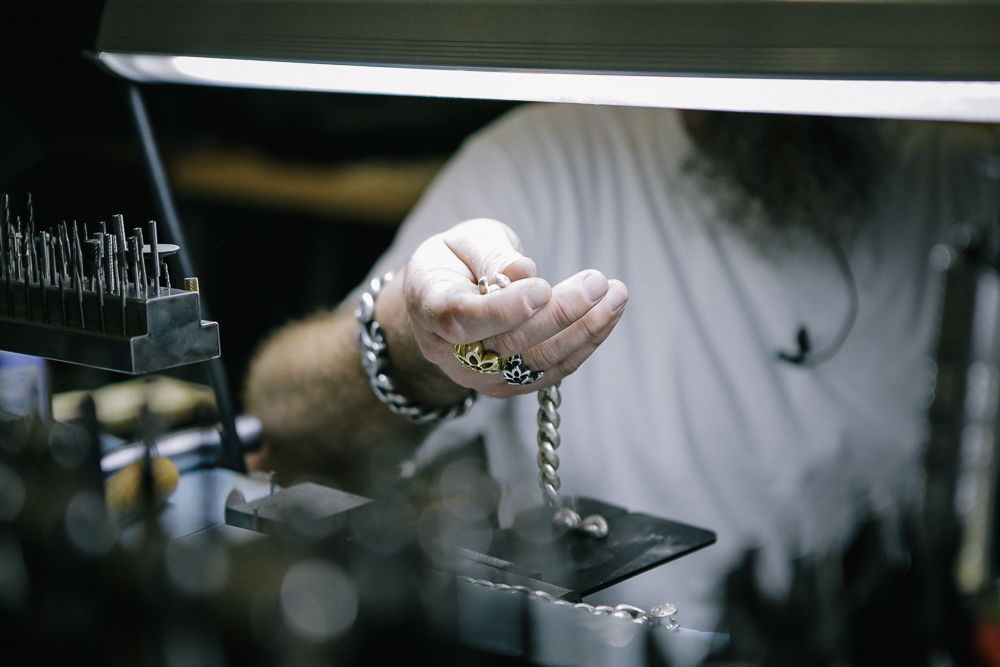
Good Art 

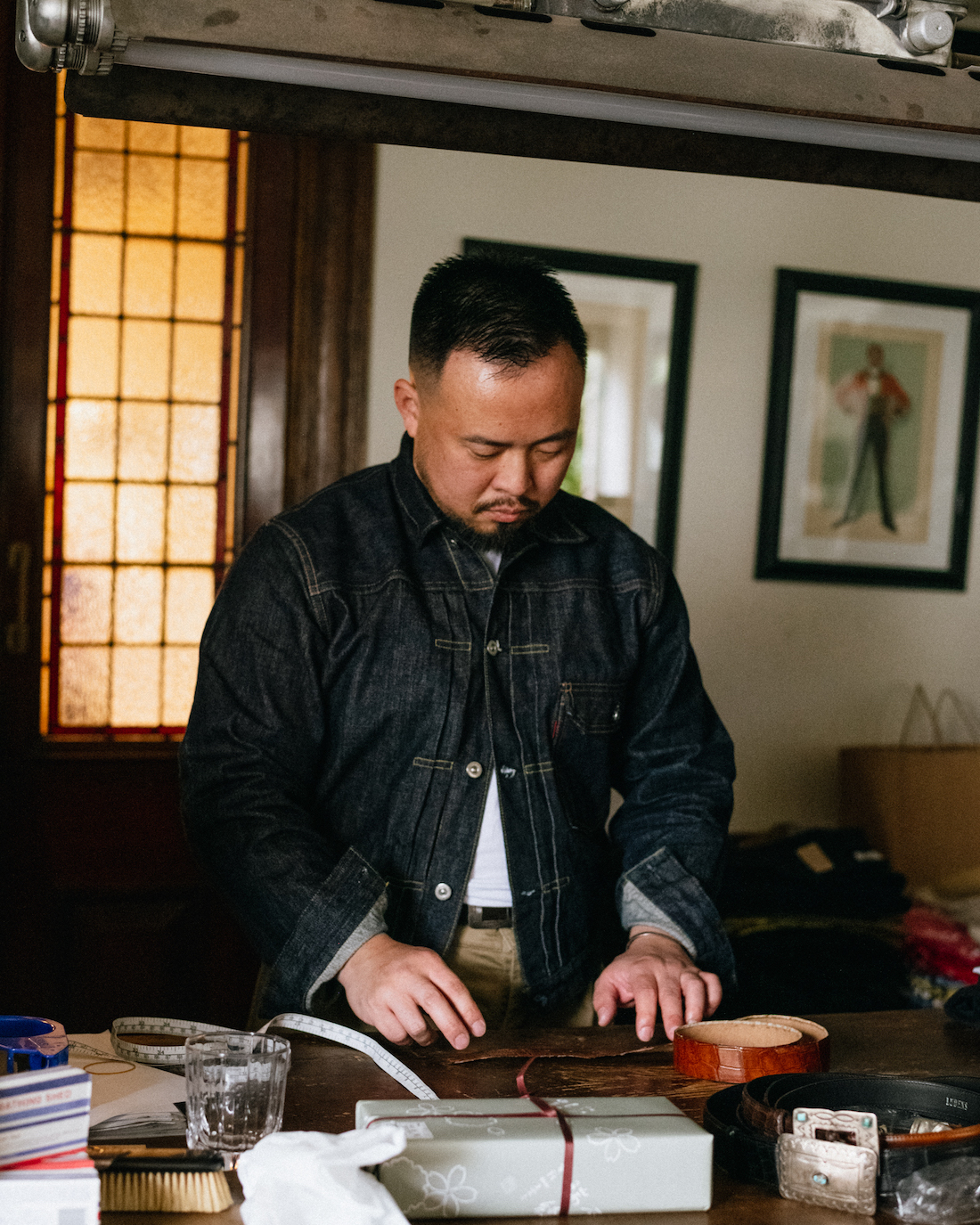
Simon has covered Good Art previously on PS and explained their approach to jewellery, but meeting and talking to Josh, the owner, and having the opportunity to see the forge Downtown left me fully enamoured. What a great brand making fun, interesting, beautifully crafted items on site.

Visvim 

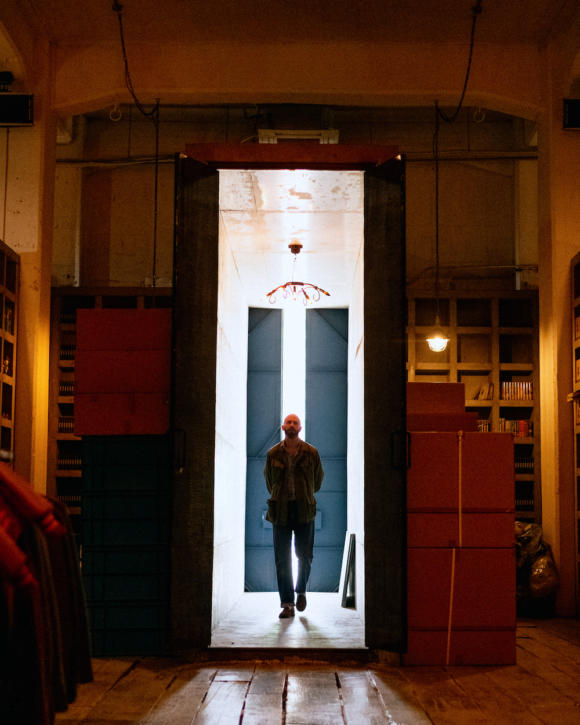
An amazing space, cavernous even. It was great to see a fuller collection of Visvim all together. The exposure we get in the UK is so limited, just a few pieces in the few stores I mentioned in a previous article. Each area is staged slightly differently and they use props to good effect, like a full Airstream caravan. It’s an experience – like Visvim is in most places, but also as I was increasingly realising LA is more generally. 

Brian the Bootmaker 

Brian the Bootmaker has a stellar reputation for his style of boot – engineers, boondockers and the like. Unfortunately I was unable to meet Brian as I ran out of time, but he’s definitely worth a visit if you’re interested in that style. 

Raggedy Threads 

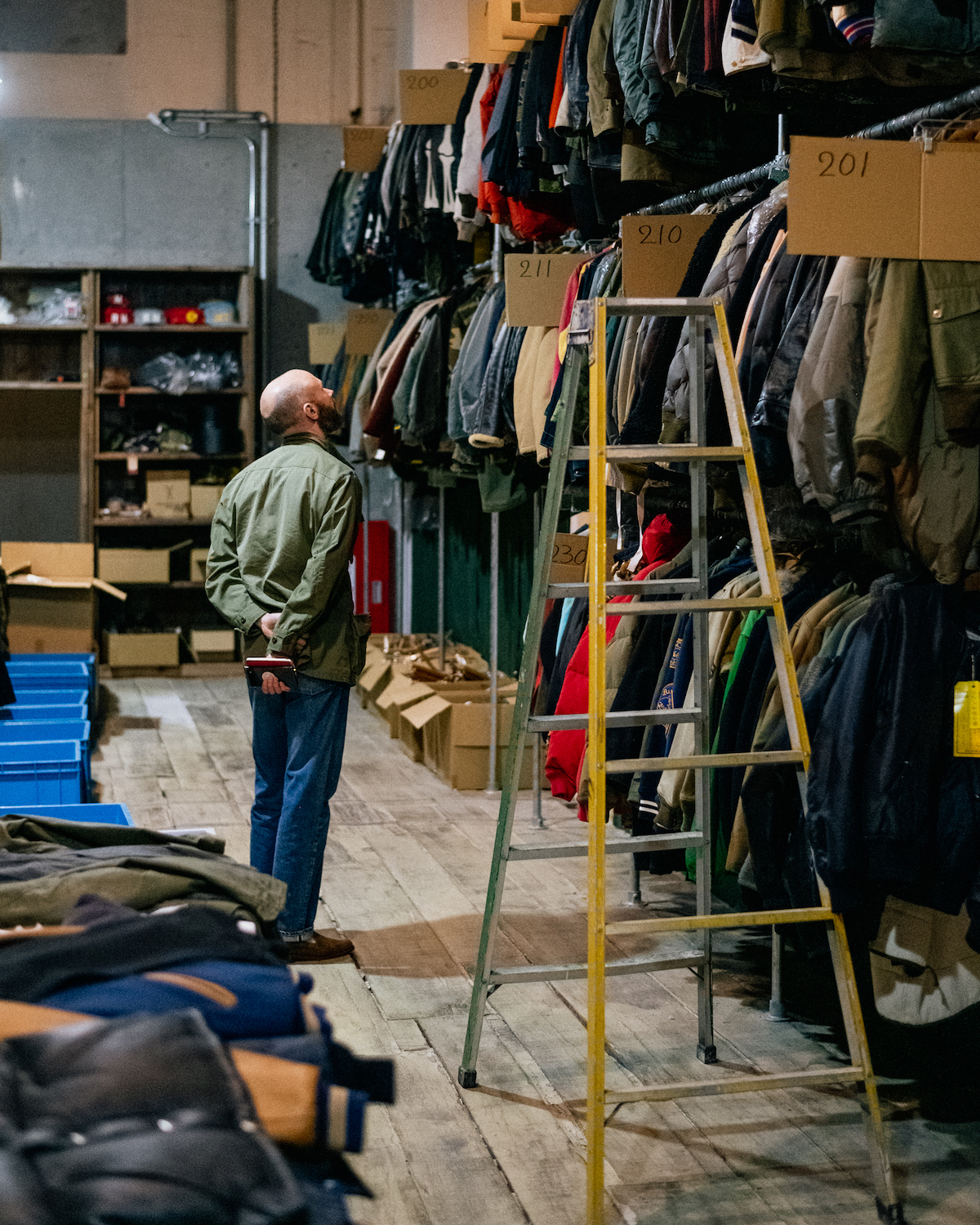
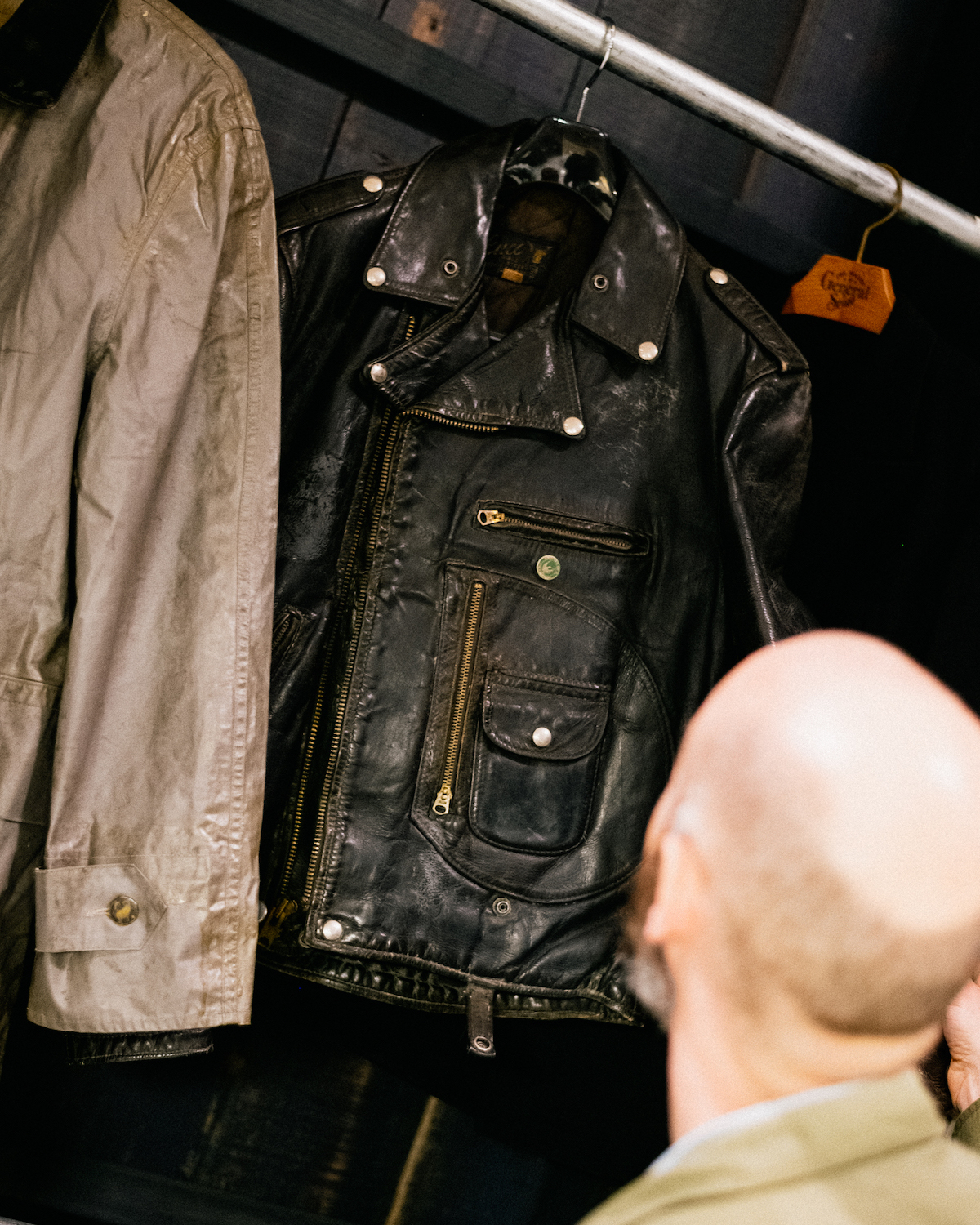
A great vintage store with outlets on both coasts. The owner cut her teeth sourcing and selling at the famous Rose Bowl flea market here in LA. Focused on the more military/workwear side of menswear. 

Rose Bowl flea market 

The market itself. Held on the second Sunday of every month, this is probably the best vintage market in the US, bringing in a wide range of sellers. It used to be more focused on western clothing and workwear, but has broadened over the years. See Ethan Wong’s (Socal local!) piece on it here

Melrose/ La Brea (this covers quite a large area)

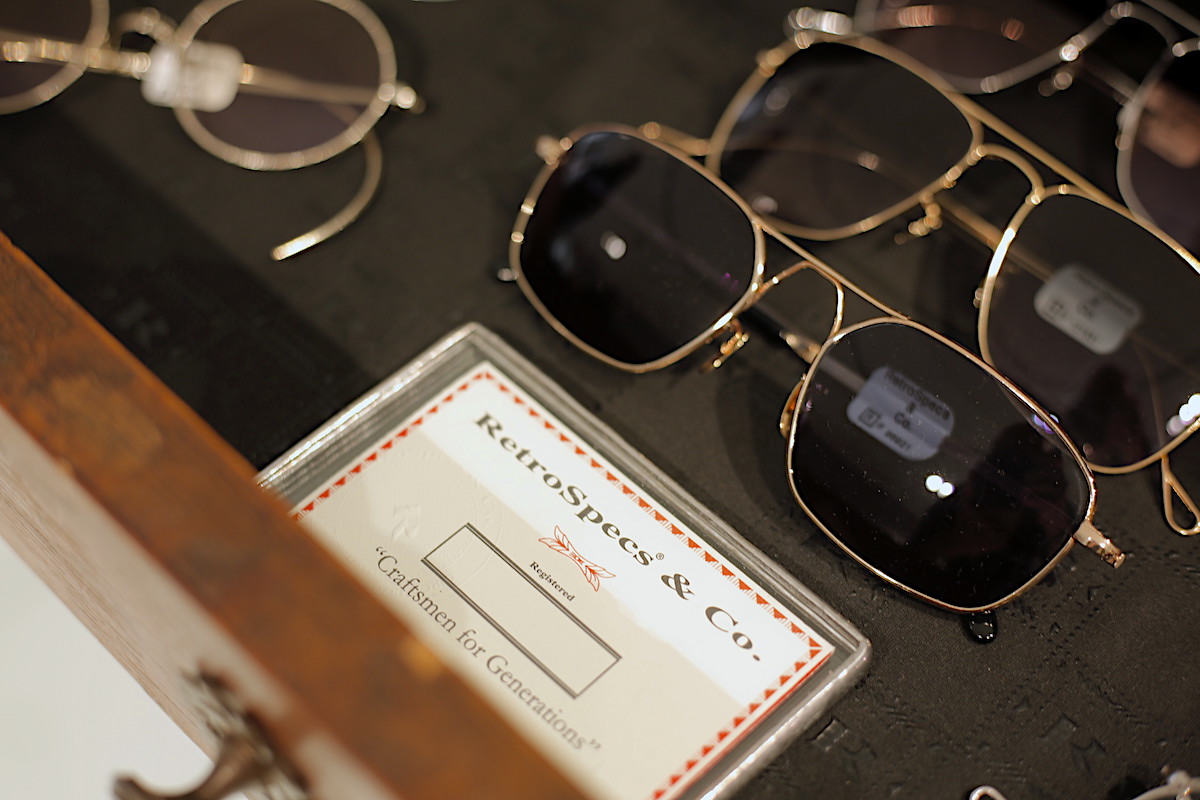
Retrospecs 

A vintage eyewear shop that also supplies scores of high-end stores around the world, and featured in a PS pop-up in London. The LA shop has a big range of pristine vintage pairs, plus a small run of their own brand. The prices are quite high but the frames are good as new (not always the case with vintage) and often rare. If you were looking for a particular style from an old movie or something similarly period, this is the first place I’d go.

Mister Freedom 

What an Aladdin’s cave! Unassuming from the outside, it’s big and broad inside, with vintage and a full range of their own brand. If you don’t know Mister Freedom it’s perhaps best thought of as a repro brand like Full Count, Real McCoy’s and others, but US-based rather than Japanese. 

Jacques Marie Mage 

The now rather famous eyewear brand is LA-based, and this is the fullest expression of what they offer. It’s a beautifully designed space with lots of styles to try on and limited editions that are exclusive to the store.

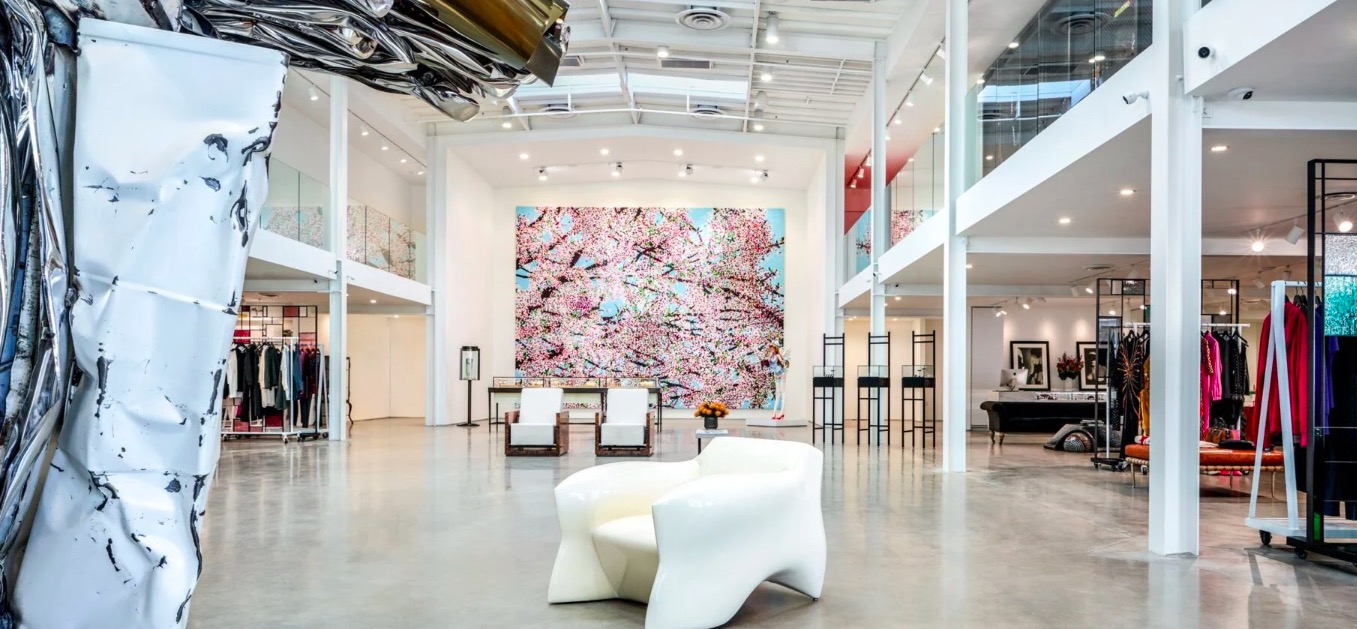
Just One Eye 

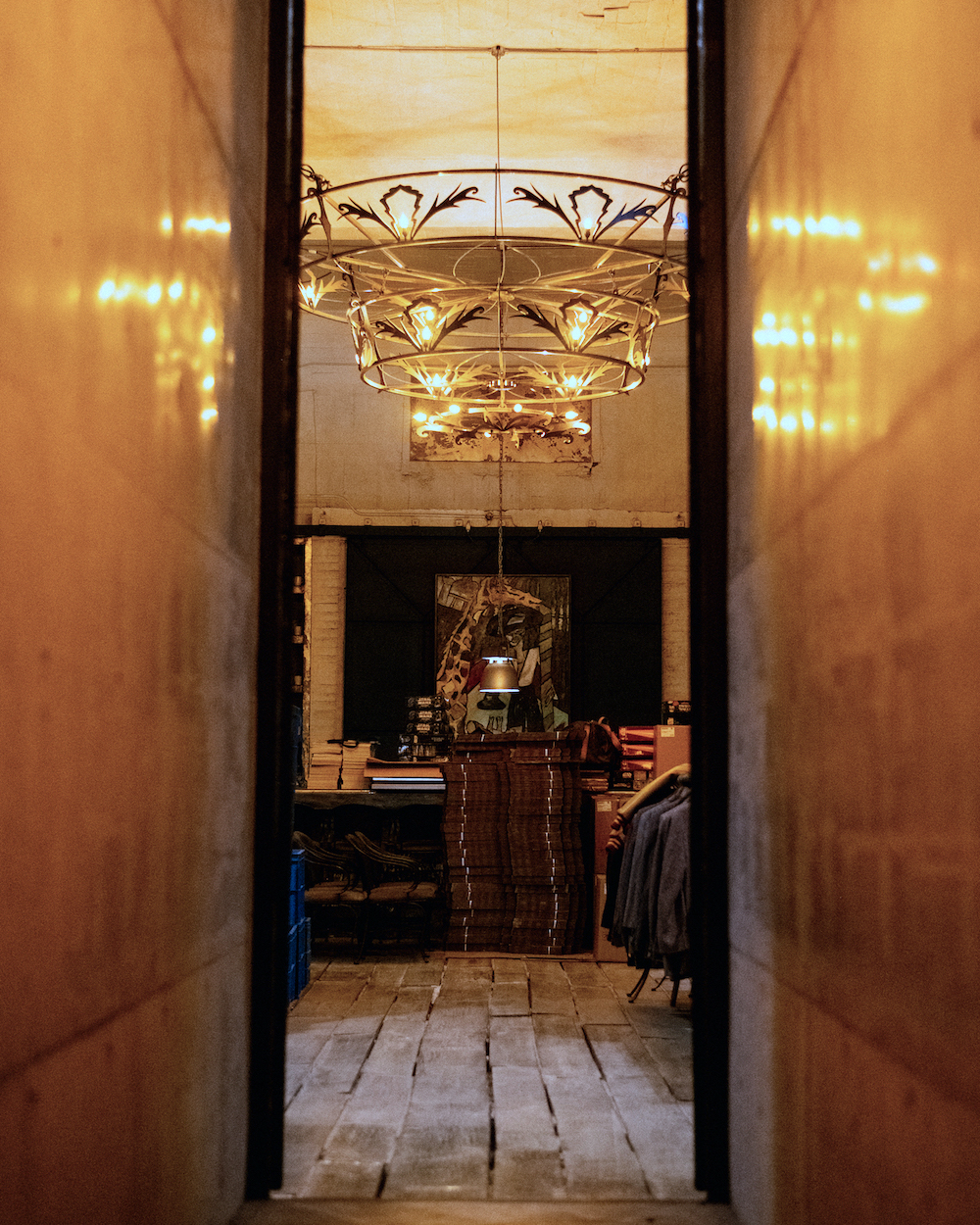
This is more of a fashion store, so it may not appeal to many readers, but it’s symptomatic of how good multibrands often are in Los Angeles. An incredible space (below), it’s impressively decorated (20 ft Damian Hirsts) and has a really tight, distinctive offering of brands and products. Exactly what a multi-brand store should be. 

Elder Statesman 

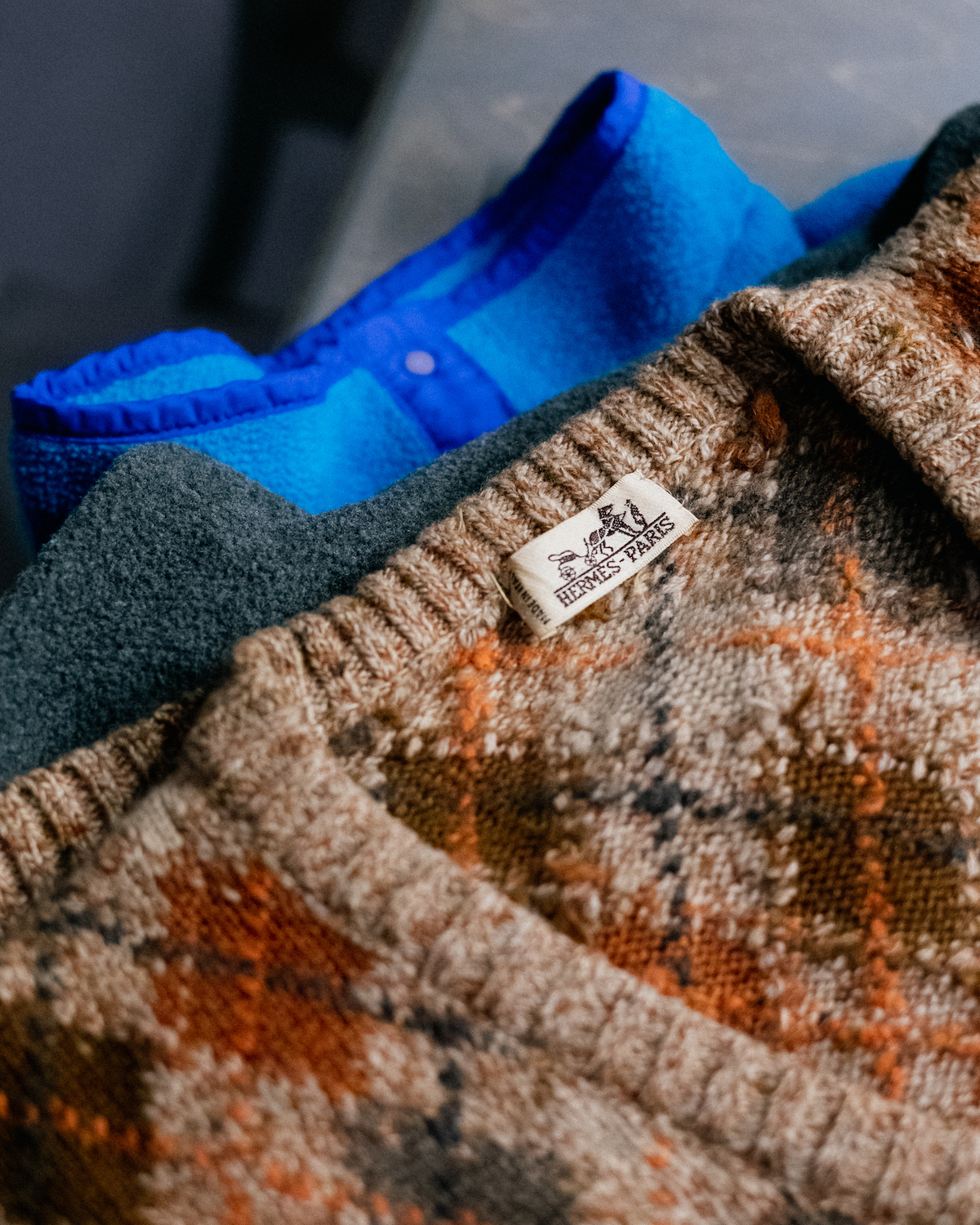
OK this is a personal one. I’ve been looking for Elder Statesmen jumpers in the sales or on eBay for a long time, particularly the tie-dye cashmere. But I had no idea they were making in LA. After speaking to the team in-store I discovered they have a facility Downtown which they filled with vintage knitting machines to create unusual knits. They also work with knitting circles in places like Kentucky and Peru. I love the commitment to craftsmanship and retaining skills, while making a product that seems to feel both classic and modern.

American Rag 

A good vintage store – cavernous in nature, from pricey rare pieces to general Americana (trucker hats and tees). They also have some new clothing from a selection of brands, giving it quite a wide appeal. 

Bode 

If you like the aesthetic of Bode this should be one of the first places you visit, as it’s a completely different level from New York. And even if you don’t, it’s a great space to see, one that reminded me of a cabin built for a kids camp in the Catskills (I’ve never been, just what I imagine). Plus their impact on menswear as a whole always makes them interesting. 

Pasadena

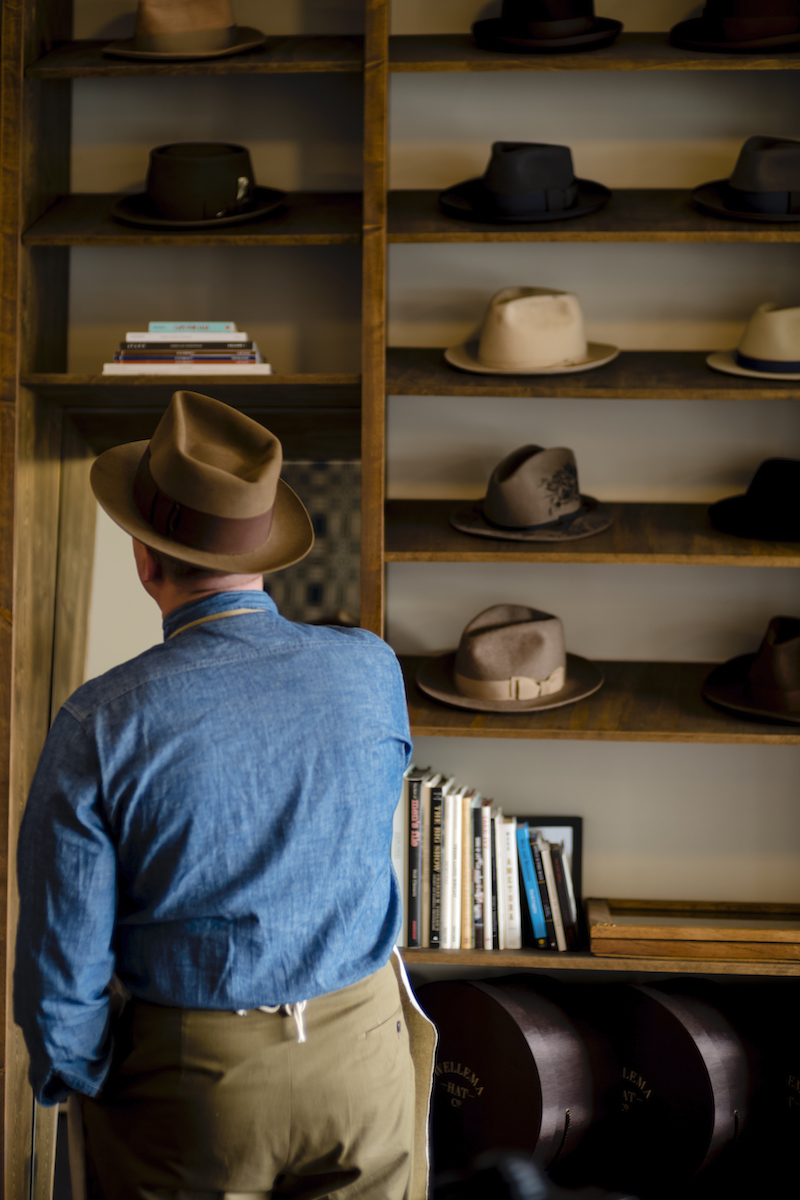
Wellema hats

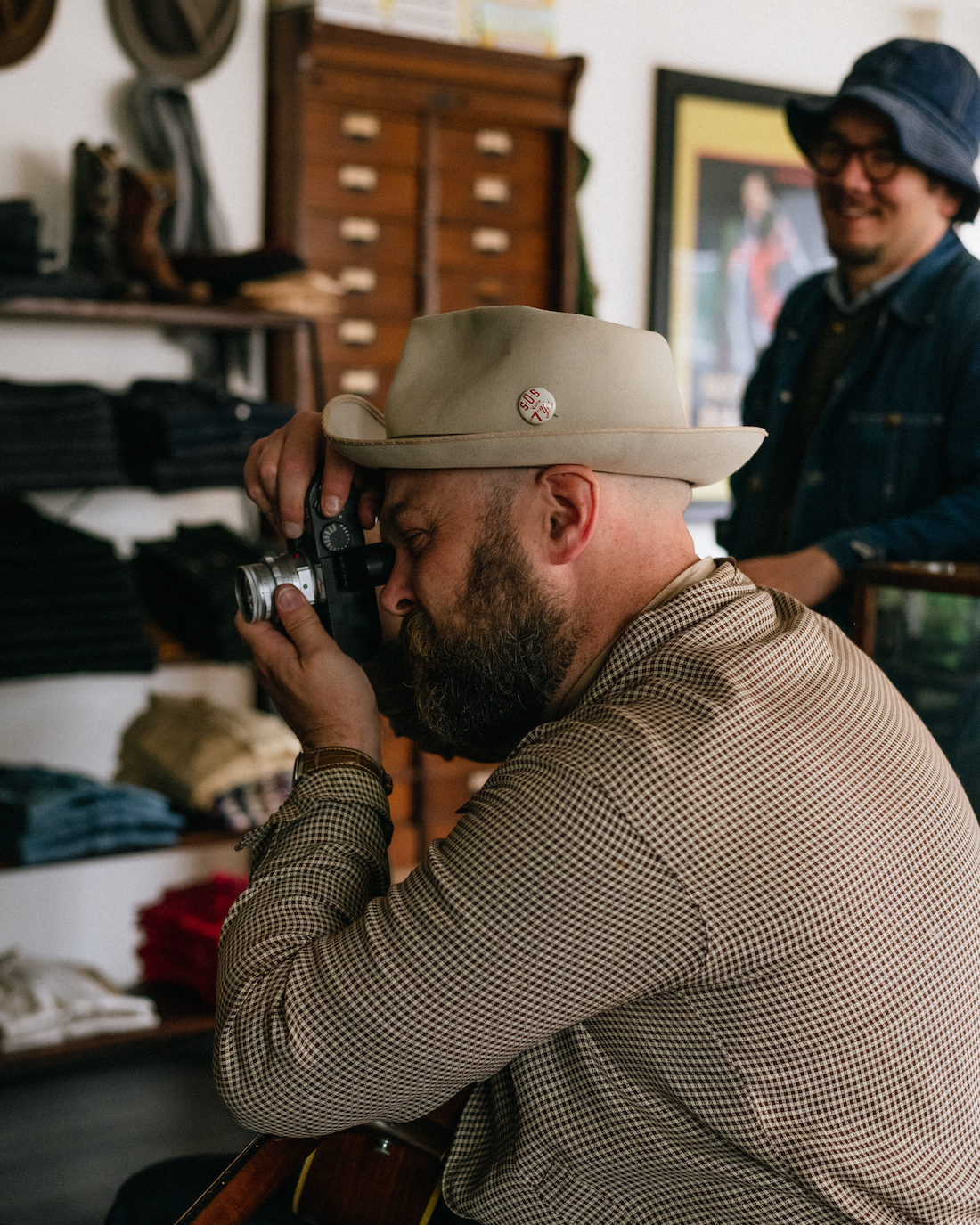
A great hatmaker covered on PS in the past, and featuring in our pop-up shops in London. Cody Wellema makes bespoke hats on site, often but not necessarily with a western style. Somewhere worth visiting if you’ve never thought hats were for you – just so Cody can try everything on you and work why they do or do not work. 

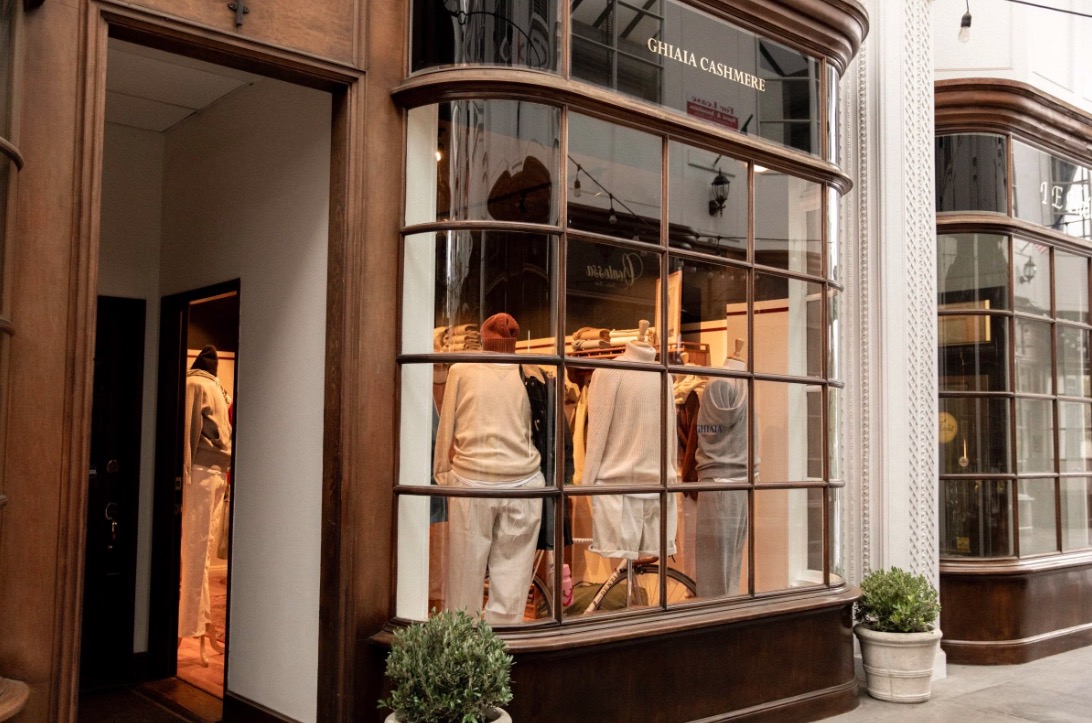
Ghiaia Cashmere 

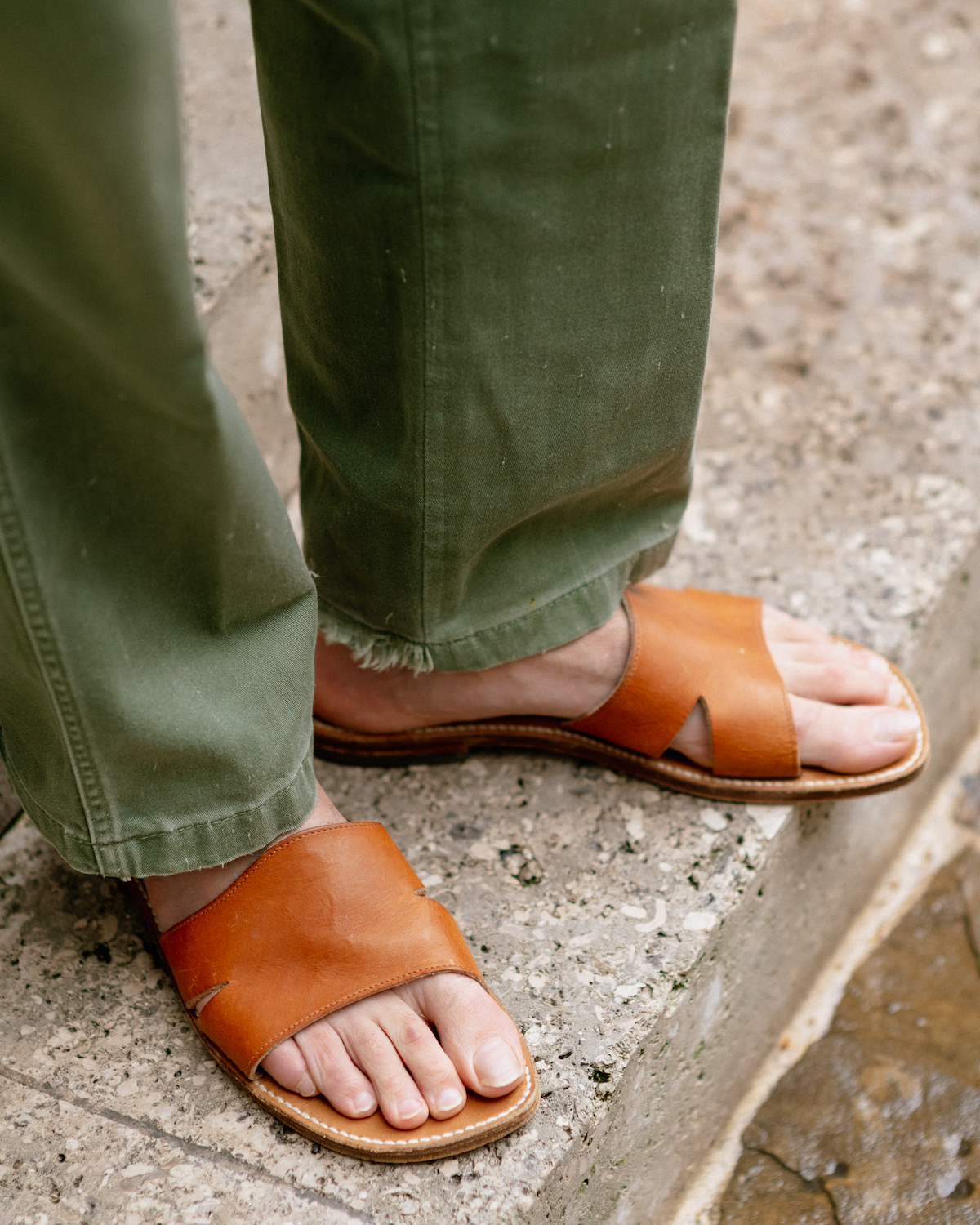
Not just cashmere anymore but chinos, socks, sandals and much else, Ghiaia has a wonderful laidback luxurious style. Currently in the replica Burlington Arcade (which frankly is a bit unnerving visiting as a Brit) but soon to be moving, Davide showed me the new space in San Marino and if it has a tenth of the character of Burlington it will be a worthwhile trip out of the city. The product is beautiful, the styling exquisite and the hospitality generous. What more could you ask for?

Silverlake

This is a trendy area with a western feel. Lots of nice little shops and multi-brand stores.

Mohawk General Store 

The kind of store that I think you could easily overlook if you’re European. The brand mix is slightly more fashion forward than some others here, with lacy shirts from Sefr, remixed classics from Lemaire and printed pieces from Dries. But as with Just One Eye It’s a great multi-brand and the kind of thing we just don’t get in London.

Lady White Co 

If you looked at Lady White Co online or on Instagram you would likely think, ‘Oh that looks nice I guess, but I’m not sure if I will have time to go there, it’s a bit out of the way’. And then you mention you’re visiting a bunch of stores in LA and ask some locals, and everyone says go and check out Lady White. So you do. And all of a sudden you’re deep in textures and subtle colour tones, and realise none of this can really come across on screen. 

Lady White started as an idea to make a T-shirt entirely in California, down to growing the cotton (the kind of nerdiness I love). The business has grown and some of the initial ideas have had to give way, but it feels like the fastidiousness is still there. The colours take in deep indigos and murky browns, steely greys and rich aubergine. The cuts are considered and everything feels simple but elevated. 

Beverley Hills 

To be honest this was a pilgrimage, I think Beverly Hills has a case for being a protected menswear area like Savile Row, given its service to sartorial endeavours over the years. It was the location for the first standalone store for all the following brands in the US – which may surprise some Europeans. (All covered in the book Deluxe by Dana Thomas).

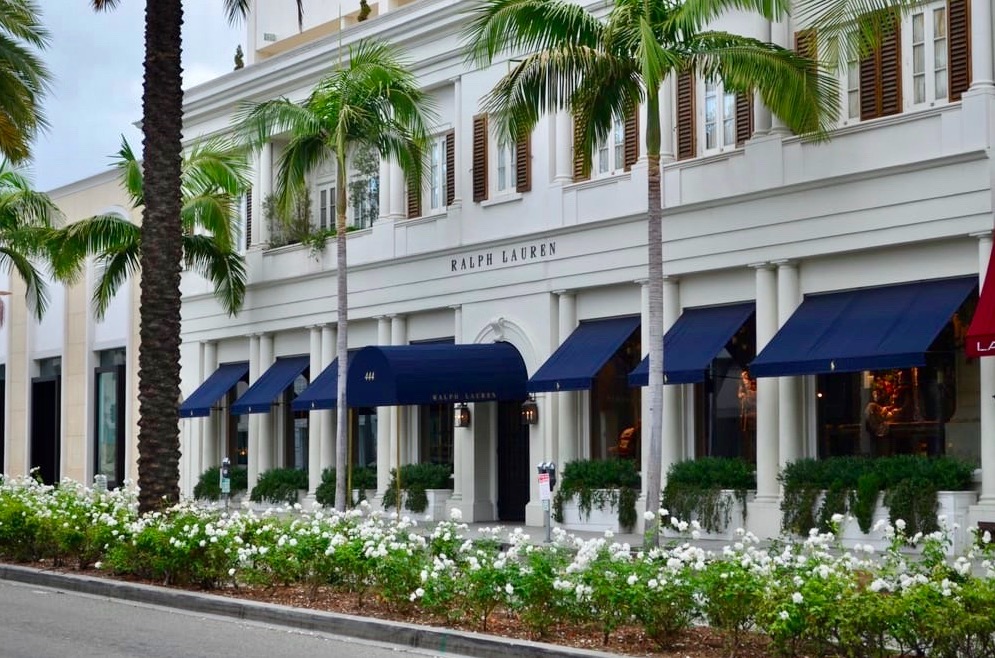
Ralph Lauren 

The positive and negative of Ralph is his world building is so strong that the shops look very much the same, but at the same time if you’re a fan you want to visit all the major ones. (On that basis, the RRL store that looks like an old gas station is also worth a visit.)

Giorgio Amani 

The shop has had a refit, it doesn’t feel like the period associated with LA, but it’s still lovely and some of the collections are circling back to that 80/90s aesthetic they’re famous for. The Gucci store, by contrast, feels like it has no real connection to that era. 

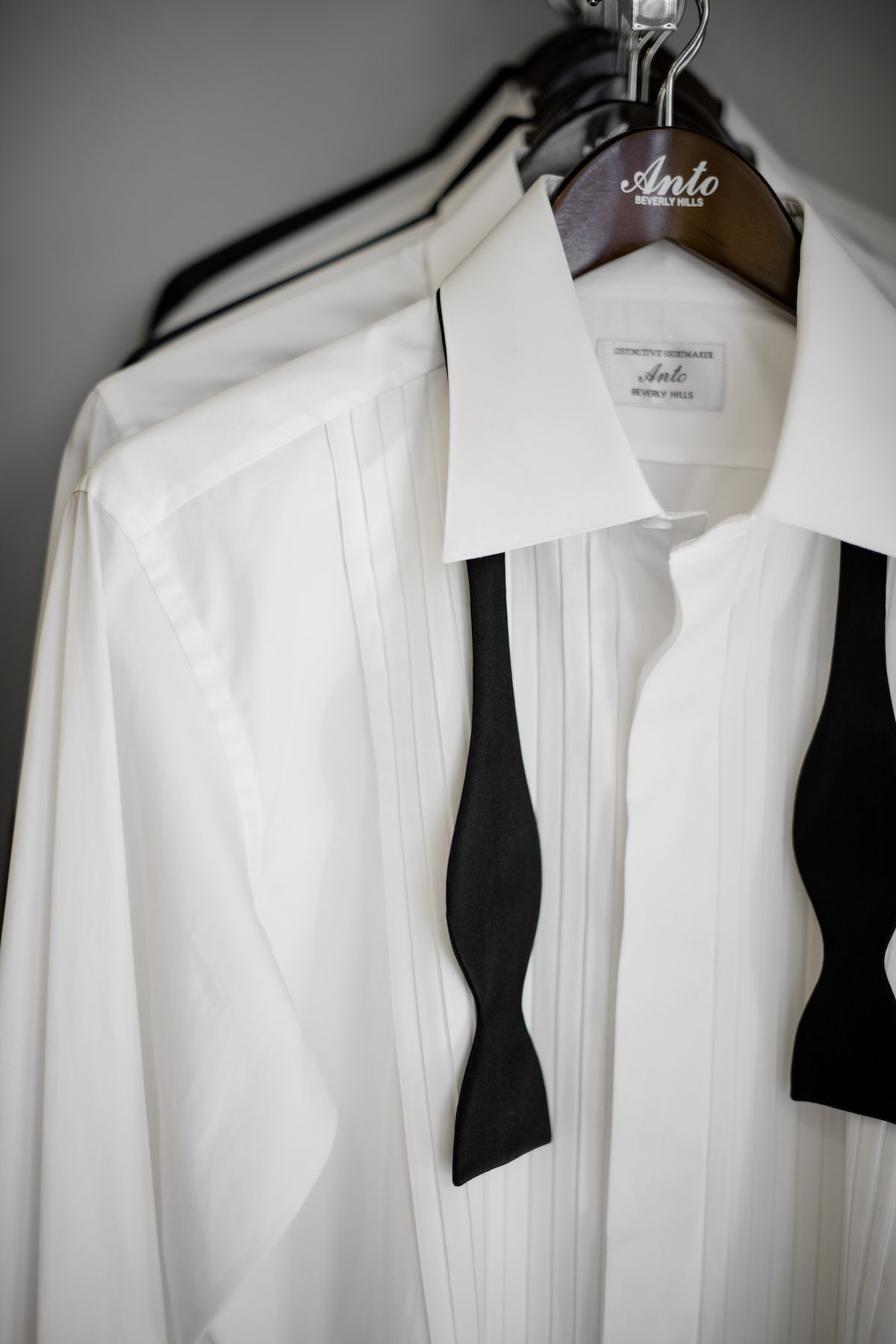
Anto Shirts 

Historic shirtmaker covered by Simon in the past – here with a profile of the store and its history, here with a review of a shirt. Bespoke shirts and some ready to wear, with a lot of the business being for the film industry. 

Hotels

Three biggies in the West Hollywood area – though staying in famous hotels is a bit like that adage “don’t meet your heroes”: no matter when someone has stayed it can always be said it was better 10 years ago. 

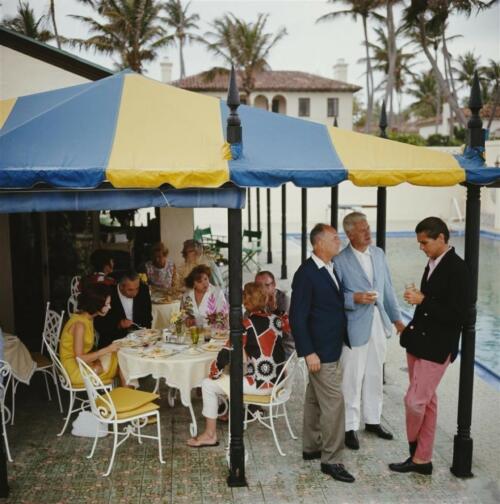
The Chateau Marmont – an icon, definitely worth a stop, despite being intimidating to pull up to all the staff were very pleasant and welcoming. The Beverly Hills Hotel – background to so many Slim Aarons pictures, go for lunch in the unparalleled Polo Lounge (perhaps a Tom Collins and the steak tartare). Sunset Tower – where I stayed, better value and smaller than the last two but with no fewer credentials. Also a soft landing from LAX.

Honourable mention to The Los Angeles Athletic Club, which is a more fun place to stay Downtown. Certainly compared to the soullessness of modern hotels.

For further reading, have a look at Ethan Wong’s piece here

Sartoria Seminara and Vittorio Salino: Maintaining Florentine tailoring

Sartoria Seminara and Vittorio Salino: Maintaining Florentine tailoring

Friday, September 1st 2023
||- Begin Content -||

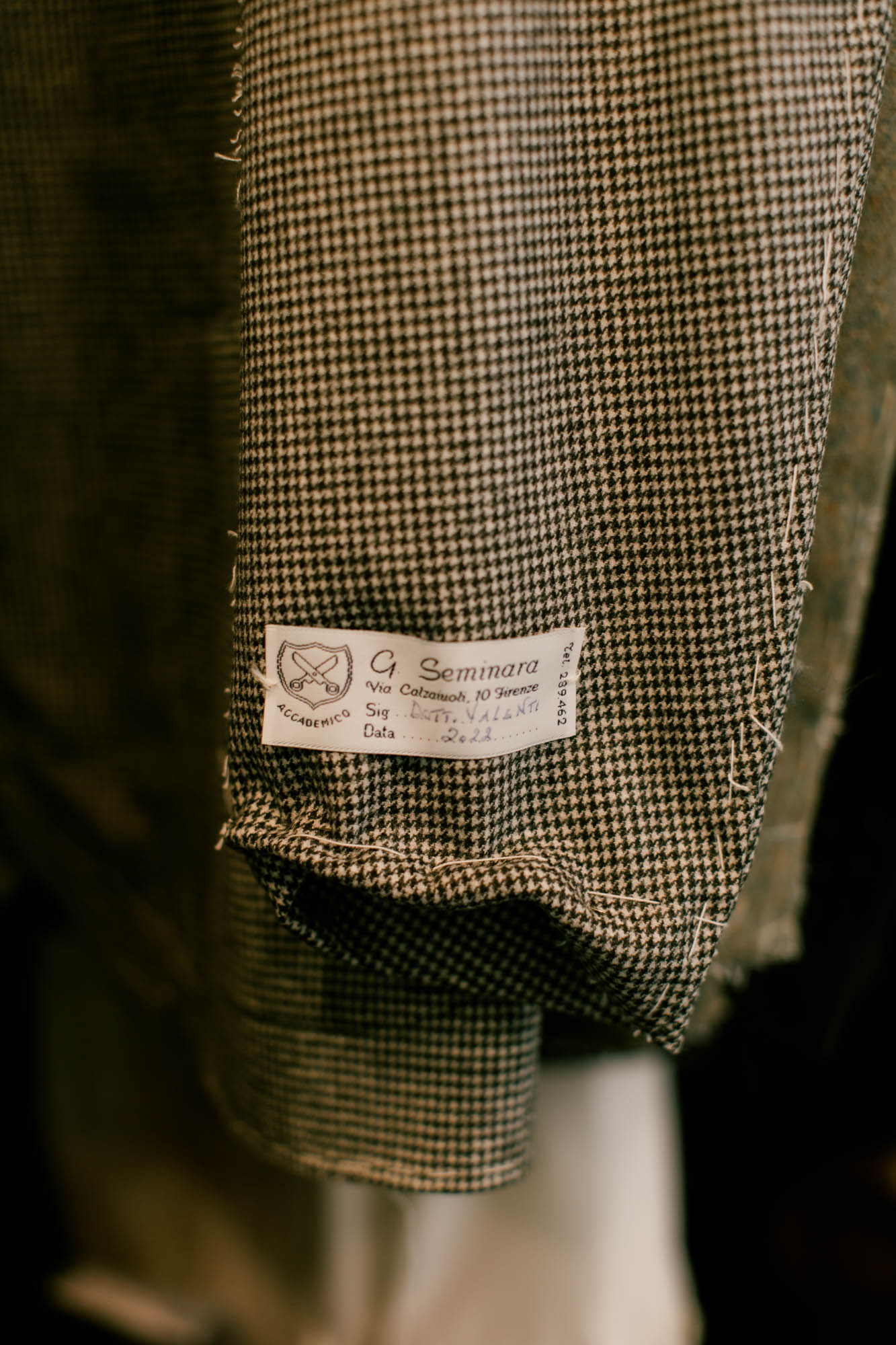
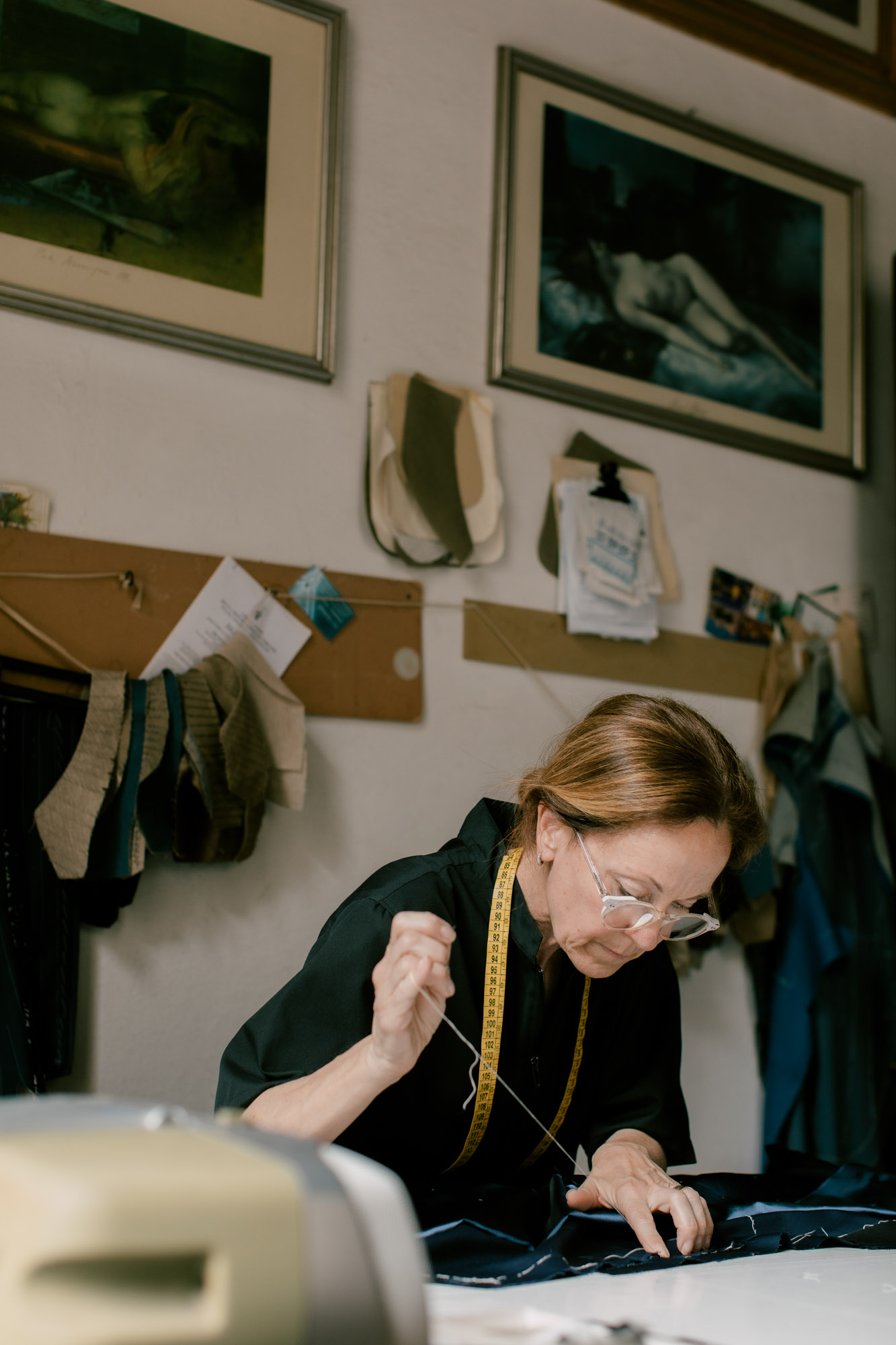
Like most Italian tailors, Sartoria Seminara is hidden away. There is no Savile Row grand entrance, just a name and a buzzer and a short walk up a flight of dark stairs. 

The effect is all the greater because this entrance is on Via dei Calzaiuoli, a few metres from the Duomo in Florence, and on any day in season, therefore from hundreds of bright, loud tourists. 

And Seminara is an especially nice bolthole. The handful of rooms on the first floor has been a tailor's shop since 1924, almost 100 years; Giuseppe Seminara took over the space in 1957 and it's been a tailor’s ever since. 

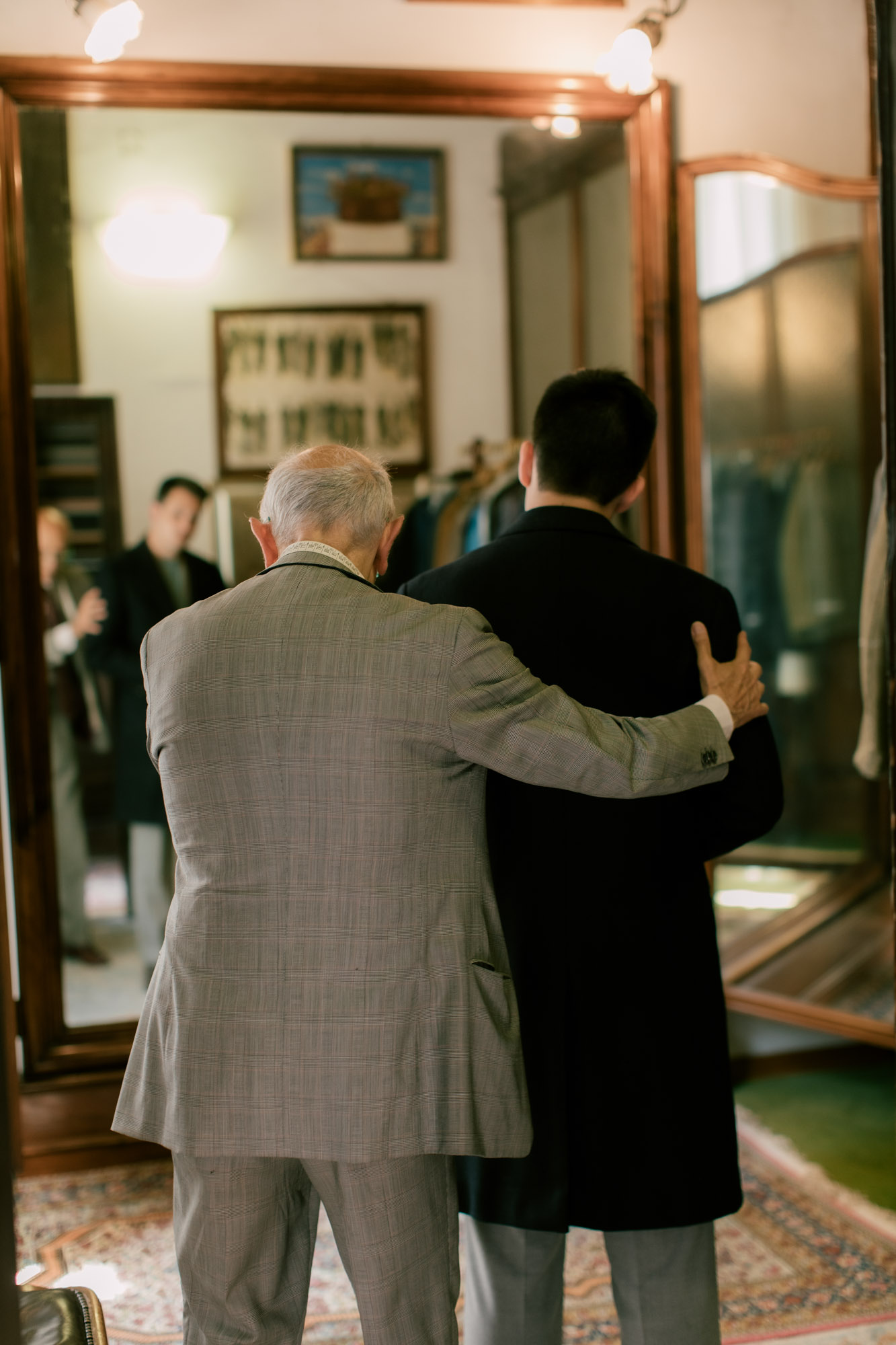
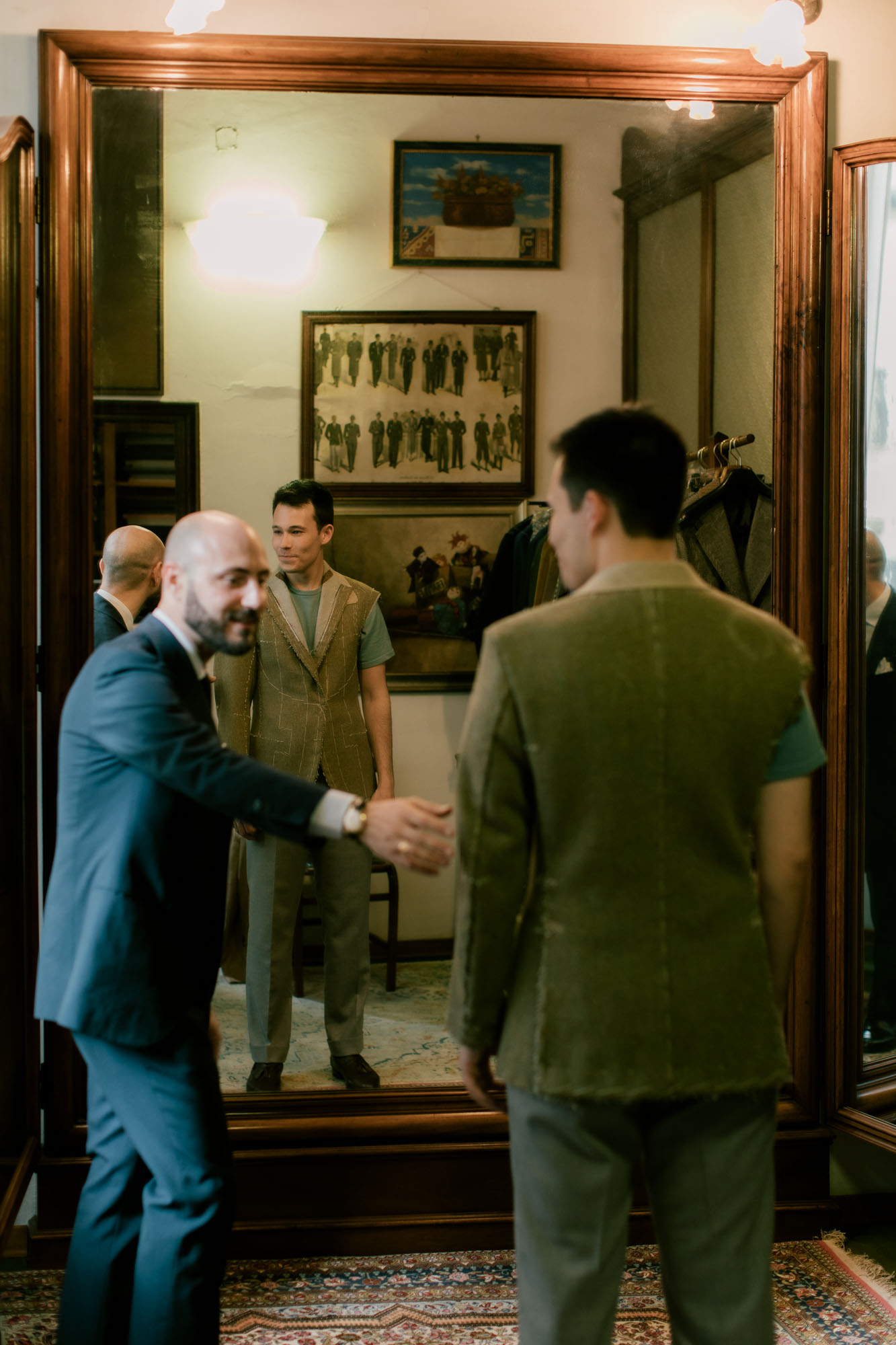
The fitting room is particularly pleasing. Large, high-ceilinged, dominated by a set of mirrors that takes up the entirety of one wall. As a customer, it can't help make you feel really rather important. 

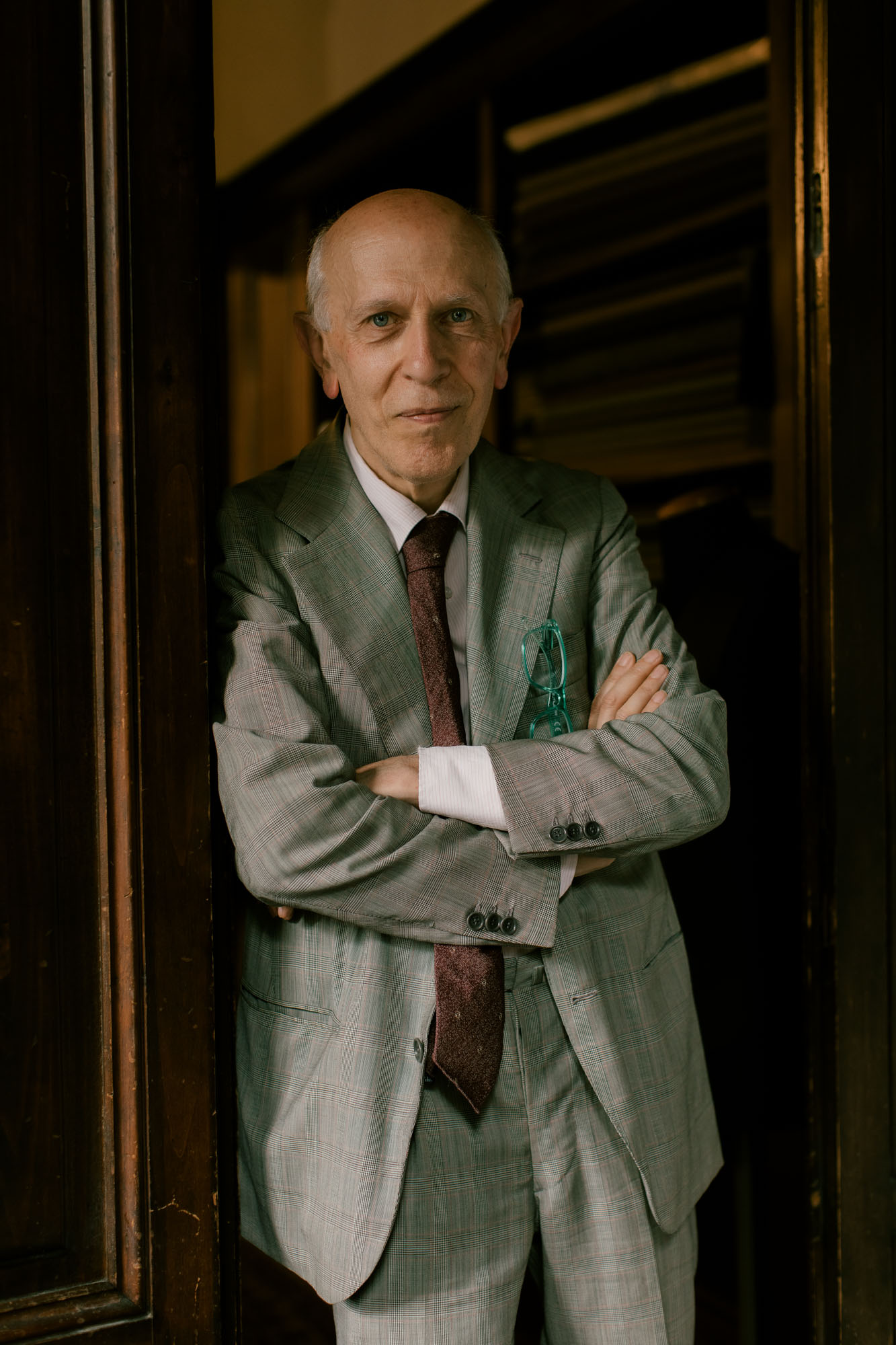
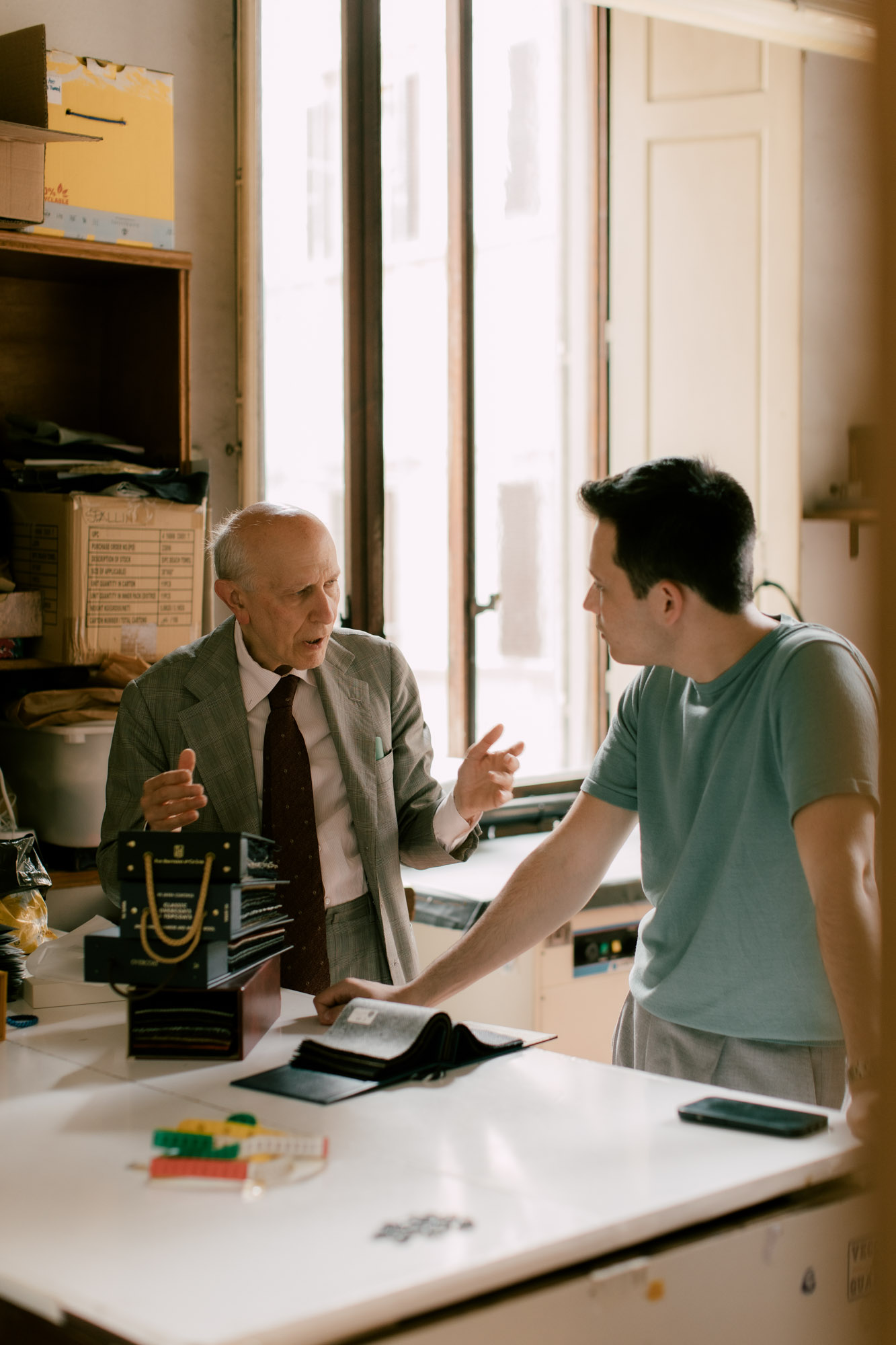
"My father was the master, this is his shop," says Gianni Seminara (below), which seems almost impossibly modest, given he himself is on the verge of retirement, and has been in this space that whole time. 

But it does bring up the topic of succession, which is important. A reason I wanted to cover Seminara - among all the other small Italian tailors still in existence - is that Gianni is now working with Vittorio Salino, a younger tailor who was previously at Liverano, and is keen to continue the traditions.

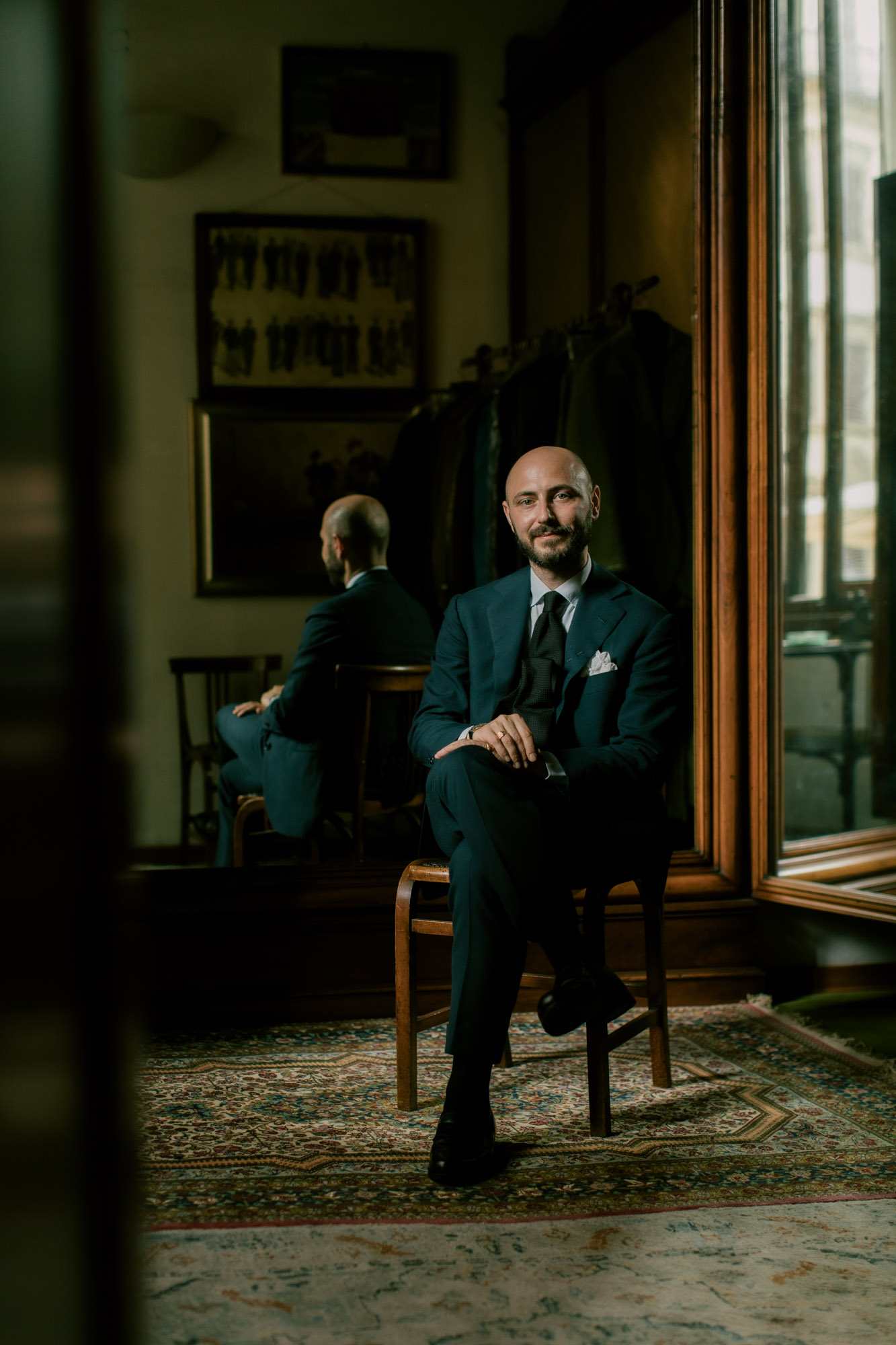
Vittorio was introduced to Gianni by a client, and has been working the atelier for just over a year. He’d love to take over the business some day, but they’re taking it slowly: for the moment they refer to it as a “collaboration”. 

Vittorio was head cutter at Liverano, and worked at Gallo in Rome, but it's still been invaluable working alongside Gianni. 

“The hardest thing about being a tailor is dealing with unusual situations - body types, unusual requests,” he says. “You learn the basics and refine them and you develop a cut that you really like, but then someone comes along that gives you a problem you’ve never faced. It’s good having Gianni to turn to, with all his experience.”

Vittorio (below) now has a young assistant (Belgian, enthusiastic, a PS reader) himself, but it wasn’t easy at the start: “It can be hard because you need quite a lot of investment for your own space. That’s one more way it’s been great being here with Gianni.”

The Seminara cut has much in common with other Florentine tailors - the fairly soft make, the straight lapel, the lack of a front dart. But there are small differences. 

The side seam is not as shaped forward, for example, and the breast pocket has a little more curve. The shoulder is not that extended and feels more natural, with just a touch of rollino in the sleevehead. 

There are similarities with Corcos, who worked here under Gianni for three years, although the finishing at Corcos is at a rather higher level.

“Overall I think it feels very natural, simple and easy,” says Max Papier (below), who works at The Armoury in New York and is a customer of Seminara. 

Both Max and Elliot Hammer, a designer also working with The Armoury, are friends and have had pieces made by Seminara. Max is also currently having a jacket made with Vittorio. 

“I found something rather different in the style here, something very human,” comments Vittorio, referring to the soft shape of Gianni’s jackets and his desire to use as little padding as possible. 

“Some tailors that have left Liverano are doing the same style, and the selling point can feel like it’s just ‘the same thing but cheaper’,” he adds. “I had a client ask me to make your tweed ulster coat, for example, Simon, and I didn’t want to do that. If someone is coming to you just because you’re a cheaper version of something else, you’ll never build anything.”

Vittorio is referring to my Liverano coat, which I have also (flatteringly) seen at other Florentine tailors in the PS Harris Tweed

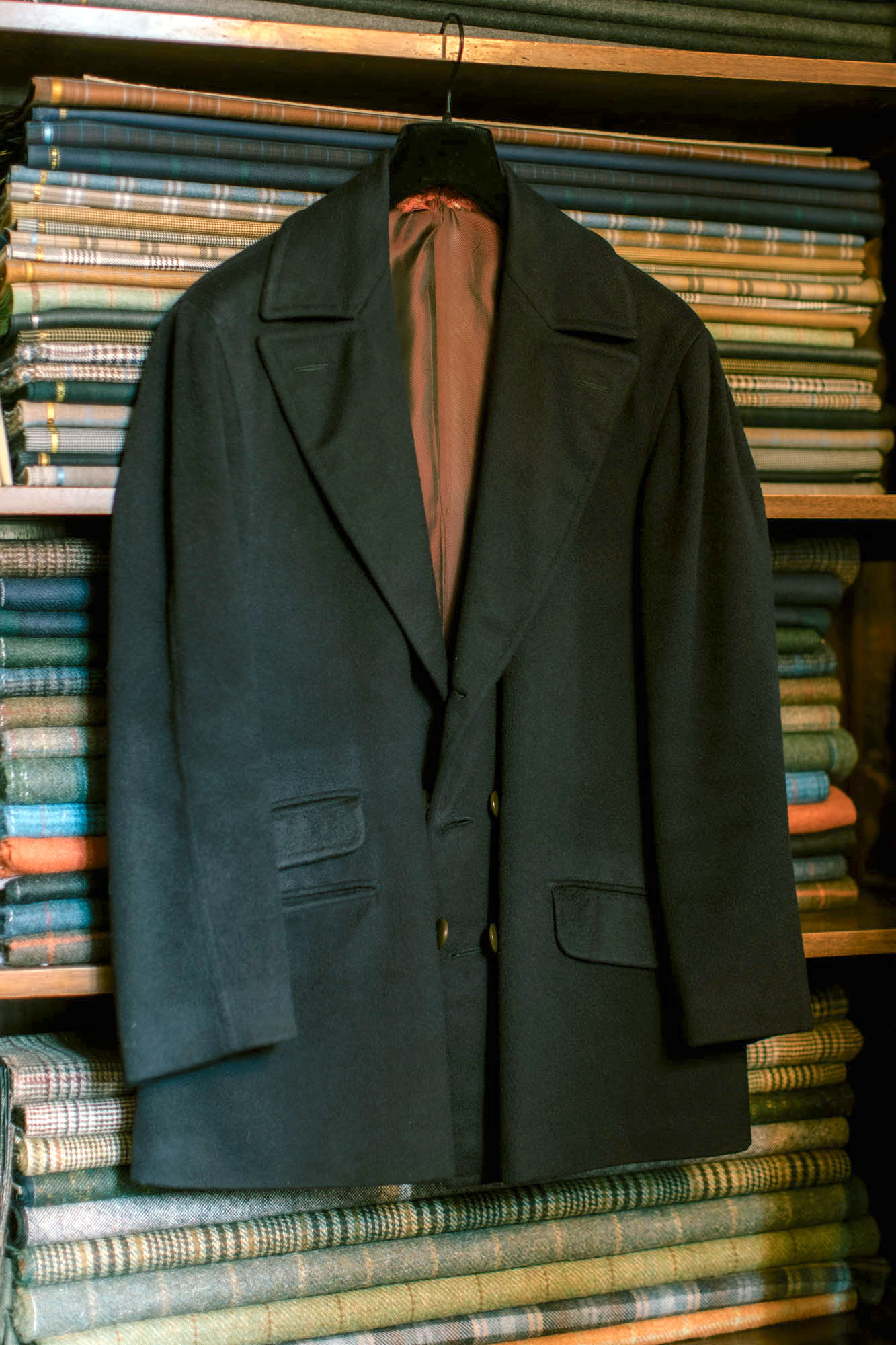
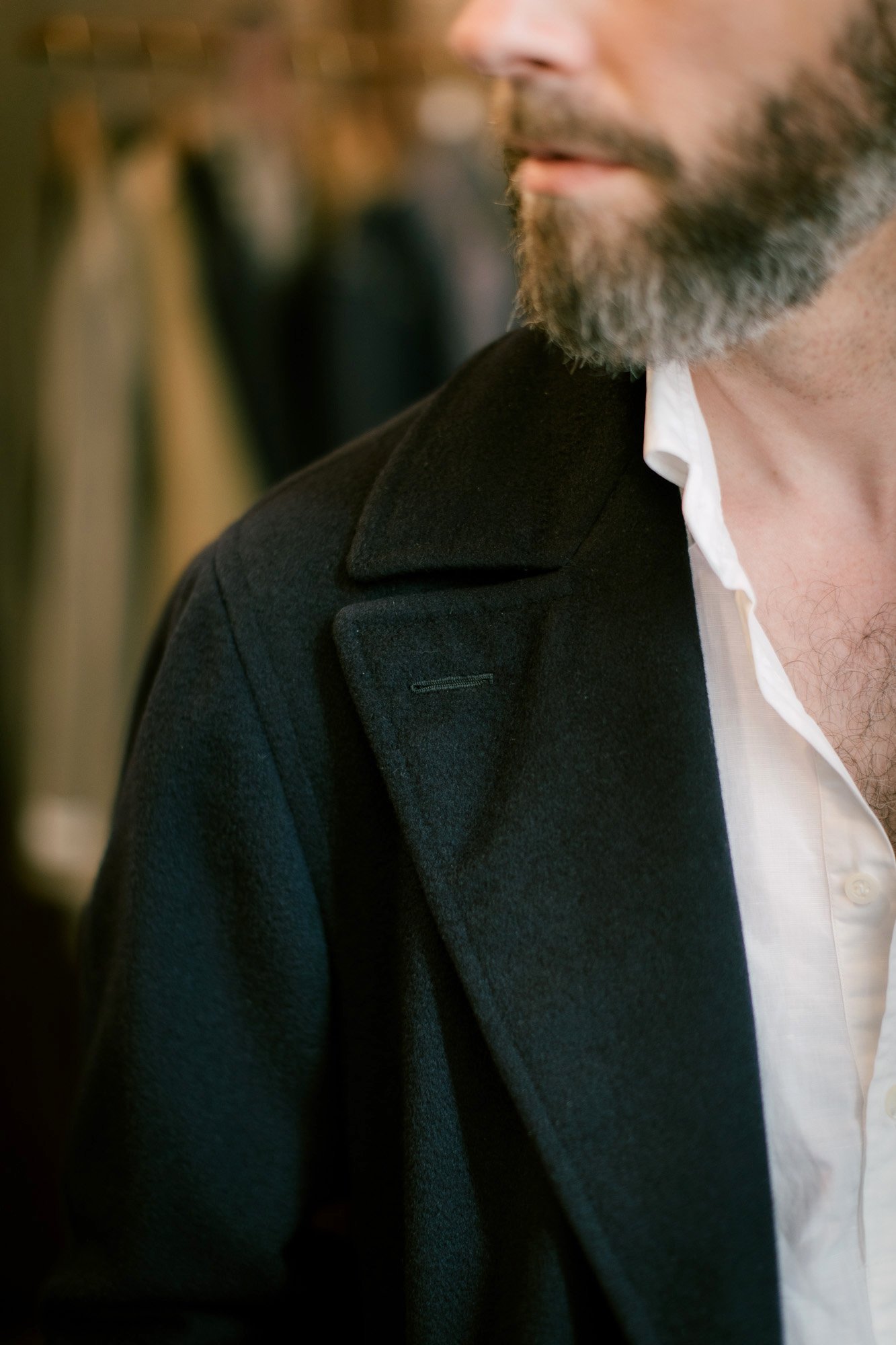
One original design that caught my eye at Seminara was the “capote” pictured above. This was originally a request from Franco Minucci of Tie Your Tie, who wanted a short coat he could wear over a jacket, but without the stiffness of a pea coat. 

The result, in cashmere or a wool/cashmere blend, has been made a good few times for other clients since. 

I liked the collar and lapel shape, although was a little unsure about the buttoning position and the softness of the body. One to try again when I’m back in Florence in January, perhaps. 

Gianni is quite inexpensive, not just compared to Liverano but to Florentine bespoke in general. His suits start at €2700 and the cashmere capote costs €3000Essentially, Gianni has no interest, now, in higher prices or trying to use those to build a sustainable business. Vittorio is different and has to charge a little more: €3000 for a suit and €2200 for a jacket (in Italy)

But then Vittorio is the one carrying bespoke tailoring forwards, and perhaps the one establishing longer-term relationships with his new customers. I also admire his enthusiasm and progressiveness. He’s actively trying to get young people involved in the business, including working with the Accademia Nazionale dei Sartori in Rome, for example, to increase its student numbers. And he's travelling to different places - to Antwerp and to Zurich.

My biggest and best wishes to them both. I’m sure I’ll be back in January, if only to soak up the atmosphere of a full century of tailoring, and take a coffee gazing out of the window at the busy Via dei Calzaiuoli below. 

Sartoria Seminara
@sartoriaseminara

Vittorio Salino
@vittorio_salino
Trunk shows: Antwerp 15-18 September and Zurich 13-16 October

Via dei Calzaiuoli, 10
Florence, Italy

The first sportswear jacket: A ‘Ricky’ or gab jacket

The first sportswear jacket: A ‘Ricky’ or gab jacket

Wednesday, August 30th 2023
||- Begin Content -||

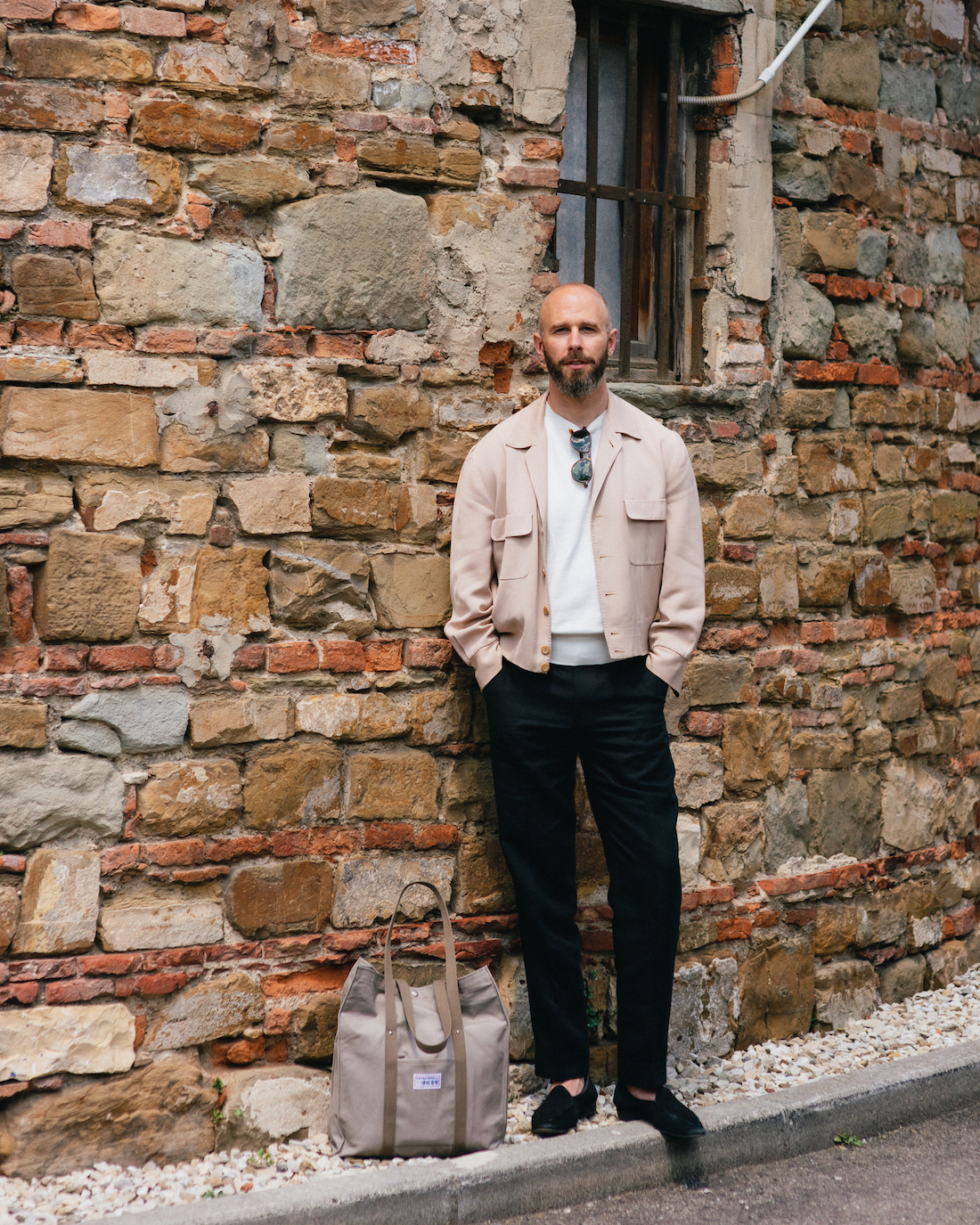
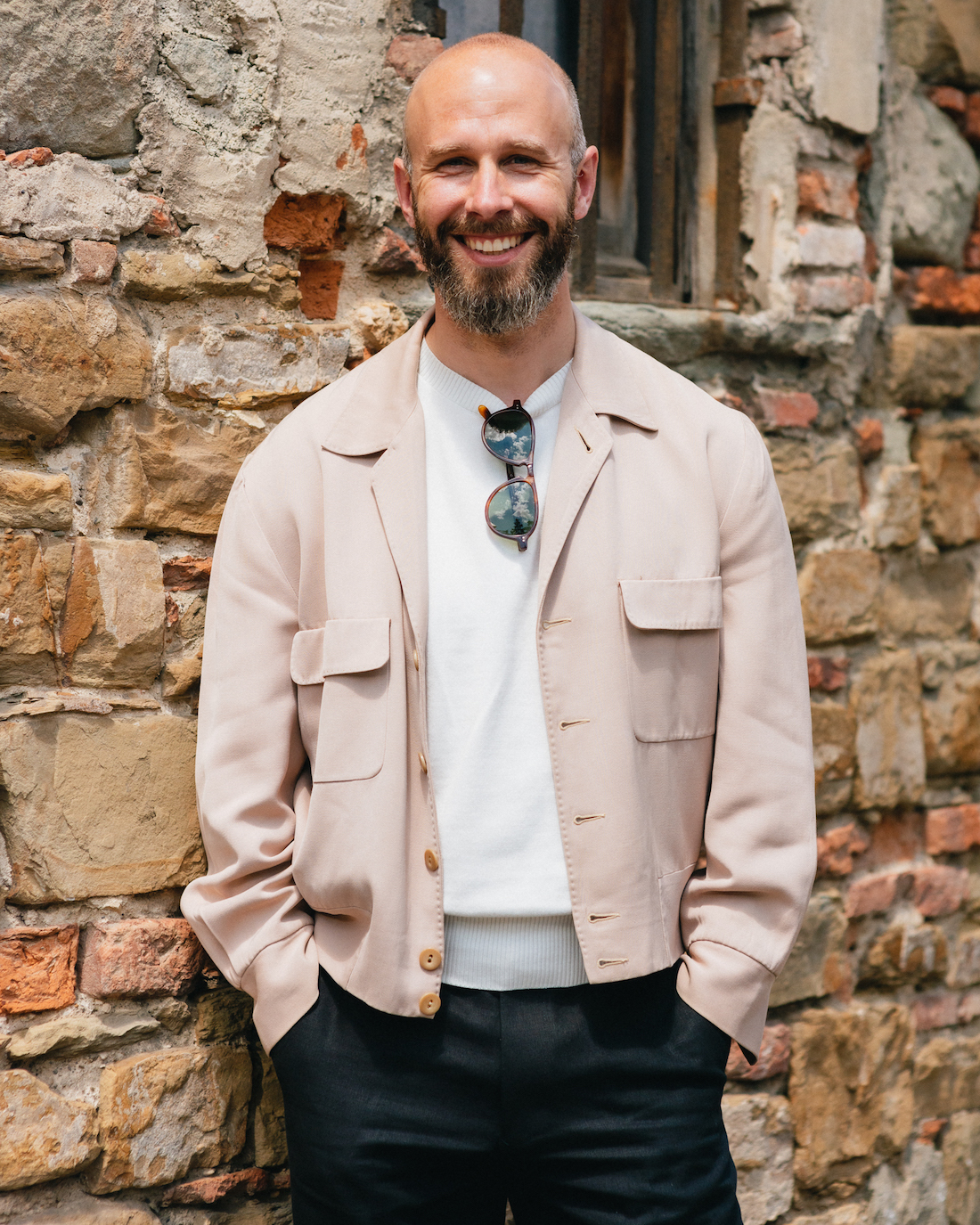
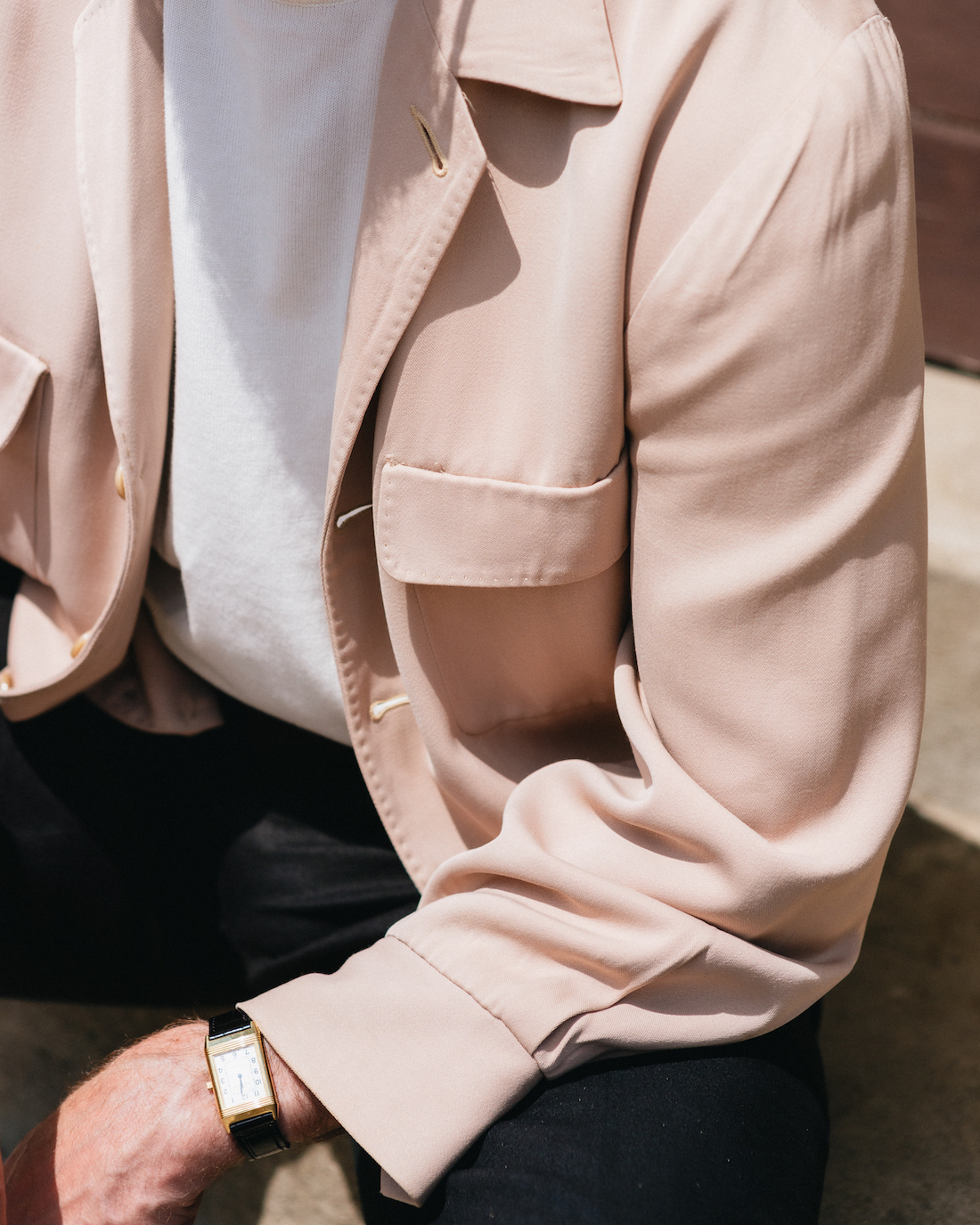
This vintage rayon jacket I bought in Japan earlier in the year has drawn quite a bit of interest since I posted pictures during Pitti. 

A couple of different brands asked about the details and whether they could borrow it to take details for a similar product - but I had to tell them that I liked it so much, we’d be working on something ourselves that drew on it for inspiration anyway. 

I think the reason I like it so much is that it hits the Permanent Style core of being only subtly unusual. 

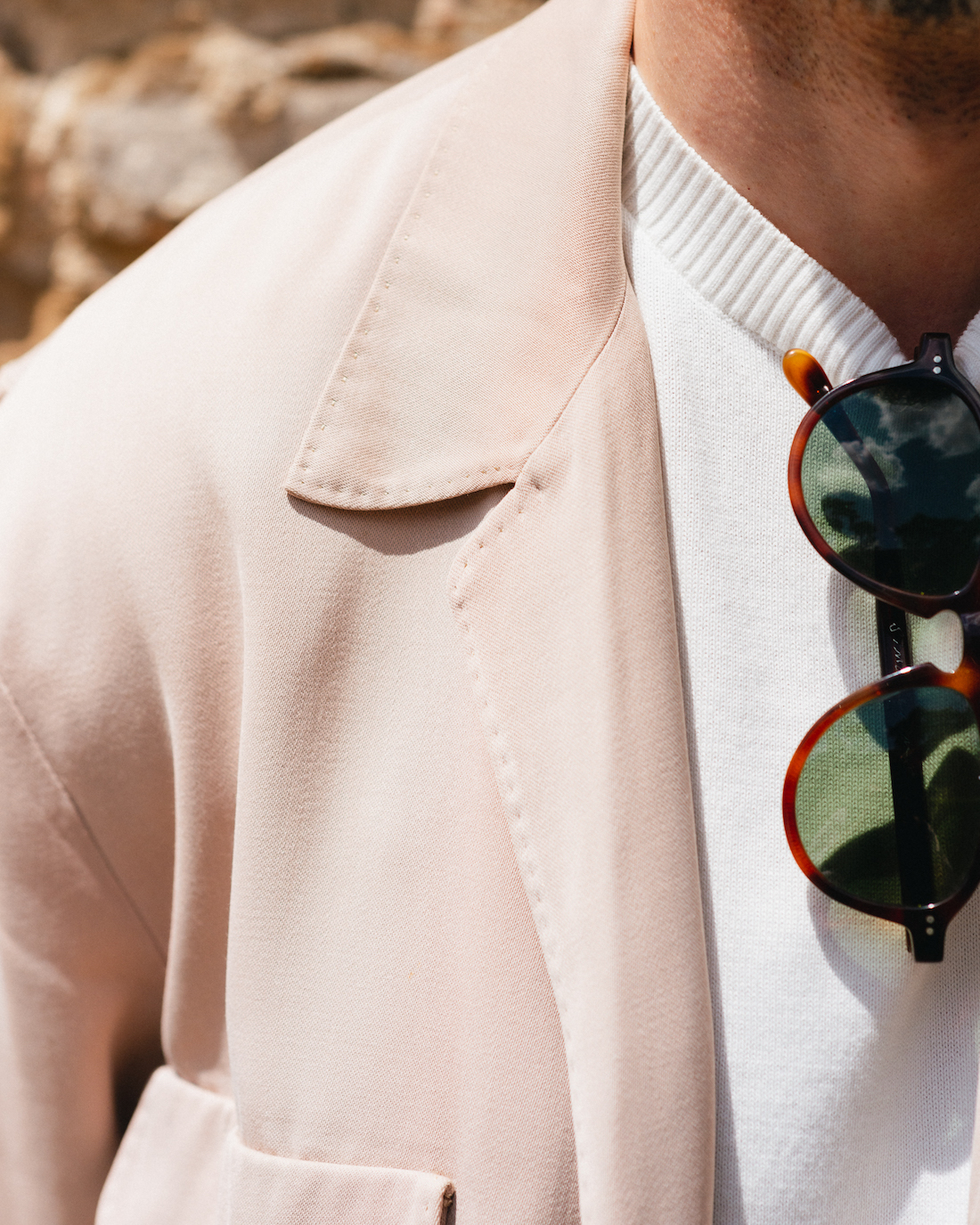
Yes it’s pink, but such a pale pink that someone even referred to it as grey. It’s the kind of pink, in fact, that would make a good tailored jacket - as Manish pictured in his article using a Ring Jacket example. 

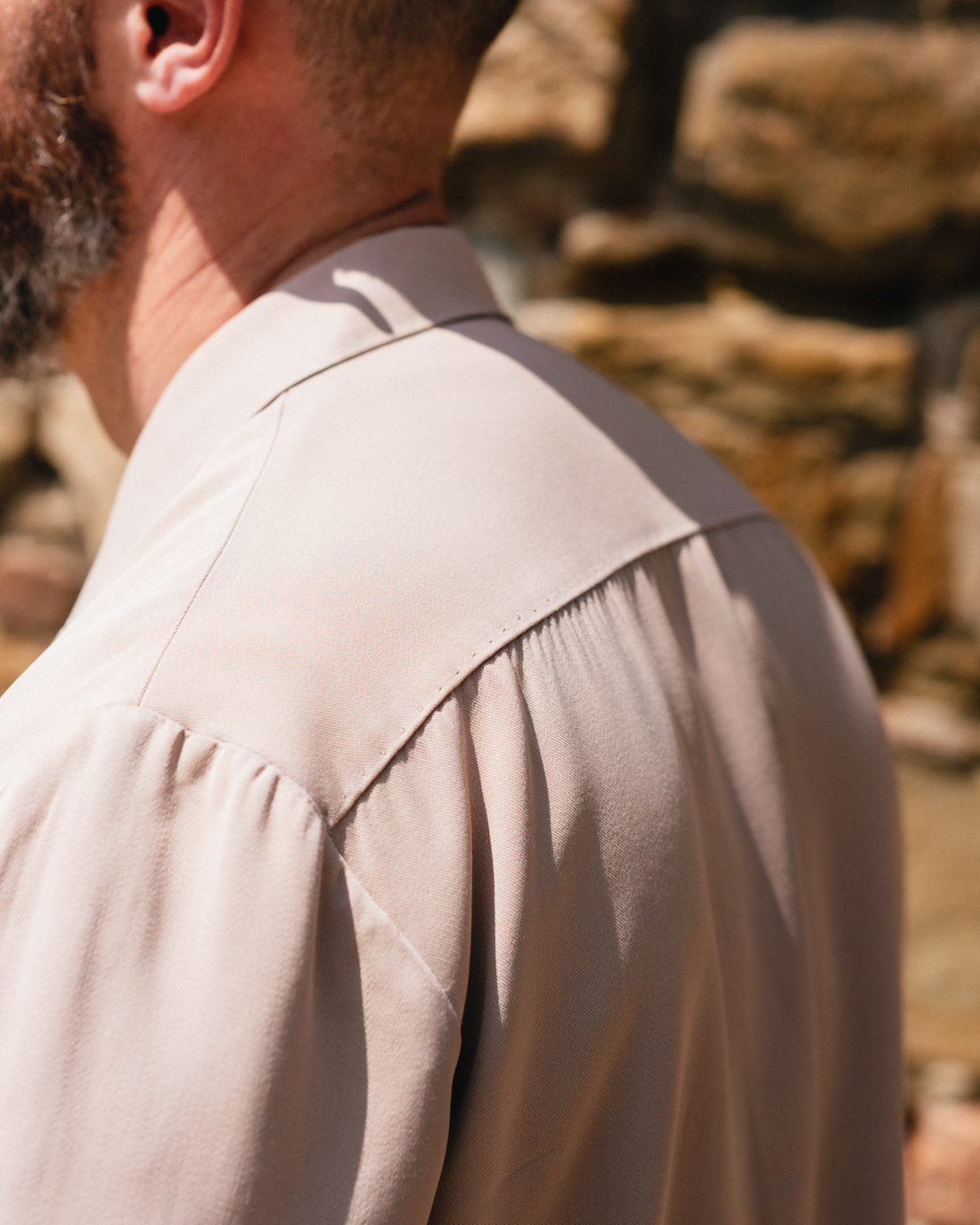
And yes it’s a vintage style, but everything is understated. It’s big in the body, but not too much; it’s short in the length, but not too much; the yoke is gathered and a little flouncy - but not too much. 

Most of this comes across only when you’re close up. Showing it to a (non-menswear) friend recently, the first thing he remarked on was the material - is it wool, polyester? Rayon and viscose aren’t that common these days, and he had no obvious reference. 

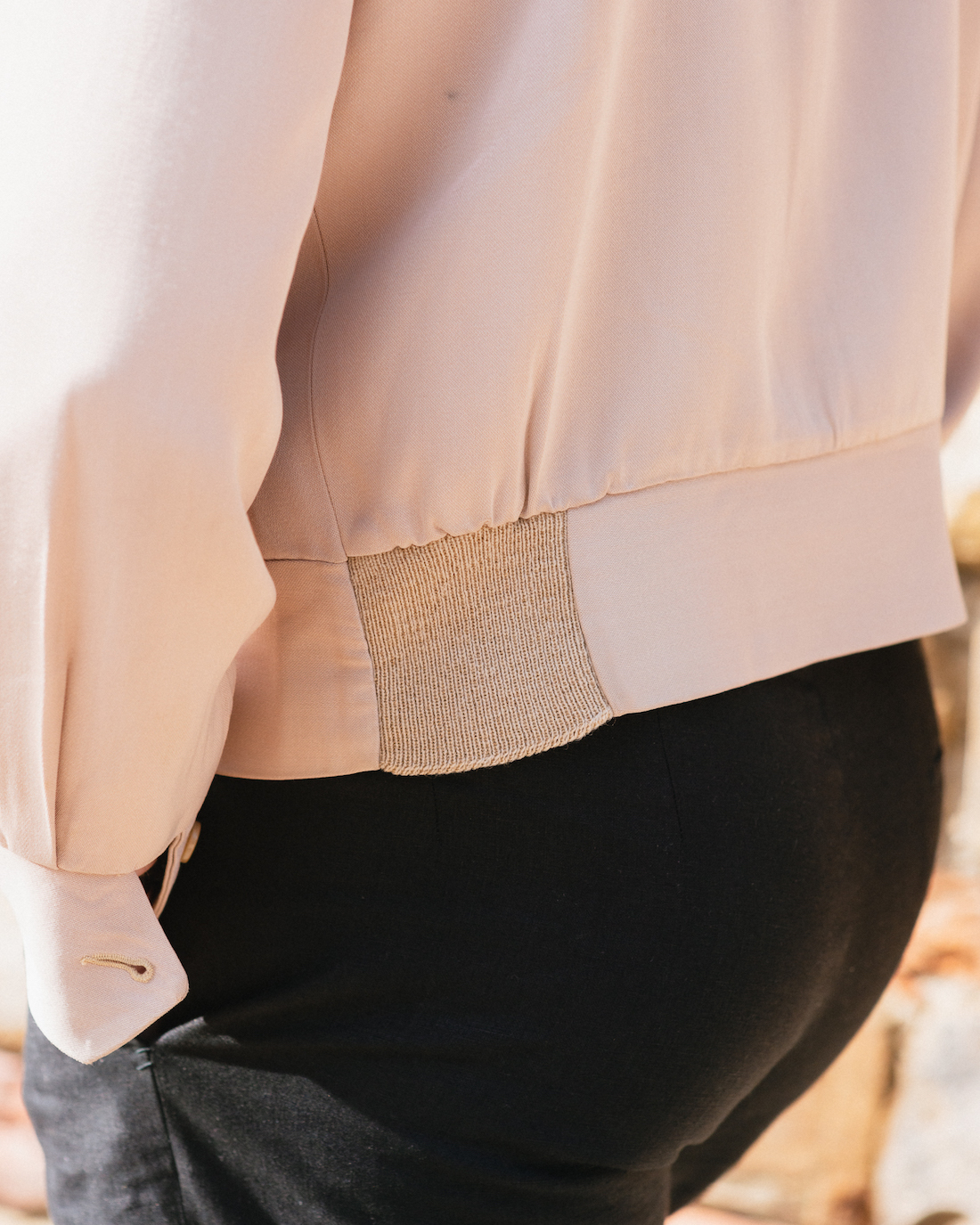
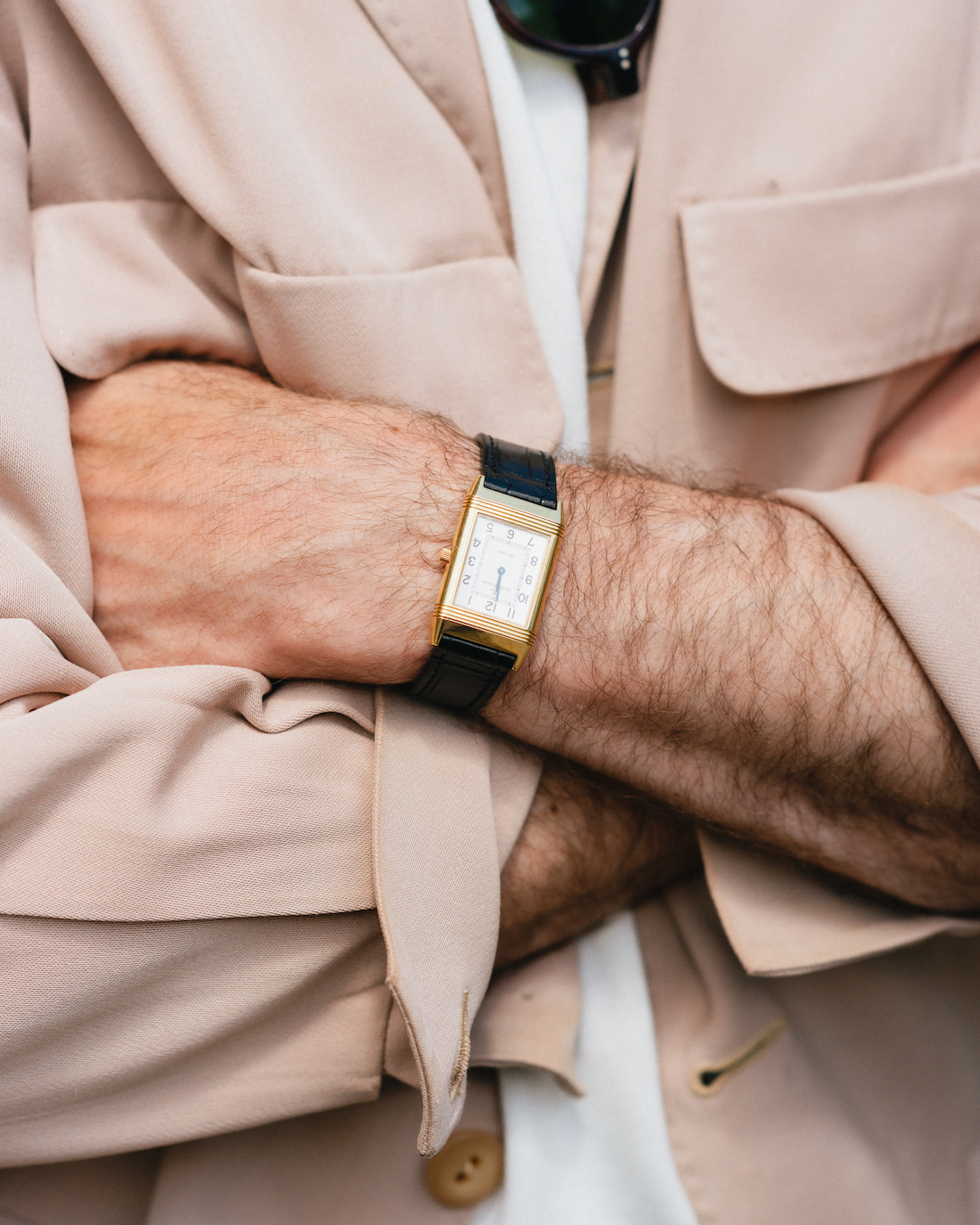
The elements I love most, though, are the buttons and that gathering on the yoke and shoulders - they give character through hardware and craft respectively, and are both things a modern high-street version would never bother to do. They’d be the first costs cut. 

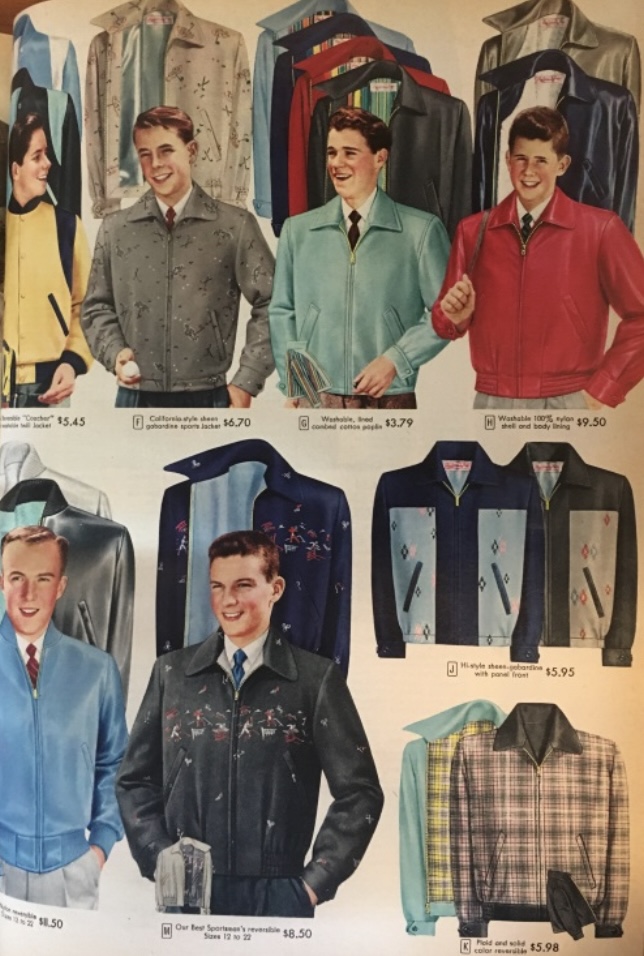
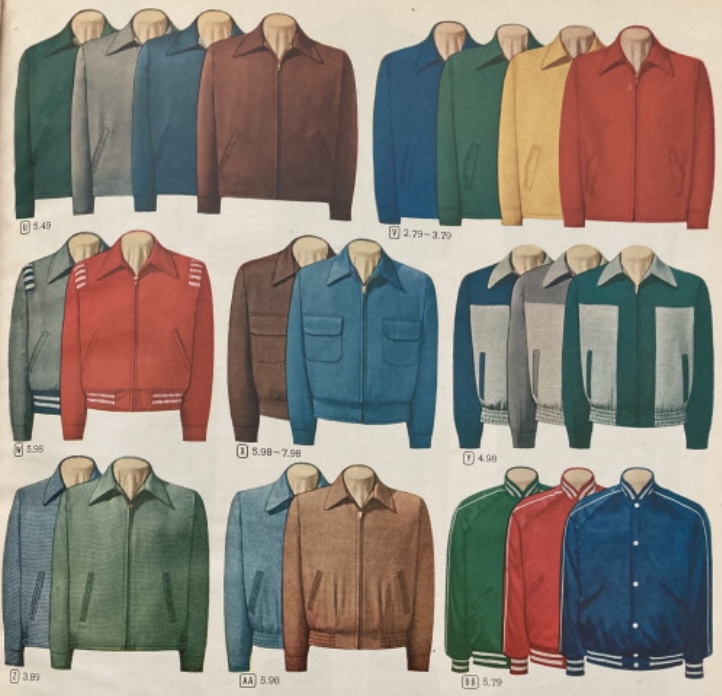
It wasn’t the case in the 1950s, when this jacket dates from. This is the era when leisure wear first started to become a serious business, and this kind of short, waisted jacket was worn with tailored wool trousers and a shirt - even a tie. 

You see them discussed more on period-dressing sites and swing-dancing blogs, but with a pair of jeans and a T-shirt, I think it makes a very effective modern jacket. Like the more common Harrington or a ‘swing’ golf jacket, but a little fancier and more tailored.

Which is where those details come in. Two small panels of elastic in the back, rather than anything bigger; pick stitching around the edges; so-called ‘bag-stitched’ pockets, where the flap simply dresses up a patch pocket. 

Actually, the pick stitching is something I could happily do without, simply because today that kind of machine stitching reminds me of cheaper RTW tailoring trying to imitate handwork. 

And I think wool gabardine would be more practical - but then again wool might not have lasted 70 years. Wool versions of these jackets are often more faded and have little nicks or holes. (One for those that liked how well polyester lasts.) 

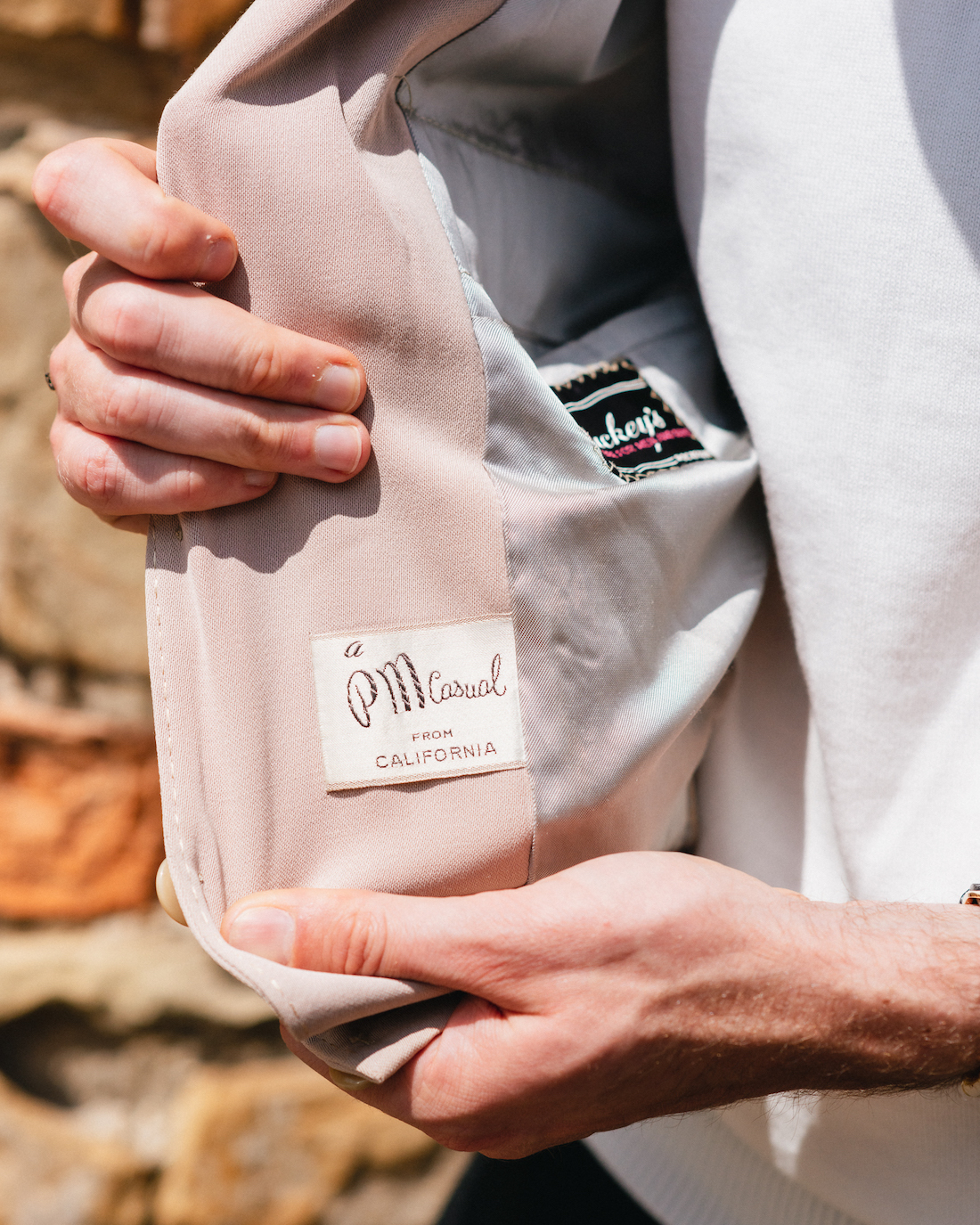
But then that’s what happens with vintage clothing - you always sacrifice something in the fit or the make, with lots of character in return. This jacket has some odd touches, like the double label on the inside right. 

The original label appears to be ‘a PM Casual, from California’ as that’s sewn into the facing (what a name, what a font!). Then there’s a second label, sewn in frankly quite poorly, presumably for a retailer - ‘Stuckey’s, style store for men and boys’ in Rockford. 

The same stitching appears to have been used to sew up the outbreast pockets, so they’re not usable. This is quite rough on the inside, and was presumably done because the pockets became baggy. But either the retailer made a strange choice or a later owner matched the thread very well. 

Such are the intrigues of vintage clothing. 

This style of jacket was meant to be worn with real high-waisted trousers, and finish on the natural waist. It would have been pretty short therefore, and is a little short on me - but not by much. The sleeves are a little short too, but again not extremely so.

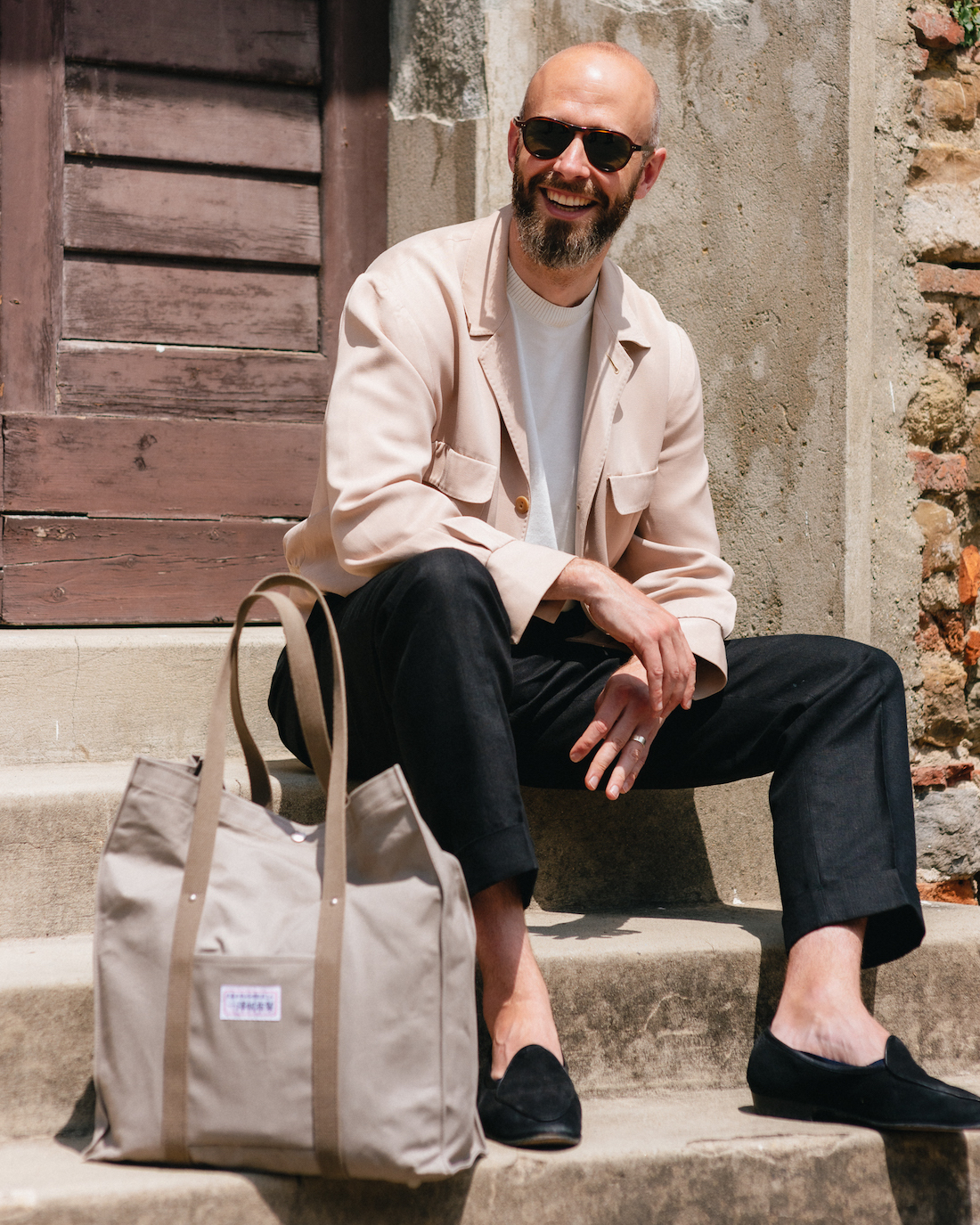
In the pictures here, taken at Pitti, I’m wearing it with black linen trousers, black Sagans and a knitted white T-shirt. It’s a little smart, a little dressy. The grey tote is a nice complimentary colour.

But later that week in Milan I wore the same colours, just in more casual materials: a regular T-shirt on top, black jeans on the bottom. The materials and textures are softer, and it’s more casual. 

Then it also works nicely with mid-blue jeans, perhaps with that white T-shirt or a grey. In fact that’s my favourite combination with short jackets like these, whether it’s a faded yellow Harrington or a tobacco suede. Mid-blue is the default, and I’m increasingly finding washed black jeans can be nice too. 

These jackets are quite regularly reproduced, and coincidentally Full Count brought out a pink polyester one this season. Personally I prefer the button front of mine, and the collar shape, but they are available at Clutch and through the Full Count website. (In navy and pink, and with ‘Hustler’s Mentality’ embroidery! Also, note Full Count's return/exchange policy.) 

There are some short casual jackets out there, like the McCoy’s Swing jacket and of course many styles of Harrington, but they are a little sportier, a little simpler. For a smart/casual look you’d probably better off sticking with flight-jacket style blousons instead.

Also if looking online, be aware that a lot of Ricky or gab jackets come in patterned materials, even contrasting panels. Ethan Wong has a good piece here showing a few of these more period options. 

Clothes shown:

  • Pink vintage rayon ‘Ricky’ jacket
  • Black linen bespoke trousers, W Bill linen made by Whitcomb & Shaftesbury
  • White knitted T-shirt by The Anthology
  • Brown ‘Californian’ sunglasses by EB Meyrowitz
  • Black suede ‘Classic Sagan’ shoes from Baudoin & Lange
  • Yellow-gold Reverso watch, Jaeger-LeCoultre

Oh, and while there's a little debate, the name 'Ricky' likely originated from the character Ricky Ricardo on the TV show I Love Lucy, who wore the style of jacket. 

The PS talks are back – with Luke Walker of LEJ

The PS talks are back – with Luke Walker of LEJ

Monday, August 28th 2023
||- Begin Content -||

A new season of talks is starting this Autumn, following the same format as the four we held last year - with Ethan Newton, Tony Sylvester, Jamie Ferguson and Rubato.

The evenings at Mortimer House were immensely enjoyable, with around 50 readers gathering for drinks on the top floor of Mortimer, gazing out over London. Afterwards they sat patiently and interestedly (as only a PS reader does) while we discussed the intricacies of menswear.

Our next talk will be on Friday, September 29 with Luke Walker, designer and founder of the brand LEJ.

I'm excited about this one because Luke is not a typical classic-menswear interviewee. He went to fashion school, he designed for Lanvin and Dunhill, before then working at Drake's and starting LEJ. He has a particularly broad perspective, bringing in the wide world of fashion to our little niche. I'm looking forward to discussing the differences and divergences.

As with last year, please register to attend the talk by emailing [email protected]. We need a list for Mortimer House, and have a cap of 50 people.

For everyone around the world who can't attend, it will be filmed and published on PS, again as with the previous talks.

See you all there.

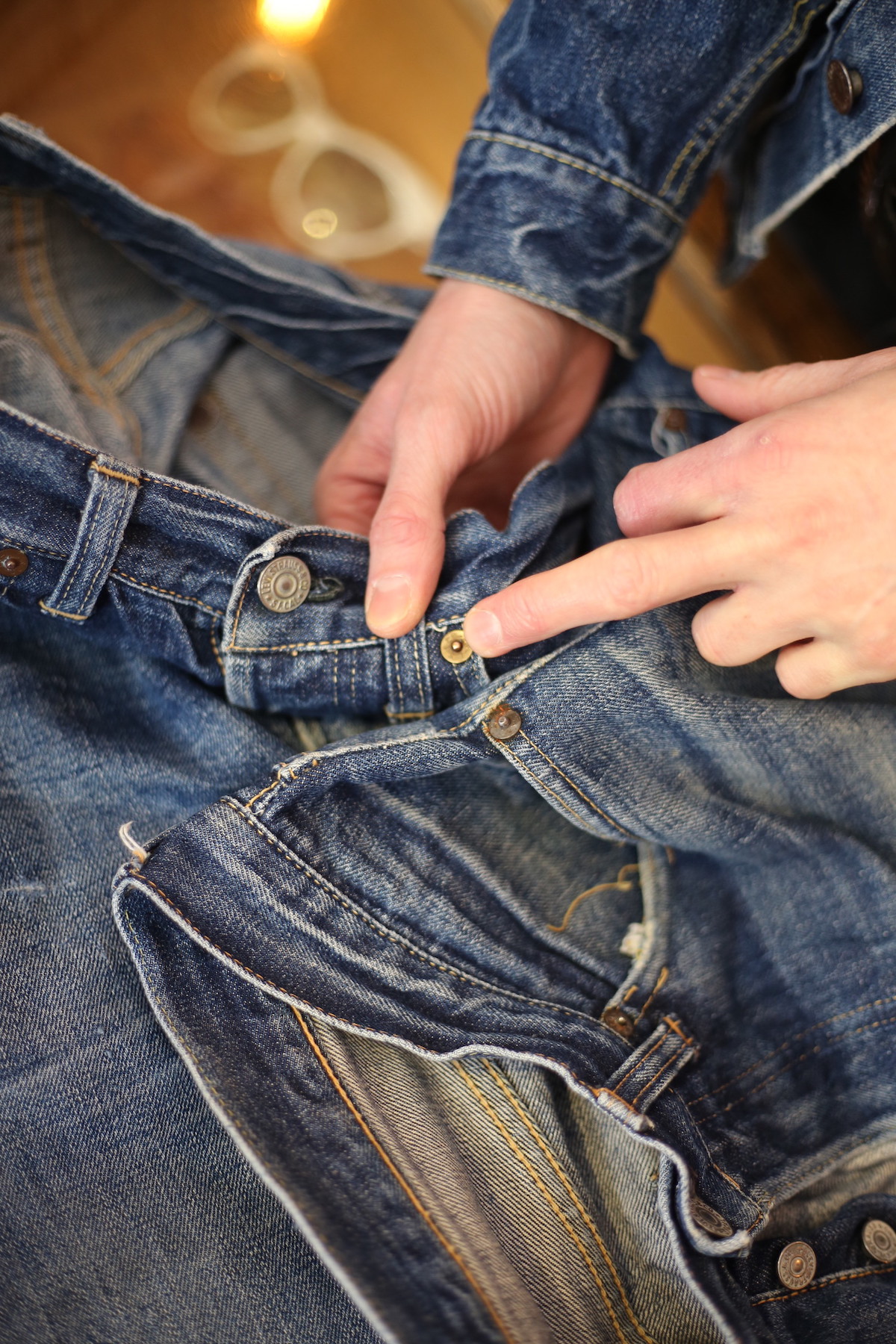
Buying second-hand US-made Levi’s

Buying second-hand US-made Levi’s

Friday, August 25th 2023
||- Begin Content -||

Getting good mid-blue jeans can be tricky, given the prevalence of raw denim among most high-end makers we cover. Several do offer washes - like Orslow and Full Count - but the range and therefore the choice is usually less. 

Plus of course that’s the very top quality, which isn’t what everyone wants or can afford. The mid-market for jeans can often be a bit more confusing in terms of quality and service. 

For both those reasons, I thought it was worth highlighting another option, which is nineties Levi’s bought second-hand, on eBay or elsewhere. 

This era of Levi’s jean was usually made in the US, and used rather better quality denim than modern ones. Not better than the high-end repro brands, or the Levi’s sub-label LVC (Levi’s Vintage Clothing). But they’re much cheaper, and LVC looks like it won’t be around much longer anyway. 

It’s the price, and therefore the value, that’s the kicker. A pair of nineties Levi’s in a good vintage store might be £80 or £100 - around the same as modern Levi’s, but better quality. 

However, if you’re prepared to spend a bit of time (and go through some trial and error) on eBay, then you can pick them up for £30 or £40. 

Here’s how to find them and how to identify them.

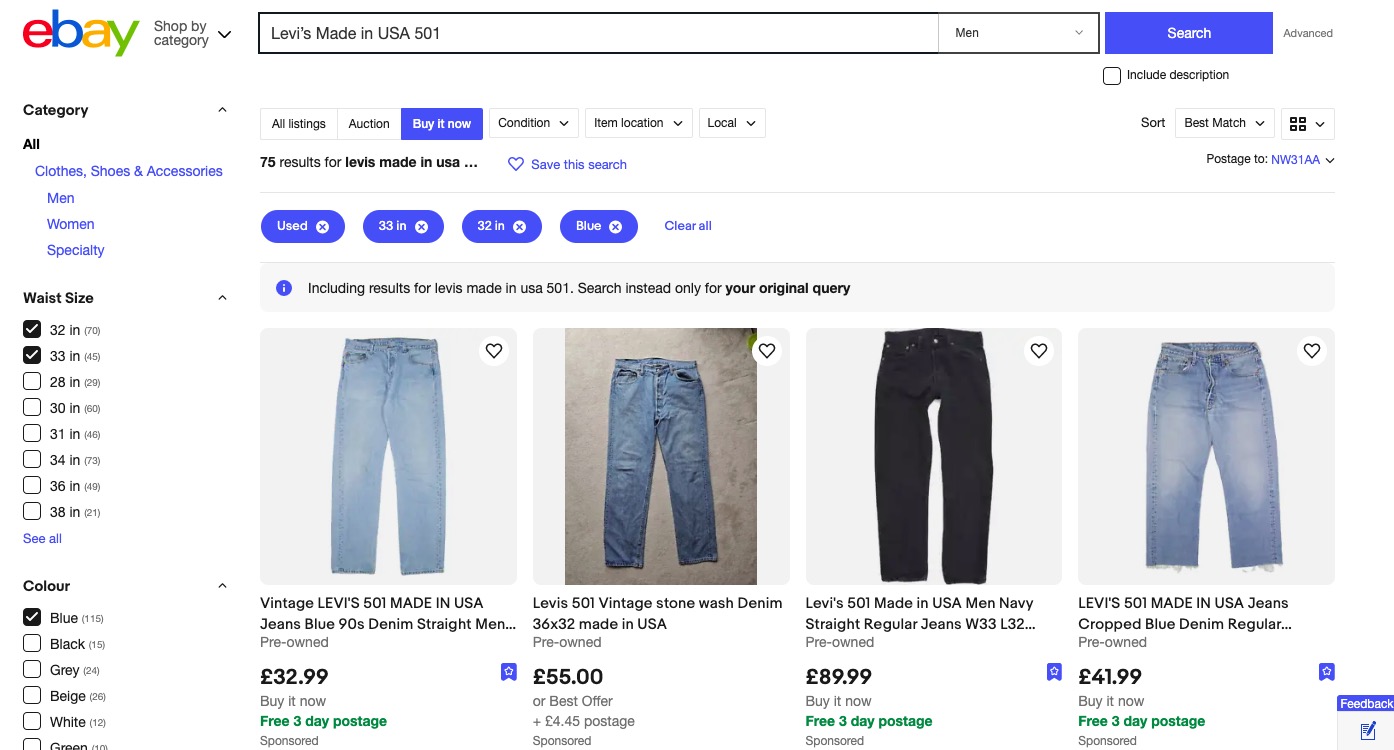
How to search, with eBay as the example:

  • Search for Levi’s Made in USA and the style, eg 501
  • Refine for just men's, then by your waist size and colour
  • Refine by condition to ‘Used’ assuming you don’t want new-old stock
  • Refine to ‘Buy it now’ unless you don’t mind going through an auction. In which case, good to sort by ‘Ending soonest’ so you prioritise those
  • Compare the provided measurements with what you need (based off measuring your own jeans) 
  • Find the fade you like best with decent measurements, and give them a go

Bear in mind that:

  • Some of these were usually shrink to fit, so the marked size and the actual dimensions will differ, and not by the same amount each time. Go off the measurements provided, and keep in mind with searching that they might have been tagged with either the marked or the actual size
  • 501s don’t vary too much in the cut in this period (close hips, straight leg) but they do vary in the rise, so keep an eye on that
  • Most sellers offer returns, but not all. Worth making sure they do given you’re trying jeans sight unseen
  • Some sellers sell jeans with an ‘example’ wash, because they have a whole load and don’t want to shoot each one. It’s a minority, but again keep an eye out
  • If there are other styles you prefer, eg 505 for a bigger size through the hips, use that instead
  • People listing sometimes make mistakes, sometimes just include things in a variety of categories to try and catch as many eyeballs as possible. These need to be weeded out

Some general tips:

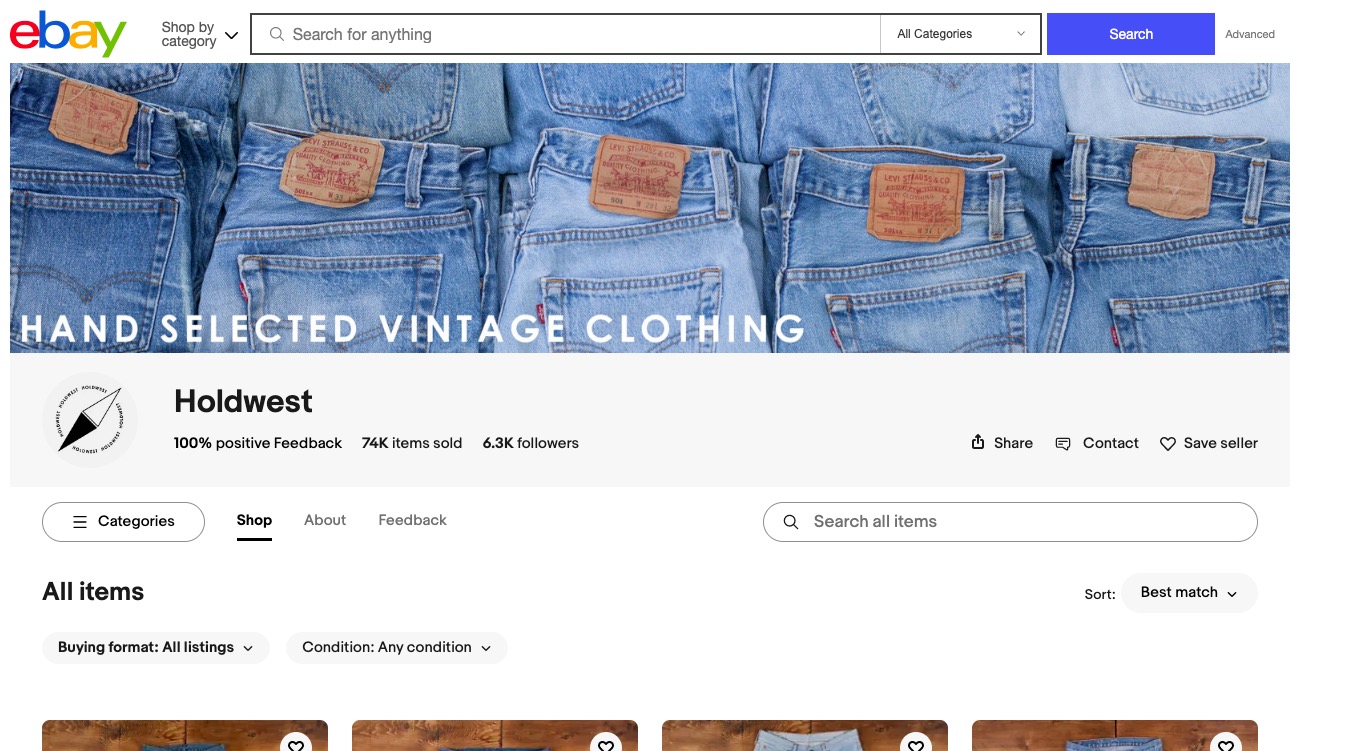
  • It cuts down time enormously when you find a seller on eBay that has a lot of what you’re after. Eg ‘Holdwest’ in the UK is good for this era of jeans
  • Searches can be very text specific, eg ‘Made in US’ brings up a lot less than ‘Made in USA’. It can take some time to work out the wording people mostly use
  • Watch out for typos. Sometimes searching ‘Lewis’ rather than Levi’s brings up something interesting. Although it happens more for obvious typos, like ‘Loro Piano’
  • Save your search so you can go back to it easily, and you can set up alerts if there’s nothing that hits what you want exactly

How to identify the jeans:

Once you find a pair of 501s, these are the kinds of things to look for in the images (or when you receive them) to make sure you’re getting the real thing. So look at:

  • The label inside, which will say whether they were made in the USA
    • The red 'bat wing' also shows they were made after 1986, which is all of what we're looking at
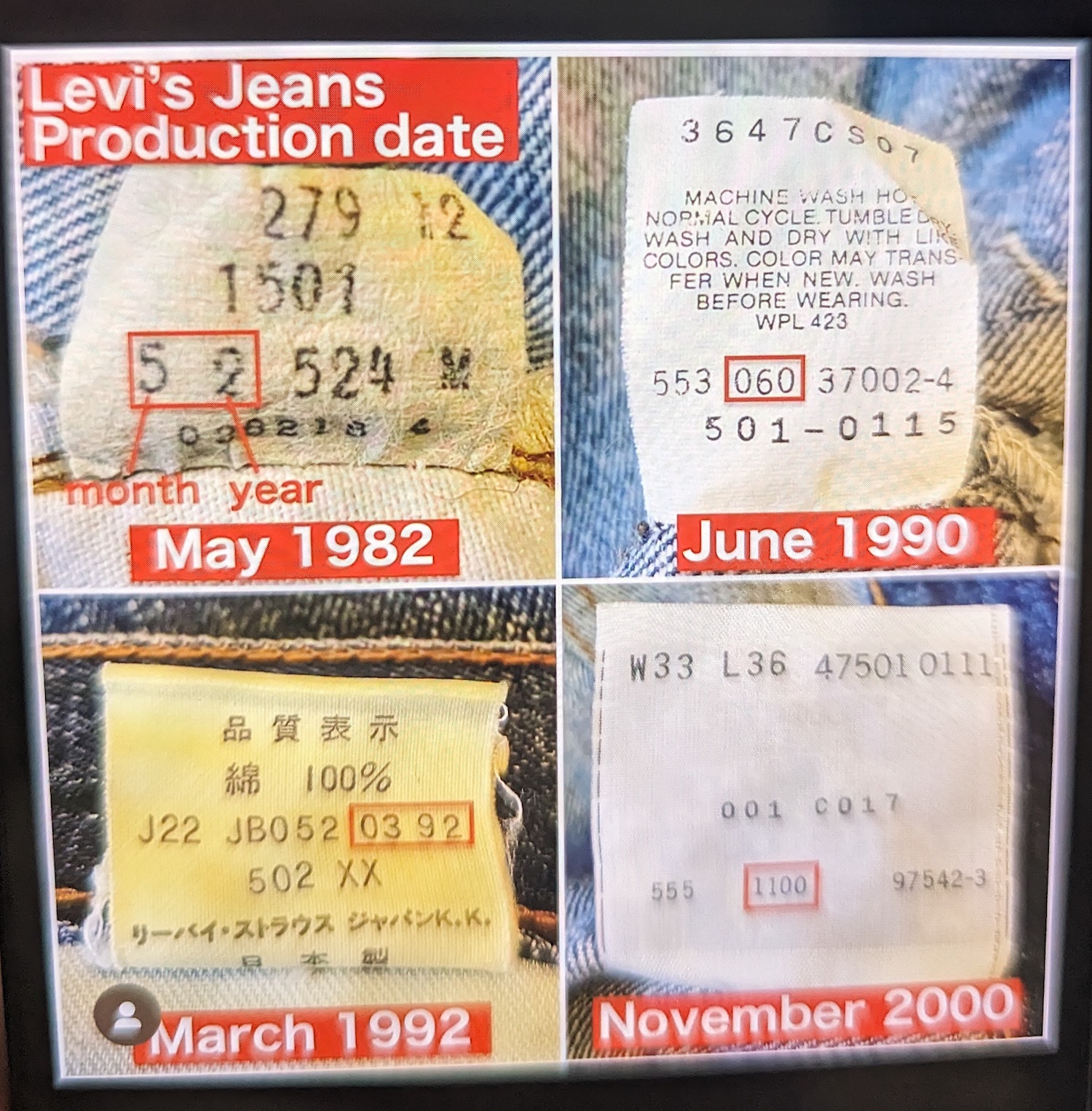
  • The other side of the label, which has a whole lot of numbers and information. These can help identify lots of different things about the jeans, and can help pin down the rise. But then you can tell that from the measurements - the one you can’t see otherwise is the date:
    • This is expressed as two, three or four numbers, representing the month and the year. See image below. 
    • Most of these will run from the nineties into the early 2000s. Anything before that gets a bit nicer but probably more expensive
  • The patch on the waistband, purely for the ‘XX’ that indicates the denim. They usually are, but the XX indicates a better denim and was usually shrink to fit. 
  • Don’t worry about the selvedge, as the quality for made in the USA was pretty consistent
  • Equally the stamp on the back of the button can tell you where they're made, but you only really need this if the label is unreadable

I’ve bought one pair of nice 501s through this method, for £39, and have another I bought in Japan for twice that, featured recently here

They’re not as nice as any of my older vintage Levi’s (60s, 70s). They’re not as nice quality denim as my washed Full Count jeans. But they’re a better cut that the Full Count, a better wash than most mid-blue jeans out there, a better fit (for me) than pretty much all of them, and cheap enough that I won’t mind if I find a better-quality pair in a year or two. 

Also, I’m happy spending that amount again on getting them altered, somewhere like Blackhorse Lane. Usually I find I need to be a little bit big on the waist in order to get the best fit through the hips and thighs, so I have them taken in by an inch or so.

I spoke to both denim experts and serial eBay shoppers for this piece, but I’m sure there are still things I’ve missed or even got wrong. In either case please leave a comment below and I’ll update accordingly. For everyone else, happy hunting. 

A couple of more in-depth articles, should you want to dive deeper:

Visiting the 45R headquarters, Tokyo

Visiting the 45R headquarters, Tokyo

Wednesday, August 23rd 2023
||- Begin Content -||

When we approached the headquarters of 45R, I was a little nervous. I'd been given an introduction by a friend, but had no idea what the management team knew about me or Permanent Style, or how much they cared. 

It was late afternoon and already getting dark as Alex and I crossed the highway, shadowed by a rumbling overpass, and looked for the right buzzer on the fairly anonymous building. 

Luckily the names were in English as well as Japanese. Unluckily, it wasn't clear which one was the reception, or otherwise the correct floor. We picked the first one, and hoped. 

No reply, but a loud buzz. We pushed the glass-fronted door and entered. A small marble lobby with an elevator: we pushed the same floor  and began to rise. 

I shouldn't have worried really, but I always do. Things usually turn out well but I'm a worrier, I can't help it. Maybe a psychologist would say it's healthy: stops you getting too full of yourself. 

When we exited the lift, there was Kokoro Alonso. Smiling, stylish, holding out her hand in greeting. In fact, very stylish - there's something about brands like 45R which means the women are often particularly inspiring. Perhaps it’s because the clothes - casual materials, loose fits - are quite unisex, and the women simply have more style. 

I should have said, by the way, that the lobby in which Alonso greeted us was also beautiful - much more 45R than the building, the elevator or the overpass. A huge wooden slab of a table sat in the middle - something that looked like it had been hewn in one long sweep of an axe, and then frozen in French polish; delicate vases were artfully positioned. 

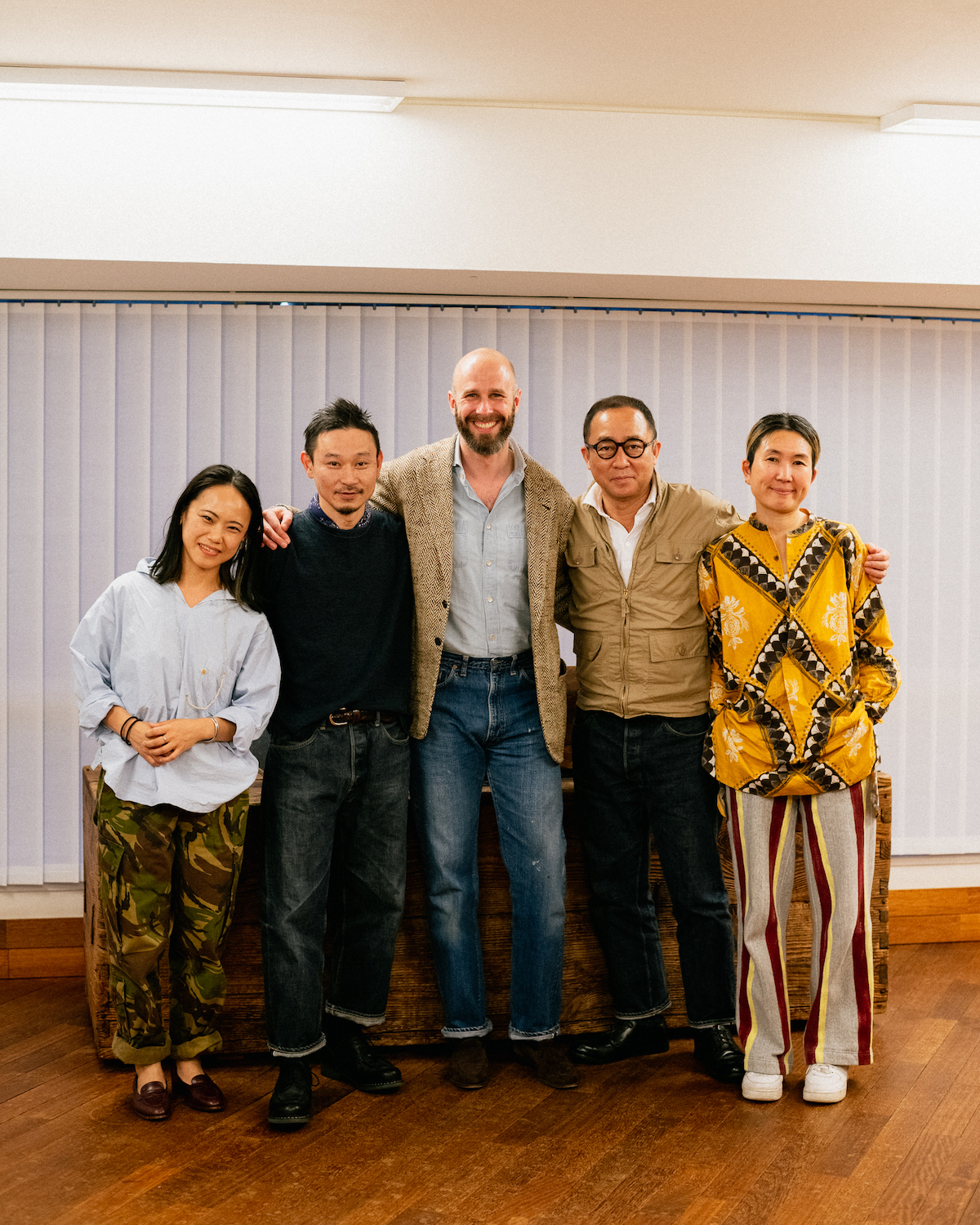
We were ushered through into a meeting room, and it became clearer we were expected, even with pleasure. Into the room came Norio Sugahara, the men’s designer; Masaki Nakashima, the president and our contact in setting up the meeting; and finally Junko Takashio, who oversees some of the production. 

That’s them left to right, with Alonso first. Her loose popover is very 45R, as is the necklace; the loafers are a nice elegant touch of contrast I think. 

And that was what we started by talking about. Sugahara first explained how much of the company’s philosophy comes from Inoue Yasumi and Shinji Takahashi, the head designer and director, and then talked about the menswear design - with a particular focus on contrast. 

“The roots of everything we do is traditional clothing,” he said, “but I like to mix them up. Naval clothing, for example, I love - the hard materials, the weather-worn fading. But I also like that attitude in hiking and mountaineering gear. So perhaps one season we’ll mix them up and do hiking clothes in naval materials and colours, particularly indigo as it’s so core to the brand.”

Indigo is absolutely central to 45R. They were the first company to introduce high-end denim into international markets like the US in the 1980s, when jeans were reaching their peak of being cheap, mass-market clothing. 

They’re especially known for organic indigo (Ai-indigo), and the varieties of indigo they’ve introduced over the years. The flagship store in Tokyo is known among some English-speaking locals as Indigo House. 

“The jeans I’m wearing today are a new indigo colour we’re working on - Kageiro Nando or Shadow Nando,” said Sugahara. “It’s a greyish shade, with a lot of charcoal in the mix. Everyone is seeing how it fades and behaves.”

Apparently the management team, the shop staff and all of the craftspeople in the factory are wearing pieces in this new indigo, both to see how it fades so they can talk about it, and to show those fades to customers. 

“After they’ve all been worn in, we will sell the clothes off for charity,” says Takashio, who has the best English of the group, and chips in now and again to clarify things. “I’m not sure it was a good idea - it’s making us all very sad!”

45R have a reputation for taking things to the nth degree, with yarns often handspun, fabrics handwoven and - certainly with the denim - hand dyed. That’s why it appeals to so many fans of craft, even if the designs can be a little quirky. But I didn’t realise before how involved the design side was.

“What’s interesting is when we combine these worn garments with genuine vintage at the beginning of a season,” Sugahara said. “We always have a vintage room full of all our inspiration pieces for that season, which the staff come in and browse. But then the worn-in current pieces get added too, and compared.”

Another project they’ve been working on recently is Natural Indigo Artisans. This involved searching Japan for remaining indigo artisans, and picking 11 to take their own approaches to dying certain 45R garments. They even combined the dyes on some pieces, to replicate the feeling of patched ‘Boro’ cloth (below)

“We’ll have people dyeing indigo in some stores, certainly Aoyama and New York,” says Alonso. “Natural indigo dyeing is such an organic process - it’s alive, it changes before your eyes. But that can be hard to get across to people who just see the finished product.”

At this point I brought up the - hopefully constructive - point that it can be hard to get this information as a consumer too. There’s so much in every 45R piece, but not much of it lives online. 

This, to an extent, is a Japanese issue - the country as a whole has been surprisingly slow on e-commerce. But it’s also a particular issue for someone like 45R, with high prices but no advertising (on principle) and so less general awareness. 

Fortunately, in the three months since I was in Japan the international 45R site has been revamped, and there is now more information online. Indeed, it’s a little hard to see where to actually shop now. But if anyone’s interested, the Journal is here, and a little piece on the new indigo is here

Another place it’s good to get information is the brand’s Instagram page, particularly the videos. Inoue Yasumi often goes meticulously through new products, or has staff show how things have worn in, such as here on denim for example. 

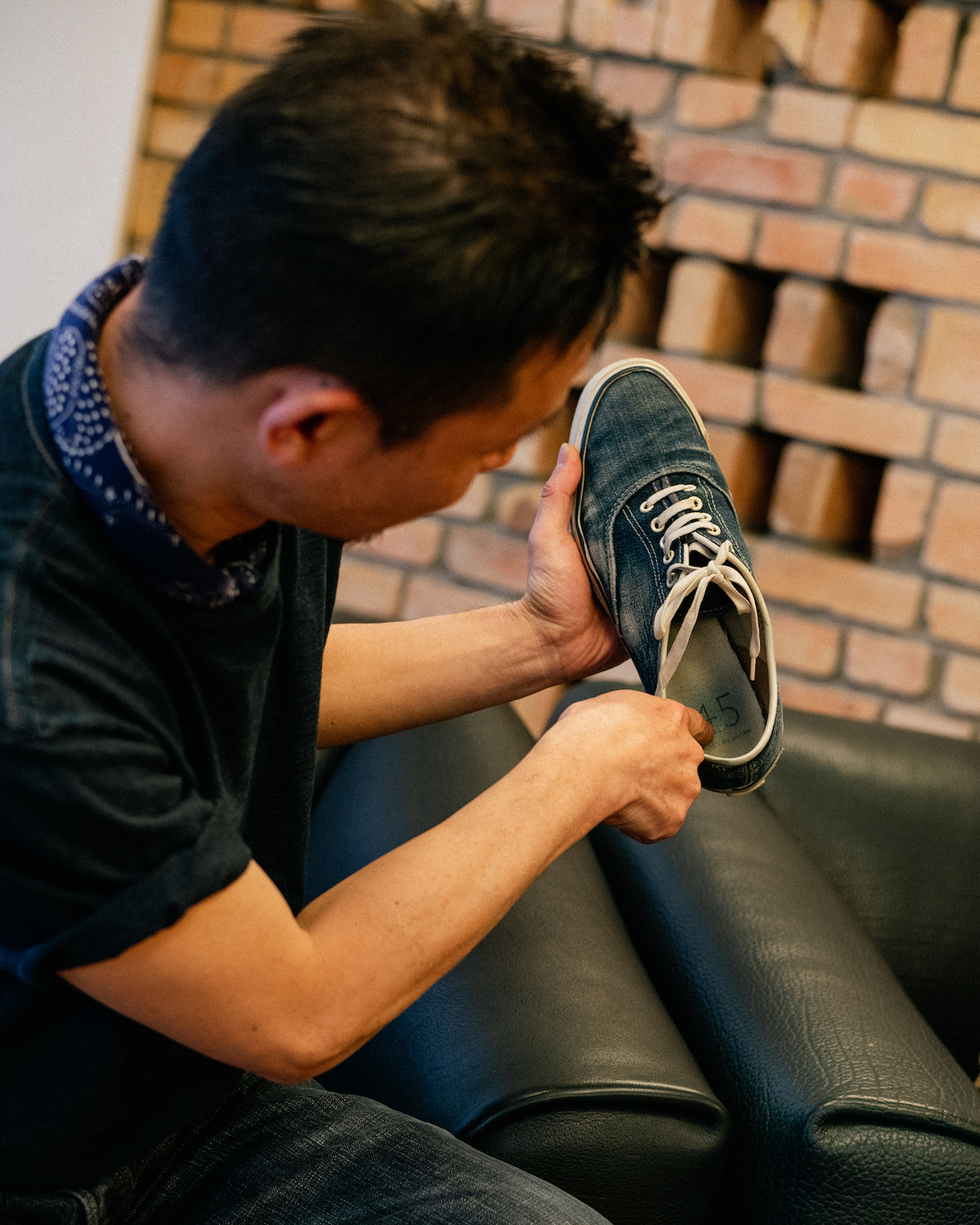
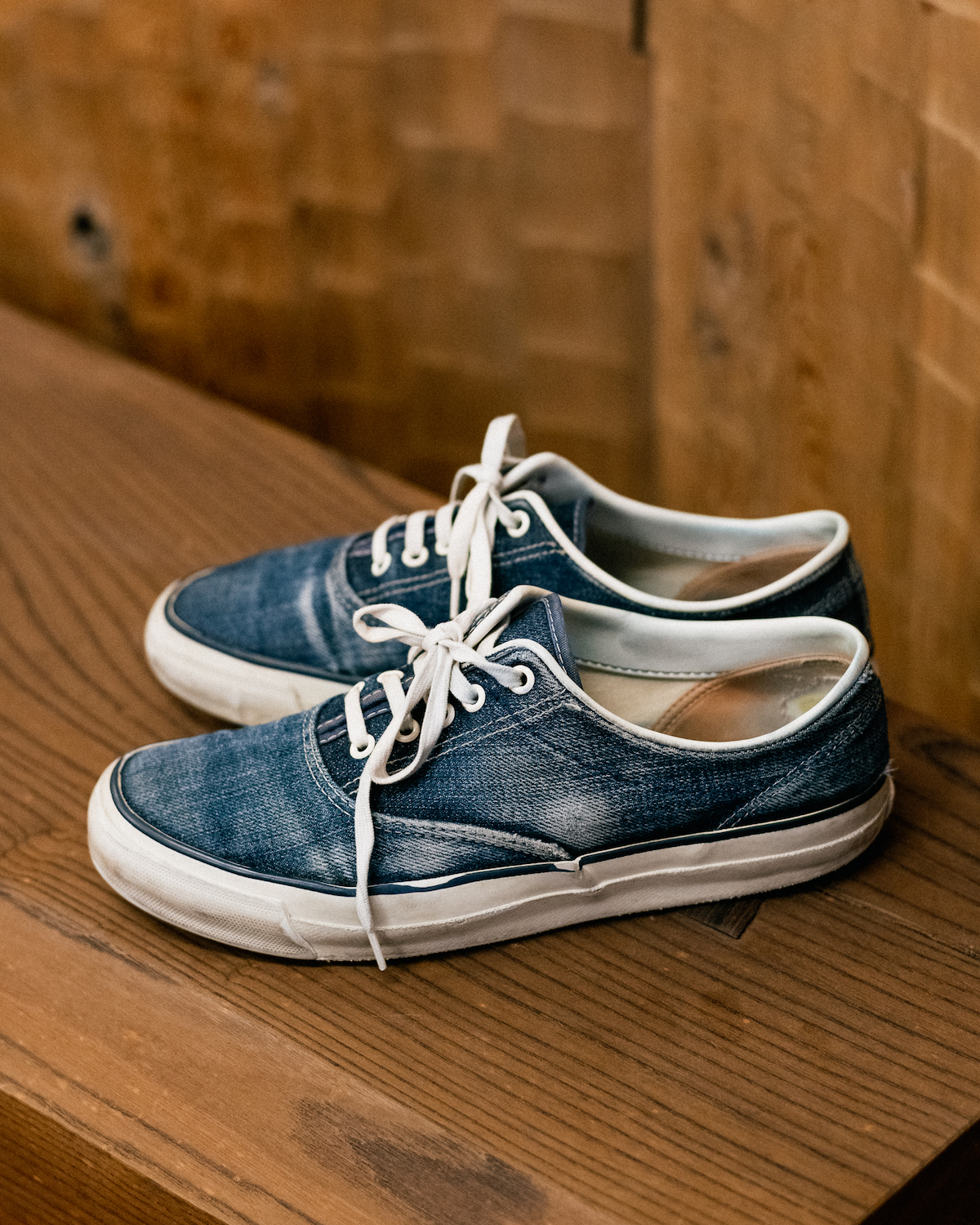
It was one such video on linen deck shoes that convinced me to get a pair, which I’ve featured previously here. When I mentioned this to Sugahara, he immediately went behind the screen into the office and brought out his own pair, shown above.

Mine don’t look anything like this - they’ve probably been worn 10 times less - but they do have lovely fade marks from the natural indigo. I should also mention that they are superbly made - the best I’ve tried. Lovely anatomic shape like Wakouwa, but better made and with a really subtle wave-like grip that any fan of the Sperry origin story will appreciate. 

We touched on a few other subjects, but I feel they should have their own follow-up post if anything. 

Today I just wanted to give a feel of what it was like to meet the 45R team, to talk about how genuine they were and use it as a way to help communicate the philosophy behind the brand. 

I feel that’s important because I also have to remind myself sometimes - when I visited Indigo House, for example, and was looking at some expensive polos and a gauze-like shirt that came down to my knees. And because the company does so little of it themselves - no marketing, no advertising.

45R is a design brand, but one rooted in traditional clothing and techniques, which is quite rare. They create clothes that are the best-made possible, that look pre-loved as soon as they’re made. They are the embodiment of the ‘how great things age’ side of PS. 

Autumn/Winter 2023 on the PS Shop

Autumn/Winter 2023 on the PS Shop

Monday, August 21st 2023
||- Begin Content -||

As has now become routine, here is a view into what’s arriving in the PS Shop during the rest of the year. There are some new products and restocks of favourites, for any that have missed them thus far. 

We try to give an accurate month for launch, but again as per usual, please bear with us as everyone's supply chain is still under pressure and there may be some later launches than planned. 

Please ask any questions in the comments below - and if you have a question, have a quick check there to make sure we haven’t answered it. 

August

  • Bullskin Tote Bag - The classic Frank Clegg tote, restocked last week
  • Indulgent Cardigan pre-order - Second payment. This is a note for customers that took part in this pre-order. We will be opening the second payment window in August and expect delivery in September
  • The New Friday Polo - The Friday Polo has been a staple of the PS offering since the beginning of the store, but has been tweaked consistently along the way. This is the latest, most versatile iteration. More details soon
  • PS Shetland cloth - Restock

September

  • New Raincoat - Single-breasted, olive, subtle and versatile
  • Donegal Coat - Restock, navy and the popular light-grey herringbone
  • Wax Walker - Restock
  • Bridge Coat - Restock
  • Reversible Suede Bomber - Restock 
  • Finest Crewneck - Restock and new charcoal
  • Undershirt - Restock - full size run - This has a high minimum so it won't be available again for another six months.
  • Oxford Shirts - Restock - White and Blue, plus Blue, Pink and Green Stripes. Cloth and shirts - no solid Pink or Yellow

October 

  • New Winter Tweed coat - Double-breasted, warm, gorgeous and grey 
  • Cashmere Rugby - Restock and new dark brown
  • Watch Caps - Restock and new dark brown 
  • PS Arran Scarf - Restock and new charcoal
  • Indulgent Cardigan - Launch for stock. Navy and grey, plus new dark brown
  • New cashmere knitwear project, details in October

November 

  • New denim shirts
  • New books - The Casual Style Guide, plus second edition of The Style Guide 
  • The Tapered T-shirt - Restock

There are still one or two projects that may come together this year, but are yet to be confirmed. They’ll be a pleasant surprise hopefully, if they come along. Again if you have any questions or requests Please let us know in the comments. 

Best,

Simon and Lucas

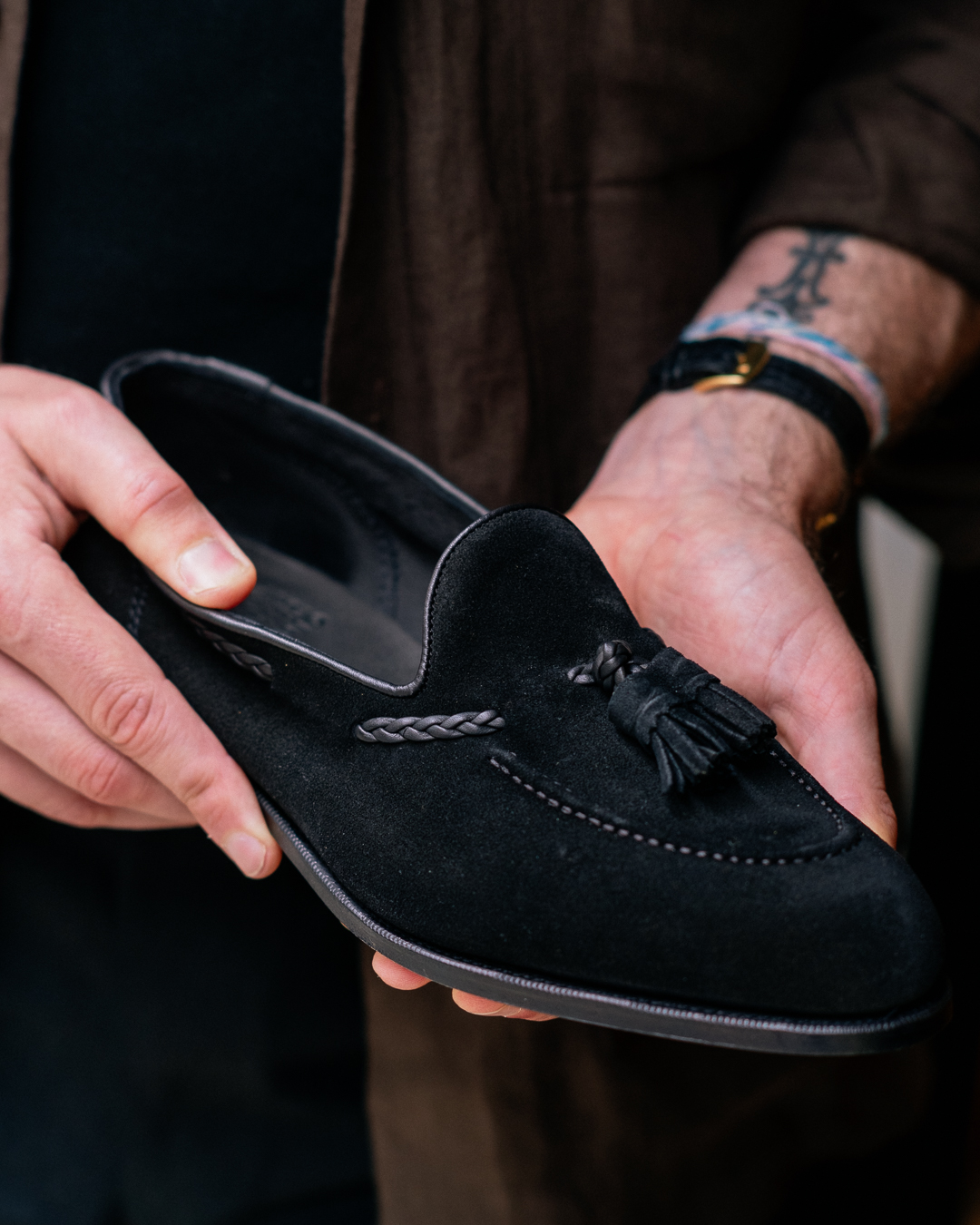
Questions about unlined loafers – with my Belgravia

Questions about unlined loafers – with my Belgravia

Friday, August 18th 2023
||- Begin Content -||

There have been quite a few queries about unlined shoes, particularly loafers, in recent months. Ones about longevity and fit specifically have come up multiple times.

I thought it would be good therefore to do a post summarising answers to them, in order to create a single place to point readers to in future.

It's also a subject I was interested in because I worked with Edward Green last year to help introduce an unlined version of my favourite EG shoe, the Belgravia

Perhaps the thing I found most instructive during that process was how little has to be changed in an unlined shoe - given the reinforcement that can remain around the toe, heel and topline. But let's start with those frequently asked questions. 

Fit

The first question people normally ask is about sizing - should I get the shoes in the same size as a regular, lined shoe? 

I can see the thought process: lining is being removed from the inside of the shoe so the inside must be bigger, therefore I must need a smaller size. (Two layers are actually removed through the sides of the shoe - a sidelining that sits between the lining and the upper, and the lining itself.)

But actually, this is not how an unlined shoe is made. The shoe is stretched over the same last as a lined shoe, so the space inside the shoe is the same. The lack of layers means the outside comes in, rather than the inside going out. 

The general advice, therefore, is to get the same size in an unlined shoe as a lined one, and that’s what I’ve usually done.

Stretching 

But will the shoe not stretch, because it doesn’t have that internal structure? And does that not mean I should get a smaller size, to anticipate the stretching?

Again this makes sense, except that most of the fundamentals of the structure are often kept in place. The toe puff, for example (that gives structure to the front of the shoe) and the heel stiffener (which holds the back) often remain, as does the lining that covers them. 

The top line (around the opening of the shoe) is retained, although it won’t be quite as strong without those three layers running into it. The vamp, on the top of the foot, will also often be lined to cover up stitching. 

So the bones of the shoe remain, which is why this structure is sometimes called a ‘skeleton’ lining. Unlined shoes can have more taken out, and this is easy to spot because the heels and toe are much softer than a regular shoe, but that’s usually a completely different style, with a cemented sole. 

The other factor is that leathers vary in how much they stretch. It’s about how open the fibres in the skin are, which is about what it’s made of and how it’s tanned. Some colours can even be more open than others, as the pH levels change with different tannins. 

However, a lot of unlined shoes are suede, and suede is mostly soft and open. It will stretch therefore, and you can see that in an unlined loafer when you’ve had it for a while - the topline, the opening of the shoe, becomes rounder, distorted by use and wear. 

But, my experience has been that the skeleton structure means the fit doesn’t change much. If you rely on that top line a lot to hold you in a shoe, it might affect you; but even with my narrow heels and issues I have with loafers, I haven’t found them to stretch to the degree that the fit changes.  

Longevity

So there’s a little bit of a trade-off with stretching. The same applies to longevity. 

The fact that there aren’t three layers through the sides of the shoe does mean they won’t last as long, though often in hidden ways. When you resole a shoe, for example, you re-use holes in the upper and the welt. When the upper is made of one layer rather than three, those holes are more likely to stretch, reducing the number of times the resoling can be done. 

Talking to the Edward Green factory, they’ve had unlined shoes come back after 20 years for repair. They’ve also repaired a pair of Harrow loafers (the unlined style they’ve had the longest) four times. Given I haven’t owned any unlined shoe that long, it’s interesting to hear.

However, a huge amount of course depends on how intensively your shoes are worn, and how they’re looked after. What kills the upper, for example, is drying out too fast - putting them near a radiator after they’ve got wet perhaps. That evaporates the fats, making the leather more brittle. 

My general advice to readers would be to worry about longevity only if you’re just starting out with good shoes (so they’ll be worn a lot), or you’re really stretching the budget (in which case longevity might be the number one priority). If either of these apply, perhaps start with a lined loafer; otherwise don’t stress about it. 

Support 

This was a point a reader brought up recently, and I actually hadn’t considered before. 

Some of the support in a shoe for your arch comes through the sides, and with an unlined shoe that is lost. There is some debate about how much support you want - more of a barefoot or more of a pure podiatry approach - but the salient thing here is that this all varies between individuals. 

Unlike a bespoke shoe, a ready-made shoe is guessing with how much arch support it includes - it’s shooting for an average. But some people have higher arches than the average, some less. An unlined shoe placing the support a lot lower, which will be bad for some people but might also be better for a small number with lower arches. 

I have average to high arches (a thin foot generally) and I don’t have a problem with unlined loafers. At the very least, arch support is way down the list of my foot priorities and problems, with hammer toes, sensitive bones and incipient arthritis higher up.

So in a similar way to longevity, I’d say only worry about support in an unlined shoe if you know it’s a problem you have.

The Belgravia

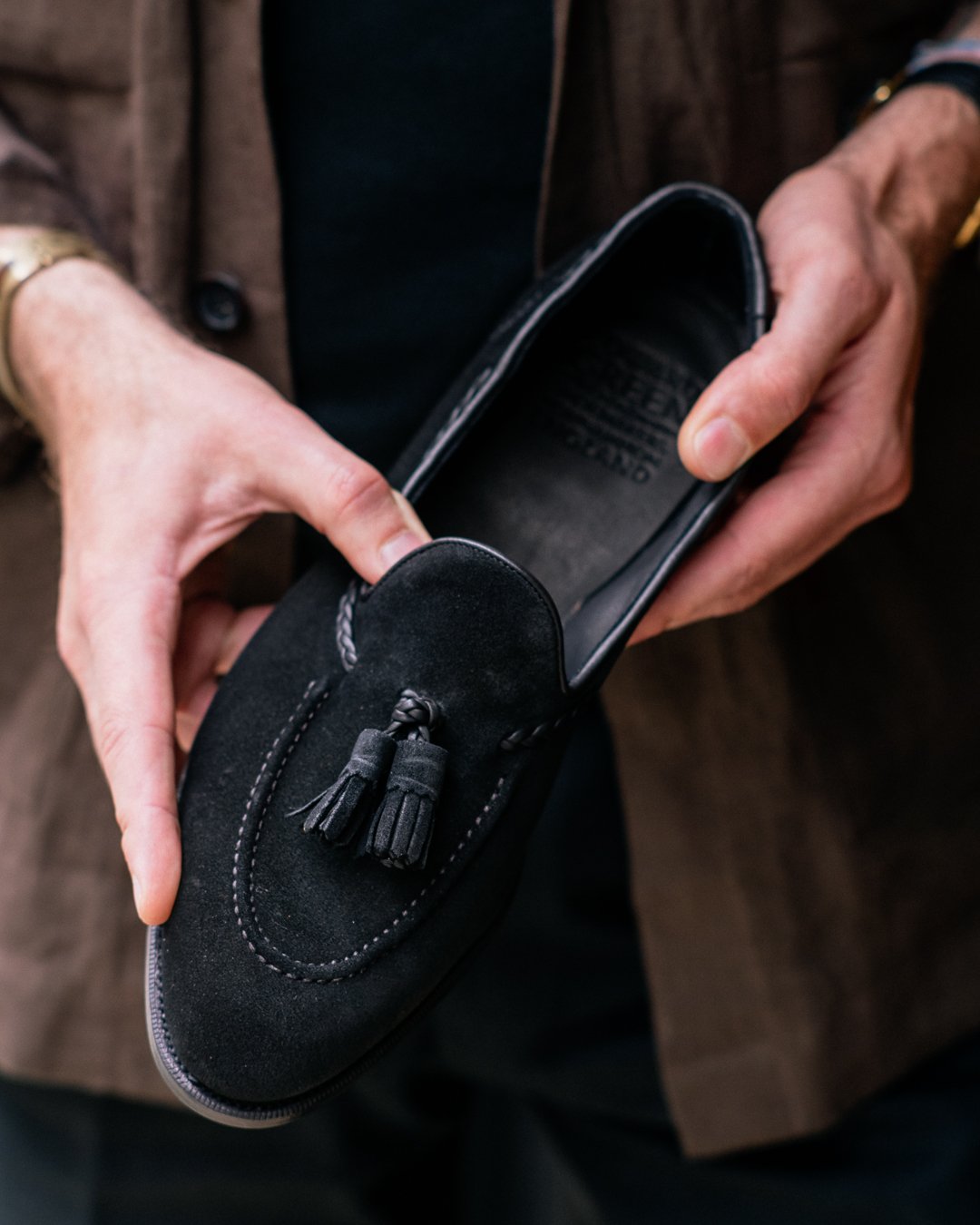
Developing the unlined Belgravia involved quite a few design decisions. For example, keeping the braided leather on the outside of the shoe (even though it’s a little bulky, and covering it harder) or resorting to the flat leather of the Greenwich?

On the heel of the shoe, there was a question of how to recreate the raised stitch of the lined version. It would be risky to do the same with the unlined loafer, as the stitch could pull or twist. In the end a waxed thread was used, and that solved the problem. 

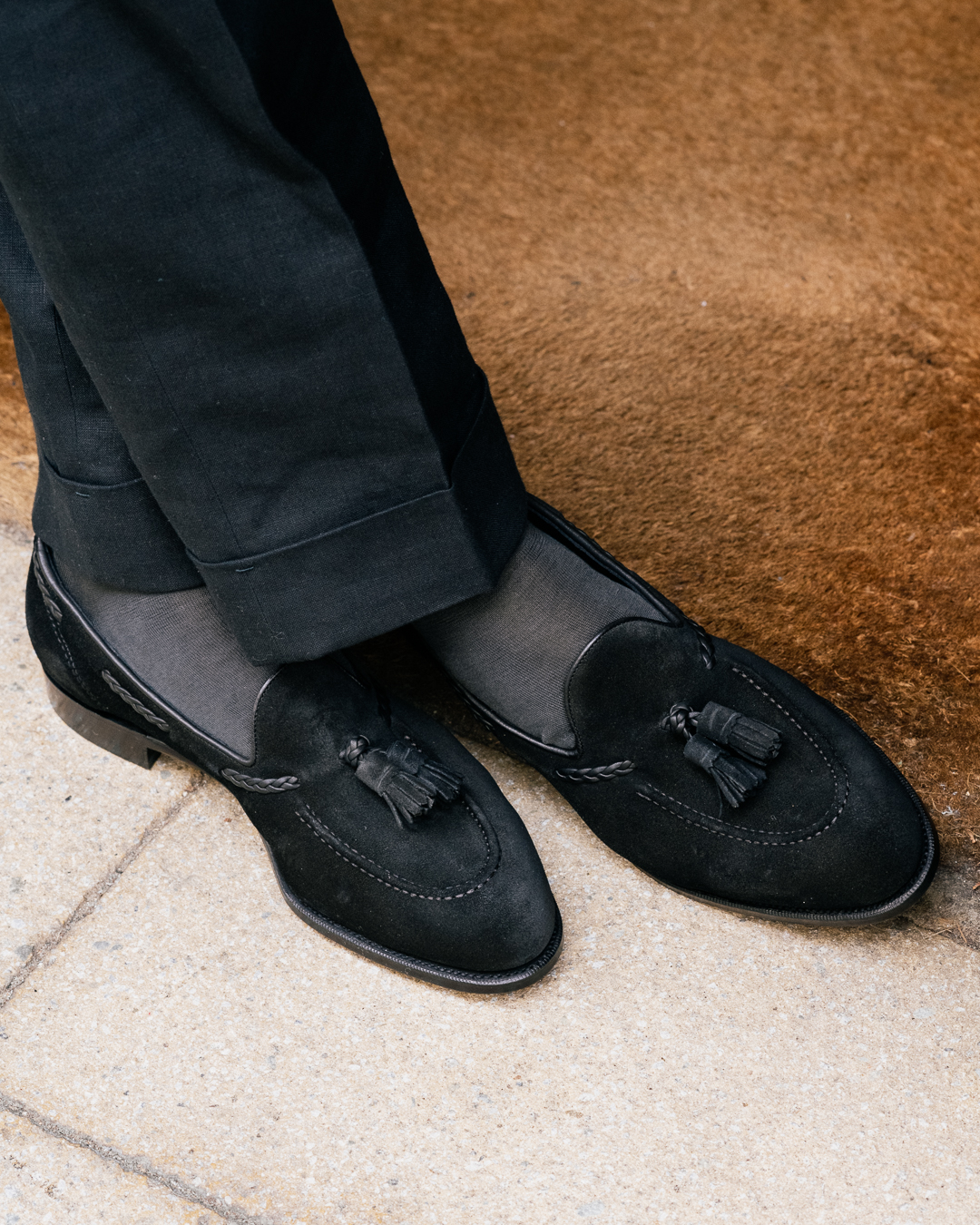
Then there were the normal questions of which colours to make, in what volumes. My favourite is the brown (mink) shown above, but I also liked black (below) while knowing that wouldn’t be as popular. 

Still, it was the questions of internal structure, and questions that were raised by readers about fit, stretch, longevity and so on, that I’ve found the most interesting. Hopefully answering them here has helped a few people that raised them - and it will do in the future as well. 

Clothes pictured:

  • With black Belgravia:
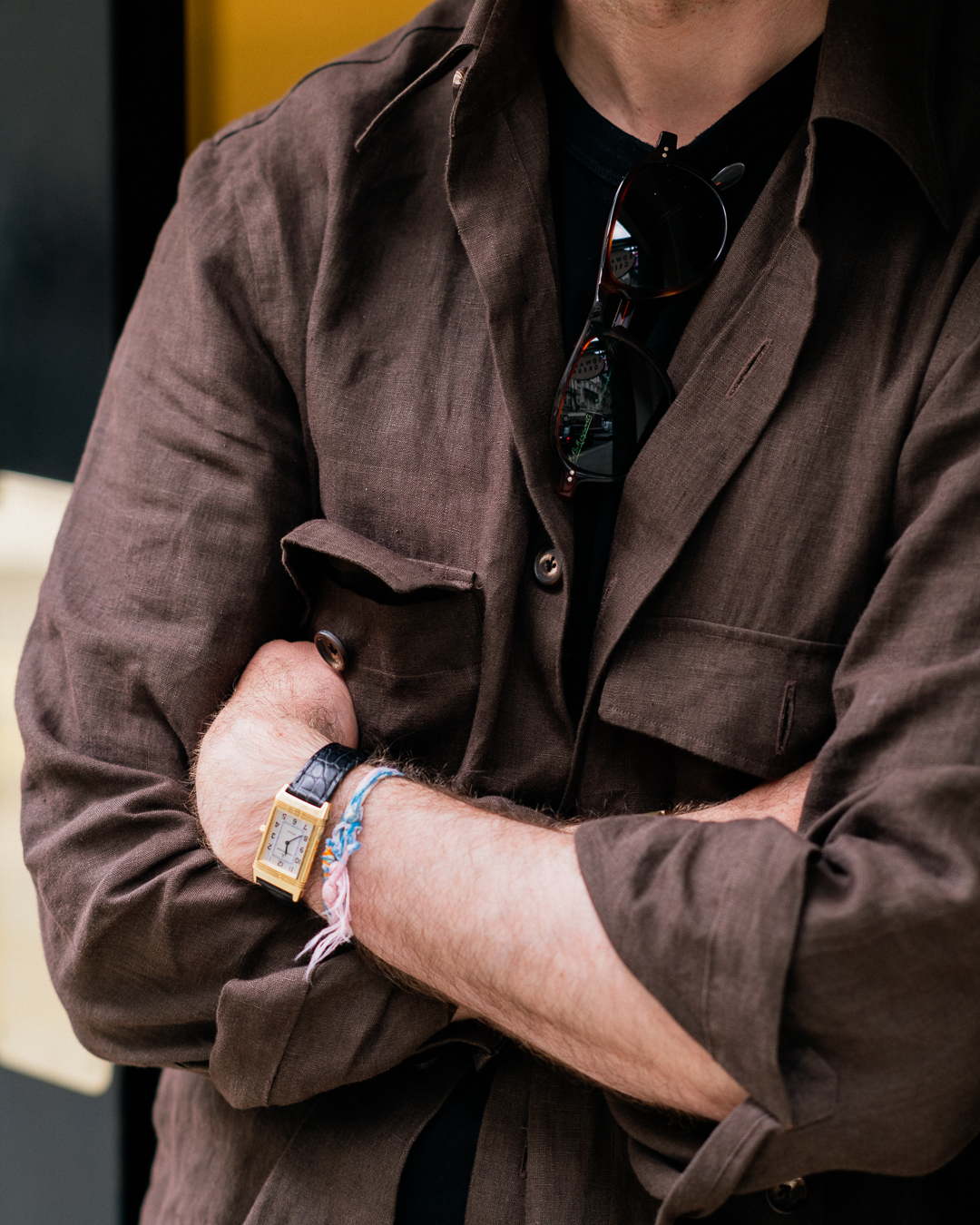
    • Brown PS Linen Overshirt (coming next Spring)
    • Black T-shirt from The Flat Head
    • Black Irish-linen trousers, bespoke by Whitcomb & Shaftesbury
    • 'Californian' sunglasses by EB Meyrowitz
    • Yellow-gold JLC Reverso
  • With brown Belgravia

Five good ready-made suits under £1000

Five good ready-made suits under £1000

||- Begin Content -||

By Manish Puri

The attention of Permanent Style has always been - and will continue to remain - trained upon the highest quality garments in the world.

However, there are barriers to accessing the very best – especially with suits. You might live hundreds of miles from a quality bespoke/MTM tailor. You might be relatively new to tailoring and thus apprehensive about what exactly you want from a suit. You might not have the occasion to wear a suit regularly. Or you simply might not be able afford the best artisans (let’s be frank, they’re not cheap).
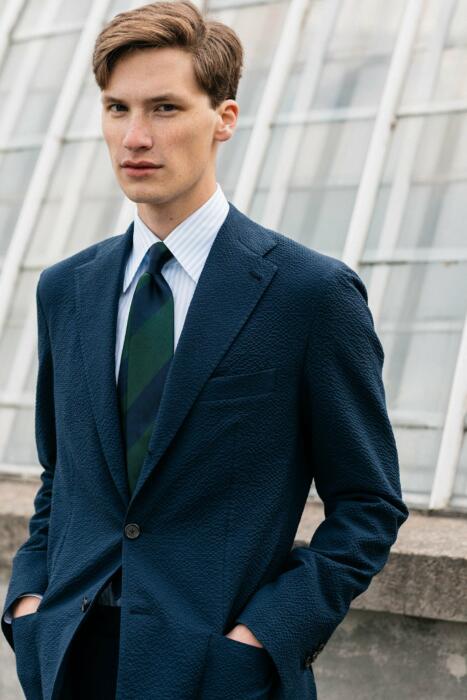
So, in any of those circumstances, it’s wholly understandable that you might be shopping from one of the growing number of RTW options that are a significant step up from the High Street (an aside, I had to chuckle at one storied British retailer advertising their suits as “luxury tailoring inspired by Savile Row; fusing exceptional craftsmanship with superior fabrics” – if you want to evoke Savile Row, it might be best to avoid using the word ‘fusing’) but more economical than the luxury market, where prices can extend beyond even bespoke.

The brands I’ve chosen for this article all sell suits that cost around £1000 or less, but also represent a range in terms of quality, hopefully making them relevant to a large part of the readership.

The brands selected also have a strong online retail presence, which makes it easier to see lots of imagery, ask questions and get products shipped to wherever you are in the world. They also have the widest range of suiting options; plain navy and grey wools dominate of course, but there are also lots of linens, cottons, checks and stripes to choose from.
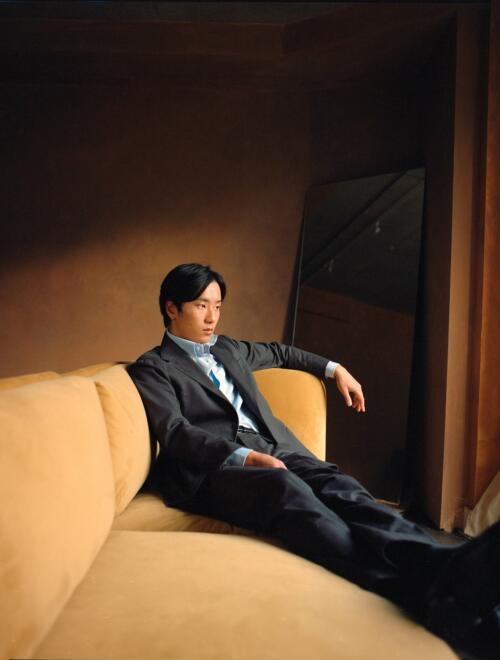
The suits in this guide have several style points in common. The jackets typically have notch lapels, double vents, 3-roll-2 fronts, and no/light padding. The trousers mostly have single pleats, side adjusters, and are sold unhemmed. However, when a brand deviates from these default styles I’ve tried to highlight it.

In terms of cloth, there is (as you’d expect) a range in the quality available. However, all the brands have suits in cloths sourced from reputable English and Italian mills (in particular, Vitale Barberis Canonico features heavily across the market). Berg & Berg are at the upper price point of this guide, and that’s partly because they select slightly more premium fabrics - Fox Brothers, Harris Tweed and Zegna have all featured in recent collections.

In terms of quality, the biggest differences are half vs full canvas, functional handwork like a hand-attached collar, and aesthetic handwork such as buttonholes - details on these are in the index at the end of the article. However, there is a lot less of this at this price level than the brands PS normally covers, even so, all the suits were made solidly and neatly with little else to differentiate them.

As always, if any readers have suits from the brands, it would be great to hear how they’ve fared over time in the comments section, where I’ll also be lurking and willing to answer any questions.
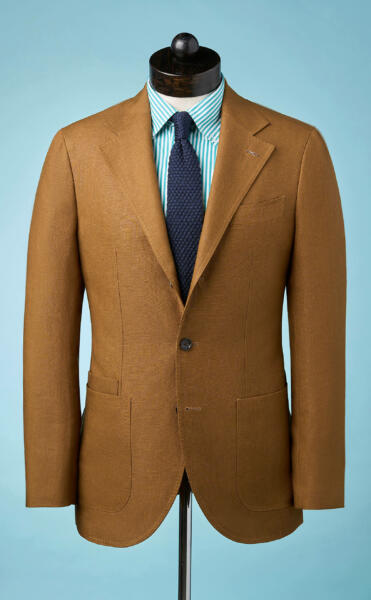
Spier & Mackay ($298 to $678)

The Spier & Mackay suit offering is the most extensive of any brand here (there are over 100 suits online), but it’s also a tad confusing. The website is a morass of cuts, canvas, fits, and labels: Neo Cut, Neo 2 Cut, English Cut, Red Label, Emerald Label “Sartorial Collection”, Tailored Fit, Slim Fit, Contemporary Fit, Half Canvas, Full Canvas.

However, what is clear is that the Red Label (from $298) is Spier & Mackay’s half-canvas, entry-level offering available in a tightly curated range of classic blues and greys. And the Neo 2 Cut ($448 to $678) is the premium line with jackets constructed using either half canvas or full canvas (unusual for this level of RTW).

The suit I tried was an EU48 Neo 2 Contemporary Fit with full canvas ($598), which no doubt helped sustain a noticeable lapel roll (even when the jacket was freshly unpacked from its cardboard transit). The jacket boasted several other details I wouldn’t expect at this price level: a neatly stitched Milanese buttonhole on the lapel, a boutonniere loop on the reverse, Bemberg cupro lining (many RTW jackets use polyester/viscose), underarm shields (sous bras) and an internal pen pocket.
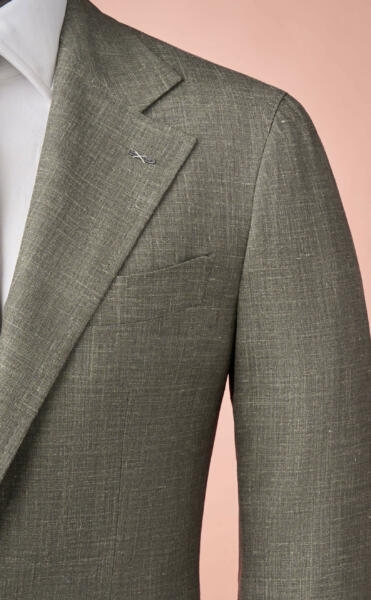
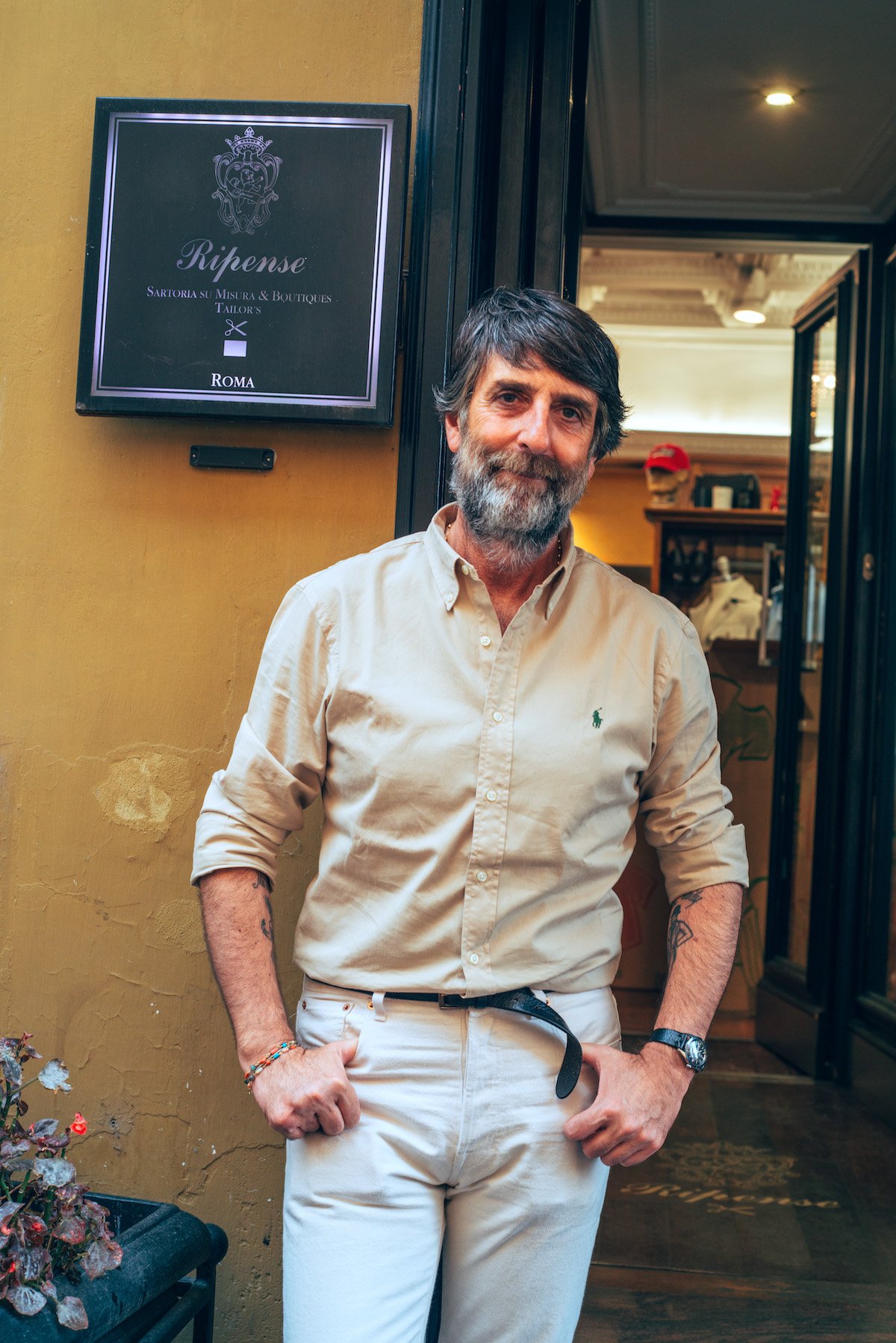
Another Spier & Mackay detail that’s atypical of RTW is the upper lapel line, which is initially cut straight before curving sharply towards the neck. This style is usually reserved for bespoke tailoring - the Roman house Sartoria Ripense among its exponents - perhaps because it’s easier and more efficient (and thus cheaper) to cut straight(er) lapel lines in RTW manufacturing.

The overall fit through the upper torso was very good – the shoulder seams sat at the edge of my shoulders and the armholes (which I’m told have been raised slightly from previous iterations) afforded movement without digging into my armpit.

The gorge line (sitting 10cm below the shoulders) is low compared to the other brands – which is something I really liked. Consequently, the buttoning point is also slightly lower than the other jackets in this guide.
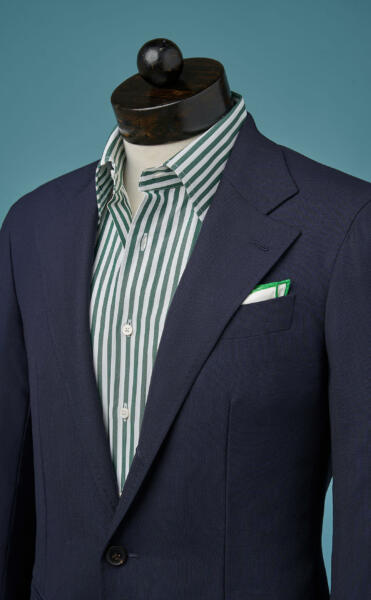
The advantage of the lower button is that it showcases more of the shirt and tie while also helping to eliminate any unsightly ‘shirt triangle’ (the portion of the shirt visible between the trouser waistband - which is higher here - and the jacket’s buttoning point).

The disadvantages are that it reduces the length of the skirt (which I’ve measured as the distance between the mid-button and the jacket hem) by as much as 4-5cm compared to the Berg & Berg jacket, which has a higher buttoning point and longer coat length.

The fit through the waist was a little tight but there is around 3cm of seam allowance within the jacket to make adjustments. Noting my experience with the fuller Contemporary Fit I wouldn’t advise PS readers to opt for the Slim Fit unless they’re especially trim.

(Please note, the cheaper models of the Spier & Mackay jackets/suits don’t have all the features/fit described above).
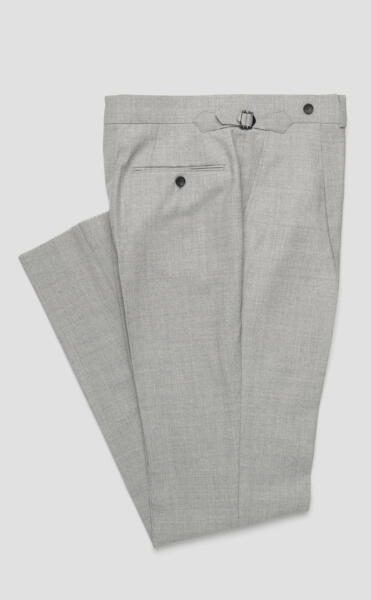
The trousers (in common with most brands featured) come unhemmed, although Spier & Mackay offer a finishing service before shipping them to you. At $12 for a cuffed hem, it’s certainly cheaper than any London alterations tailor, though be aware that altered trousers are non-refundable.

As standard, suits are sold with a drop-six trouser (meaning a 38-inch chest jacket, in British sizing, is accompanied by a 32-inch trouser). However, customers can request a “trouser swap” for a different size at checkout (subject to availability) and I availed myself of this option by trying a pair with a 34 waist.

The fit of the suit trousers was spot on in many respects: mid-to-high rise, comfortable in the waist, slim leg but not restrictive. However, the seam from crotch to seat was punitive in its line, cutting sharply into parts of the male anatomy that should only ever be treated with the tenderest regard.

Uncomfortable standing up and eye-watering sitting down, it was, as Lyndon B Johnson once said to his tailor, “like riding a wire fence”. This is something that can be improved by a good alterations tailor, but, in my experience, never to full satisfaction.

In all seriousness, it’s the only black mark against what I consider to be an incredibly good value suit.
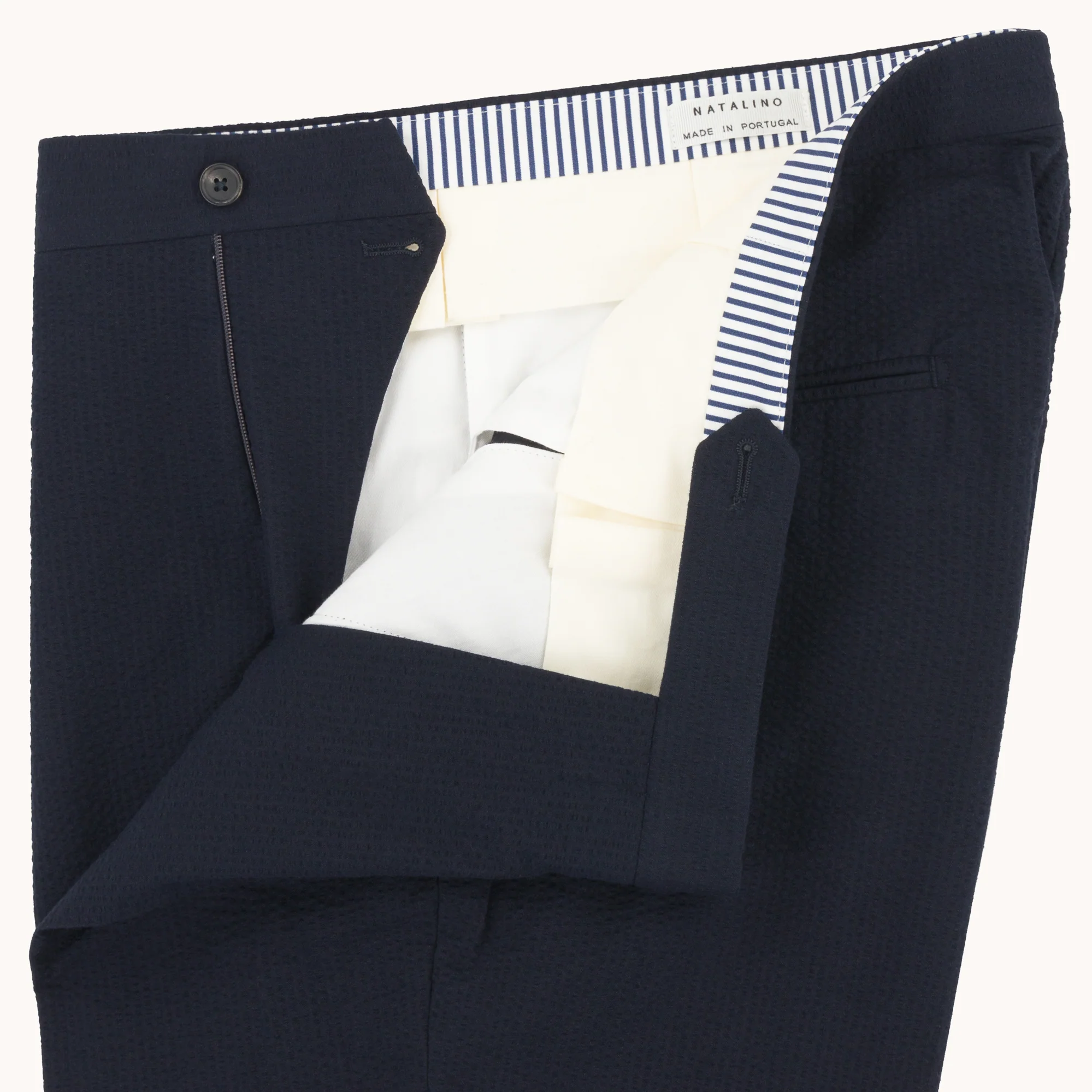
Natalino (£530 to £605)

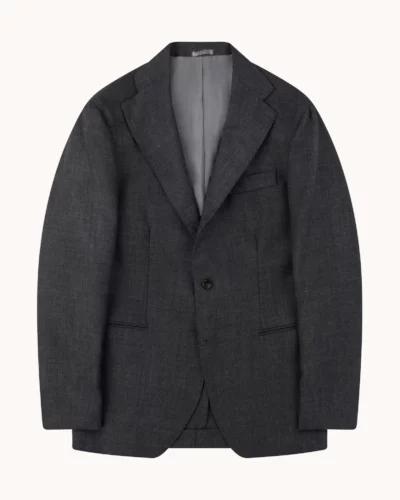
Natalino’s Italian-made jacket is strongly inspired by Neapolitan tailoring – the shoulders are spalla camicia and the gorge line is the highest amongst the brands in this guide (I measured a gap of 6cm between the gorge and shoulder seam compared to 10cm for Spier & Mackay).

A high gorge can help to visually lengthen the torso and draw the eye to the shoulders, but it does also depend on your style and body. For my taste, it’s a touch high, and apparently, Natalino agree as they have told me that their Autumn/Winter jackets will have a lower gorge, and have kindly shared a preview of what it will look like below. The comparison with the current model is illuminating (I'd love brands to show more side-by-side comparisons please), and, in my eyes, it’s a marked improvement.

During our chats, the brand also informed me that a London shop is scheduled to open this autumn so customers will have the opportunity to view the range and try things on before purchasing.
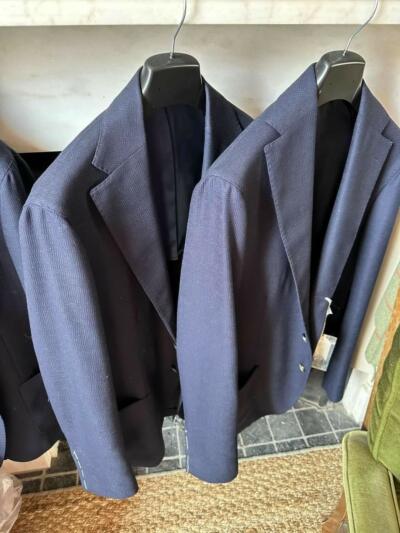
I was pleased with the overall fit of the jacket (a size EU48): neat across the shoulders, good shape through the sides and a fair coat length. When buttoned, the jacket was as shaped as it could be before becoming tight or uncomfortable.

The sleeves are left unfinished so you can adjust their length as desired, but my only gripe is that they are a touch slim. To be fair, I am notoriously picky when it comes to sleeves. I would love to be able to tell you it’s because my glorious, sculpted man-pythons refuse to be bound by even the finest of cloths; alas, I’m packing a pair of hairy twiglets and I’m just fussy.

I did try a size EU50 and while the sleeves were better, I found the jacket to be too roomy across the shoulders and in the back so I would advise readers to stick to their regular size.

Natalino sell their suit trousers separately – a blessing for those that like an extra pair to help extend the longevity of their suit, or for those of us that don’t conform to the industry drop-six standard.

(An indirect consequence of selling suits as separates is that Natalino is quite conservative with its fabric choices – you don’t want to end a season with a stock room of pinstripe trousers and no jackets – which could form the basis of a strong capsule wardrobe: navy tropical wool, khaki linen, olive cotton and mid-grey flannel)

I paired the suit jacket with a 34 trouser which was comfortable in the waist but also slightly tight in the arc between the seat and crotch (although not nearly to the extent of the Spier & Mackay trousers). The fit through the legs was slim but not as much as Cavour’s Mod 2 trousers.
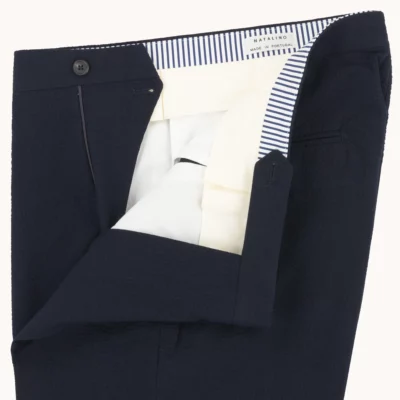
The potential for letting out the waist is curbed by the relatively stingy amount of excess fabric folded into the curtained waistband – there’s maybe an inch, which wouldn’t even see me through a moderately jolly Christmas (of course, reducing seam allowances is one of the ways that enable Natalino to offer a suit at this price level). Given this and the lean leg-line, I’d advise anyone in between trouser waist sizes to go up a size.

Details include a coin pocket secreted below the waistband which, on the inside, is curtained and anchored by striped fabric – a minor yet pleasing aesthetic detail that’s reminiscent of Pommella’s finishing.
Suitsupply (£378 to £1029)

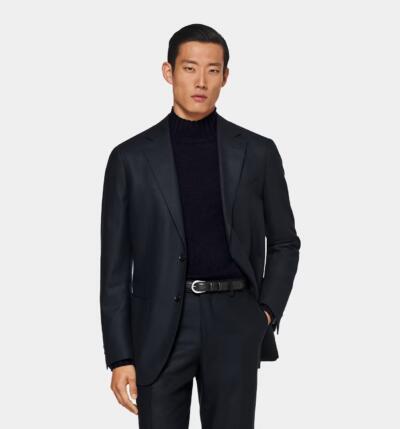
Suitsupply were an instrumental part of my sartorial journey. Their construction details, cloth choices and price point were game changers when they first began sprouting up in the early 2000s.

Unfortunately, whilst my tastes have evolved - I think (and hope) for the better - Suitsupply seem to have remained wedded to a very particular, slim look.

I concede that I tried the Havana (which is Suitsupply’s slimmest cut) and may have been better served by a more relaxed model such as their Roma. However, there were over 100 suits available online in the Havana fit and only eight in the Roma, and I wanted to sample the option with the most variety in cloths.
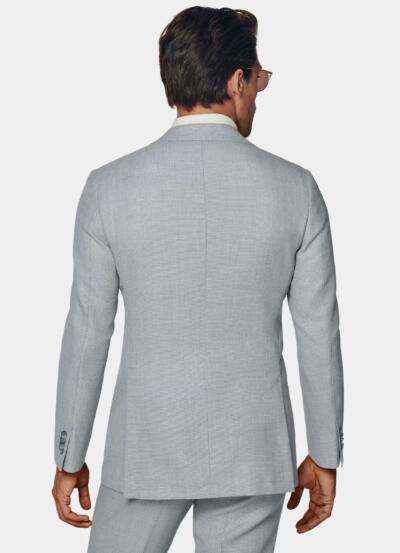
I didn’t even entertain the idea of trying a size EU48 and jumped straight to the EU50 in the Havana; it had a lot in common with the Natalino EU48: high gorge, nice across the shoulders, a respectable coat length, and shaped through the sides without being too tight (but only just).

The sleeves were a little narrow and, unlike Natalino, have functioning buttons so any significant adjustments to length are harder. However, Suitsupply do offer comprehensive in-house tailoring that can be turned around within three days at competitive rates.

For example, a sleeve length alteration from the shoulder will run you £50; contrast that with a highly regarded alterations tailor in central London who charges £75 for the same service.
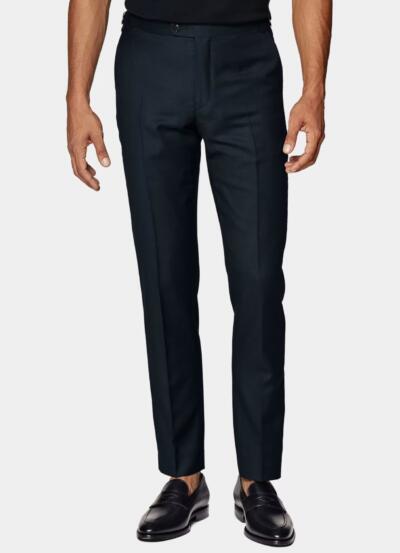
My biggest issue was with the trouser (which will come as no surprise to anyone that’s read anything I’ve had to say about trousers in the past couple of years). I tried a size 34” and the effect was Proustian.

As the zip groaned its way up the straining metal track I was hurtled back in time to the summer of 2012 - where I’m sure climatologists will one-day point and identify the heat generated by my chafed Suitsupply-clad thighs as a major contributor to global warming.

The leg was very tight from the hips down, and the rise was the lowest of all the trousers I tried – I know I prefer a higher finish than most, but I don’t think this rise will appeal to too many PS readers. I came away with the sense that the trousers had been designed by an overzealous cosmetic surgeon rather than a pattern maker - every millimetre of excess scraped, nipped and tucked away.

The rise aside, these issues could be obviated by sizing up, except that most of Suitsupply’s suits are sold as drop-six (there is some limited mix-and-match available).

If you’re in good drop-six shape and looking for a slim suit, at a reasonable price, lots of options to pick from, free delivery and returns, and the facility for quick and inexpensive alterations, then it’s hard to look past Suitsupply. But once you’ve experienced a more classic fit it’s even harder to look back at it.
Cavour (£800 to £1050)

Readers will recall that I reviewed Cavour’s Mod 2 trousers (sold as part of the Mod 2 suit) last year in a market survey of RTW trousers. I described them as “fuss-free with a sharp silhouette” but had to size up to a 36” to get a comfortable fit through the legs.

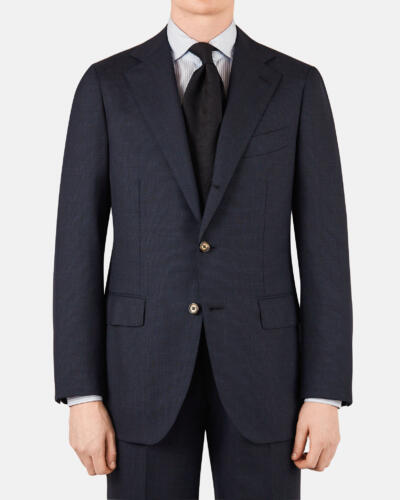
With this in mind (and following Cavour’s advice) I sized up to an EU50 in the Mod 2 jacket. There are rare occasions when you put a leg through a trouser or an arm into a sleeve and, before you’ve even had a chance to finish dressing and examine yourself in the mirror, your sartorial instincts – honed through years of trial and error – signal that it’s a good fit for you.

I had that delightful but elusive sensation when throwing on the Mod 2 jacket for the first time and I would say it was the best overall fit of the brands I tried.

The shoulder line ended fractionally past my shoulders with a nicely proportioned spalla camicia sleeve. The chest had a little drape and contoured gently into a generous waist. The sleeve length (as per usual for me) was a touch long, but as the buttons are non-functioning this would be a simple alteration.

The jacket even fared better in my ‘telephone test’ – where I raise and crook my arm to take an imaginary phone call so I can observe how close the collar remains to my neck – than some of the MTM jackets in my wardrobe.
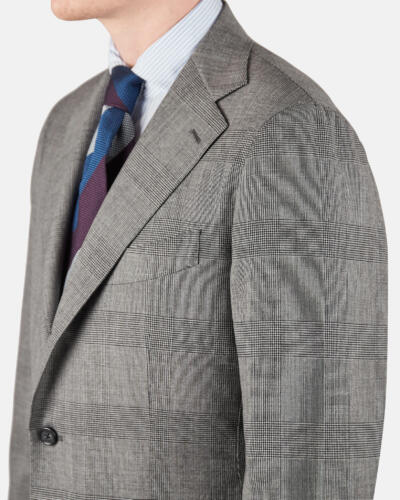
Cavour’s gorge line does sit quite high (7cm from the shoulder seam), but I find it less (for want of a better word) claustrophobic than Natalino’s (6cm). I think it’s because the Cavour notch cuts deeper into the lapel (4cm vs 3cm on the Natalino) and the combined visual impact of those extra couple of centimetres permits some air between the lapel and the shoulder.

The trousers and jacket boast several hand-made elements (more than any other brand) including bar tacks, buttonholes, collar attachment, sleeve attachment, lining attachment and pick stitching. Whilst some of this handwork is an aesthetic embellishment, the hand-sewn attachment of collar and sleeve is usually a hallmark of quality construction and allows flexibility in the places where it is most needed.

Cavour are also the only brand in this guide that construct all their jackets with a full canvas.
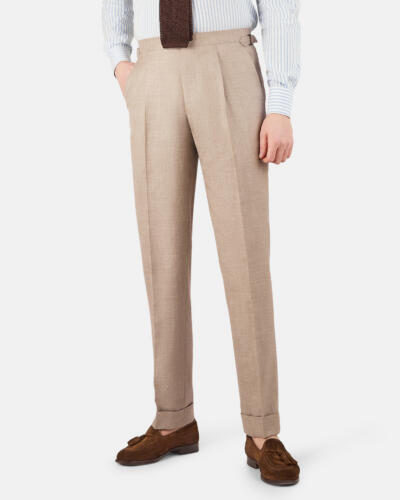
The only thing preventing me from a full-throated endorsement is the fact that the suits come with a drop-seven trouser; this might work for a young, athletic Scandinavian, but sadly this middle-aged office worker is more of a drop-four.

Cavour are one of the most generous brands on the market when it comes to seam allowances, so a good tailor can help bridge some of that ‘drop-gap’, but in my case, it would be a literal and figurative stretch.

I do understand that carrying the range of suits that Cavour do and offering mix-and-match has the potential to create an inventory nightmare, so it’s just one of those things that must be accepted at this level of RTW.

That said, Cavour have informed me they will be offering a mix-and-match programme this coming season for two versatile suits made from high-twist navy and grey cloths. At the same time, they will also expand their range of Mod 3 trousers which are fuller-legged and higher-waisted than the Mod 2.
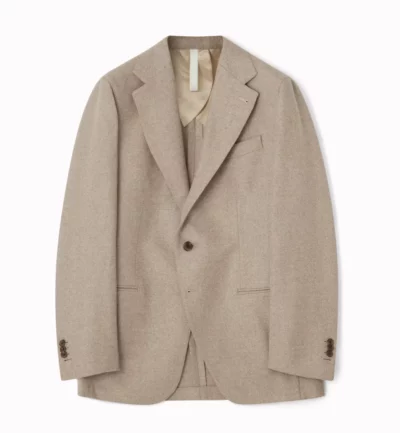
Berg & Berg (€1230 to €1320)

This Berg & Berg jacket (the Dan) was the most elegant and classical of the ones I tried.

It may have been a trick of the cloth – the reassuring weight of the sandy flannel sample suit (above) alerting my body to the fact it was carrying tailoring in a way that the lighter tropical wools of the other brand’s sample suits didn’t – but, more likely, it was the slightly broader lapel, the longer coat length, the fuller sleeve and the soft, natural shoulder that elevated it above the others.

There is also a notable amount of handwork that goes into each jacket: the collar, sleeve head and lining are all attached by hand and the buttonholes are hand-sewn.

Berg & Berg’s website lists the buttoning point as lowered, but I would politely disagree with that assessment - for example, it sits 4cm closer to the shoulder seam than the Spier & Mackay. Regardless of quibbles on whether it is low or high, I found the buttoning point to be ideally balanced, midway between the gorge and the hem, permitting a generous sweep of the skirt.
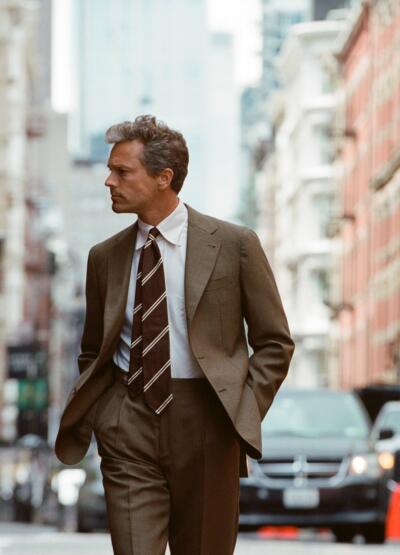
I tried jackets in my regular size of EU48 and EU50. The former was too narrow in the shoulders, tight in the waist and cut into my armpits; the latter was better on all counts - there wasn’t as much room in the waist as I’d anticipated having sized up, but it was fine, nonetheless.

The main issue I had was with the sleeve length. RTW jackets do tend to come up long in the arm on me, but Berg & Berg’s was unusually long (I’d need it shortened by 5cm), and as the sleeves come finished with functioning cuffs any alteration would require detaching it from the shoulder (not a cheap fix).

I spoke with Andreas (Berg & Berg’s Creative Director) about this and he’s sympathetic. However, the feedback he’s received from customers globally is that they don’t always have access to reliable tailors, so the brand has taken the decision to provide finished, functional cuffs. Andreas also said the length could be shortened from the cuff by about 2cm without disturbing the visual balance of the sleeve.

Of course, for readers who typically find RTW garments short in the arm, the Berg & Berg sleeve might also be an ideal length.
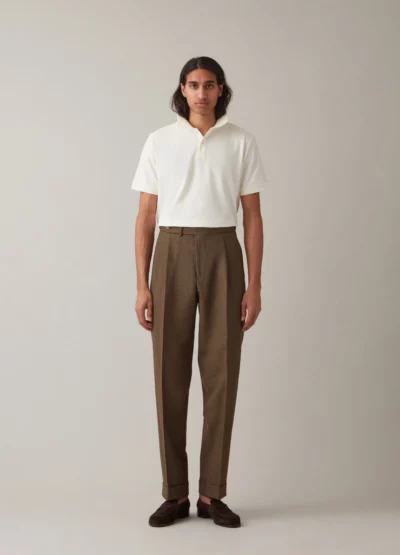
Having sized up in the jacket I’m frustrated that I didn’t do the same with the trousers. Berg & Berg’s Antonio model (which comes with double pleats while their Arnold model has single pleats) in my usual size of 34” was just too tight in the waist – somewhat surprising given the trousers, in keeping with the proportions of the jacket, have a higher rise and fuller leg than any other brand in this guide.

There was a decent seam allowance, but I suspect were I to let the waist out fully it still might not be enough, plus I’d have no margin for any weight fluctuation in the future. I’d certainly consider sizing up to a 36” trouser next time (which isn’t a problem as trousers are sold separately) but that may require a compensating taper to the volume of the trouser leg.

Manish is @the_daily_mirror on Instagram
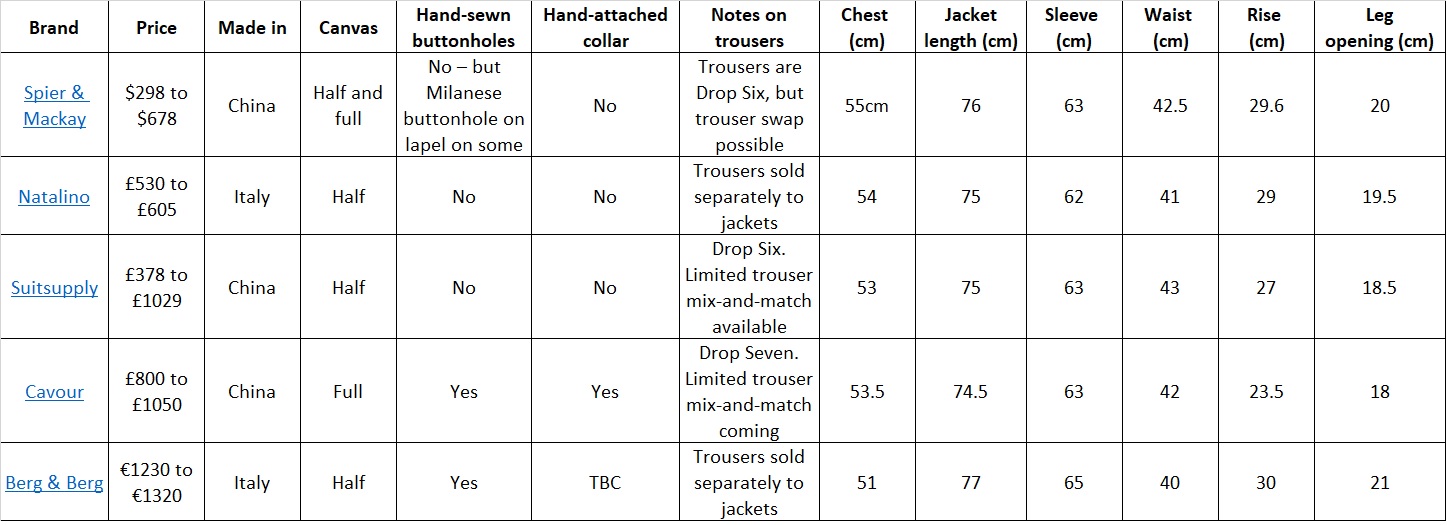
The Index

The index is designed to collect the key information of each of the suits featured. To aid comparison we’ve shown the chest, jacket length, and sleeve length for size UK38/EU48 jackets and the waist, rise and leg opening for 32” trousers - measurements taken from the brands.

Prices are correct as of time of writing.

The table is an image - click on it to bring up in a visible size.

Reader profile: Ian

||- Begin Content -||

Ian is retired, and got into luxury menswear late in life. But he always had an interest in clothes, from his early days in Ivy clothing to the forties and fifties influences that came with learning jive dancing. 

It could be easy to see him as being able to wear whatever he likes, just because he's retired - but it became clear when we chatted that Ian has always dressed his own way, even if it was something simple like wearing his horsehide Eastman when he was driving the Tube.
Warm and chatty, Ian is a real pleasure to talk to, and I encourage anyone to do so that sees him around London. I hope you enjoy our conversation as much as I did. 
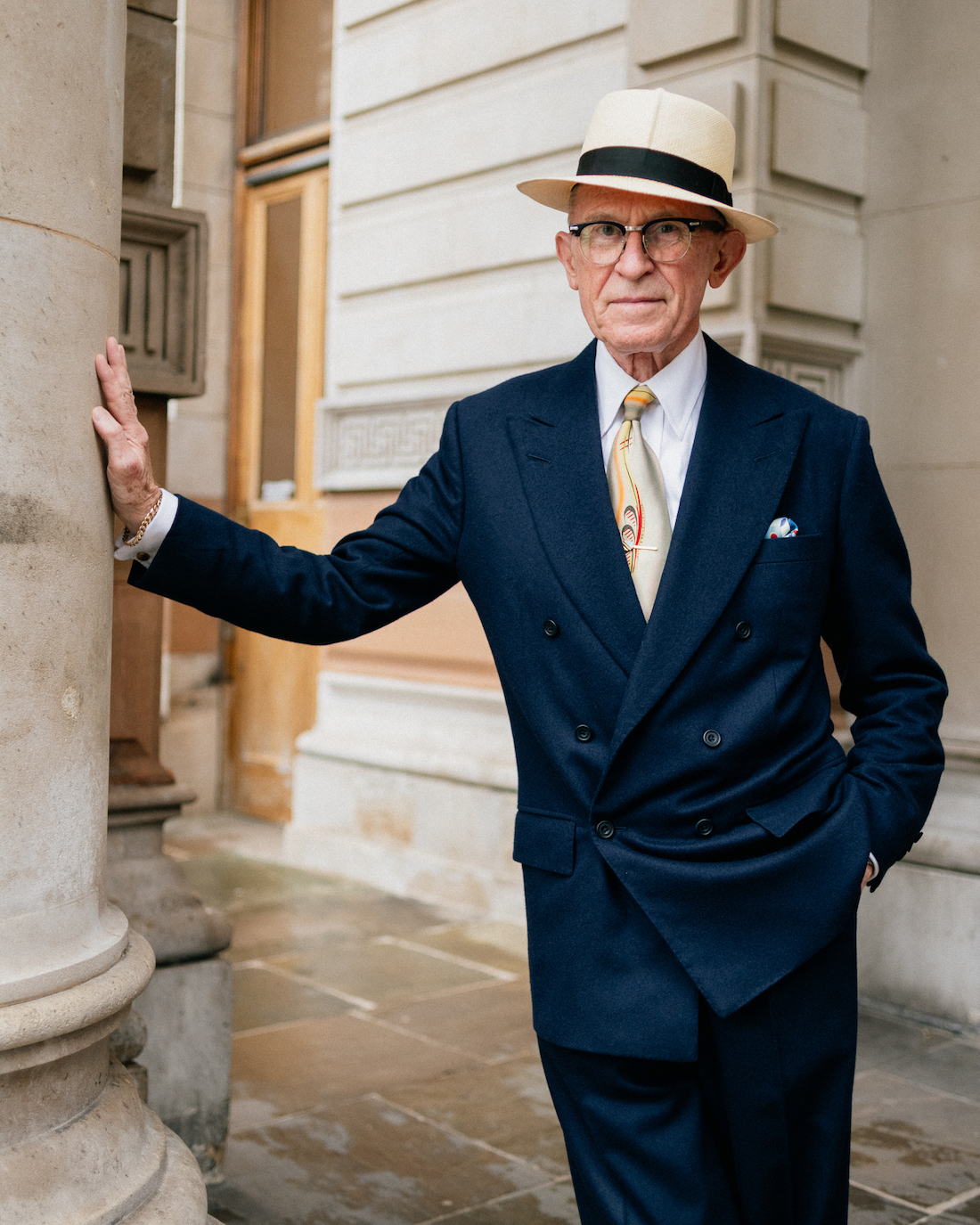
Outfit 1: Bespoke and Fred Astaire 

  • Hat: Bate’s
  • Glasses: Shuron
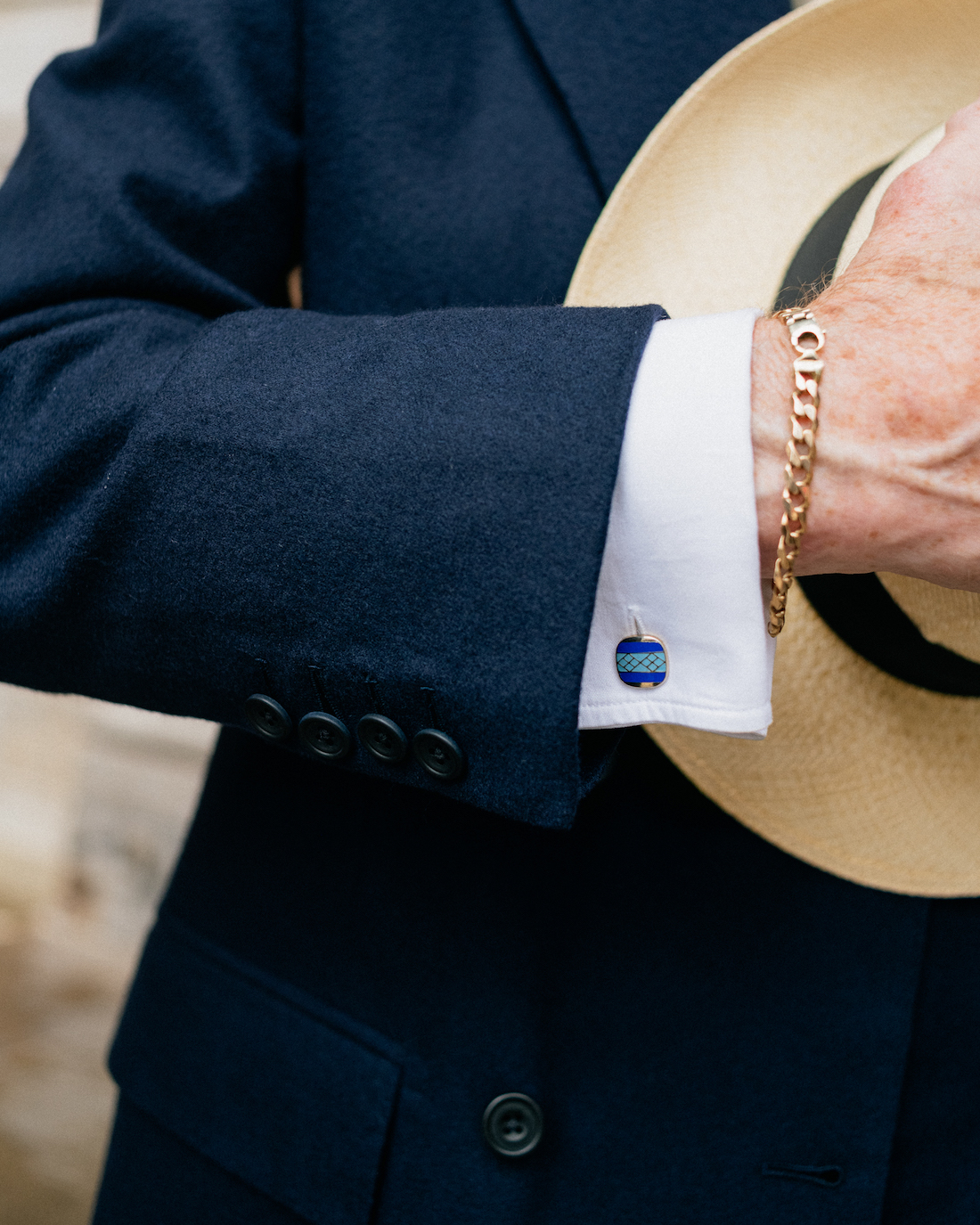
  • Suit: Anderson & Sheppard
  • Shirt: O’Connell’s
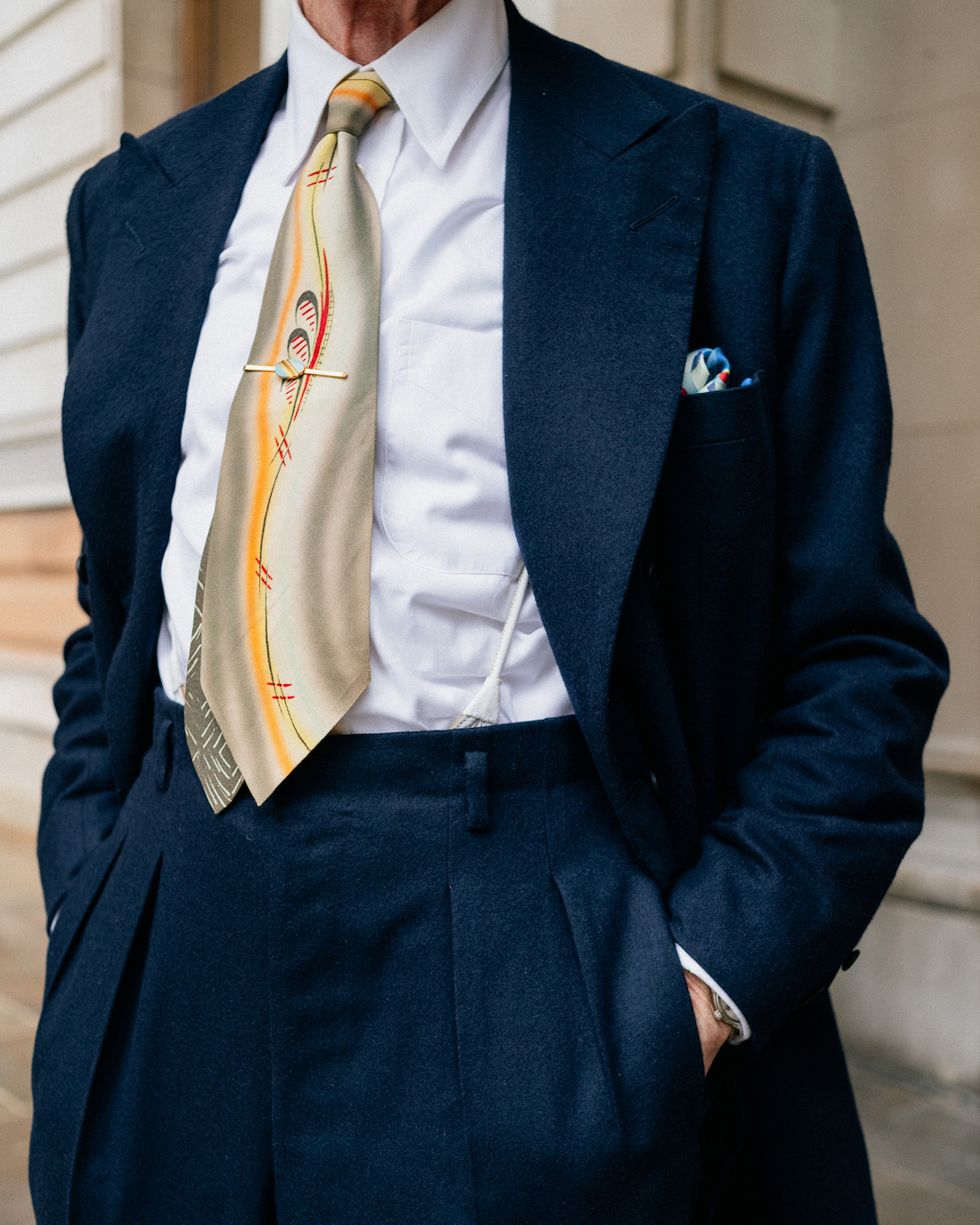
  • Tie: Vintage, hand-painted silk
  • Shoes: Tricker’s for Mark Powell

So Ian, I hear a real estate deal launched you into luxury menswear? 

Ha! Yes you could say that. I owned a house in Ealing that I'd bought back in 1978, and sold it a few years ago when I moved in with my wife in Islington. That made quite a lot of money. 

When I did the sensible thing and talked to a friend who worked in investment, he told me just to spend it, so that's what I've been doing! I didn’t need telling twice. 

And what was your first extravagance?

It was a bespoke suit at Anderson & Sheppard, the heavy navy flannel I’m wearing. For a man the ultimate has to be a suit, and that means Savile Row. I chose Anderson & Sheppard largely because Fred Astaire has always been my idol.

I told myself I’d just get one, for the experience. But it’s ruined me - I used to wear a lot of vintage tailoring but I can’t do that anymore, you just notice all the places where it doesn’t fit, often on the back of the neck.

So I’ve been back six times now: five suits and one tuxedo. The latter was a copy of a vintage one I had, and they did a good job of replicating all the details. Even on this suit, I asked them to replicate the style of an old pair of Hollywood-top trousers I had, with the drop loops. 

Oliver was the trouser cutter - I think he’s at Marinella now - and he loved them, he’d never seen anything like it. 

Where’s the tie from?

That’s vintage, a birthday present from Terry Murphy - the late Terry Murphy - who ran a vintage stall in Camden Market, real high-end Americana. It’s hand-painted silk and probably worth - actually I have no idea what it’s worth, it probably depends how many people want it. You see these for over £100 on auction sites, but then in markets for £2. 

The shoes are from Tricker’s - Fred Astaire used to wear blue and white ones like this, though they were slightly different: the collar around the back was blue too. 

You won’t be surprised to hear I watch a lot of old movies - I was rewatching The Red Shoes recently and there’s a great section where they go to the Riviera, very relevant for your recent articles

The film is OK - Moira Shearer can’t really act, she’s just a great dancer. But those films have such depth to them, there’s always something you pick up on, especially in the clothes. 

What did you do for a career, before you retired?

I’ve never followed a career really, I’ve done all sorts of things. I got a degree but I never used it. 

My first love was music so I worked in record shops for a few years, until around 1980. That was when they all started closing down - one of the first big waves of record-shop closures. I was unemployed for a while, worked on a market stall, then became a postman for five years.

I wasn’t very good at it: I could never get up in the morning. I’m always on time - friends know that and if I’m a minute late, they go. But the mornings were the problem for me; I became famous for always being late. 

Then I got headhunted by a friend who worked in music, delivering records in a van - on the other side of the counter as it were. I was white van man - well, red, a big Mercedes van. I’d call round independent record shops and deliver records. Reggae mostly, a little house, some garage. Whatever we could get hold of. 

It was pretty full on, 24 hours a day. Some of those places only shut at midnight and they’d call me up, knowing I’d always deliver. It was fun though, good times. 

And you later became an Underground driver?

Yes that was after that - I became a driver on the Underground at the age of 50. At that time 50 seemed old, and I only thought I’d do it for a few years, but now I’m over 70 and 50 seems really young! I retired after doing that for 17 years.

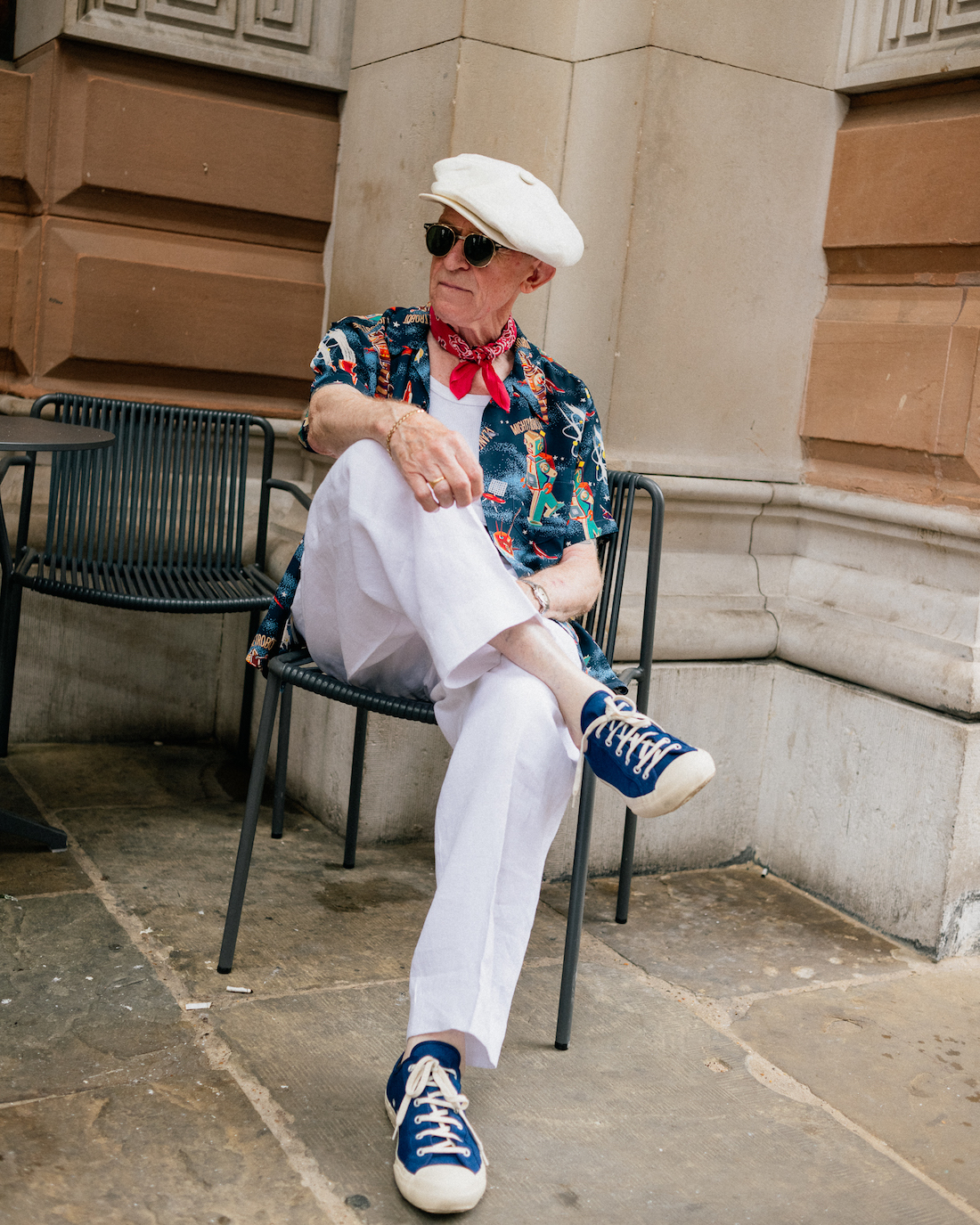
Outfit 2: Summer jive

  • Hat: Thomas Farthing, linen
  • Shirt: Sun Surf
  • Vest: Henri
  • Trousers: Thomas Farthing, linen
  • Belt: Anderson & Sheppard, braided leather
  • Shoes: Doek
  • Bandana: Vintage, from Hunky Dory

This second outfit looks like something for much more active dancing. Was it your love of music that got you into that? 

Yes pretty much. I was taught to dance originally by a couple of guys from Grenada that I used to hang around with, in the late sixties. It wasn’t ever reggae back then - the term hadn’t even appeared on the horizon - just rock steady. 

They taught me the basics and I went on from there, always dancing. The other big turning point was when I learnt to do a rock ‘n’ roll jive - which is obviously a partner dance, and comes with a whole world of style. 

Before that I had always been a bit Ivy League, maybe with some Italian influenced - I used to always read Italian Men’s Vogue. 

Sort of like the Continental Look that brought that influence to America?

Yes, just a little bit later, seventies not the sixties.

But that all went out the window?

Yeah I don’t tend to do things by halves! All the Ivy League stuff went, all the J Press suits, and I bought a lot of vintage suits and shirts instead - and I’ve been on that path pretty much ever since. 

Are you ever afraid it can look like costume?

I know there’s that risk - you talk about it on Permanent Style - but I think a lot of the people that look like they’re wearing costume just haven’t got it right. I see them at events and they’ve bought clip-on braces, a hat from a market stall for five quid, a pair of black-and-white shoes for £20 from TK Maxx, and it looks pretend. 

So is it about quality, or style as well?

Both I think. You see the style problem with brands - they want to recreate all these sixties and seventies youth movements, but they never get it right. They don’t bother to do the research and it looks like an imitation. 

I guess there’s always going to be that period risk, but it helps a lot if everything works and you feel comfortable in it too.

Exactly. Find the original stuff, hunt down a nice Arrow shirt or something rather than a modern polyester. 

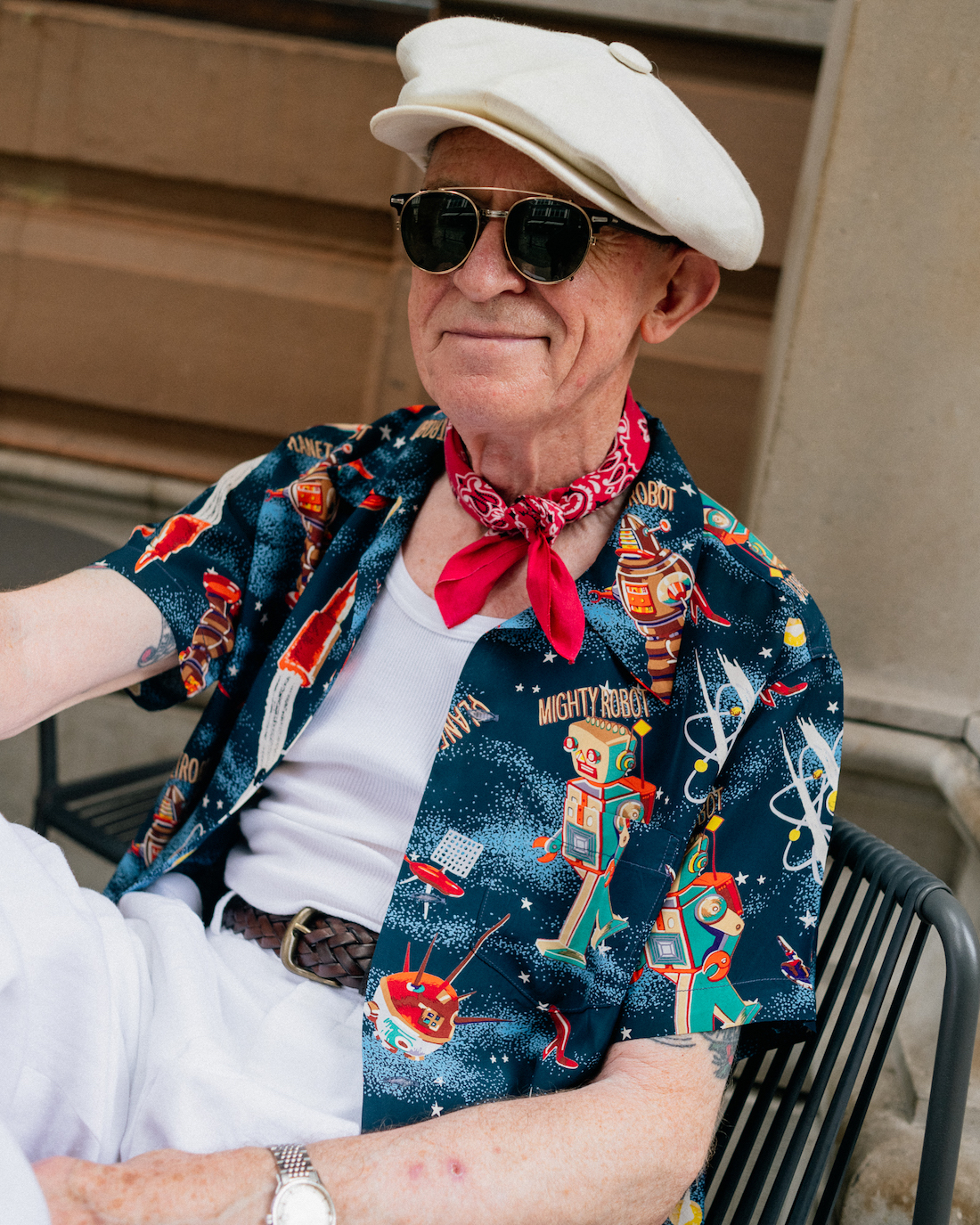
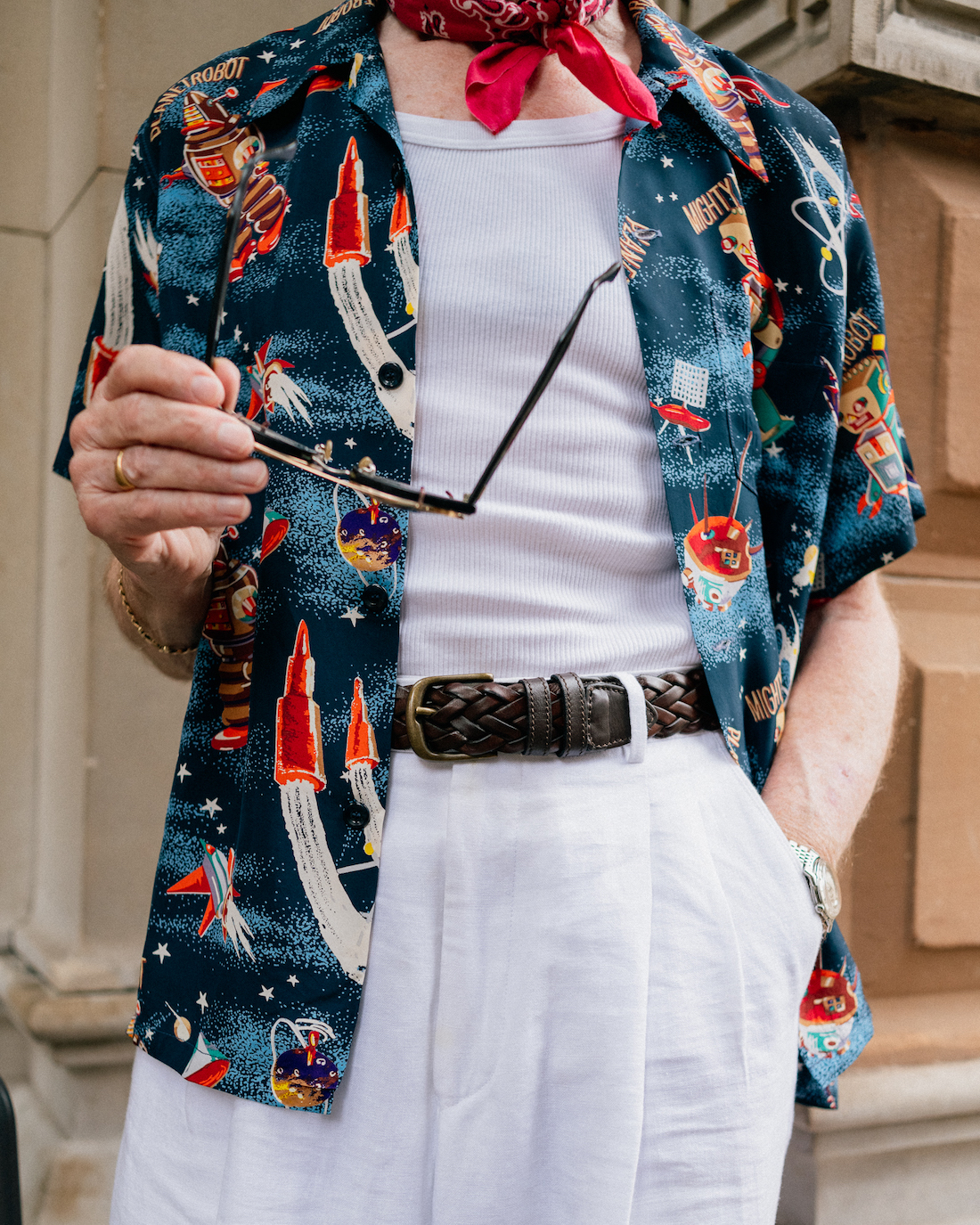
Is your shirt Sun Surf?

Yes, one of their limited editions. Comes in a nice box, a complete reproduction - well you know what the Japanese are like, so it has the same label, the same hang tags. You don’t really want to get rid of the box really, you want to display it somewhere. 

I think the design is called Land of Robots, but I’m not 100%. The only robot I recognised was Robby the Robot, but I have a friend who’s into science fiction and he could name all of them. The only one I recognised was Robby, from Forbidden Planet

Where’s the vest from?

That’s from a street market in Grado, in northern Italy. My wife’s family are from there so we used to go quite a bit. The brand is called Henri - Henry but spelt like the French - and they do good quality underwear, all made in Italy. 

I only buy the vests but they do T-shirts and all sorts. And they ship to the UK, and they’re quick, and cheap! I know you can spend a lot of money on a singlet, or you can go to Primark and get one for £1, but these are cheap and they last for years. They go a bit yellow eventually, but only after a long time.  

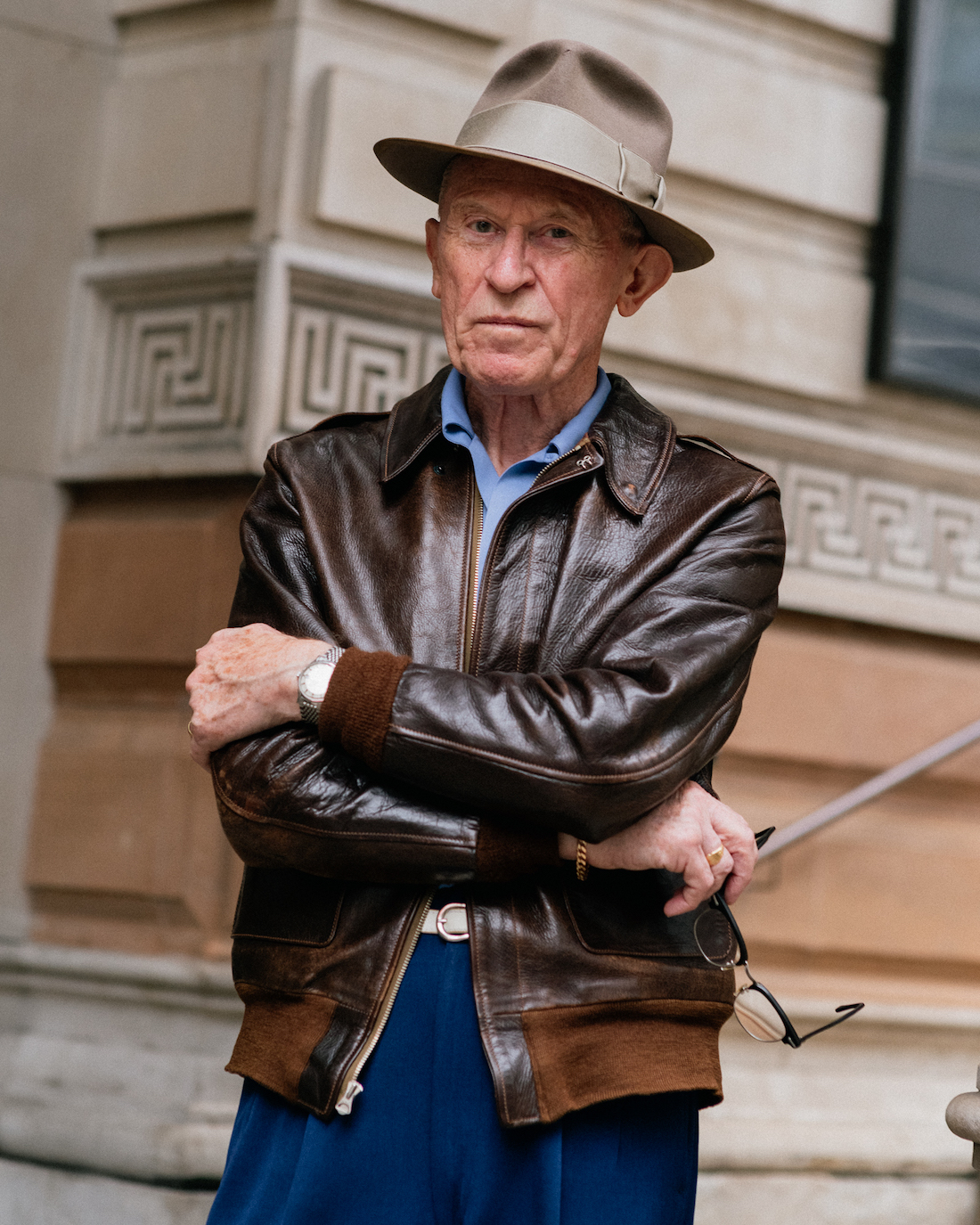
Outfit 3: Blues and leather

  • Hat: Vintage, JJ Hat Center
  • Sunglasses: Shuron as above, with Shuron clip-on
  • Jacket: Eastman, Star Sportsman A-2, horsehide 
  • Shirt: ‘Skipper’ by Wilfson Brothers, vintage gabardine
  • Belt: Vintage, Grado market
  • Trousers: Vintage
  • Shoes: Sanders
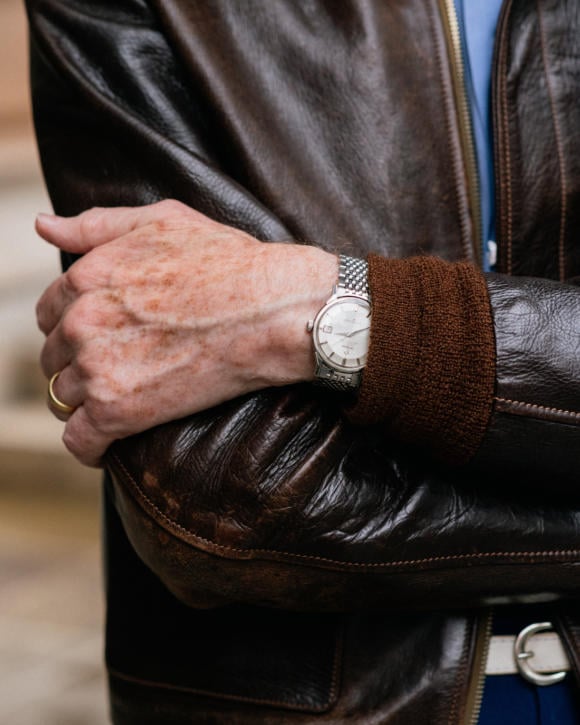
  • Watch: Omega sixties Constellation

This looks very comfortable, but then you look very comfortable in all your clothes - something is kind of hard to portray in pictures. 

Thank you, and yes it’s a good thing to raise. As you often say on Permanent Style, it makes such a difference to looking good. 

You see guys at weddings now, squeezed into these suits and ties, and it’s obvious they don’t normally wear a suit. They look like tailor’s dummies. Whereas even when I was working on the Underground, and had to wear a uniform, I’d relax into it, make sure I felt comfortable. 

I used to be very careful with things, but now even if it’s a £4,000 Anderson & Sheppard suit I try to forget about it. 

Did you find it was hard to feel relaxed straight away, for example when you first started wearing those forties and fifties clothes? It can take a few times of wearing something to feel comfortable - but then you’re also not sure how long is too long. 

Yes I guess I did, but age is a very positive thing there. I couldn’t care less at my age. Younger people get physically assaulted for wearing things that are different, especially outside of London. I know lots of people who got beat up for being goths or whatever - they end up moving to London just to have a sense of anonymity. 

I don’t want to sound big-headed but I get people come up to me and compliment me on what I’m wearing. I get abuse sometimes too, but it’s much more the positive side, which I think is lovely. 

I guess you’re always going to draw some kind of reaction dressing that unusually. 

You are, yes, and I’m probably lucky I don’t get too much of the negative. Maybe I just give off some kind of threatening presence when I walk! My wife always says I look miserable and aggressive but I’m not.

This Eastman jacket looks especially comfortable. How long have you had it?

About 10 years, and it’s had a lot of wear. 

Yes it’s at that nice point where it almost looks like vintage. 

True. I have three but this is my favourite. I actually have a G-2 as well, but I didn’t wear that for about five years after Jeremy Clarkson started wearing one - he ruined it. I was told his stylist went into American Classics and bought a whole load of stuff - there’s no way he would have picked that out on his own. 

The hat looks vintage too, is it?

Well spotted, it’s from JJ Hat Center in New York. I went in once and they had this little vintage concession in the corner, a kid was running it and he’d clearly been given his little space to get on with whatever he wanted. 

This was $50 but the hat band was ruined, the leather on the inside was coming away. Thing is, they’ve got this great archive of materials in the back, because they’ve been around so long, so he went and found a new band - and matched it exactly. They reblocked it too, relined it, replaced the sweatband. Great job. 

Thank you Ian, it was great chatting to you, and see you around Chiltern some time. 

I’ll be there, see you around Simon. It was a pleasure. 

Ludens: Japanese belts and leather goods

Ludens: Japanese belts and leather goods

Friday, August 11th 2023
||- Begin Content -||

In recent years I've been wearing more belts with tailoring, as I've worn other accessories such as ties and handkerchiefs less. 

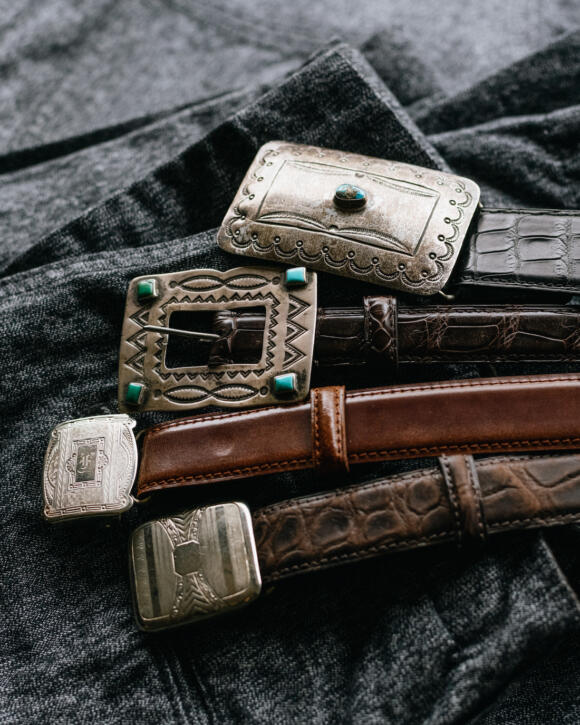
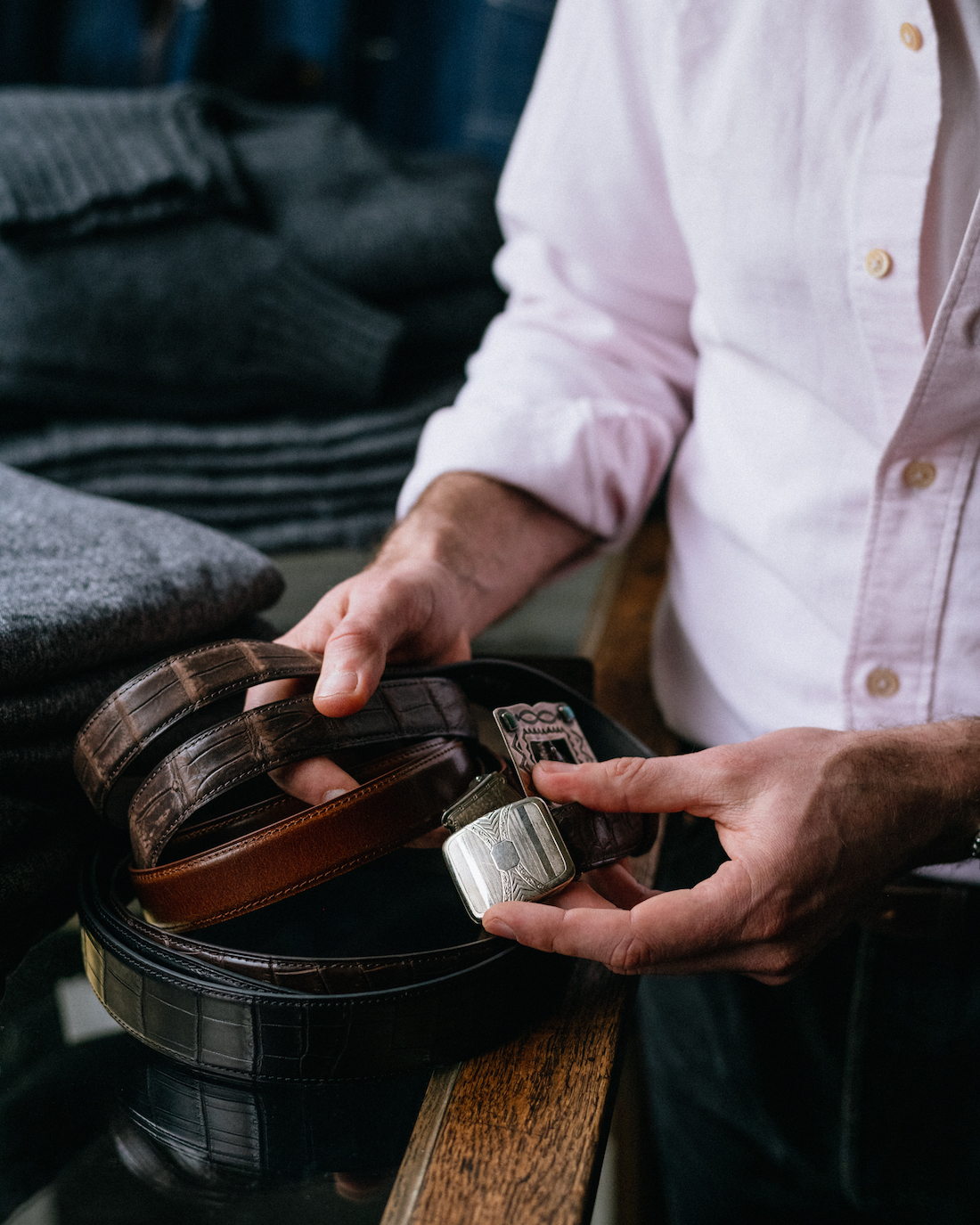
That's meant me upping my belt game, with a couple of commissions from Tightly Stitched, some great belts from Rubato, and some vintage finds (like the unusual style here). 

I'd also admired Ethan Newton's slim crocodile belts, which he usually wears with vintage silver engine-turned buckles. You can see me wearing one in the image below. 

These are made for Bryceland's by the maker Ludens (below) - a sole operator who works from home near Kobe in Japan, and also makes small leather goods for the shoemaker Spigola, also in Kobe. 

When we were in Japan earlier this year I had the opportunity to meet Fujii, the man behind Ludens, and learn a little bit about his background as well as commission a couple of belts. 

He trained with a bagmaker, starting 11 years ago, and moved to work with Koji at Spigola four years ago. But he always wanted to do his own thing, primarily focused on American-style products, made to a fine Japanese standard. 

"There are lots of leather workers in Japan, as you'd expect," he says. "But there isn't really anything you could call a Japanese tradition. They vary a lot in style - if there is one thing in common it's probably a certain finesse, a precision."

One of those styles would be very polished French-type leather goods, like some of those made by Ortus. Another would be the tough, biker-associated wallets made by the likes of Tenjin Works. And then there are those that make more in the English style, like the well-known Fugee.

The aim with Ludens is to do something a little different again, with dressier American pieces such as those slim crocodile belts. 

"It's very early days for me," says Fujii, "but we've developed a few different belt styles and these deerskin pouches that work well."

Below is the deerskin pouch in tan, and lower down in black. I also showed something similar recently on PS (actually the bag my belts from Fujii came in). 

"For the moment I'm just making these pieces for Bryceland's and selling through them, but at some point I'd like to have more of my own brand and sell direct to customers," says Fujii. 

Of course, as with many of the brands Bryceland's sells and supports, it's Ethan's taste you're buying into as much as Fujii's skill. I'd like those vintage-silver buckles if it wasn't for Ethan, but it expanded the ways I thought I could weave them into my own style. (That's Ethan below, photographing Fujii - with shoemaker Seiji McCarthy in the background.)

The belts I bought were very similar as a result. The same black and dark brown crocodile, made for a silver buckle I'd picked up on eBay. (There aren't many nice ones around - Fujii said he'd been looking at the same one.) 

Bryceland's tries to buy up these buckles itself, and sources from private dealers, in order to have some in the Tokyo and Hong Kong shops must of the time. But there haven't been any for a while. 

I can understand why some readers, by the way, wouldn't like having someone else's initials on their buckle. But I don't mind it. It feels like a piece of a beautiful object's history, like the initials you get on vintage luggage and other vintage silver.

The belts Fujii made for me are beautiful. Cut from the middle of the belly (the big square scales are unmistakable) and of course made in one piece. 

The stitching is by machine but fine and precise, and the interlining is thinner than most on this 'lined and raised' style of belt. That's the most obvious difference from something like my crocodile from Rubato, for instance.

Fujii also took an old tan-coloured skin I had (below, from a belt that was a present from Zilli, many years ago) and turned it into a similar belt, both slimming it down and adding a few inches of tan suede to make it the right length. That was expertly and tastefully done, without asking me for input. 

Of course, the nice thing about the silver buckle is that it can be swapped between belts, with each belt made with an end that folds over and snaps, to enable release and attachment of any same-width buckle. 

I don't have any pictures of my belts yet, but they're virtually the same as shown here and I'm sure they'll come up in future articles. This piece was more just about Fujii. 

I can also do an article in the future about my belt collection, small as it is, if there's interest. It could even be a 'if you only had five' piece, though that's hardly a small number of belts! 

These belts will replace a couple of western-style ones I've had from RRL for a few years, with similar buckles. Those have proven to be poor quality, growing stiff and shredding with age rather than getting richer and softer. 

It's a shame - the quality there varies so much. Perhaps like high-street brands, leather is one category where it's always worth waiting for quality. 

Details on Ludens and prices: 

  • Belts and cross-body bags available made to order
  • Wallets and watch straps coming in the future
  • Only currently in Bryceland's Tokyo and Hong Kong stores
  • Crocodile belt, buckle not included, ¥138,000 (£765) +tax
  • Leathers available: smooth crocodile, nubuck crocodile, kudu suede (all in black or bark brown)
  • Deerskin crossbody bags, ¥54,800 (£305) +tax
  • Bag currently available in beige, black in the future
  • @ludensjp

Note: Ludens uses both crocodile and alligator for belts and other goods, with the top end crocodile the most common. That's what I bought, but had originally described it as alligator; this has now been corrected. Croc and alligator look a little different, but at the top end of quality neither is necessarily finer. 

Speciale: Fine Florentine tailoring and haberdashery

Speciale: Fine Florentine tailoring and haberdashery

||- Begin Content -||

Speciale is a beautiful little shop in the west of London, making fine bespoke tailoring and unique shirts and knits. I should have covered Bert and George earlier and I haven't, and it's entirely my fault. 

My only excuse is location. Speciale is at the top end of the Portobello Road, known for its market (made more famous recently by Paddington) but otherwise not on the menswear radar. It's not really close to anything else, even in west London.

Still, my job is to seek these things and I should have done so before now. Hopefully today's article will help make up for it. 

First things first. 'Speciale' is not just a name picked by two guys that want to say they're special in Italian. It was the name of the Florentine tailor, Lettorio Speciale, whose work inspired George to become a tailor. 

George (below) had been at art school in Florence when he was introduced to the tailor Lorenzo Albrighi in Santo Spirito. (The square where all the students hang out - if you want to feel old while in Florence, go there.) 

Albrighi was the last tailor to be trained by Speciale, and was wearing a jacket he’d made. George was so taken with it that he dropped out and moved to live in Albrighi’s workshop in Milan. 

In 2014, George returned to London having finished his apprenticeship. That’s where he met Bert, and the two set up a tailoring business out of Battersea. George returned to Tuscany three years later, to work under the coatmaker Mauro Fanfani and then with Liverano in Florence. 

Bert also moved to Italy and worked for a small tailor, Rosario Sagliano. But by 2019, both were back in London, having found it hard to earn a living in Italy. Once back they decided to set up on their own, with Bert (below, right) focusing on the shop and brand rather than tailoring. 

“I loved tailoring but I felt I’d hit a point where I had the hang of it enough - paradoxically - to realise I wasn’t actually that good, certainly compared to George or the people I looked up to,” he says. 

The approach to the shop was partly inspired by the Anderson & Sheppard Haberdashery, with its determination to not sell tailored jackets or coats but everything you’d wear with them - at the same high standard. 

“There was also this uniform you wore as a tailor at your board, of a shirt and sweater every day,” says Bert. “We wanted to replicate that, though often with our particular take.”

The shop has been slow to fill up, but you can see their point of view in both the shirts and the knitwear. The V-neck knits and vests, for example, have a particularly deep neckline that’s accentuated by the short body (designed to wear with high-waisted trousers). 

The knitwear is mostly cotton, with a small(ish) armhole to make them easier to wear with tailoring, but a generous body, and an unusual mix of ribbing - 2x2 on the collar but 1x1 on the cuffs and hem. 

Bert and George have tweaked things over time - those knits are now 3cm longer than they used to be - but I'd say they're still best with high-waisted trousers. I bought a Large in the navy crewneck above, for example, and while the cotton, the colour and the neckline are perfect, the sleeves are rather long. With the pale-blue vest, I was best in an Extra Large (pictured) but that meant a fair bit of extra room in the body. 

The knits were also designed to be unisex, with a full range of sizes that men and women can pick through depending on how they like the fit. Emilie Hawtin wears both the vests and the shirts beautifully - as mentioned in her piece for us here

This means there aren't many at the top end of the size range for men. Lucas, for example, [Nicholson, Permanent Style] was too large for the range and normally wears a 44-chest jacket.

The shirts are also in a process of transition, being made now in exclusive cloths for the first time - high-count cottons that have a silky feel, with unusual asymmetric stripes. 

Unfortunately when we visited only two of the colours had arrived, the others being stuck in customs. But they showed the aesthetic well I think, both being unusual but subtle stripes - cream on blue and the reverse, blue on cream. I tried a size 15.5 and it was a nice fit, with a point collar and a generous body without being overly big. 

Around the shop there are also other bits and pieces, often with a Florentine theme. The jewellery of Ranfagni, for instance, and display shoes from Saskia Wittmer. “Florence meant so much to us,” says Bert, “it made sense to have this in the shop”.

“Same goes for the ties from Sevenfold. I know the embroidered designs are a little quirky, but we couldn’t believe there was no other stockist in the UK.”

Of course, the main interest of many PS readers will be the tailoring - so what’s that like? 

George’s tailoring is more or less directly descended from Speciale, a small house that produced Florentine tailoring fairly similar to others we’ve covered such as Liverano and Vestrucci - no front dart, straight front edge, soft make and a lot of hand work. 

“Generally in Florentine tailoring the block is quite basic,” says Bert. “You’ve only got one dart to help you, so its really left to the making to give a jacket its expression and bring it to life. And there is a unique depth of largely unseen hand and iron work that goes into prepping and making each element of the jacket.

“It’s this that gives it more shape, longevity and cleanliness: how little excess and bulk there is left in a corner of a lapel, how little lip there is at the top of the welt pocket, how clean the roll of the lapel or sleeve-head is, how flush the lapel sits on the chest etc.” 

The making really is impressive, and something I think I'll end up returning to on PS for more detail.

There’s also a functionality to Florentine handwork that I always admire - but Bert describes better than me: “The thing is the jacket should wear and look better because of the extra work, that’s the key: the philosophy is about practicality, not just prettification. It can even be quite brutal to that end in places.”

As an example of this brutality, Bert points out the the hand seam that’s sewn one centimetre in from the edge of the lapel, but which is so tight it looks like machine work. We’re looking at the old Speciale jacket they have (above) and I would never have spotted that for the work of hand and needle. 

“That locks the lapel forever,” he says. “It really is built around the assumption you’re going to live in it.” 

If anyone wants any more details on the tailoring now, the Speciale story highlights on Instagram have quite a lot, as do the Bespoke photos in the Specialeworld section of the website. 

Speciale is at 324 Portobello Road, Notting Hill.

www.speciale324.com

Prices (including VAT): 

  • Bespoke suits from £4884
  • Bespoke jackets from £3806
  • Bespoke coats from £4994

Timelines are normally around six months for a first customer, with three fittings. There is no travelling currently, but trunk shows to Los Angeles are planned for next year. 

Sandals: Slides and huaraches, open-toe and closed

Sandals: Slides and huaraches, open-toe and closed

||- Begin Content -||

Espadrilles are my preferred, casual summer shoe. I’ve always liked their clean lines and simplicity, which make them more elegant than pretty much any other option. I also quite like the massage-like feeling of walking on rope. They’re cheap, easy and surprisingly not ubiquitous.

However, there are times I like and wear sandals. There are two main reasons – one old and one new – and I’ll explain those, which models I like and why, and discuss other sandal options in this post.

The first reason, which has existed as long as I’ve been going on holiday, is having a shoe to quickly slip on and off. Like many people, a lot of the time I’ll be barefoot – around the villa, around the pool – and it’s useful to have something to slip on just to get across the gravel or the grass. It’s also nice around the beach of course – as you walk out to the sand, as you come back out.

Espadrilles can be used like this, with the back folded down, and there is something pleasingly dégagé about it - in the same spirit as a sweater literally thrown around the shoulders. But sandals will always be that touch easier, and of course are happier around the water than espadrilles*.

The sandals I wear in this vein is the ‘Bande Coupée’ from Rondini, pictured above.

Still made in the same location in St Tropez, the Bande Coupée is simple but quite functional for a slider, with slits that help the strap fit better on the foot, and leather that moulds effectively. They were apparently the model for the H-shaped Hermes sandal.

Lucas turned me on to Rondini, and I’ve been pleased with how they’ve worn. I haven’t tried any of the other models though, as this was the only style I needed, so if any readers have experiences with the others I’d be interested to hear how comfortable and long-lasting they’ve been.

The other obvious sandal would probably be Birkenstock, and I have worn them in the past. They’re a great company and a great product, and I’m not even put off by how ubiquitous they’ve become.

But they are chunkier – deliberately often, ergonomically – and I don’t find they work as well with a slimmer or more refined style: better with more casual, perhaps streetwear or workwear style.

Of course, as discussed recently, I don’t really like wearing open-toed sandals outside of holiday or the home. They feel out of place to me, like shorts in the office.

(And at the very least, if men are going to wear sandals like that to the café, or the library, they need to learn to look after their toenails. Women go to some effort here for a reason.)

How about closed-toe sandals though? Fisherman styles have become popular recently, perhaps driven by a shared desire to stay cool, and comfortable, plus casual but not quite as casual as a pair of Havaianas.

Tony touched on a few options in his Riviera-style article, including those from Church’s, Paraboot, Ralph Lauren and Ludwig Reiter. He’s a fan of the ‘Triestiner’ from Reiter, which has a series of holes around the front (so more closed than most).

Personally I find a lot of these sandals too chunky. Not the Triestiner, but the Pacific from Paraboot, Steve Mono sandals, La Botte Gardiane or the French military from Blackhorse Lane.

It makes sense that they’d be like this of course, given they’re styles for fishermen or similarly functional occupations. But the combination of thick (often grained) leather, wide lasts and often contrasting soles makes them too coarse for my style.

Still, I’ve been thinking about the style for a few years, and decided after various try-ons that the slimmer, truly closed-toe style from Church’s and Ralph Lauren was one that might work for me.

Unfortunately this model only seemed to be sold by companies with big, big-company mark-ups, and that held me back - until earlier this summer, when I managed to get the pair above from RL Purple Label second-hand.

One thing that attracted me to the style when I tried it on, weirdly, was how nice it felt with socks.

Socks and sandals, of course, have a bit of a dodgy reputation (even though brands like Ghiaia are doing a lot to reclaim it). But this is different – fine, dress socks, worn tone-on-tone with similar sandals.

It sounds odd, but the combination has both practical and historical justifications. Practical, because it’s actually very cool given the thin socks, and fairly subtle in style. And historical, because this is how many summer shoes were originally worn, whether sandals or espadrilles. It was cooler than a regular shoe, but you still wanted to cover your toes and ankles.

Of course, such a historical precedent should never be taken too far (and often is, by classic menswear fans). At the most I think it should prompt you to question modern assumptions – rather than ignore them and adopt period dress.

That questioning has worked quite well for me here, however. This isn’t an everyday look, and it won’t be for everyone. I wouldn’t recommend readers wear it into the office with their tailoring on Monday. I’m also fully aware it might be something that, next summer, I look back on and decide was a wrong turn. But so far it’s a fun experiment, didn’t break the bank, and I like the combination of subtlety and originality.

It could even prove to be a stepping stone to other sandals, like those Ghiaia ones (below) or a slimmer Paraboot model like the Ferret/Aragon. (Although I do prefer it when they have more of a captoe – a real closed-toe).

Other options in this area are the almost-closed sandal from Adret, shown below. I like the simplicity of these, but found them a little too chunky for everyday wear.

Then there are huaraches, which I’ve tried in the past. These can be very functional and achieve the same effect of a closed-toe sandal, in being cool but covering much of the foot.

The issue I usually have with huaraches is that they’re often wide, with big soles or (in the case of some Chamula) contrast leather. But I did try a pair from US brand Nisolo recently, based on a reader’s recommendation, and they were much better.

The only issue there was the quality - OK for the price but not as good as Chamula or Rondini. Perhaps there’s a bit of a gap here, for a range of huaraches and similar sandals that are between the high street and the top makes in terms of quality.

Clothes shown with Rondini sandals:

Clothes shown with Ralph Lauren sandals:

  • Adret ‘Riviera’ shirt in natural handspun cotton
  • Bespoke linen trosuers from Whitcomb & Shaftesbury in Solbiati ‘Art du Lin’
  • Charcoal cotton socks from Anderson & Sheppard Haberdashery
  • Large working tote in chestnut from Frank Clegg
  • T-shirt and sunglasses as above

Photography: Alex Natt

How much do you actually know? An interview with Alan Flusser

How much do you actually know? An interview with Alan Flusser

Friday, August 4th 2023
||- Begin Content -||

By Manish Puri

A few months ago I had the privilege of speaking with Alan Flusser about the history of New York bespoke tailoring.

From the opening beats of our conversation it was clear that Alan wasn’t about to be constrained by the narrow parameters of my article. How can one speak about New York tailoring without benchmarking it against the best of Savile Row? How can one appreciate New York tailors without acknowledging the Italian traditions that many of them were raised in? Why should Alan survey the scene without contextualising his unique place within it?

So, across more than two hours of charming conversation (pausing only at the behest of Zoom Basic’s time limit), Alan and I spoke about a variety of subjects that spanned his career in menswear. And I thought it was a shame so many didn’t make it into that NY bespoke article. 

So here I’ve included some highlights of our discussion, including several themes that I think would be of interest to Permanent Style readers: wearing unstructured tailoring, learning to dress well, the differences between Savile Row and tailors in the US, and some fascinating insights into the sartorial importance and cultural impact of the colour pink (which I wrote about a few months ago). 

But first, we began with a brief history of Alan’s first taste of buying custom/bespoke clothing.

On his introduction to custom 

I ended up having my clothes custom made for me since I was 17 years old, though it was not by design, no pun intended. My girlfriend's father was a self-made real estate guy and he needed his clothes made because he was big. After seeing that I was very interested in these things, he said to me, “Why don't you come to the tailor and just help me pick out clothes?” So, long story short, I did that. 

He liked the results, and was always very entrepreneurial, so he said “I have three or four friends who can afford to go to tailors. You could take them, advise them, and they could pay you a commission, and you could get a commission from the tailor,” which I thought was a great idea. 

So I started doing that, and I told the tailor, instead of you paying me a commission, why don't you just give me credit towards clothes, and I'll make clothes as we go along. So from the age of 17 or so, I would go to a tailor and I was interested in having him help me become the best-dressed person I could be.

When I went for my first important job interview for Pierre Cardin (above), I brought four or five of the garments I had made for myself to show them. I guess they thought they were sufficiently interesting enough to qualify, and I kind of started my real career.

On visiting the UK

I was making clothes in England in the Cardin era. I was going to Scotland and to Shetland and to different places. We really took advantage of what England had to offer. Ralph and I are the ones who went to these places, took these old mills and had them make new things for America. So, I spent a lot of time in the UK, and was having clothes made there.

I stayed at all the hotels, and I finally decided Claridge’s was my favourite because it was easier to get in than the Connaught. Every time I came downstairs to have a drink, they would play some American tune – on cue. 

On Savile Row compared to America

Savile Row is the most unique collection of tailoring people in the world. You have all these tailors, and they have their own house look, and that's how they've survived. In an English suit you're going to get into less trouble because they have a house style, and it's something you can judge upfront. 

There's also much more of a uniformity. Of course, there's differences in subtleties between Huntsman and Poole and Anderson and Sheppard and Davies. But from 10 feet, they could look similar. 

In America, tailors came into being because they made something that was different from everyone else  - it was much more distinct. The tailoring represented more of a lifestyle. 

And because we don't tend to have a house style, and people need business, they're apt to make more stuff that caters to what people want to have. In America, it's very dangerous when someone says, “I'm going to make whatever you want”. You're really in a lot of trouble. It means you are now the designer, and it’s going to live or die based on what you tell the tailor.

Plus, with England, along with the actual making of the clothes, you tend to get more information about tastes and style, even if it's more conventional, than you would in America - where at this point, very few have any real background with regards to the history of clothes or what differentiates the twenties or thirties from the fifties. 

There's more of a continuum with each tailor in London. You'll get to see how the English are putting together ties and shirts with suits, and you're more apt to learn something about the skill of it, because it is a skill.

Savile Row is still a little bit of an oasis of learning in that sense - one place that you can get to understand what you look good in and why. There are so few places like that now. America's not as tradition bent, and today it's even less so - it's more like, “well, what are you making now?”

On pink

How could you have ever known [when writing an article on pink] that you picked up a sartorial poker, whose cultural origins and social impact transcend not just some coded gender identity, but the American soft-shoulder sensibility becoming known as Ivy League. 

Unfortunately I don’t have the time or scholarship at hand to elaborate on the referenced wearable - that being the original Brook Brothers pink oxford button-down. However, make no mistake, this article of attire is inextricably tied up with the elitism, tradition, and even sexual coming of age of the period. A creation of Brooks Brothers, they turned its ownership into one of the Ivy League’s standards and an obligatory rite of membership.

I’ll just point you to a 1949 Vogue and Brooks Brothers woman’s advertisement (above) that sanctioned the pink male classic for the opposite sex, that also happened to spearhead the first Brook Brothers women’s collection. (The model above is also wearing a Brooks Brother Oxford shirt for the 1949 Vogue College issue).

Once the beachhead of pink for men had been forged, other pastel garments awaited, followed by the country’s increasingly sportswear-driven fashions, including golf-course brights and all measure of high-colour nautical blues for island and water life.

Palm Beach became America’s most important sportswear breeding ground, and in America’s menswear industry the pioneer for at-play sportswear, which included more colour in menswear than had ever been seen. 

The real story of pink and its outsize impact on colour in menswear is probably one that will never been written, yet it is well-documented in the fashion pages of the early Apparel Arts and Esquire magazines.  

So…pink is pretty much a uniquely American tale. But fortunately, it's one that I can still enjoy, recollecting my clothes-conscious father attired in one of his ‘346’ Brooks grey-flannel lounge suits, obligatory Brooks pink BD, black ground club tie, and shod in pink hose and black tassel slip-ons. Astaire never danced too far from his sartorial reveries.

On unconstructed tailoring

The thing about America that makes us unusual is that we invented sportswear. We know how to appreciate soft, unconstructed, comfortable clothes. We are the country of comfort.

There were lots of obstacles to unconstructed tailoring, but we've been moving towards it inevitably, and COVID has done more to advance it than anything. Since the eighties, every good retailer in the United States has carried some kind of unconstructed clothes and tried to get his customer to understand it three or four different times.

That came very slowly, because it was always more expensive. The term unconstructed denoted to people, “Oh, this is less expensive”. No, it is actually more expensive, because you have no linings covering everything up so the tailoring has to be very, very good.

And there wasn’t a whole lot of makers of soft clothes outside of Italy. Because it takes more than just tailoring skills - it takes people who have a sense of style and understand what's going on in fashion, and how to translate that into their own work.

Plus, when you're talking about the attitude of unconstructed dressing, it's a lot more difficult to teach because you don't have the structure to hold it in place. A suit was always the easiest of things for a man to wear. Anybody can put on a blue suit and a white shirt and some tie that matches - that's really easy. 

But if you're asking someone to, all of a sudden, wear an unconstructed blue blazer and let's say a grey pair of pants, and now the shirt, what are we doing with the shirt? What kind of collar? Tie? Am I wearing a pocket handkerchief? I mean, it's asking a man to do much more. That's a whole ‘nother void, so to speak. 

We don't have people that can teach how to dress at retail. We used to, but this is an education, an illumination of the idea of wearing something that looks similar to what you are accustomed to seeing on someone from the outside, but feels totally different. And you wear it totally differently. 

On fashion vs permanent style

The issue with, let's say Armani, was that one year you had low gorge, wide shoulder clothing, long - and the next you had rounder shoulder, tubular looking clothes. All of the previous ones were obsolescent. The great majority of fashion sold in the seventies and eighties and nineties is obsolescent.

That's one of the reasons of Ralph Lauren's success - he has a higher percentage of clothes that don’t become prematurely obsolete than any other designer in the world. And that must resonate with people. 

I think that plays a big role in terms of Simon's idea of permanent style. Things that transcend the moment - and for people to be able to distinguish that requires some education on their part.

On learning to dress well

Being able to learn how to dress well isn’t that complicated.

I mean people have to know what colours flatter them the most and why; what proportions flatter their individual physique and why. And that's actually what's difficult about it - getting the right information. 

What's easy about it is the fact that it's finite. In other words, the width of your shoulders is not changing. The size and shape of your head is not changing. It's just that it's very difficult to get the right information for each individual person. 

That's why our shop, I think, has all these years behind it. I say to customers, it doesn't cost us any more to give you the right information than the wrong information. It doesn't cost us any more to make something fit you properly, than not fit you properly. But what goes into it is an awful lot of knowledge. And, to a certain degree, that's what dressing is about, how much do you actually know?

Manish is @The_Daily_Mirror on Instagram

Images of Alan courtesy of Alan Flusser Custom

Tracksmith running clothing: Review

Tracksmith running clothing: Review

Wednesday, August 2nd 2023
||- Begin Content -||

Tracksmith, the running brand, recently interviewed me and a bunch of others for their magazine. The photos here are from that piece, and if you’d like you can read it here.

It was nice having the excuse to reflect on what running has meant to me. I started young because my Dad was a runner - he ran marathons around the world, and I remember watching him run London. We used to go running together in Richmond Park, close to where I live - a place that’s a privilege to run in. 

However, the article wasn’t as much about running clothing, and I know that’s something readers have regularly asked about. I’ve probably covered cycling clothing more over the years, largely because since I was injured in my twenties (training for the London marathon), cycling has taken up more of my time.

But I am running regularly now and have tried many brands over the years, from the obvious Nike, Adidas etc, to niche start-ups like Iffley Road and Soar, and the start-ups that are now much bigger, like Castore and Tracksmith. 

Although I don’t like all the styles, Tracksmith has become the one I wear the most primarily because of the design. 

I was always ribbed as a cyclist for caring more about the clothes than the bike - although, as a menswear enthusiast, I guess that should have been predictable. Tracksmith is the same - in a sea of black and grey (which does look good on a lot of people but is rather dull), they’re the only brand using colour well. 

And of course it’s often quite classic menswear colour, drawing as it does on old collegiate styles - burgundy and forest green, soft yellow and grey marl. It’s the kind of colours you buy vintage sportswear in; the colour of my Dad’s Harvard sweatshirt. 

Some of Tracksmith’s colours in recent years have varied more - teal, stripes, hot orange. But there’s still a sophistication to the palette, such as the brown and black I’m wearing in these pictures. I guess the way you tell is that they’re colours I’d happily wear in non-running clothing.

I’ve tried perhaps a dozen Tracksmith pieces over the years, and had my ups and downs with them. 

As a classic-menswear enthusiast, the first piece that got me into the brand was the Grayboy T-shirt, a cotton-blend piece that was inspired by a traditional kit of the Georgetown track team (below). It was meant to be a T-shirt you could run in - the comfort of cotton but with some performance from the synthetic. 

I got one when the brand first launched and loved it. I even managed to wear it when I interviewed the founder, Matt Taylor, at their Boston store in 2019 (at that time their only one). That was at the end of the trip where I also visited Horween, Optimo and Frank Clegg.)

When I bought a second Grayboy, however, they’d changed the fabric. It was softer and stretchier, and lost more shape when it was washed. It didn’t feel like something that in their words “wore in, not out” - a way of thinking that of course resonates with high-end workwear too.  

Happily, now there is a store in London (on Chiltern Street) I tried the Grayboy again, and they have returned to something closer to the original - a cotton/rayon mix that is rather stronger and tougher. 

My original Grayboy had ‘Tracksmith’ written on it, but that was back when no one had heard of them. Being the snob I am, I now prefer the plain ones. It’s like the Rapha jerseys with the white armband - you don’t want them when everyone has them. 

I guess at least I’m a self-aware snob. 

The heavier stuff like the Grayboy is great for a casual, easy run, and that’s what I’m doing most of the time these days. It’s also good for doing exercises part-way, or sitting in the cafe at the end. 

But for something a little more serious, you obviously want a lightweight synthetic, like the Twilight Tee I wore for these pictures. To be honest, I’ve never noticed much of a difference between these types of tops from any brand, other than the drier handle you get from the Nike Dri-Fit and similar tops from New Balance (which has great ALD-influenced advertising these days, but that isn’t really reflected in the activewear).

I prefer the silkier feeling of materials like this Tracksmith, and again I like the styling. Though more in plain colours like this than the distinctive sash-stripe of some of the Van Cortlandt tees.  

I’m a little between sizing on the tops, but a medium (shown here) is OK. I could wear a large but a medium is probably closer. 

I’ve found shorts a little trickier with Tracksmith, because the sizing varies a little between styles and the fact I’m in between sizes makes for a difficult trade-off sometimes. In the rain shorts, for example, a medium is too tight on the thighs but the large is a bit loose on the waist. 

The shorts pictured here are the Twilight shorts, and they work well (in medium). The range of shorts seems large, but actually if you find the short-short ones too skimpy (I’m not that good a runner) and don’t want tights or the semi-casual Longfellow, there aren’t that many. 

Among other things I’ve tried, the rain jacket works well and is pleasingly feather-light. The long leggings for winter I found a little thick and tight. The sunglasses are a guilty pleasure but beautifully made - I’ve worn District Vision for a long time. I’m not that much of a fan of a lot of the off-duty clothing (‘Trackhouse’) but then I’d always want my Real McCoy’s or Warehouse sweats there. 

Oh, and I also wear the Harrier long sleeve in winter, a mostly merino top that's really nice. A silk version I had was less successful, but they don't sell that any more.

The Elliot trainers I haven’t worn for that long, but they compare well to all the specialist Nikes, Sauconys and Asics I’ve had in the past. Again, perhaps not for a marathon, but they’re really well made - nicely fitted upper, good multisurface footbed, responsive midsole. And of course classic styling.

Overall I’ve been through enough different phases of Tracksmith, and tried enough of the products, to know it’s the best running brand for me even if some large parts of the range aren’t.

As ever happy to answer any questions on the things I have tried, or any other brands. 

Photography by Milad Abedi

Shot in Circolo Del Tennis, Florence for Tracksmith. Interview online here

The glow and romance of it: Douglas Fairbanks on stage

The glow and romance of it: Douglas Fairbanks on stage

Monday, July 31st 2023
||- Begin Content -||

By Tom Mastronardi.

Anyone that knows me appreciates my resolute affection for being well-tailored. Even as a kid raised in a decidedly blue-collar neighbourhood on Chicago’s South Side, I never required any coaxing to don a jacket and tie.

But of all the explanations for my embrace of bespoke, the best and certainly the truest has its genesis in a first date: one that marked the culmination of a teenage crush on an outstandingly lovely (of course) young girl.

Now, in my dotage, I realise my memory might be slightly porous, but still, I have the fondest recollection of an unforgettable evening spent with said lovely – and, more to the point, with the (distant) presence of Mr Douglas Fairbanks, Jr (above).

Okay, then – a boy and a girl and a Hollywood icon. But how does a tale of young romance – even one with a Hollywood version of a Fairy Godfather – lead to my enduring enthusiasm for tailoring?

Let’s go back even further to 1958, when a new play entitled The Pleasure of His Company by Samuel A Taylor and Cornelia Otis Skinner premiered on Broadway. (The New York Times found it to be "thoroughly delightful.”)

The plot of the play follows the return of a wayfaring bon vivant father, one Biddeford ‘Pogo’ Poole, who has returned to San Francisco for the wedding of his now grown (but long neglected) daughter, as well as to pursue his former lady, the mother of the bride. Charming hijinks ensue – which is why the French title is, with good reason, Mon Séducteur de Père. Racy stuff in Eisenhower-era America.

Fast forward to 1971 when, on the eve of my 16th birthday, I was in the throes of a mad crush on the aforementioned girl (whom I’ll henceforth refer to as ‘Olivia’, owing to discretion and her overwhelming resemblance to Olivia Hussey of Zeffirelli’s Romeo and Juliet, also a significant presence in my youthful aspirations).

How to win her heart (or at least get her attention)? The planets aligned when I was given a pair of tickets to a road-company revival of The Pleasure of His Company at Chicago’s Drury Lane Theater, starring the still esteemed Douglas Fairbanks, Jr, who toured the play for a number of years both in the US and internationally.

(Full disclosure: back then, we had only the Late Show to provide context, so my familiarity with the actor was confined mainly to films like The Prisoner of Zenda, Gunga Din, and Sinbad the Sailor – still, it all sounded good to me).

I was certain that this would tick all the boxes for a memorable first date:

  • Cultural uplift? Certainly.
  • An unchaperoned public transit journey to a glittering metropolis? Passage on the Orient Express couldn’t be finer.
  • Two-plus hours in the dark, sharing an armrest with the leading lady of my personal romantic reveries? The sheer pleasure of the thought thrills even today.
  • Topped off with the pleasure of an actual movie star’s company…Huzzah.

I asked, she accepted.

On the appointed evening, I sported my finest three-piece suit. As I recall it was the best Robert Hall had to offer, and featured a reversible vest that cunningly matched both the self and the accompanying odd trousers. Olivia wore a velvet mini-dress (no issues with recollection there) that only enhanced her lit-from-within beauty.

Off we went – by ever-so-romantic Chicago Transit Authority – from the old neighborhood up to ‘Downtown’ Chicago. Dinner somewhere that was optimistically, madly, elegant (read: white tablecloths) and finally, the theatre.

Curtain up.

Act 1, an interlude, Act 2, and final curtain.

Followed by tumultuous applause.

In the midst of that perfect evening, I realised that, in addition to young love, something more, something exceptional had marked me for life. I was, of course, riveted – gob-smacked – by Mr Fairbanks Jr’s wardrobe.

To this day, I can’t tell you exactly what he was wearing; just that it looked great (although that probably had as much to do with Himself as the aptitude of his tailor) and was largely realised in shades of grey (perfectly complementing the great man’s silver mane).

What he wore was, in retrospect, clearly less important than how he wore it: with grace, with charm, dignity, pleasure, and certainly without pretense – all key elements of his exceptional style, and all attributes which, callow youth that I was, I now desperately yearned for.

And luckily, beyond Mr. Fairbanks Jr’s particular sophistication, I discovered something that provided a sure and certain application – a manual, if you will – for me to achieve the singular sophistication I sought for myself.

Something that, conveniently, I held in hand. The Playbill.

Despite all the things unfolding around me – the young lady’s shoulder brushing mine (for the life of me, I still can’t remember anything else about the first twenty minutes), the glow of the stage lights, the air redolent with cultural sophistication – it was the Playbill, which noted the source of each item of Fairbanks’ impeccable wardrobe, which has stayed with me all of these years.

As in:

Mr Fairbanks’ suits by STOVEL & MASON, London

Mr Fairbanks’ hats by LOCK’S, London

Mr Fairbanks’ shoes by GUCCI of Rome and by A. CLEVERLEY, of London

Mr Fairbanks shirts and ties by TURNBULL & ASSER, London and by ASCOT CHANG, Hong Kong

Mr Fairbanks top coats by HUNTSMAN, London

All this and his signature red carnation. Just like that, I was hooked. Deal with the Devil dealt — and marked delivered.

This, I concluded, was how a proper gent progressed.

All you needed to be well-dressed was the right names (as sartorial icon Adolphe Menjou’s autobiography made clear in the title, It Took Nine Tailors – plus assorted shoemakers, hat makers etc) and I was henceforth prepared to join that line of worthies that stretched back at least as far as Beau Brummell.

It would be a decade and then some before I could afford my first bespoke garment – and there was a full run of designer suits in the meantime, starting with Pierre Cardin, extending through Giorgio Armani and running into a bevy of other erstwhile Italian RTW.

But his initial lesson took. There has been steady but not rash accumulation of these craftspeople since.

Fairbanks himself discussed the method of acquisition in in Salad Days, the first volume of his autobiography: I’m rather conservative about suits…No one in public life can afford to overstep. One has a responsibility, and before I get anything new, I brood about it, try it out on my wife and daughters, and perhaps on someone in the Club.”

If ever there was an attitude to emulate, it was this.  The notion of excess — or at least enthusiasm – tempered by moderation.

(Though I do wonder what Mr Fairbanks would make of Instagram— rather than the approval of the wife, or attaboys at the Club, using social media as the laboratory for proposing and analysing cut, colour and combination.)

Importantly, I do believe Olivia enjoyed herself; and I did get a kiss at evening’s end — which I considered a wild success. A line from the play comes back to me: “I’m still filled with the glow and romance of it”.

Still, I can’t help but wonder all these years later, if young Olivia realised the bullet she dodged, had things turned out differently. Possibly the best person to ask is the lady with whom I have been sharing a closet — albeit lopsidedly — these many years (“why yes; my love, but that does indeed appear to be another new suit…”), and to whom my only excuse is yet another bon mot courtesy of The Pleasure of His Company, this one delivered by Pogo:

“Oh, I know. I’m sorry. I get carried away.”

Memories of Edward Sexton 

Memories of Edward Sexton 

Friday, July 28th 2023
||- Begin Content -||

Edward Sexton, the English bespoke tailor, sadly passed away this week.

We were, as many readers will know, supposed to be holding a talk with Edward this past Spring, but his health has been poor for a while and that was postponed. 

In preparation for the talk, Edward and I had had a reminiscing talk together, going over the old days with Tommy Nutter, the celebrities and the personalities, and disrupting Savile Row. And that's how he comes back to me now - looking intently as he made a point, gesticulating slowly, with an occasional curl at the corner of his mouth that would turn into a smile.

I didn’t know Edward anywhere near as well as many peers or customers, but we had many such interactions over the years. He and wife Joan were always front and centre at our Symposium talks in Florence - always curious, always interested. That’s them above at the Retail Symposium in 2017.

Two years earlier he had taken part in the tailoring iteration of that series, alongside the likes of Lorenzo Cifonelli, Antonio Panico and Antonio Liverano. There was a discussion at the Four Seasons (pictured top) and then a demonstration of styles in the atelier of Stefano Bemer (below).

Of those other tailoring greats, it was Lorenzo that Edward seemed the most like, and I remember the two spent a good time talking that day. Both had a similar mix of the serious and humorous - often smiling, welcoming, but turning on a sixpence to serious discussion as soon as it was raised. 

I remember I had an unexpectedly long conversation with Edward that evening about overcoats. 

He had a thing for long coats, and bemoaned their ever-shortening proportions - couldn’t understand it as a fashion choice or a practical choice. I agreed, obviously, wholeheartedly, and we spent the next half an hour discussing our perfect coat, with its length, its drama, and a satisfactory buttoned-up-to-the-chin quality. 

A couple of months later we started work on making a similar model - which I’ve worn with joy ever since, even as it evolved and was shortened, always in consultation with Edward. 

Talk during our fittings was rather more limited, with most of it around particular cloths or aspects of fit that Edward preferred. 

He liked a jacket to cover the seat completely, so that from the rear (or from the front with a double-breasted) the legs seemed to have no end, running up into the jacket and theoretically carrying on forever. There was a parallel there with a woman’s skirt which I always thought hinted at the sexiness of Sexton clothing - for men and for women. 

Edward’s occasional comment about cloth was always worth noting, for example regarding Lesser’s or Lumb’s Golden Bale, because they came from experience and you came to Edward for a very particular look, so it made sense to use whatever cloth he liked for that particular look. 

Over the years we made two suits to compliment the coat - a grey flannel DB and a brown linen DB - and they will both be more special now, simply because they are means to remember someone you always felt you got on with, and enjoyed being with. 

I remember when we were preparing for our talk, sitting outside The Service, Edward said something like, “the talk will be great Simon, you’re always good at putting people at their ease”. I can’t think of a greater compliment as an interviewer, and I suspect it’s one that will stay with me.

The other thing that struck me during that talk was how radical Edward and Tommy were back in the 1970s. 

Not so much for the exaggerated styling of the clothes, or the celebrities that came to the Row for the first time, but the overall anti-establishment attitude. At one point their shop - on the western side of the Row - had a window display of dustbins and dancing stuffed rats.

Everyone that has been heralded as ‘shaking up the Row’ ever since pales by comparison, whether it’s the nineties Richard James/Timothy Everest/Ozwald Boateng generation, or the various streetwear and other iterations since. 

Everything seems suddenly more commercial and mediocre. 

I’m sure every other article online at the moment will tell about the tailoring on Abbey Road, the suits for Mick and Bianca, jumpsuits for John and Ono, dressing Bowie, Hockney, Sir Hardy Amies. It really is an incredible list. 

But arguably Edward’s work was more significant for the impact it had on industry - for the different ways he worked. 

What started with innovations like women’s tailoring later extended naturally into making costumes for Poor Little Rich Girl and other films; becoming a consultant to Wilkes Bashford and then Saks Fifth Avenue in the US; and curating Stella McCartney's first collection for Chloe. 

All the time he was breaking new ground. 

Besides, as he told me during that chat: “I didn’t know most of the celebrities, Simon - Tommy brought them in, promised them the world, and then I had to deliver it!” He was much closer to Paul and Stella McCartney, later, than to the crowd around Nutter’s in the seventies. 

Thank you, Edward, for our times together. And my absolute best wishes to Dominic and the whole Sexton team as they take the company forward. 

Talon zips and velvet chandeliers: The Real McCoy’s headquarters in Kobe, Japan

Talon zips and velvet chandeliers: The Real McCoy’s headquarters in Kobe, Japan

Wednesday, July 26th 2023
||- Begin Content -||

The Real McCoy's headquarters in Kobe, Japan is extraordinary. 

I had been warned it would be, but it really didn't prepare me for the scale of the operation or for the mix of craft and eccentricity. 

The company owns four warehouses in the port of Kobe, down by the water. They are huge, triple-height buildings, mostly used by neighbouring companies for importing and exporting food. Apparently all the region's school meals come through here; big white bags on trolleys come by stamped 'tapioca'

The main warehouse McCoy's uses is accessed by a huge brushed-steel door. Inside this, they've built an artificial concrete hallway, which leads you some 15m into the building (above). 

A few bits of the design, like this one, come from the fact that the space was originally intended as a combination shop/cafe, as well as an office. The walls of the first room are decorated with hundreds of Star Wars toys on one side and vintage Fire-King mugs on the other for the same reason. 

These are from founder Hitoshi Tsujimoto's personal collections, about which much more later.

This ground floor is subdivided into several open rooms (no ceilings) which are used as a design office, a vintage archive, a hardware store and a stock room (above).

Not much of the production is done here - exceptions are leather jackets and printed T-shirts - but most of the materials and hardware go through. 

The racks of both vintage and McCoy's stock are obviously absorbing as a customer. It's hard not to start flipping through the rails of vintage references and old McCoy's products, and some of the former are amazing (below). 

But actually, the things that impressed me most were to do with the production. 

The first was the fabric samples in the design room (below), which cover an entire wall - even though the company's only been keeping a record for four years. Ninety-nine per cent of the fabrics McCoy’s uses are exclusive (even sleeve linings) so there are a lot of them. 

This also means big volumes. The minimums for exclusive nylon are huge, so it all has to be stored here, awaiting use. Cotton thread is the same - the company only uses pure cotton, but that’s rare in Japan (it’s mostly used for baby clothing). So big minimums have to be ordered, and stacks of it stored away. 

The second thing was the vintage hardware. 

One room tucked along a wall has shelves upon shelves of the company’s hardware: zips, pullers, studs, all custom made. (Which is very rare - perhaps a handful of the manufacturers I’ve ever covered do this.)

But then in a set of shelves at the end are several crates of vintage zippers - old Talon ones. “We bought all these in the 1980s, at a cost of about $10 a bag,” says Kent (pictured above in the fringed jacket), Hitoshi's son. “That seemed crazy then, but now they cost $5 per zipper.”

The vintage pieces are all gradually being used in McCoy's products, and will of course eventually run out. But for all those buying today, what a great addition to something trying to be a really authentic historic product. 

"You should have seen this whole area 10 years ago", says Kent. "It was a mess, everything written by hand, no stock tracking. It took me five years to sort and codify it all."

The Real McCoy's as a company was founded in 1990, but has been owned by Hitoshi since 2003. He ran a chain of vintage stores at the time that also sold repro clothing, and was McCoy's biggest stockist. 

In the past few years Kent - American educated and an ex-professional baseball player - has helped modernise the business, with help from his brother. "He works in IT and created our internal software system," Kent says. "That's made such a difference." 

Kent is a product person, always happy talking about loopwheel knitting or the intricacies of denim. He runs the McCoy's production, managing suppliers and the company’s factories, of which there are an increasing number following issues with suppliers during Covid.

Those pressures have also changed the way the company sells: in the early 2000s it had over 100 wholesale accounts in Japan and one store. Today it has 20 accounts and nine stores.

Returning to our tour, we’re now getting to my favourite room, on the first floor. 

Climbing up a metal staircase on the outside of the warehouse, you go through a small door and enter a room that runs the length of the building. There’s a big stove at one end, with a table, a few foldable chairs, and a big vintage coffee roaster around it. It's saturated with the smell of wood and coffee grounds. 

"This is where we all congregate for lunch," says Kent, pouring us coffee. "We spend ages sitting around here in the winter, just chatting. There's no heating so it gets pretty cold." 

There are only 18 employees across the two warehouses that the company uses, so the place has rather a loose, open atmosphere - it’s rare to see more more than one person in a room. So this area serves as a focal point. 

After a few minutes, Alex (Natt, photographer) wandered over to the other end of the building. There, in glass-fronted cages, were some very rare and expensive cameras. And some watches. And many other things. 

This is where we get into Hitoshi's hobbies/obsessions. They include, or have included, sound systems, cameras, coffee, watches, fishing, and of course every type of old clothing. 

"Sometimes when he has a new hobby, the best thing is to get a shipping container in and just put it outside the building - to store it all," says Kent. 

Later he shows the one at the back that contains all of Hitoshi's fishing equipment. You unbolt the steel door, step inside, and are surrounded by racks and racks of poles, flies, nets, and other fishing-related paraphernalia that I can barely describe, let alone name. 

"It's very efficient - you can just lift in one of these things, put in light and air conditioning, and you're good to go," says Kent.

Right now, we're being led up a spiral staircase that takes us into the middle of Hitoshi's lair (above). 

Here the hobbies are on full display. At one end is a desk backed by three beautiful old Hermes bags. In front is an EMT turntable with a set of Cello amps (not something I knew - Alex filled me in) and various other models dotted around the sofas and table.

One last level up, in the roof, is a personal cinema. One sofa faces a wide screen, with the whole room clad in types of sound proofing. Even the chandelier is covered in velvet.

"My Dad patented a couple of different types of sound proofing - this one is based on a bamboo forest," says Kent. 

Charmingly, Kent also says he remembers when he was a kid spending weekends sticking foam pieces to the ceiling, under careful direction of Dad. He looks at one as we leave and presses it back into place.

Above all this is the roof, giving out panoramic views of Kobe. 

The company holds barbecues and other events up here, but until recently it was all covered with attractive indigo-dyed wood. Unfortunately the local council made them take it all off recently, and it’s now sitting in stacks next to that fishing/shipping container.

Later on we see a room filled with nothing but mammoth coffee roasters; part of another warehouse being turned into a T-shirt hub; production of horsehide jackets (the only things that are entirely made at HQ); and a yoga studio. 

There is also a World War II plane, partial and rusted, sitting amongst old furniture in the second warehouse. Apparently it was discovered by a friend of Hitoshi’s in the Philippines, dredged up and brought to Japan, but none of the museums wanted it. So here it sits, surrounded by wooden chairs and jeans adverts.

It says something about the experience of visiting McCoy's that this didn't surprise us in the least.

Many, many thanks to Kent and everyone at The Real McCoy’s for their hospitality in Japan. For more on McCoy’s products, see article here including an interview with Hitoshi.

Kind of showy: All black jacket and jeans

Kind of showy: All black jacket and jeans

||- Begin Content -||

On Permanent Style we’ve always talked about dressing with subtle elegance - clothing that makes the wearer appear simply well dressed.

This is still the style I get most pleasure from. It's a matter of good fit, quality materials, and tasteful combinations. It's the way I dress the most, and the one most people I know aspire to. 

But part of my journey with Permanent Style has always been about experimenting with other styles, and exploring how they relate to this central, elegant core. 

Some, such as today's outfit, push away from the safer end of the subtle/showy spectrum: they're consciously more of a 'look', deliberately standing out. Playing with styles like this is a sign of being open-minded, I think, but is also something a lot of style niches struggle with, perhaps particularly classic menswear with its rules and traditions.

As far as Permanent Style is concerned, these outfits are a sign of expanding what we cover, rather than shifting in any particular direction. The circle grows; the centre is unmoved. 

Expanding on that theme, I wore this all-black outfit to Pitti Uomo because it’s a nice opportunity to try things out. Everyone’s aware of this, everyone’s interested in what others are wearing, and you're often interested in the opinions of your peers. 

That’s very different, to my mind, from the garish clothes some still wear to get as much attention as possible. For me and those I know, it’s about quality, not quantity; seeking the thoughts of those you respect rather than being the centre of attention. 

The other issue with more unusual outfits like this, is there are fewer places you can wear them, and perhaps a smaller number of people who would. They’re not as universal as some of what PS covers. 

But I would wear this all-black outfit to some evening events and indeed have done so recently. Not fashion events either: a friend’s dinner party, a celebratory evening out. 

It’s a little showy for a dinner party - you might have someone comment that you look like a rock star (or more likely, like you’re trying to look like a rock star). Something similar in navy would always be easier. But again, it depends how subtle or showy you are as a person, and want to appear. 

One more angle on this, before we talk about the clothes. This feels like me, in this place and time; it feels appropriate. 

At this point in my career, in this place (Pitti) it feels natural for me to dress in this manner. It wouldn’t have done 10 years ago; it wouldn’t do now if I was having a birthday lunch with my family. But there, now, it fits. It’s not too much of a reach. 

This doesn’t mean that a much younger person, with a very different standing, couldn’t rock the look. But I wouldn’t have done. Me, myself: the person I am, with this personality. 

As big a mistake as any other when you're first getting into clothes, is trying to look like someone else. Everyone should explore, everyone should push themselves, and often it takes a while before something feels natural. But some things just aren't you, at least today. 

OK, so now the clothes. Hopefully some of that chin scratching was interesting. 

The jacket is my black hopsack from Paolo Martorano, worn with washed black Levi’s. The jacket is not a natural one, not the easiest, to wear with jeans because it's quite sharp. 

But that matters far less when you’re wearing one colour like this - monochrome. There’s less contrast - everything recedes into silhouette and texture. And it also matters less because we’re aware this is a showy look anyway - not the subtle jacket-and-jeans discussed previously on PS and which most readers will aspire to. 

It's also worth noting that I would rarely button the jacket here, which makes that sharpness less relevant. It would seem odd to, in a look which while clearly considered, is also so laid back.

The shirt is a washed denim from 100 Hands (a prototype we’re working on). The shoes are classic Sagans from Baudoin & Lange. The belt is alligator from Rubato and the sunglasses are vintage gold-rolled Caravans. 

The unusual piece is the bag, which is actually the packaging I received belts in from Japanese maker Ludens recently. I’ve been exploring small day bags like this - as with the vintage cartridge bag - and this pouch with its drawstrings works pretty well. 

The only issue was that the suede initially shed a little, leaving little bits on my jeans. But it settled down during the day and wasn’t a problem by the end - so clearly something on the surface, that perhaps I could have brushed off before use. 

It’s the same suede that Ludens has used for cross-body bags at Bryceland’s, which gave me the idea. Those are only available made to order in the Hong Kong and Tokyo stores, in this sand colour and black, and my bag is not available separately. But I know Ben in London is hoping to get some in at some point.  

Wimbledon smart/casual: Everyone loves an excuse

Wimbledon smart/casual: Everyone loves an excuse

Friday, July 21st 2023
||- Begin Content -||

This past weekend I attended Wimbledon for the first time in a while. I used to go a lot when I was at school: it was nearby, and standard practice was to walk down after school and try to catch people coming out, and ask for their tickets. 

People rarely stay the whole day, but play can run late, so if you were lucky you'd get two or three hours of tennis in the evening. If you zeroed in on posh-looking Americans, you could even get Centre Court. (Sorry to highlight Americans, but they were consistently the best targets.)

In the intervening years I've only been a few times, and the rules have changed in any case. Tickets are all digital, and guests are encouraged to transfer them when they leave so they can be resold for charity. 

Returning to Wimbledon this weekend, the thing that struck me most was how well a lot of people were dressed - how much effort they had made. It was a pleasant surprise, and had me thinking how much of it was part of Wimbledon being such a public event. 

Of course the women caught the eye more than the men. So many were in lovely summer dresses, with comfortable but elegant shoes and sunglasses. There were flowing skirts, printed jump suits and linen blouses. 

But the men had upped their game too. Nice knits, polo shirts, button-down oxfords: it wasn’t spectacular, but you could see the average was higher, that this was the kind of event were there was a small but understood expectation of dressing up.

There is no official dress code for most areas of Wimbledon, but the messaging over the years has always been about ‘encouraging’ smart and dress, and ‘smart casual’. The members enclosure introduced a specific dress code in 2012, with pictures (below). Men are required to wear a ‘lounge suit or tailored jacket, shirt, tie, trousers and dress shoes’. 

I’ve been to Wimbledon once in the members enclosure, and while the dress was certainly more uniform, I’m not sure it was more stylish. I was more impressed by the general dress this year: when people felt that expectation to dress up, but could also express themselves. 

Plenty of people still got it wrong. We were on No. 1 Court, and two rows in front of us was a man wearing a three-piece green checked suit, matching yellow tie and handkerchief, a tie bar and a narrow-brimmed tweed trilby. It was loud and in many ways not that smart. 

Some of the women too. Three rows over were two in their early thirties. One was wearing a three-piece cream-linen zoot suit with huge shoulders, rolled up trouser legs and a matching hat with safety pins on it. Her friend was in an oversized Adidas windbreaker, worn with baggy jeans and high-tops. 

I actually liked both looks - they were very stylish and well-executed. But neither - the very underplayed or the overplayed - was really in keeping with the smart/casual elegance seen elsewhere. 

That went for too formal among the men as well. The most obvious was those essentially in business clothing: navy or dark-grey suits, white shirts, black shoes, tie. You couldn’t fault the formality, but it was a little out of place. 

However, there was so much else that was good. I spotted a handful of cotton double-breasted suits worn with T-shirts, perhaps inspired by presenter Qasa Alom (above), who did a good job of interweaving some ‘casual’ into the ‘smart/casual’ among BBC staff. 

After initially starting with just an untucked linen shirt, he smartened up with a couple of cotton suits, worn with dark T-shirts or polo shirts underneath, and peaked at a suit, open-necked shirt and thin line of pocket square - an effective and subtle outfit for a presenter.

If you look at crowd scenes at Wimbledon - especially on the outside courts - it’s true you’ll have no issue spotting T-shirts and hoodies. But contrast that with the crowd and most other sporting events, and I think the difference is obvious. There are far more smart shirts and shoes; far more shirts have collars.

I wonder how much of this dressing up is due to the fact that Wimbledon is on TV - free, public TV, on BBC 1 and 2. 

Most people that go to Wimbledon will have watched Wimbledon, even if only briefly. They’ll have seen the Royal Box (above), with celebrities and royalty in elegant clothing. They’ll see shots of the crowd on Centre Court, also often tastefully dressed. 

And their impression of the event as a whole will be of something rather elegant. The grass is bright, the players are in white, there are flowers and that pleasingly rich purple-and-green combination everywhere. I’d argue Ralph Lauren adds something stylish with its uniforms too, although it would be nice if the ponies weren’t so big, not on the blazers as well as the shirts. 

I wonder what it would be like if the opera were seen as publicly as the tennis, and it managed to keep up an equally elegant crowd. I think many people would appreciate it and gladly take the excuse to dress up.

(The Proms is on TV of course, but Wimbledon is more popular, gets more coverage and has more focus on the crowd.)

I think this is my point, I’m slowly realising: people like an excuse to get dressed up. If the events are there, if everyone else is making an effort, then it’s easy and enjoyable. 

As to what I was wearing, it was something out of the ‘summer casual-chic’ playbook: long-sleeved knitted polo, tailored linen trousers and suede loafers. In retrospect, if I had tickets for a show court, I might dial it up just one notch and add a jacket - but my combination worked well, and I think embodied the spirit of the tournament. 

Swimming shorts: Simple, tasteful, flattering

Swimming shorts: Simple, tasteful, flattering

Wednesday, July 19th 2023
||- Begin Content -||

I haven’t written about swimming shorts for a long time. Other than a passing reference on our regular ‘holiday snaps’ articles, it’s been over a decade since they were covered on PS.

Even back then, it was a pretty short article about Orlebar Brown. I took the time to interview the founder, which most bloggers wouldn't bother to do, and it went into some technical detail about the make and pattern cutting. But there wasn’t much general guidance. 

My feelings about swim shorts haven’t really changed in the 12 intervening years. I still feel that what suits most men is a simple style in a comfortable, often slightly shorter cut, with a good make and minimal detailing. 

No logos or ‘funny’ patterns, no prints of a Slim Aarons photo or, worse, something James Bond-related. Why would you want to reference James Bond by wearing something he would never go near?

Anyway, I thought I’d take the opportunity of being near a pool this summer to illustrate these thoughts on what makes good swim shorts, and give some recommendations. 

In terms of cut, swimming shorts should be roomy - not baggy, but usually the danger is more the other way, with a certain guy wearing skin-tight swim shorts in the same way he wears skin-tight casual shorts, or stretch chinos. There is the idea that this is more flattering when I’m not sure it is. 

Swim shorts also look good with a fairly short inseam - perhaps five or six inches. Of course the proportions depend on height, but these are sports shorts and my rationalisation is they look better when they give the impression of freedom of movement. Mid-thigh or thereabouts. Those pictured are five inches. 

This leads onto points about colour and pattern - style. I like this kind of length because it’s moderate, unremarkable. There is no attempt there to make a style statement, by wearing tiny stretchy shorts or at the other extreme, knee-length board shorts. 

Pattern is similar. Nothing wrong with a little micro-pattern if you want, but the aim is not to make a statement. No bold zigzags or little dancing bananas. 

Which in turn leads onto colour. While brands will often offer a swim short in something classic like navy, most of the other colours are usually bright - scarlet, pale blue, lemon yellow. 

These bright colours certainly look better on holiday in the sun than anywhere else, but that doesn’t mean they suit most people even then, unless they have a strong tan. 

Given most men will only have one pair of swim shorts, it also makes sense for them to be versatile. A bright-yellow linen shirt can be lovely in the summer, but if you only had one shirt, it wouldn’t be yellow; chances are it would be white. 

There should be more sophisticated colours out there - tobacco, dark brown, olive, not just navy and black. I know these colours are harder in synthetic materials, but it is possible - it’s the reason I impulse-bought the (definitely overpriced) Hermes ones pictured; they were such a great colour.

Lastly, make and material. I’ve tried perhaps a half dozen brands and materials in the past decade and the biggest difference I’ve found is weight. (Readers, please do chip in as always with your experiences.)

The polyesters and nylons don’t vary that much in feel, but if the material is too light, and there is a drawstring or elasticated waist, they quickly look like boxer shorts. It doesn’t help if you’ve gone for a ‘jazzy’ stripe that could well be the colour of your boxers too.  

We want something that looks like regular shorts rather than boxer shorts. Details like a drawstring rather than elastic help, as do pockets, but the weight makes the biggest difference. 

On the subject of make, I’m no longer much of a fan of the Orlebar side-adjusters style. It looks a little fussy for a swim short, but a little cheap for a proper short: I’d rather have one or the other. 

In fact, I should go through an update some of those earlier posts about Orlebar polos and swim shorts - if indeed readers still find them through search. Let me know. 

A last style point: I’d always avoid logos and branding. You wouldn’t have it on your normal shirts or shorts, so I don’t know why it’s necessary here. 

Here are a few other brands I’ve tried over the years. Once more, do let me know which you like and why - there are a lot out there.

  • Hemingsworth: Like the Orlebar Brown style, but better. Expensive (£200) but with nicer side adjusters, a mother-of-pearl button and other details. 
  • Patagonia Baggies: The versatile go-anywhere option. Big fit, great maker, nothing luxury about them but good value (£60).
  • Mr P: As with a lot of Mr Porter’s own-brand range, good make and good value. A cleaner style than the Baggies for a similar price of £65. 
  • Ripa Ripa: A start-up (you get a lot in this area) with some nice touches. Clean fit, rope drawstring and some fairly sophisticated colours including olive; €105. Shame about the branding on the back.
  • Orlebar Brown: They’ve become steadily more expensive over the years, and Hemingsworth is better made, but if you like the style they have a really big range including different lengths. 
  • Fedeli: The Italian maker’s swim shorts are sold quite widely, but they’re a little expensive (£160) and too light a material for me.
  • TIMO: Sold at Trunk, a very simple make but with the advantage of a nice olive colour. Shame again about the logo on the back. 

Note: These are shorts for holiday, for the beach, for the holiday pool. Not necessarily actual sports shorts for swimming 30 lengths every day. 

Other clothes shown: Black Nonpareil polo, Rubato; ‘Californian’ sunglasses, EB Meyrowitz.

Photographed at the COMO Castello del Nero hotel and resort, Tuscany, by Milad Abedi.

Sartoria Ripense: Visiting Andrea Luparelli in Rome

Sartoria Ripense: Visiting Andrea Luparelli in Rome

Monday, July 17th 2023
||- Begin Content -||

By Manish Puri

Whenever an article related to Rome is published on Permanent Style I’ve noticed there’s usually a reader comment or two about Sartoria Ripense – either asking about their style or praising their work. With this in mind, I decided to stop by and meet Ripense’s founder and cutter Andrea Luparelli on a recent visit to the eternal city.

Andrea’s grandfather was a tailor, and so after a brief stint working for an electric company, he chose to pursue his passion, follow in his grandfather’s footsteps, and opened Sartoria Ripense on the Via di Ripetta in 2000. Ripense’s tailored offering is bespoke only – Andrea has toyed with introducing made-to-measure but thinks having one line offers the customer greater clarity and certainty.

On the afternoon I visited, Andrea was busy conducting final fittings for a couple of local clients and boxing finished garments for a business trip to Paris. Ripense have previously held trunk shows in several European and Asian cities, but their current trunk show schedule is Paris only. Nevertheless, he was most accommodating as I quizzed him on the particulars of the house style.

Even though I didn’t commission anything on this occasion, I have included my thoughts and the experiences of two long-time Ripense customers. As always, it would also be great to hear the experiences of readers in the comments section below.

It’s always fascinating (and quite revealing) to see which topics people elect to open a conversation with; in Andrea’s case he instantly leapt onto the notion that the best bespoke tailoring begins with “a beautiful idea”. To illustrate, he showed me one of the jackets he’d recently made for himself – a 6x1 double breasted (modelled above by me).

Andrea had been searching for a cloth that was “both heavy and soft – like chewing gum”. One day, in a local fabric warehouse he spotted a weighty cream linen in a wide herringbone pattern stippled with pale brown.

Unusually the cloth was only available in a narrow width, 70 cm (typically tailoring fabrics are woven at 140cm to 150cm) – the reason being that it had been woven for a manufacturer of dish cloths. Andrea purchased the remaining length anyway, gave it a good wash to soften it up and made a jacket for himself and a few of his customers.

With similar enthusiasm, Andrea showed us a field jacket made from deadstock WWII-era cotton bedding. I got the impression that he found the classic navy two-piece a little prosaic - not that he isn’t happy to make them, there was a whole rail lined up to deliver to Parisian customers - but Andrea is clearly someone that likes exploring the full possibilities of bespoke.

He also said he prefers to use materials that aren’t widely available in ready-to-wear: “I try to use exclusive bunches whenever possible. How can I go to dinner with a client and explain my price when someone at the next table is wearing a jacket in the same cloth for €1000?”. Outside of this, he tends to prefer British mills and merchants: Fox Brothers, the Harrisons group and Bateman & Ogden.

Trying on a few of Andrea’s jackets also helped to assuage a concern I had that the Ripense jacket might be a little close in the body. To be honest, I think this concern was based purely on Andrea’s slimmer casual style which I had wrongly assumed would translate to his tailoring. In reality, Andrea’s jackets were very comfortable to wear and move in.

Andrea led me downstairs, below the shop, to one of Sartoria Ripense’s two workrooms - the other is located about 200 metres away – where four tailors (out of a total staff of seven) were preparing garments.

Later that afternoon I observed the benefits of having the tailors so close to hand: when a customer had a minor trouser issue Andrea summoned a couple of colleagues from the basement and an ad hoc tailoring quorum was assembled to agree on the best approach.

As to Ripense’s house style, Andrea was reluctant to categorise it as Roman or otherwise. “When bespoke tailoring began, there was no Neapolitan style or Roman style. There was only classic style – something that looks good this year and in 10 years.”

To bolster his argument Andrea pointed to some framed Apparel Arts-esque illustrations that were hanging on the wall – the gentleman depicted clearly wearing neither Roman nor Neapolitan tailoring. “Look at his quarters – a little open but not too much. A very similar line to how I cut my jackets. Classic style. Looks good then and looks good now.”

The preferred shoulder style is rollino (aided by a layer of canvas rather than shoulder pads) but spalla camicia is also frequently made. Upon enquiring about a 3-roll-2 jacket Andrea light-heartedly countered: “Why? What do you need the extra buttonhole for?”

While discussing other aspects of style, I found Andrea and I frequently gestured using our thumb and forefinger curved into a C-shape: the universal indicator for a little or un po’.

Lapel width? Moderately wide. Lapel line? A very gentle curve. Button point? Slightly lowered. To my eyes, it’s a well-balanced jacket (with two darts through the front) where no single element dominates.

However, the detail most emphasised to me (and although small, could be considered a Ripense signature) was the seam between lapel and collar. On a Ripense jacket, the point of the lapel is cut at a strict 90-degree angle, but when the top of it meets the collar, it twists sharply up towards the neck (as you can see in image on the left).

The intention here is for the collar piece to be of uniform width as it snakes from one lapel and around the neck to meet the other lapel – an aesthetic Andrea prefers. When the lapel line is straighter (as is the case with the jacket on the right) the collar piece starts slim but must widen to ensure a good fit around the neck (shown by the red markers).

A typical Ripense suit is worn above by regular customer Max Poux (below). I reached out to Max to get a client’s view of the Ripense experience and product, and he was most generous with his time.

“I’ve been a customer of Sartoria Ripense since 2016 when I was introduced to Andrea through a friend. We bonded over cars and watches first, then I asked him to make me a suit and since then he’s been my only tailor and become a very dear friend.

“Previously my bespoke tailors were Terry Haste and Anderson & Sheppard (who I used for many years: 2007-2015). I’ve also commissioned made-to-measure tailoring from Sartoria Partenopea and Orazio Luciano.

“Haste was a little too structured and I couldn’t ride my motorcycle! I found A&S too ‘old school’ with too much drape. For me, Ripense is the best looking fit, a modern style, and the most comfortable I ever had.

“Since 2016, I’ve built up an extensive wardrobe made by Andrea. My favourite pieces are a tuxedo (above) and a Solaro double-breasted - simply because these are garments worn for special occasions and aren’t work related. But the piece I wear most is a blue hopsack blazer jacket (above).

“They put so much work into tailoring the garments that the only changes I usually ask of Andrea are to simplify - not putting buttons in the trousers cuffs, or not necessarily stitching a buttonhole in overcoat lapels.

“What I like most of all about Ripense is Andrea’s eye. He has impeccable taste, brilliantly mixing English elegance with Italian nonchalance! Anything he wears immediately becomes an inspiration and knowing you can trust your tailor’s taste brings real peace of mind for any customer who wants to look his best without having to overthink it.”

I also spoke with Paul Fournier (above) who has been a customer since 2010. “I discovered Sartoria Ripense, in 2010, and it was love at first sight. The craftsmanship exhibited in their garments is unparalleled, a true testament to the art of bespoke tailoring.

“I have commissioned garments from Cifonelli, Camps de Luca, Anderson & Sheppard, Gieves & Hawkes, Sartoria Dalcuore, Sartoria Panico, WW Chan, Orazio Luciano and many others I would rather forget.

“What sets Sartoria Ripense apart is the ability to understand one's lifestyle, making each piece a reflection of one's individuality.

“My favourite piece from Ripense would be a double-breasted jacket in a 4-ply open weave wool fabric from Vitale Barberis Canonico (above). There is an undeniable allure to their double-breasted jackets.

“While my overall experience with Sartoria Ripense has been exceptional, there was a period where I had some concerns regarding their trousers. However, they have since made changes to their trouser maker.

“Unfortunately I haven't had the opportunity to try the new trouser offerings, as I currently have all my trousers made by Salvatore Ambrosi, in my eyes the best trouser maker out there. Nonetheless, it is encouraging to see that Sartoria Ripense is attentive to feedback and continuously strives to improve their craft.

“Above all, what sets Sartoria Ripense apart is the unparalleled consistency of their tailoring. I have yet to encounter another tailor in the industry that consistently delivers such exceptional results.

“I am fully aware that I am using an unreasonable number of superlatives. They are deserved.”

I would echo Paul’s enthusiasm for the Ripense double-breasted cut – above you can also see the Solaro suit referenced by Max alongside another customer’s 6x1 jacket – and were I to commission anything from Ripense, it would almost certainly be a double-breasted suit.

The lapel line, with the peak arrowed towards the shoulder crease, seems to strike a pleasing balance between a louche, low-slung vibe and the over-excitable antenna look.

For international customers, Andrea’s English is perfectly serviceable - certainly far superior to my Italian. If you have very specific requirements or want to get into technical details it might prove challenging, but otherwise I wouldn’t worry about a language barrier.

And if words do fail, Andrea isn’t shy of resorting to a bit of theatre to make his point. At one stage in our conversation, he was on his haunches re-enacting the evolution of man: from hunched knuckle-dragger to upright biped, his hangdog eyes running the gamut from bewildered agony to spine-straightened ecstasy.

I think the purpose of this natural history lesson was to demonstrate how subtle shifts in one’s posture can fundamentally alter the balance of a bespoke jacket. But to be honest, I was laughing too hard to fully comprehend.

Sartoria Ripense’s prices start from €3000 for jackets, €4000 for suits and €5000 for coats.

Photos by Olimpia Piccolo @lollipiccolo

Additional images courtesy of @sartoriaripense, @maxpoux and @paulluxsartoria

Manish is @The_Daily_Mirror

How different materials decompose – The Aigat pond

How different materials decompose – The Aigat pond

Friday, July 14th 2023
||- Begin Content -||

Last week I wrote about the loopwheel knitter Aigat, one of the most specialised producers of loopwheel fabric - for sweatshirts, T-shirts etc - in Japan. 

Something I wanted to save for a separate article was the display they had in their reception, where they’d decomposed different fabrics in their garden. 

The factory is set in attractive grounds, with water pouring down from the mountains behind. Establishing them, and running the factory along environmental lines, has been a passion of the founder. 

In the middle of the garden is a pleasant pond, but a few years ago the team filled the whole thing and parts of the garden with lengths of fabric, made up of different fibres (cotton, rayon, polyester). 

The idea was to have personal, physical experience of how much better natural fabrics - like their own - break down in the environment. 

The results are displayed in chronological order on the board, below. 

The first strip on the left is the original fabric. The strips with red labels at the top are the ones that were buried in the ground (after 50 days, 100 days, 200 days, as labelled), while the blue labels are those that were in the pond (again, after 50, 100 and 200 days). 

The strips themselves are then divided vertically into different fibres. First, two different finenesses of polyester, then a polyester/cotton mix, then two finenesses of rayon, and finally cotton.

If you click on the image, it should open in a lightbox, and you can then click on it again to zoom in. Or you can right click and open in a new tab, and zoom in there.

The rayon was the first to go - a synthetic fabric, but of course made with regenerated natural cellulose, so it broke down easily.  

The cotton is only just visible, lying on the table at the bottom, but it broke down just a little slower than the rayon, mostly eaten away in the water after 50 days, and completely gone after 100. 

But the polyester kept going and going. After 200 days, in water or soil, it had shrunk a little but was otherwise fine. 

Perhaps scariest of all is the cotton/polyester mix. You might think this would be a little better than pure polyester, but it's pretty much the same, despite some of the cotton breaking down. 

I wasn’t surprised at the results, but it was powerful seeing the process rather than just being told about it.  

It also made me appreciate rayon (or viscose) a little more. There are lots of things wrong with it of course, including the materials cut down to make it and the processes used, but it is certainly better than polyester and nylon in this respect. Other natural materials used in high-end menswear, such as wools and vegetable-tanned leathers, are also better in that way.

We probably can't get into all the nuances of material sustainability here - and volume of consumption is generally the biggest issue - but on this one aspect the point is pretty compelling.

Aigat, I should add, only use pure cotton and generate their manufacturing power 60-70% from solar panels on the roof. Actively growing the garden helps a bit with the CO2 emissions as well. 

For more on PS about sustainability, see:

Summer casual chic: Riviera style Part 2

Summer casual chic: Riviera style Part 2

Wednesday, July 12th 2023
||- Begin Content -||

I really enjoyed Tony’s evocative piece last week on Riviera style. The image of the rose-coloured hotel with palm trees cooling its flushed façade, in particular, has stayed with me

I also thought there was more to explore. Given how challenging men can find casual summer clothing, it seemed worth looking at ordinary, everyday applications of the style; combinations that don’t involve a jacket, but don’t resort to a T-shirt and shorts either. 

The evolution of men’s style that took place in places like the Riviera - as leisured classes met in a new environment, often adapting their clothes to heat and to new activities - can offer real inspiration I think. The more informal aspects even demonstrate a sort of summer casual chic

There’s a bit of a formula with this style, I find, and it comes down to three things:

  • An easy shirt or knitted polo on top
    • Could also be a knitted T-shirt. Could be a short-sleeved shirt if done elegantly. Main point is it’s not a bog-standard T-shirt
  • Tailored but easy trousers
    • Relaxed fit, non-formal materials. Could also be shorts, but like the top it makes a big difference if it’s noticeably different to the T-shirt-and-shorts default
  • Soft, breathable shoes
    • Everything from an unlined loafer with no socks, to an espadrille, to a fisherman’s sandal. Nice if more elegant, but the hard work has been done by the two pieces above

Let’s take the images above to start with. 

It’s all shirts, trousers and bare ankles. The shirts are casualised in some way - sleeves rolled up, chest unbuttoned one or two more buttons than usual. The trousers are linens, cottons, nothing too formal - but they are trousers, not shorts. 

And the shoes, if there are shoes, are soft, open and comfortable. There are no socks. All of those things, of course, are why Dickie Greenleaf looks so much more appropriate (and so easy and stylish) than Tom Ripley. 

Then there are these images from photographer Willy Rizzo, republished recently in Where Is The Cool magazine, showing scenes from St Tropez in 1949. 

Notice the preponderance of shirts, sleeves and trouser legs. Rolled-up trousers, rolled-up shirt sleeves, shirts often tucked in - yet everyone looks relaxed, easy and comfortable. (Often the first thing a man complains about when you suggest a shirt or trousers.)

There’s not a T-shirt to be seen, and the shorts are pretty much only on the women. (Who themselves then usually wear long-sleeves - a decent rule of thumb, if you can do it: long sleeves or long trousers, one or the other.)

More images from Rizzo above, this time in a few different locations and a few years later - some on the Riviera, the beach shot apparently taken in Tahiti in 1959.

There are T-shirts in the cafe scene, but they’re tucked into trousers, and coolness comes from those ever-present soft sockless shoes. Note also the simplicity of the clothing - blue and white predominates, and there are no logos, no flashy designs. This is how casual clothing is elegant.

Then on the beach and the harbour, it’s trousers and easy shirts again. The woman in a Breton top and presumably shorts or a bikini. 

In the well-known image of Gianni Agnelli above, he’s smarter than our other examples, but it’s still a relaxed shirt (here a long-sleeve polo, very PS), trousers and soft shoes. He manages to look more elegant than the two members of his posse behind him, despite them wearing suits. 

And Sean Connery - that menswear nerd’s favourite - makes a helpful contribution with the second image, demonstrating a polo, trousers and bare ankles. 

If we revisit some of those archive images in Tony’s article, these kinds of looks are all there, just scattered among a variety of styles. 

The image above is also a great demonstration of the role these pictures played. This is clearly not a real situation, given the huge variety in formality. Rather, its intention is to show every current summer fashion - every level of formality, even type of look, every optional accessory. 

The gentleman smoking a pipe is wearing a breton and shorts, like many in the photographs. But the magazine is not saying you need to also wear a matching white belt and beribboned espadrilles - just that these are all options, and hopefully you’ll like some of them.

Then the gentleman on the far left. He’s wearing something similar to our casual-chic formula - just with a beret and what look like Hollywood-top trousers. The lesson again here is not that you need a navy beret or have to wear socks with your espadrilles (though that’s a discussion for another time). It can be simply that a nice knitted tee, tailored trousers and soft shoes elevate a warm-weather look. 

Then the lead image of Tony’s article, below, shows how this was actually worn in practice - much more normal and understated. All three gentlemen are wearing good polos, tailored trousers and sockless shoes. 

Your beach holiday is unlikely to be as sophisticated as any of this. And in any case, most of the sophisticated places on the Riviera have had the taste drained out of them by lots and lots of money. 

But when you do go to the beach this summer, with the kids, you could consider a light, loose untucked shirt rather than a T-shirt. You might actually find it breezier and more comfortable. 

Or could consider espadrilles rather than flip-flops - easier to drive in, arguably as easy to get on if you tread on the backs. Certainly more flattering. 

And then the full casual-chic look is for summer working from home, or the weekend. Much more appropriate for a trip to the shops than a T-shirt and shorts - both because that look so easily makes men look like boys, and because no one in Caffe Nero wants to see your hairy toes. 

Top image courtesy of Adret. Second image of me taken from this post.

Schostal: Socks, shirts and pyjamas in Rome

Schostal: Socks, shirts and pyjamas in Rome

Monday, July 10th 2023
||- Begin Content -||

In quite a few European cities, including most in Italy I’ve visited, you see small, slightly old-fashioned shops selling underwear and nightwear, often with these little hand-written price cards. 

Although charming, the quality in these shops is often not at the superlative level we cover on Permanent Style - though they can be interesting for their range of vests and boxers in rare, old-fashioned designs. 

It would be easy to take Schostal in Rome for one of these, given the variety of underclothing and similar price cards. But this beautiful shop operates at a higher level, and just as interestingly, has a long and rich history. 

Schostal was founded in Rome in 1870, at a time when the country itself was just being unified. It occupied a bigger, grander space back then, and became something of an institution. It then only just survived WW1, when the Austrian founders were forced to leave the country, and had a similarly narrow escape from Mussolini’s racial laws a few years later. 

Amusingly, the story with the latter is that owner Giorgio Bloch managed to convince the authorities that the Austrian name Schostal - despite being traditionally Jewish - actually stood for Societé Commerciale Hongroise Objects Soie Toile Articles Lainage (Hungarian Commercial Company selling Silk, Canvas and Wool Articles). As a result, although the shop had to close for two years during WW2, it didn’t have to transfer ownership like many other Jewish businesses in Italy. 

Giorgio’s daughter-in-law and grandson now run the shop - Shirley and Andrew. That’s Shirley talking me through the extensive stock below. She was at pains to point out all the famous people than patronise Schostal, including Richard Gere and Naomi Campbell, Wes Anderson and Harry Styles. 

That’s a very effective way to communicate the shop’s status, because although many locals stop by, there are also plenty of tourists. The current shop isn't as prominent as the original on Via del Corso, but it’s close to the luxury shopping street Via dei Condotti, which runs down from Rome’s famous Spanish Steps. 

I feel a Permanent Style reader is more likely to be struck by the quality and range of the clothing, however. Fine over-the-calf socks come in a huge range of colours and cost €25; many of the shirts often have beautiful hand-sewn embroidery; everything is made in Italy. 

The shirts, pleasingly, come with a spare set of collars and cuffs, so Schostal can replace them when the originals wear through. This used to be pretty standard among bespoke shirtmakers, who either made a spare set for each shirt or held onto material to do so in the future. I remember talking about it with David Gale when he was at Turnbull & Asser, back when I had my first ever bespoke shirts made.

However, what most attracted myself and Milad (Abedi, photographer) was the pyjamas. Available in linen, voile, cotton twill and fibre mixes, they have a variety of collar designs, many colours, and also styles for men, women and children. 

Some of the makes are admittedly quite straightforward, with a simple elasticated waist on the trousers and no fly. But it’s hard to argue with either the variety or the value, with most starting at €102.  

The pyjamas also come in either long or short sleeves, and legs. Given it was roasting that day in Rome, Milad and I both liked the idea of pyjamas with both short legs and short sleeves. 

I ended up getting the black cotton set shown below, which have been lovely when London has experienced heat waves. I imagine it’ll be the same when the temperature gets to that level later this summer. 

There was a bit of a fashion trend at one point to wear sets like these outside - matching short-sleeve shirts and shorts. It’s not something that particularly appeals to me, but even if it did I wouldn’t say a set like this is that suited to the look, no matter how cool it is. The simple make and shape rather give away the fact that they’re pyjamas, rather than outdoor wear.

Schostal also carry knitted garments, with the range originally starting because so much underwear was knitted. Today that includes cotton T-shirts, merino T-shirts, and knitwear with every collar you can think of. 

The only downside to this range of clothing is that sometimes a particular style, size and colour is not in stock. This seemed to be the case fairly often with the knitwear, occasionally with the pyjamas, and less so with socks and shirts.

Schostal do have good e-commerce but it doesn't have everything. The family has also deliberately never done wholesale, and you can see it would be hard with the pricing. 

As ever with these independent shops, though, the lack of access is part of the charm. Although I’d like another set of pyjamas, I also like the fact that the shop is a destination, waiting for me whenever I manage to get back to Rome. It wouldn’t be the same if there were one in London and New York, or it was carried by Mr Porter.

For anyone that doesn’t know, I published a book with Thames & Hudson a few years ago with guides to similar independent menswear shops - it’s available on Amazon and the PS Shop

It didn’t include Rome as one of the featured cities, but if we ever publish a second edition I certainly would, given the number of great places I visited. You can see six of them by searching for ‘Rome’ on PS. 

I can do a shopping guide on the site too, if people are interested; the guides to other cities live here in the City Shopping Guide section.

I’m generally trying to update them every few years, and did that with Tokyo recently. Next will probably be London and New York. 

Clothes shown:

  • Black linen overshirt, Permament Style (restock later this month)
  • White knitted cotton T-shirt, Thom Sweeney
  • Off-white linen trousers, Ambrosi
  • Black Sagan loafers, Baudoin & Lange
  • 'Californian' sunglasses, Meyrowitz

Schostal is at Via della Fontanella di Borghese, 29

schostaloriginals.com

[email protected]