The jungle jacket: Summer’s M65

The jungle jacket: Summer’s M65
||- Begin Content -||

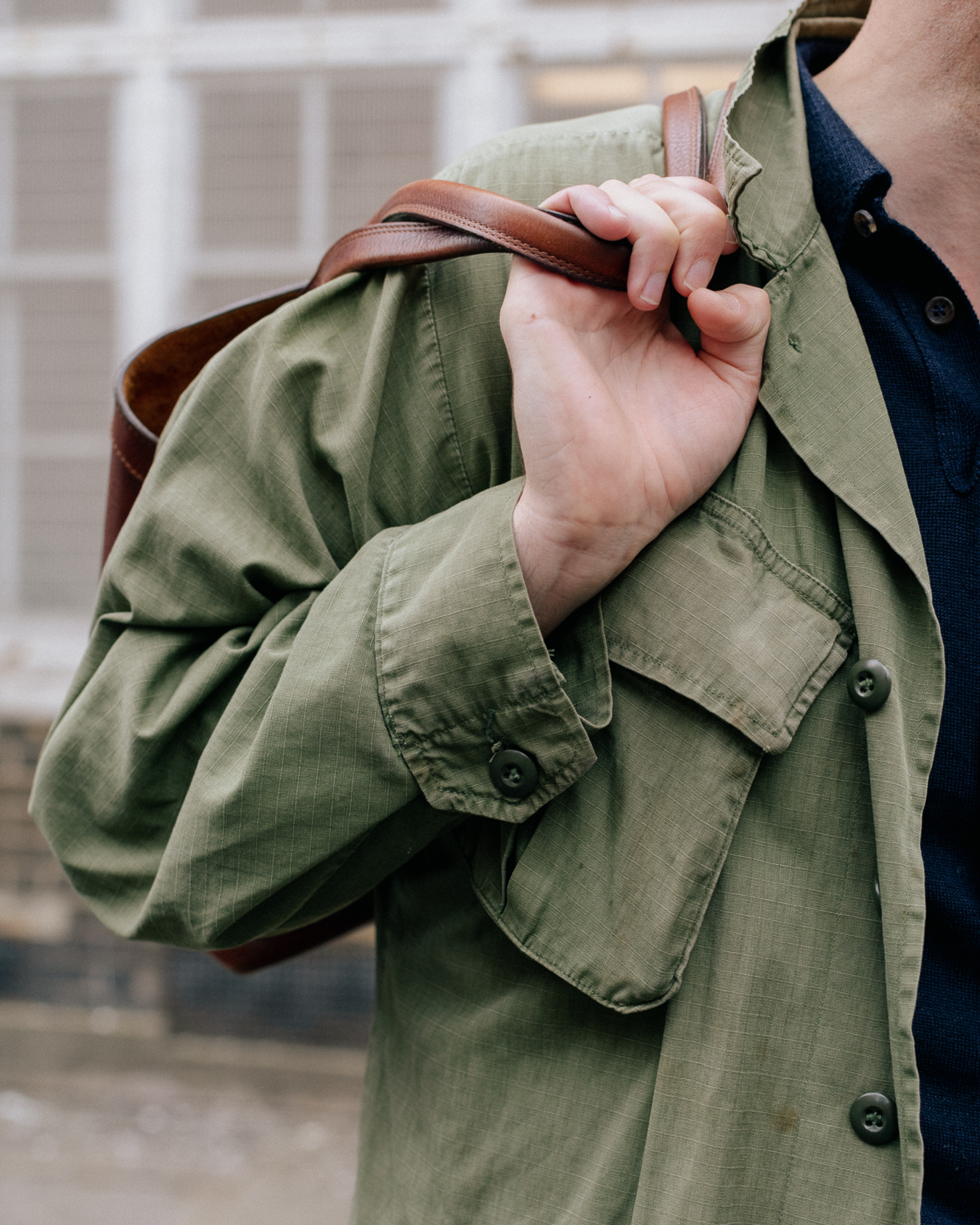
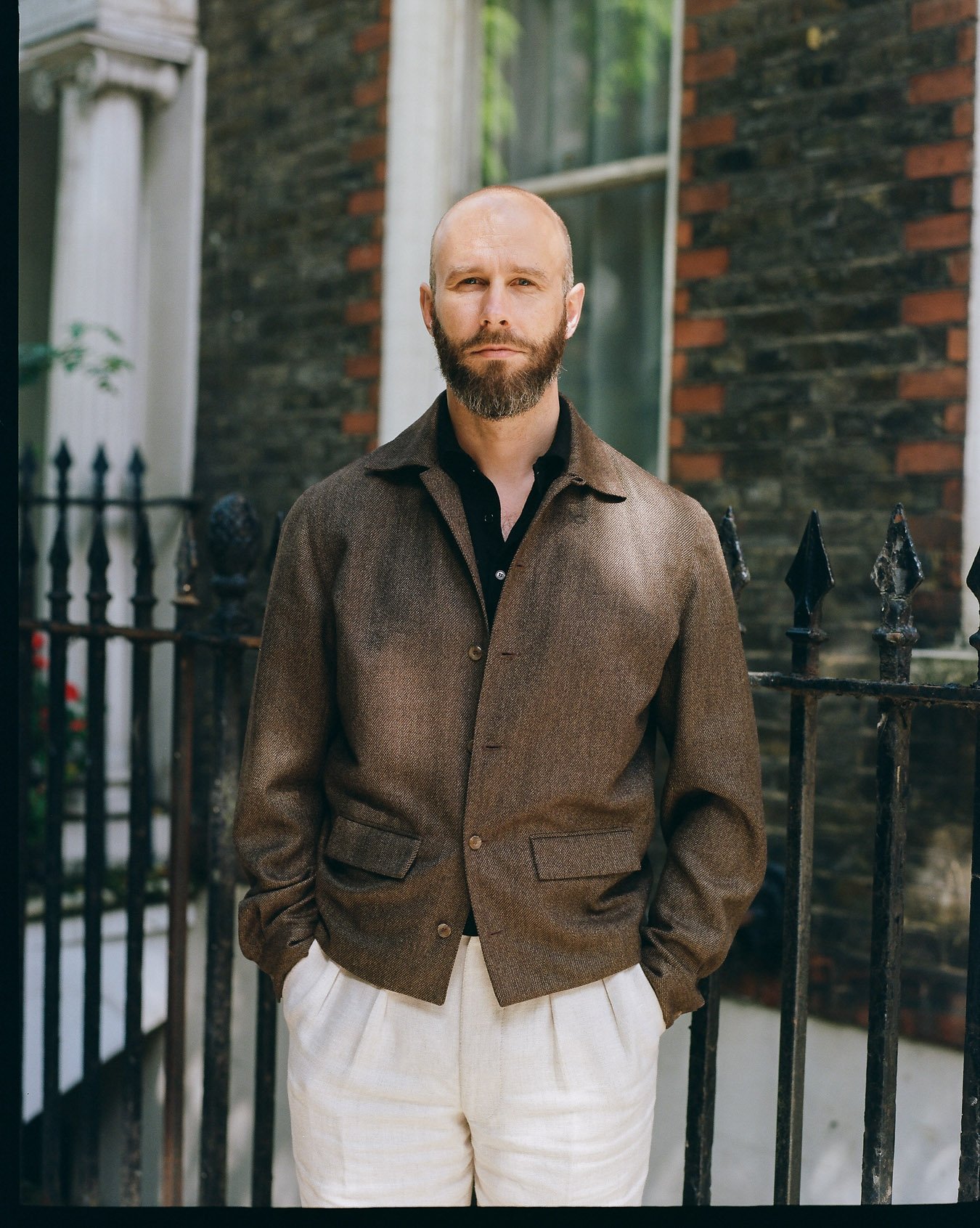
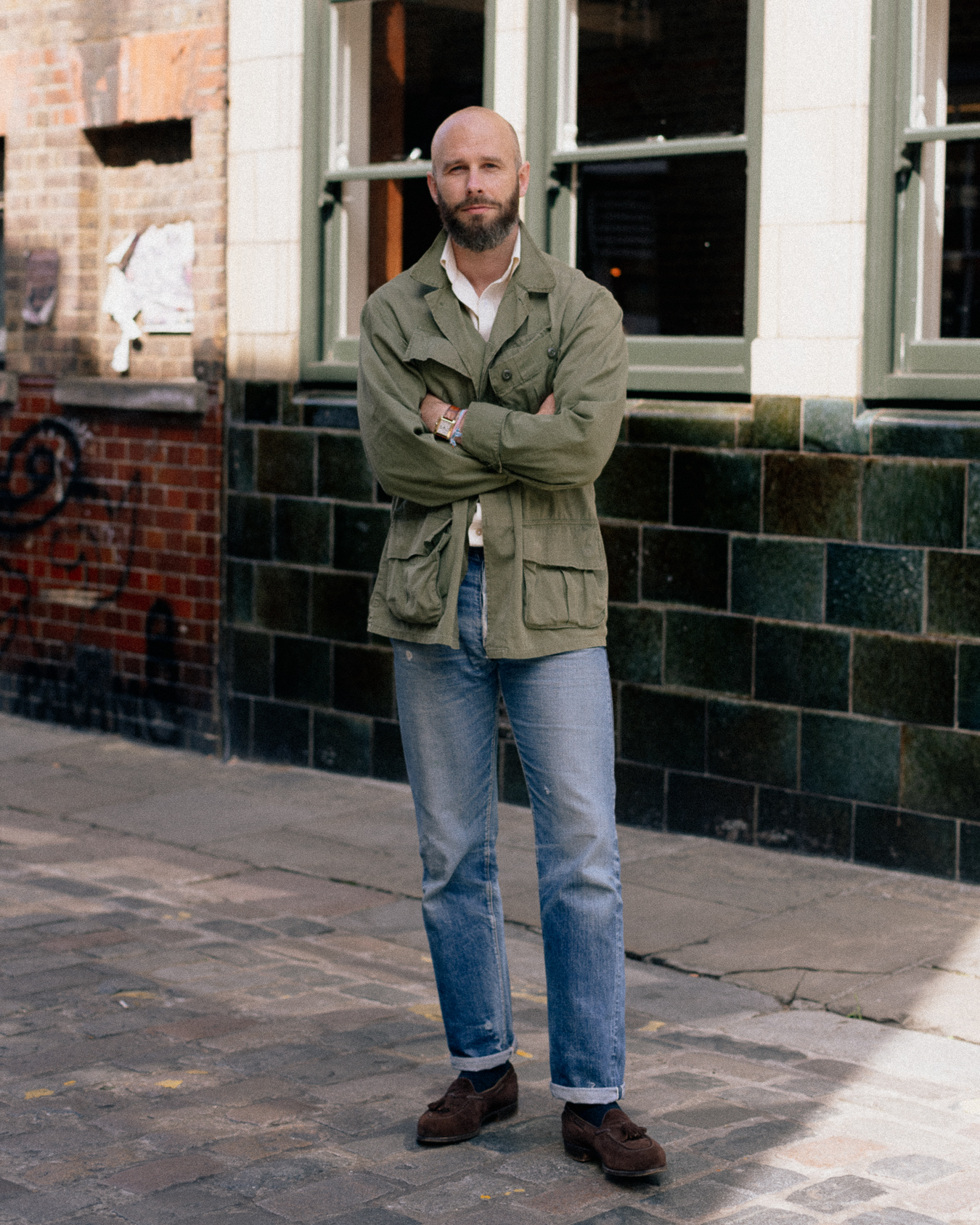
This might be our last piece on summer clothing this year, and I wanted to use it to talk about one of my most useful pieces of the last few months - this vintage ‘jungle jacket’. 

I bought it two years ago, at the now sadly closed Vintage Showroom in London. They were popular then, and have only become more so since - Drake’s released its version earlier this year. 

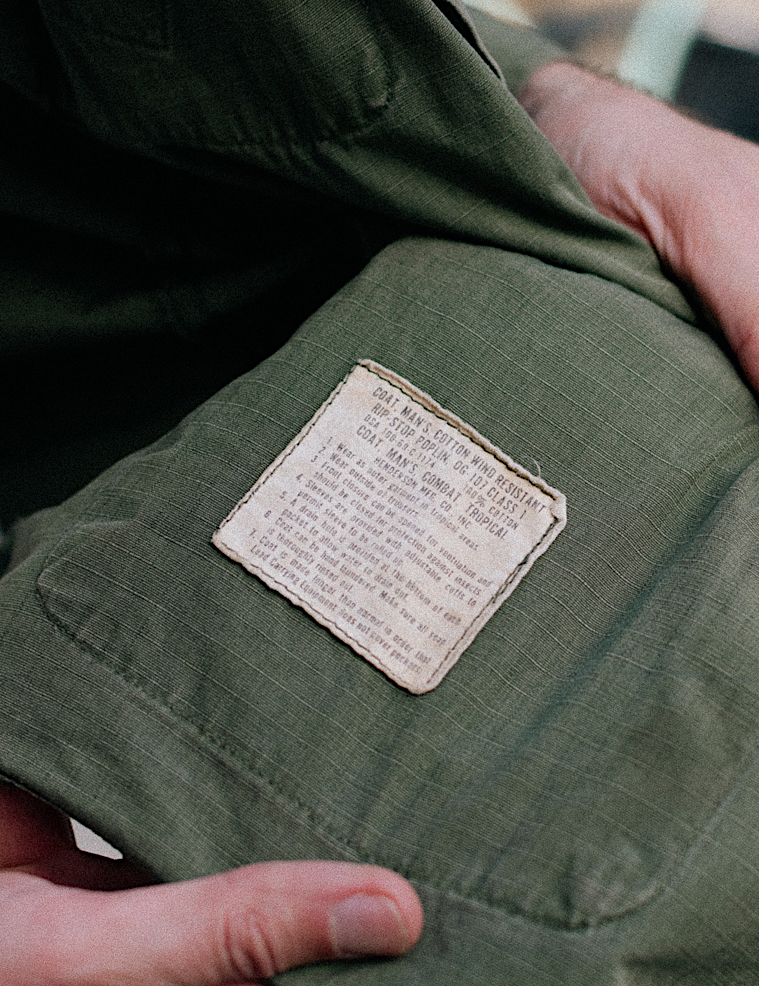
But something I find the new versions can't achieve is the lightness of the originals. That rip-stop cotton was made for tropical climates, and it’s as light as a linen overshirt, perhaps even more so. 

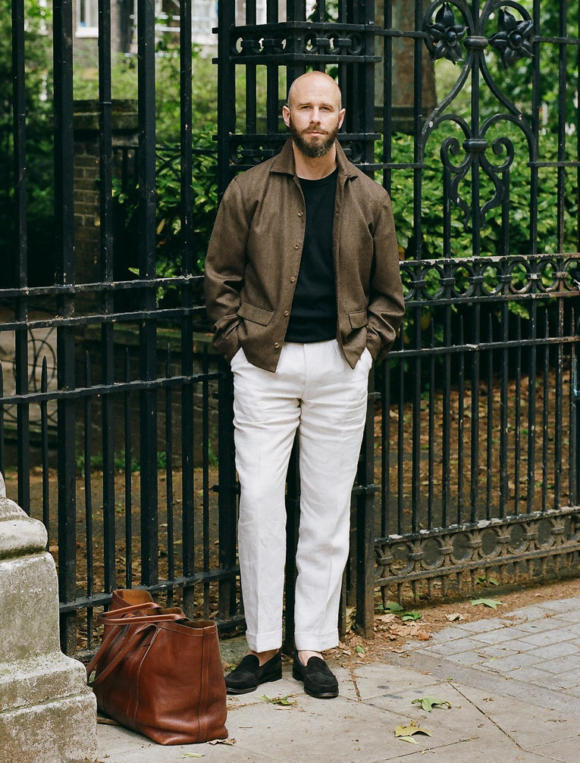
As a result, it became my default outer layer for casual combinations this summer, such as a T-shirt and workwear chinos at the weekend (example here). Or jeans. Or shorts. 

It has all the pockets you need - which is often the reason for wearing an extra layer in the summer - but is so light you almost don’t notice you’re wearing it. 
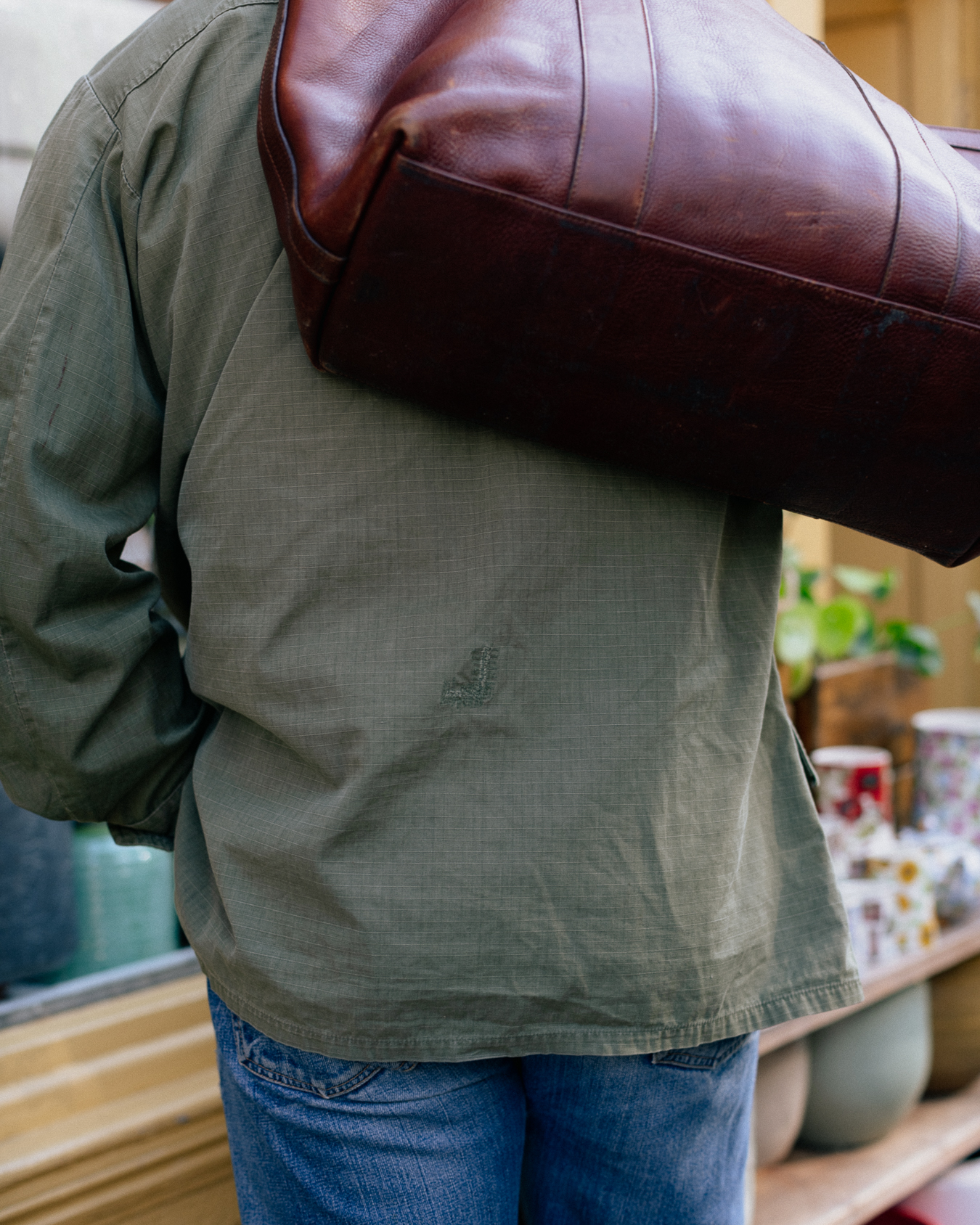
It helps that vintage versions have been washed and worn countless times, making them softer and perhaps even lighter too. 

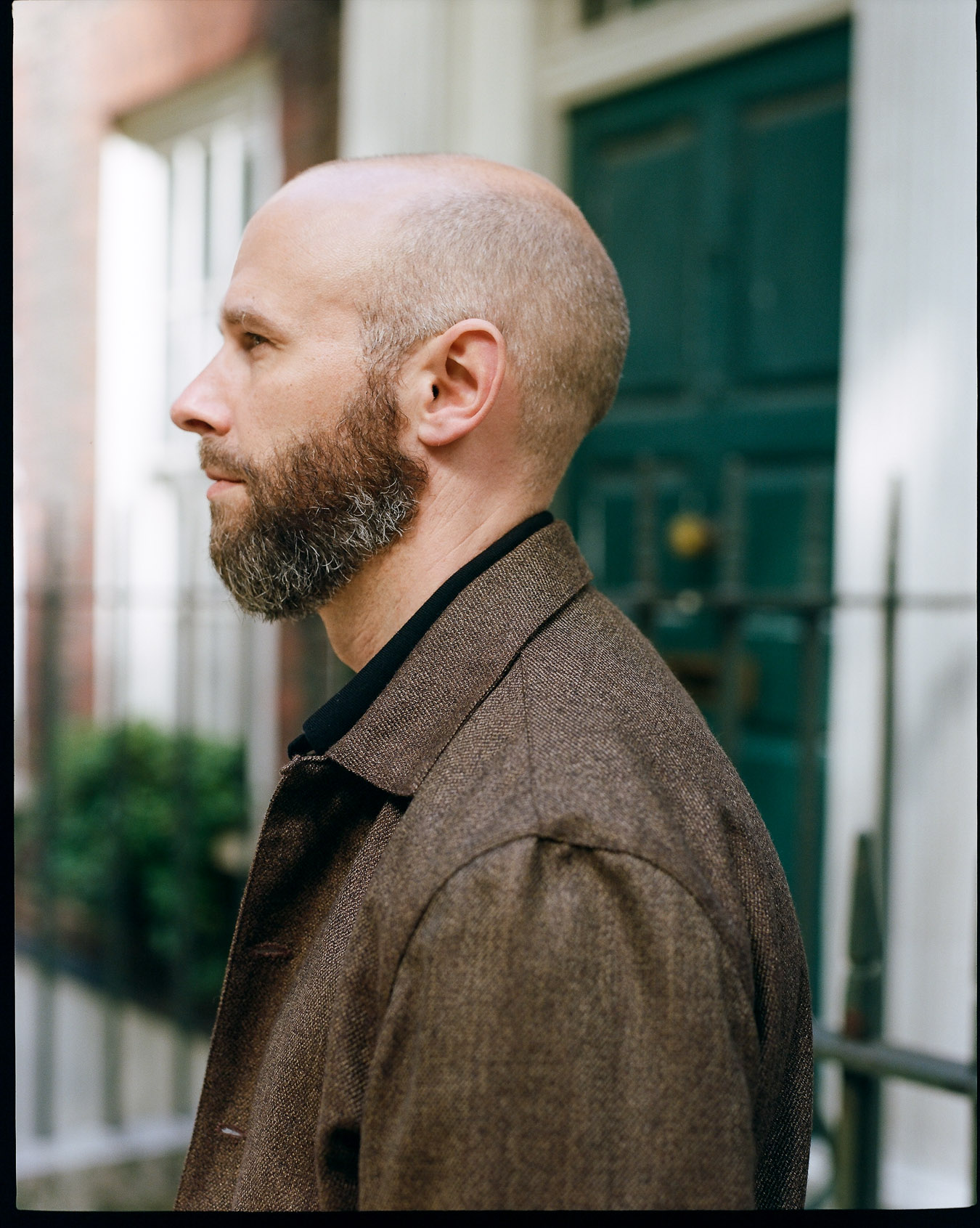
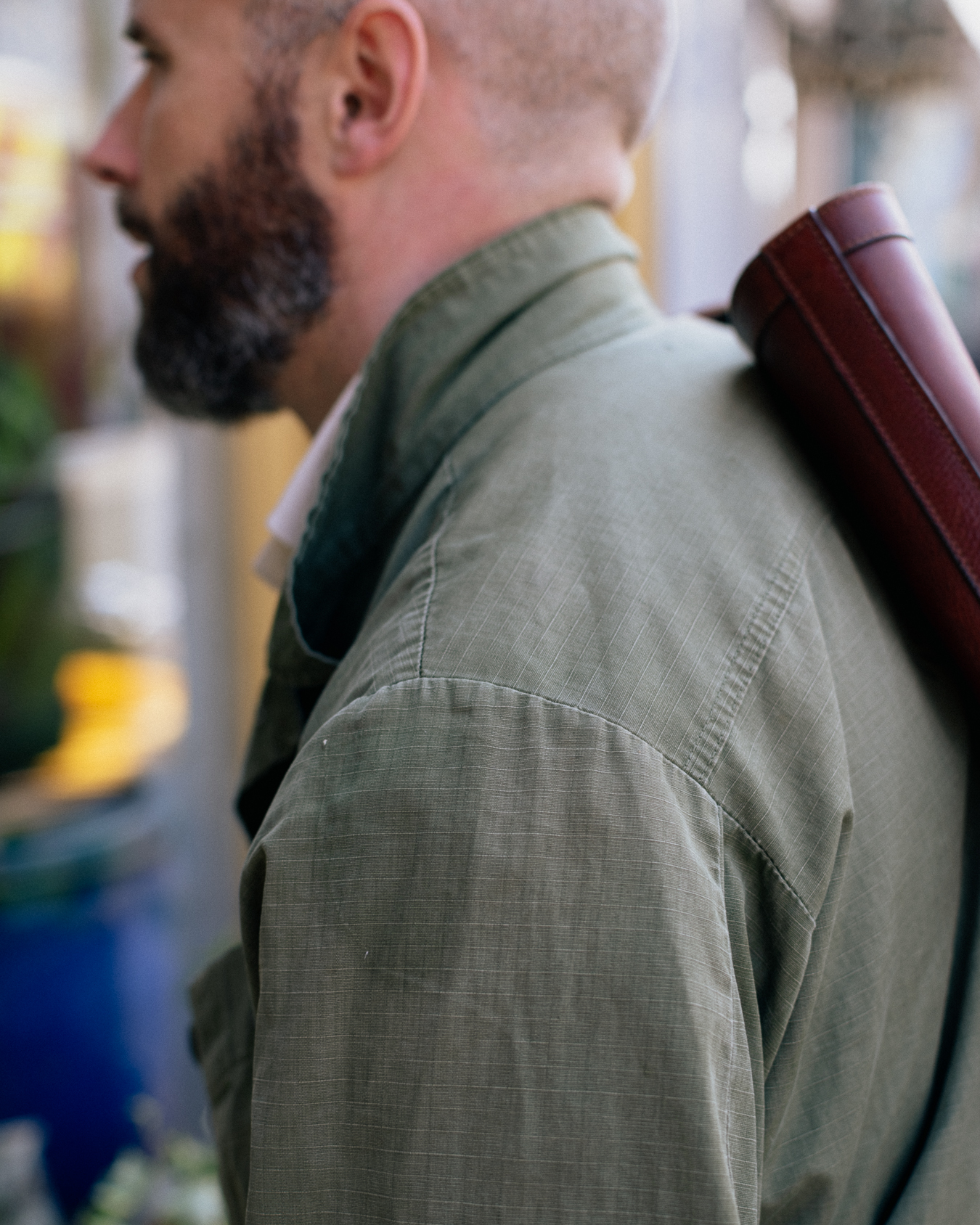
Then there’s the normal pleasures of a vintage piece, like the natural fading at the hems and seams, and the little repairs where the jacket has been caught or worn through. You can see one on the back of my jacket in the picture above. 

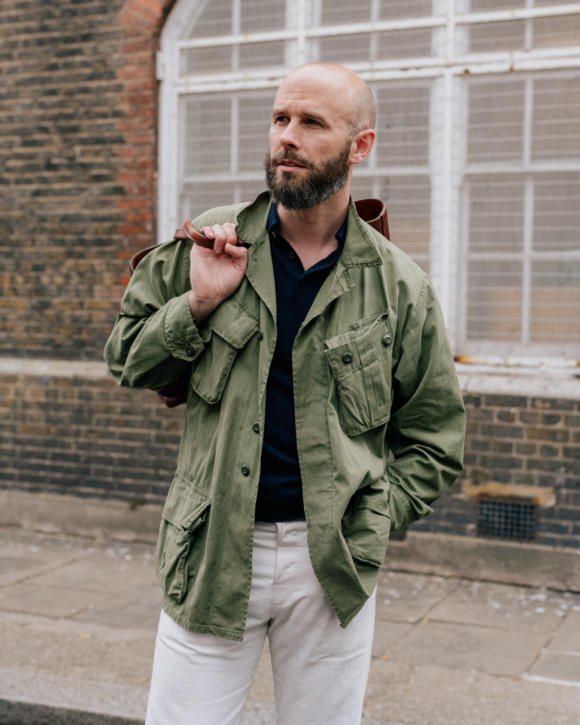
In many ways, the jungle jacket is the summer equivalent of the M-65 field jacket, which has become so popular with menswear fans over the years. It is the same versatile pale-olive colour, and is just as effective at adding a touch of high/low dressing to an otherwise smart outfit. 

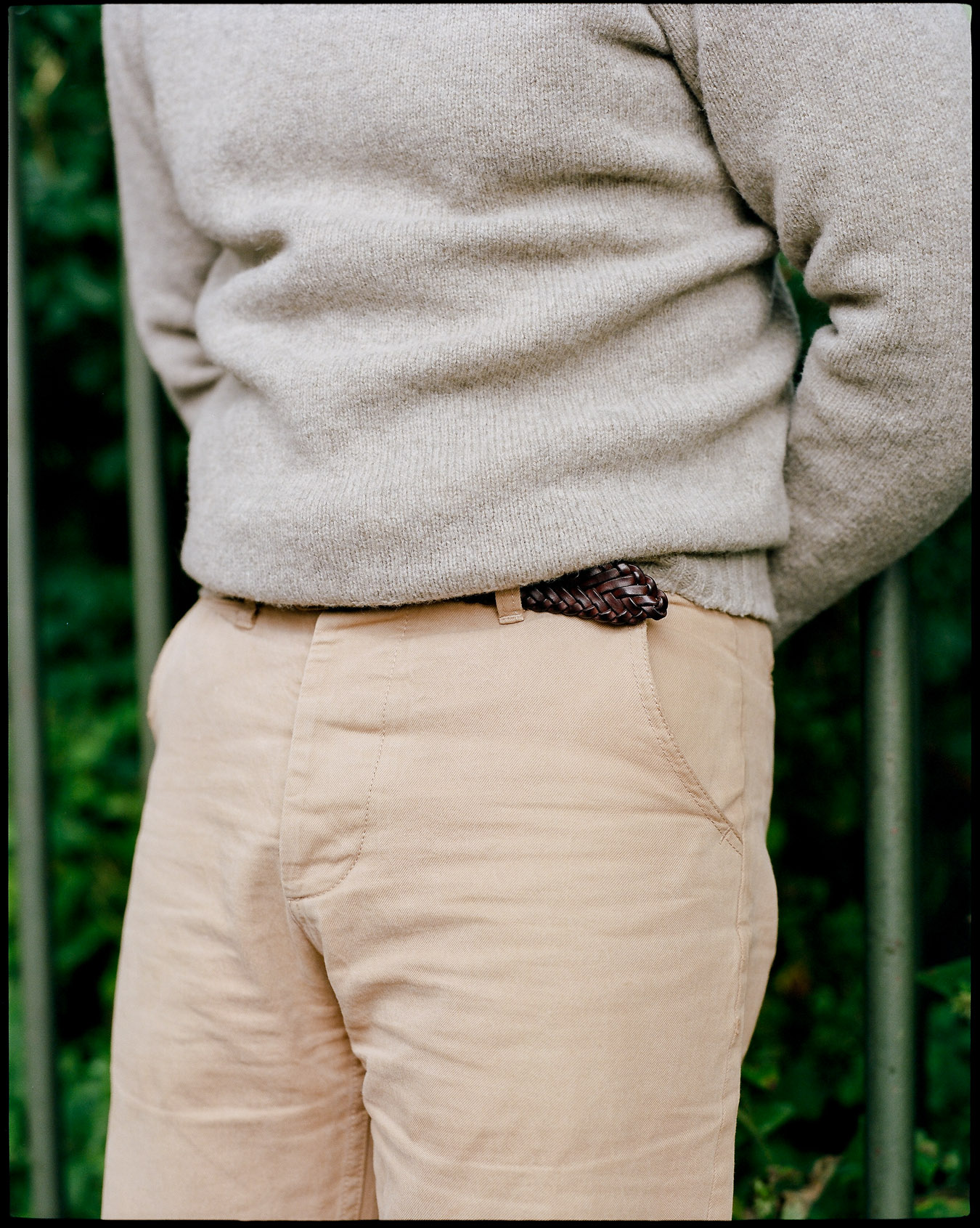
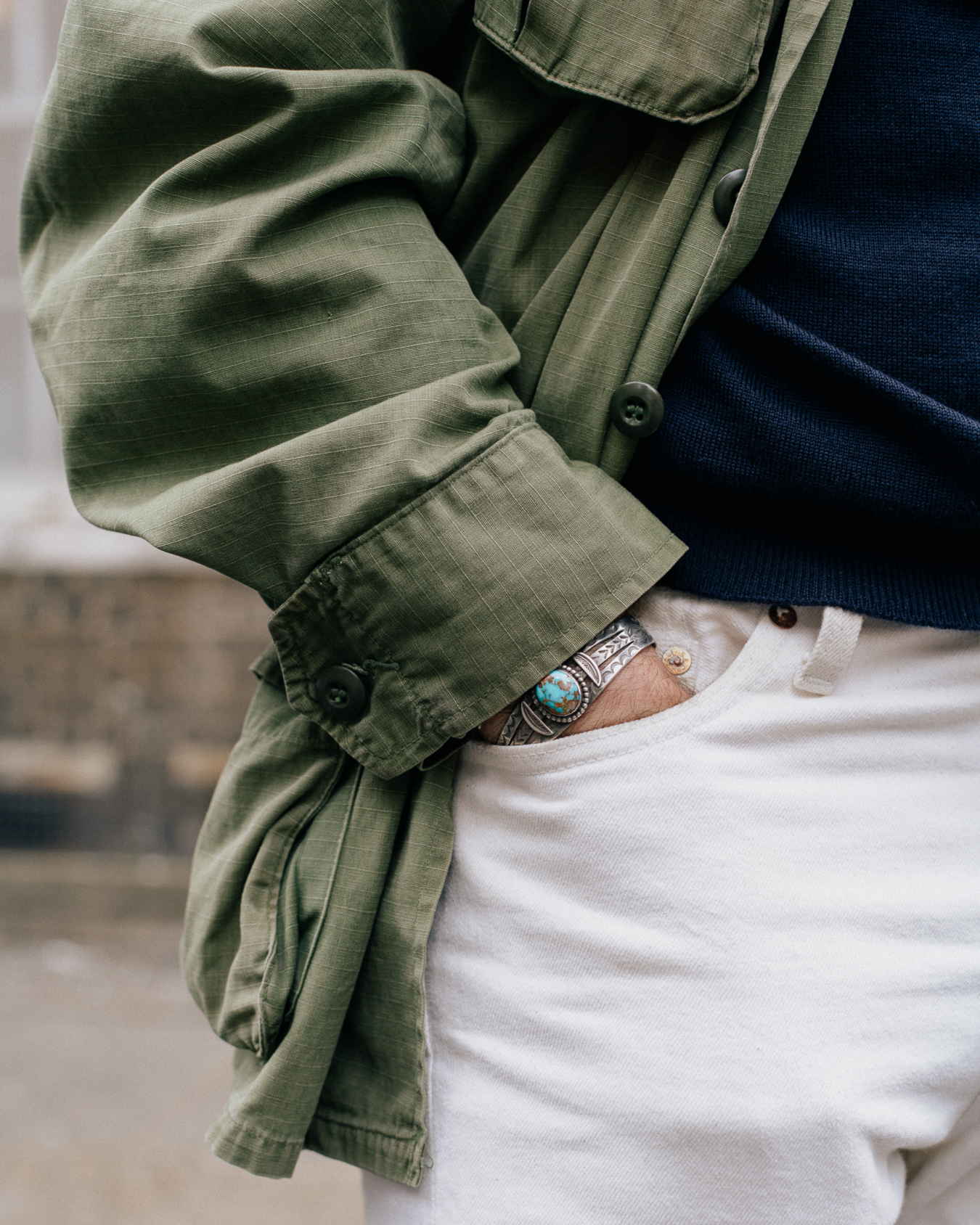
I’ve shot it with two outfits here, and the one shown at top is a deliberately smart colour combination: navy knitted polo, white jeans, brown-suede loafers. The same colours would work just as well with more formal materials too, such as cream flannels, a blue oxford shirt, and a navy cashmere knit. 

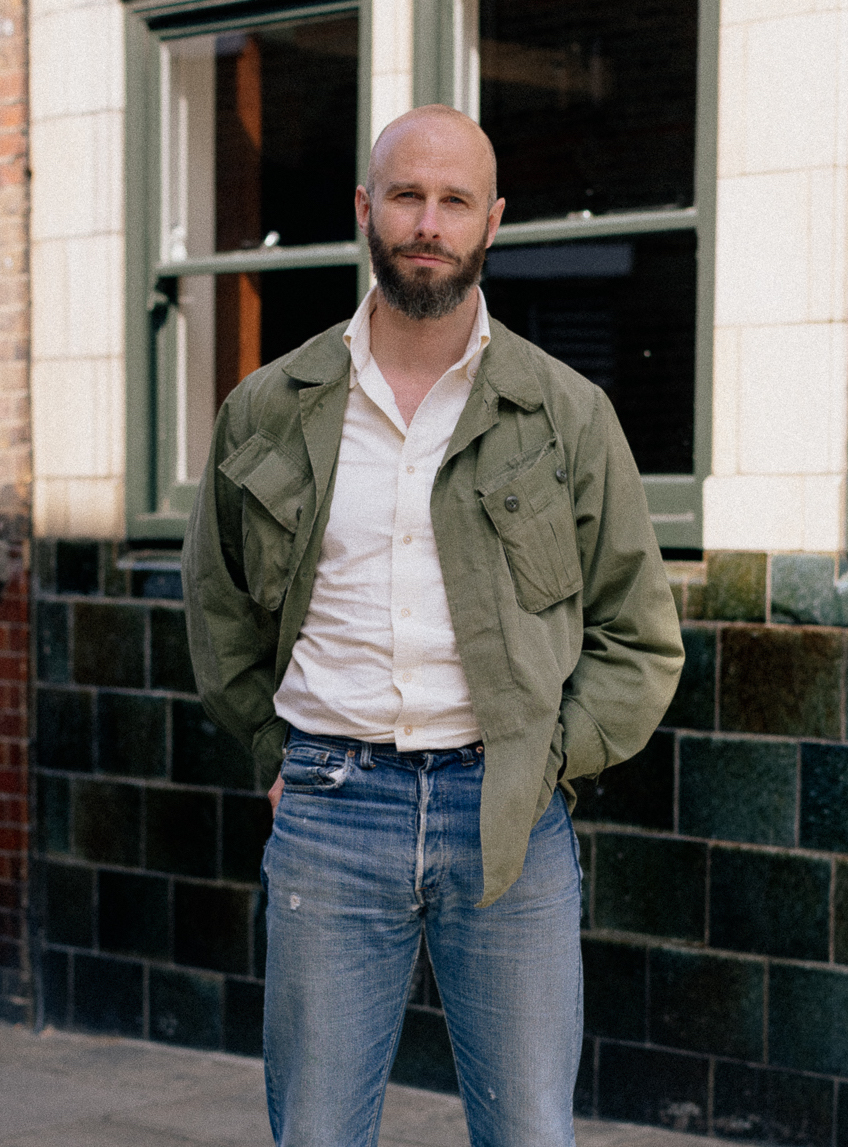
The second outfit, meanwhile, shows how nice it is with denim and with colour. It can look work with much stronger colours than that PS Yellow Oxford as well.
Of course, the M-65 is not that warm, being just two layers of cotton. But when you combine it with the fur lining I had made a couple of years ago, it gives you three casual outer layers - jungle jacket, unlined M-65, lined M-65 - that cover most of the year. 

The only obvious disadvantage of the jungle jacket here is that you can’t cinch the waist, which I always felt was one reason sartorial dressers particularly took to the M-65.

It meant you could mimic the waisted shape of a tailored jacket, and buy a fairly big size to fit over a jacket’s shoulders without it being too shapeless elsewhere. 

But then, the jungle jacket is a summer piece, where the main consideration is coolness rather than shape, and you're less likely to be wearing it over anything else. 
There were three different versions of the jungle jacket made by the US, from the early sixties into the seventies. But we’re not vintage collectors here on PS - we don’t care which is rarer, the version with the slanted chest pockets or the straight ones. 

We care more about which looks good, which is most useful, and what the fit is like. On that score, it's worth noting that the third iteration was made in a plain cotton poplin rather than the ripstop. You can see the differences on the Broadway & Sons website - they have a ripstop here and a poplin here.

I personally prefer the ripstop (below), because it feels a touch lighter and I like the texture, but it’s not a big difference. 
In terms of sizing, my advice would be to avoid the Large, which is so long that even friends that are taller than me (so over 6’1’’) find it too long. 

The jacket was designed to cover the seat and then some, with the option of a belt between the two sets of pockets - as a lot of military jackets have been over time. But those proportions look odd today. 

Mine is a Medium Regular, which has a perfect length. There is a slight compromise on the sleeve, which would ideally be an inch longer, but it’s a small point on vintage, which is often so hard to size right. Plus I often push the sleeves up in warm weather. 

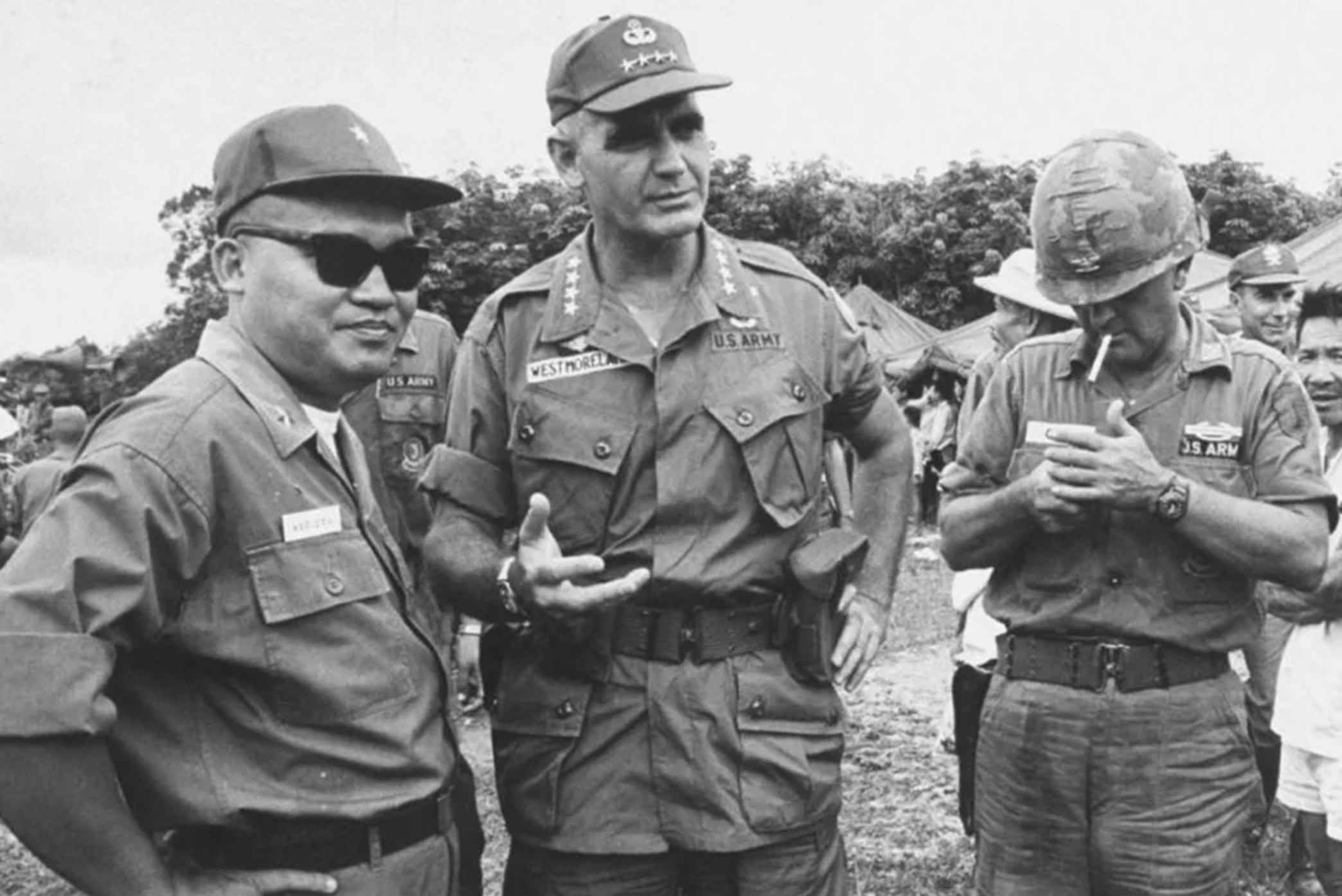
Also, note that the shirt from the OG-107 US fatigues is sometimes referred to as a jungle jacket. This is a different style, having just two pockets on the chest and mostly worn tucked into the matching trousers. It’s still nice, but more of an overshirt.

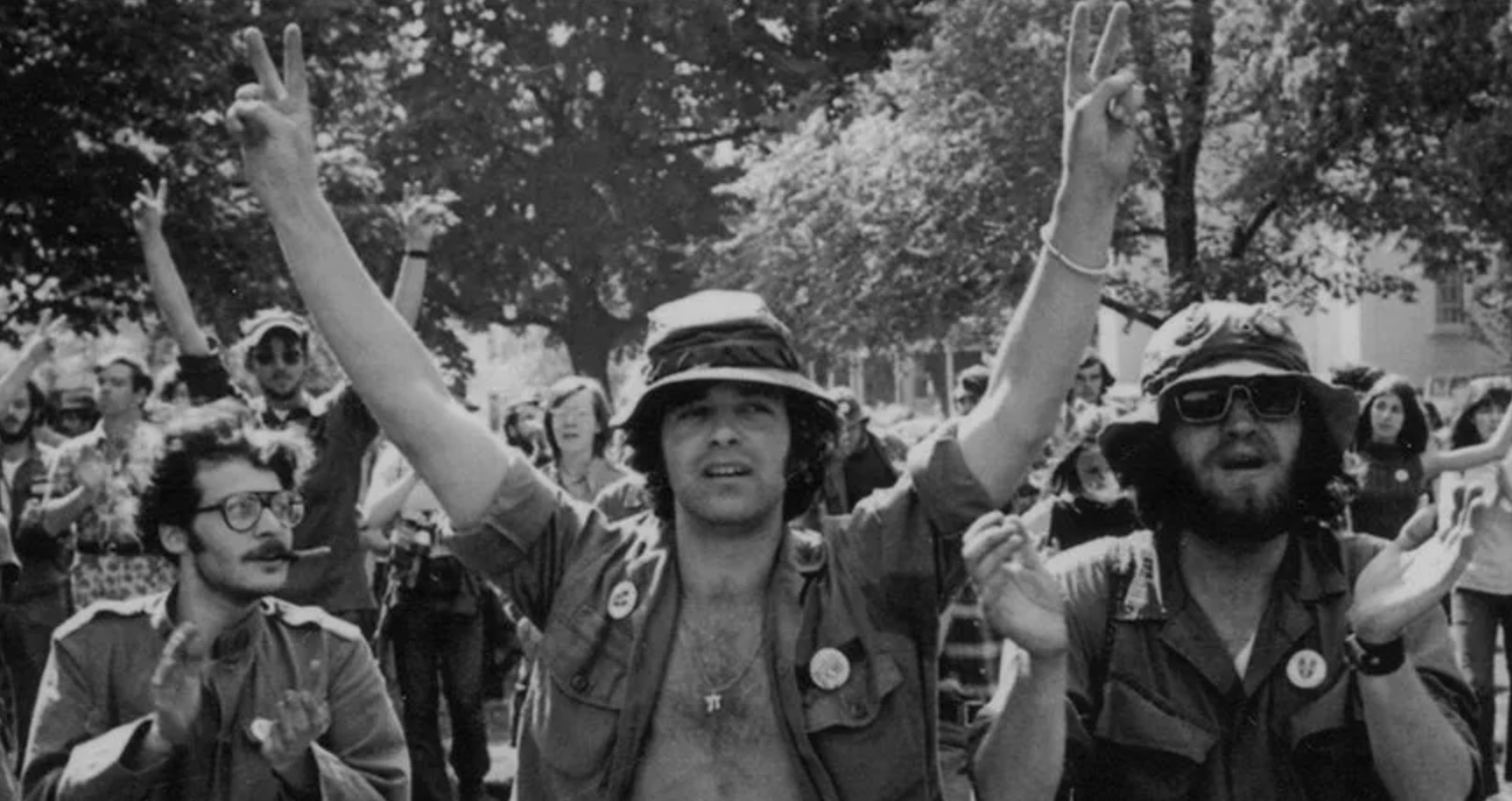
Below, it is worn on the soldiers on the left and right, while General Westmoreland in the middle wears the four-pocketed jungle jacket.

The shirt varieties were also those most associated with protests against the Vietnam War, and John Lennon in particular (second image below). This probably gives them the most countercultural feel, but still, the jungle jacket and the field jacket still have a bit of that.
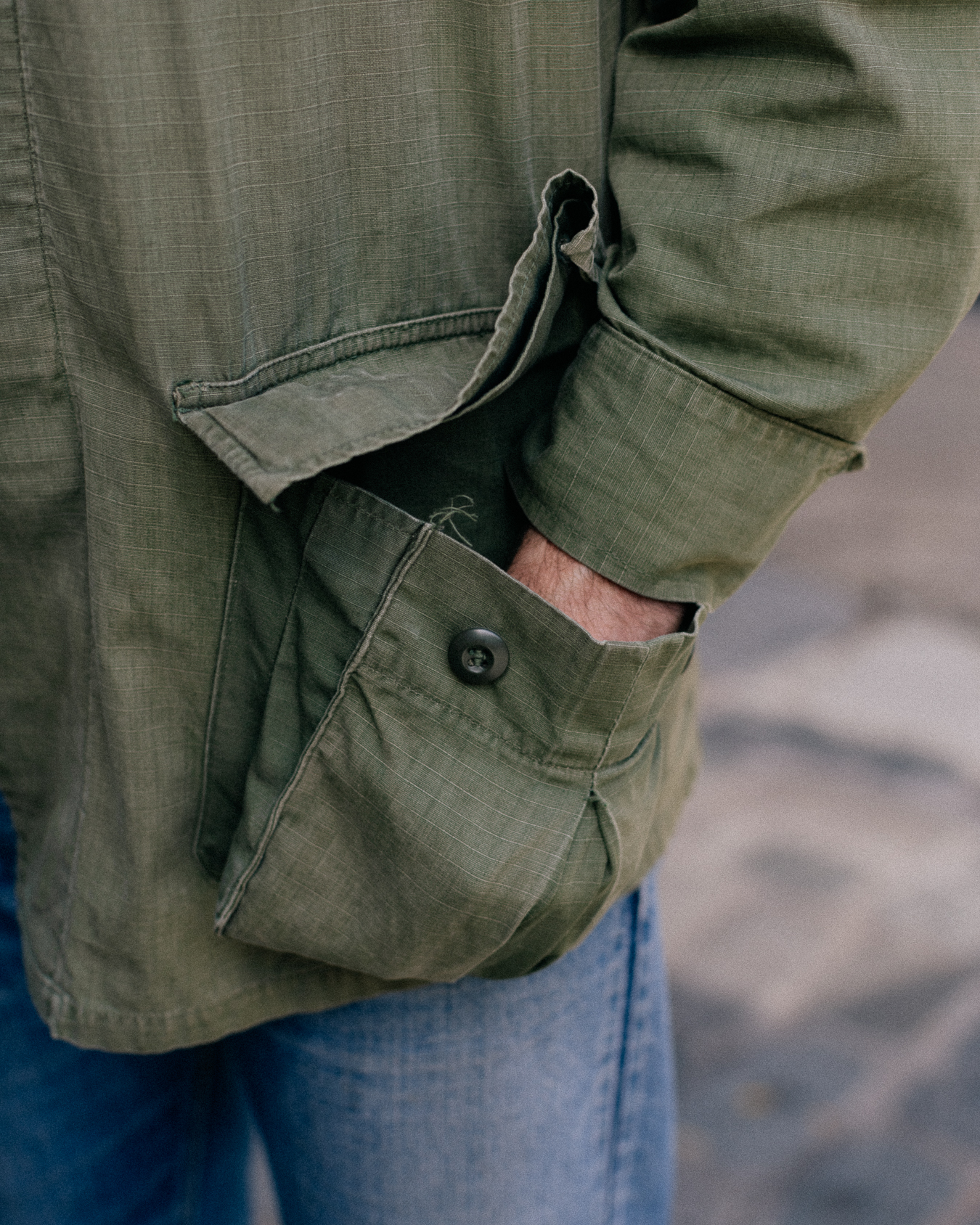
One of the few annoying aspects of the jungle jacket is that the hip pockets are extravagantly bellowed, in order to fit in as much as possible (see below). This can make the jacket a little ungainly if those are used and left unbuttoned. 

In fact, I find this is one of the main issues of modern reproductions, which often keep that sizing of the pockets, but in a new and heavier material that means they look especially bulky.

I tend to keep my hip pockets partly buttoned as a result. But that still means they're usable - in fact, I was wearing it so much over the summer that I developed a habit of using each pocket for a particular thing. 

My phone went in the top-left pocket, with one button closed so it wouldn’t slip out when I bent over; wallet went in the top right, with no need to button at all as it is so light; my face mask went in the bottom left, with one button closed for easier access; and keys were in the bottom right, with both buttons fastened to avoid any chance of them slipping out and hold the weight better. 

I’m sure that kind of organisation will please the geeks/obsessives out there. I’m rarely that systematic, but I did notice it was the one time I never forgot the leave the house without something!
The volume of jungle jackets originally made means they’re not hard to find - it’s often particular sizes that can be tricky, or if you want just one of the iterations. 

They’re also not expensive. I saw a few when I was at Hang-Up Vintage recently, all priced at £95, though the website only shows a deadstock poplin one for £155. The ones at Broadway & Sons noted earlier are €199 and €149.

There are camouflage versions too, but I don’t like camo as much. It’s very subjective, but camo for me is more obviously military, without the countercultural associations of the plain OG. It feels more towards glorifying warfare. 

In fact, that can be an issue with names and badges on a lot of vintage military clothing. But that’s probably a debate for another day. 
Clothes shown:

Photography: Alex Natt @adnatt

The guide to types of knitwear: Gauge, end and ply

As men start to dress more casually, knitwear is becoming ever more important. It’s more often the top layer of an outfit, and so holds greater responsibility to both flatter the wearer and reflect their style. It deserves proper, in-depth attention.

This article is the first in a series that will create a PS ‘Guide to Knitwear’. Over the next few months, it will look at everything from quality to fit to history, and eventually become a comprehensive resource on the same scale as our Guide to Cloth or Guide to Shirt Fabrics.

What types of knitwear are there? When I pick up a sweater and it says 2-ply or 30-gauge, what does that mean? And how does that knowledge help me buy better – particularly online?

This first article in our Guide to Knitwear takes a bird’s eye view, looking at the world of knitwear as a whole and categorising it, by explaining how it’s made and what it’s made from.

This will give anyone with an interest in good clothing a better understanding of what they’re buying, and explain some of the key processes and terminology along the way.

Gauge: Shirt or jumper?

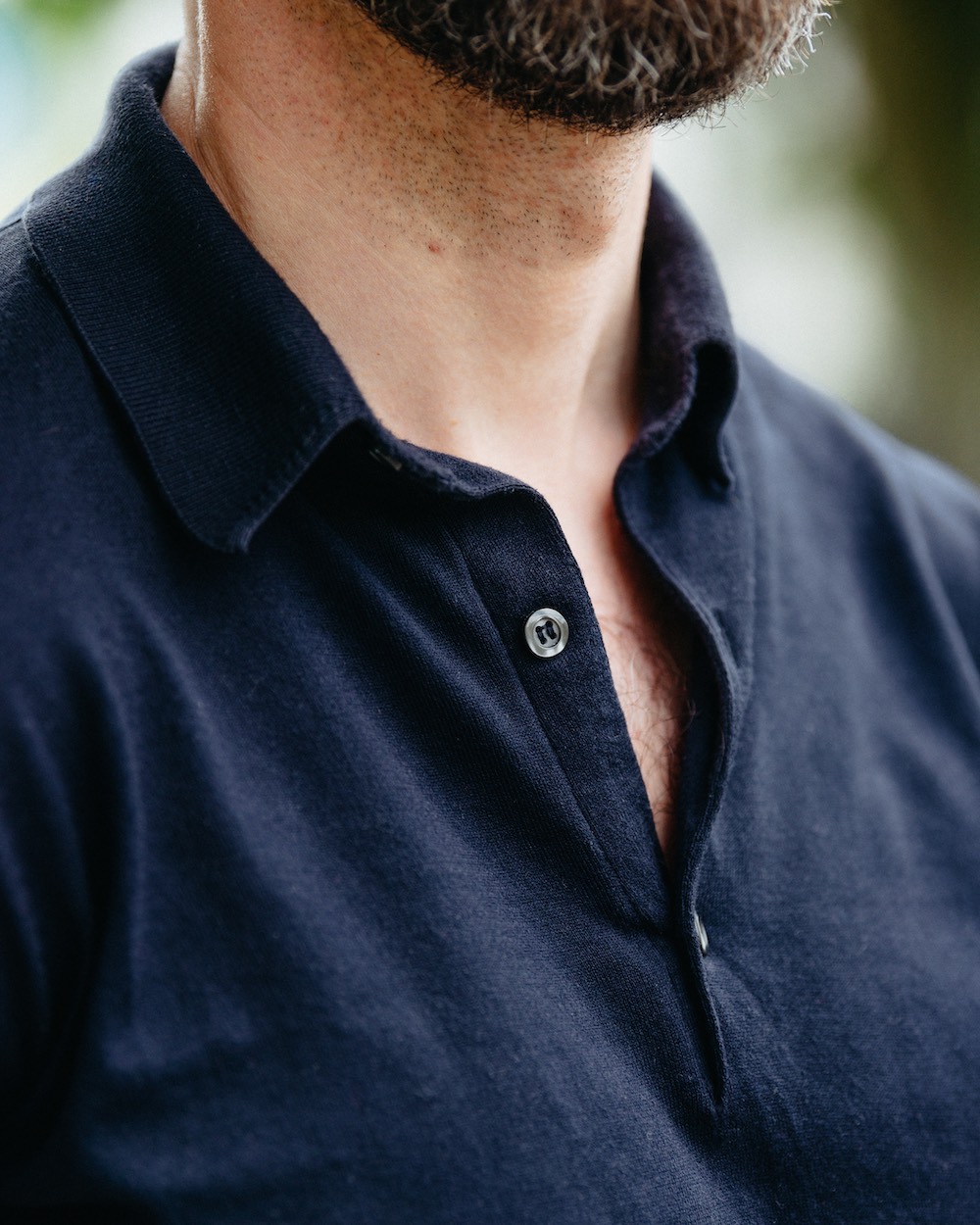
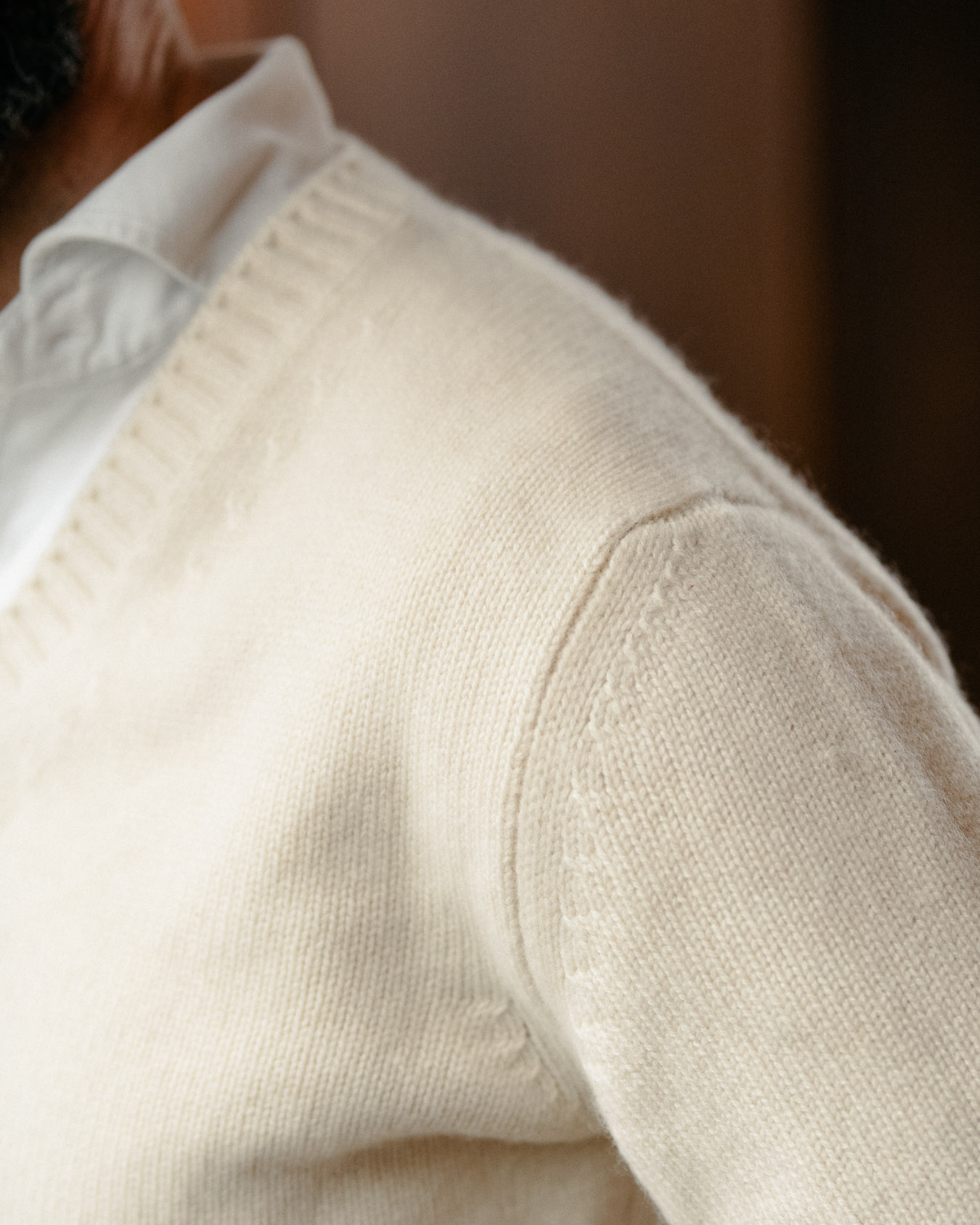
You may have noticed that most Scottish knitwear is at least a certain weight or thickness. Finer, thinner sweaters tend to come from Italy, or from makers like John Smedley in England (above).

It’s the biggest, most obvious difference between types of knitwear, and it’s an important one, because fine knitwear is much smarter – more akin to a knitted shirt in terms of style and formality – while thicker gauges are what you think of as a typical jumper, designed for warmth.

The main reason brands, and indeed whole regions, identify with one weight of knitwear is that you need different machines for different gauges, and machines are expensive. Plus, the local workforce tends to build up expertise on those types of machines.

A typical Scottish cashmere crewneck today is 21 gauge (although it’s got lighter over time – 50 years ago the standard was 15). The same factory will probably make that and everything heavier, up to a 5 gauge, which is the chunkiest shawl-collar cardigan. A fine-gauge knitter will usually produce a narrower range, perhaps 24 and 30 gauge.

The number refers to the number of needles, and so stitches, per inch on a flat-bed machine*.

This difference between types of knitwear will usually be obvious if you’re browsing in a store. But online, armed with only a product description, it can help define what kind of knit is on offer.

Ply: Thick or thin?

While ‘gauge’ is usually only mentioned in the technical description of a piece, ‘ply’ can be more prominent, sometimes even in the product name itself. As in ‘cashmere two-ply crewneck’.

This is because, within the categories set out above, ply is the best shorthand for how thick a sweater is.

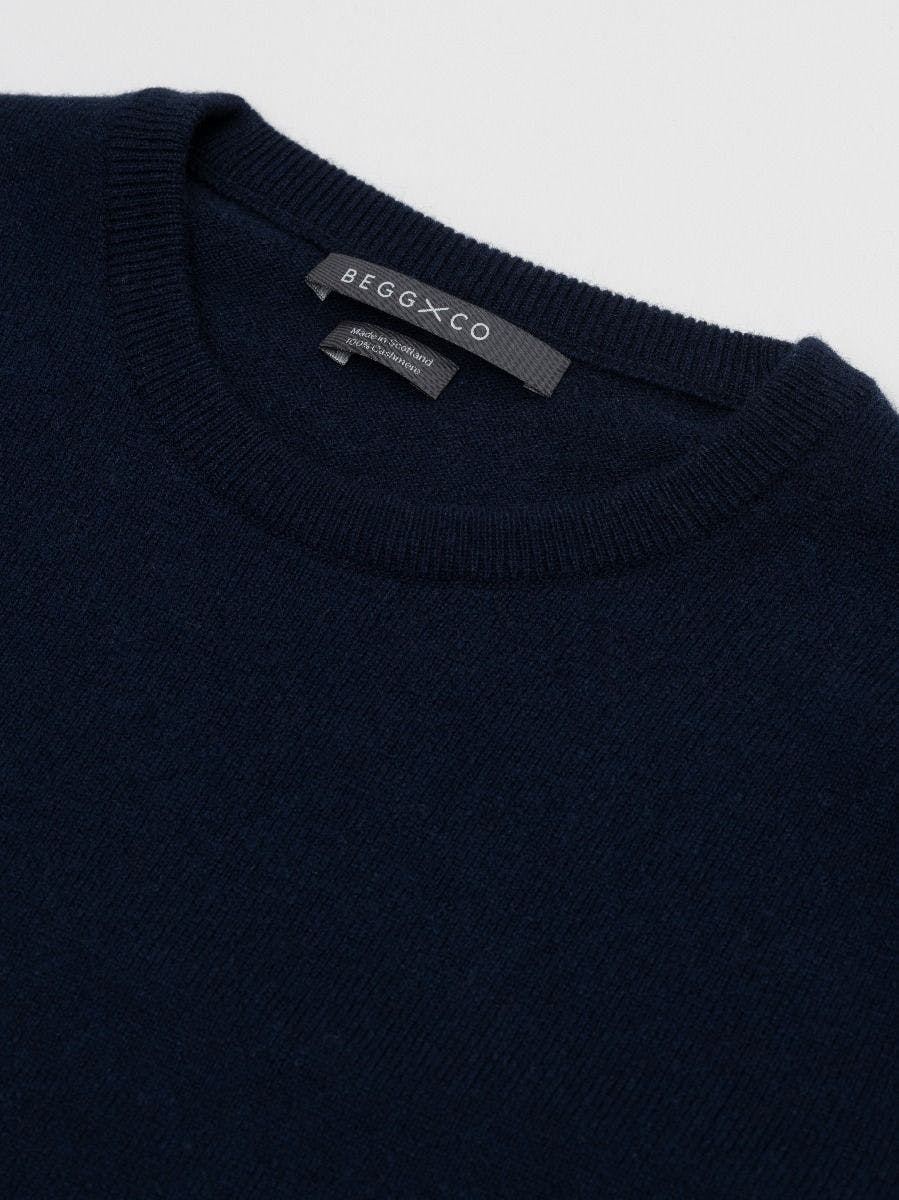
The crewnecks you’re used to wearing are probably 1 or 2 ply (above). This is the most standard. The next level up is 4 ply, which is really a heavier, cold-weather jumper. Anything above 4 ply is usually a chunky shawl cardigan, which can be 8, 12, even 16 ply**.

But what does it mean? The number refers to the yarn used: 2 ply means two threads (‘ends’) twisted together in the yarn, 4 ply means four of them, and so on.

A yarn might be described as 2/28, which means two ends of a 28-count, with the 28 referring to the fineness (28 metres of it would weigh 1 gram).

This can get confusing when you go into detail, because the same thickness of yarn can be made by using one end that’s twice as thick, or four that are twice as fine (eg 4/15). But this happens rarely enough that ‘2 ply’ and ‘4 ply’ are still good shorthand for thicknesses of knitwear.

Knit: T-shirt or jumper?

This might sound strange, but T-shirts are knitwear. The cotton is knitted, just like on a jumper (the opposite being woven, like cloth for a shirt or suit).

What separates a T-shirt from a jumper is the way its knitted panels are put together. A T-shirt’s panels are ‘cut and sewn’: cut along the edges and then sewn together, with an overlock stitch for example.

The edges of knitwear panels are fully finished (or ‘fashioned’) along the edges, so there’s no need to cut them. They are complete pieces, which are then linked together, in a surprisingly painstakingly process.***

This is what separates a cashmere jumper from a cotton sweatshirt****. And it’s why a polo shirt made by a knitwear manufacturer is so different from the regular cotton version you associate with tennis and polo. When someone refers to a ‘knitted’ polo, they mean one that has been fully fashioned.

Hand, machine, or hand-machine?

There are also slightly different types of fashioned knitting.

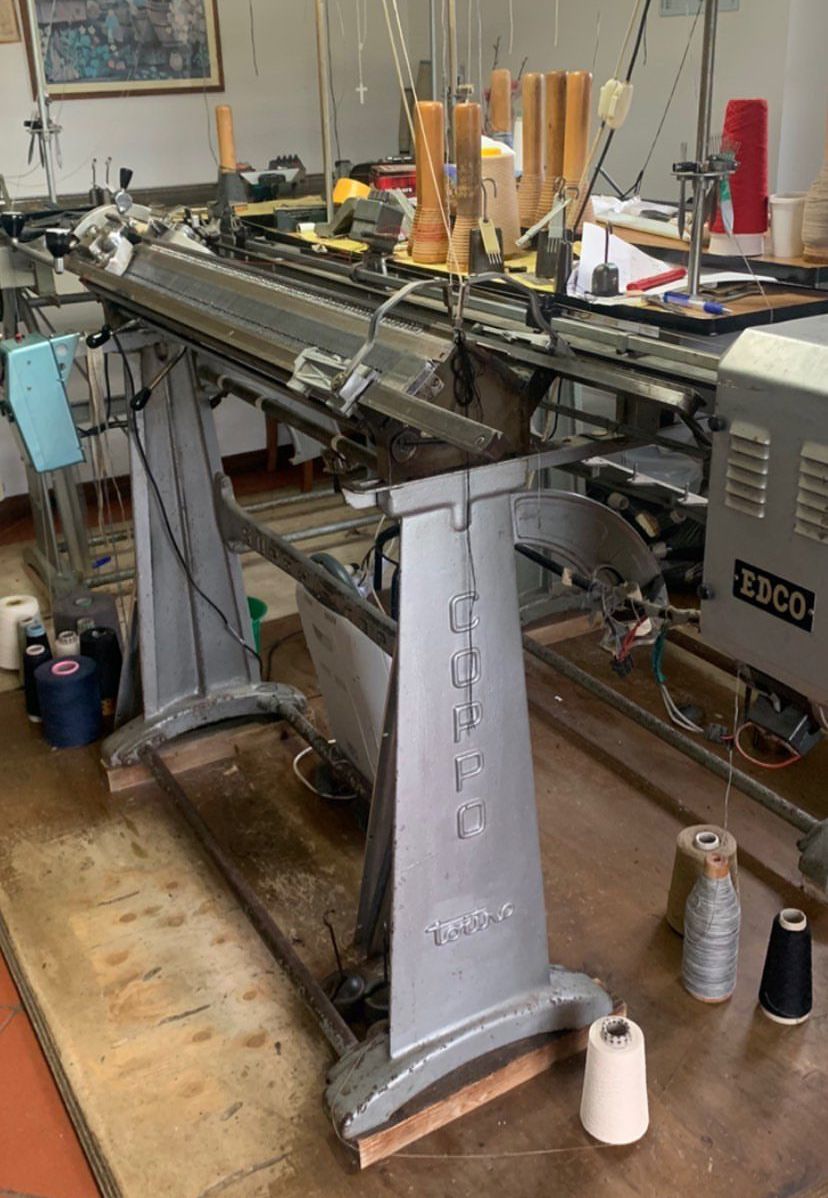
The vast majority of knitwear uses automated knitting machines. Some makers still use hand-operated machines though, and this is often called ‘hand framing’ (above). This is much slower, with the advantages being that it can produce a more open knit, has some slight natural variation, and is an easy way to create designs or pictures (‘intarsia’).

The feel of hand-framed knitwear is also a little similar to actual hand knitting – as in, no machinery at all but just one person with a pair of knitting needles – which does still go on. Hand framed is often what brands mean when they describe something as hand knitted.

Finally, a very small amount of knitwear is made all in one piece, without any seams. The machinery to do this full-garment knitting is expensive and so not seen as much, and is perhaps better for lighter weights. Regular jumpers arguably benefit from the structure that fashioning and seams give them.

Fibre: Sheep, goat or plant?

This categorisation is a big one, but also the most obvious. Which is why it’s only being mentioned now.

Most consumers know what cashmere, wool and cotton are, and their various properties. They probably even know what shetland wool is like (above), and a silk/cashmere blend.

There is still a lot of detail that can be delved into here, such as the different qualities of cashmere, the types of cotton, and the breeds of sheep. Few people realise that with wool, for example, most is merino, most of that is lambswool (the first crop from the merino sheep), and lambswool originally from a particular part of Australia is Geelong. They are all subsets of each other.

But that level of detail deserves a separate article.

Finishing: Wash and brush

This is a minor distinction, but finishing on knitwear can make a difference.

The most obvious one is a brushed shetland, where shetland sweaters are deliberately brushed to make them fluffy.

But all knitwear is washed at the end to soften it and bring up the fibres, and in general Italian makers do this for longer than Scottish ones. The result is knitwear that feels softer when it’s first bought (above), but sometimes doesn’t age as well, either pilling or (if also knitted more openly) losing its shape.

In fact, that’s a final minor category: tighter knitting. It’s something that was done more in the past, to make knitwear that would feel very heavy and robust today. It was also only lightly washed, and sometimes called ‘bare finish’ knitwear as a result. But really most traditional pieces were knitted more tightly – not with any more stitches per inch (‘gauge’) but just with more tension on each one.

Conclusion, notes

Knitwear is either heavy or fine gauge, thicker or thinner, fashioned or sewn, machine or hand knitted, and more or less washed.

These are the things that define it and divide it. Understanding them helps you know why a 30-gauge polo works under a blazer, but a 15-gauge will be too thick. Or why a fully fashioned polo is a better match for flannel trousers than a cut-and-sewn one.

Even if you understood such things already, knowing the terms makes it possible to talk about or communicate them. Which is particularly important when buying things remotely.

Hopefully this first installment in the Guide to Knitwear has been useful. There is much more to come, on necklines, fits and identifying dead fishermen.

Notes:

*Sometimes the term ‘needles’ is used instead of gauge, to accommodate different types of machine. The numbers don’t align – eg 21 gauge is 12 needle. Easiest to stick with gauge.

**You rarely get 1 ply in knitwear, because, interestingly, spinning two yarns together makes the result more stable. A single yarn has a natural tendency to twist, or torque, one way, and having two spun together that have been twisted in different directions balances this out.

***The two panels of knitwear that are to be joined, have to be placed on the needles of a circular linking machine, one stitch per needle, by hand.

****Some T-shirts and sweatshirts are also circular knitted, so there are no side seams. This traditional technique gives more pliability to the cotton, but also means the body has to be straight and square, rather than shaped at all.

Introducing: Permanent Style Plaid

Introducing: Permanent Style Plaid

||- Begin Content -||

Two years ago, when we visited the Joshua Ellis mill near Batley, Yorkshire, I spent a happy couple of hours browsing their archive. 

As you might expect, the vast majority were classics: plain or textured cashmeres, houndstooths and herringbones. This is the majority of the market, and what most people expect. 

But now and again, there were little collections of really wonderful checks. Unusual - with real personality - but subtle with it. 

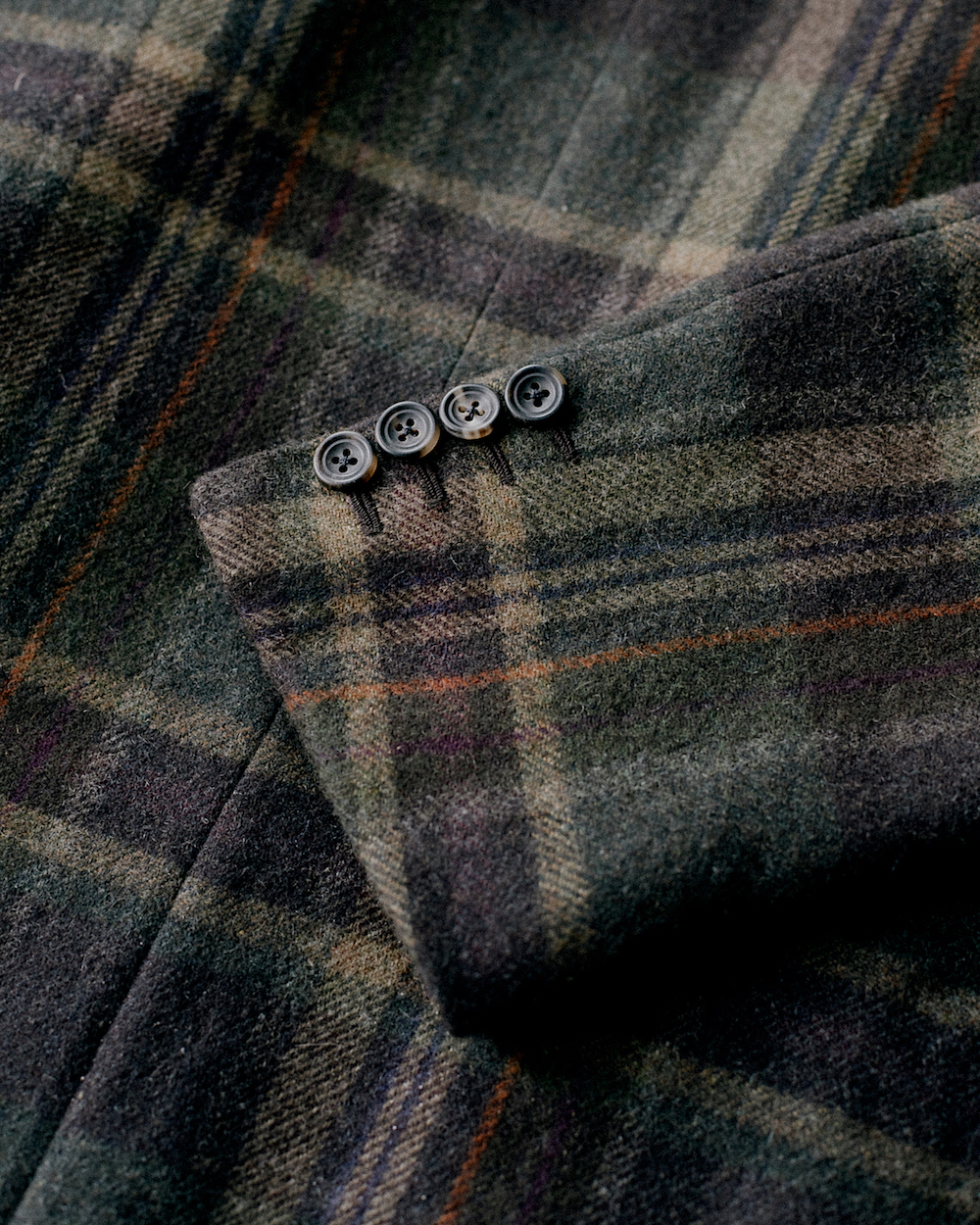
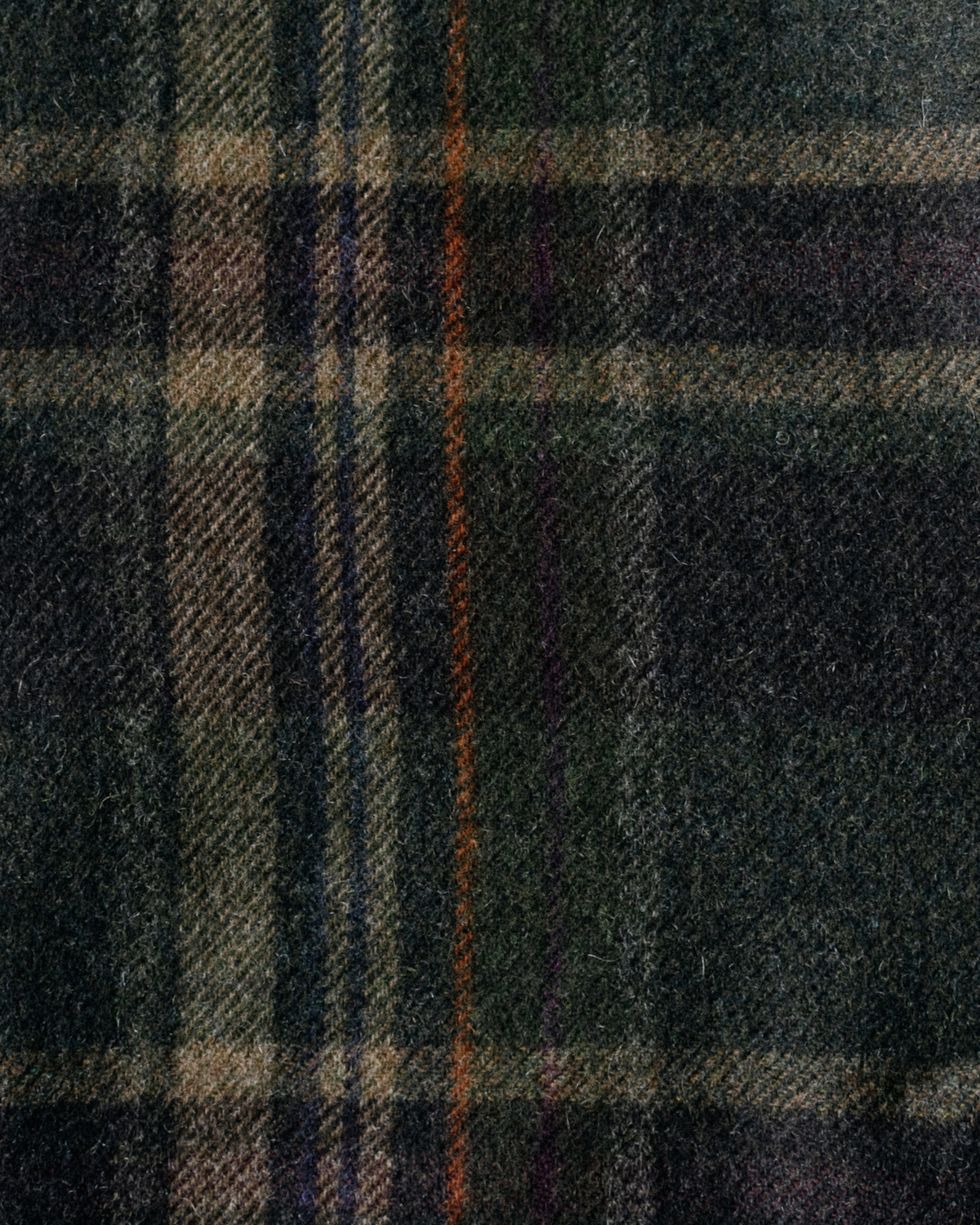
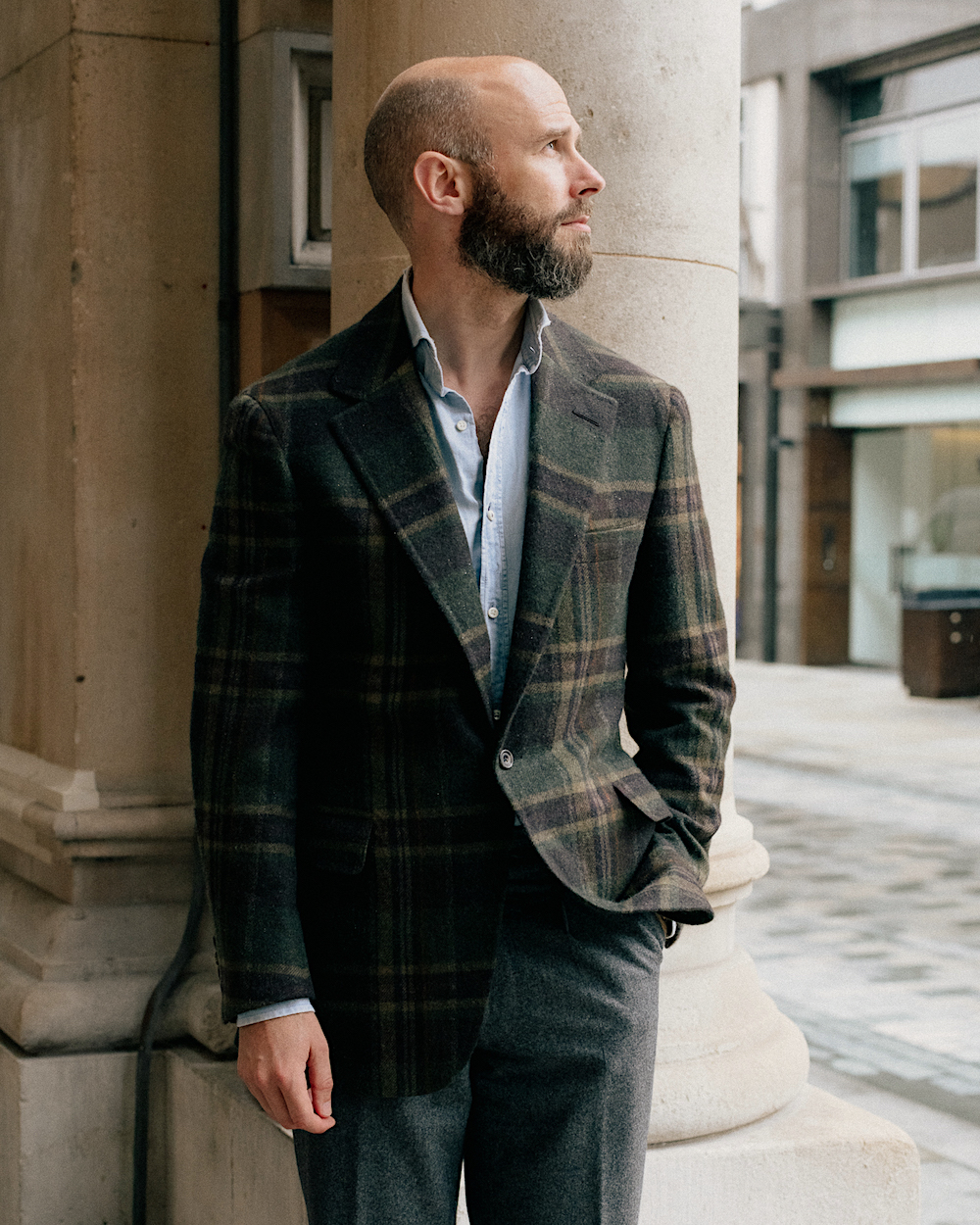
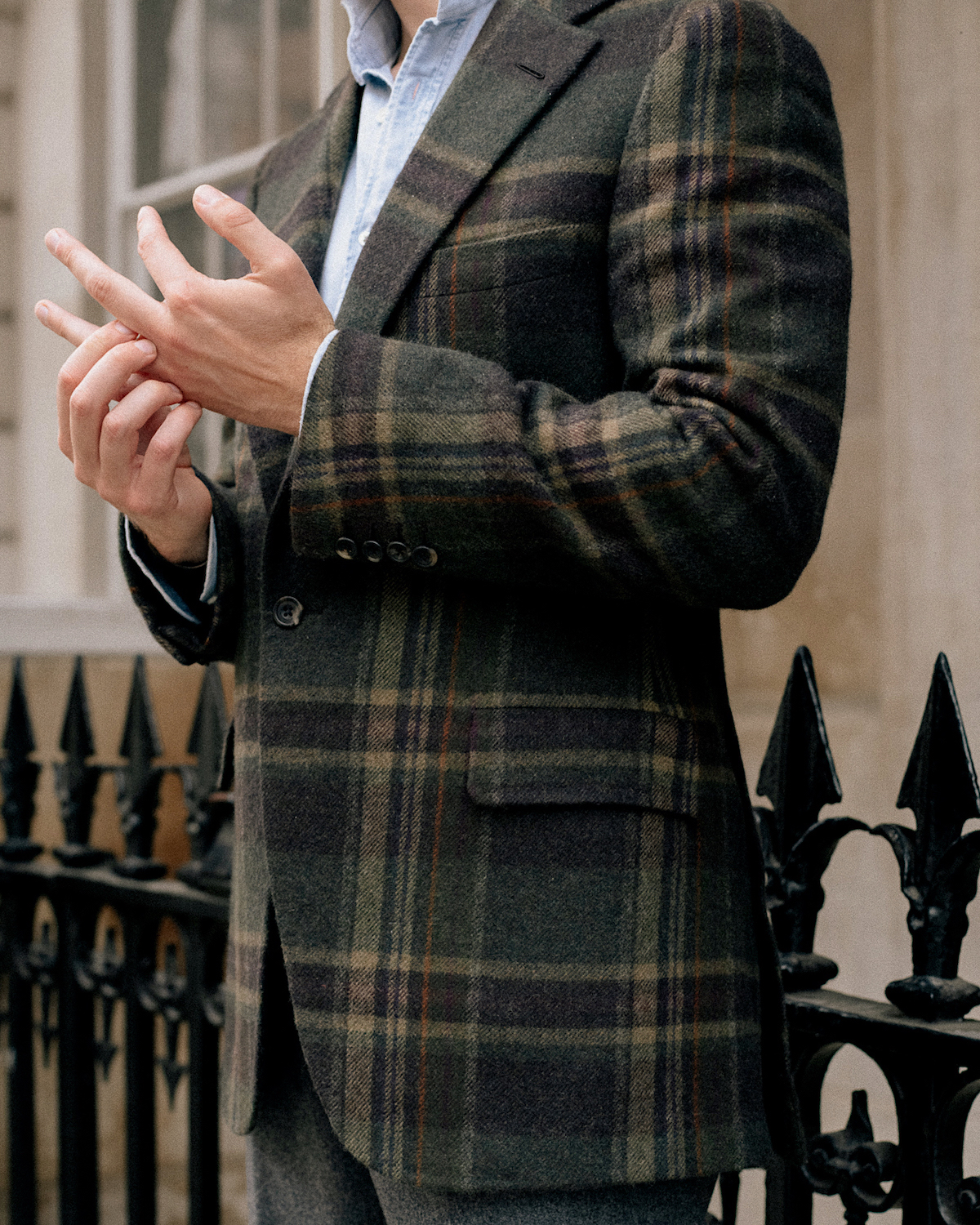
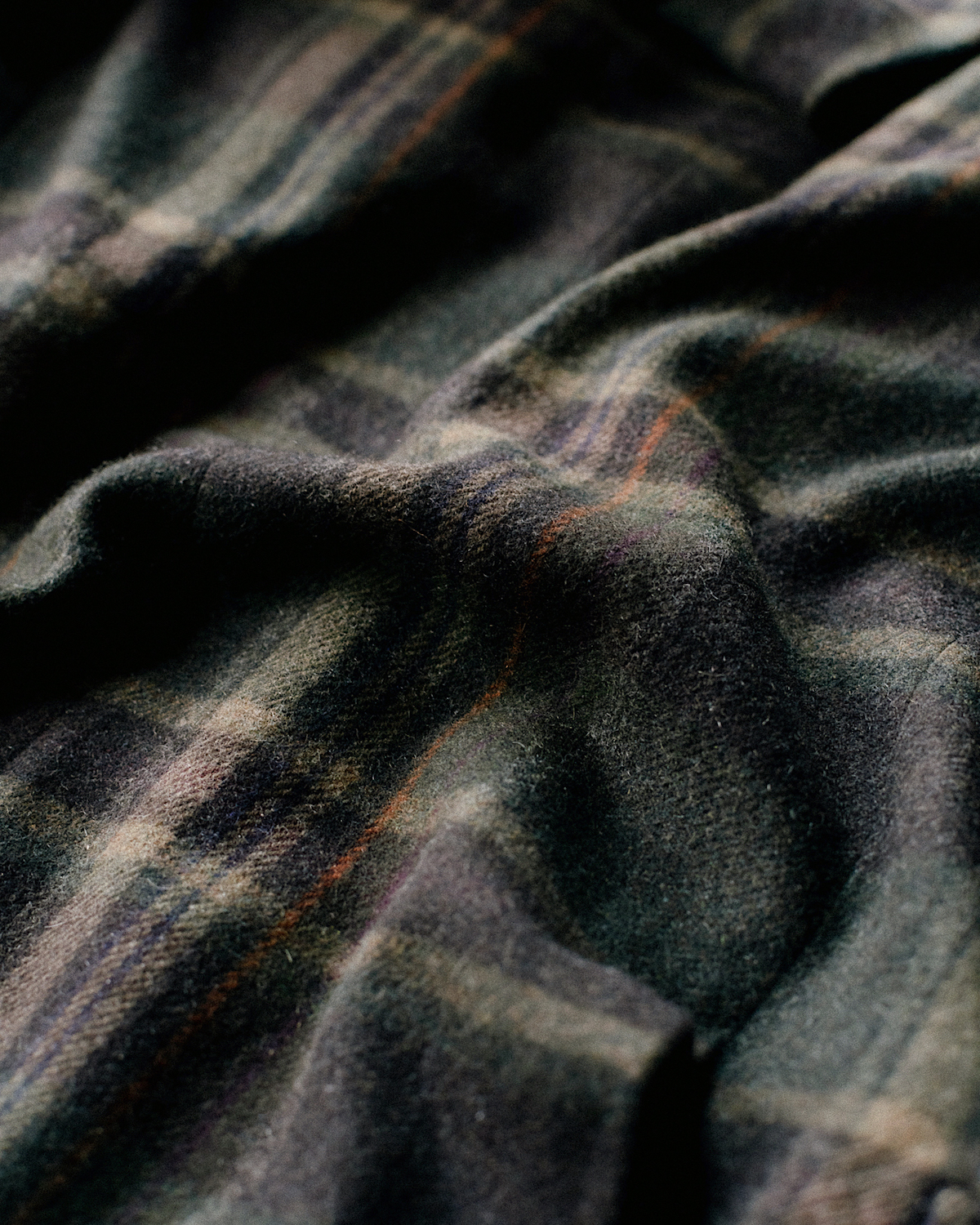
It was these I spent the longest time poring over, and which resulted in us bringing one of the most beautiful out of obscurity - the dark purple and green cashmere you can see pictured.

It’s available on the Joshua Ellis website, from today, in the same way the Escorial has been previously (rather than on the PS site). 

I've always had a soft spot for checks, but in the past I’ve tended to go for strong ones, or have them made into suits rather than jackets - which makes them stand out rather more.

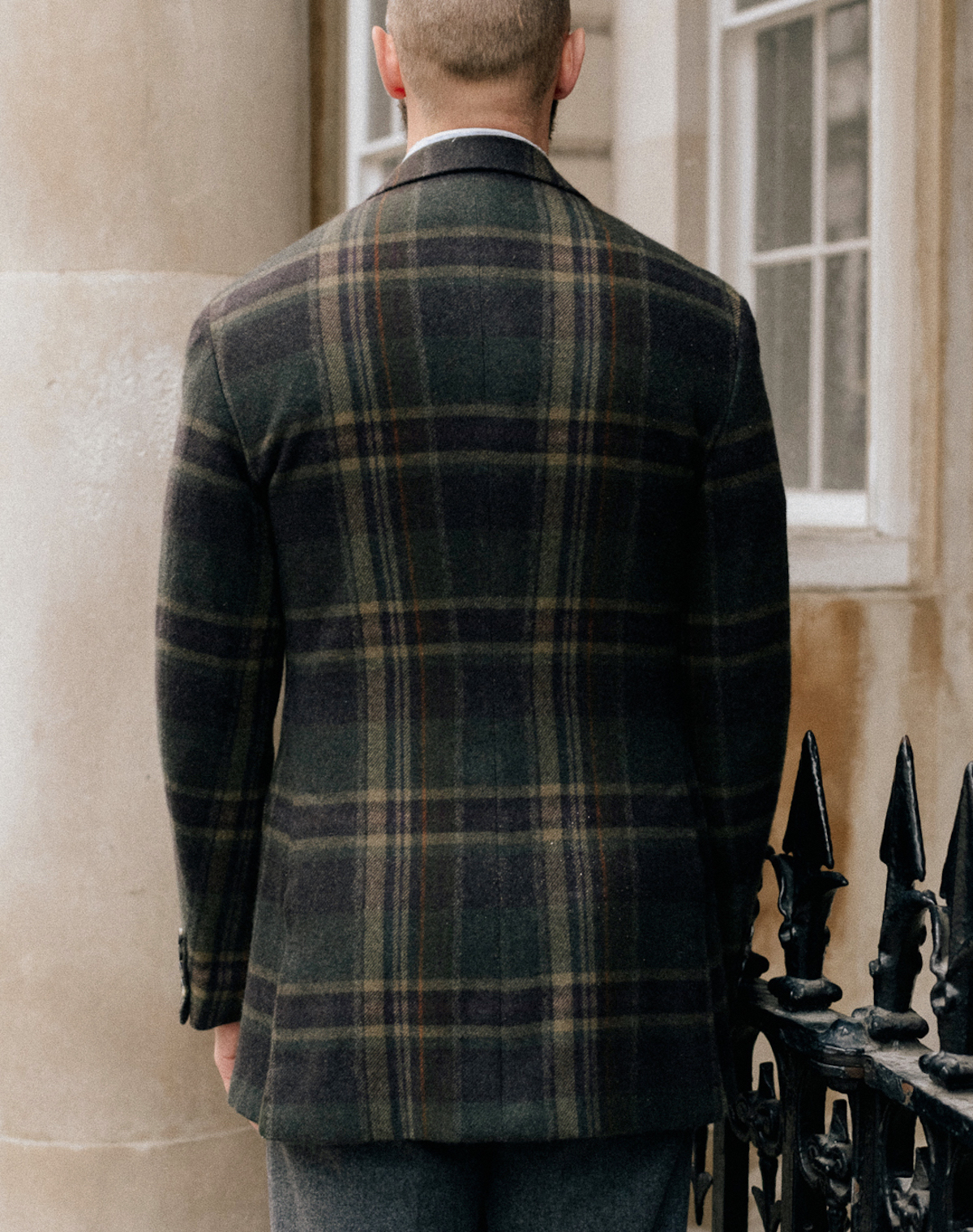
The key thing I loved about this pattern was how much was going on, yet how subdued the overall impact was. When you say you’re going to wear a purple-and-green check, this is not what people expect. 

The base of the pattern is a dark green and very dark brown/purple. The latter, in fact, is so dark and mixed in that it’s hard to say exactly what shade it is. 

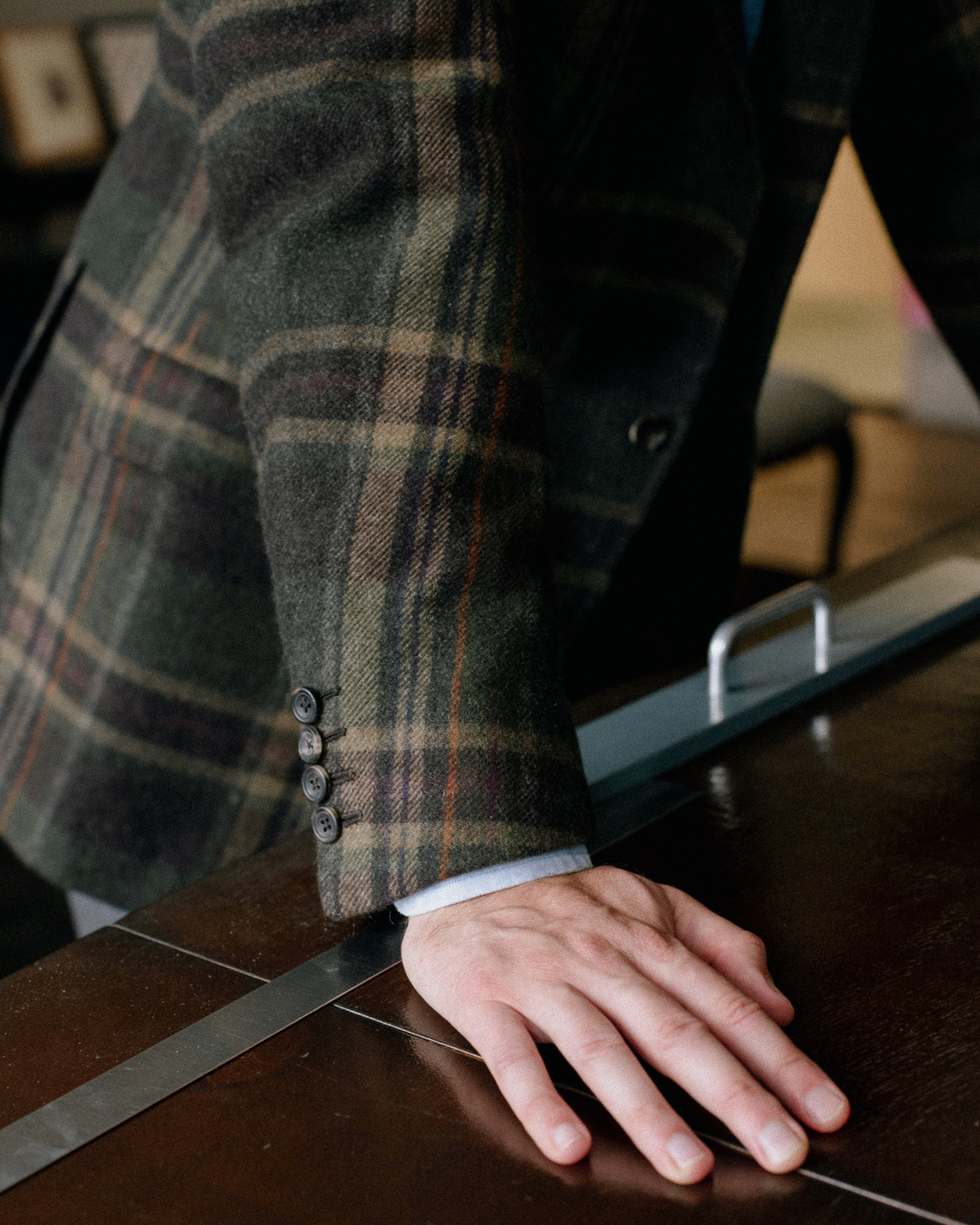
The suggestion of purple, though, is reinforced by a faint additional purple stripe (alternating with white in the twill) running horizontally, and a thinner, uniform purple line vertically. These are surrounded by straw-yellow stripes of varying widths. Then there’s a white stripe, a couple of faint blues and an orange. 

I know from experience how hard something like this is to design, how easy to get the shades or balance of the colours completely wrong, and I bow to the expertise of the Joshua Ellis design team. It’s a rich and beautiful pattern. 

I decided to call it the Permanent Style ‘plaid’ only partly for the alliteration. 

The pattern also has something Ralph Lauren about it - unsurprising perhaps, given Joshua Ellis have worked for Ralph for years - and I think to that extent something American too. 

English mills don’t usually produce designs like this, and the Italians rarely do either. The English would make it up in tweed, and the colours would be brighter. The Italians would happily make it in cashmere, but the cloth would be light and the colours less rich. 

This luxurious take on tartan has more of an uptown American feel, and hence we’ve used American terminology. It is the PS Plaid. 

I think it would suit a jacket worn more in the evening too, for these reasons. 

I’ve pictured here during the day, with some of my favourite things - a denim shirt, flannel trousers, suede tassels. Looking at that outfit now, an old red bandana might have looked nice as a pocket square. 

Or a purple spot. The fun thing about checks like these is picking up little aspects of the pattern and using them elsewhere. I might not use green in a hank or tie, but certainly a brown or yellow.

However, I do think I’ll wear the jacket often in the evening. It would look excellent with a charcoal rollneck, or a cream shirt. Even black. I have tried it with a cream knit, charcoal trousers and black Sagans and it works wonderfully. 

Something this luxurious - which must come from the depth of the colours as well as the cashmere - seems to suit dressing up.

We were keen to produce a fabric that felt as sensuous as the design implied, and to that end decide to use the finest cashmere Joshua Ellis has to offer, with slightly brushed finish.

The finish raises the fibres and gives both more ‘cover’ to the pattern (fluffiness makes any pattern less pronounced) and a more tactile feel. 

This is very understated - we're not talking anything like the milled finish of a flannel - but it does make the cashmere both more indulgent in feel and more subtle in tone, so accentuating both of the things that already drew me to the cloth. 

If anything, it reminds me most of this jacket in a vintage cashmere I had a few years ago. Not as heavy, but with the same old-school feel. 

The weight is a versatile 350g. So not for warmer months, but I'd certainly wear it nine months of the year in the UK - perhaps with a grey crewneck underneath when it was my outermost layer. 

For anyone looking at other Joshua Ellis jacketings, this weight and finish mean the PS Plaid is a unique quality, so not comparable to anything else in the range and not available elsewhere. 

The jacket itself was made by Whitcomb & Shaftesbury, in a softer style they are now doing with an inset shoulder, plus a more generous fit than what I’ve had from them before. 

There are many other things to comment on there though, so I'll do so in a separate post. 

The shirt is my old Al Bazar denim, the flannels are from Cerrato and the shoes are my Belgravia tassels from Edward Green. The red handkerchief that would have made a nice addition is here

Thinking as I write, I reckon a black or navy knit-silk tie would like good with this too. Unlike a regular checked-tweed, there would be nothing old-mannish about the combination. 

Details on the cloth and on ordering: 

  • The PS Plaid is available through the Joshua Ellis website only. 
  • Buy the length you require in units of 1m and 10cm. 
  • In terms of length required, I need 2.1m for a single-breasted jacket, but requirements will vary a lot with your size and desired style. Check with your tailor.
  • There is a limited number of swatches available, with a small charge that is refundable if you place a full order. Again, on the Joshua Ellis site.
  • If you want to send the cloth straight to a tailor, that is possible (and saves on shipping twice). Just put them down as the delivery address - with your name included in it - and let them know it’s coming, to avoid any confusion.
  • The cloth costs £175 a metre, including VAT. For jurisdictions outside the UK, there are separate set charges that will show on checkout - but which do not include VAT or duties. Joshua Ellis does offer free shipping worldwide however.
  • The cloth is regular width, a 350g 100% cashmere twill, woven by Joshua Ellis in the UK.
  • The check repeats every 6.5 inches horizontally, and 6 inches vertically.

There are no current plans to reweave the Escorial Tweed. The PS Harris Tweed, however, is being rewoven again and should be available again later this year.

Photography: Alex Natt @adnatt

Reader profile: Manish

Sometimes I feel a bit envious of brands holding trunk shows, because they meet so many more PS readers than I do. 

I see people at occasional events, and of course the pop-ups once or twice a year, but that's about it. 

So one of the nice things about starting this series was just chatting to people like Manish - about what clothes they buy, which they don't, and how their style has changed in the past 18 months. 

That, of course, is also the benefit for other readers. These articles should provide a different perspective to my own - from people not in the industry, from different places and professions. 

We'll try to keep to one a month or so, and keep them regular. I hope you enjoy the first installment.

Outfit 1: Casual

"Here I’m wearing Crockett & Jones Harvard loafers and W. Bill linen trousers from City tailors Graham Browne.

The shirt is an old Uniqlo-Christophe Lemaire collaboration, cost twenty-five quid, is thick with sweat, ice cream and beer by the end of each Summer and still gets more love from friends than any of my tailoring! If Hemingway had gone into the ice cream business I think he would have worn this shirt.

Do you think you spend a lot of money on clothes?

I don’t have any super-expensive bespoke tailoring, but yes, I think I do spend a lot of money and I think it’s important to acknowledge that so I appreciate how lucky I am to be in that position, and to remind myself to take care of the things I have bought. 

I would add that, like many of your readers, clothing for me is more than just about looking good. It is also a passion and so maybe it’s better to compare what I spend on clothes against what others spend on their interests - for example following a football team home and away isn’t cheap either.

What job do you do, and how does that interact with what you wear?

I work in financial services in Canary Wharf and it’s a curious sartorial landscape. The vast majority of men are in ‘business casual’ which generally means a shirt and trousers, and the balance are in suit and tie. 

The mid-ground – which I would assume to include jacket and trousers – is hardly ever seen and would be considered more dandy than a suit and tie, which I don’t feel is the case in most other working environments.

Pre-pandemic I would wear a suit and tie to the office every day, and that wasn’t really about style (although, of course, it wasn’t not about style either). It was mainly about having a uniform that was easy to pull together and expressed my intent for the day. 

However, once I do go back to the office I am going to try and sit in the mid-ground a little more and wear a jacket and trousers. I sense that everyone’s views on work have been pulled into very different shapes over the last eighteen months, so it will be fascinating to see how people respond with their office attire.

Outfit 2: Semi-formal

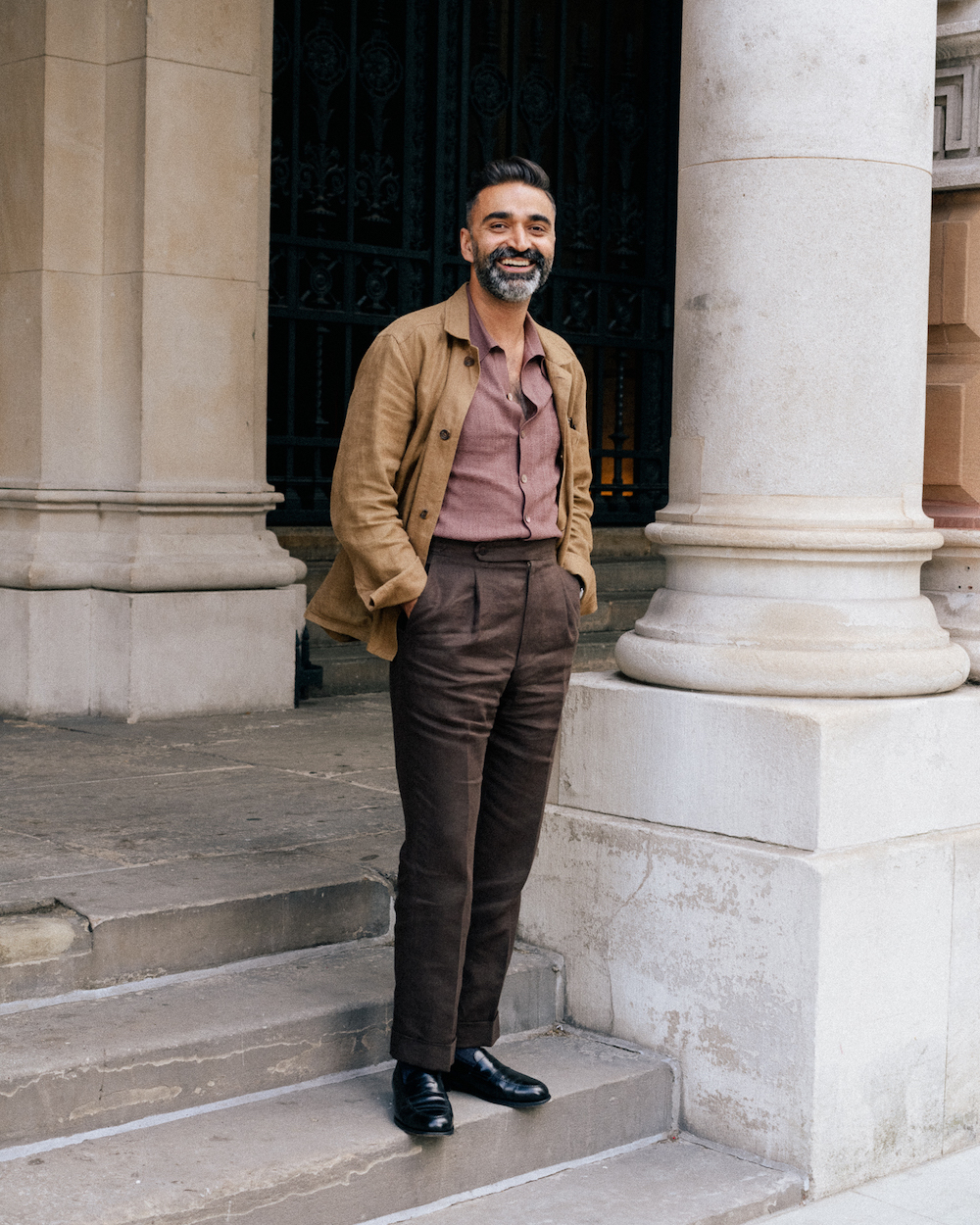
I’m wearing penny loafers from Morjas and a shirt from Yuri & Yuri. The linen trousers are from Stoffa. I remember when I was being fitted for them it was the first time somebody had been bold enough to squeeze their fingers through my love handles to locate the top of my hips. The result is a pair of trousers that rest comfortably on the lip of the hip all day long. 

The linen work jacket is from Anderson & Sheppard and I waited patiently for 18 months for that thing to go on sale on Mr Porter. When it eventually did it was only available in a medium and I was hoping to get a small, but over the years the jacket has worn in beautifully and now I’m so happy I’ve got the slouch and comfort of the bigger size.

What do you spend least money on?

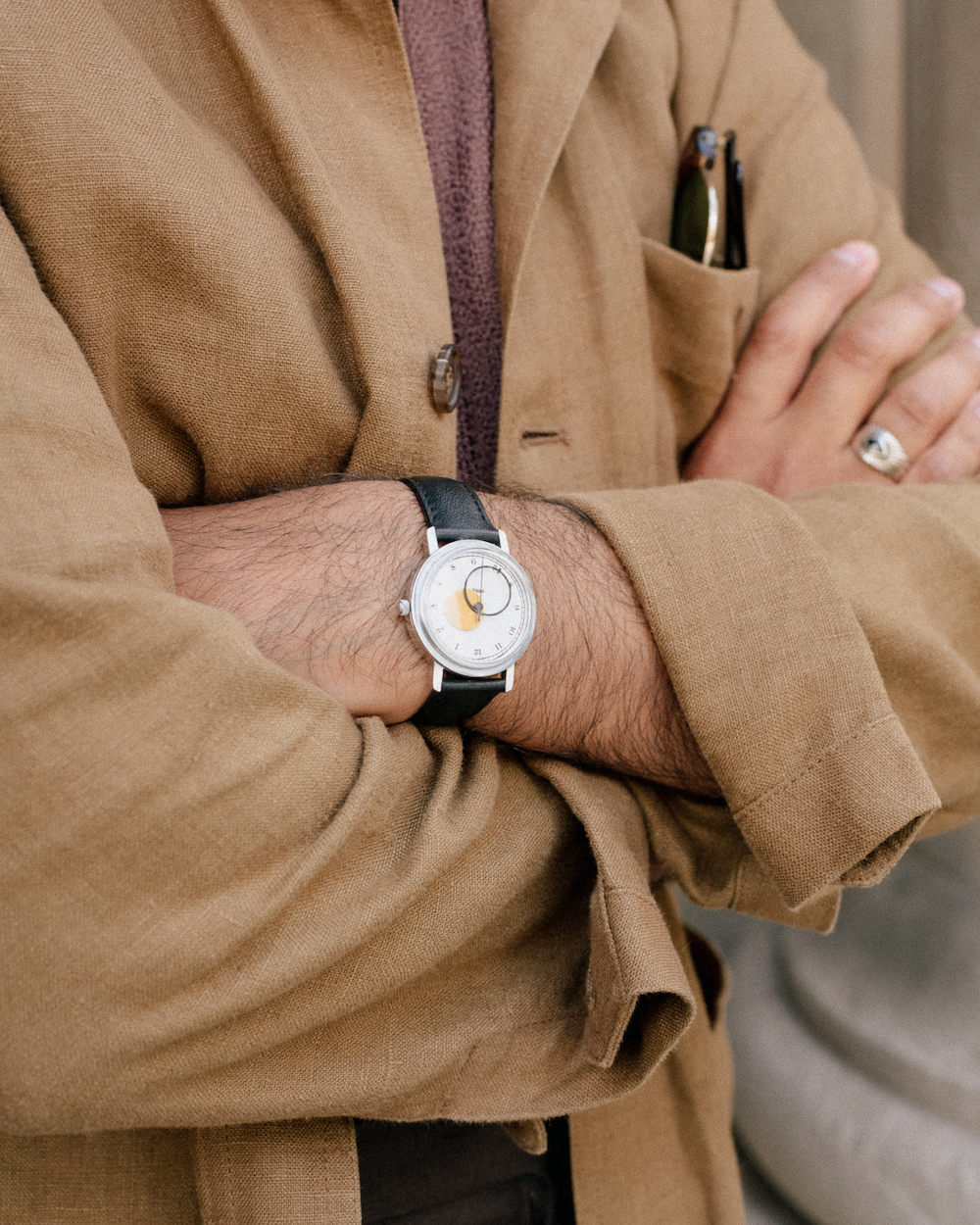
I spend the least on watches, which is largely because I know sod all about calibers, crowns, cogs and crystals. I’m sure if I did I could quite easily get sucked into a horological black hole and want to buy expensive timepieces but for now, I’m really happy digging through eBay and Instagram for old Russian watches.

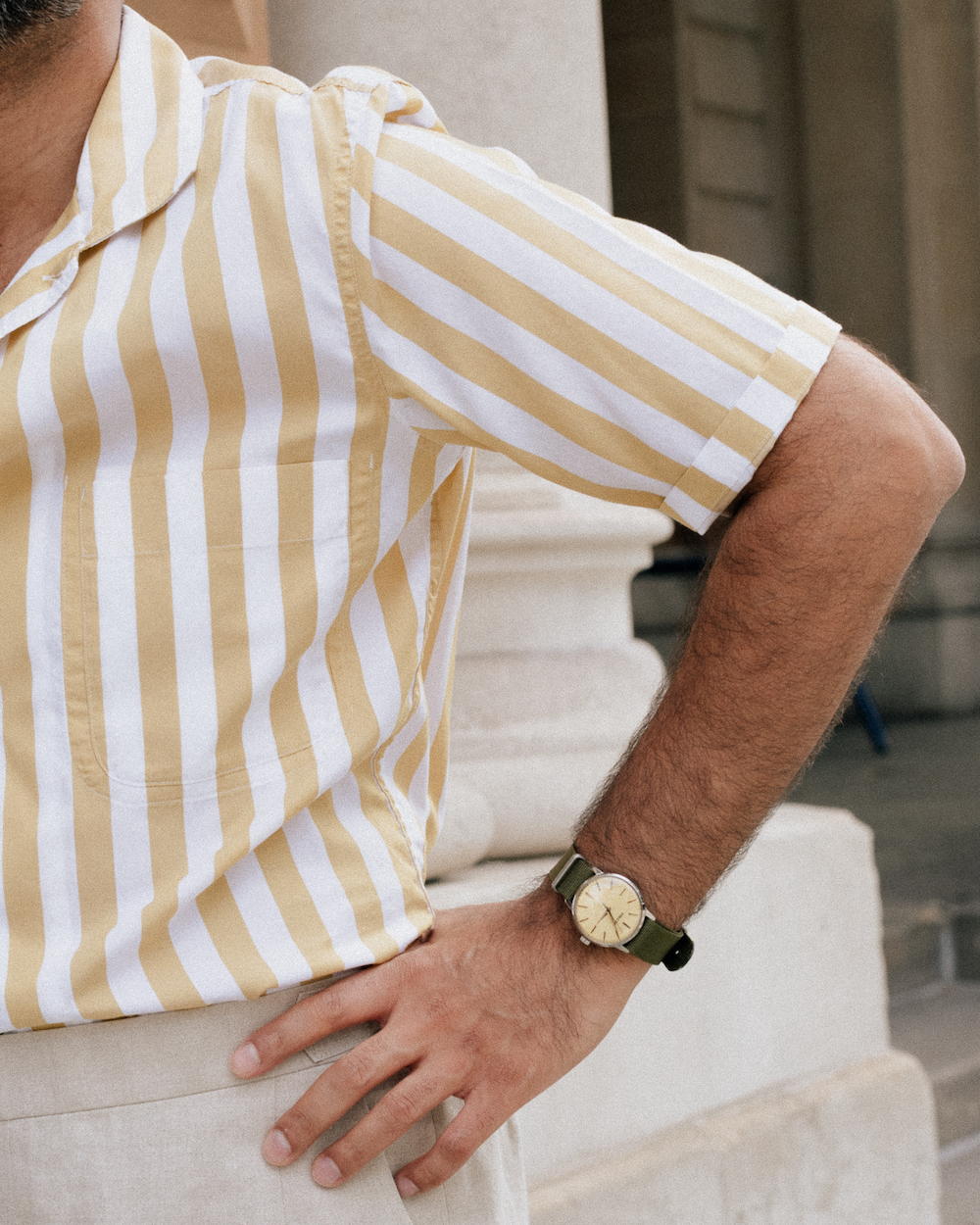
In the 60s and 70s, the Russian watch industry was making watches for both the domestic market and for foreign companies like Sekonda, so it’s not too hard to find vintage stock that is robustly made for a good price – I have six that all cost less than £60 each. My favourite maker is Raketa (meaning Rocket) not least because in Cyrillic the letter ‘R’ looks like a ‘P’ so more than one person has glanced at my watch and assumed I’m wearing a Patek.

How long have you been reading PS? What do you like about it?

I dug back through the archives to try and answer this question and it was late 2013/early 2014. What I like, and I think this is especially true of the last three or four years, is how you’ve been exploring the tension within the title and underlying credo of the site: Permanent Style. 

How do those definitions expand and contract over time? How does something we once considered permanent transition to impermanent and vice versa? Is it possible to have a ‘permanent’ part when the ‘style’ part is so subjective? 

I think the main reason that the site has been able to explore those broader questions is that you’ve never gotten too bogged down in dogma and have championed using the PS platform to explore and discuss things that I never thought would be covered when I started reading back in 2013. I’m thinking of articles like Tony Sylvester’s superb series of recent columns, the increased coverage on casual wear and highlighting other people’s styles that aren’t straight-up classical menswear. 

Outfit 3: Formal

I’m wearing Alden tassel loafers, a Bryceland’s Oxford shirt and a cashmere tie from Drake’s factory store - may it rest in peace. The jacket has been made up in a Fox Brothers tweed and both it and the trousers are from The Anthology. 

I wear a lot of my tailored jackets with black shoes, charcoal trousers and white shirts. The intellectual reasoning for this is that I like a contrasting gradient that leaves lighter colours nearer my face, plus I have dark skin and a dark beard (although that is whitening with each passing day) and so I find a white/cream shirt very pleasing. 

However, I genuinely think the real reason for this mode of dressing is that it has just been ingrained in me as a boy by the different school uniforms I had to wear, all of which were as above but just topped with a polyester blazer.

What's your biggest tip for other readers in terms of building a wardrobe?

For those readers that are just starting out, I would advise taking it slow. Sadly life isn’t like a Hollywood makeover and any headlong dives into changing up the wardrobe will probably end up with you looking and feeling a little phoney. 

Work with what you’ve got as a base. If you’re a jeans and T-shirt guy that’s cool! Maybe just trade up those jeans to start with and then in time the favourite band T-shirt gets rotated with one that doesn’t smell of Lynx Java (which is what all of my old band T-shirts still smell of).

For those that have a base, I would say trousers, trousers, trousers. Jeans are fantastic but so limiting. Jackets are the crowning glory but, in my view, you can still look sharp without them. But trousers? Once you have a few pairs of versatile and well-fitting trousers in the wardrobe it’s like when Dorothy opens the door in The Wizard of Oz – everything turns to technicolour.

How does your partner view what you wear?

With lust in her eyes! Seriously though my partner Gemma is so unbelievably supportive. I think a lot of us have been in positions where we’ve had to play down how much we’ve bought or what we’ve spent to people close to us, ‘Yes darling, I couldn’t believe Drake’s had another sale with all clothes in my size on heavy discount. And so soon after the last sale too.’ 

So I feel very lucky to be with someone who not only tolerates but actively encourages my interest. I think it also helps massively that she is a talented home sewer (@sewersaurus) and so we enjoy talking about cloth and construction - she’s always taking a look at how my seams are finished on different garments. 

It’s wonderful to have an overlap in interests and I’m trying my damnedest to expand that overlap by getting Gemma to make clothes for me. I’ve got two beautiful camp collar shirts so far and I’m nudging/nagging her into making me a quilted vest for winter but her waitlist is longer than Sartoria Corcos!

What do you worry about most in terms of what you wear?

I think the last time we talked, Simon, was at an event that you hosted for Saman Amel – another brand that I have so much time and respect for. At the event, Dag said something insightful, in that supremely casual manner of his, which was about how the challenge for a lot of their customers was to be ‘elegant but relevant.’ 

I think I’m getting a little better at the first part of that statement, but if there’s anything I do worry about it’s about trying to fulfil the second part.

Photography: Alex Natt @adnatt

Manish is @the_daily_mirror on Instagram

Good Art Hlywd: Unexpected craft and beauty

Good Art Hlywd: Unexpected craft and beauty

Friday, August 20th 2021
||- Begin Content -||

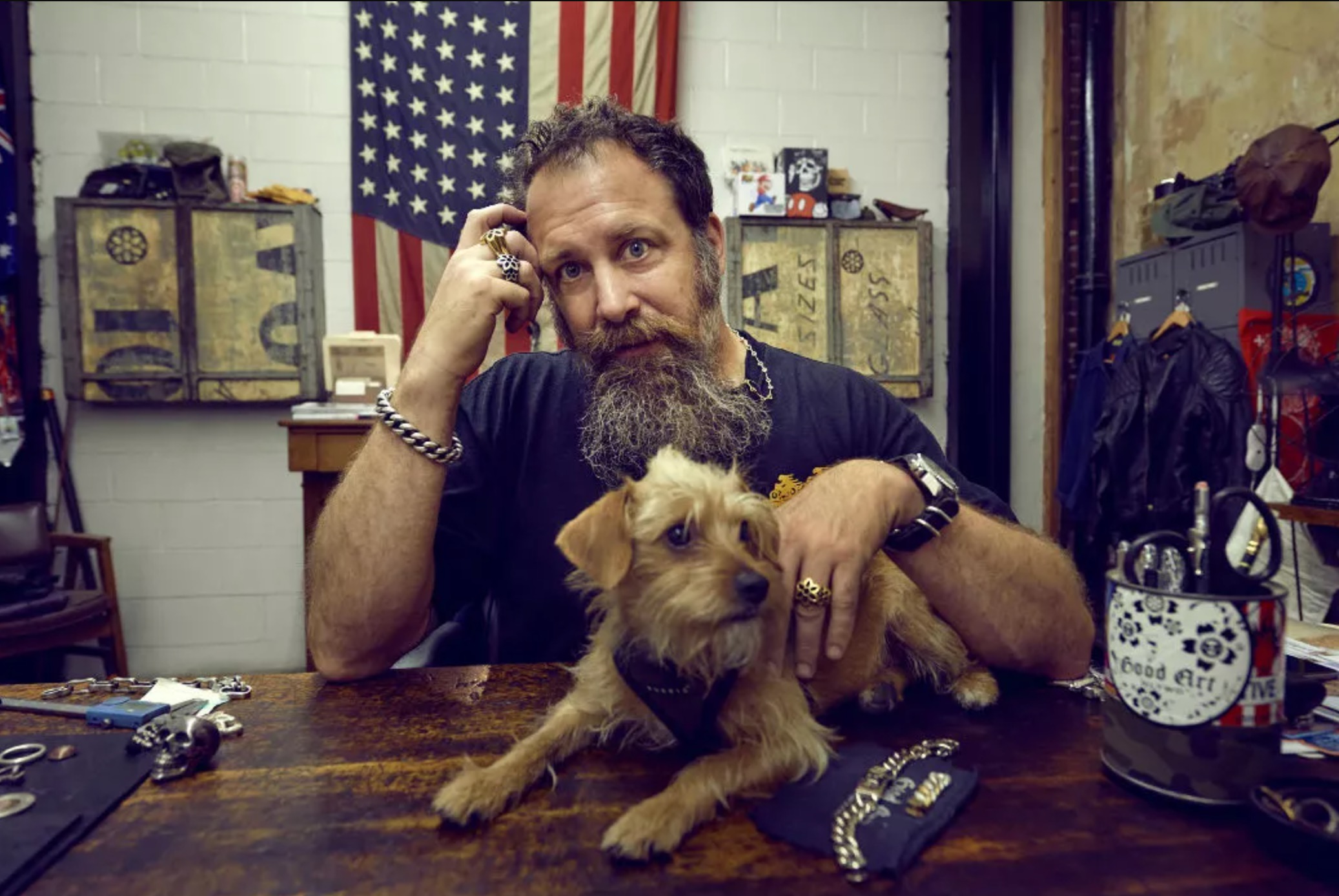
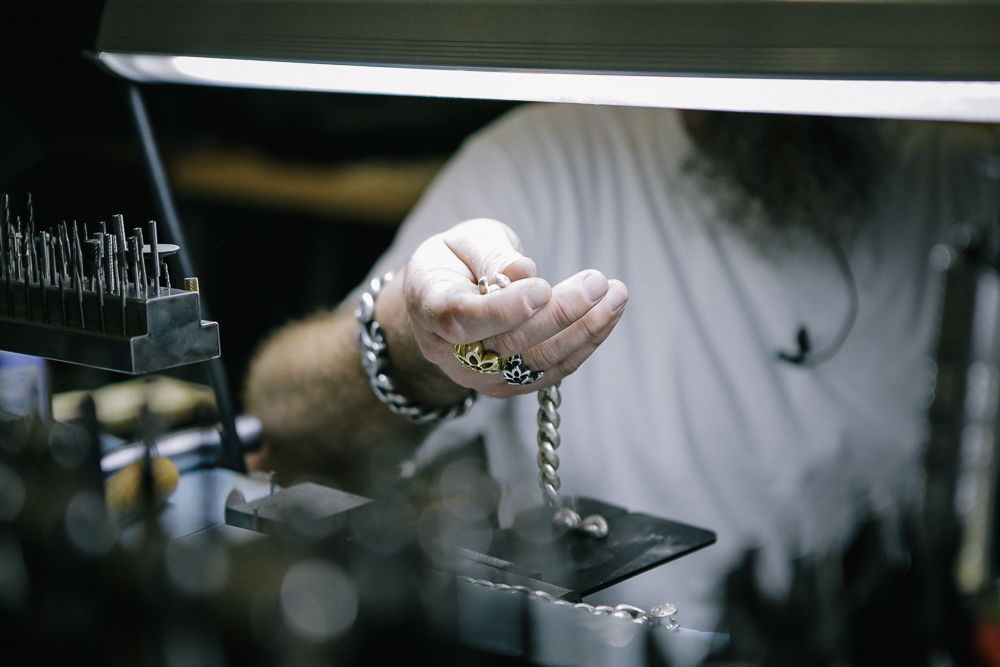
I was buzzing when I got off the phone with Josh Warner of Good Art (above) last week. 

It's been a while since I've talked to someone new that has that bright-eyed passion - the enthusiasm of an obsessive creator. 

He reminded me of Graham Thompson, of Optimo, or Simone Mattioli of Umbria Verde. There was the same excitement about the product, the keenness to explain it, and the simple love of beautiful things. 

It says something about Josh that he liked my comparisons, found them interesting and wrote them all down. 

While trying hard not to generalise, I also think there's also an openness about this kind of person. 

As soon as Josh appeared on the Zoom call, he was showing me round his house in the Hollywood hills, introducing me to his partner and his dog. They're building a guest house a bit further down the hill. 

It’s the same simply, unpretentious welcome I felt from Graham in Chicago or Simone in Italy. 

Let's rewind a bit, though, and explain why I'd asked to interview Josh in the first place. 

For a few years, I've admired the silver jewellery from Josh's brand, Good Art, on display at Rivet & Hide in London. 

Now this might raise a few reader eyebrows. After all, Good Art makes curb chains and belt clips, decorated with skulls and expletives. Surely Simon doesn't think he's some kind of biker? 

No, but look closer. Remain curious. 

Pick up a piece of Good Art jewellery, and if you appreciate these things, you'll immediately recognise something in the quality of the materials and the work.

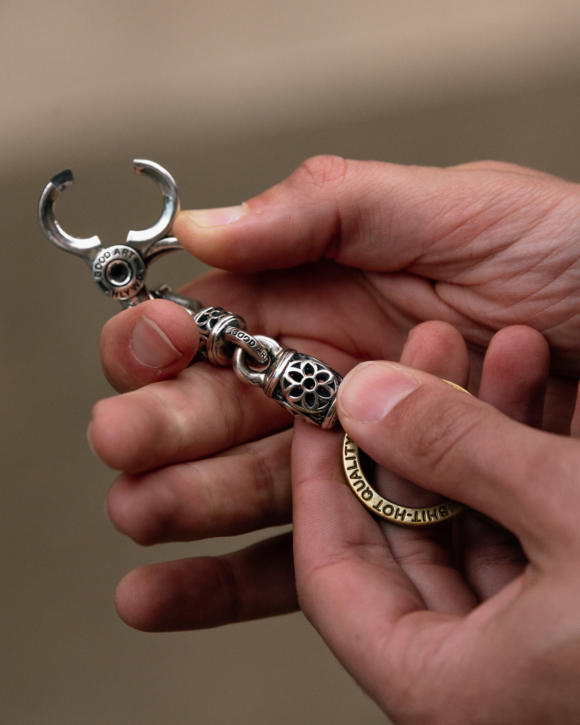
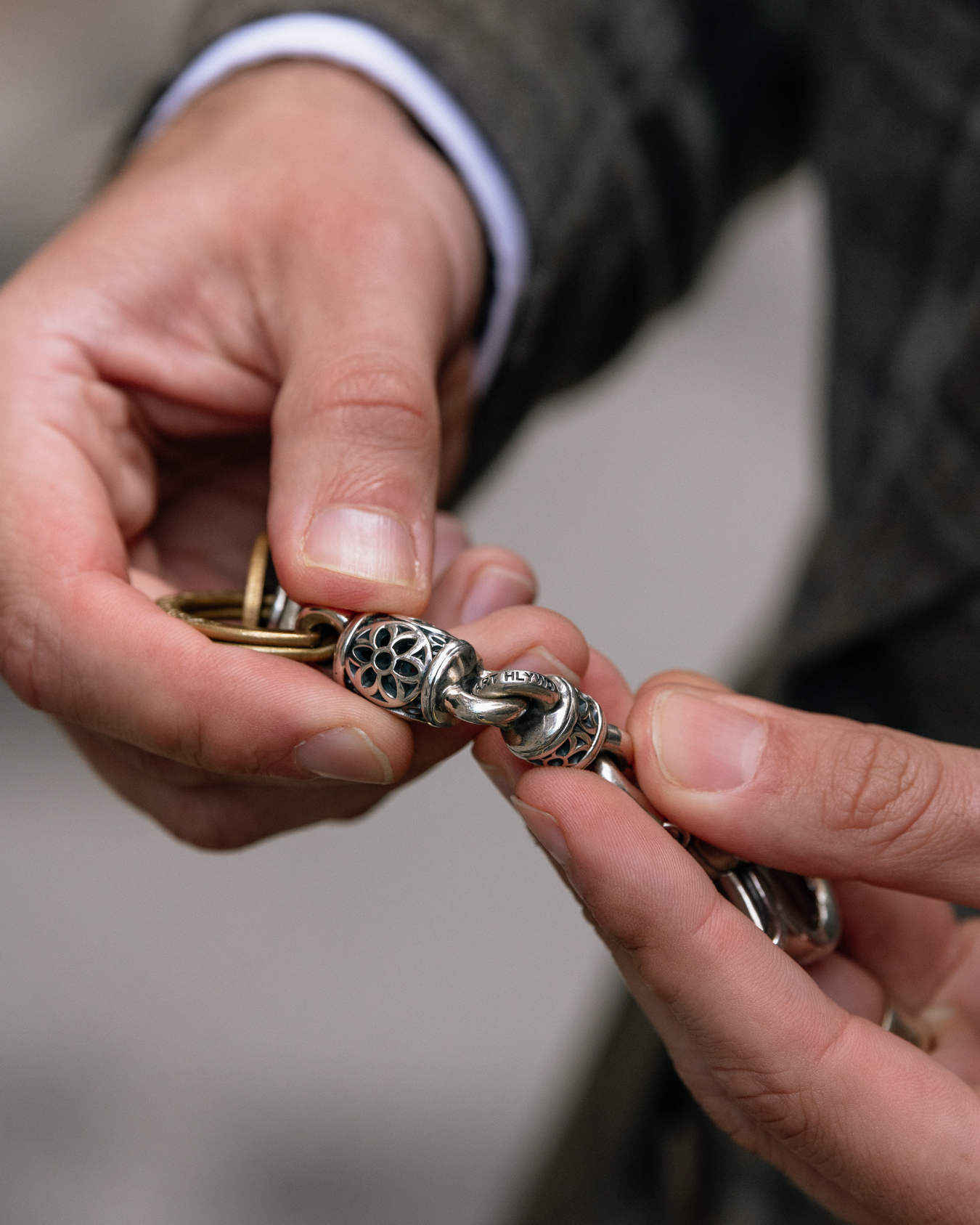
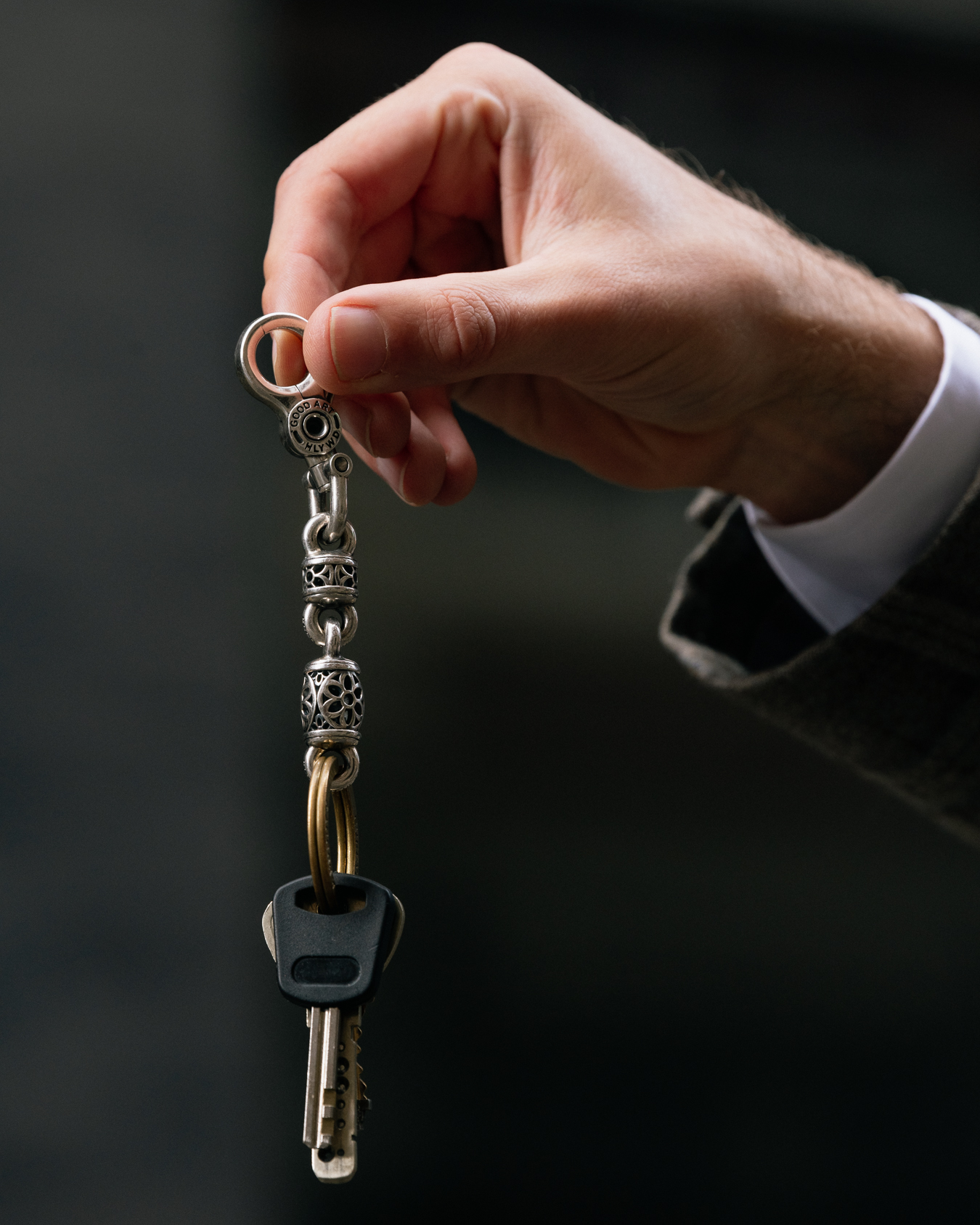
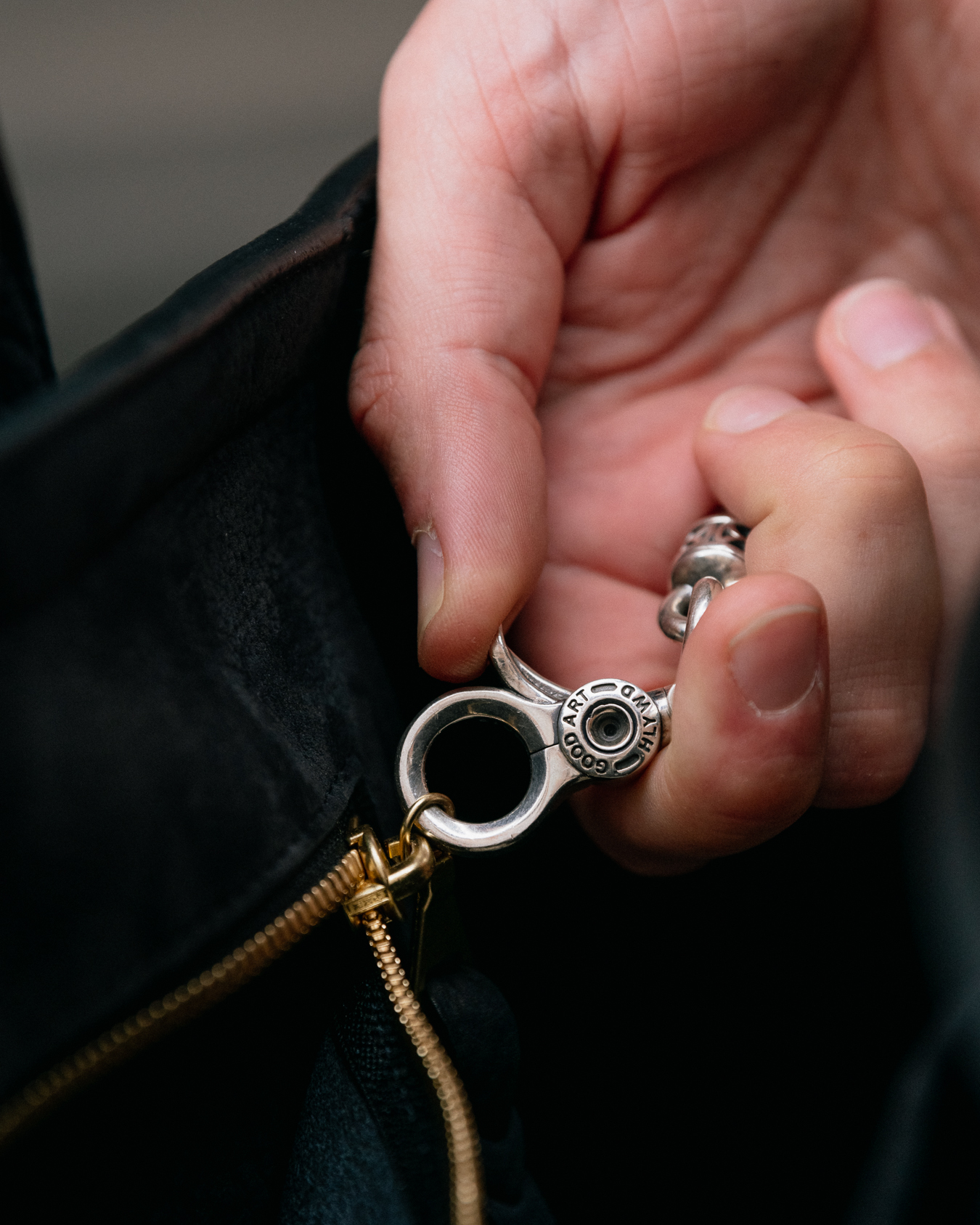
Chain links move smoothly and effortlessly against each other. On a key chain like mine (below), the sections all revolve and twist frictionlessly. You notice how the clip is split in two, so there’s a clean overlap. The thumb lever is pleasingly bevelled.

It's not so much the decoration you notice, but the engineering.

It was only when I talked to Josh - always the best part of the discovery process - that I understood the reasons his jewellery felt like that.

"Most jewellery is very cheaply made," he says. "Even with the big names, there is no attempt to improve the quality - just the decoration, branding and materials.

"If you pick up a keychain from a fashion brand and compare it to one from the corner store, they might well be made in exactly the same way. There's no interest in performance."

Josh's aim - since he started selling his own handmade jewellery, from a stand on Venice Beach - was to make jewellery with his biker aesthetic, but to the same level as Cartier or Tiffany. 

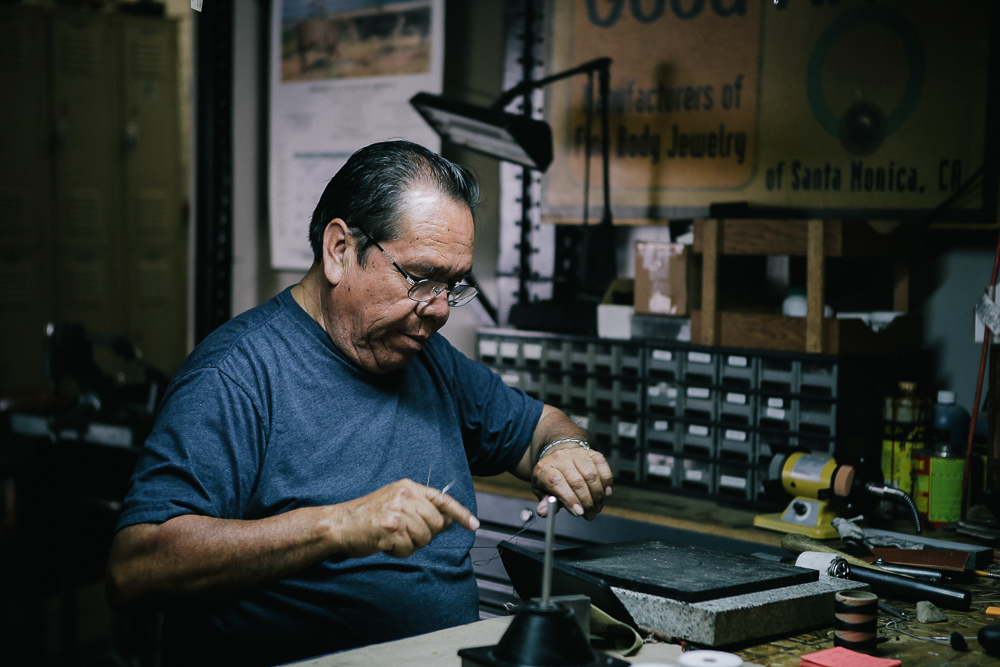
"That means an interesting combination of really expensive, modern machinery and detailed hand work that has been the same for millennia," he says.

“You’ll have a cutting-edge machine for extracting oxygen from the casting process, next to someone using a pin to etch a ring detail.” 

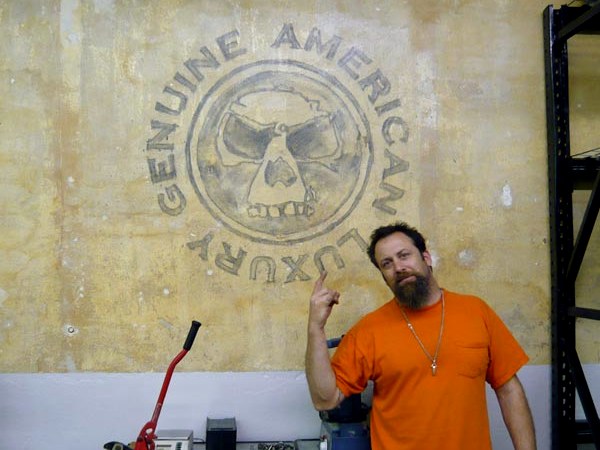
Good Art is now a company of 25 people, with its own dedicated foundry in LA. 

It's on Mr Porter (although Rivet & Hide is the only London stockist) but remains relatively unknown, largely because the quality and the materials make it expensive. (The solid-silver keyring is £775; gold rings are £7-11,000.)

As with many of the finest things in the world, it's not very scalable or very efficient. 

"Look I just want to put beautiful things into the world, to create joy with them. There's enough cheap shit in the world," as Josh says. "I'm at a place where I can't even afford my own stuff, but that doesn't matter. I still think if you're going to do something, it should be the best it can possibly be."

Like the type of enthusiast I characterised him as earlier, Josh’s feelings about competitors are a mix of anger and bemusement. 

"Jewellery is just a terrible business, particularly here in LA,” he says. "Everything is brand, everything is about which celebrity wears it. And everything is outsourced - nobody trains their own people, so all the stuff is basically the same." 

Or, as he sums up: “What’s the word for when nepotism rots through a village of idiots?”

Josh reserves a particularly strong stream of vitriol for one competitor that will remain nameless. Because of their low quality, but also their dishonesty.

"On our bracelets, we forge every link, then cut each open, attach the next link and solder up the join. It's the strongest way to do it, but it's hard and it’s time-consuming," he explains.

The competitor doesn't bother with that. They just make each link open (a 'C' shape) and squeeze it closed around the next one. That's the same technique used on the cheapest chain you can imagine - on my kid's £3 souvenir keyring. 

Josh knows he shouldn't rant about other brands so much. As he says, it shouldn't be the point. It's not the point. But it does come from a place of confusion as much as anything else (as in, why would anyone want to make this crap?).

“People talk about a thing called a purpose line. My purpose line is aesthetics, creating beauty. Others’ is making money. I guess that’s what I need to remind myself.”  

I’ve always had a soft spot for things that are hardier because they are finer - as opposed to fine socks or knitwear, which are often more delicate than cheaper versions. 

Felt hats, for example. A fedora made with finer felt will be stronger than one made with coarse felt. That’s why a great hat can be run over by a car and still refurbished. Or why cheap hats come with plastic rain covers, and good hats don’t need them. 

Good Art jewellery falls into this camp: the craft makes it stronger. “I’ve always wanted to build things that are welcoming to life,” says Josh. “We go to great lengths to make sure our pieces are perfectly polished and gleaming when they leave the foundry. It should be that way. 

“But they’ll look better once they’ve been used and dinged up. You’ll knock that keyring on a door handle and it’ll get a scuff. Then you’ll drop it and it’ll get a little nick. And after a few weeks it’ll look like no one else’s in the world. 

“It’s so much better that way. Silver is a soft, warm metal. It's just beautiful with that kind of use.”

I am not an expert on jewellery, and many of the things Josh says I’m taking on trust. But as should be clear by now, that’s something you naturally do when you talk to him. 

Plus the results are clear to anyone that holds a chain in their hands. Most readers can’t do that of course, but if you can, it’s worth a visit to Rivet & Hide in London/Manchester, or Self Edge in LA/San Francisco/New York - or the other various dealers.  

My key ring - the Barrel Key Chain - is shown here on the new black version of our nubuck tote, made by Frank Clegg (below). There are still a couple of these left from the last batch, in the black and the original brown.

More details in this article, plus information on the clothes shown. 

Many thanks to Josh and everyone at Good Art for their time.

Photography: Alex Natt @adnatt
Colour, size and drama: How to dress like André Larnyoh

André Larnyoh has enviably easy style. 

It’s tempting to put this down to his work as an actor, but that would be too simplistic. That training certainly creates “natural physical awareness”, as he puts it, but there’s also fascination with aesthetics in general, and the influence of working in menswear. André used to work at Trunk in London, and recently started at Drake’s. 

It’s also easy to think that there are photos of André everywhere. After all, he appears in Trunk’s feed, has modelled for Scott Fraser Collection, for Adret and for Polo Ralph Lauren (see bottom of article). 

But as he says, none of those were his clothes, reflecting what he actually wears every day. And as with Gianluca Migliarotti – whom we covered most recently in this series – André posts very few selfies.

So I think he’s a great subject for this latest ‘How to dress like’ feature. 

Outfit 1: Finding the right denim

OK André, let’s talk through the first look. Where’s everything from?

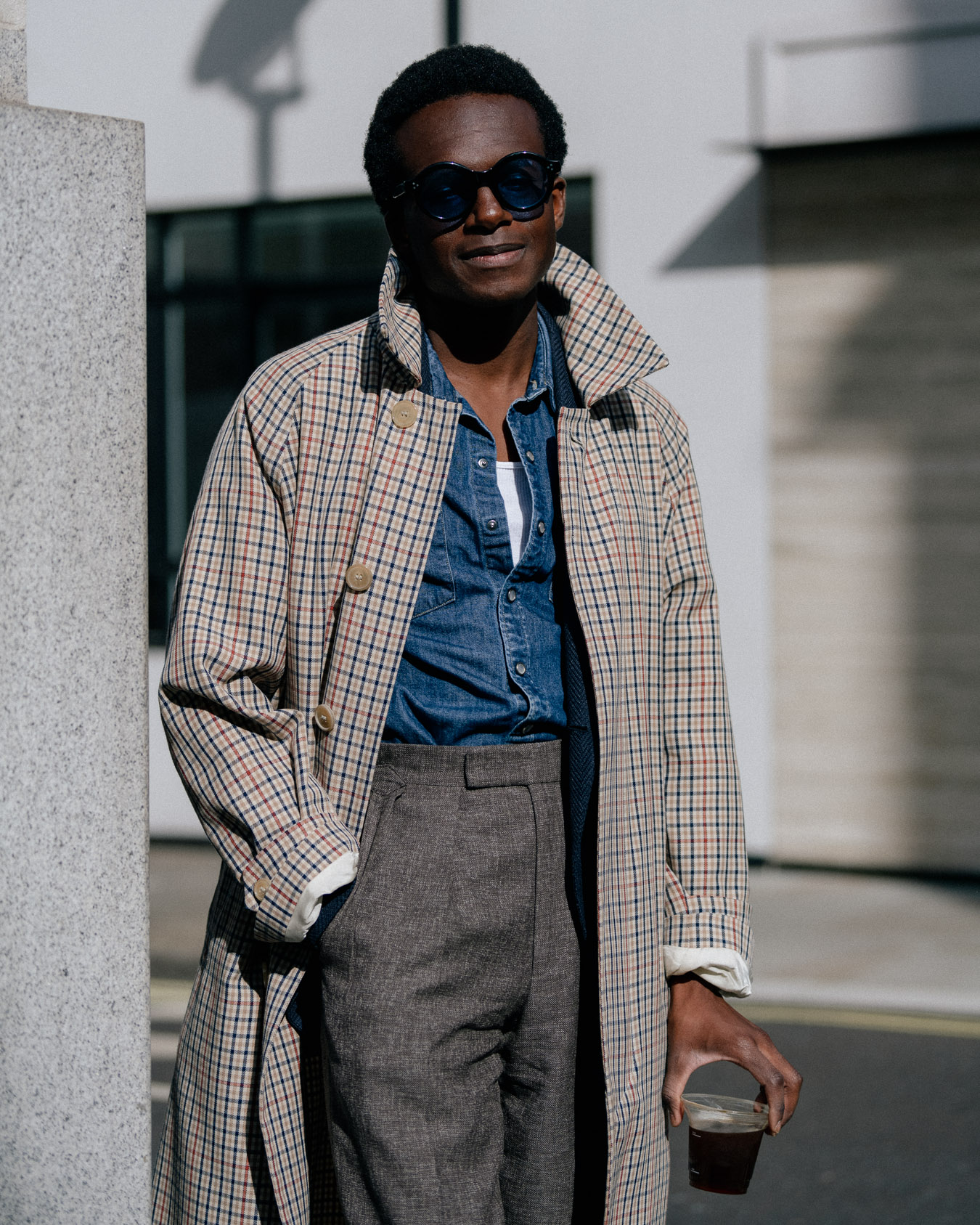
This is a lightweight Mackintosh that I got at Trunk about two years ago, with a Levi’s shirt. I have a lot of Western shirts, I pretty much live in them. 

Where have you had them from?

It’s been a bit of a learning curve. My first one was from Levi’s and a size medium, and as you can see I’m pretty tiny. It fit in the shoulders, but was just too blousy in the body. 

It was also too light – I think the secret to a good Western shirt is nice snaps and a mid-weight. It can’t be as light as a normal shirt, but you don’t want a original heavyweight either. Just something so it can soften nicely over time, all that good stuff. 

I have a Polo one, which is OK, and then this heavier Levi’s which is my favourite. Maybe one day I’ll be able to get a Bryceland’s one. 

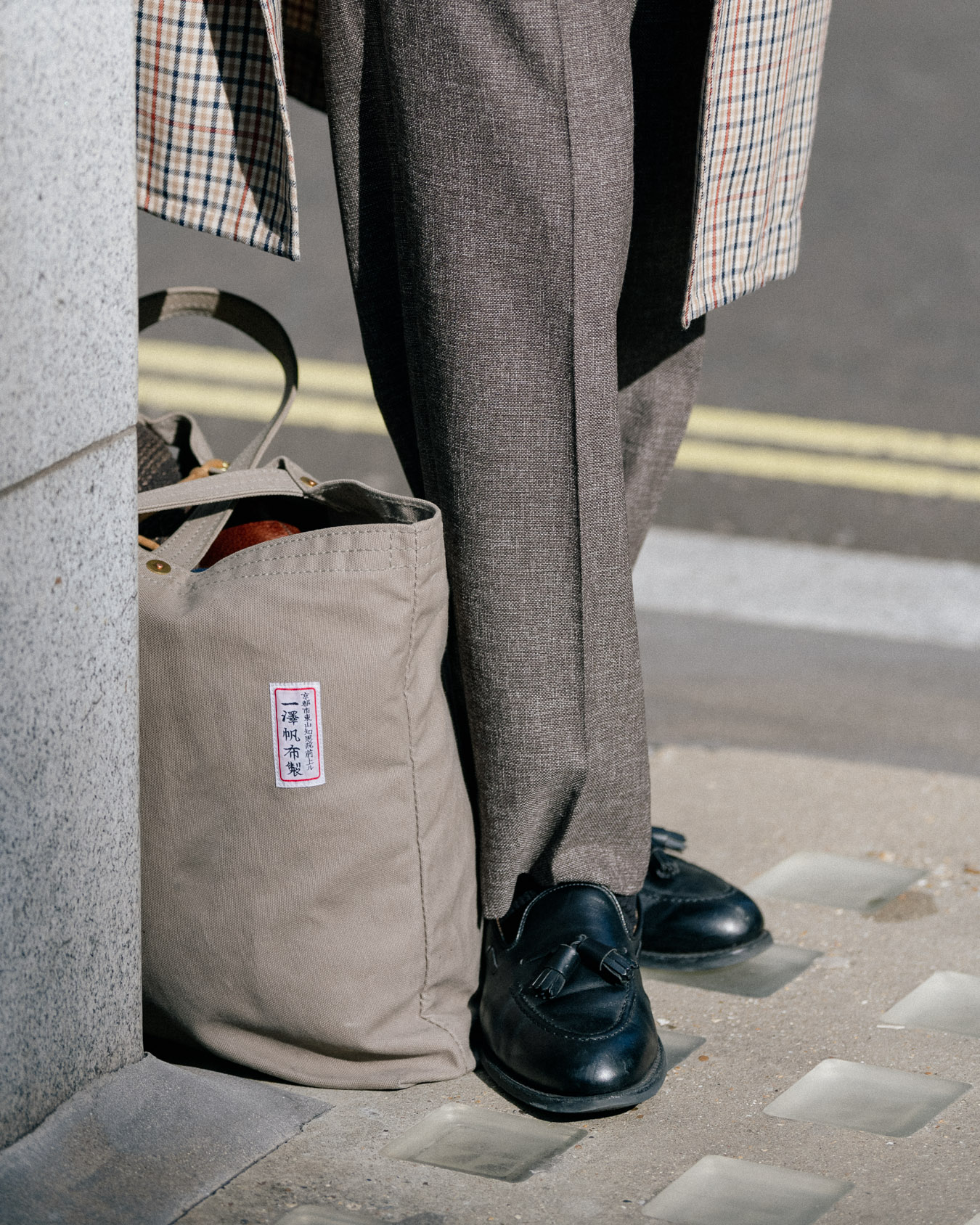
The trousers are Kit Blake, the Aleksander cut, with double pleats – a high-twist wool in a mottled grey/brown colour. It’s a bit more casual than normal flannels, and I love the rise. 

I always wear high rise. I think it makes me taller: I hope it makes me taller. But either way I like it because it’s so comfortable. 

A good example of being aware of menswear principles without necessarily following them. 

True. The shoes are Crockett & Jones, my absolute favourite shoe, period. They go with everything. The jacket underneath is from Lardini, and the glasses are from the Japanese brand that Trunk sells, Ayame. They don’t sell this model though – the Around (which is a terrible name!) 

The glasses are big, bug-eyed, with a 50% blue tint, and I love them. I’m wearing them right now actually. I don’t know, maybe I look ridiculous and nobody’s told me yet, but the tint makes everything seem calm, and I love the size – there’s almost a Jackie O thing about them, where the size hides your face. 

Outfit 2: Wearing colour

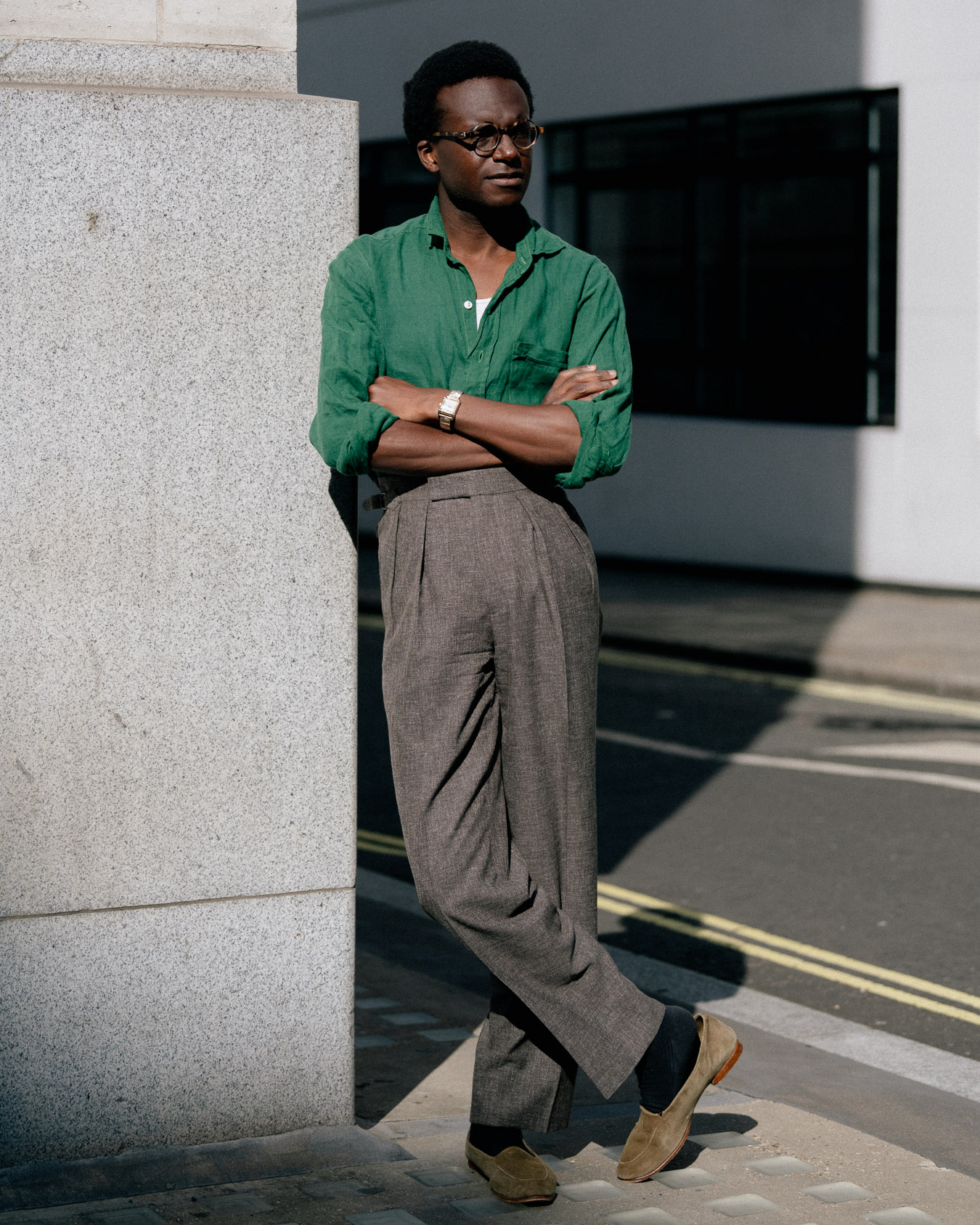
Number two, the green shirt. Now I know we’ve talked about this before, but not on PS: do you think your skin colouring makes it easier for you to wear colour?

I think it does, yes, but actually I don’t wear that much colour. I’m scared of big blocks of it. Partly from teenage years I think – all the mistakes you make, going round in a violet shirt with a paisley tie and thinking you’re the shit. 

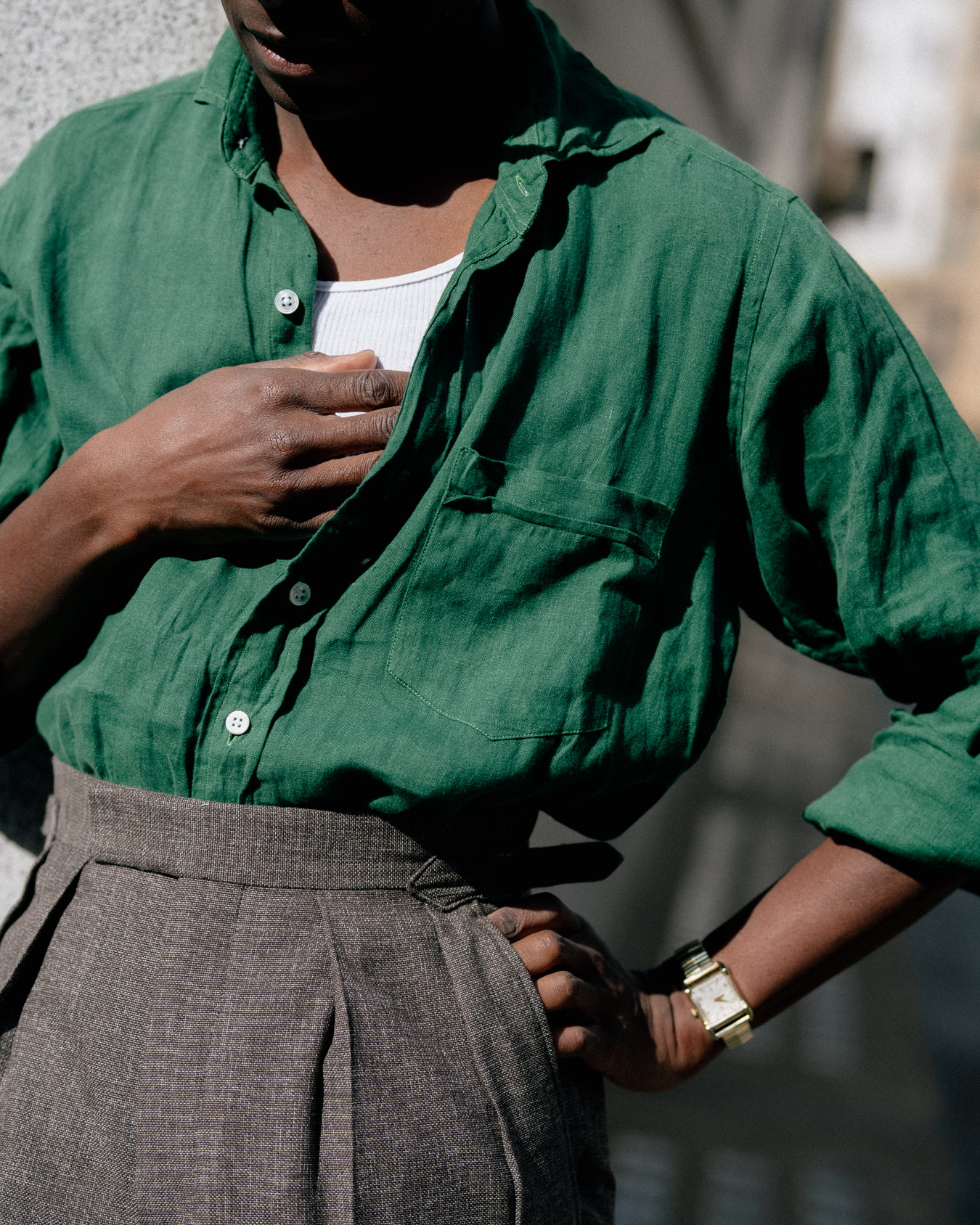
So I wear neutrals mostly – white, grey, black, dark brown, navy. But I really like the colour of this shirt.

I laughed when I first saw the drop from Drake’s, along with a yellow one and a pink. But then I went to this exhibition at Tate Britain, by Lynette Yiadom-Boakye. It was mostly portraits of black men and they were often in dusty-pink, black or green shirts. That inspired me to try the pink and the green Drake’s ones, and I love them. 

That often seems to be the way with colour, or perhaps with any clothing you don’t usually wear – you need to see it on someone else before you feel confident to wear it yourself. 

Yes, true. And in those portraits it made their skin seem more vibrant. 

Maybe I can wear more colour than other people, and if that’s true I’ll take it. But it’s still always easier to wear neutrals, and so I do it more. I mean I already have a big wardrobe for someone my age – it’s hard enough to choose what to wear from among dark colours. I don’t want to have to think about colour coordinating in the morning as well.

I feel self-conscious in strong colour, and perhaps that’s because I’m wearing big sunglasses and other unusual things too. You need some self-restraint. 

I see the trousers are the same as the previous outfit. How about the shoes – that’s a fairly light colour with the trousers, and with dark socks. 

Yes, I think the shoes (from Adret) look a little paler than they are in real life. Or maybe they’ve lightened over time. And the socks – yes I think was actually planning to wear no socks with this outfit, but I forgot to change! 

I don’t think dark socks are that bad though, to be honest. There’s the whole thing about matching socks to trousers, and that lengthening you etc. And that is probably true, but the fact is I’m wearing pale khaki shoes, so they’re going to stand out against the trousers no matter what. 

Outfit 3: Shawls and cable knits

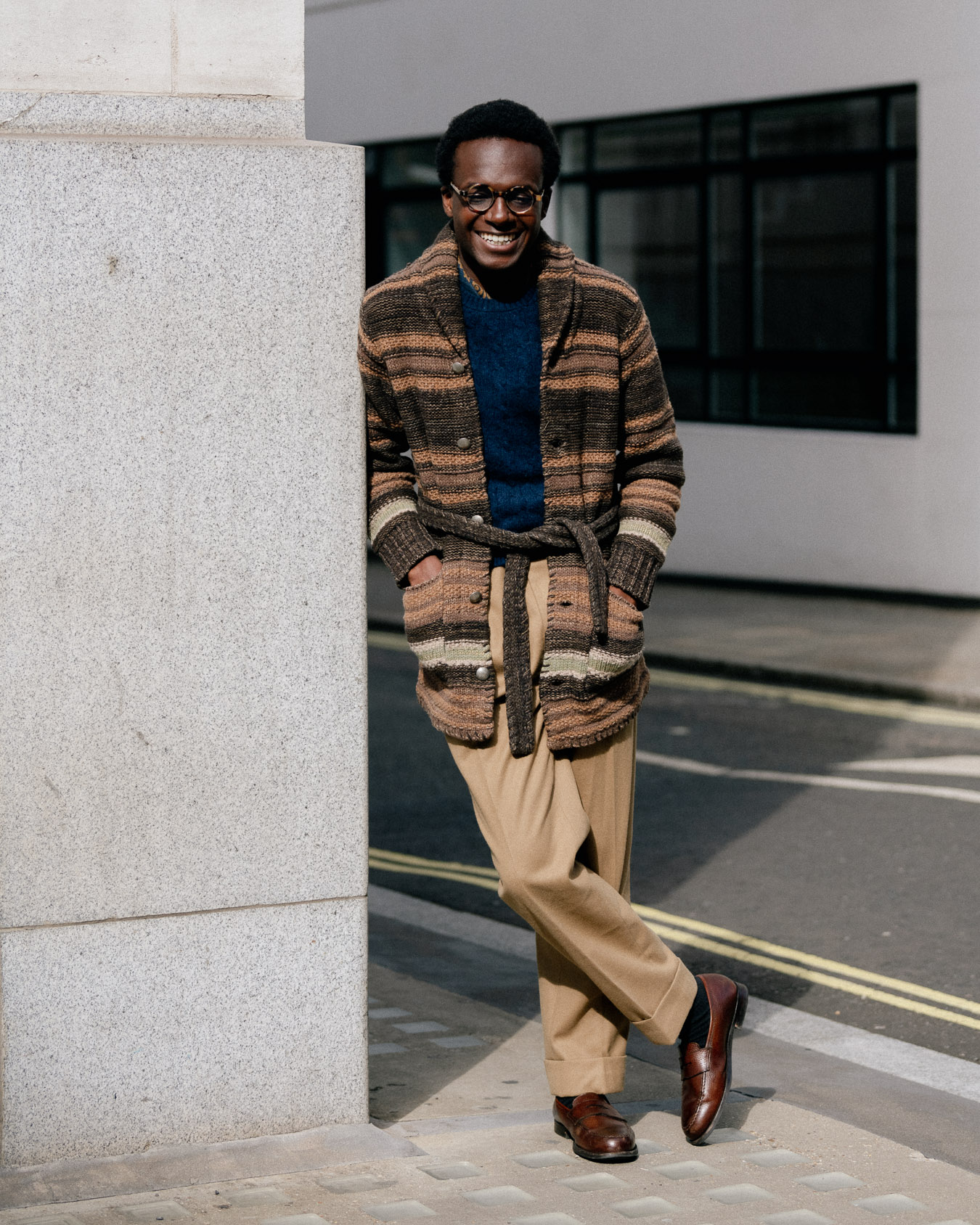
Is that RRL, your lovely cardigan in the next outfit?

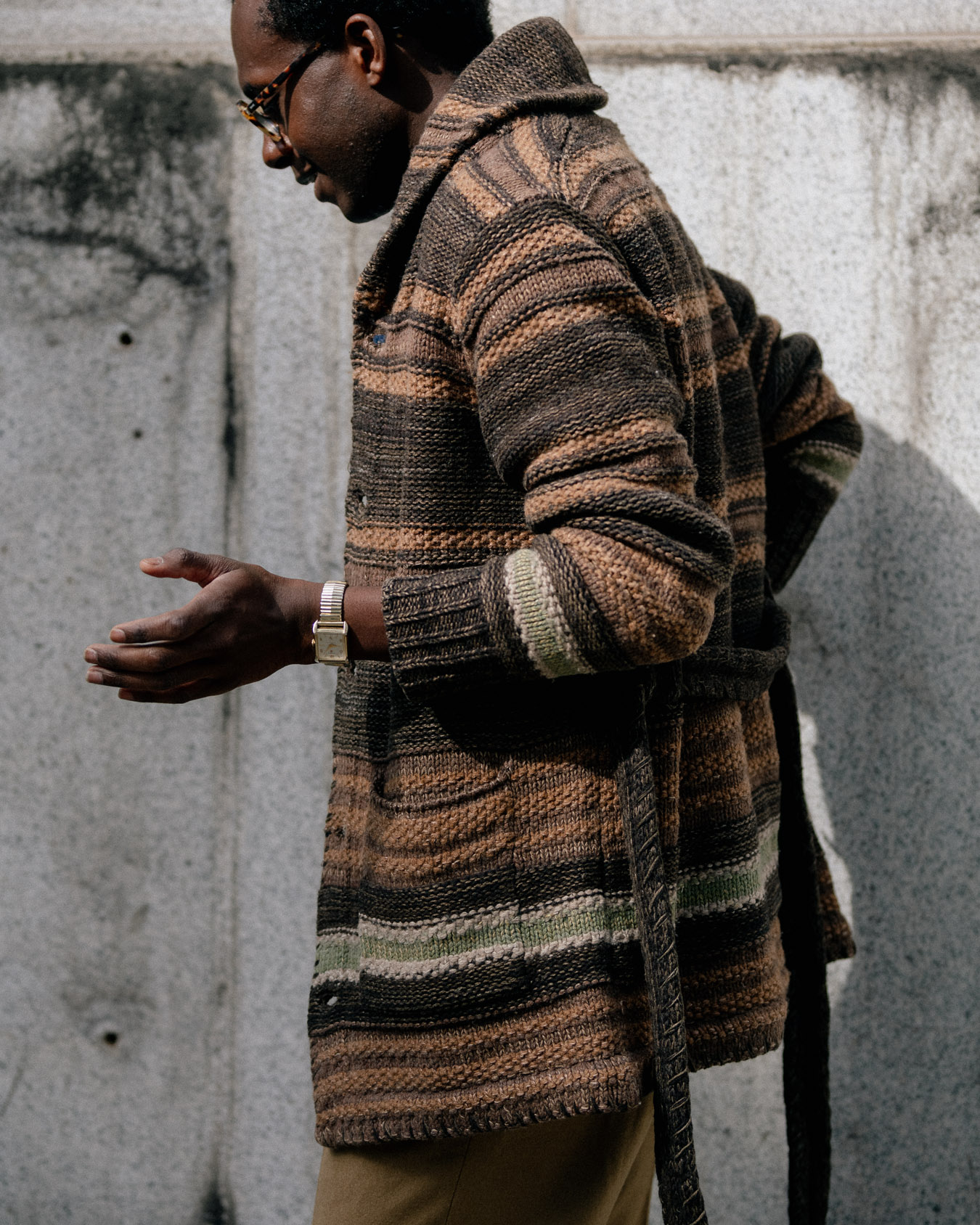
Oh yes, I love that thing so much, and it’s the one piece of RRL I’m lucky enough to own. It’s not the hand-knitted ones, but it’s still lovely. It’s wool but with some silk too; the colour variation is lovely; and the concho buttons have this satisfying ping whenever I take it off. 

I’ve had it almost two years and while it looked a little aged at the start, it’s really nice and worn in now. I shove things in the pockets – not just my hands, but books, anything. If it’s not cold enough to wear a coat, then I just wear this, so everything goes in those pockets. 

Is it hard to get the right size in slouchy things, given you’re smaller?

Yes – any bigger in this cardigan and it would have drowned me. But it’s just right. It fits on the shoulders, which is the main thing, and then it doesn’t matter if it’s a little long. 

Shawl-collar cardigans are great too, I’d love more. They frame my face, they feel cosy, you can wear them over shirts, T-shirts, knitwear, anything. 

Do you often layer knitwear like you’re doing here?

Yes a fair bit, and this combination of a cable-knit jumper, trousers and loafers is my absolute go-to in the morning. You know everyone has something they just turn to when they have no other particular ideas? This is mine. 

I wear the cable knit with a bandana if it’s cold, but otherwise not. And I wear a jacket, coat or cardigan over the top. It’s a base outfit that takes me anywhere, and is good for anything. 

I notice you rarely wear shirts under jumpers like this one. Is there a reason?

I just don’t like myself like that. I think maybe because it looks a bit old, and a bit clean-cut? It looks great on other people, but it makes me look like someone I’m not. 

I’m only 26, and I feel a button-down under a crewneck ages me 10 or 20 years. So I wear the cable knit on its own or with a bandana instead. 

The trousers are Edward Sexton, in a camel Fox flannel, and the shoes are Crockett & Jones, the Boston model. 

Outfit 4: Mismatched navy

Talking about dark colours earlier on, here you are in all navy. 

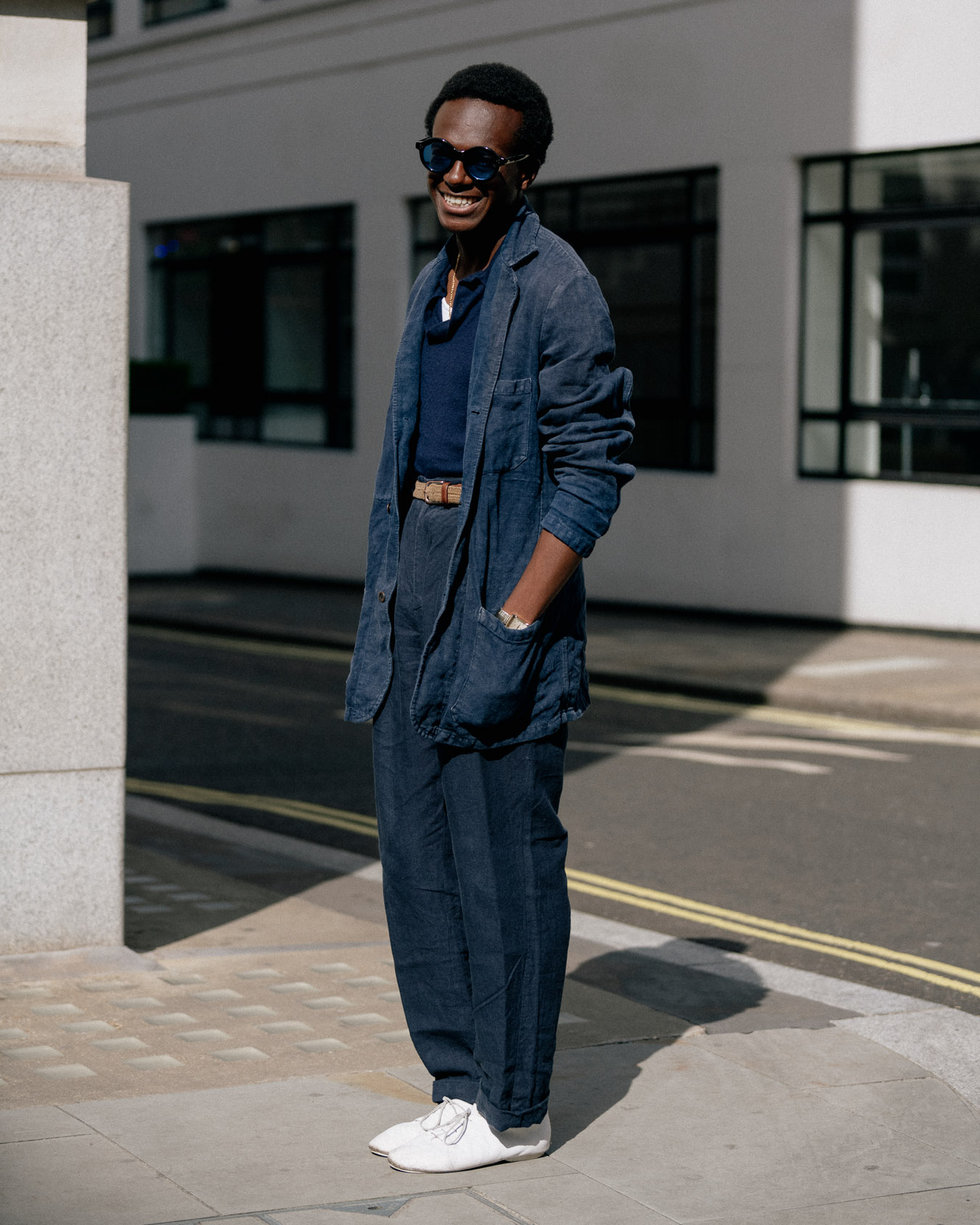
Yes I like slightly mismatched navy combinations like this. The jacket is from Vetra, bought at John Simons, and I think it looks good because of how much it’s been worn and washed. It’s the first thing I get out in the Summer – when I get those lightweight things out from under my bed (they’re kept in a suitcase). 

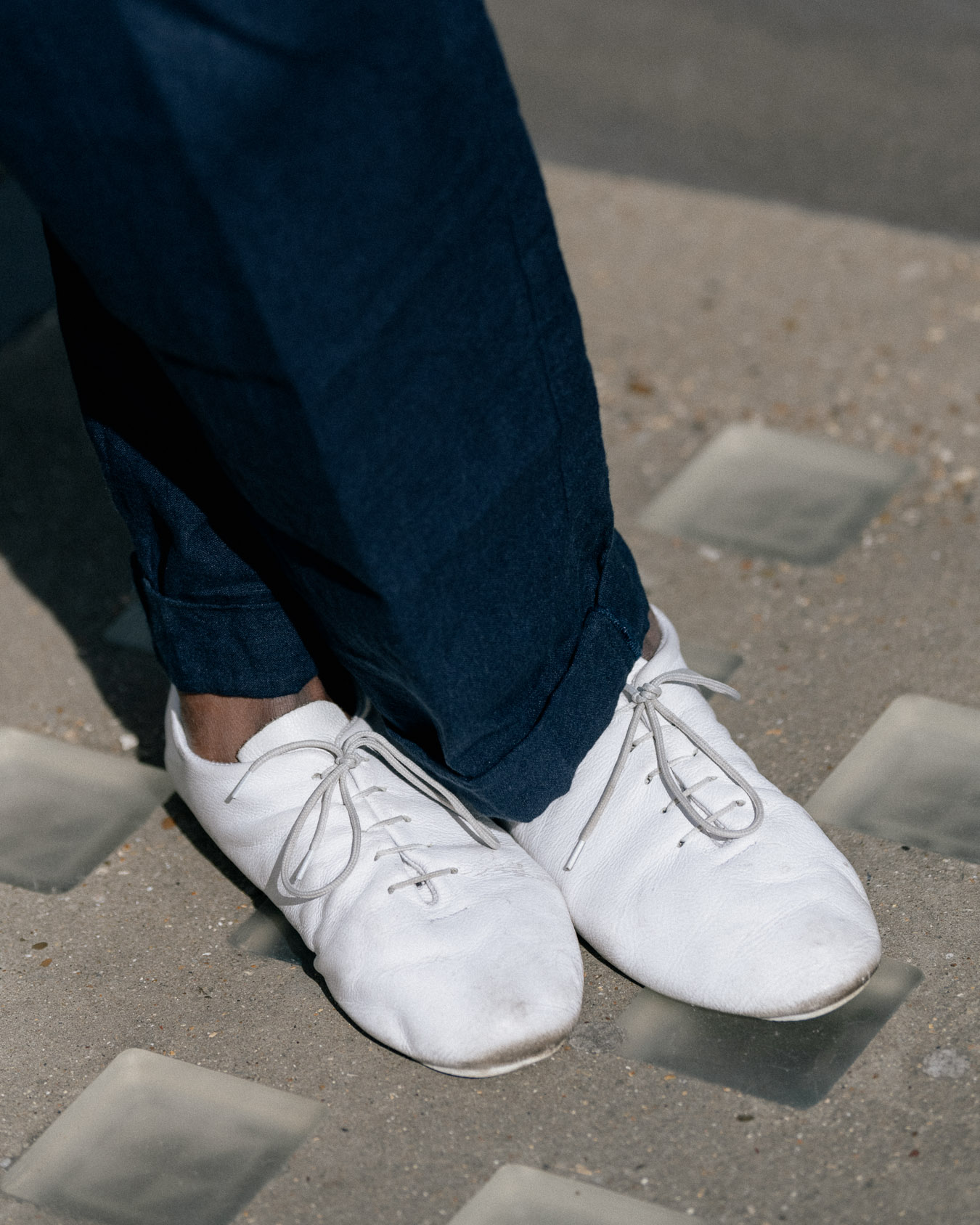
The shoes we’ve chatted about before as well – it’s the jazz/dance shoe right, from Crown?

Right, the Regent model. I got them only a year-and-a-half ago, but they’re pretty bashed up already. It’s a dancing shoe really, it’s not designed for being worn out and about. Similar to Repetto shoes, the French brand. 

They suit your style a lot I think, as they look so soft and relaxed. But I can imagine other people feeling they look a bit too much like a ballet shoe. 

Yeah, and I get teased about them all the time for that. It helps that I actually did a little ballet, so that’s some kind of comeback. 

I’m sure some readers will be able to relate to being teased a bit for their clothes. Does that ever stop you wearing things? 

Sometimes, but when it’s things that are fundamental to how I dress it’s fine, because it feels so part of me. If you feel awkward in the clothes already, or a little stiff, it’s then that you can start to feel bad. 

You wear vests a lot under shirts and knits as well. That’s something else that I think people can be nervous about, thinking it makes them look like some kind of lothario. 

It’s weird, I’ve gone through stages with vests. When I was a kid, I wore them all the time. My background is Ghanaian, and everyone in that community wears them. Then when I was in my teens, I didn’t want to wear them anymore, because they made me feel like my uncles. 

Then about three or four years ago, I put one on instead of another undershirt, and it really worked. To be honest, I’m not sure how I feel about it in the UK – how do you feel? I know you wear them sometimes.

I guess I like it just peeking out of a shirt, so one more button done up than you have. But I think that’s about recognising who you are and your style too – if they had that heritage for me, as they do for you, I might feel differently. 

To be honest, most people where I come from would cover them up, but I think you’re right that that makes a difference. Plus, I do think it has a little sex appeal, hard as it is for a guy to say that. 

Outfit 5: Navy and black

So many great themes coming up. OK, so last outfit. We have mismatched navy again, and the undershirt. The same black loafers as outfit one as well – do you ever wear brown shoes?

Not really. So many people seem to think black leather shoes are formal, but they don’t feel like that to me, at least as a loafer. And I used to think that they couldn’t go with everything, but they do.

There’s probably some light shade of brown that they wouldn’t work with, but I honestly can’t think of anything else.

Is it a little bit a function of what else you wear?

Yes perhaps. I also wear them with military tan, but there might be a stronger khaki shade there that wouldn’t work. But I just think black looks so much more sexy and elegant than brown ever did. That might also be associated with drama school. 

How so?

It’s weird. We were just always told to wear black. Because it’s neutral, because you’re there to learn and to perform, not to be noticed for your fashion choices. And I was getting into menswear at the time anyway, so I had black and brown shoes (and hats, and lots of other silly things I won’t get into). 

Over time that kind of bled into what I liked, and I’d wear for example a black rollneck, because it would mean I wouldn’t have to change when I got there. It was New York too, so it was probably part of the feel of the place. 

When I moved here and started working in menswear, it was all about brown. But I just don’t like brown shoes – sorry, but it’s true. I’ve got the exact same shoe in brown calf, and they’re killing me, because I haven’t worn them enough for them to wear in. 

Where is everything else from?

It’s the Lardini jacket that you could just see in the first outfit, a baby-cord shirt from Camoshita, and vintage navy trousers. 

Cheers André. 

Photography: Alex Natt @adnatt, except images below, Ralph Lauren and Adret

Adding interest to a navy blazer and grey trousers 

Adding interest to a navy blazer and grey trousers 

||- Begin Content -||

We used to do a lot of posts called ‘Reader questions’. Someone asked recently what happened to them. 

Well, we still do them - it’s just that the site is now so big that posts normally reflect a half dozen readers asking similar things. Today’s post is an example. 

In the comments to the post ‘Flash vs fuddy’, a few readers asked how to make more standard outfits - those neither flash nor fuddy - more interesting. Another reader then asked, on a separate post, specifically how to add interest to the ‘menswear uniform’ of navy jacket and grey trousers. 

I have a couple of more obvious, general points, before illustrating some specific options around shirts. 

Quality and cut

The first point might be obvious, but it’s important. 

The things that make these conventional outfits interesting are precisely the ones that I’ve been banging on about for the past dozen years: quality and cut. 

If you want to look good in tailoring, don’t wear a double-breasted jacket, a pinned collar and double-monk shoes. Get quality shoes that look better as they age, good trousers that flatter your shape, and a quality jacket that’s been made for you. 

This doesn’t have to be expensive. Most people don’t look after their shoes, have their trousers adjusted, or buy flattering styles of jacket. Do all three and you’ll be better dressed than 99% of the population. 

Then, buy quality when you can afford to. Slowly and intelligently, buy fewer clothes but the same amount of money. The effect will be telling - especially where materials make a big difference, as with shoes and ties.

Shirts one: Add pattern

While you’re waiting for that policy to take hold, you can experiment with some little changes around the jacket and trousers. 

Shirts are by far the easiest way to do this. You’re unlikely to be wearing a handkerchief in your pocket these days, and may not be wearing a tie. A scarf is a great option without those other two decorative pieces, but decorative scarves aren’t for everyone either. 

There’s knitwear, but that’s weather dependent, and there are options around shoes. I particularly like black suede, for example, as a way to shake up a pretty conventional, formal outfit. But there aren’t many more options than that. 

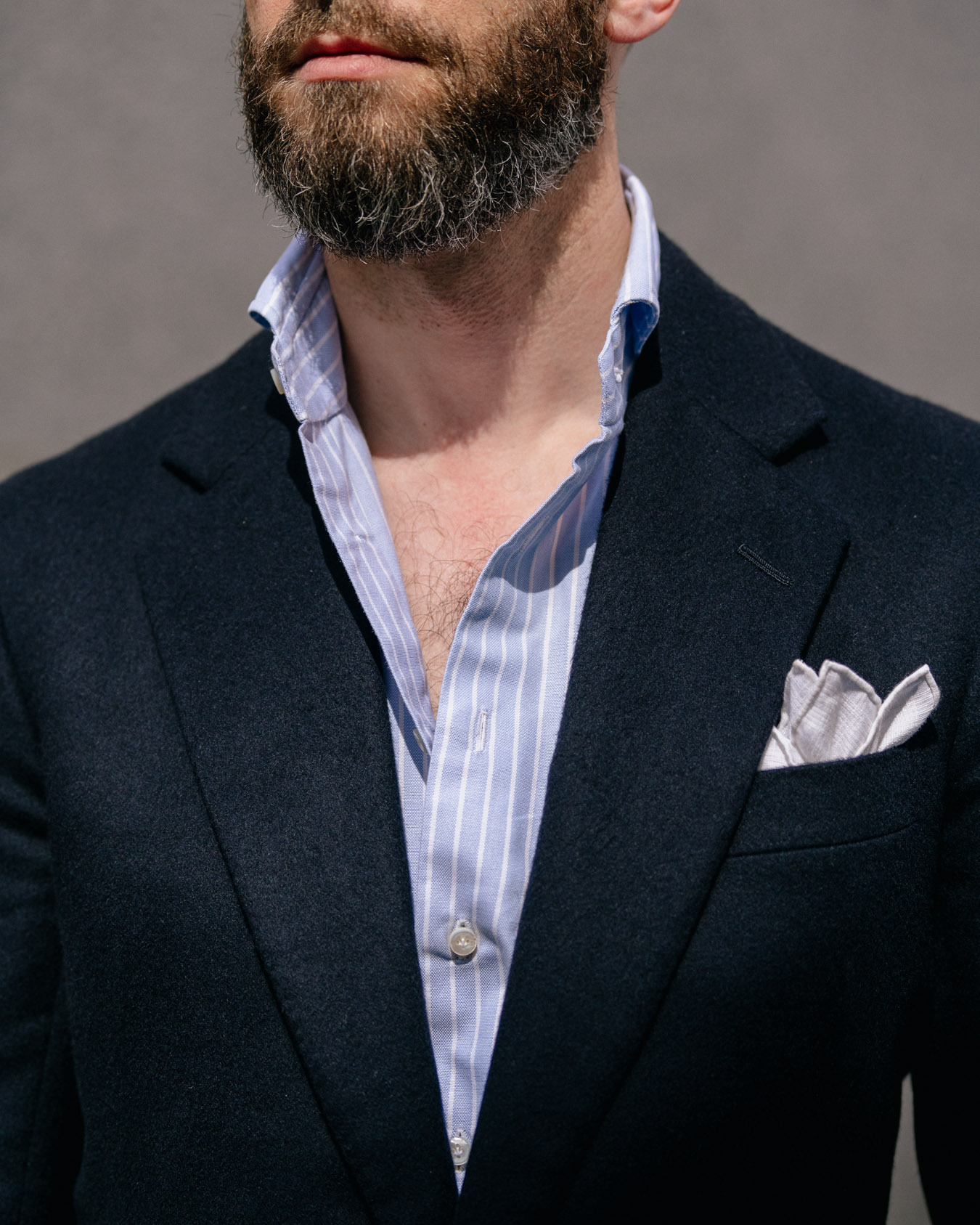
So, shirts. First option is a nice stripe, like the ‘shadow stripe’ pictured above. This pattern is nice because it’s not too bold, as an awning stripe might be, nor something that looks like it’s still missing a tie, as a hairline stripe can. 

If you want to go less corporate, pick a coloured stripe instead. Swap the blue above for a lilac or a pale green. 

Shirts two: Texture

Second option: change not the pattern, but the texture. 

This is our old friend the denim shirt. (It’s a very old friend of mine, being an eight-year-old shirt from Al Bazar that’s literally falling apart at the seams. About two years ago the dissolution had an old-world charm to it, redolent of frayed cuffs and faded carpets. Now it’s just as mess, but I haven’t found a replacement I like. So it’s the only example we have.)

I shouldn’t have to tell readers why denim is nice here. But as briefly as possible: it’s the same colour as a business shirt, but a different texture; its associations are of workwear rather than formalwear; so it’s a little unexpected with fine tailoring, which subverts it pleasingly, if subversive is what you’re after.

Denim adds personality, basically, which was the desire of all the readers that brought this subject up. 

If you want more personality, less corporate, less smart casual, you can add more design details to the denim shirt or change the smart blue colour. A Western shirt - with all its points and snaps - would have more details (see here). A darker denim or chambray shirt (see here) would change the colour. 

Shirts three: Dark colour

Which brings us onto option three, where we ditch the business blue and go to the darker end of the colour spectrum instead. 

Navy on navy still looks elegant, but less formal. I wear it a lot, probably too much in fact. It’s just so easy yet no one else seems to be doing it. (That I see in person, not that I see in my echo-chamber of a social media feed.) 

Here the navy is an old version of the Friday Polo - our heavy cotton-piqué shirt that Permanent Style first offered back in 2015 (which launched with, I now realise, me wearing navy on navy). 

The colour change makes this an interesting option, but we have the change in texture as well. The cotton piqué immediately suggests sport, activity. And this colour even fades a little over time, in some of the same way as the denim. 

And four: Knitwear

Final option. Not a shirt at all anymore, but knitwear. 

The impression knitwear gives under a jacket - at least in my head - is one of relaxation. It just looks soft and comfortable in there. 

The material is soft, the edges soft. There’s no sharp cutaway collar or tight little tie knot. The appropriate activity is lounging in a club chair, not (like the polo) swinging your arms at a tennis ball. 

And it certainly looks interesting, which again is the whole point of this. 

In the US, I’ve noticed, there is a tendency for security guards to be given a uniform of navy blazer and grey trousers. 

First of all, I’d like to say, be grateful for what you’ve got. I wish guards in the UK were granted at least this semblance of seriousness by their employers. 

Second though, I do see how the prevalence of this look could make guys a little less keen on the ‘menswear uniform’ of blazer and flannels. It’s like wearing a cream jacket to a restaurant where you realise all the waiting staff are wearing cheap, synthetic versions of the same thing. 

But still, I do feel that the combination of quality, cut and options one through four should sufficiently separate the elegant man about town from any security staff. Perhaps the knitwear most of all. 

And there are plenty of other ways to add more personality, if that's what you want. That's where things like jewellery come into their own.

Do please tell me if you disagree, or indeed have any other helpful suggestions. Those from other readers are always at least as useful as mine. 

Clothes shown:

Photography: Alex Natt @adnatt
Below: some other old examples from PS of navy jackets and grey trousers


Why has Italy been so influential?

Why has Italy been so influential?

Friday, August 13th 2021
||- Begin Content -||

The reason Milan became the centre of Italian fashion was Florence and Rome couldn't sort out a fight. 

Italian clothing itself became successful abroad because people were tired of the 'haughty, arty' French. 

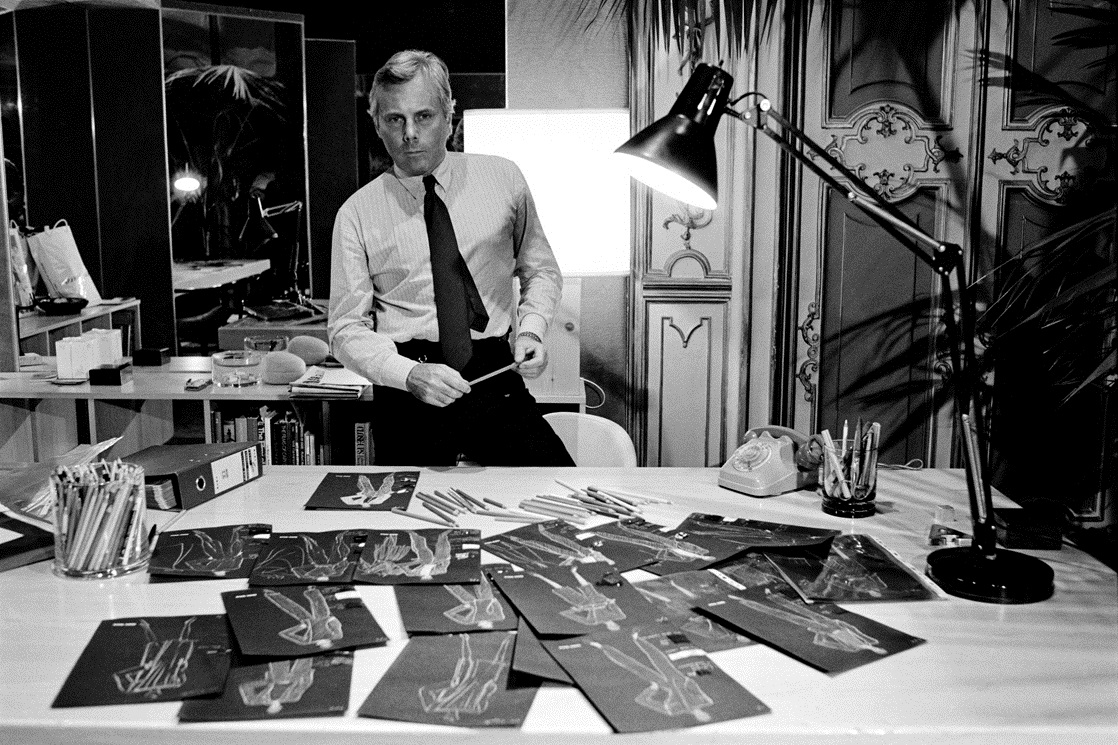
Spurred by our recent discussion of Armani (below) and his degree of innovation, I've been reading more into the history of Italian fashion, and found it rather interesting. 

Speaking to some Italian friends, many of them weren't aware of this background either, so I though it would make a nice article. 

The easiest thing to forget is how recent the advent of ready-to-wear fashion is. 

In Italy it was particularly late, only starting in any way after the Second World War. There was production of textiles and leather goods (Ferragamo, Gucci) before then - and of course couture and bespoke tailoring - but no real industrial production. 

That changed with Italy’s extraordinary growth after the War, and particularly in the 1950s and early 1960s. That was when Italian designers first started to emerge, initially couture (Capucci, Simonetta) and then women’s ready-to-wear (Valentino, Missoni). 

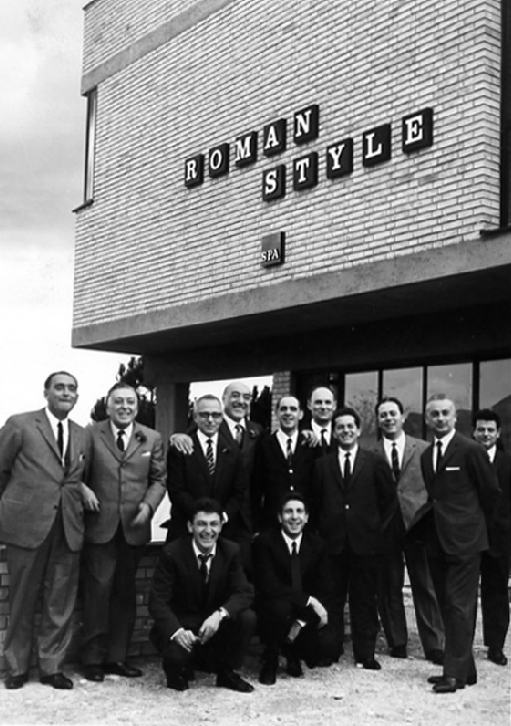
It’s no coincidence that so many of the Italian companies we’ve covered over the years on PS, from Bresciani to Bonafé (below), were founded in that period. 

I find it particularly interesting how the style of Italian clothes at that time is described. In many ways you could use the same terminology today. 

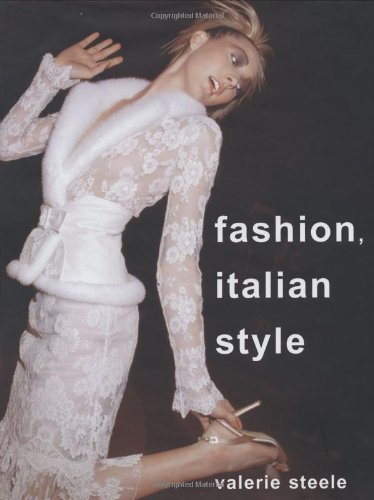
In the book Fashion, Italian Style, which accompanied an exhibition at FIT in New York in 2003, Valerie Steele writes: “Deeply ambivalent about French high fashion, Americans ardently embraced the casual elegance of Italian fashion.” The clothes are described in Newsweek at the time as “for real people - albeit rich people - to wear to real places” and as “refined sportswear”.

We’re talking about jersey dresses and pumps here - and for men, lightweight tailoring from the likes of Brioni - so it’s a long way from what we think of as even old-fashioned sportswear. But still, the Italian attitude - in contrast to the British as well as the French - has been quite consistent ever since. 

This ‘easy elegance’ of Italian fashion seems ubiquitous now. It’s the foundation for nearly all tailoring we see, from designer brands to the high street. And for anyone that has grown up in the past 50 years, it can seem like that’s always been the case. 

But it was the first real challenge to Britain’s menswear hegemony for centuries. And the growth of ready-to-wear allowed it to take over remarkably quickly. 

First was the growth of Italian couture, in contrast to the cerebral French; then ready-to-wear that felt easy and accessible; and finally the big designers of the 1970s and 1980s, Armani (below) and Versace, followed soon after by Prada and Dolce & Gabbana. 

So why was Italian fashion so successful? 

It’s easy to generalise about the culture, to talk about dolce vita and la bella figura. But that’s a long way from explaining everything, even if it explains something. As the Neapolitan writer Luigi Settembrini said, Italian style is a question “constantly in danger of foundering on the stereotypical reefs ‘national characteristics of peoples’”.

What’s more certain is the fundamentals of craft and regional specialisation that Italy had. Even before clothing production started, Italy was where couturiers went to source the best lace, silk and other textiles, as well as bags and shoes. 

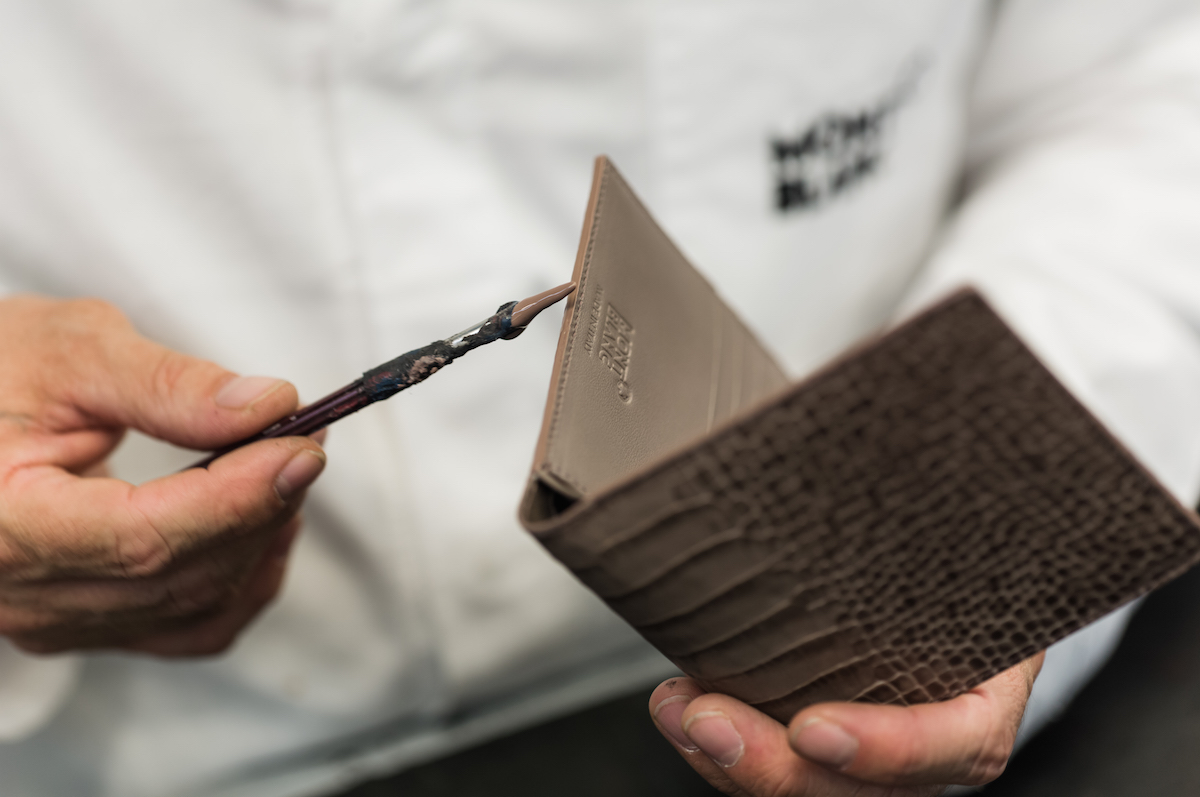
Of course, this is an element we’ve covered on PS over the years. There’s the weaving around Biella, making use of the waters coming down from the Alps. The leather work in Tuscany (Mont Blanc visit below), originally based off local cattle production. The silk around Como, and so on. 

As Steele says: “Creativity is universal, but that marriage of traditional craftsmanship, innovative design, and modern industrial technology is rare.”

Italy’s specialisation and small workshops laid the foundation of the success of ready-to-wear in the 1960s and 70s. What’s striking today, 50 years later, is that a lot of it still remains. Certainly compared to the UK and France. 

A friend who runs an Italian mill commented to me recently: “Everyone complains that production is moving to China. And it is. But there’s still so much more left here that elsewhere, and we need to remember that so we preserve what we have left. China is getting more expensive every day.”

As a journalist, you only have to visit the mills around Huddersfield, and then a behemoth like Ermenegildo Zegna or Vitale Barberis Canonico (below), to see how much Italy still has to lose. 

There are quite a few good books on Italian fashion, even if most of them focus on womenswear. They include The Origins of Italian Fashion (Sofia Gnoli) and Italian Fashion since 1945: A Cultural History (Emanuela Scarpellini). The bio on Brioni, Gaetano Savini, the Man Who Was Brioni (Morelli, Della Cagna and Finamore) is also nice visually.

I found Steele’s FIT accompaniment the most accessible, however. It has lots of illustrations, not too much academic detail, and good contextual quotes from contemporary media. It’s still mostly womenswear, but that’s inevitable. 

One story in it that I found entertaining was the explanation of why Milan became the centre of fashion. 

Italian fashion was born in Florence. Giovan Battista Giorgini organised the first show for Italian couturiers at his villa in 1951, and a year later the first grand show took place at Palazzo Pitti. (How many guys going to Pitti every year realise that this was effectively the birth place of all European fashion?)

Unfortunately there were more couture houses in Rome, and soon after the first Florence show a group of designers defected to their own Roman version. This split maintained for a few years, forcing buyers and media to choose between them. 

That opened the way for Milan. As ready-to-wear became more prominent, the industrial city became a focus for production and boutiques. Soon fashion shows started moving there, and within 20 years Milan became a fashion capital, despite not having the same cultural or artistic heritage. 

In 1952, American Vogue declared that “Italy is capable of producing a kind of clothes which suit America exactly...Namely: clothes for outdoors, for resorts...separates.”

Twenty-six years later, the same relaxed elegance was still being picked up on. Newsweek reported that Italy was popular because buyers were “weary of French fantasy clothes” and Italian RTW was “classically cut but not stodgy: innovative but never theatrical”.

A few more decades on, and I feel the characterisation still generally holds.

There are certainly Italian brands that tend towards the dramatic, and ones that are no less arrogant than anywhere else. But easy elegance is still something we turn to Italy for. 

The biggest change in the past 20 years has probably been the bleeding of cultures, as the internet has brought everyone closer. Swedish and Japanese brands are doing things in just as chic and relaxed a manner.

But they all owe a big debt to the past 50-plus years of Italian style. 

Books included in this article below. References, quotes and information also taken from various PS interviews over the years.

Adret ‘Jack’ bomber jacket: Review

Adret ‘Jack’ bomber jacket: Review

Wednesday, August 11th 2021
||- Begin Content -||

Although there has been quite a bit of coverage of Adret in the past two years (including on PS), pictures of the clothes in the wild are rare. 

I thought it would be useful to shoot my most significant purchase from Adret, therefore, and reflect upon it. That's the Jack bomber jacket in worsted wool, pictured below. 

(The other purchases were a thermal top, a pair of sandals, a handkerchief and a scarf. I comment on those briefly at the end of this piece.)

The Jack bomber is a short, casual jacket whose most unusual aspect is probably that it is entirely tailored. 

It's more common for blousons and bombers to be elasticated at the hem, and therefore sit on the waist, letting the rest of the body flow out above. Most that are not elasticated simply drop straight, rather than trying to taper into the waist.

This does taper, with a pronounced dart on either side of the hips at the back rather than elastic. I think it’s this lack of ribbing, combined with a material that you’d more commonly find in tailoring, which makes the jacket look quite smart and unusual. 

The material is an old Vitale Barberis Canonico wool, which appears to have quite a lot of texture due to the mixture of black, brown and olive yarns in the weave. It would make a nice sports jacket. 

The tailoring feel continues with matte horn buttons up the front, each sitting on a good shank, and pleasingly functional hip pockets. 

On most good sports jackets, the flaps of the pockets can be tucked neatly inside, leaving a clean, jetted finish instead (see below). This can be useful if you need ready access to them, or simply want to change the style.

Yet it’s rare for casual jackets to do this, presumably because it’s quite a fiddly job. The only bomber or blouson I own that has that feature is from Loro Piana. 

One of the questions people ask about Adret is what the quality is like (presumably because of the high price).

I think it’s more useful to judge that on considered touches like this, rather than simple things like precision of stitching, which should be a given. 

The cut of the jacket is pretty roomy, which anyone who has followed coverage of Adret will not be surprised by. 

As I think these pictures show, though, the chest is generous but not oversized. Other styles of jacket, such as an old bomber or a varsity jacket, would be bigger. 

What is noticeable is the size of the sleeve, which is large in the upper arm and tapers significantly below the elbow (shown below). This I think is very effective. It makes the jacket look flatteringly big but without any sloppy dropped shoulders or excess material. 

The knock-on effect is that the Jack really looks better with other loose-cut clothes. These are some of my wider linen trousers - from Edward Sexton, 9-inch hem - and yet they don't look wide here. 

It has been asked whether Adret is a ‘whole look’ brand, where you really need to buy all the clothes together. 

I don’t think you do, but Adam (Rogers, co-founder) does have a particular aesthetic, which means certain silhouettes and certain colours. The clothes will always look best with other pieces with the same outlook. 

This jacket, for example, would look unbalanced with skinny jeans, and a rich, vibrant top would be out of place. It’s much better with wider trousers and muted tones.

My combination here is particularly restrained, which I guess is typical of me, particularly when I’m trying out new clothes. It doesn't have to be as dull as that - the Adret range includes a huge range of colour, from pink to yellow to green. But they're all similarly pale or muted. 

In these photos I've worn the jacket with two different tops, to show it can switch between being a little smarter and perhaps a little younger or contemporary. 

I would guess most PS readers are likely to wear a jacket with a collared shirt or sweater, like the black Dartmoor above. This certainly looks more put-together, and flatters me more when the jacket is removed. 

But I probably prefer the look at the top of this article, with just a black knitted T-shirt underneath. It looks more modern, and perhaps more relaxed too. 

Interestingly, the collar of the Jack bomber works quite well when it’s up - staying up at the back and dropping down at the front - but it’s not a tall collar when folded down. It can look a little small with just a T-shirt underneath. 

So to the issue of price. The Jack bomber was £1600; the linen version £1200. This is on a par with any designer brand, and very expensive for the kind of start-up we normally cover.

The defence is that Adam and Seto (the other co-founder) have invested a huge amount in their workforce in Indonesia, their livelihoods, workplace and training. The shop in Mayfair is one of the loveliest you will ever visit, and cannot have been cheap. 

More importantly, Adam has created something genuinely distinct in menswear, and beautiful. The former should be recognised and rewarded by anyone that cares about clothing, while the latter will always be to particular people, priceless. 

It is modern, easy and elegant. That’s the way they describe it, and I think it’s true. 

But the price remains a barrier. For me, it means mostly that I can’t afford to buy much. I’ve bought the pieces I have both because I love them and because I want to support Adam and Seto, but if they were less expensive I would certainly have bought more. 

Those others pieces, by the way, were:

  • Fellows sandals, which are great but I bought the size too small. Currently considering putting money aside for another pair. 
  • Yellow handkerchief. A great example of Adam’s sense of colour. A soft, buttery yellow cotton that is wax-resist dyed and looks much more sophisticated than the more common bright silks. 
  • Indigo scarf/bandana, which I love for the same reasons.
  • Cream thermal top, in knitted cotton. A great piece too, but I find it too like a thermal to wear on its own, so it’s restricted to layering under things. 

Images of all those at some other stage. Also featured in this article are black-suede Alden LHS loafers and my Frank Clegg large working-tote bag. 

Photography: Alex Natt @adnatt

Are bespoke shoes worth it?

Are bespoke shoes worth it?

Monday, August 9th 2021
||- Begin Content -||

Every time I do a review of bespoke shoes, the question comes up as to whether they're worth the money. Whether bespoke shoes in general can really be worth it, given the little issues I often report. 

My short answer is that, in my experience, they are not worth it unless you're in for the long haul. 

Don't commission one pair of bespoke shoes, from a famed and distant craftsman, and expect them to solve all your issues. It's very unlikely. 

I've overheard so many guys talk about dreaming of using a maker - usually Japanese - and how everyone says they're the best. That those shoes will finally be perfect (unlike the others they've tried). It's hard to hear.

However, I do think bespoke can be worth it - and highly pleasurable - over the long term. If you work with one maker for a while, and will regularly need dress shoes, then it can develop into a really effective and enjoyable experience. 

The real issue is that modern society is not set up for that kind of relationship. 

The reason the famous shoemaker is unlikely to make you a perfect pair of shoes is that sculpting a pair, from scratch, to fit your particular feet, is surprisingly hard. 

Much harder, in fact, than making a beautiful pair of shoes - and yet it's the aesthetics most people focus on. 

Even among those in menswear, it's surprising how many talk about really ill-fitting shoes they've had from big names, which they'd never admit publicly.

These are nearly always a first pair. When I've used a shoemaker multiple times - as with Stefano Bemer for example - the fit has always improved on the second pair, and even on the third. 

I must emphasise though, the fit has nearly always been better on the first pair than most ready-made shoes. So it's still a good fit. It's just not perfect. 

Perfection comes slowly, because fitting is tricky. You can't see how the foot is inside the shoe (unlike tailoring); you can't adjust the fit much after the shoe is made (unlike tailoring); any issue with fit can cause actual, excruciating pain (unlike tailoring). 

Plus, as some shoemakers say, you have to 'fit the mind as well as the foot'. People vary in how they like shoes to fit, but they don't necessarily realise how they're different. And even if they do, they've probably never had to communicate it. 

When men wore dress shoes every day of the week, and rarely used more than one maker, this didn't matter. 

Within two or three years, you'd have a great last and could order shoes made on it any time you wanted. That would be your experience for the rest of your life, for decades.

You also had a maker that knew you personally, that would be very good at repairing and refurbishing their own shoes, and so on. Fashions also changed less, so there was less risk of shoes looking out of date. It still happened (old industry magazines show that clearly) but a lot less. 

There are many reasons that doesn't work today. Men wear fewer dress shoes; they want to try more makers; fashions change more; it's less likely the maker is local; and, relative to the income of the guys that aspire to them, the shoes are more expensive. 

(They're actually probably cheaper relatively than they used to be, but everyday working Joes like you and me didn't used to shop at top West End makers.)

Even with all this, bespoke shoes today can be wonderful.

Making them is both an art and a craft. 

It involves actual sculpture, for God's sake - sculpting of an artistic, idealised form of your foot in the shape of a wooden last.

The skill of then making them is an amazing combination of strength and delicacy. Tiny stitches made by calloused hands. 

And the resulting object is also a piece of art in itself. There is no other area of menswear where some people actually buy the shoes to look at them more than wear them. Or where there are companies that only make versions that are works of art - that cannot be worn. 

If you do wear them, the shoes are also one of the few pieces of clothing that get better with age, that become both more beautiful and more distinct with time.

It's no wonder they can sometimes feel like a fetish.

Ready to wear is wonderful too, but bespoke shoemaking is the zenith. 

The problem is making it fit for purpose, today. 

I encourage everyone that can afford it in the long term to try bespoke shoes. But if you can, I'd recommend to: 

  • Try as few makers as possible 
  • Accept that none of those first pairs will be perfect 
  • Patronise a local maker, or one to whom you will have regular access 
  • Once you have one you love, slowly build a small collection of classic shoes, that you will therefore use and wear for a long time
  • Along the way, talk to your maker, establish a relationship

Shoemakers can help here too, I think, for example by shortening waiting times as much as possible. 

I also think an adjusted last system or RTW make on a bespoke last, rather than full bespoke, is a good option as long as expectations are managed well. 

A friend recently asked me whether he should save up for a pair of bespoke shoes. He'd had bespoke suits, shirts and invested in a lovely dress watch. But he wanted to try shoemaking.

I advised him against it. He was only ever going to buy one pair, and I couldn't help feeling, after all that money and all that waiting, that he was going to be disappointed.

In a follow-up article, I’ll walk through how I would have approached my bespoke shoe journey differently (as a regular customer).

Note: There are of course many other advantages to handmade shoes, including the strength of saddle stitching, the ability to resole more often, the fitted arch support and so on. Here I’m intending to reflect my experience and give advice, rather than go into them all. (Unlike this piece on bespoke tailoring.)

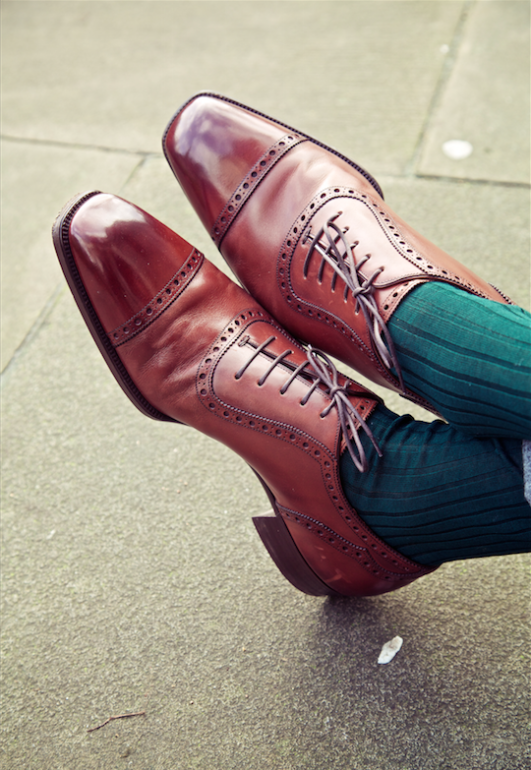
Shoes pictured, top to bottom, with links to relevant articles:

Artists’ clothing: Comfortable, practical, modern

Artists’ clothing: Comfortable, practical, modern

||- Begin Content -||

By Tony Sylvester

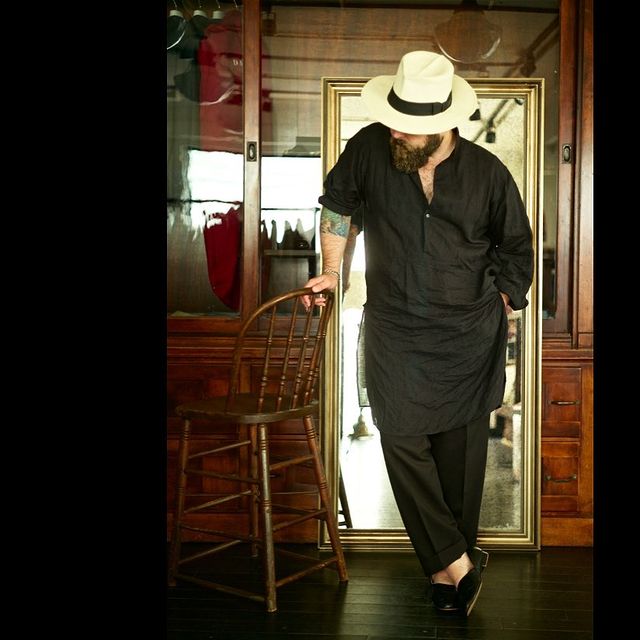
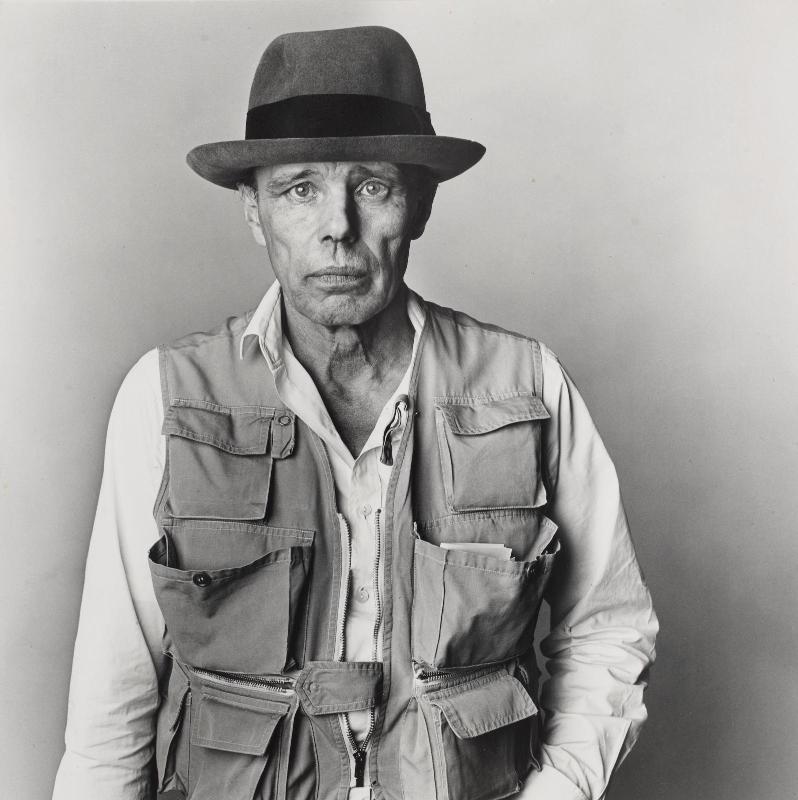
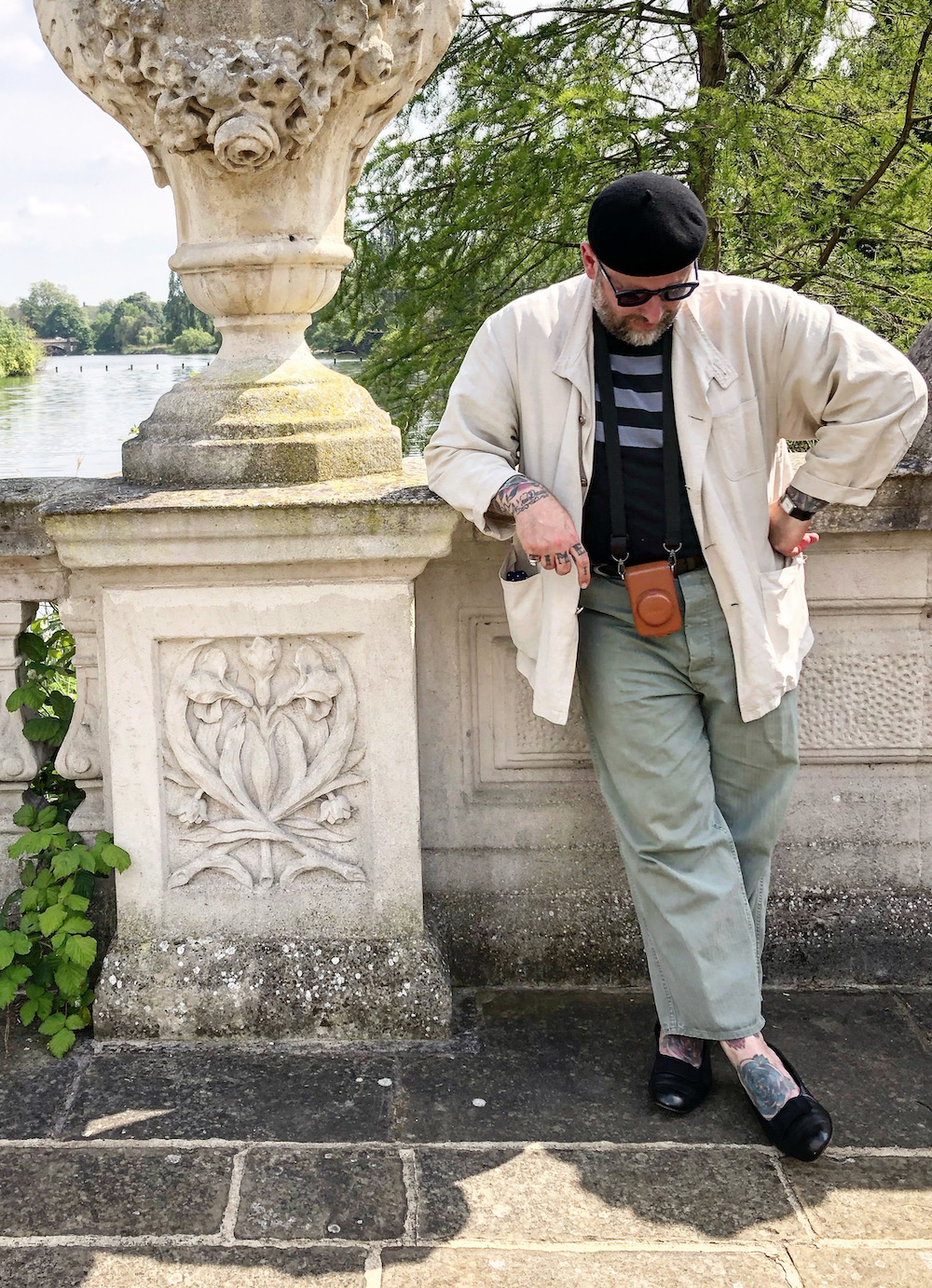
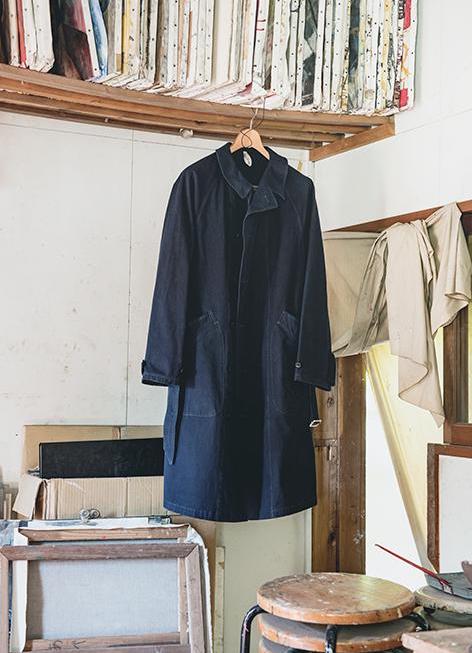
Sitting down to write today, I am wearing my favourite recent piece of clothing. Brand new from Bryceland’s, the knee-length linen Farmer’s Smock (below) might be a bit of a departure from what you expect from the design team of Ethan Newton and Kenji Cheung, but it nevertheless fits their manner of doing things to a tee. Similar to their Towel Shirt, it feels like an undiscovered item eager to be reinterpreted for the modern wardrobe, and I’m all in. 

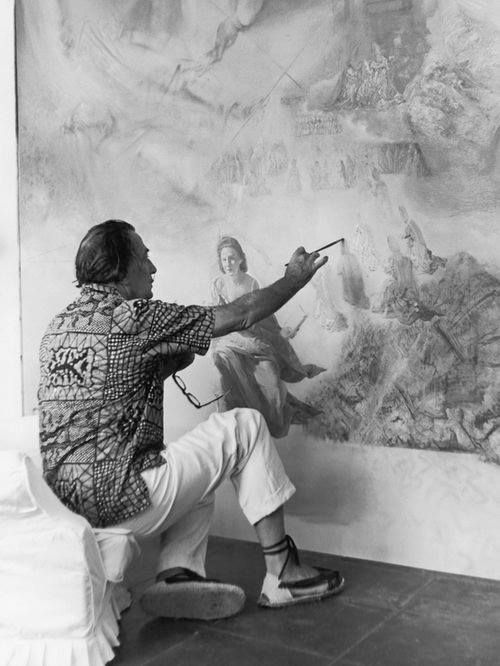
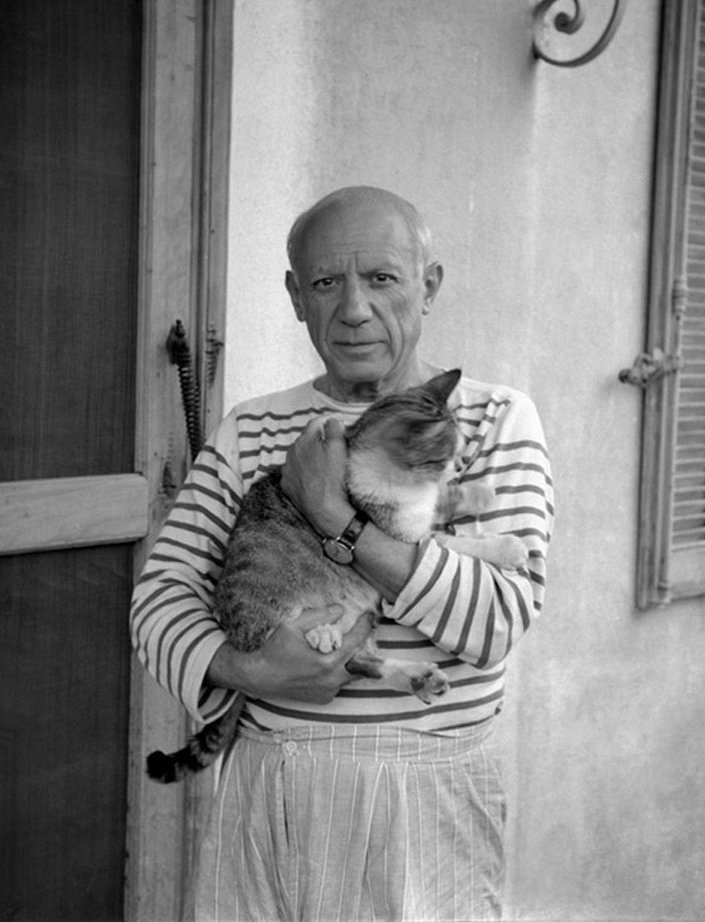
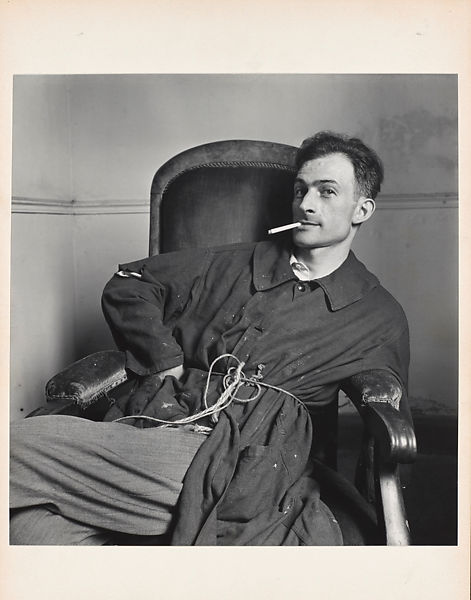
Despite the modest name that reflects its humble origin, the smock feels Bohemian in spirit rather than workaday. All the elements of the piece, from the bib front and stand collar to the gathering at the cuff and yoke, put one in mind of a fin-de-siécle painter more than the French labourers who originally wore such garments. But maybe that’s no surprise, considering how ‘workwear’ has been co-opted by artists over the years. 

I've tried the smock loose and billowing over old beaten-up jeans and paired with sandals one day, and tucked into a pair of high-waisted black-linen trousers with Belgian loafers the next, highlighting its similarities to a dress shirt. Or simply with pyjama shorts and grecian slippers, as today. 

In the chapter ‘Dressing like an avant garde artist’ in his superlative A History Of Men’s Fashion, Farid Chanoune notes that at the turn of the Twentieth Century, “a metamorphosis occurred under the triple aegis of youth, sport and art”. The beginnings of this modern age were driven by a new creative generation, weary of the old world. 

How did they dress? They “drew on workers’ and tradesmen’s attire - corduroy pants, blue smocks and overalls” in an effort to break free of bourgeois notions of class.

It didn’t hurt that workwear was both comfortable and hard wearing as well as being ‘of the people’; this was a functional as well as a creative choice. 

This legacy is still with us today. I’d wager a lot of readers can get away with wearing navy ‘chore coats’ based on bleu de travail to meetings instead of sports coats or suit jackets, which to me speaks to the association with artists rather than the jacket’s workwear origins.  

I am fortunate enough to have never had a job that demanded a code or uniform - at least since stacking shelves as a teenager - so dressing has always been a question of personal aesthetics rather than a regimen. I have been lucky to be able to create my own image. With this in mind, I have purloined much from artists when it comes to my wardrobe. 

I’ve pilfered Picasso’s Orcival Breton Stripe (above), Joseph Beuys’ Lock & Co felt fedora (also above), Dali’s laced espadrilles (article top) and Jackson Pollack’s Weejuns (bottom of the article). But probably none have taken such a prominent spot in my wardrobe as the Forestiere jacket by the sadly defunct Paris brand, Arnys (below). 

Originally commissioned by the artist and architect Le Corbusier in 1947 as a uniform jacket, he took as the starting point the classic French gamekeeper’s moleskin or cord jacket (in this case one worn by Gaston Modot in the 1939 film La Régle Du Jeu). 

Simplifying its construction, he added a mandarin band collar, patch pockets, elbow pads and a kimono sleeve for ease of movement. Over the next 50 years, the Forestiere became a French ‘Bobo’ (Bohemian Bourgeoisie) staple,  beloved by politicians and men-of-industry alike. 

My cream-linen summer version (below) is simplicity personified: loose of fit and ‘worn in’ (a polite way to put it) where the winter iterations are plush affairs in autumnal colourways with contrasting linings. Mine came from the Paris-based vintage dealer Chato Lufsen, who also make a spot-on repro version called ‘La Bores’.

This is an article of clothing that can slot seamlessly into a wardrobe, taking on a similar role to a chore coat or unstructured sports jacket.

Most of the modern brands I admire give a nod to these artistic traditions, whether it’s implicit mood-board aspiration or explicit pieces named for a painter or poet.

Kentaro Nakagomi’s label Coherence is one that makes no bones about its mission: a series of seriously quality coats taken directly from portraits of 20th century artisans and writers; Duchamp, Corbusier (again), Camus and Hemingway have all featured heavily. 

One of the most eye-catching examples from the past year is the ‘Mitsou’, an oversized coat in sailcloth canvas that owes as much to a craftsman’s shopcoat as an overcoat (below, top), and is based on a particularly splattered, wrinkled and threadbare coat worn by the Polish-French painter Balthus in a portrait in 1948 by Irving Penn (below, bottom). 

I’ve always loved this photo. The defiantly louche artist reclining, cigarette in mouth, his disheveled coat tied up with string and buttoned to the throat, perhaps to keep the cold at bay in his garret.

A much more enticing inspiration for an overcoat purchase than some aristo horsing it up on the polo field. 

On this theme, the fashion journalist Charlie Porter has just published What Artists Wear on Penguin. The clean stark cover features Georgia O’Keefe’s suit seemingly floating in the void, the graphic design consciously echoing the secondary school curriculum fave Ways Of Seeing by John Berger

There is a lot of Berger’s tone in Porter’s writing here too. It has a breezy, conversational style, heavy on opinion. He elects to cover a lot of ground rather than going in depth, giving the book the feel of a transcribed lecture or a BBC4 mini-series.

It is most certainly a book about art rather than ‘style’, but its sentiments echo a lot of what we’ve discussed above. The concerns of practicality and function, the idea of dressing as role play, the symbolism of how we present ourselves to the world.

I especially enjoyed the delve into the lounge suit as the “standard of authority” in male dress - a benchmark to be subverted or accepted, as Porter puts it. 

Of particular note is the quiet surrealism of Gilbert & George’s complimentary, but not identical, check suits, and Alberto Giacometti’s “clothing of Male respectability: tweed jacket and flannel trousers” (above): a conservative sartorial choice undermined by the fit and condition the sculptor elected to wear them in. 

As Porter writes “Giacometti’s jackets have style from their spacious cut, the aged softness of the cloth, the wilful shambles that overrides any smartness, the relaxed balance of his baggy pants”. 

As a man who wears extraordinarily nice clothes in an almost inelegant manner, this resonated with me deeply.   

Playing around with white bucks

Playing around with white bucks

||- Begin Content -||

During sunny weather in the past few weeks, I've been playing around with these old shoes from Lodger, the shoe shop that used to be on Clifford Street in London, and where I first started writing about menswear

The shoes were a recreation of a 1920 tennis shoe, made in white nubuck with this extra band behind the toe cap. 

They are not white bucks - the shoe identified with upper-class society in the US (hence the 'white shoe' law firms I used to write about in my previous career), and part of Ivy traditions of menswear. 

But they're close enough to allow me to play around with wearing the style of shoe, and seeing what I like it with. 

Now in theory, white bucks go with anything. 

They're historically a smart shoe, worn with Summer suits and other warm-weather tailoring. Although they have a derby construction and usually a pretty round last, their stark white colour makes them quite smart.

Formal pale shoes are not that unusual historically, but these became the best known thanks to Ivy students that went on to wear them in their establishment careers - and popular figures such as singer Pat Boone in the 1950s. 

You see echoes of that today in fashion brands more than lawyers. Thom Browne is a good example, though Fred Castleberry is a better one. Fred styles white bucks with tailoring very effectively, and even though his style is usually too fashion/showy/plain unusual for me, he’s always worth checking for inspiration. 

Below: three eras of white dress shoes.

On the more casual side, you see white bucks commonly worn with jeans and chinos, and they can look great. 

The whiteness suits casual trousers in the same way as a white sneaker, and here the round-toed shape is an advantage. The traditional red sole helps as well. 

I think the look tends to be best with an open-necked shirt and some fairly simple or formal colours elsewhere, such as white, navy and grey (examples below). Wearing a necktie or bowtie pushes it over the edge.

It can also be easier to wear them casually when the bucks are  more worn in - scuffed and even plain dirty. 

This too is an Ivy tradition, though its roots might have partly been in just how hard it is to keep white shoes clean, rather than an aesthetic choice. 

The results of my personal playing around were that I did like the tennis shoes in both smart and casual outfits, but not too smart or too casual. 

So while they did work with this pale-grey suit, it required the shirt to be open-necked and even then the shoes stood out a lot. Not what I was after. 

And with jeans they were usually too smart - even a simple dark, straight-leg jean like these from Blackhorse Lane

The latter might have been because the shoes were too white still, having recently been cleaned, and they might work better when scuffed up. But I'm not going to go around rubbing them on walls just to find out. That will have to come with time. 

So, slightly smart and slightly casual. 

The outfit above is the casual option. The chinos aren’t quite as rough as jeans would be, and the the shirt elevates it significantly. A white collared shirt under a grey crewneck is clean and neat. 

I probably also feel more comfortable in this combination because it has Ivy elements in common with the white bucks, namely the chinos and the shetland sweater. 

This is largely meaningless in terms of cultural associations, given this is the UK not the US. To anyone walking by these are just white shoes, not white bucks. 

But these traditional combinations are often a rich seam for mining ideas. There will usually be reasons they worked historically, which might well pertain today.

The smarter equivalent is a menswear uniform of navy top and grey bottom, but while the trousers are tailored, the top is not. It’s a cotton sweater rather than a blazer. 

More subtly, the white shirt reflects the shoes, and the trousers are light grey rather than mid- or dark. Both help the shoes to stand out less, and the whole seem more harmonious. 

You’re still wearing white dress shoes in a city where there’s a chance not one other person is. But they would stand out even more with navy or charcoal trousers. 

Both outfits would be nice without the knitwear, by the way, and in warm weather they wouldn’t be required. But as explained here, I think sun is more important than temperature or season when it comes to wearing white. 

I’ve also played around with a navy overshirt, rather than the cotton knit, which is more practical if you’re out and about. 

And I like a vintage military-green piece as equivalent outerwear with the casual outfit. Either jungle jacket or M-65, depending on the weight required. 

Playing around, by the way, usually means trying out outfits on my bed or valet, and then wearing potentials for a day or two, with rather too many glances in shop fronts or cars windows. 

It’s fine, I tell myself, it’s my job. 

The shoes were cleaned by Tom from The Valet (previously 'The Jaunty Flaneur'), last Summer. 

The traditional method is to apply white powder to the surface, but this is basically just covering up the dirt. Better is to try and remove them, initially with a Gommadin block (Saphir's answer to a pencil eraser) which lifts some stains away with friction. A steam and brush can help too. 

With white you usually want to avoid wet treatments, as it can create new water marks; but here Tom did use Saphir Omni-Nettoyant suede shampoo as well, and that worked OK.

In terms of where to buy white bucks, I haven’t shopped for them myself so can’t provide any direct recommendations, but Alden is the standard. I’m sure readers will be able to fill in other options. 

This post also reminds me, now I think about it, how interesting Lodger was. Nate and the team turned out a new shoe design every month - initially two a month - of which this tennis shoe was one of the first. Such investment in design. 

They also sold them for a while using a ‘reverse auction’ model, where the price dropped steadily until someone bought them. That was quite unreliable, but still innovative compared to shoe companies today. 

The clothes shown are:

Casual:

  • White button-down shirt, bespoke from Luca Avitabile
  • Grey shetland sweater, Berwick shetland from Trunk Clothiers, size Medium
  • Old ‘Army’ chinos from The Armoury, no longer sold
  • Woven leather belt, E Tautz
  • Large Working Tote bag from Frank Clegg

Formal(er):

  • White linen shirt, bespoke from Luca Avitabile
  • Dark navy cotton sweater, Anderson & Sheppard, size Small
  • Bespoke trousers from Solito in ‘Crispaire’ high-twist wool from Holland & Sherry
  • Jaeger Le-Coultre Reverso watch in yellow gold

Photography: Alex Natt @adnatt

Carreducker remote-fitted bespoke boots: Review

Carreducker remote-fitted bespoke boots: Review

Monday, August 2nd 2021
||- Begin Content -||

I think when craftsmen are doing remote fittings, they err on the safe side. 

That’s one consistency I can draw from my online bespoke over the past year. 

Whether it’s with WW Chan, Massura or Ferdinando Caraceni in tailoring, Carreducker, Carlino or Petru & Claymoor in shoemaking, or Stoffa in shirtmaking, they all seem to have stayed conservative. 

In many ways that’s understandable. After all, with most clothes it’s easier to take them in than to take them out. Certainly with shirts and knitwear, and with shoes it’s easier to add an insole that it is to start stretching the upper. 

My bespoke manufactured boots from Carreducker, recently received and pictured here, are really lovely, and the only fit issue is a similar, slight roominess. 

With a thicker sock, they’re perfect. There’s enough room to wiggle my toes around, and the heel is held firmly in place. 

Avoiding heel slippage was the biggest challenge of the fitting, as my slim ankles mean the boot had to be cut quite close - but couldn’t be uncomfortable. 

When I first got the boots I was worried the fit was much too loose, as the heel was slipping. But that turned out to be largely down to the stiff sole. Once that softened up a little - after a handful of walks - it stayed snugly in place. 

I will wear the boots with thicker socks in the Winter, so the fit might be fine as it is. And they’re fantastically comfortable with a chunky cotton sock, and then all that quality calf and suede surrounding the foot on the inside. 

Realistically, though, I haven’t worn the boots enough to tell. And if I do need them smaller, it’s simple to add an insole. I’ll make a decision when the weather turns cold again. 

I mentioned suede surrounding the foot - that’s the long, bellowed tongue that runs up the front, and might even be my favourite part of the boot. 

It’s very fine and soft, in contrast to the tough and rugged make elsewhere. And it’s lovely feeling that fold around the foot as you lace them up. 

Some of my Edward Green boots have that feature as well, and it’s similarly pleasing. With the Carreducker boots it’s exaggerated because the tongue is so long. A bit like enjoying more material in an extra-long overcoat. 

My initial reaction when I received the boots was surprise at how chunky they looked. 

This is down to two things: the thickness of the sole and the height of the storm welt. The two build on each other, creating a tall dark barrier between the upper and the ground. 

The sole is the same thickness as the example I picked, but appears thicker because I chose a dark rather than mid-brown edge. The storm welt, however, is definitely taller. 

This I hadn’t seen during the fitting process, as the welt wasn’t attached, and James says he tried it as a style point that could easily be reduced later. As the stitching as it at the bottom, it’s fairly simple to cut off a strip from the top. 

I quite like the welt height though. 

It’s certainly not disproportionate to the rest of the boot, given its height. And it looks practical and only a touch unusual. 

Still, I might have to trim it a little for another reason, which is that when I wear the boots there is a small gap in places between the top of the welt and the upper. This undermines the water resistance rather, as rain would get into that gap. 

James had foreseen this might be a problem, but until the wearer has their foot in the boot and so pushes the upper out, it’s impossible to know whether that will close the gap. Mine doesn’t, quite. 

In places, even with thick socks on, the boots do lace up completely, with no gap between the facings on either side. 

This is normally something you want to avoid, because as the leather softens with wear, those facings will want to go a little closer to maintain the same fit. 

But actually, I find this happens much less with bespoke shoes than with ready-made. 

The reason, another bespoke maker told me, is that a RTW shoe never fits precisely and so has little gaps in places between the foot and the shoe. It is these that close up as the upper softens and fits more closely to the foot. 

A bespoke shoe should fit more closely, and so doesn’t have these little gaps. Hence less change to the lacing over time. 

The Carreducker boots are generally well made. The only thing I would pick up is the stitching along the storm welt, which in one or two places could be more precise. 

James held his hands up to this, and agreed it could be straighter. Going through the welt and the upper like this is not easy, and with handwork some variation is inevitable. But it’s still something that could have been better. 

It’s also worth bearing in mind that Carreducker’s style is not the same as other, finer and dressier makers. While not necessarily excusing that welt stitching, James’s aesthetic is generally of a functional, strong shoe, more akin to his former employer John Lobb than say Daniel Wegan or Yohei Fukuda. 

A comparison with those makers on making points wouldn’t be fair. 

The boots were made under what Carreducker calls its ‘Bespoke Manufactured’ system. They are bespoke in every way, except that the sole is sewn by machine. 

They were also measured and fitted remotely - James and I did not meet face to face - and they were my first pair of shoes from Carreducker. There was no existing last. 

It’s worth repeating that the fit was good, and particularly good given this remote process.

You can read more about these approaches from Carreducker, as well as many others they offer, on our introductory article here

These boots cost £660 for the lasts (a one-off cost), £1745 for the make, and an extra £200 for being boots (more materials, more work). Total £2605 (including VAT). 

The olive-green chinos are from Blackhorse Lane. On which more soon. 

Photography: Alex Natt @adnatt