La Bowtique made-to-measure: Review

La Bowtique made-to-measure: Review

Monday, December 30th 2024
||- Begin Content -||

By Manish Puri.

The first dinner suit I ever purchased was from the online vintage shop Savvy Row: a nineties bespoke Anderson & Sheppard double-breasted. And, after some alterations - which, out of a sense of custodianship of the suit, I chose to have done at A&S - I turned to La Bowtique for a bow tie.

As Simon said in his introductory piece on the brand, “[the founder] Mickael…makes some of the finest bespoke bows”, and the one I purchased - a large drop in grosgrain - was the crowning glory of my eveningwear.

However, of more value to me was the opportunity to tap into Mickael’s knowledge of evening wear (he’s literally written the book on it) and his boundless enthusiasm for it.

As a consequence, I’ve felt emboldened to wear black tie at events that I’d never have previously considered: at the theatre, special dinners, and even a night out to mark a friend moving to New York. My dinner suit, instead of being a dusty trophy worn every couple of years, is now a fairly active part of my wardrobe.
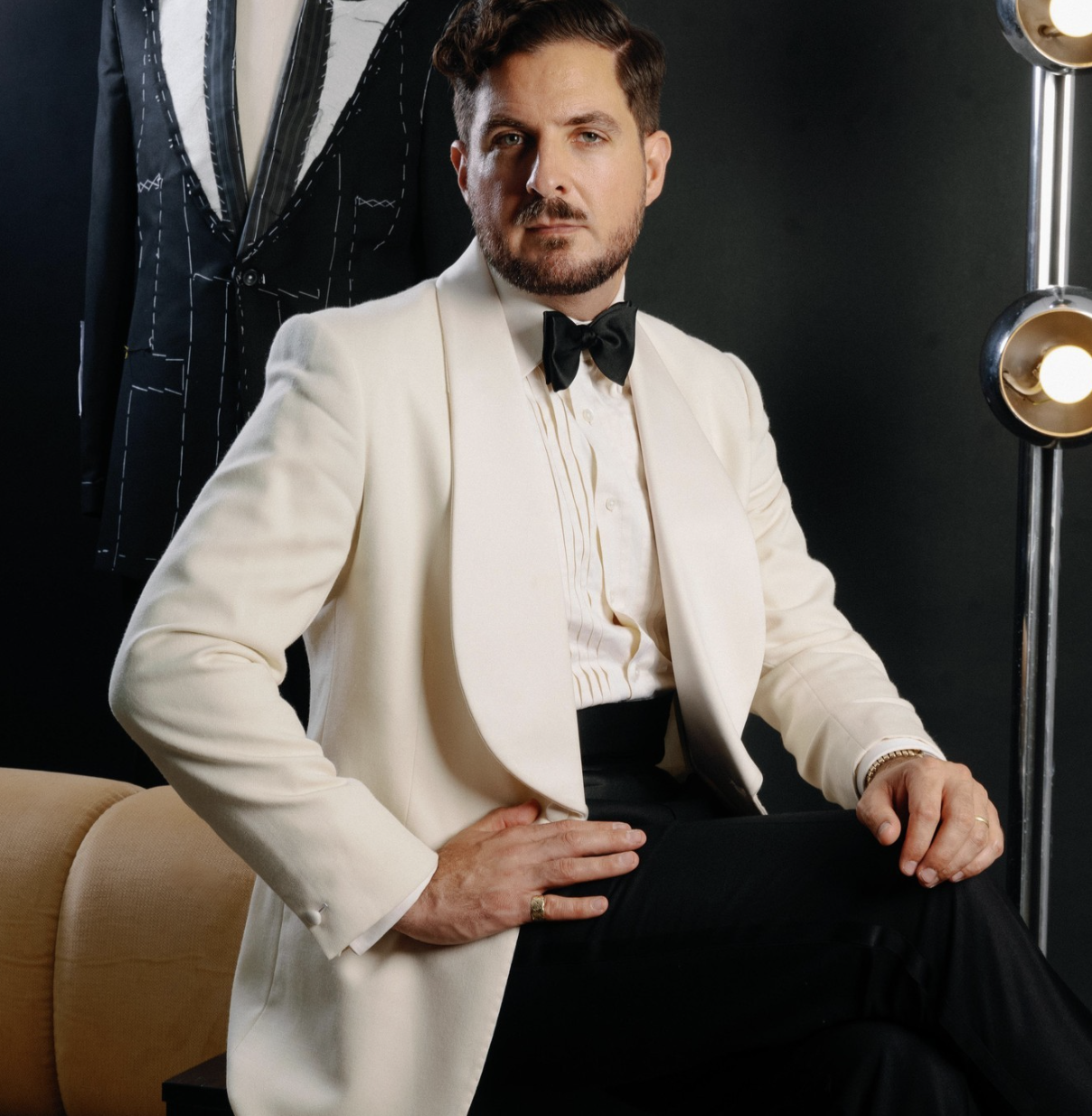
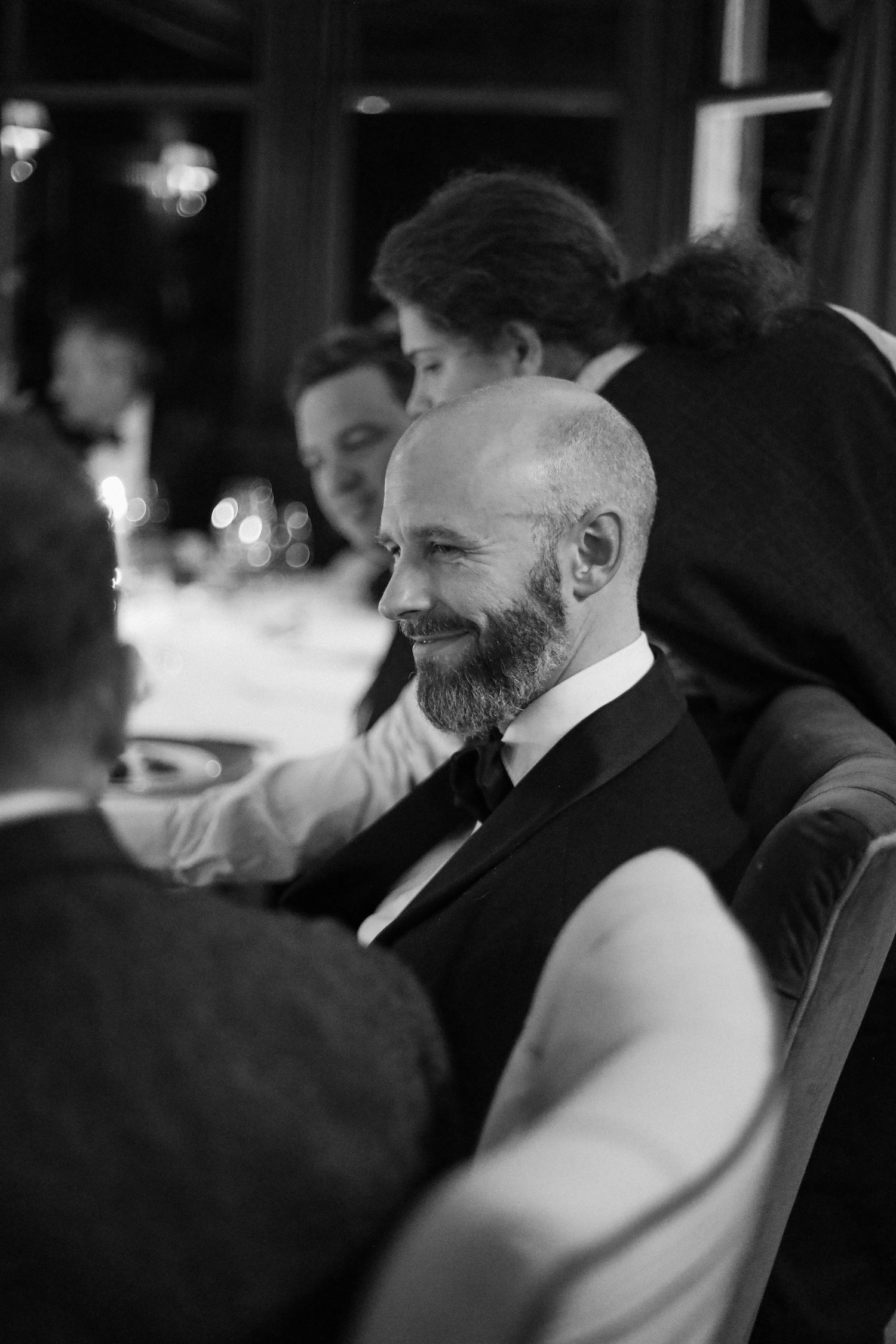
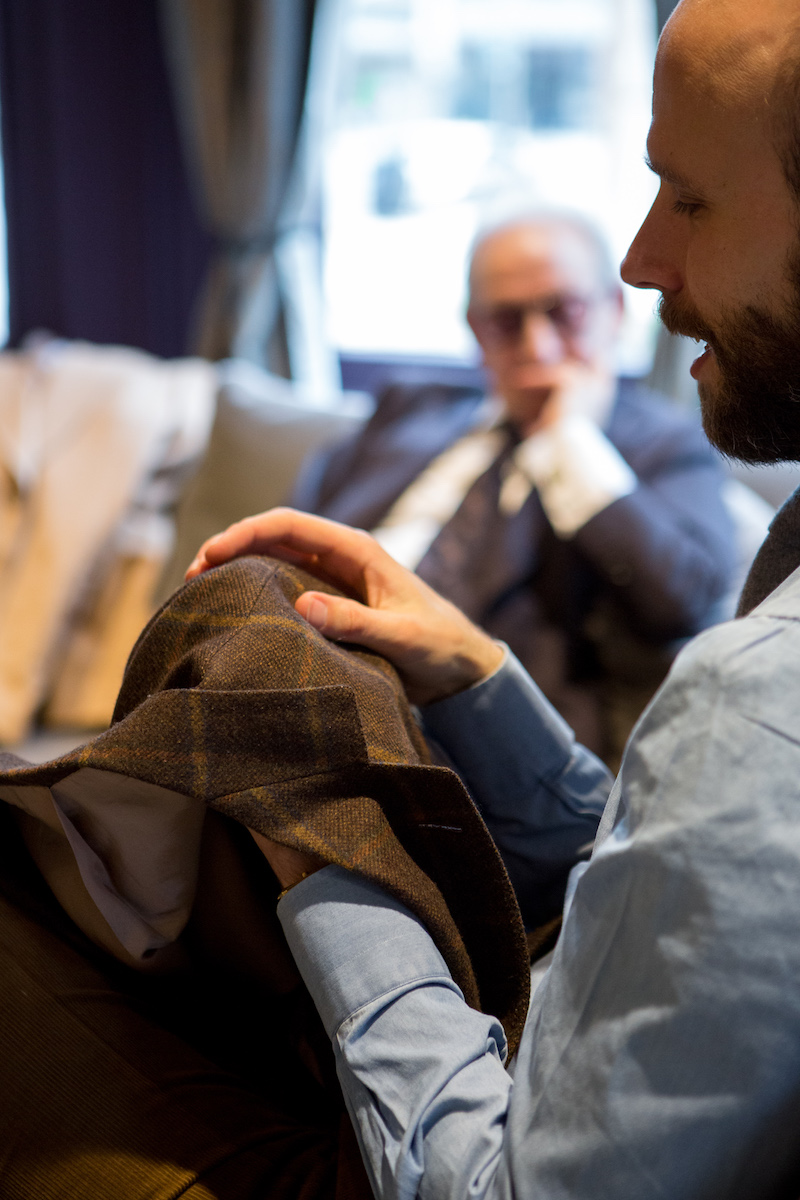
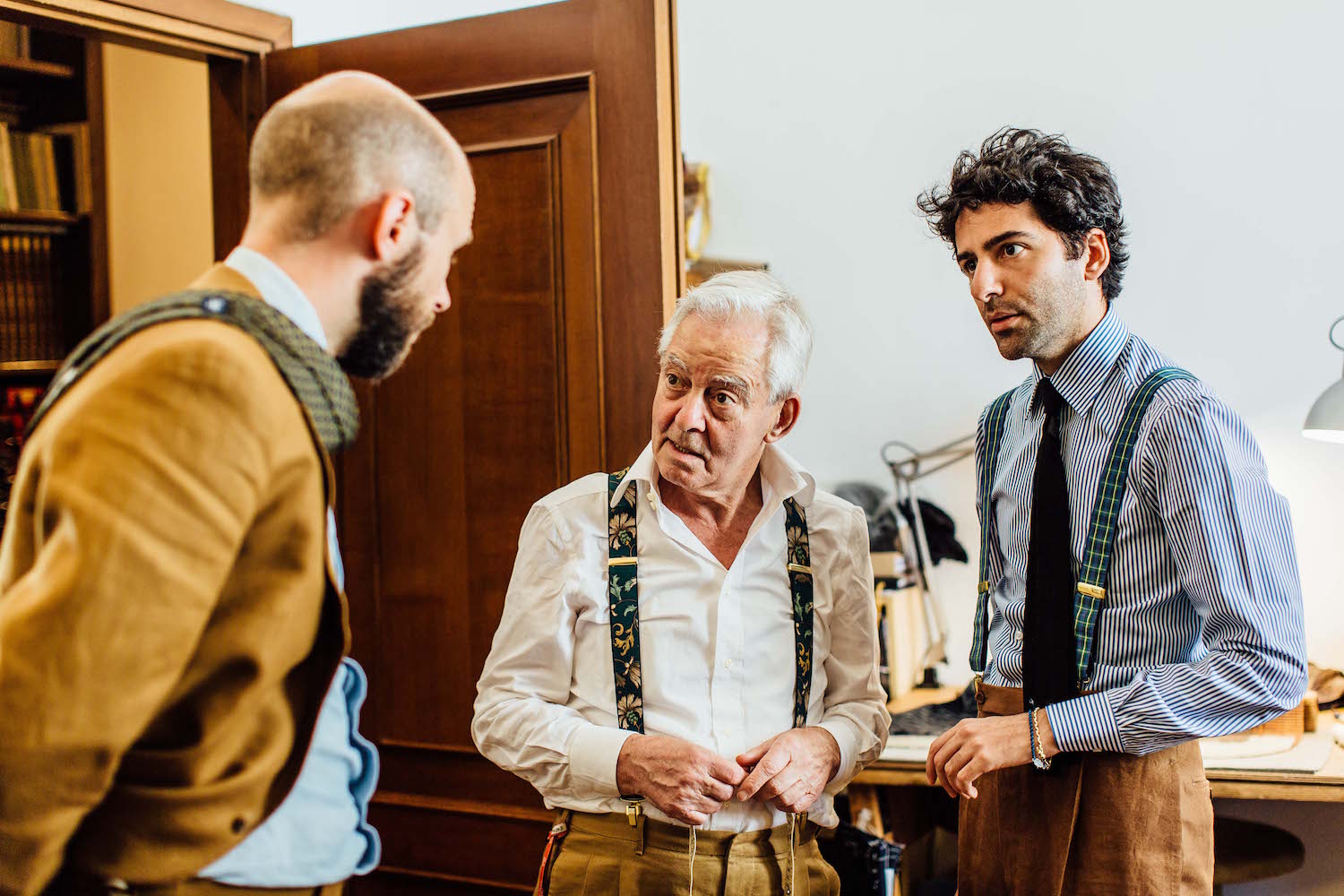
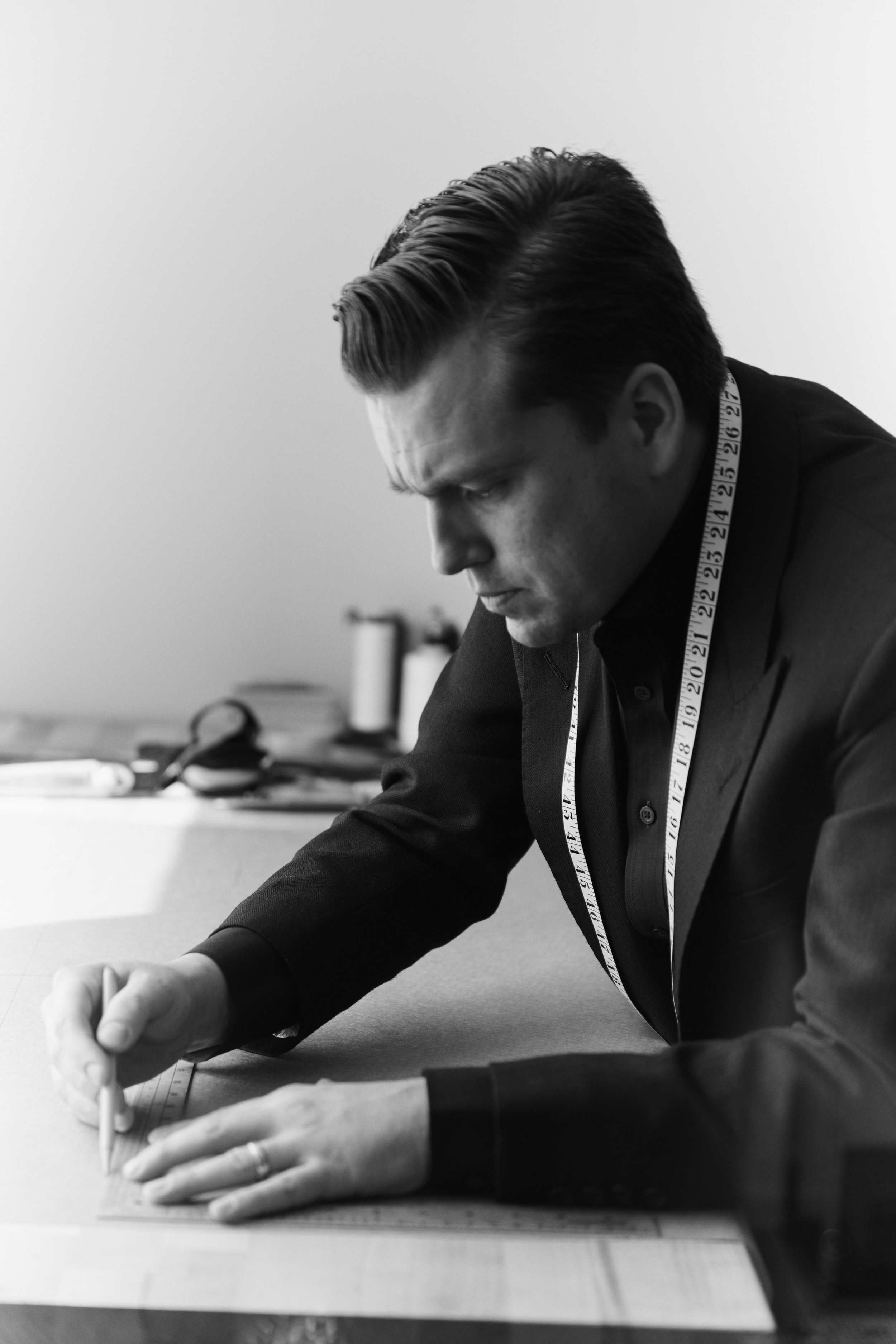
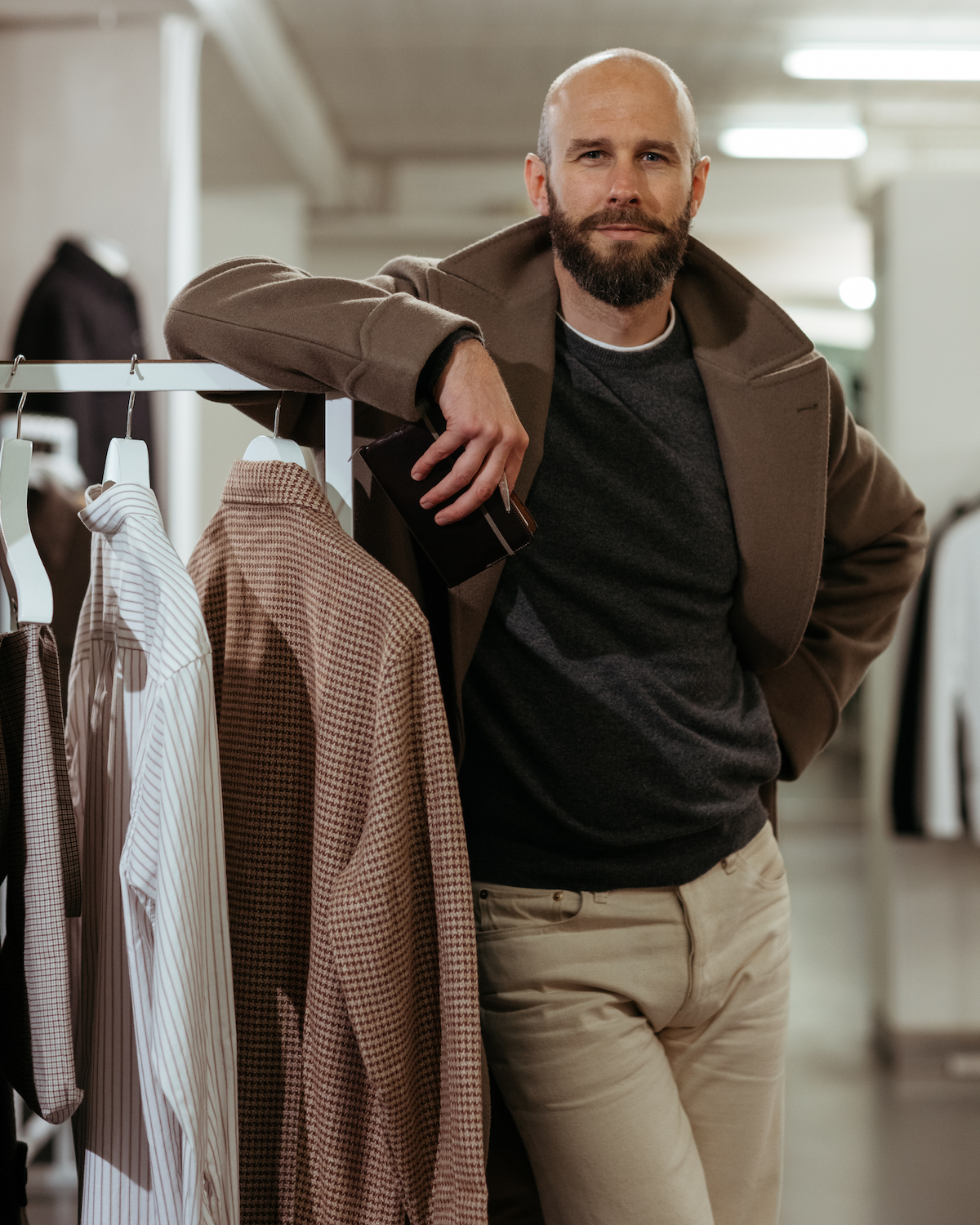
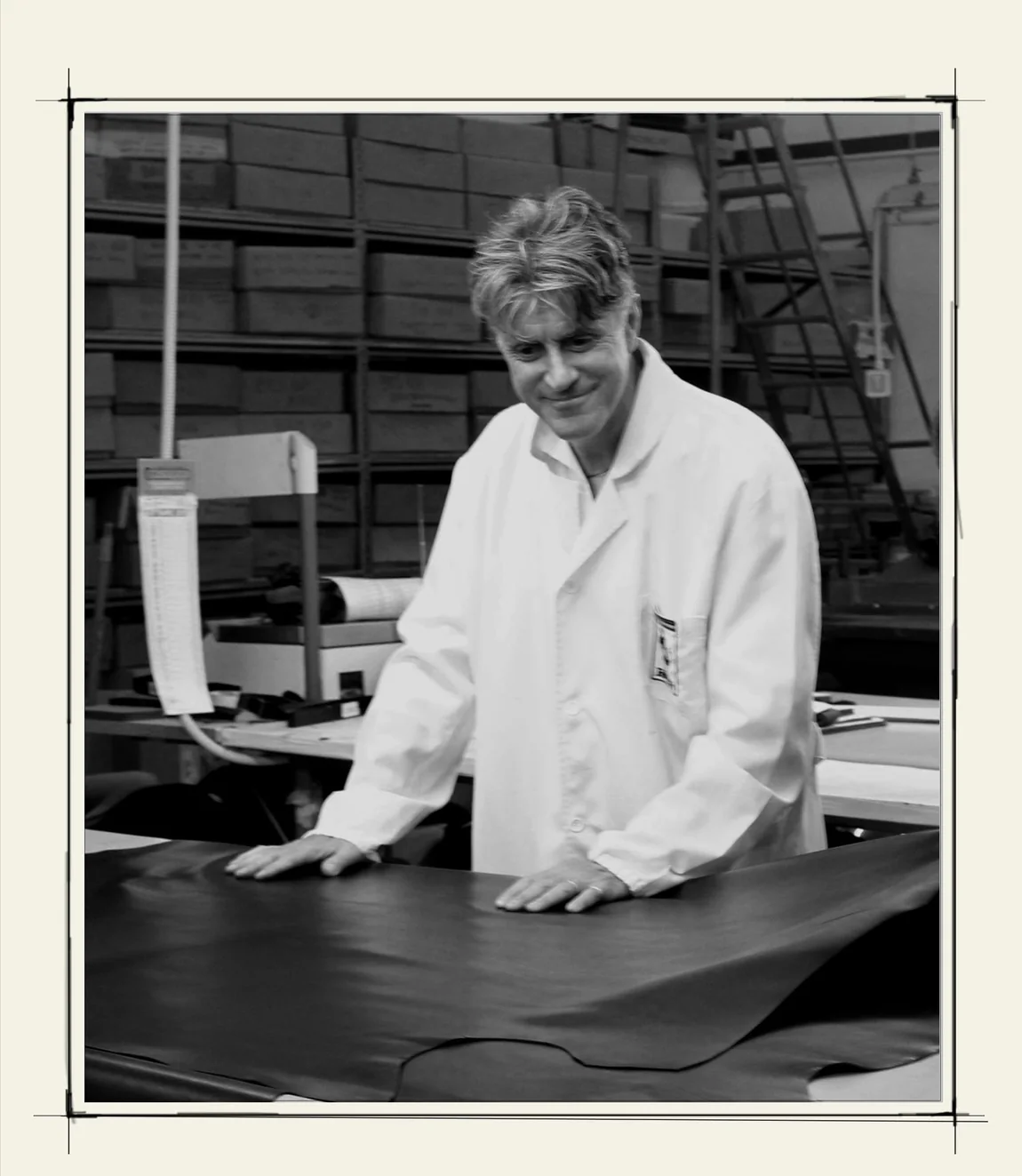
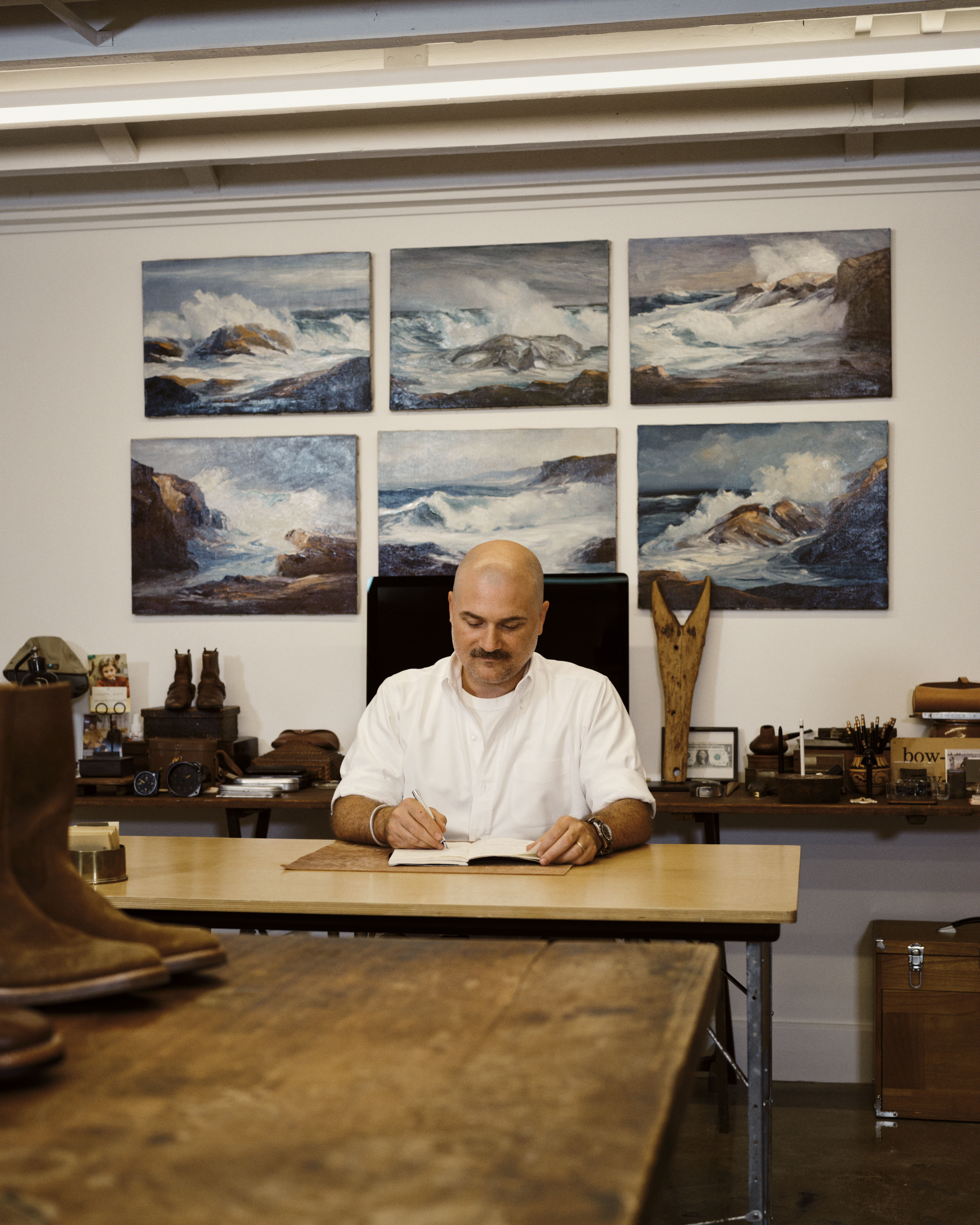
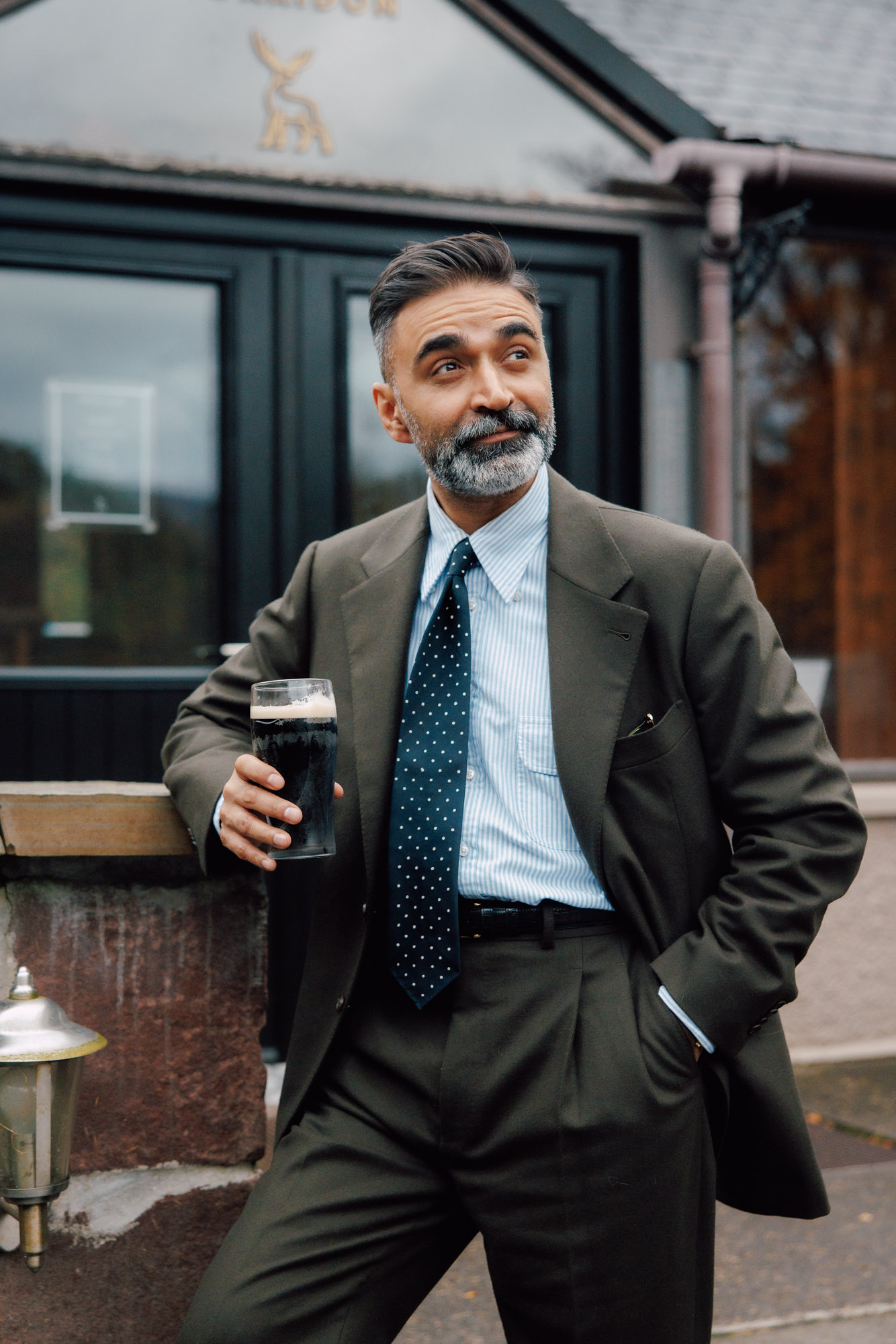
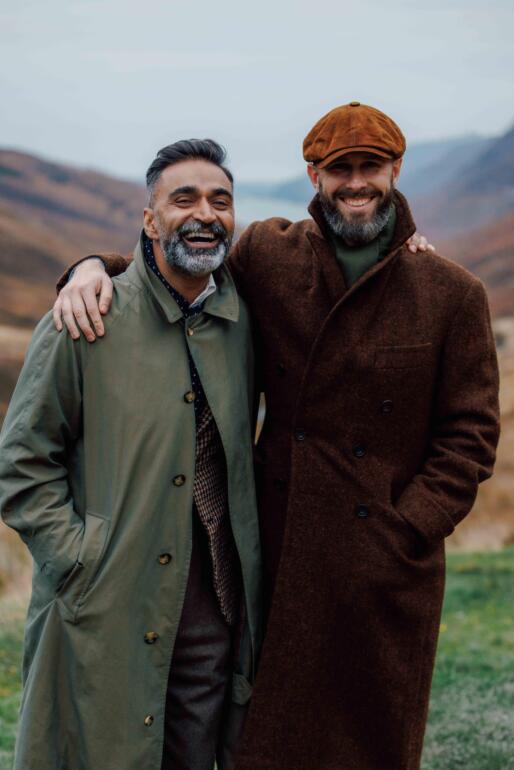
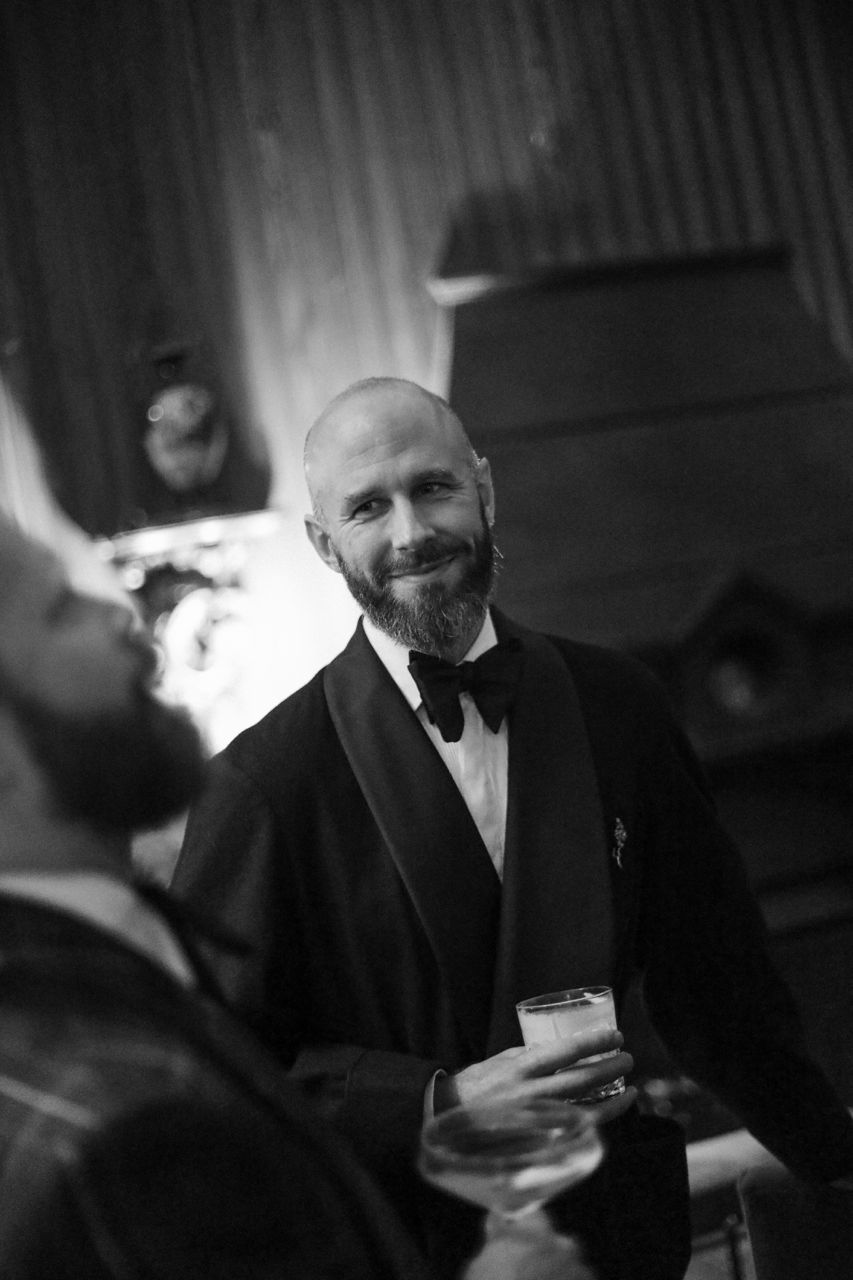
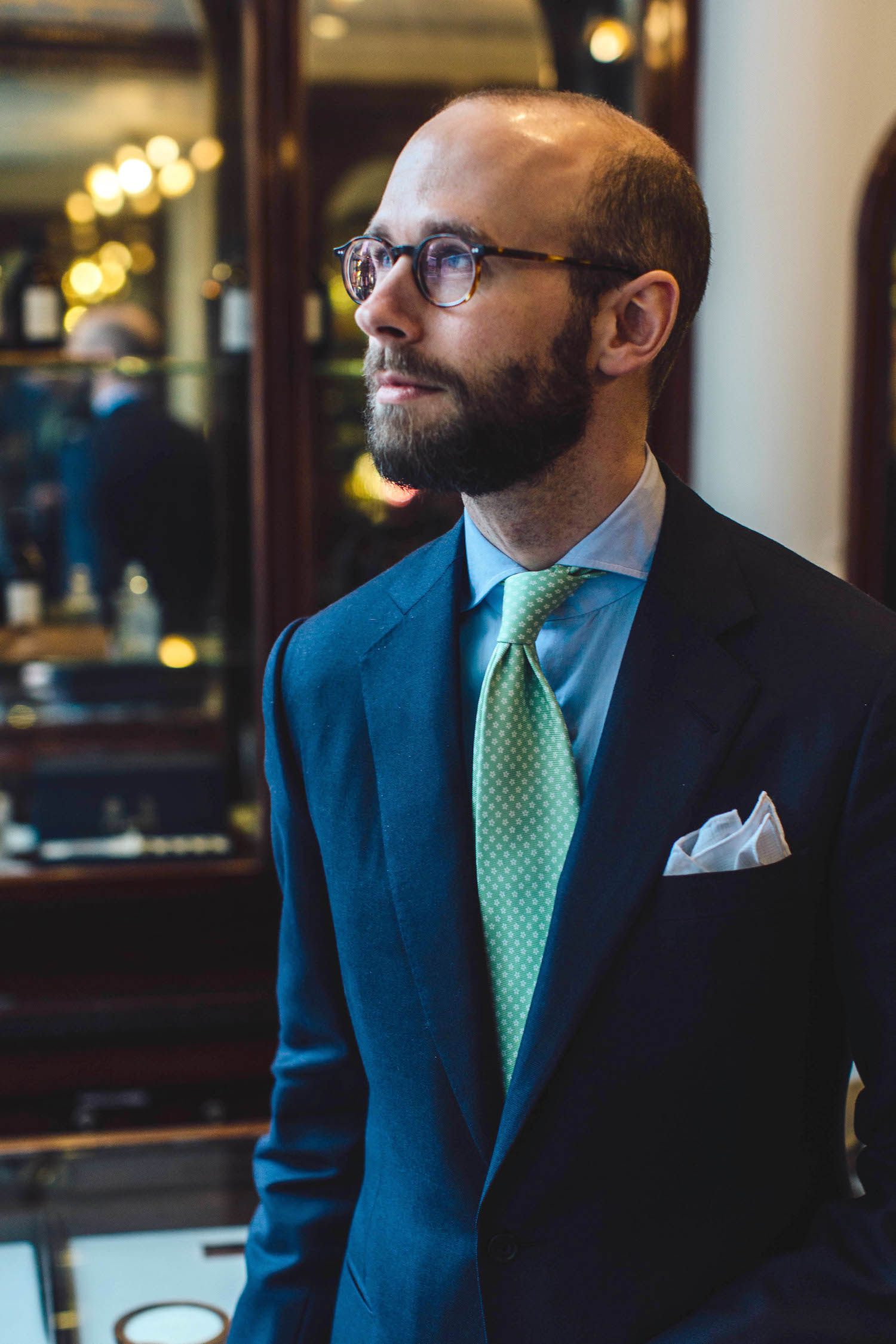
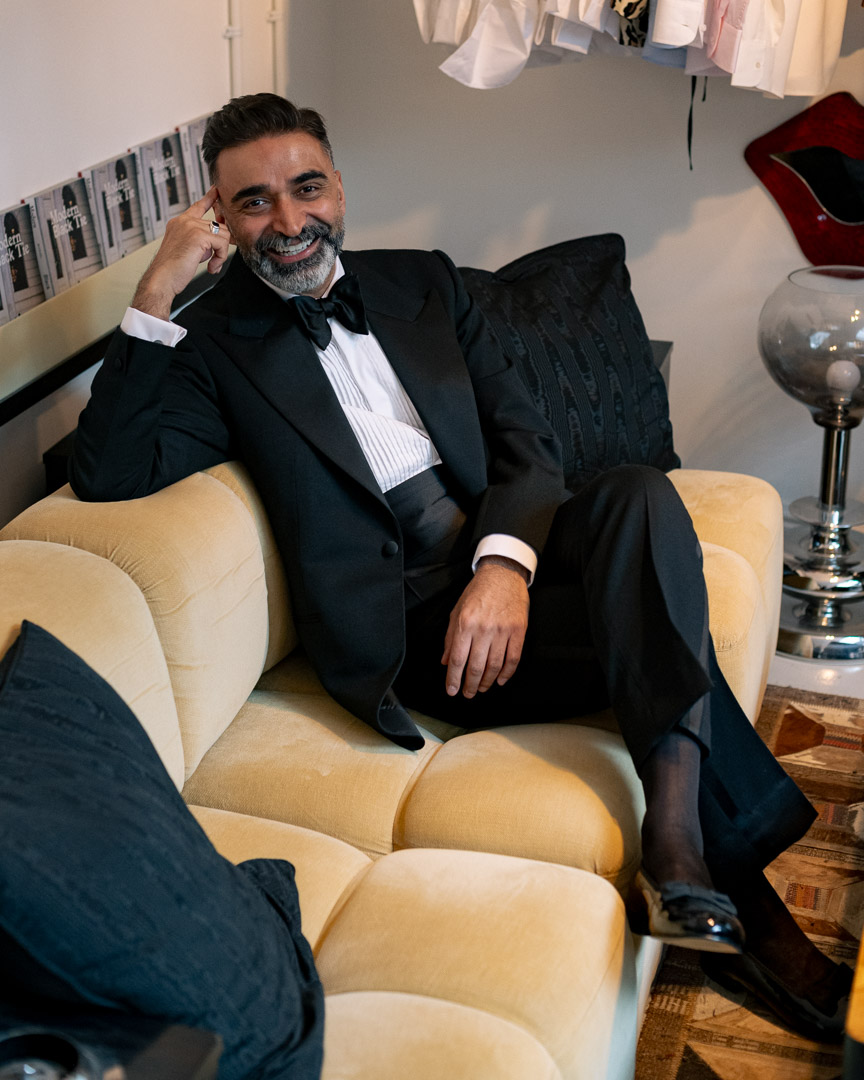
Before bow ties became his full-time occupation, Mickael (above) spent a decade fitting customers for bespoke and made-to-measure at Cad & The Dandy and Huntsman. So when he launched his own MTM tailoring this autumn, I knew I’d want to try it if I could.

Although one can commission suits and separates, the core offering revolves around evening wear - a genre of clothing I think marries well with MTM. It's not a stretch to assume assume readers would want to look as good as possible when attending a black tie do, so they might prefer something more customised than RTW; but, on the other hand, the cost-per-wear ratio of bespoke can be prohibitive.

Mickael offers the full spectrum of dinner jacket styles. However, it was the single-breasted peak lapel that caught my attention and ultimately my commission.

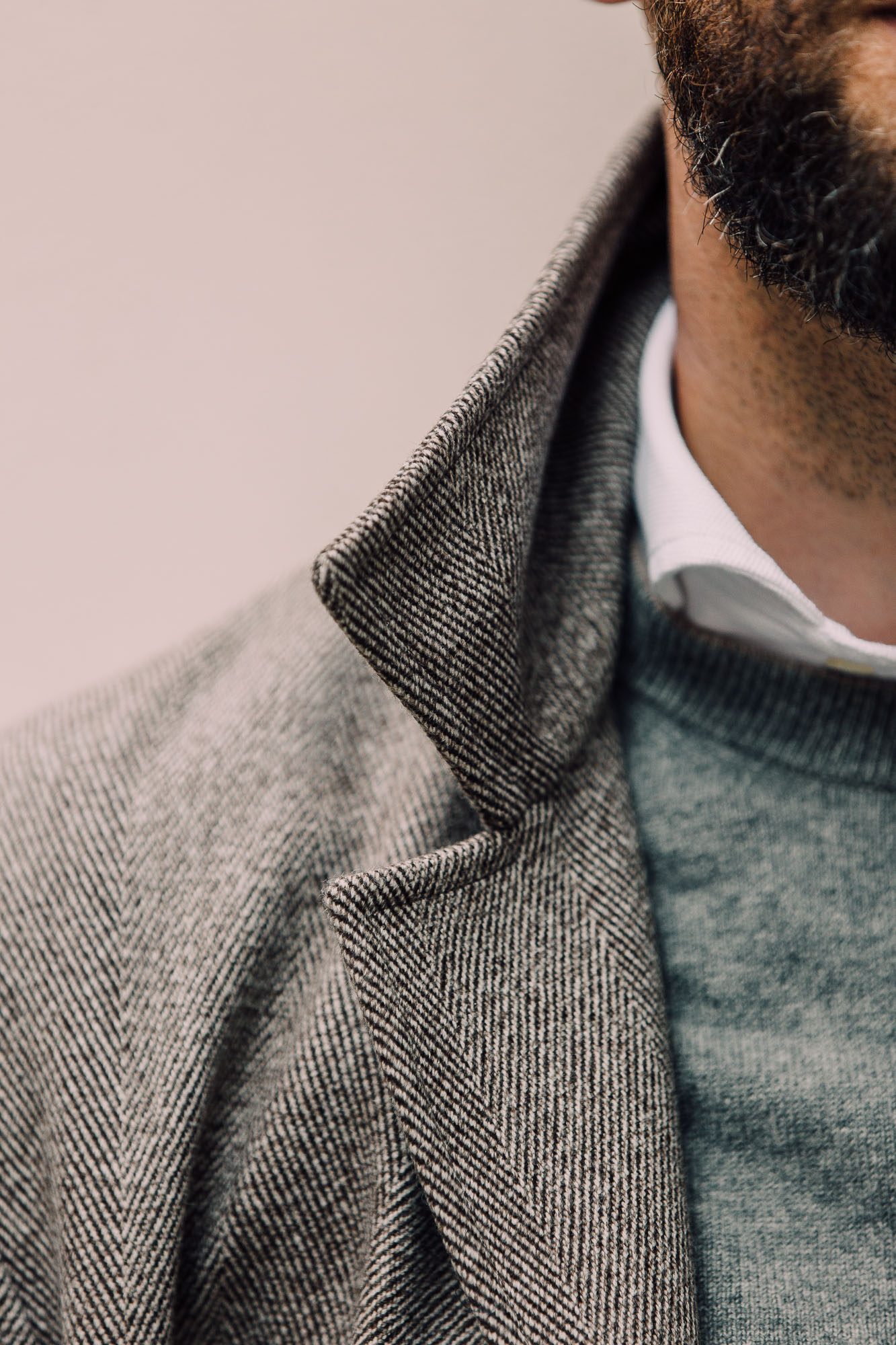
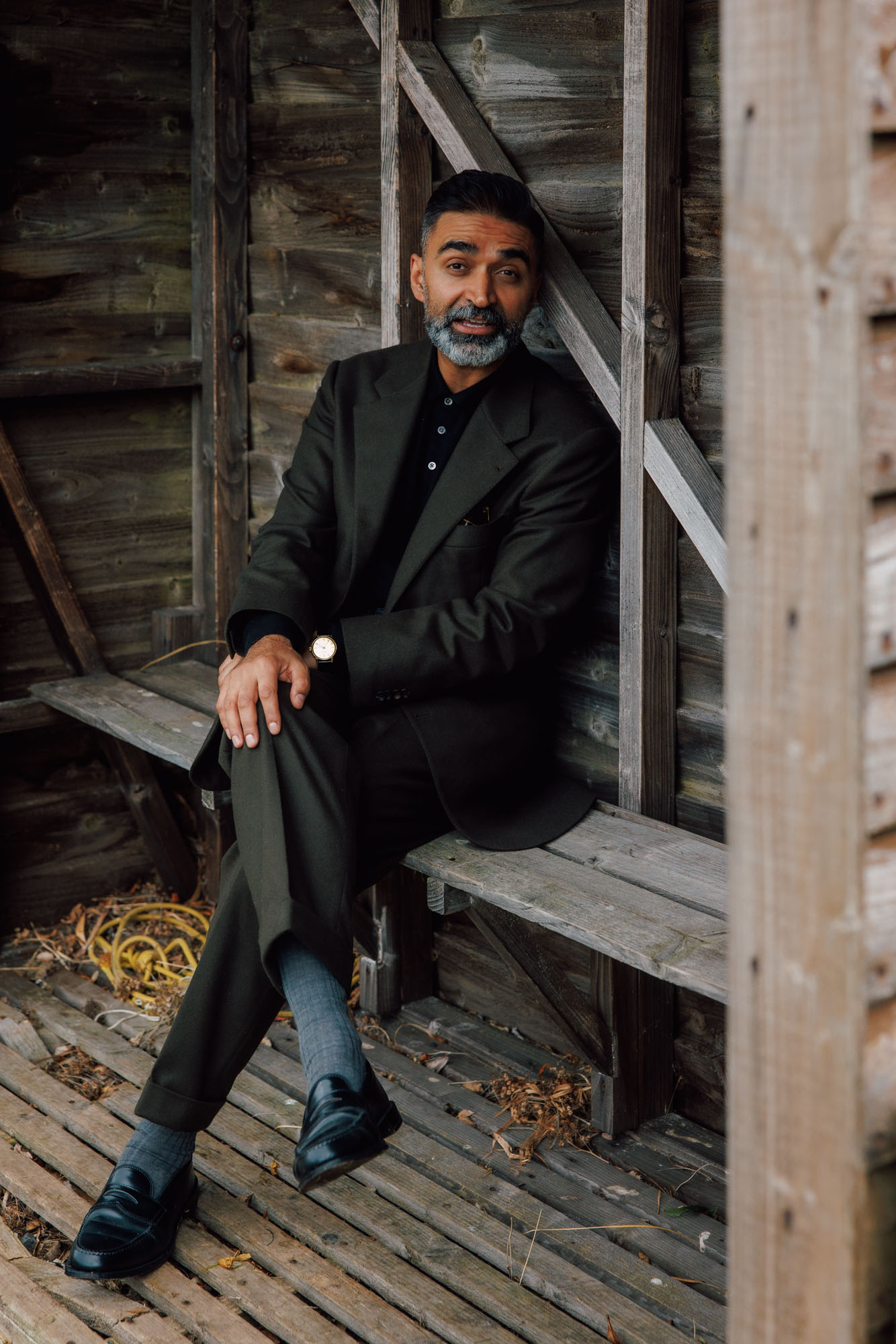
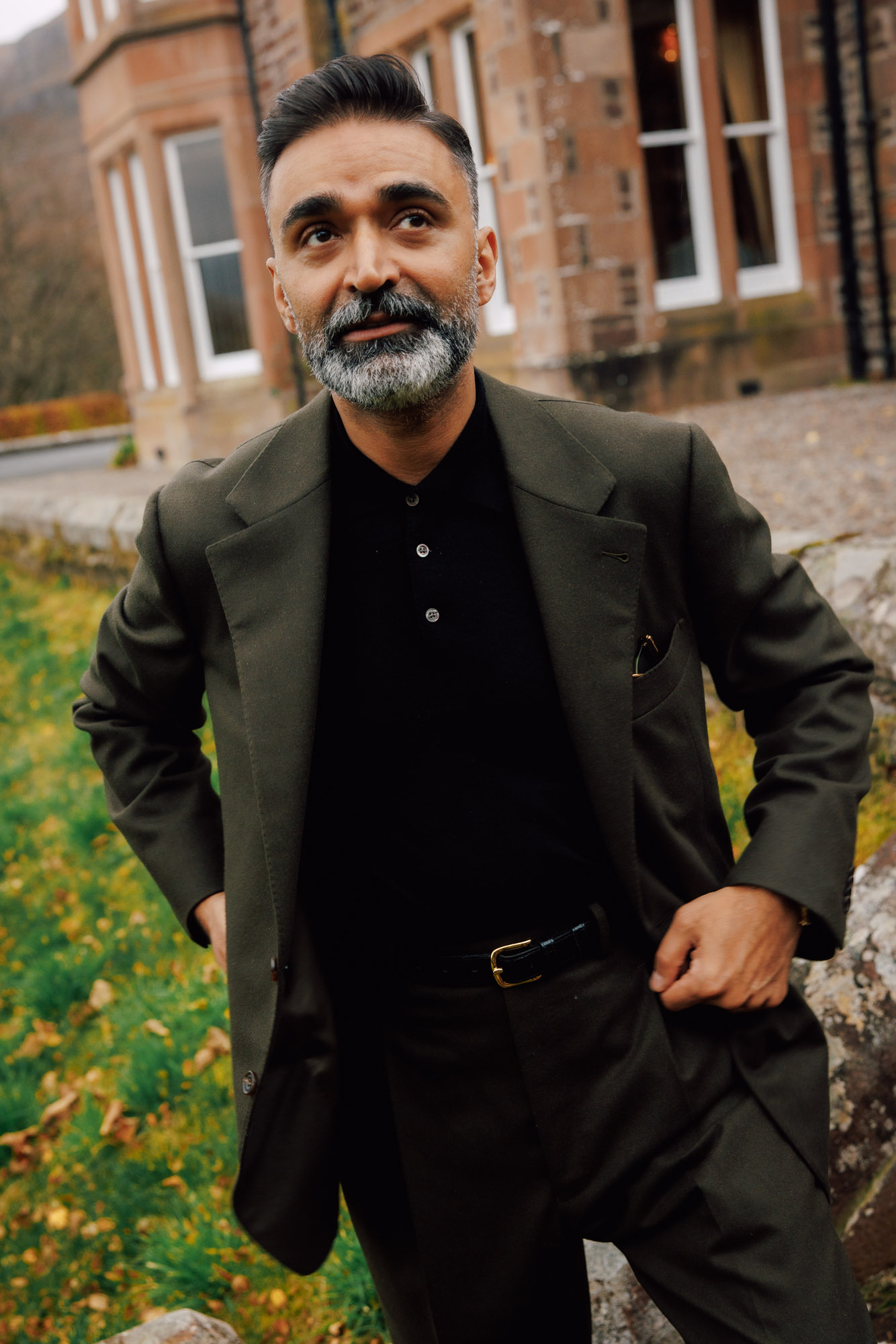
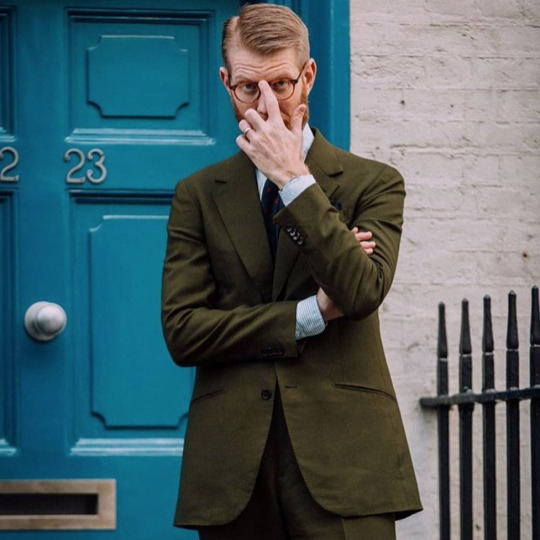
My jacket is typical of the house style in that it’s a classic cut - single-button closure, lightly padded shoulders, no vents, and longer and fuller than most modern jackets. The latter born out of pragmatism as much as any stylistic ideology, according to Mickael: “Black tie events are usually indoors, so you really don’t want anything to be too close fitting or you’ll overheat.”
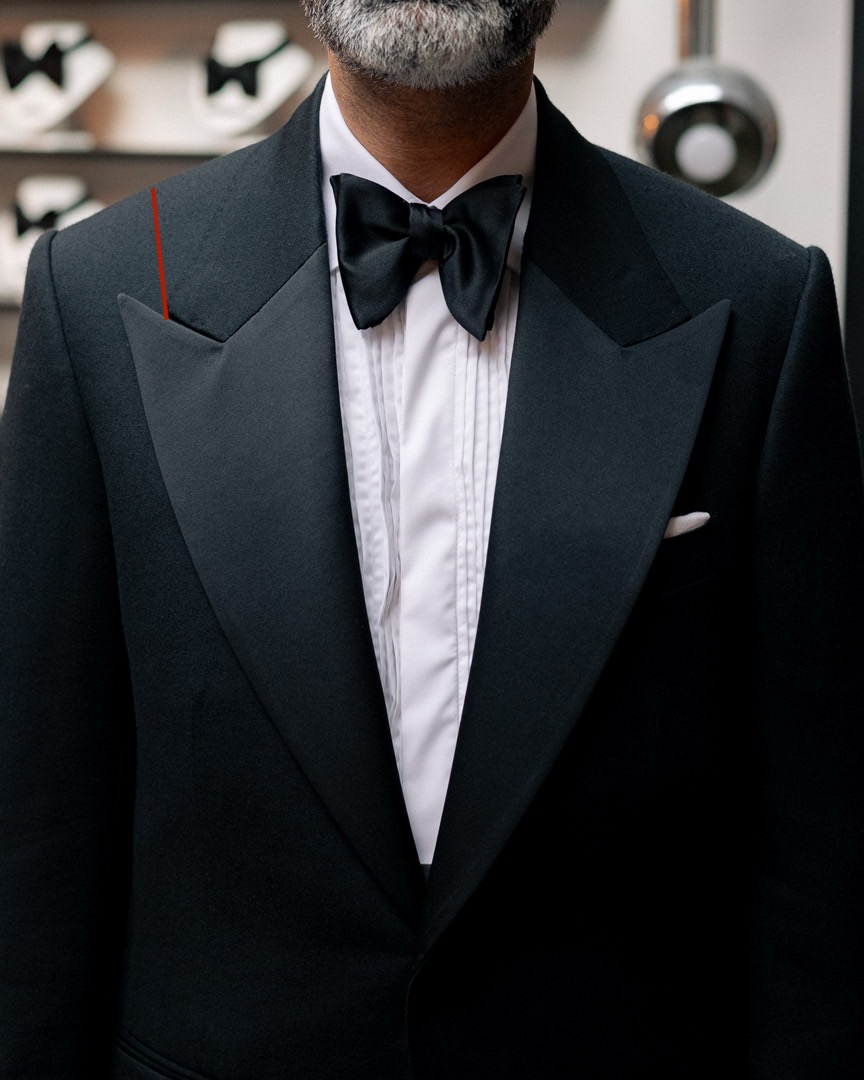
The defining feature of the jacket is the gorge line - which is low by contemporary standards. On my La Bowtique jacket, the distance between the shoulder seam and the point where the lapel meets the collar (marked in red) is 4.5 inches. The biggest gorge drop on my other tailored jackets is 4 inches, and most have a gap of just 3.5 inches.

While there are some benefits to a higher gorge (something we should talk about in a future article), it’s not something Mickael finds flattering in modern evening wear. Although, he acknowledges that the mainstream trend toward shorter jackets has meant the gorge has had no choice but to rise to maintain proportions.

Once again, there’s a practical element to his preference: a lower gorge permits the bow tie space to breathe. I mean, you don’t put angel wings close to the star on top of your Christmas tree, do you? 

While it is possible to adjust the gorge height, I didn’t stray from the house standard. And while I might not go as low on every subsequent lounge or business suit, I love the visual impact on evening wear.
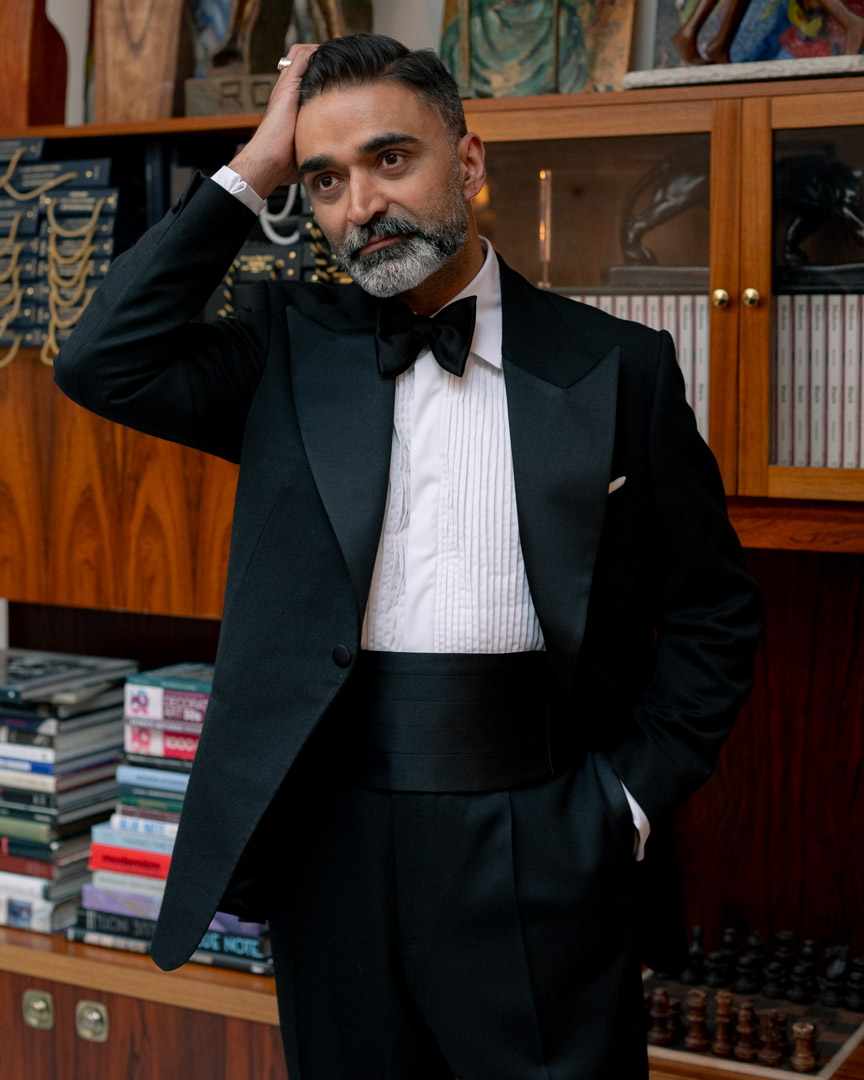
Perfecting the gorge and lapel is something I know Mickael has spent many months on - not just in design, but in his efforts to find a maker that could accommodate those designs. His initial plan was to use MTM factories, but found they usually operated within too strict parameters. “There wasn’t much room for any personal imprint,” he says.

Instead he partnered with a bespoke workshop in India to deliver garments made at a level typically reserved for bespoke: a hand-padded chest, collar and shoulder as well as hand-made buttonholes. The price is higher than if he’d pursued the factory route, but he and the customer have more flexibility as a result.

I did ask whether, given the nature of the make, he’d considered upgrading to a fully bespoke product. Mickael was emphatic that, even though in his tailoring career he’d done “everything but”, he wasn’t a cutter. He’s also someone who prefers to keep things simple. 

“I don’t enjoy the back and forth that comes with bespoke, and there are so many variables that can go wrong,” he says. “I believe 80 to 90% of people can get a good result from MTM. Having fitting garments helps to visualise the outcome at the start of the process, which limits the risks massively. Of course, it’s important to explain to people what the limitations of MTM are to manage their expectations.”
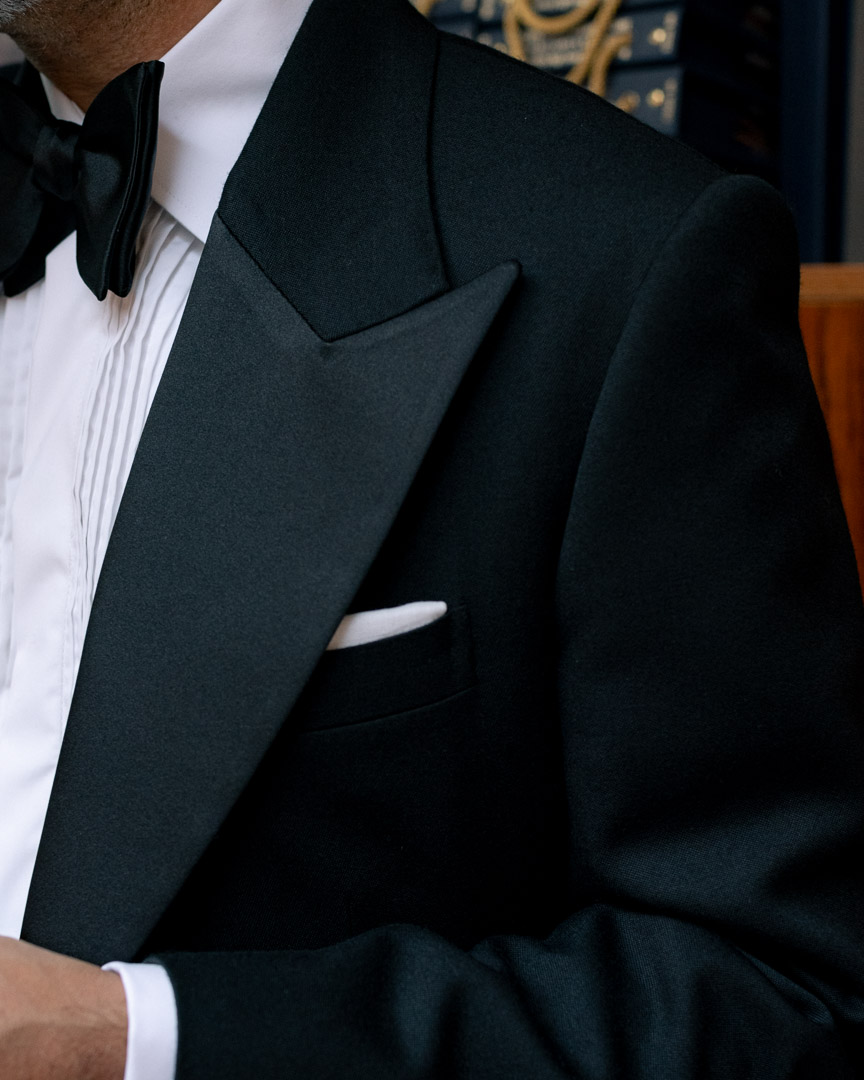
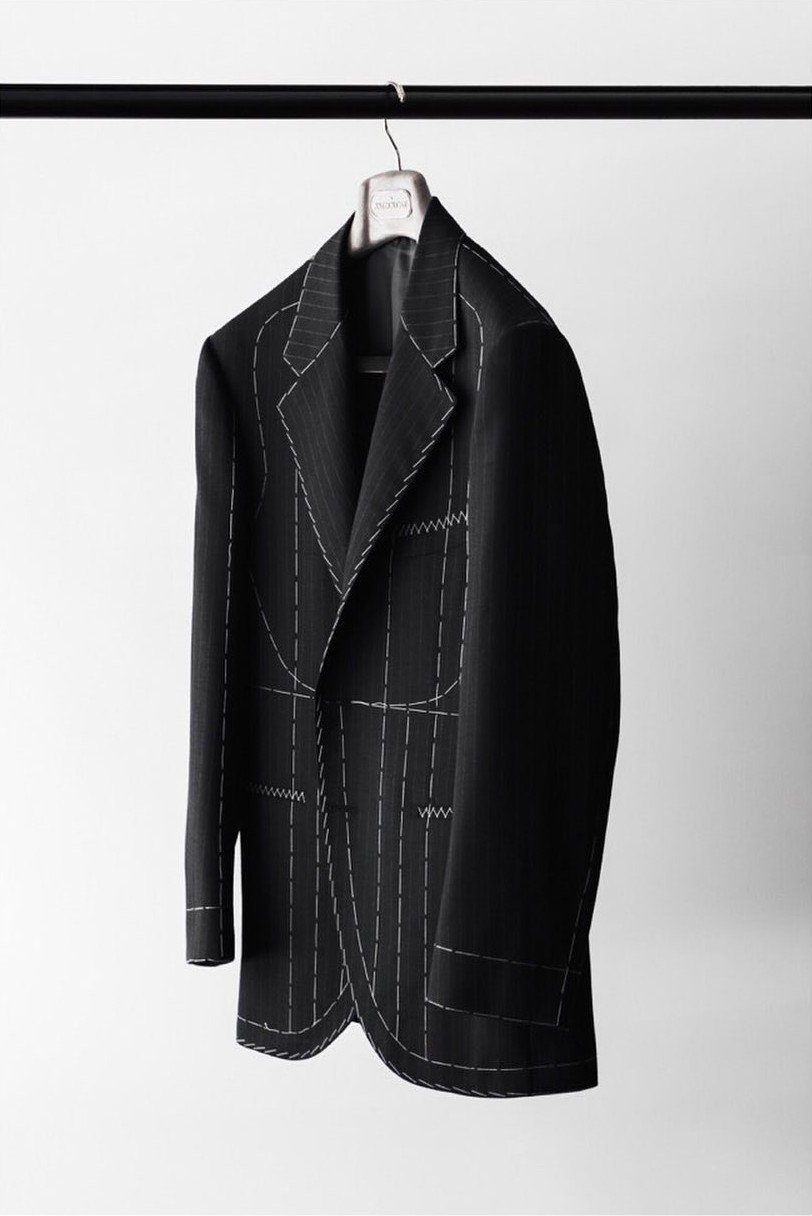
The fitting garments referred to are made from a kid mohair/wool blend. Mickael likes to use a lighter cloth here, as it’s easier to see where he needs to direct his attention when making adjustments.

But, equally important are the initial conversations around the customer's existing wardrobe, their tastes and how they like to wear things. In Mickael’s opinion, because of the use of fitting garments, MTM’s main pitfall is less about style and more about miscommunication: mistakes occur because the maker hasn’t tried to, or hasn’t been able to understand what someone wants.

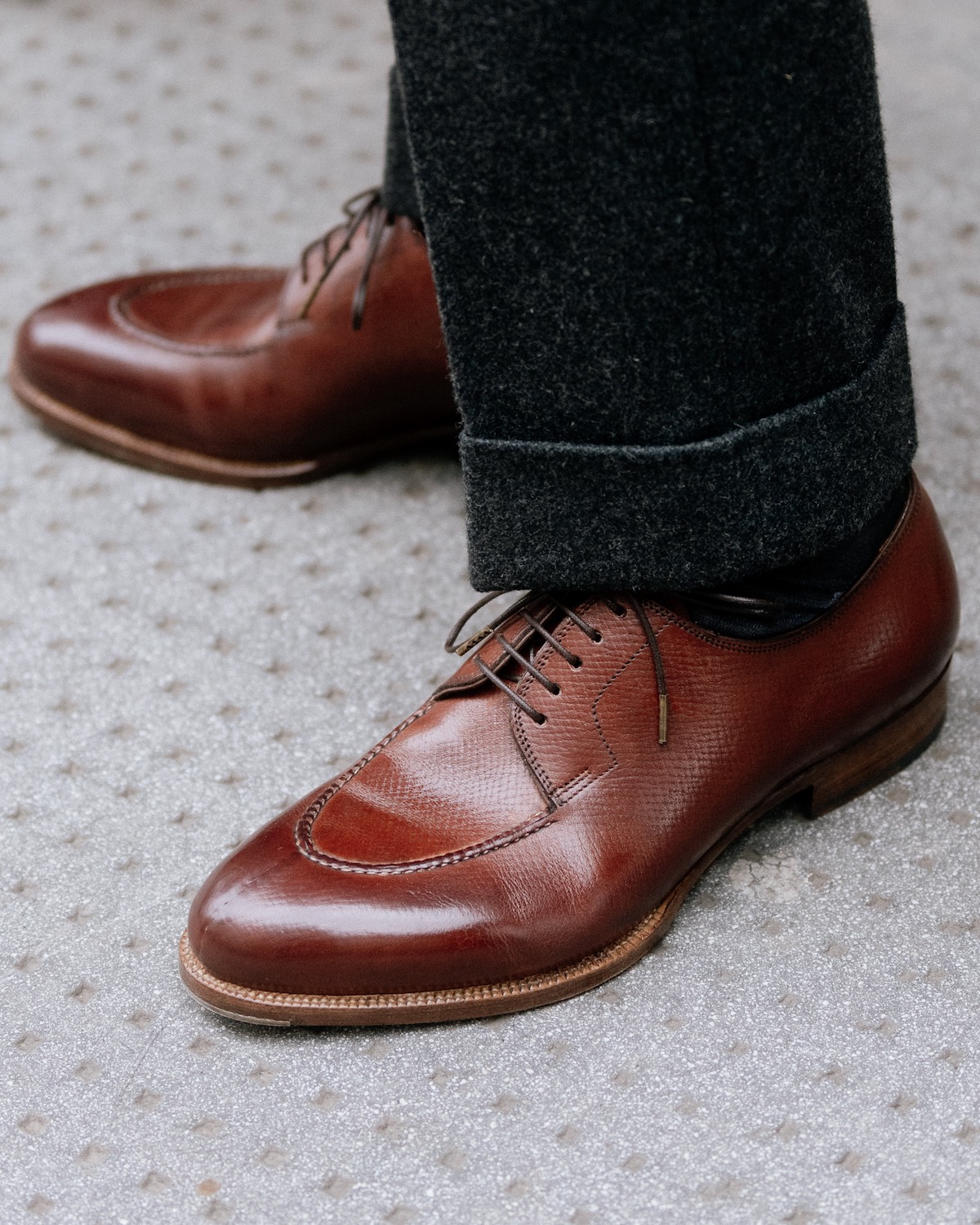
Knowing my more traditional persuasions for evening wear, he guided me toward a heavier 14oz barathea from Dugdale, which he said would drape well (it does). I also prefer the matte finish of the barathea (the mohair/wool blend has a little sheen) as I find it allows the accents - the satin lapels, bow tie, studs, cufflinks - to catch the eye more.

One note of caution is that barathea is a tightly woven cloth and doesn’t have much give. Perfect for maintaining the sharp, crisp lines you want for evening wear, but a recipe for restriction if you opt for an overly tailored fit. If in doubt, I’d ask for a little more room.
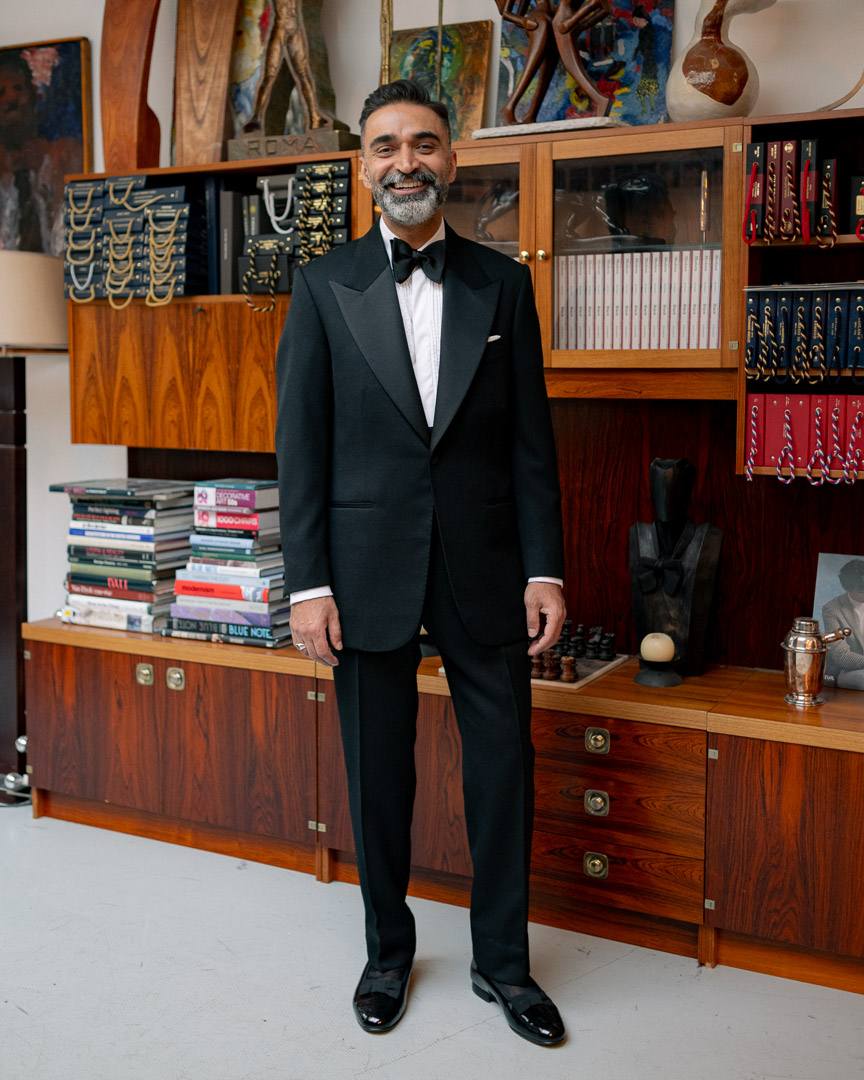
The suit was delivered five weeks after our fitting appointment, where any final alterations - which are done in London by Savile Row tailors - can be discussed. The photos in this article (shot at the La Bowtique studio in east London) were all taken before the local alterations (with one exception, which I’ll come to).

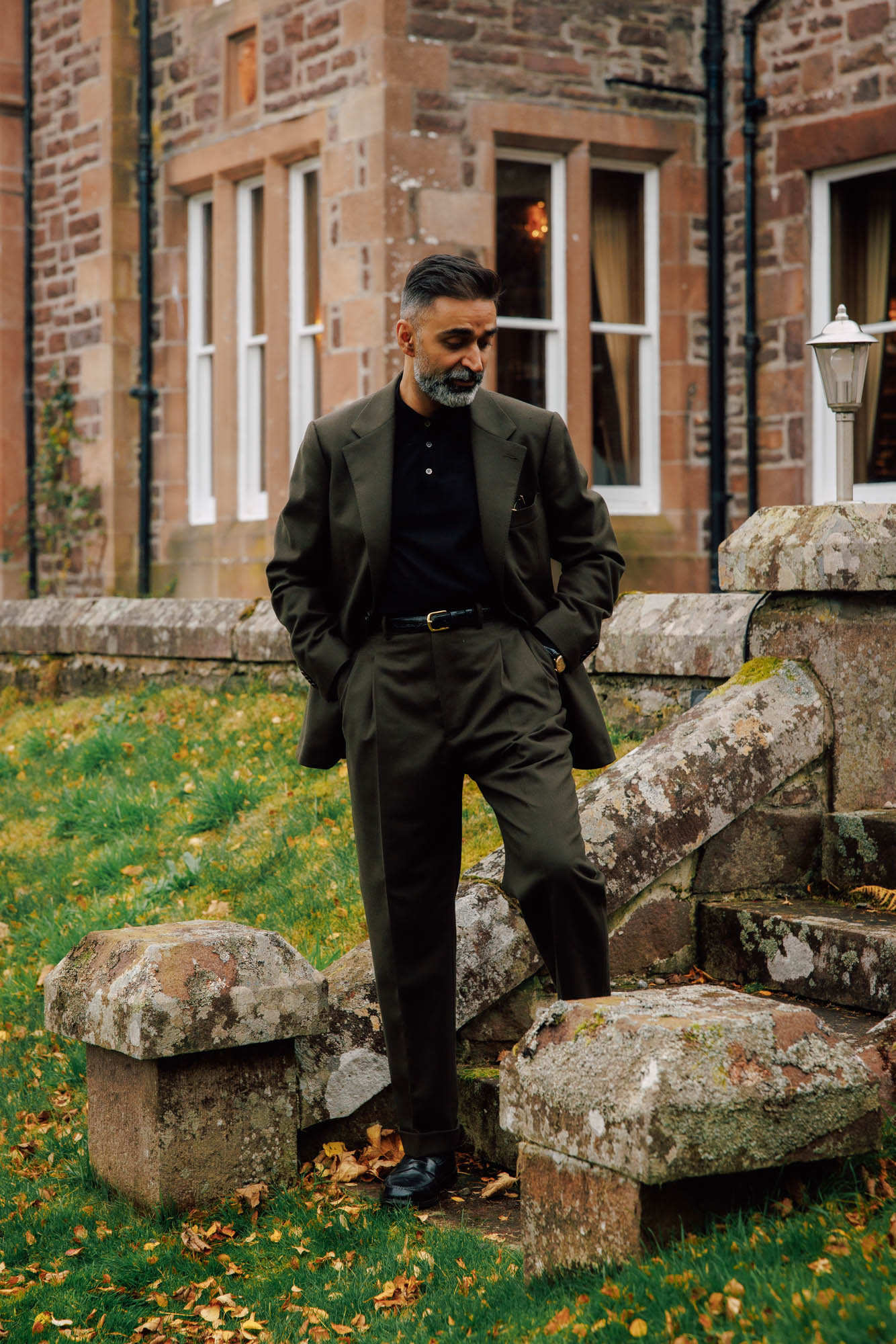
There’s not much to say about the front, because, as Mickael has already pointed out, I kind of knew what was coming. I liked the house style, the size 40 fitting jacket was a pretty solid fit off the rail, and I’d already seen the barathea made up in one of Mickael’s personal suits.

The front shot does underline how classic that house style is. At a length of 31.25”, the La Bowtique jacket is longer than any tailored jacket I’ve ever had by a minimum of three-quarters of an inch - my others range between 29.5” and 30.5”. But if there’s ever a time to try a longer, more traditional coat, I think it’s for evening wear. 

I’m very pleased with the length, but, as before, I might go half an inch shorter on subsequent lounge suits. Of course, as with the gorge, you can opt to shorten the jacket at the fitting stage, but at what point do you start to lose the essence of the house-style? Too many adjustments and you might be better served trying another maker or going bespoke.
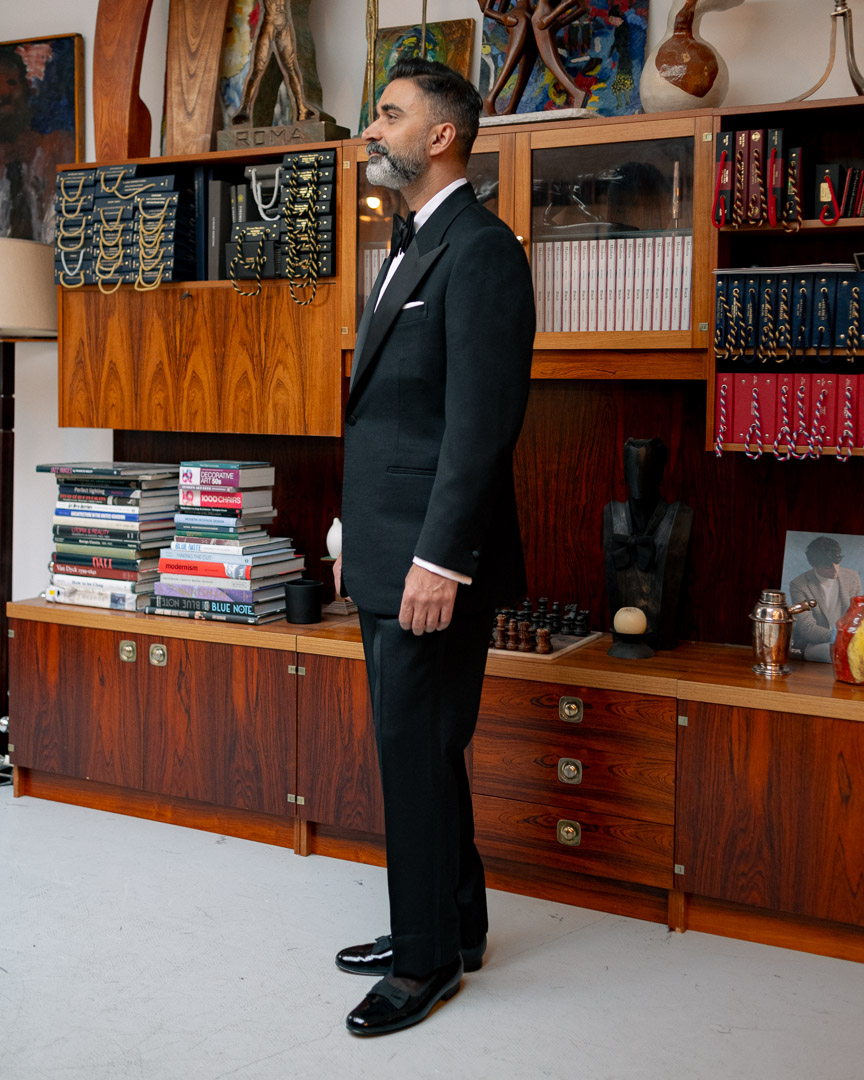
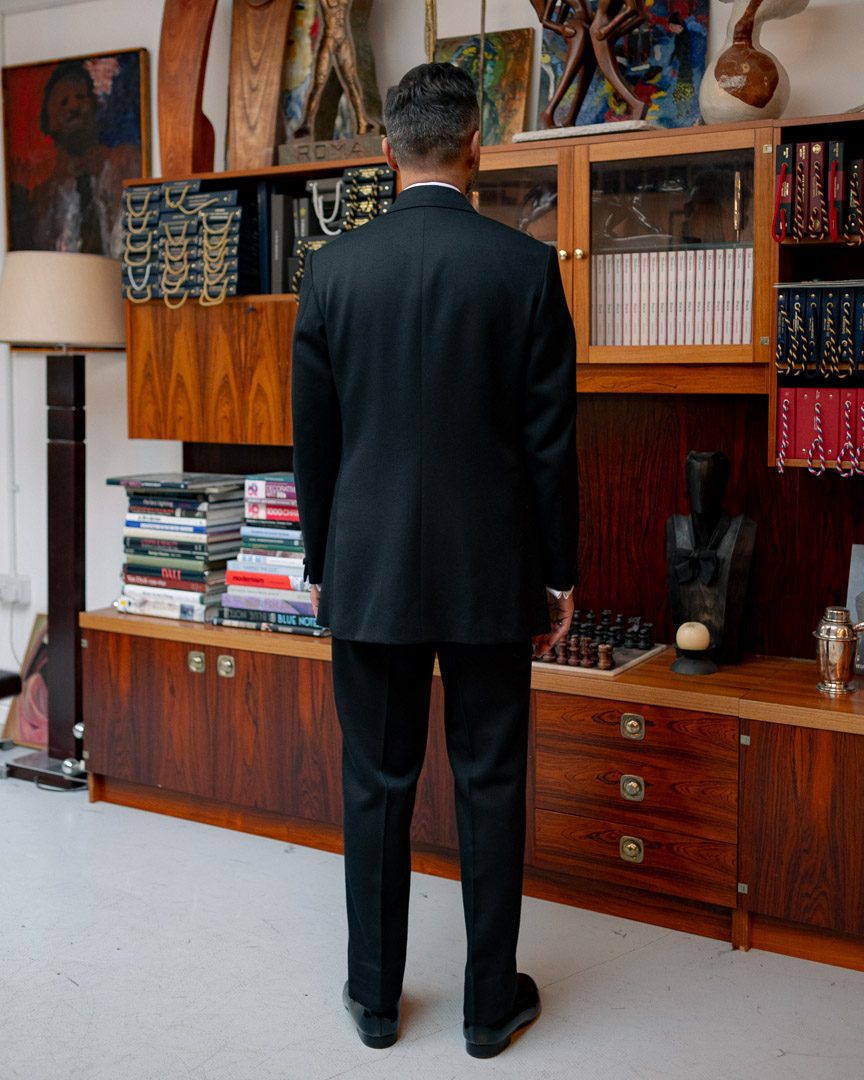
To maintain consistency with Simon’s reviews, Alex took a rear photo. It’s the first time I’ve ever looked quite so forensically at the back of one of my suits; it’s certainly instructive, but (as Simon is often at pains to point out) can be misleading too. A tilt of the camera, a shift in the light or a quick brush down can change the perception entirely; if you’re not careful one could end up chasing phantom fit issues in a game of whack-a-mole.

Nonetheless, Mickael and I spoke about three things. The first was the back of the knees where the trousers gave slightly, and he suggested we pick them up at the waistband.

The second was across the shoulders. Now, you should know that I’m a hugger, a wildly inept dancer, and I like to lean forward with shoulders rounded when in conversation with friends - as if engaged in a dangerous conspiracy. 

I’ve learned the hard (and expensive way) that I need comfort, so the back of my jackets tend to have a bit of drape. We’d already picked the back up at the fitting stage, however, we both agreed it could be slightly cleaner, without restricting me, by taking it up a touch more.

Finally, the right sleeve looked a little rumpled. From side-on, the pitch seemed fine. We discussed removing a bit of excess from the sleeve - which is fairly full - but I decided against that for reasons of comfort.

After the local alterations, the suit was pressed and ready for collection about a week later - the photo above shows the back of the finished suit.

I know pressing is something that most quality MTM/bespoke tailors will do, but few are quite as vocal about the benefits as Mickael. “It’s a totally different garment,” he tells me. Not only does it sharpen the lines of the suit, but it also brings shape and comfort when properly done. Case in point, the right sleeve has settled down nicely. 

I could have just used this photo of the final suit and ignored the interim shot, but I hope the inclusion of both helps give the readers a better insight into the process, and illustrates that not everything necessarily needs ‘fixing’. I also appreciate Mickael’s openness to sharing images of the interim stages. 

These minor alterations have helped turn a good fit into a very good one, and this will now be the starting point for subsequent commissions.

Having read Permanent Style (and the comments section) for many years, it’s clear to me there’s an increasing demand for quality MTM delivered at a reasonable price. Comparing like-for-like (i.e. this first make vs. other first makes), I’d rank La Bowtique among the better MTM tailors I’ve tried.

A two-piece suit or dinner suit starts from £2400 (mine was £2700), which is comparable to the price of most of the MTM tailors in Simon’s list (after allowing for a bit of post-Covid inflation). 

Most of the brands on that list have less handwork than La Bowtique. Saman Amel’s Napoli line has similar levels (and I’d agree with Simon that theirs is another of the best MTM offerings going), but that’s around £1000 more expensive than La Bowtique (and some of the reasons for the price difference are explored here).
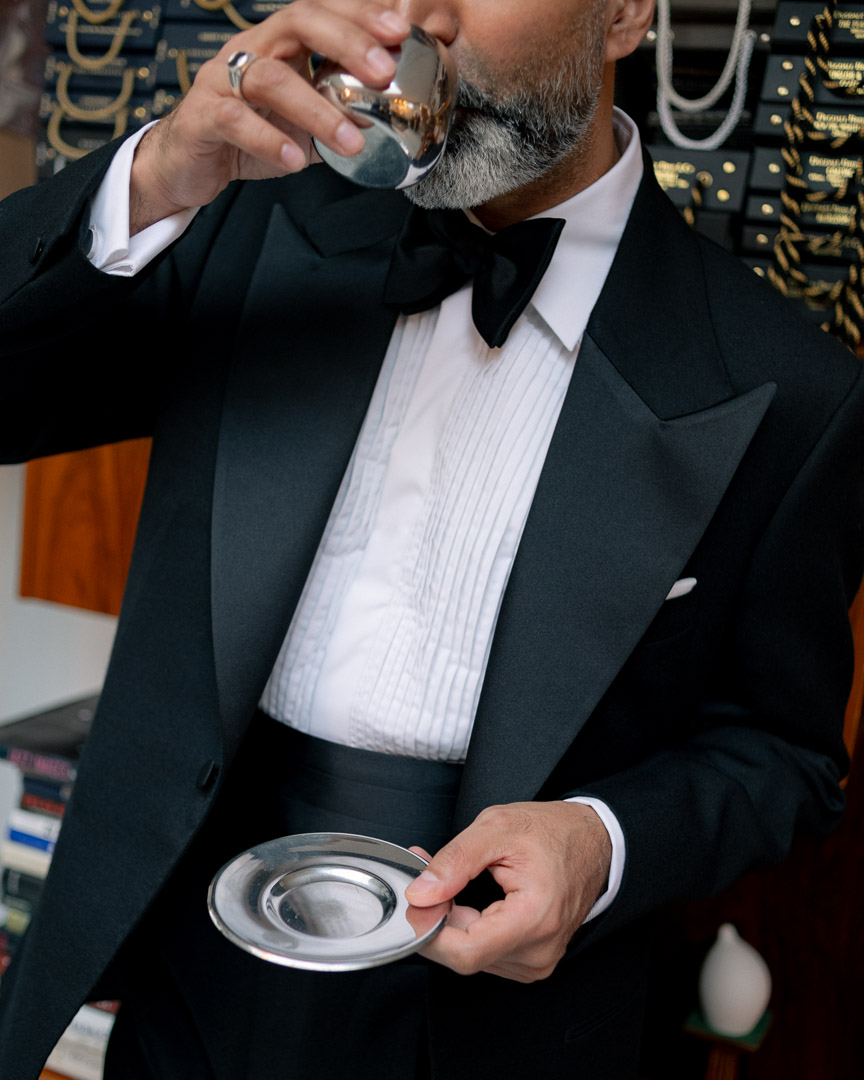
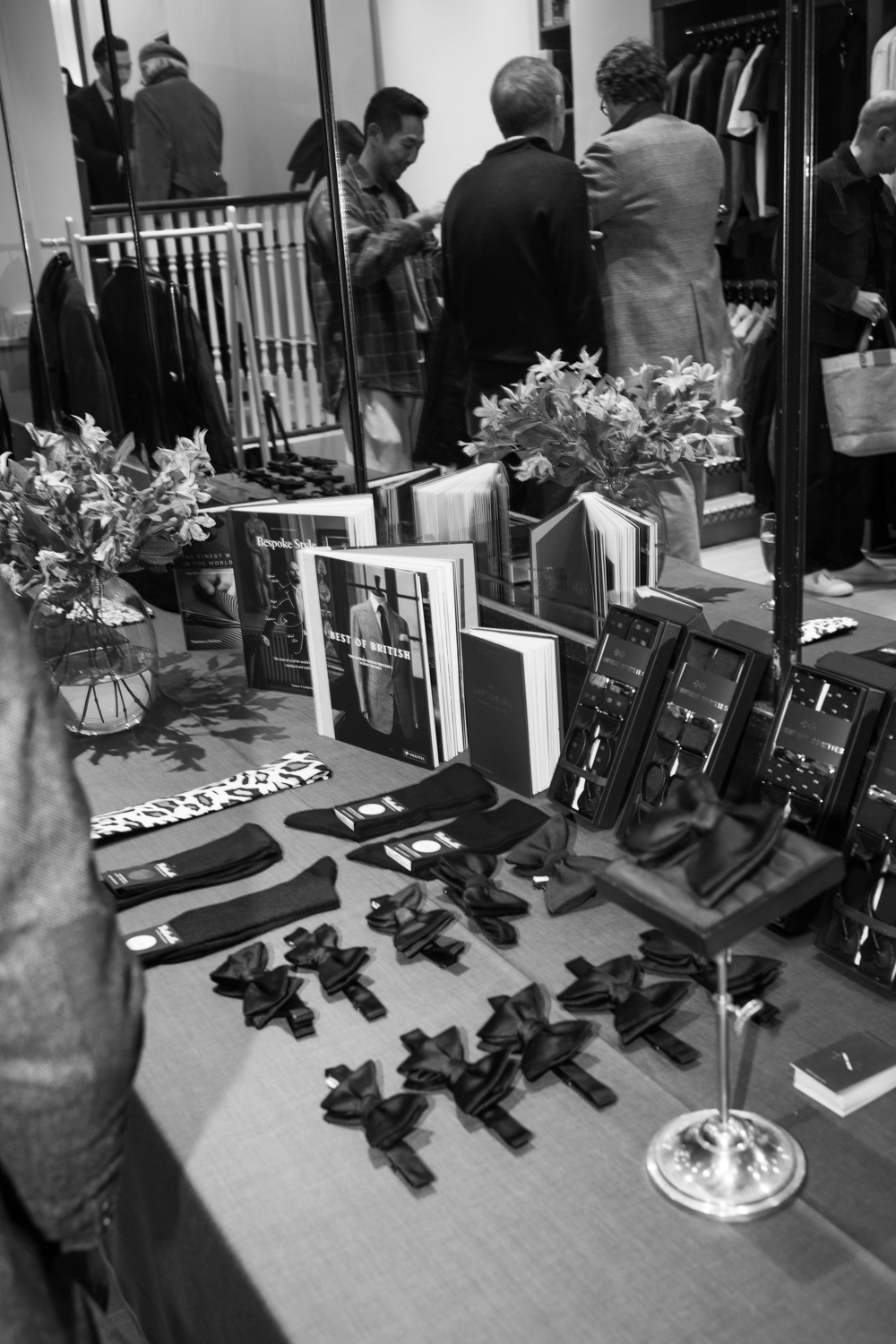
For the first-timer, it’s also incredibly convenient that La Bowtique sell every accessory you need for a black tie rig (bar shoes and jewellery): silk socks, cummerbund, braces, pocket square, MTM shirt and, of course, a bow tie - which is complimentary with every MTM dinner suit. 

I’ll write about these in a follow-up article - some worked better than expected and some (notably the shirt) less well.

However, ultimately, the main reason I’d recommend La Bowtique’s MTM to readers is the same reason I went to them for my first bow tie: their affinity for evening wear. Mickael has worn virtually every type of evening garment you might ever consider for yourself; he knows the little details that can make or break black tie, and is familiar with the angels and the devil that lie therein. But, above all, he understands that these are clothes of celebration, joy and fun.

La Bowtique can be contacted on WhatsApp at +44 7572 869286

Manish is @the_daily_mirror on Instagram

Photos by Alex Natt

Merry Christmas 2024!

Merry Christmas 2024!

Wednesday, December 25th 2024
||- Begin Content -||

Thank you everyone - readers, friends, customers, contributors - for a wonderful 2024.

It's been quite a year, with more people than ever before reading PS, and The Casual Style Guide being such a success. Trust me though, there's more exciting things coming in 2025.

Have a fantastic holiday, and see you all on Monday.

Photography: Jamie Ferguson

Be a patron

Be a patron

Monday, December 23rd 2024
||- Begin Content -||

A friend of mine has been into menswear since he was a teenager. He obsessed over three-piece suits with collared waistcoats, dreamt of visiting Savile Row, and for years sought out second-hand bespoke online.  

He briefly worked in menswear, and began to access these kinds of makers. He made the same kinds of mistakes we all do of course - everything too bright, everything too much - but he got to know some of them personally as well, and found a deeper appreciation of the genius of some, the sheer hard work of all.

In the past five years or so, my friend has become more successful professionally. He left menswear, he’s making more money, and he doesn’t yet have the commitment of children. His disposable income is higher and he is deliberately revisiting some of those artisans, in order to buy wonderful, long-lasting things from a very small number of them - always at full price. 

He is becoming, I thought recently, a patron. 

A patron can be a very rewarding thing to be. You spend the money you have on people you know deserve it, and together create beautiful pieces of craft. You use them every day, and both your experiences are enriched by the value you place on them. 

You bring the clothes (or shoes or leather goods) back to be repaired. You make comments on how they’ve worn, and how you have worn them. You talk to the maker - whom you know fairly well at this point - about the world you move in and who else appreciates these things, what others wear and why. 

The relationship is interactive, and that is powerful - both financially and creatively. 

Financially, it gives the craftsman a consistent income, which is often all he wants - a reliable way to do the thing he loves. Bespoke makers often say that big orders from rich people (Middle Eastern royalty often) are what make them money. But it’s the regular, long-term customer that holds the business together. 

And creatively it’s powerful too. Tailors used to be kept on their toes by their knowledgeable clients. Here’s a misquotation from a half-remembered conversation I remember having with John Hitchcock of Anderson & Sheppard (above, left) about 15 years ago:

“Customers used to be so much smarter back then, Simon. They would always be dressed up, really the most elegant men in the world. And there was always this interplay between the customer, our front of house, and us [the cutters]. 

“The customer would observe a fashion, and make a suggestion during a commission. The salesman would be instinctively conservative of course, but perhaps they’d make an adjustment - certainly they would take it all in. Little changes happened, both to keep up to date and to enrich the house style, to deepen it, all within that little nexus.”

Now I write it down, it doesn’t sound anything like John. But I clearly remember the point he was making: stylish, consistent customers are just as important to a tailor’s style as the people selling it (the ‘front of house’). 

The problems these days of course are manifold. People don’t use one tailor, or buy as much, for as long. Style has expanded and fractured. Consumers are less educated about clothing. The idea of the designer (or rather today, a corporate brand) telling you what to wear is the norm. The idea of anything being interactive is alien.

But it's still possible to be a patron. - to support artisans through what you buy and how you interact with their creator. 

There’s another reason I was thinking about this recently.

I get regular questions from readers asking how they can get into menswear. The growth of ‘influencers’ and start-up brands has given the impression this is an easy thing to do, or at least very possible. 

The vast majority of people who work in menswear do so in a shop, and spend long hours standing on their feet, straightening shirts and folding sweaters. Or they’re online, answering customer service emails. Or they’re in the basement, packing orders and receiving crumpled returns.

Menswear is hard. Many brands fail. The ones that are successful have often been plugging away for years. PS was going for a decade before it started making real money; Aimé Leon Dore is 10 years old, not new; Buck Mason is 11. 

If you have a dream, please follow it. But there is also a good alternative - be a patron. 

Pursue your professional career and make good money. Use that to buy a house, have a family and so on. Then use your disposable income, whatever it might be, to support makers you like, and establish relationships with them. This is so undervalued, and so powerful. 

It’s easier with artisans, but even with brands the chances are you’ll get to know the managers and probably the founders. That’s the great thing about classic menswear - it’s so small.

These days, if you wear the clothes well, chances are you’ll get a following on social media and brands will ask you to appear in their shoots or campaigns as well. There’s always a lack of good people for that. 

I know it’s easy for me to say all this. It’s not what I did, and now I can tell everyone else how hard it is. But I mean it about a dream - if you do have one, do follow it. Just remember that it isn’t the only way to be involved in menswear, in a rich and rewarding way. 

Being a patron is fantastic - I’ve met many over the years, among which the great, late Edmund Schenecker was a favourite. But you are all patrons right now, as PS readers, given how you interact with clothing. 

I'd say value that, and deepen it. 

Pictured, from top to bottom: Sr Francesco, Charvet, The Tailors Symposium, Sartoria Melina, Musella Dembech, Philippe Atienza

The menswear and culture of Bangkok

The menswear and culture of Bangkok

Friday, December 20th 2024
||- Begin Content -||

I was in Thailand last week, holding an event at the shop Decorum, and I have to say I was impressed with the local menswear culture.

I’ve travelled a fair bit round east Asia, but not much in the south-east – just Singapore many years ago. Frankly I didn’t associate Bangkok with menswear – I’d think of Singapore perhaps, then skip over most of the rest onto the likes of Hong Kong or Seoul to the north and Australia to the south.

But the city is really open and international, distinct and cultured, and has some good shops (including strong vintage), a couple of decent local tailors, and a lot of PS readers.

Speaking to those at the event, I learnt that business dress is pretty casual here - few people wear a suit, preferring a shirt and trousers. The weather doesn’t help of course, but fewer people wear tailoring than in Japan (which is also very hot and humid in the summer) or Hong Kong.

Yet there is of a culture of dressing up. It’s more common for people to dress up to go out here, to have dinner at one of the luxury hotels perhaps, than in somewhere like Singapore.

Decorum has a shop in Singapore too, and I spoke to the manager Charles about this: “Singapore is more dressed down, the norm is T-shirts and flip-flops,” he said. “Despite being a rich city it’s a harder market for us in many ways than Thailand.”

Bangkok is growing fast, particularly in luxury malls and the brands that come with them. Decorum started in 2017 but has expanded into six shops around the city, with a seventh opening in the new One Bangkok development next year.

The original shop was modelled as a townhouse, and both it and the Singapore branch still feel that way. But the newer branches - including the one we were in - are largely in those new malls. Decorum also branched out into areas like women’s clothing and fashion brands, to cover more of the local market.

Trunk shows have always been a big part of the business model. Decorum were the first to do them in both Bangkok and Singapore, and they now do two or three every month - Singapore did 22 last year. The ones in Thailand include Husbands (who were very popular), J Mueser, Ascot Chang, Yolo knitwear, Igarashi trousers, Sartoria Raffaniello, Assisi (Decorum were the ones that introduced me to them) and Bryceland’s.

Guy and Ball - the co-founders - asked me to bring out something from the PS Shop that local readers could try, so I brought a set of the Linen Overshirts, which seemed practical for the local weather and (being a lot colder in the US and Europe right now) not many other people are looking at.

Among other good shops in Bangkok are Pronto - which is the biggest workwear retailer and has several branches - and the various vintage places.

Bangkok is a big vintage centre, and one of the prime places Japanese dealers come to source pieces to sell back home. The best ones, such as Wooden Submarine, make most of their money this way.

You can see why, as the prices here are less than a third of what you pay in Japan or the US. Though the quality is also more mixed - you pay for someone to find the prime pieces as well as to import it to a shop near you.

After Submarine we visited Memories Brand, the beautiful and unusual Overall Days - which specialises in women’s and children’s vintage - and a big market known as the ‘Red Building’.

This is a multi-floor market with a mix of vintage watches, clothes, and furniture, and then a big flea market outside as well. The clothes floor has almost 50 shops, with some specialising in military surplus, others in band tees, others in sunglasses, and two or three with very high-end Americana.

I bought a couple of things, including a beautiful Big Mac denim shirt and an old camp blanket (I love how soft those things are). But there were ‘big E’ Levi’s in some of those stores for £200, for example, compared to something like £900 in Japan.

It never fails to amaze me that there are so many readers around the world getting both enjoyment and advice from Permanent Style. It was wonderful to meet those in Thailand, and I felt both honoured and humbled.

Thank you to Guy, Ball, Krittanan and everyone that helped with the event. And to Ethan, Janet and Cici for keeping me company. Hopefully it won’t be too long before I come back, and I can see much more of the country.

On the clothes pictured: I’ll do a separate post on those, so please leave questions until then. Thanks.

Ralph Fitzgerald: The Chrysler Tailor

Ralph Fitzgerald: The Chrysler Tailor

Wednesday, December 18th 2024
||- Begin Content -||

By Manish Puri.

For my money it’s the most beautiful building in New York. And yet, despite being lucky enough to have been to the Big Apple on more than a dozen occasions, I’ve never actually been inside the Chrysler.

But today, after leaving Grand Central via the correct exit (itself a noteworthy accomplishment), instead of just gazing up at the steel gargoyles and the spire glinting in the early autumn sky, I’m going in.

The lobby glimmers with soft light and the rich browns of African marble, like the interior of an ornate Easter egg that’s slowly melting away. A security guard approaches and says, “How can I help you, sir?”

“I’m here to see Ralph Fitzgerald, the tailor.”

“Oh, Ralph. He’s on 49.” I’m ushered toward a bank of elevators and whisked skywards.

Ralph Fitzgerald started his career in London at the age of 16 when his Dad, who was friendly with a doorman at the nearby Scott’s restaurant, bagged his son an apprenticeship with Douglas Hayward on Mount Street. “He was the coolest tailor,” Ralph tells me, “I know Michael Caine’s Alfie was based on him, but I can’t believe there hasn’t been a movie made about Doug.

“I was there for four years and worked for no pay for the first two. It was totally worth it because I started as a nervous kid and came away with a lot of confidence.” For the record, Ralph’s claims of poverty aren’t strictly true: Roger Moore, upon delivery of a Hayward suit, did tip Ralph £50 for the express purpose of wining and dining an upcoming date.

After a spell at Kilgour, Ralph settled at Huntsman, and in 2017 was promoted to US Head Cutter and sent across the pond to help establish their pied à terre on West 57th Street, where he remained until he founded his own house in 2023.

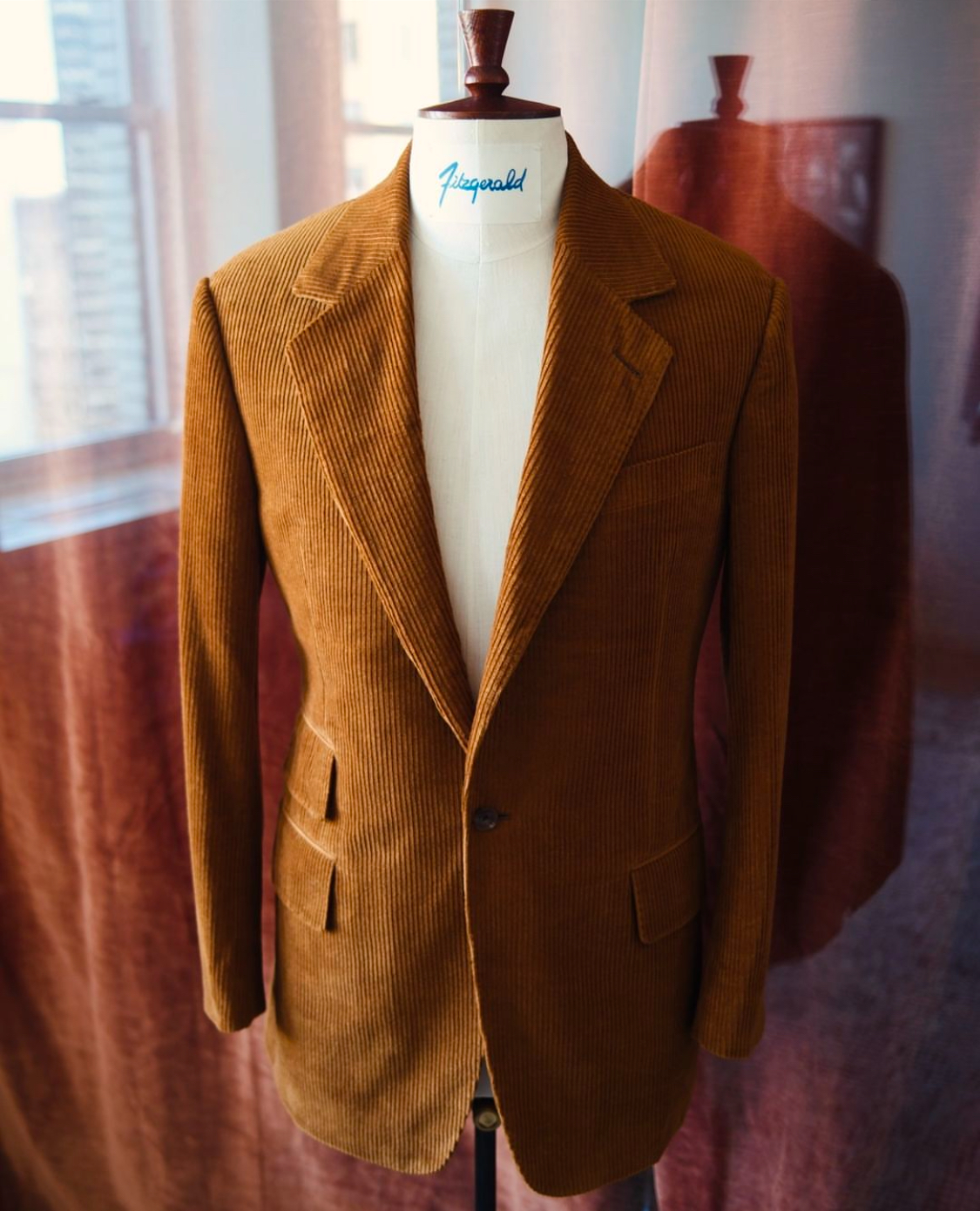
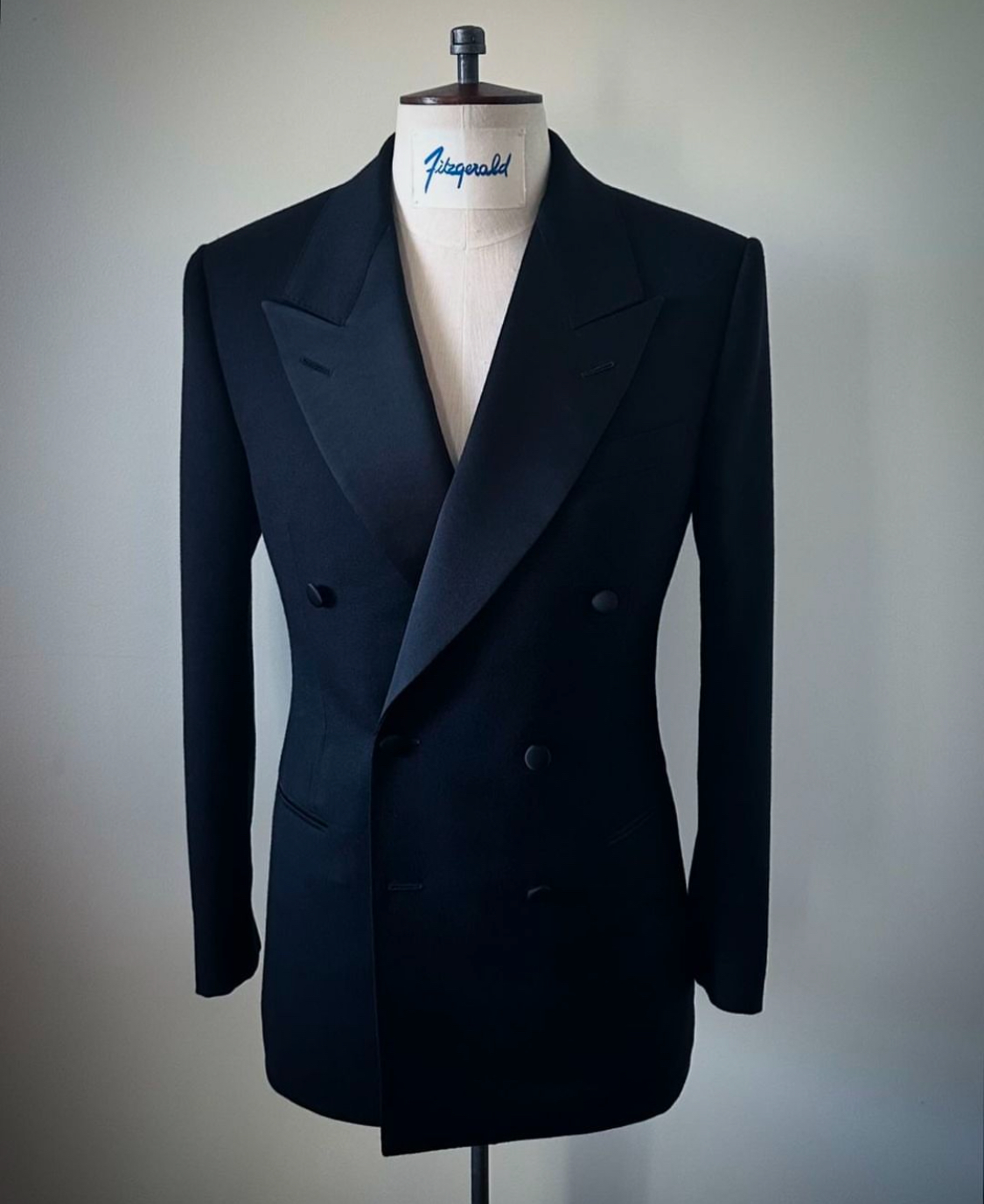
Ralph’s house cut is clearly inspired by his London origins: strong shoulder, dropped gorge, nipped waist and lower buttoning point - often secured with a solitary button. (I could literally hear the strains of Mrs. Robinson as I tried on the rich corduroy jacket above).

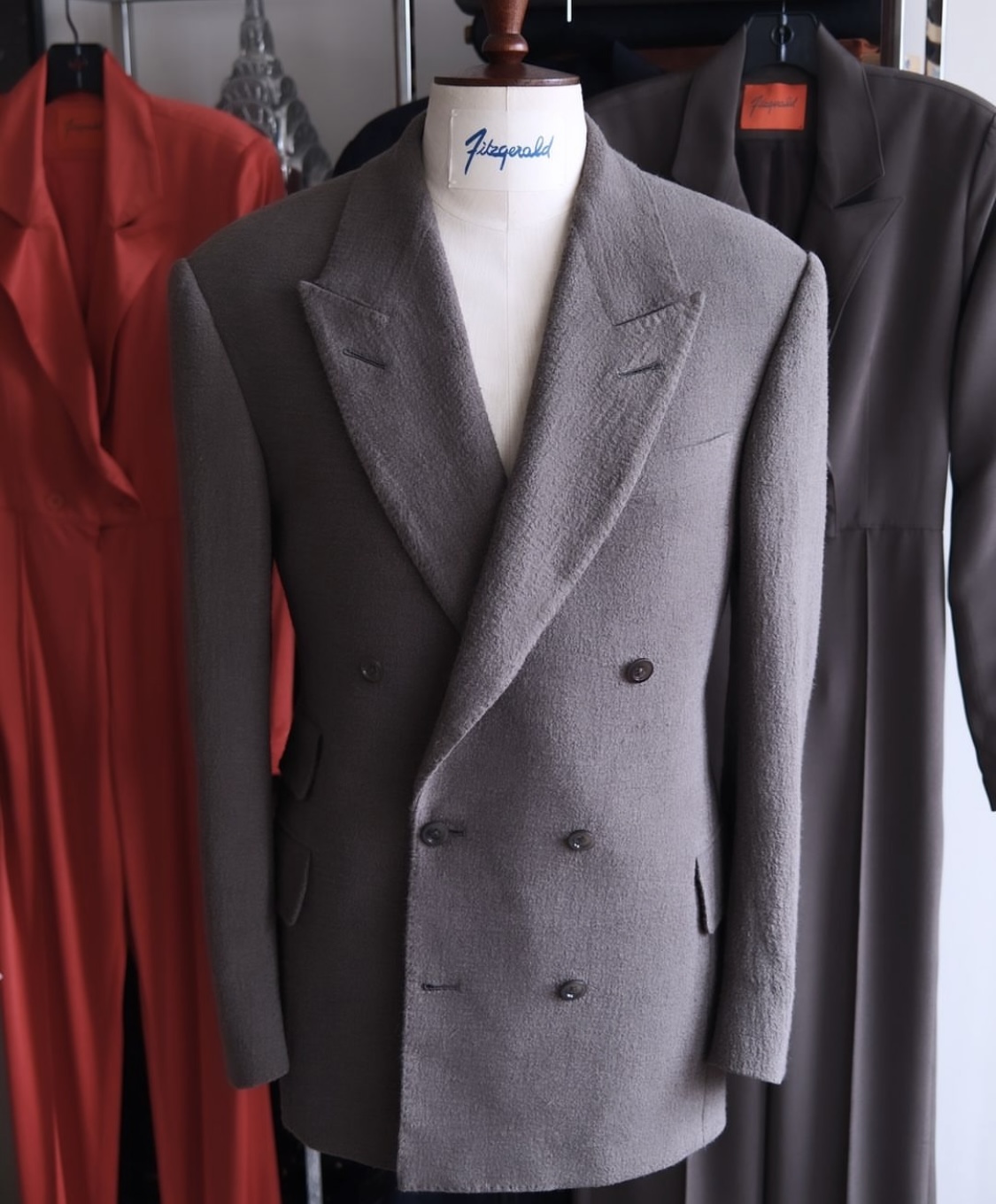
I also found the double breasted model (below) very flattering. The low buttoning point (which Ralph favours as it exposes more of the shirt and tie), moderately wide bellied lapels, double buttonholes and rounded lapel points combine to look like the face of a somnolent fox.

Ralph also prefers a wider collar piece as it helps the leaf-edge of the collar to read straight upon the form - which he thinks looks better. It’s fascinating how, having expressed doubts about a bigger collar in the review of my Taillour DB (reservations that most readers politely and helpfully dismissed in the comments), I’m really starting to appreciate a fuller collar panel. A lesson in being patient with your clothes and allowing the eye and the mind time to adjust.

In deference to the meteorological and sartorial climate of his newly adopted home, the house construction tends to be much more lightweight than a traditional London coat - with less padding and lighter canvas.

This is just one of the ways that Ralph has adapted to and embraced New York life. But, just as interesting to me is how his overall approach has a simplicity, clarity and openness to new ideas that I’ve always found to be characteristic of my favourite New Yorkers.

Take the fitting process. This is kept as simple as possible - the majority of Ralph’s garments are delivered fin-bar-fin after one baste fitting, i.e. finished without buttonholes and with the lining still to be hand felled. As a result, turnaround times are relatively short: around 10 weeks for a first commission and five weeks for repeat orders.

While it's fairly unusual to skip a forward fitting, Ralph's model has been honed by his experience of US trunk shows - where a garment can easily take over a year to finish. As he explains: “Time is a big factor here. It’s nobody’s fault, but I think people get exhausted by lots of fittings."

With that said, Ralph made it clear to me that he wouldn't baulk at offering a forward fitting if one were needed. In his experience, he's just found that it's not often the case. I'd recommend that any potential customers with concerns reach out to Ralph beforehand. However, ultimately, the proof is in the wearing, and that's something I will be able to comment on in the future.

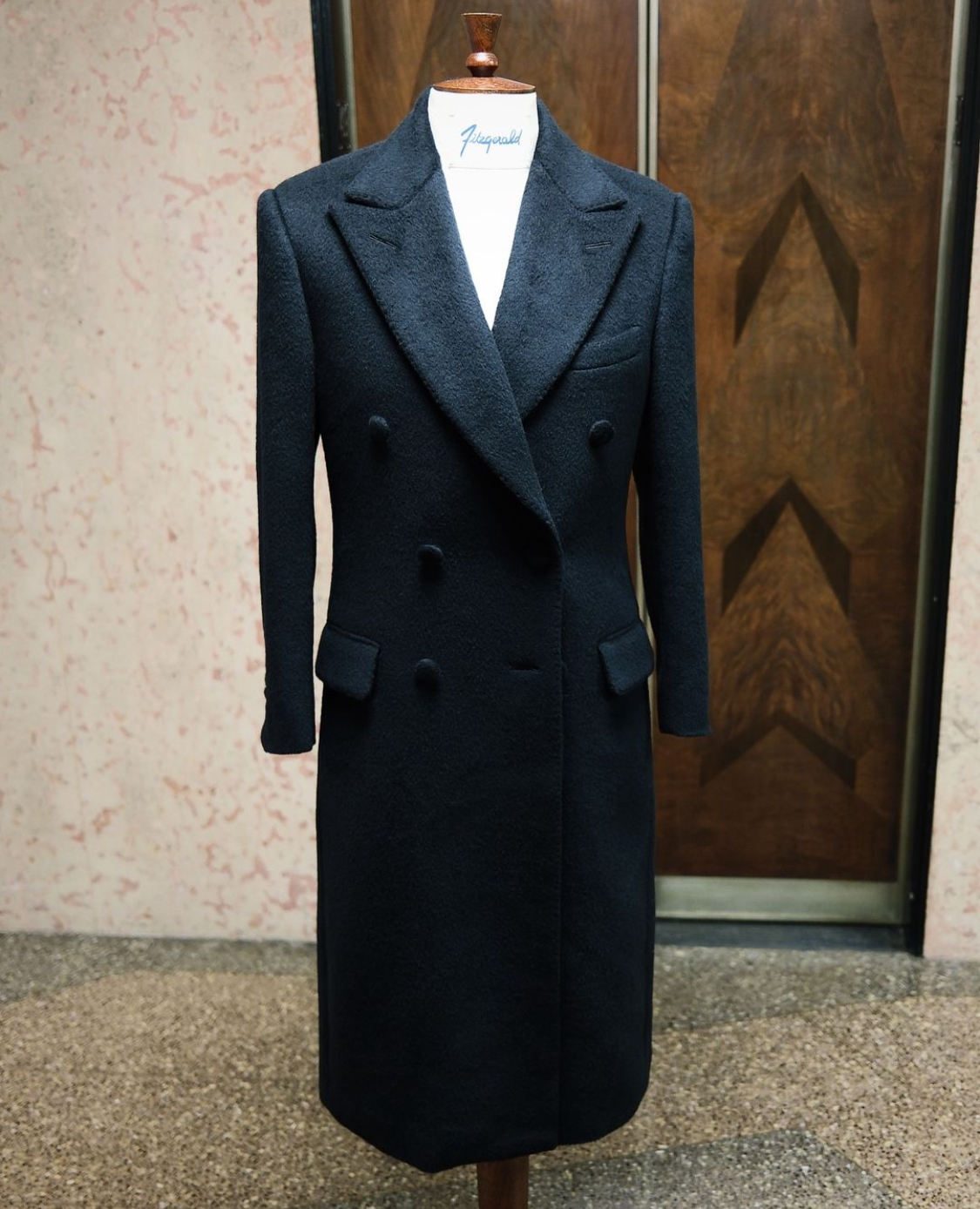
Ralph’s pricing is also a good example of clarity. Sports coats are $5,000, and suits and overcoats $6,000. These are fixed rates for most cloths, barring super-luxe selections such as cashmere, vicuña and alpaca - the latter used for the overcoat above which is my favourite commission of the year (alas, not mine). As Ralph explains, “It’s frustrating for a customer when they're told an initial price and then get charged an extra 10% because they picked a more expensive cloth.”

I’d agree with that sentiment and add that, in a pricey town, Ralph represents good value, especially when you consider that more established American purveyors of an English style, such as the travelling Savile Row tailors or Leonard Logsdail, can charge up to nearly twice as much. 

Of course, the decision to have fewer fittings helps to control costs, plus those other businesses carry more prestige and significantly higher overheads than Ralph’s nascent, one-man enterprise.

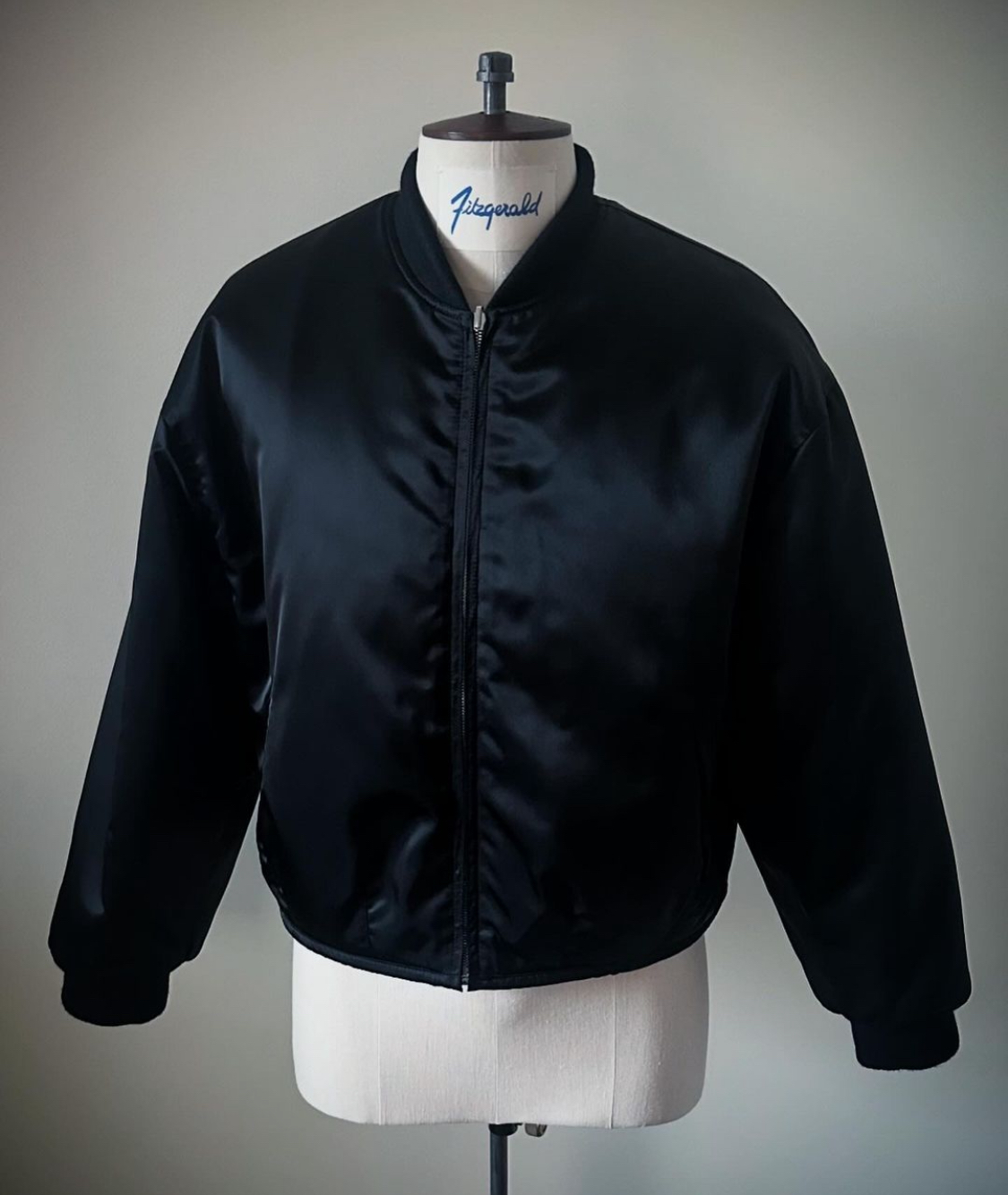
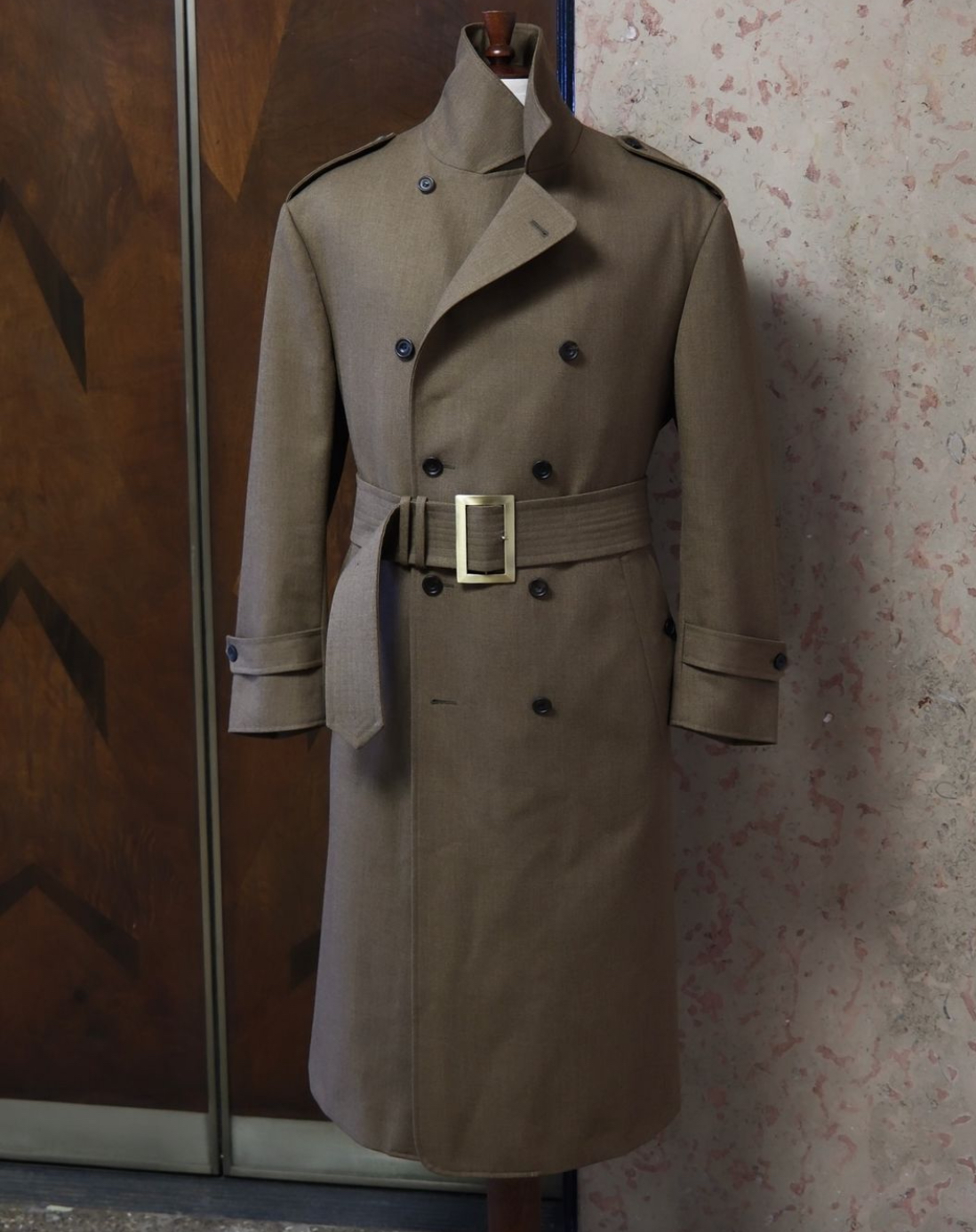
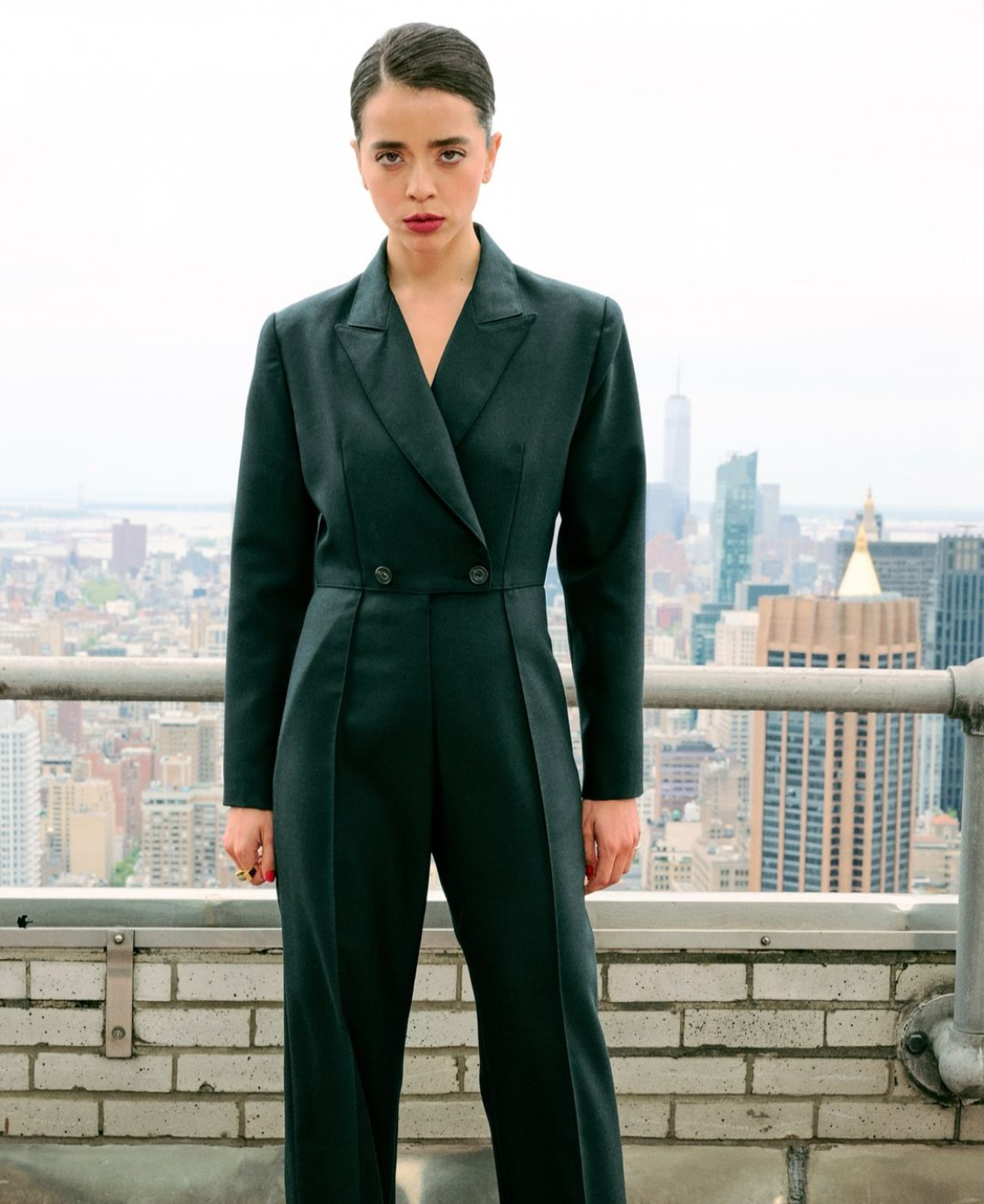
At the heart of Ralph’s tailoring identity is an openness to new ideas. Recently finished commissions that I saw hanging on the rails included a reversible satin/alpaca bomber jacket, a trench coat made in a reproduction World War II cloth by Hainsworth, and a barathea jumpsuit for a Pilates instructor (below).

“I think tailors should be excited to do something different. I’m not better than any garment, and I like to understand how things are made,” he says. 

In my opinion, it’s that enthusiasm and willingness to try new things that’s helped Ralph become an inadvertent hit with the ladies…in business terms! Around 50% of his clientele is women.

“New York women have incredible taste and they’re often accustomed to paying very high designer prices, so when they walk into a bespoke studio and realise they can have whatever they want for a similar amount it’s a shock to the system. Women are also great at spreading the word if they’re happy.”

I asked Ralph about the challenges of adapting to cutting for women: “It’s not rocket science, but, of course, it is significantly different. However, the main difference isn’t technical, it’s taste.

“Generally, there will be small differences in men’s taste. But women have wildly different preferences on the shoulder line, lapel, shape through the waist, trouser style - it’s far more challenging in that way. But that’s where I think the cutter’s skill lies: working out what the customer wants.”

At present, Ralph sends all his cut bundles to London to be basted and finished. “There’s some incredibly skilled makers in New York, and I’d love to have everything made here one day, but there isn’t the same capacity as there is in London,” he says.

However, minor alterations and certain finishing touches are done in New York - including two of my favourite stylistic flourishes of Ralph’s.

The first is the precisely stitched buttonholes - long and lean with a small keyhole, they resemble matchsticks and are among the neatest I’ve come across.

The second is cloth-covered buttons. Ralph found a shop in the Garment District that would cover them, and now it’s become something of a signature on evening wear, overcoats and even blazers. It’s a detail that I always liked on George Cortina’s Anderson & Sheppard suits (from the days when he was a fixture on The Sartorialist’s now-defunct blog), and I think it looks particularly charming on winter clothing, as though the buttons are chilly and need a protective layer too.

That Ralph was pottering about in the Garment District will come as little surprise to those that know him. He has a self-declared passion for sourcing cloth, and his vintage collection - much of it scored in that neighbourhood - is as interesting as any I’ve seen. Among his stash you’ll find hand-dyed ombré lambswool, Pierre Cardin alpaca and a prototype worsted-spun cashmere-denim made by Dormeuil. 

“The Garment District is sat on so much rare and wonderful cloth, and a lot of it is really unusual because it comes from the fabric development teams of big designer brands. A new find that I really like is cotton gauze [as seen on the first DB shown in this article]. It gives some of the same effect as linen, but it’s more porous, requires less maintenance and tailors better in my view.”

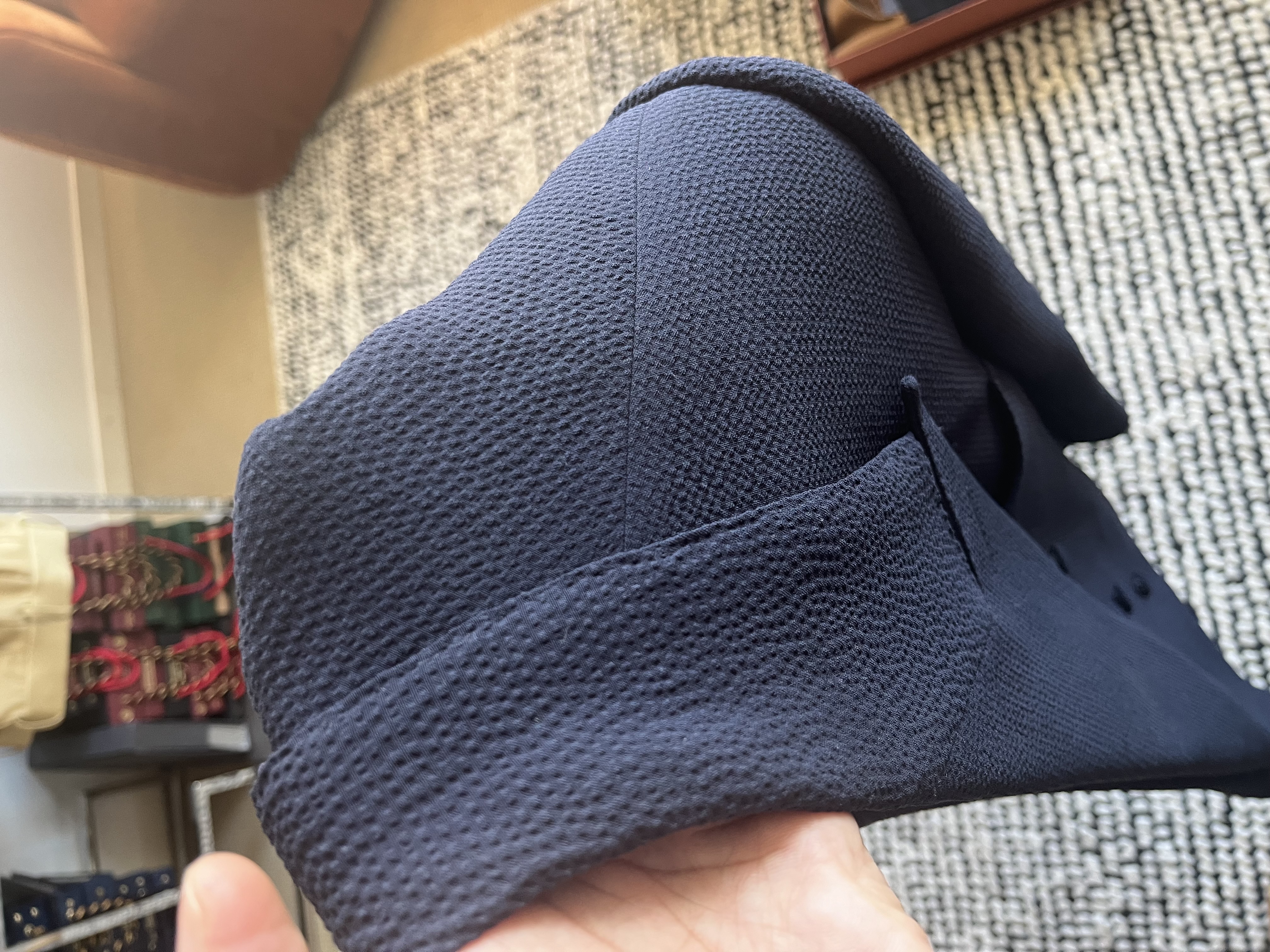
For my first commission with Ralph I chose a vintage navy Japanese wool seersucker (above) that is so crisp and textured it could double as a very gentle skin exfoliator - not a property I’d normally commend to you, but you really should feel this stuff. Count on a review from me when it’s ready next year. 

I left Ralph to the tranquillity of his studio, high above the hustle and bustle of midtown Manhattan. “It’s nice just to lose yourself in your own stuff, and not see what everyone else is doing all the time,” he tells me.

As I exited the majestic Chrysler I took one last admiring glance at the spire - and asked myself 'Has it always looked like a sewing needle?'

Manish is @the_daily_mirror on Instagram

Ralph Fitzgerald can be contacted at [email protected]. All images are courtesy of Ralph Fitzgerald.

Learning lessons: Light-grey overcoat and horsebit loafers

Learning lessons: Light-grey overcoat and horsebit loafers

Monday, December 16th 2024
||- Begin Content -||

I had this overcoat made earlier in the year by Sartoria Ciardi from Naples, but have only had a chance to wear it consistently the past few months. The cloth is CT17 from Fox - a 20/21oz wool in their overcoatings bunch. 

I was confident of the style, as it was the same as the taupe ‘British warm’ I had made with Ciardi a few years ago - the original review of that is here.  

But I was a little unsure about the cloth. Not the weight or the quality necessarily, but the colour. The weight is light at 20oz, but it felt like it had enough heft. And the quality seemed pleasingly tweedy without actually being a tweed - and so could bridge smart and casual. 

Perhaps I should use a word other than ‘quality’, actually. When people in the cloth trade refer to a ‘quality’ they mean a particular type of cloth - a yarn, weave, weight and finish, varying only then in colour or pattern. But of course that’s not how normal people use it, so perhaps I should call it the ‘type’ of cloth. Anyway, the type seemed nice and has proved to be so. 

It was the colour that has proved tricky. My thinking was that I didn’t have a grey tailored overcoat, and if there was any hole to fill - in anyone’s wildest definitions of such a thing in my wardrobe - that was it. But I didn’t want a grey herringbone, like our Donegal or English Tweed coats. 

This grey twill (the diagonal lines of the weave) looked nice. There was a little brown in the colour mix, the melange, which would add some warmth and make it less formal - good with black and cream jeans, perhaps even dark indigo, and great with all shades of brown. 

This subtle design is the kind of thing Fox Brothers are particularly good at, by the way, and is an example of when I’m happy to pay their higher price. It often makes for cloth that’s both interesting and tasteful, and it’s not worth sacrificing that for a couple of hundred quid in saving. 

When this coat was made up, however, the grey was a little lighter that I’d expected. It wasn’t hard to find a combination it looked good with - the tonal Scandi one here, all beige and brown, is typical for me and lovely - but it wasn’t that versatile. 

With dark suits it stood out too much. With more rural colours like burgundy, forest green or a warmer brown, it was too smart and cold. 

Interestingly, my Saman Amel coat (below) is a similar tone but I find it easier to wear, perhaps because it’s completely unstructured and more casual. 

I also think the Ciardi is a little harder to wear because the colour makes its dandyish details stand out - the martingale back basically, with its half belt, box pleats and the buttoned vent. The Saman one is plainer. 

This experience is the opposite of the Ciardi taupe coat (below). That turned out to be more versatile than I thought, as despite not being a classic navy, grey or charcoal, it worked with a wide range of outfits, including the tell-tale test of black and brown shoes.

The lesson there is probably that how light (in colour) a material is, is more important than whether it’s a slightly unusual colour, like taupe.

I also struggled with button choice on the light-grey coat. My instinct was to avoid contrast, so I initially chose a light-brown horn. 

But these stood out too much, so next time Ciardi visited, I had them change them to dark brown. In retrospect this should have been obvious, given I knew how well dark brown worked on the Saman coat. 

I guess the lesson is the similar to the one about overall colour - if in doubt go with darker buttons, even if it means higher contrast. 

Let’s be clear - I still really like this coat. I wear it quite a lot and really enjoy doing so. 

The material (the ‘quality’) is really nice - it is the perfect mix of smart and casual that I hoped. According to Fox, this is typical of west-of-England cloth - hard wearing but with slightly milled finish. 

The colour just means that it isn’t something I’d recommend to readers as their first one or two coats. (There is of course a whole article here on making that choice.) It works for me, as I already have lots of more versatile options. But it might not for others so much. 

The shoes, by the way, are vintage horsebit loafers (I'd guess from the early 90s). I’m still not sure of the horsebit style, but I picked these up for $40 at the excellent Alfargo’s Market Place in New York, and buying cheap second-hand is a nice way to experiment. 

Trying horsebits is evidence of Lucas’s influence, and I do wear a lot of black loafers, particularly with a low vamp. So perhaps these will work out well - they just might be better with a relaxed warm-weather outfit than a wrapped-up winter one. We’ll see. 

I don’t find I ever stop learning. I know I dress better than I used to - the trendline is definitely up, even if the data can look a little scattered. And anyway, life would be pretty boring if there were nothing left to learn.

Other clothes shown:

  • White Permanent Style oxford button-down shirt
  • Fawn Rubato V-neck lambswool sweater
  • Brown flannel trousers, Fox cloth, from Whitcomb & Shaftesbury
  • Californian model sunglasses, EB Meyrowitz
  • Old Ralph Lauren cap

Métier: A fashion bag brand, but with quality and functionality

Métier: A fashion bag brand, but with quality and functionality

Friday, December 13th 2024
||- Begin Content -||

There are a few reasons why I think the bag brand Métier might appeal to PS readers. Let me set them out in typically geeky PS-style. 

First, they don’t have any branding. The prices might be fashion-brand prices, but there’s no big name stamped on the outside - the identity comes from the colours, that diamond-shaped hardware on the women’s line, from some distinctive designs. 

Second, they are well made. The construction in Italy (Florence and Naples) is very good and uses precise thicknesses of leather to keep the weight down. The leathers are high-end, often unusual, and age well - this is not the fashion norm of corrected grains. 

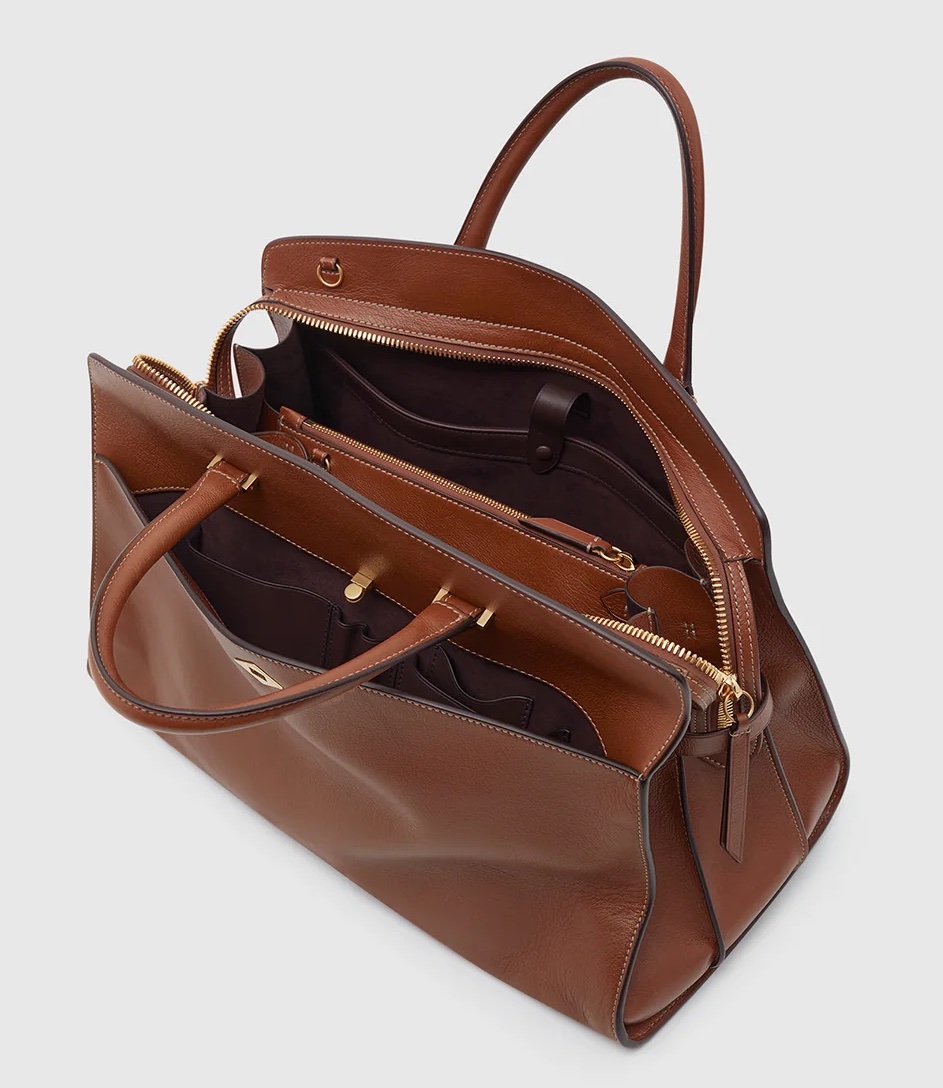
Third, the design is deliberately practical. The bags nearly always have a magnetically sealed pocket on the outside for quick access, plus a zippered one for security. There are multiple internal pockets. In fact I don’t think I’d ever use all the card and pen pockets most bags have.

The brand started 10 years ago and has had a London shop since 2017. The founder, Melissa Morris, is American but wanted to open in London partly to be closer to the makers in Italy. The brand is also planning on opening in New York. 

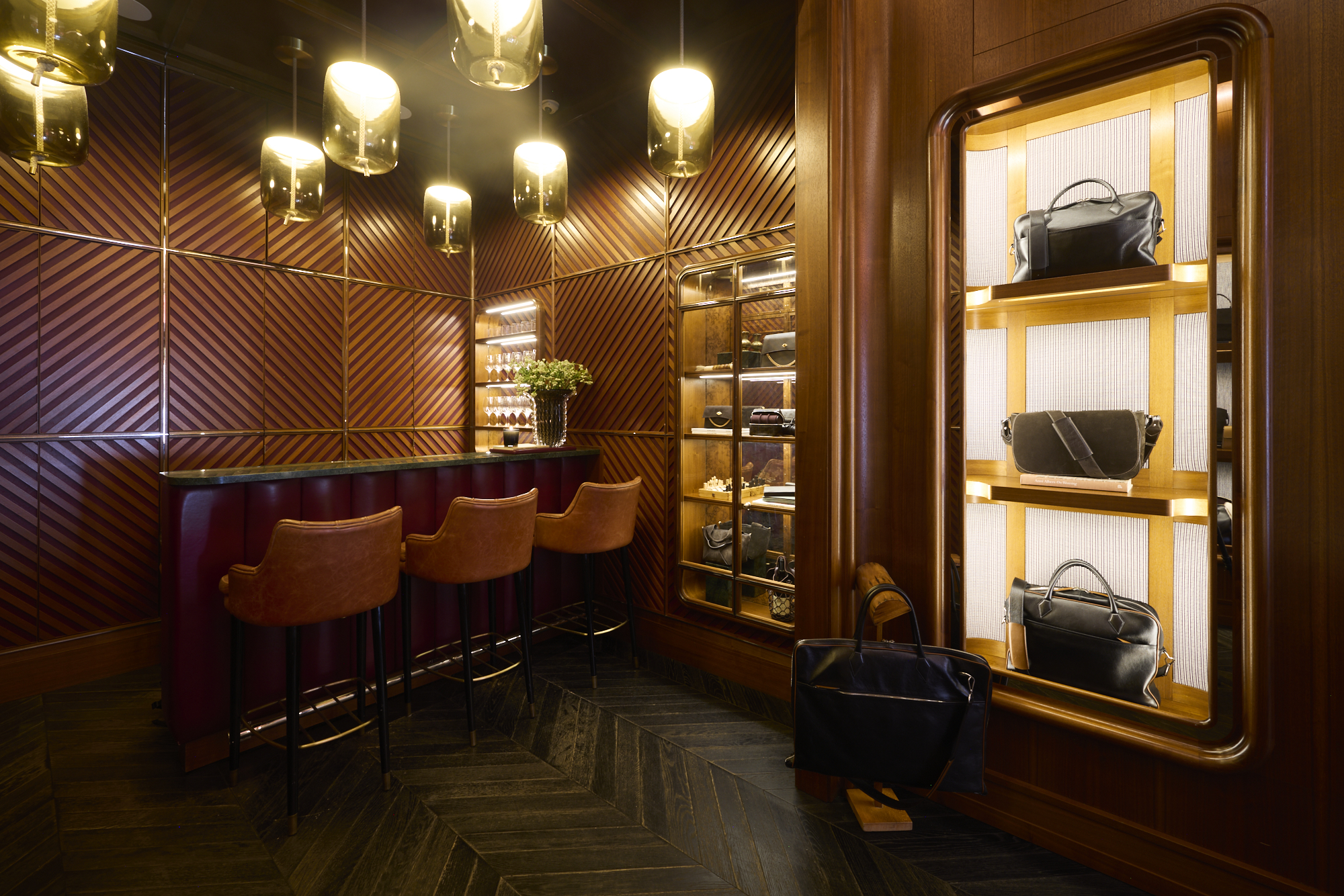
The shop on London’s South Audley Street is beautiful: wood-panelled with hidden cupboards to echo a Riva boat, subtly branded with things like a diamond-shaped table. But given the luxurious décor, and the lines of tourists outside brands on Mount Street around the corner, I can imagine a classic-and-craft-driven reader being a little sceptical. 

Which is why I led with points about the product. This is very much a product-driven brand.

Fashion brands don’t tend to include stories about how products age. Partly that’s not what people want, and partly it’s because they don’t have good stories to tell. But Métier do, even if they don’t put them front and centre.

I saw the shop manager’s handbag when I visited, several years into its life, and what looked like an almost patent leather had softened into a surface with a subtle, varied texture, which was much more rich and personal. 

One of my favourite materials for the men’s bags is buffalo. Melissa used buffalo leather because she wanted a fine, irregular grain but didn’t want to stamp a pattern on, as most brands of that ilk do. I also like the ‘Elvis’ leather (above), which is the same but with a waxed finish, giving it a more glamorous look but one that also softens over the life of the bag. 

There’s a good article here on the Métier site actually that looks at some of those making details, and the idea of journeys that drives a lot of the functionality.

Not all of the designs are my style. I find the backpacks a little too delicate and the big zips on something like the Vagabond are too prominent for me. 

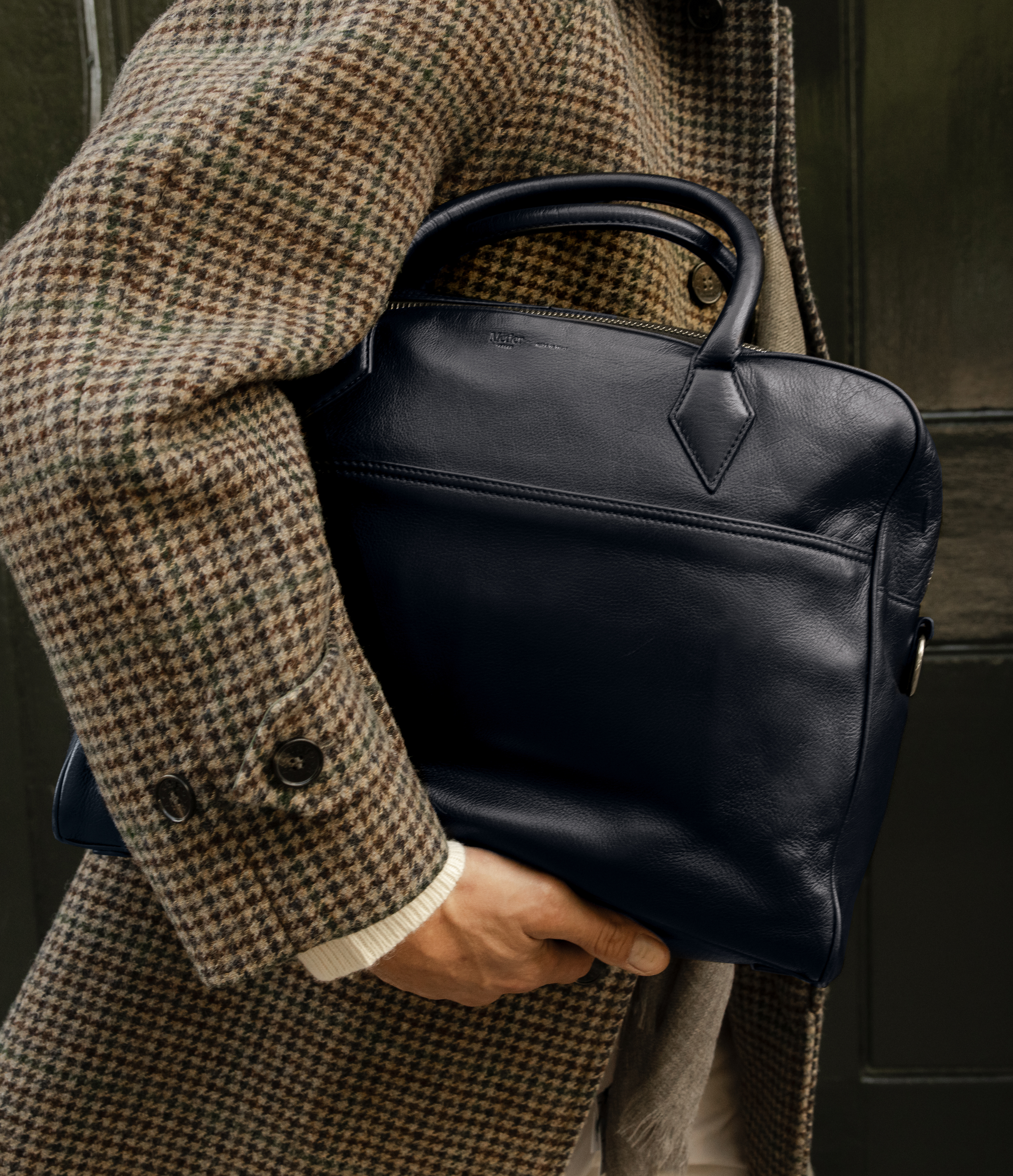
But all of them are interesting - striving to be new on well-trodden ground - and there are everyday classics in there as well. The Closer All Day (below) is as good a briefcase as you’ll find, filling that gap that men often struggle with between an old-fashioned flapover case and a simple tote. 

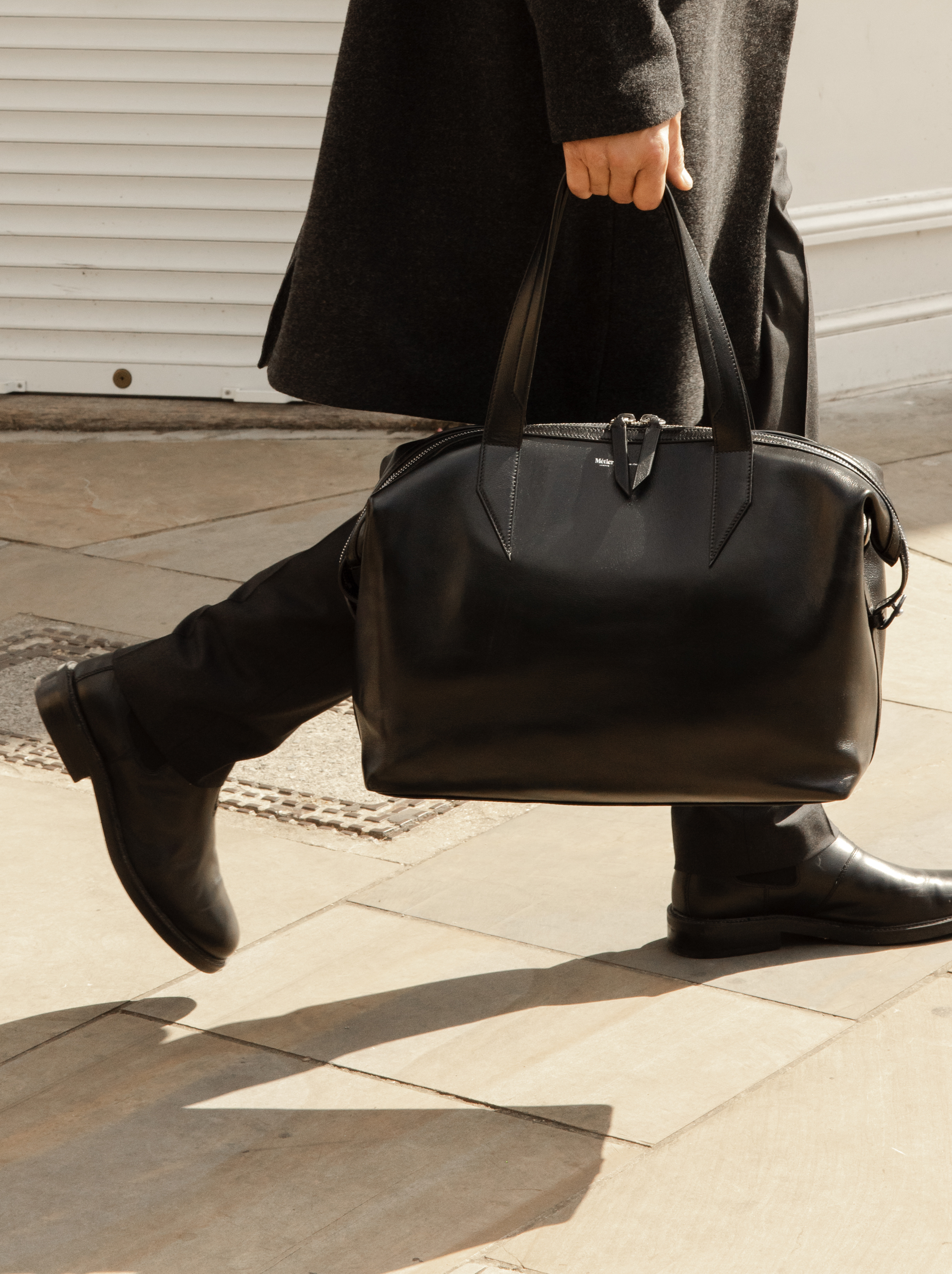
My other favourite is the Nomad, which in its smaller size also fills a gap I think - one between a briefcase and a weekender; not so small as to be dinky but not so big as to quickly become heavy. 

In some ways, the women’s bags are actually more classic than the men’s - often because they’re simple and clean. 

The Vérité (above), for example, doesn’t read as feminine to me despite its slim handle. It just looks a little fancy. It’s only when the women’s models have more hardware on the outside - like that lozenge closure - that they start to look feminine. And even then I know guys that would love them. 

Something like the larger version of the Private Eye (below) looks like quite a traditional men’s style, but the silhouette and the lines of the outer pockets have been redrawn, making it look fresh. 

In fact this is probably the crux of the issue - the thing that would push someone to spend the big tag of £3000 on one of these bags.

Traditional men’s bags are great - they’re strong and they age well and they’re good value - but they can feel as if no one’s rethought them in 100 years. That makes them heavy, sometimes impractical (eg an attaché) and obviously very traditional in style. Men’s bags rarely get the design attention that these Métier ones have. 

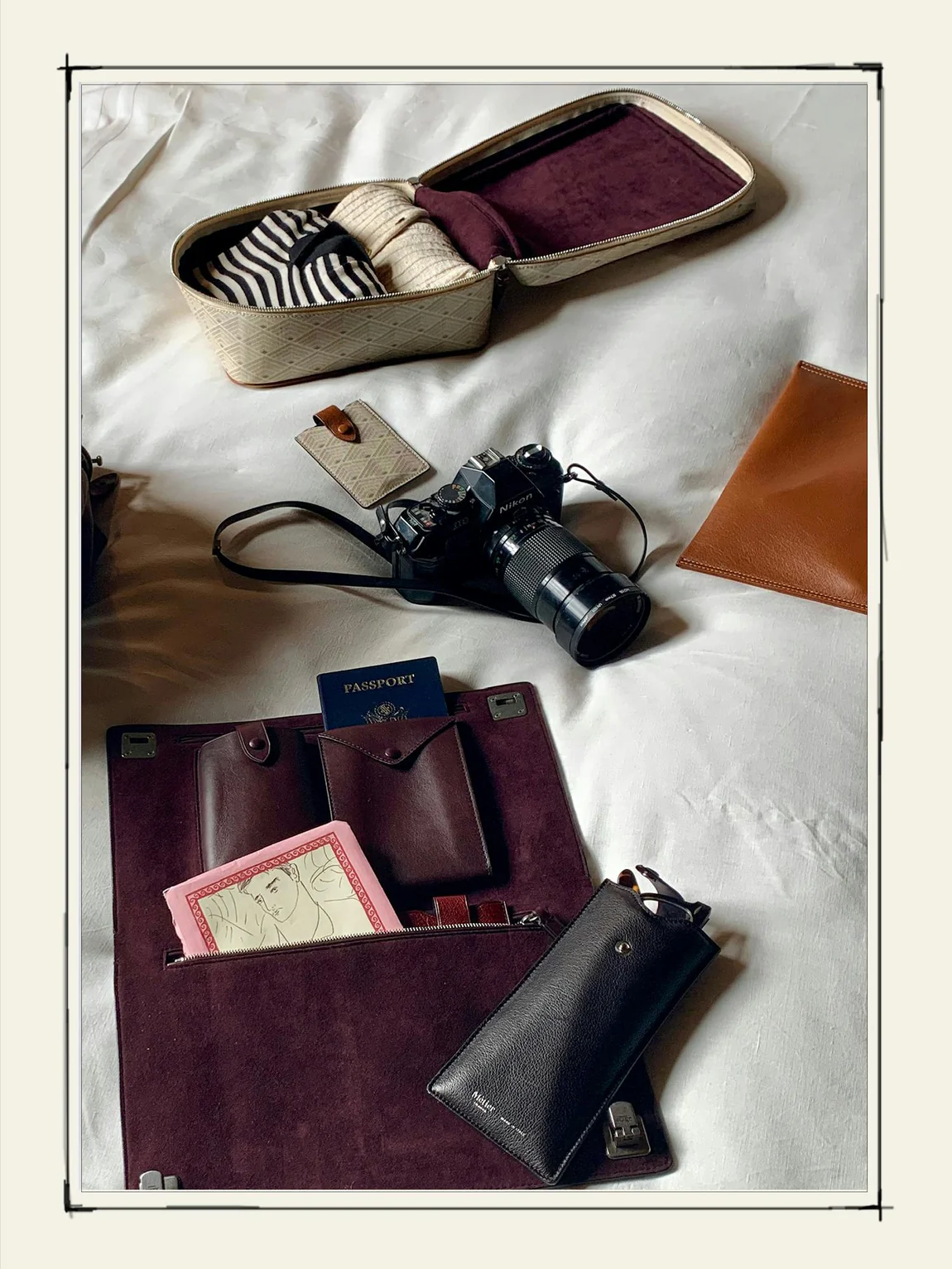
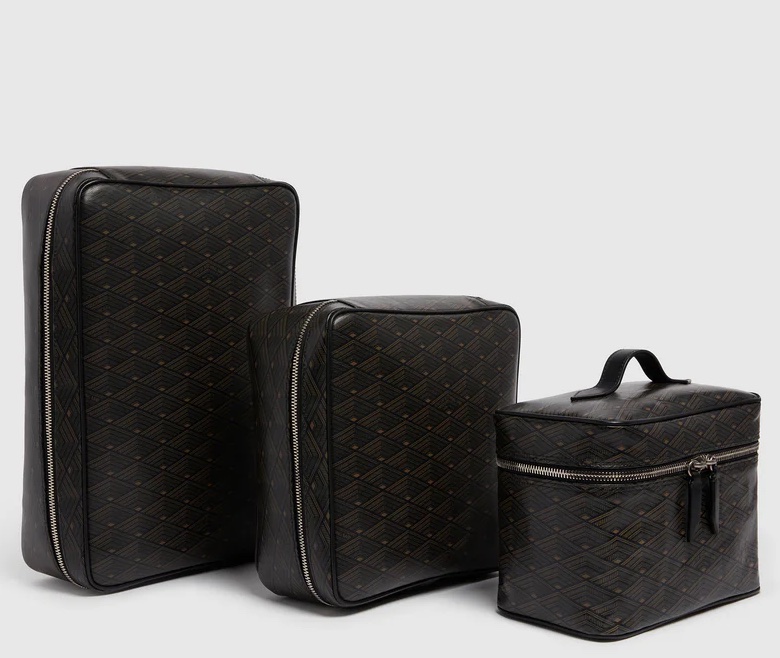
Everything from the colours to the travel cubes has been thought through with a particular use case in mind. Those travel cubes are expensive too, but they're lightweight, practical and tasteful, such that I’d still be tempted to get one to put in another bag.  

New style means unusual style, and Métier won’t be for everyone. In fact in many ways the brand is more Paris or Los Angeles than it is London, despite the shop being here. It’s more refined and obviously luxurious.

I’ve had quite a few questions from readers about Métier in the past year, which I think shows there is interest in new bag brands like this. Interesting high-end men’s offerings are pretty rare. 

If I had to choose, I’d get a Closer All Day in the black buffalo (£3,150) or the impressively subtle racing green. I love the fact that the latter looks almost black but it's not. It’s perfect for the guy that wants the formality of black but feels that’s a little boring or corporate. 

Or I'd get the smaller size of the Nomad (£2,890) in a dark suede, chocolate or khaki. Those colours aren’t available at the moment, but are coming back apparently. The Nomad I’d use every day as a commuter bag, but it would have more room for clothes samples, a little gym kit and so on.

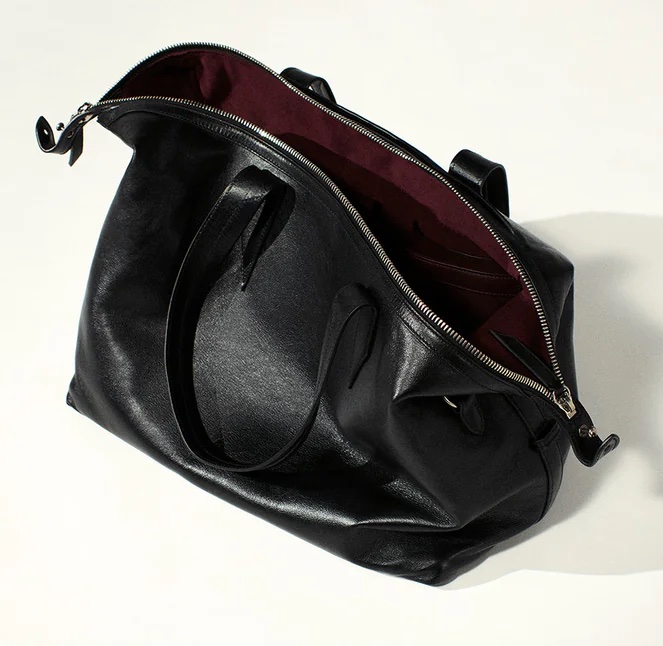
It says something for the taste level of Métier that all these colours work with the purple 'Amarone' lining used throughout. It shouldn't work with everything, but it does.

metier.com

Bryceland’s made-to-order chambray shirt: Review

Bryceland’s made-to-order chambray shirt: Review

Wednesday, December 11th 2024
||- Begin Content -||

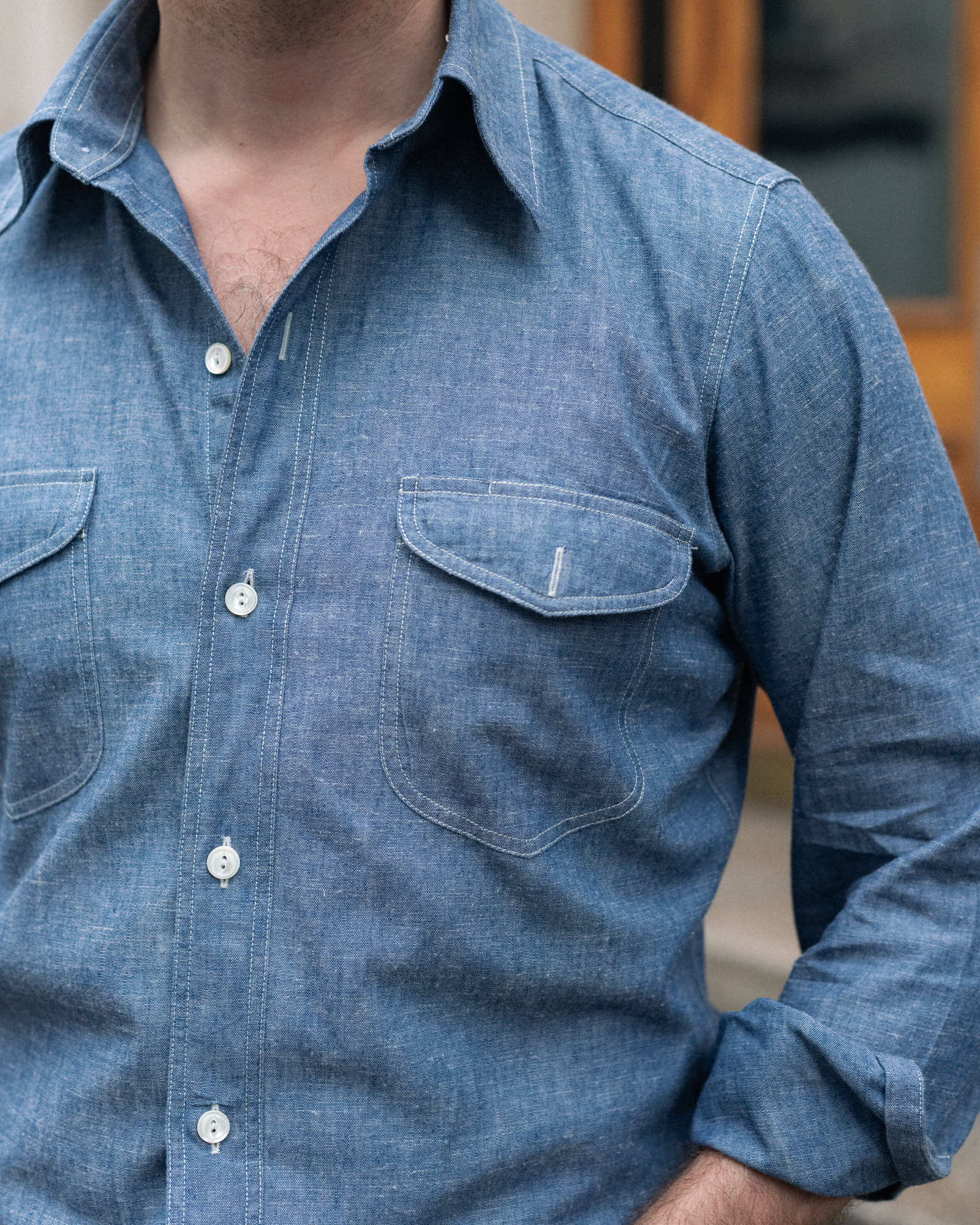
Made-to-order services are useful with workwear shirts, where bespoke makers can rarely replicate the construction or the materials. We covered one such service recently, from The Anthology, and today we’re reviewing another, from Bryceland’s. 

I should say, by the way, that in that Anthology review I didn’t mean to directly compare the shirt with my bespoke ones. That would be unfair, as this system offers something much simpler, cheaper and quicker. 

I had a couple of comments from readers about this, because I used a bespoke shirt to find out what my ideal measurements would be - and see how close I could get with the Anthology MTO. I still think that’s a good way to work - to pick your best-fitting shirt and measure it when you’re picking adjustments in an MTO system - but I wanted to emphasise that I wasn’t saying the Anthology fell short in not replicating a bespoke fit.

Now, on with Bryceland’s. 

I’ve always liked Bryceland’s shirts, yet often found the styles didn’t quite work. Ethan* tends to favour more original, authentic designs rather than completely reworking them, and it was often these elements that stood in my way. 

For example, early on I owned both the Teardrop (top image above) and the USN chambray (second image above). I wore them both but over time less, especially with tailoring. I found the longer collar of the USN better with a jacket - and on me more flattering - but liked the design and material of the Teardrop more. 

These points are largely subjective of course. Which design you prefer is entirely subjective, and different collar styles - especially heights - work better for different people’s body shapes.

When I was talking to Ben** in the London store a couple of months ago - actually about their MTM tailoring, which we covered recently - he mentioned that they could make a shirt to my preferences: the USN collar on a Teardrop shirt. 

Now that doesn’t mean you can chop and change everything on a Bryceland’s shirt. The style still has to be retained. But there’s more flexibility than you might think, particularly given how closely they work with the manufacturers.

The same goes for fit. You can change shoulder width, body length and sleeve length, but you can’t make the body shape very different, or add darts for example. This is a work shirt though - it shouldn’t be that tailored. 

In my case, I know that most of the time I’m a standard size in the chest, shoulders and sleeve length of a shirt, but a size down in the collar and waist. So I tried the Teardrop and was, as predicted, a Large in those first things and a Medium in the others. We put in an order for the shirt in those measurements, with the collar swapped for the USN one. 

Ben also suggested raising the height of the collar slightly and so we added half a centimetre there. This was felt to be still within the existing style, as was the new collar.

The resulting shirt was exactly what I ordered. It might seem odd to say that, but as we all know it’s not always the case with bespoke makers. 

The result also illustrates, I think, the power of making simple changes to existing garments, rather than starting from scratch. The gap between expectations and result - often the biggest issue with bespoke - is narrowed from both ends. 

The collar on the shirt felt a little long to start with, probably because I was used to it in the softer USN material. But after wearing it with a jacket for a while the collar moulded slightly, getting a subtle ‘S’ shape and looking a little shorter as a result. It also fit nicely under a tailored jacket. 

The colour will fade a little with repeated washes, which will make it nicer I think. I enjoy the construction details on the teardrop as well - as it says in the product description, it’s a work shirt from a time when even the most robust clothing still had charm in its design. (Such as the little pleats on the back, shown above.)

The only small issue I had was a little shrinkage, around 1cm in the sleeves after three washes. This is tiny really, and certainly within the tolerance for any fabric supplier, but when I make another one I’ll likely err a little longer than shorter. Easier to shorten if I need to.

(The chambray/linen, by the way, definitely has more shrinkage than the plain chambray, and I’d ask advice there on how much extra to have to account for it.)

Prices for MTO shirts are generally around 20% more than the RTW. My shirt was £269. The linen/chambray is a little more as it’s a more specialist cloth. Delivery times are usually 4-6 weeks. 

Other clothes shown:

  • Jeans from Rubato
  • Jacket bespoke from Ciardi, in Anglo-Italian cloth
  • Brown suede belt from Rubato
  • Watch from Cartier, Chronoflex in yellow gold

*Newton, co-founder **Chamberlain, London store manager

August Special: Innovative, rugged boots and loafers

August Special: Innovative, rugged boots and loafers

Monday, December 9th 2024
||- Begin Content -||

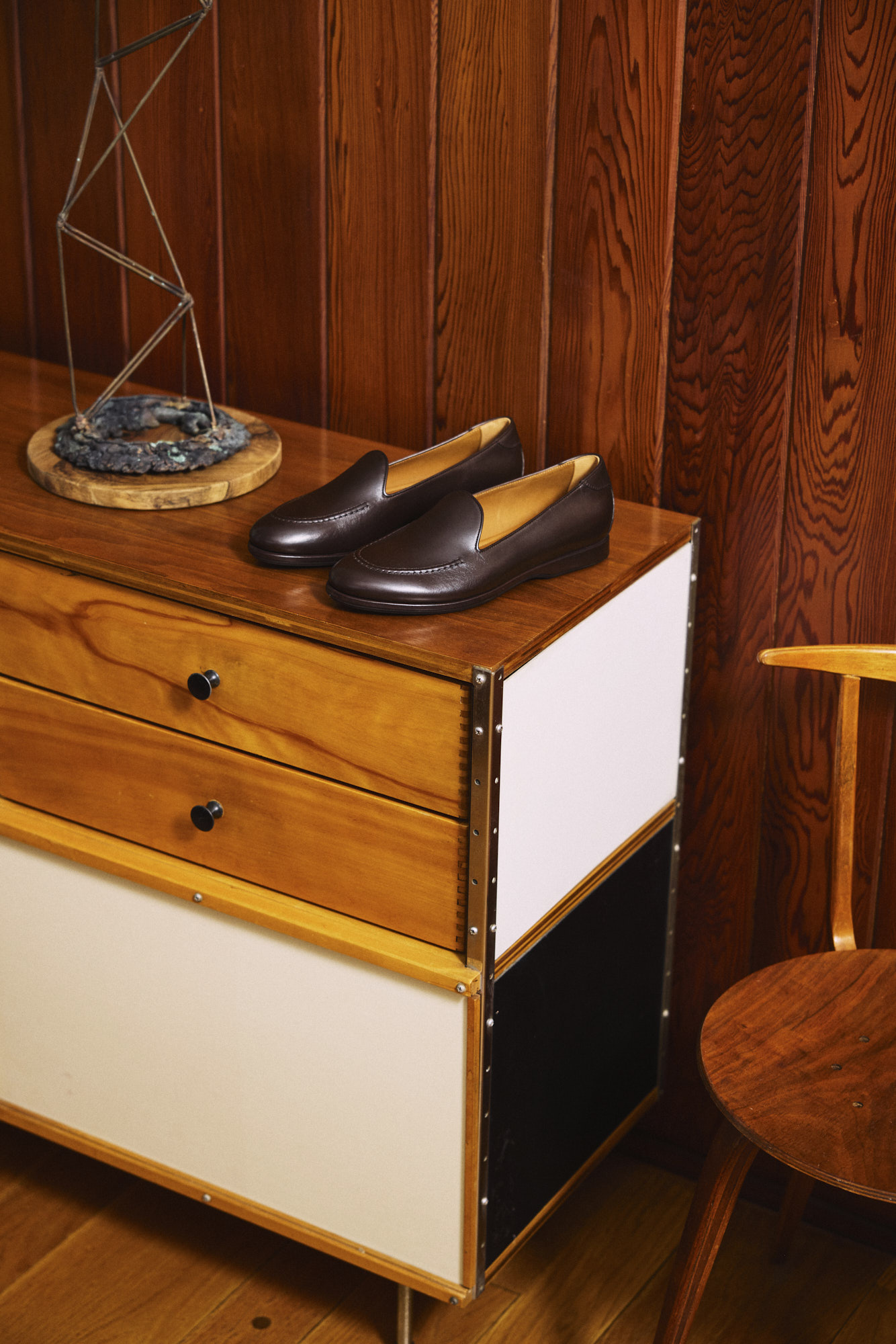
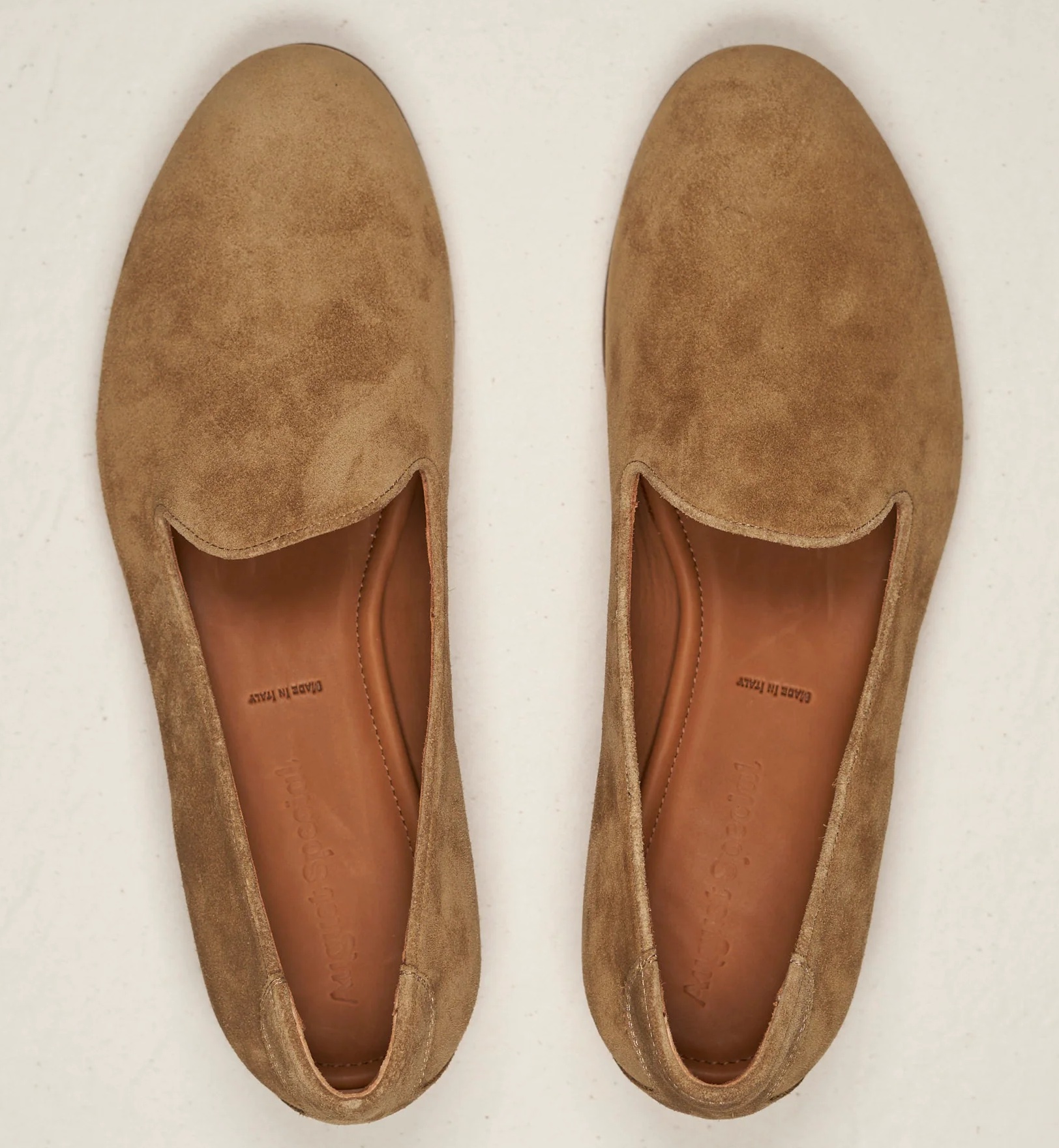
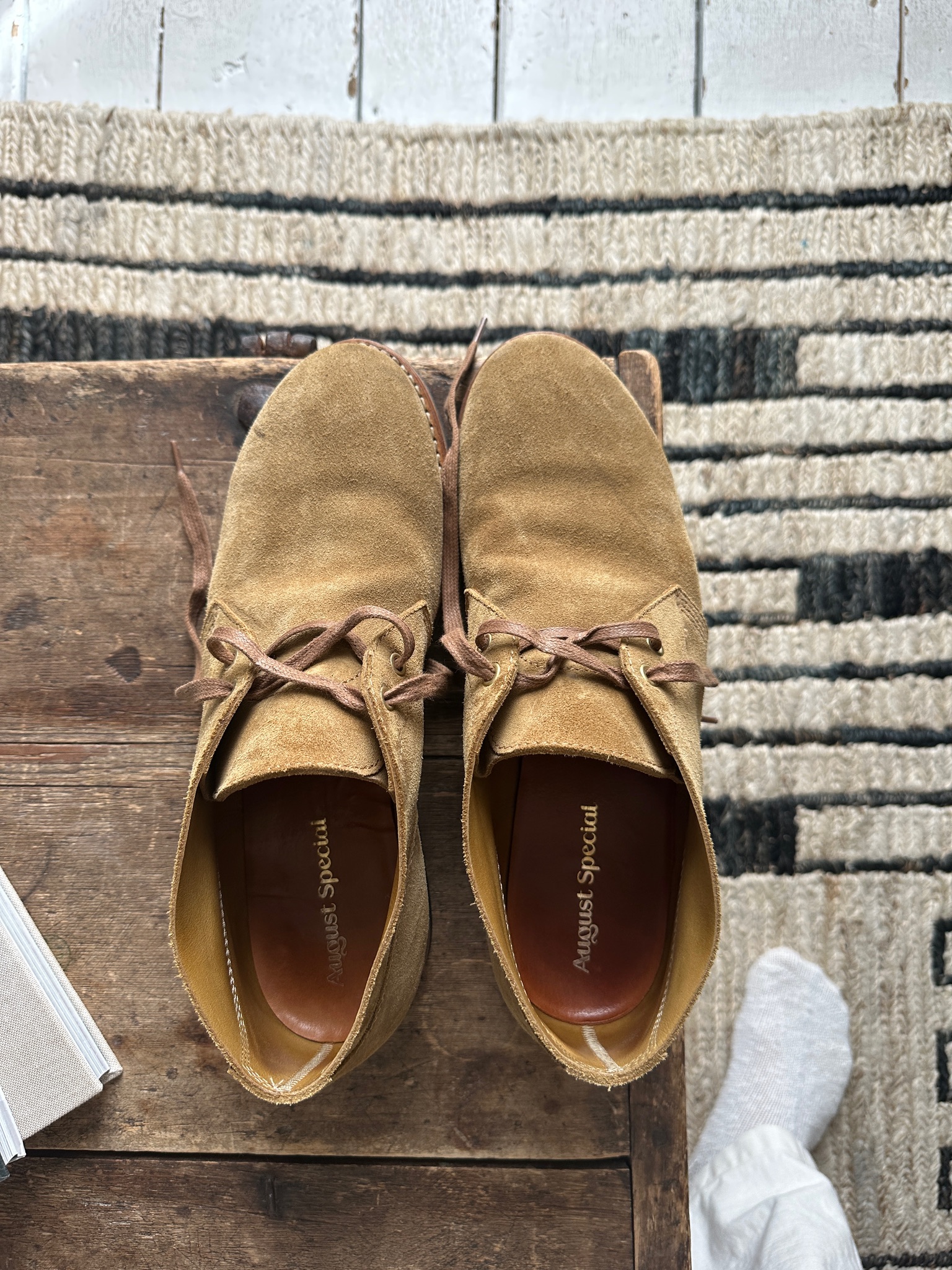
August Special is a new shoe brand - they launched online back in May - and it’s an interesting proposition I think. Comfortable versions of traditional shoes that have more style than most in that combination, and rugged styles that are actually made in a refined way. 

The reason the design is good is that the founder, Joseph Pollard (below), is very experienced. He’s been a menswear designer for more than 20 years, primarily at Polo Ralph Lauren and RRL, where he ran the outerwear and accessories/shoes categories at different points. 

He’s English and worked for Duffer of St George among others in the UK, before going to the US to work for Abercrombie and then Polo. He made a lifestyle change in 2019 when the family moved to Philadelphia.

“I took a little time off, maybe six months, while the kids got settled in school,” he says. “We’d made one major move before - to the US from England - and I knew how hard it could be. But after that I started thinking about what I wanted to do next.”

Joseph wanted to do something he believed in, made on his own terms, which is of course a very Permanent Style-type motivation, tying together many brands we cover. Joseph is, like many of those, a product person first and foremost. 

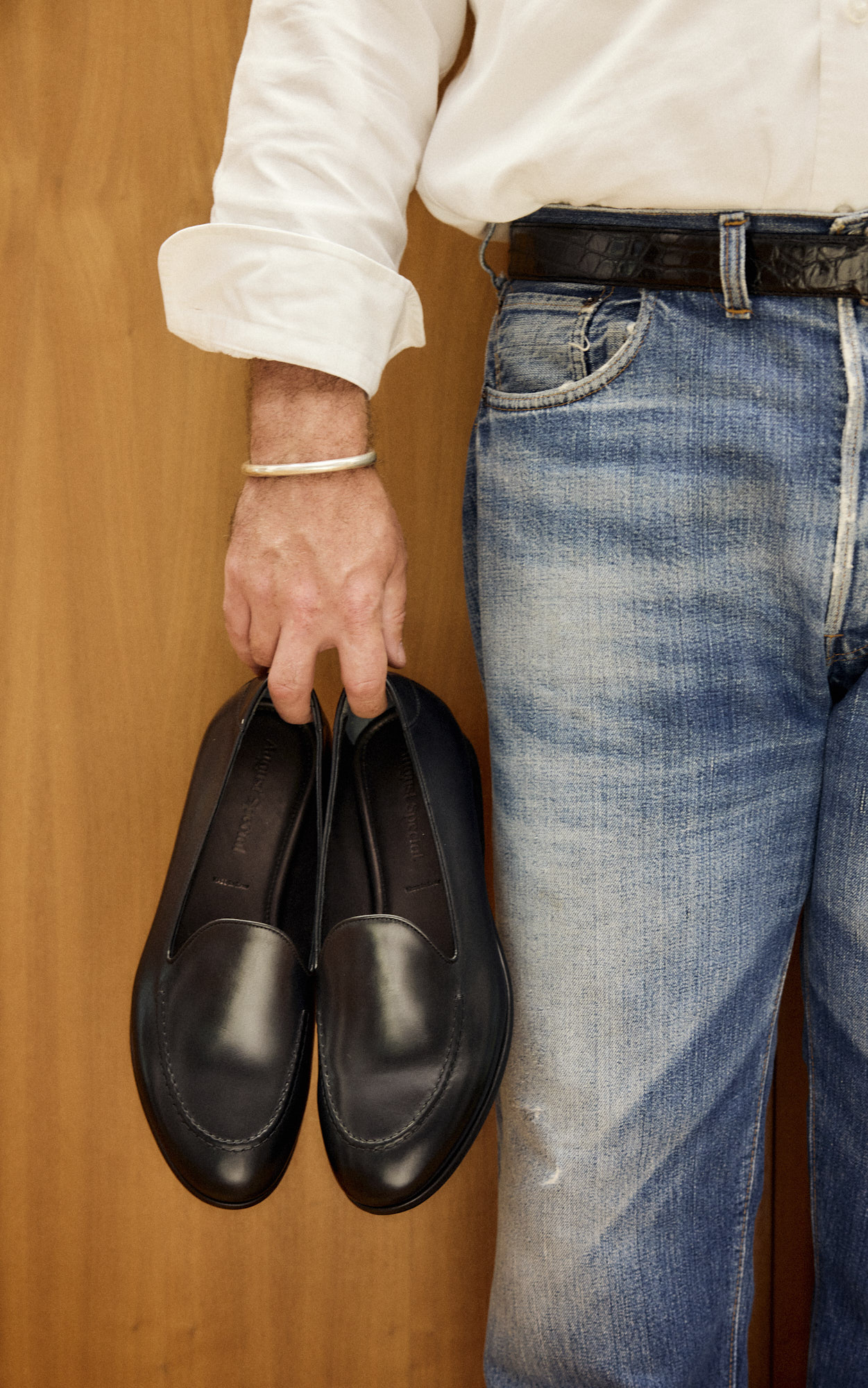
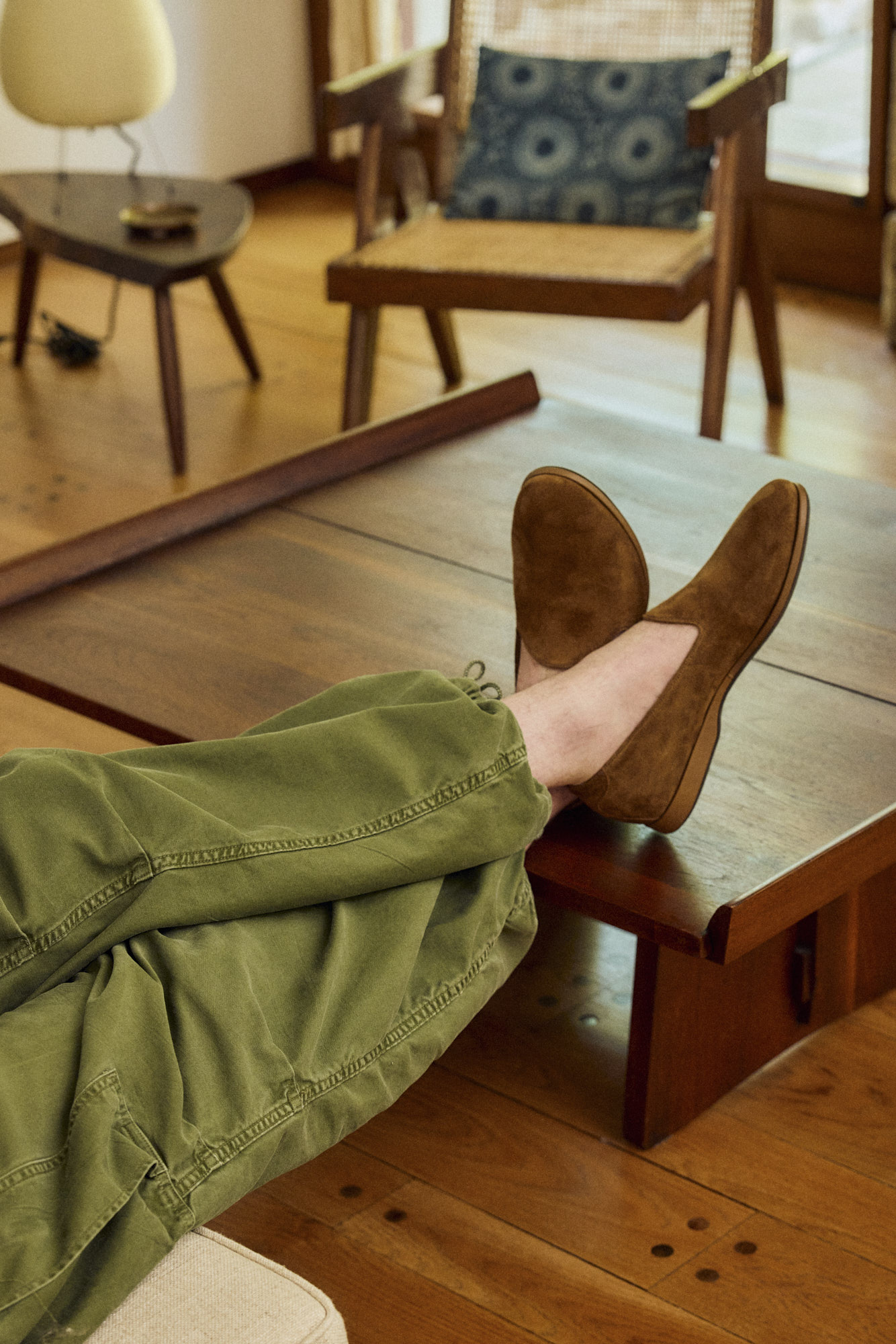
The first product he created, the Augie loafer, came from a desire to make a tougher and more comfortable version of Belgian loafers he had worn in New York. “We moved from Brooklyn to the Upper East Side when he had kids, and I used to wear Belgians all the time,” he says. “I knew the shop, and I’d walk to the office in them.

“But when we moved to Philadelphia, that didn’t really work. I’m sure people do wear them here, but that’s more of a country-club set than we are! Basically I couldn’t wear them to Home Depot - the city would  just chew them up.”

He’d also never been much of a fan of the Belgian Shoe’s little bow. “It’s too fancy for me. My wardrobe is a mix of tailoring and workwear - jackets and denim, chambray shirts and loafers. You can do that look with a dressy slipper, but it’s not my style.

“By the way Simon, that might seem a very current look but the Duffer guys were all doing it back in the day - their standard was a Crombie coat, jeans and a good shoe.”

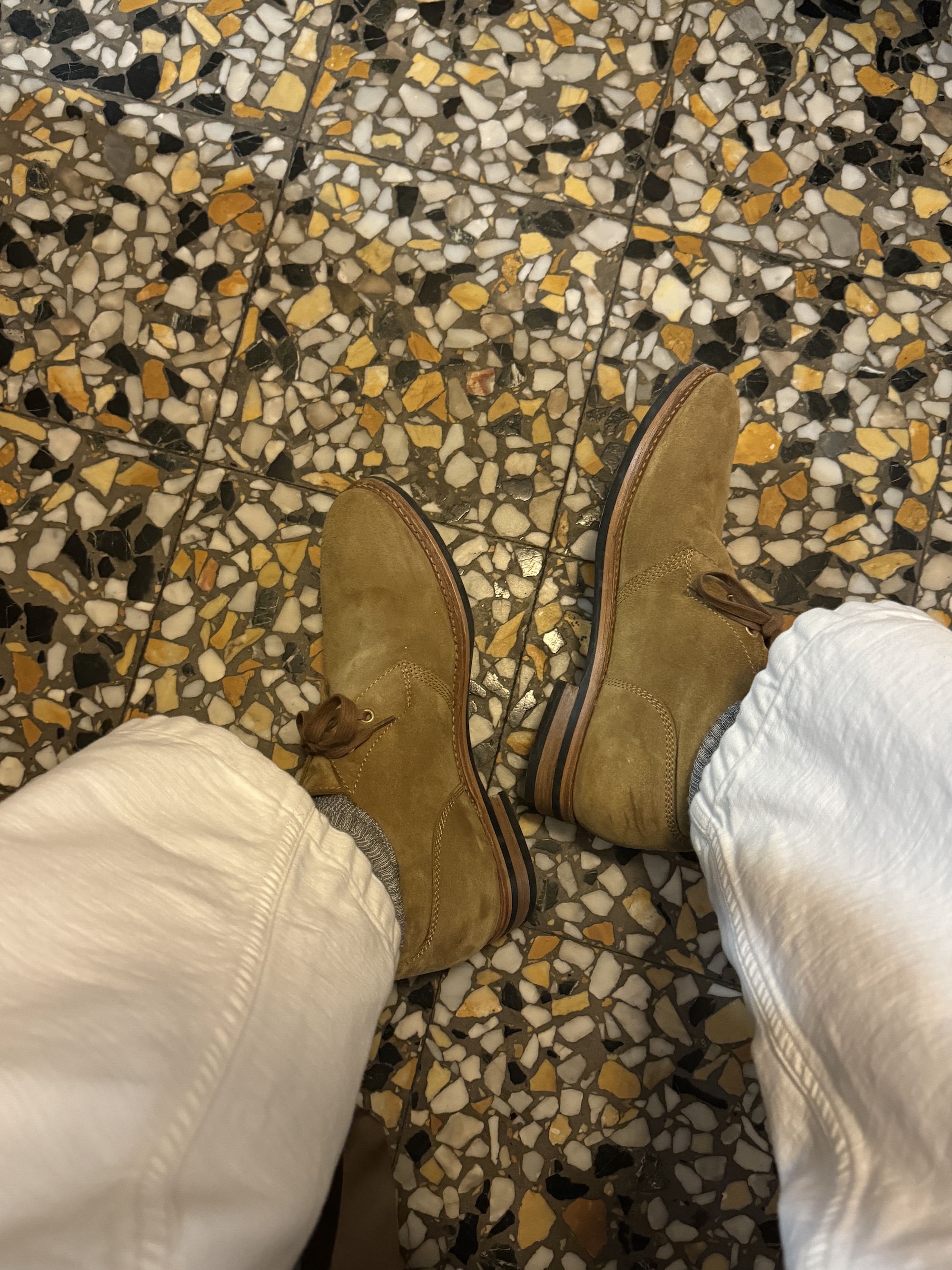
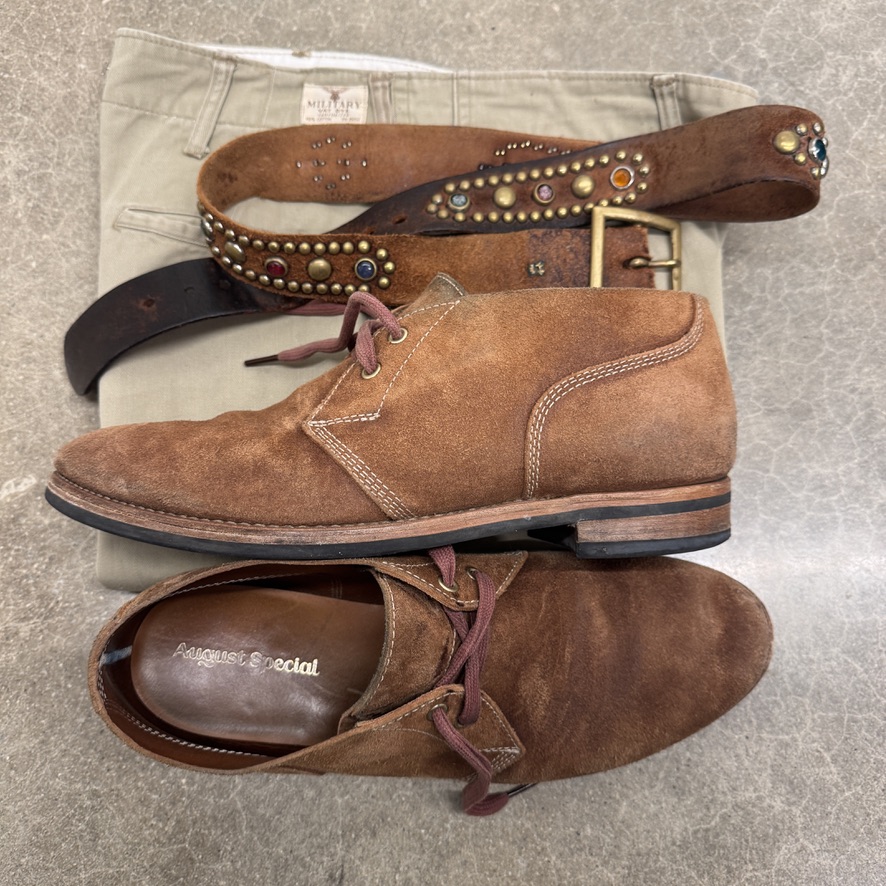
OK, so what makes the Augie (and the chukka boot, the style I own, above left) interesting?

The first thing is the last. It’s based on old 40s and 50s shoes, which had a slightly more orthopaedic shape, curved on the outside line and straighter on the inside, with a narrower waist. 

The example of this that most readers will be familiar with is the modified last from Alden. But while that can look very unusual, August Special is more moderate. I find it both very comfortable and not the kind of thing anyone would notice.

The emphasis on comfort goes through into the construction too. The insole has a full-length piece of memory foam, which your foot sinks into in a satisfying way. The midsole on the loafers is then a piece of sports foam, wrapped in leather. That’s what you can see between the sole and the upper in the pic below. 

At first I wasn’t sure about the way that sole looks, but I like it more now I appreciate the functional reasons. I also like the fact it’s not the same rubber unit that everyone in the world is slapping on suede loafers, trying to be an Open Walk or a Belgian with very little extra to offer, other than perhaps cheapness.

The sole on my chukka boot is a more standard Vibram and there isn’t that extra foam in the mid-sole, but I’ve still found it more comfortable than any other chukka I own. I’m not so keen on the contrast between black rubber and natural leather in the sole edge and heel, but that’s a personal preference and will darker over time. Darker suede or leather options would have less of a contrast. 

The design is based off boots issued to US Navy pilots, who presumably had a functional reason for the lower height. I wasn’t sure about that height to start with, but I rather like it now. I’m not sure I’d have it as the default for my chukkas, but it seems part of this boot’s style and character. 

The other thing that’s interesting is August Special’s combination of rugged and refined. 

The chukka’s upper is one piece of full-grain leather, unlined, with a supporting piece around the heel. The thickness of the leather gives it a rugged look, but the quality of it means it’s soft and comfortable - more so than the thinner leather on an Alden chukka for example. 

The make is very good, benchmade in Tuscany close to the area the veg-tanned leather, laces and other things come from. The welt is slim for example, cut close to the upper and running 270 degrees around the boot rather than 360 (so not including the heel).

Personally I don’t think these points make the boot any less rugged, just less chunky in shape. I’ve only worn them with jeans and workwear chinos so far, but I can see how this style might enable them to be a little dressier - with tailored cotton trousers and a cashmere knit for example.

The loafers didn’t quite work for me - I seemed to be in between sizes, and while the lacing of the chukka made fit easier there, the loafers had no such luxury. Still, Lucas has a pair and they work really well for him. There are other versions of the loafer coming in the future too, so I will try those. 

The thing I love most about the August Special shoes, though, is how good they look beaten up. When Joseph came into the pop-up shop in New York recently, that was the thing I liked the most. It’s his look of the loafers with workwear chinos and a loose chambray or white oxford shirt that really appeals to me, I feel would be relevant for a lot of readers.

I also saw a pair of chukkas on Sean Crowley (an old colleague of Joseph’s from Ralph Lauren) and they looked fantastic. I can’t wait for mine to get to that stage. 

augustspecial.com

Some facts in anticipation of questions:

  • I wear an 9.5 (US) in the chukka, but was between 9.5 and 10 in the loafer. My standard now in something like Edward Green is 9E (UK). August Special only comes in an E width 
  • August Special is only sold online at the moment, and is based in the US. There is no wholesale at the moment, but that might change in the future 
  • The boots are Goodyear welted and can be easily resoled. The loafers are Blake stitched and are harder - August Special has no current solution there but is planning to offer a resole service in the future, including on those
  • The shoes are all made in Italy

The chukka boots are being restocked in February

Christmas Gift Guide 2024

This is always fun. Each year the gift guide is an opportunity for me to mention non-menswear, or at least menswear-adjacent, products and brands. And given PS readers are fussy (perhaps we should we say discerning?), it also necessitates unusual or at least mildly surprising choices. 

This year those choices seem to be rather expensive; perhaps the eye has been a little too greedy. But they are all beautiful and special, worthy of attention and a place in that discerning home. Next time we’ll err more towards the affordable. Probably. 

By the way, the nature of classic menswear means that most of the things listed in previous gift guides are still available - so do browse those if you haven’t before. Search for ‘Christmas gift’.

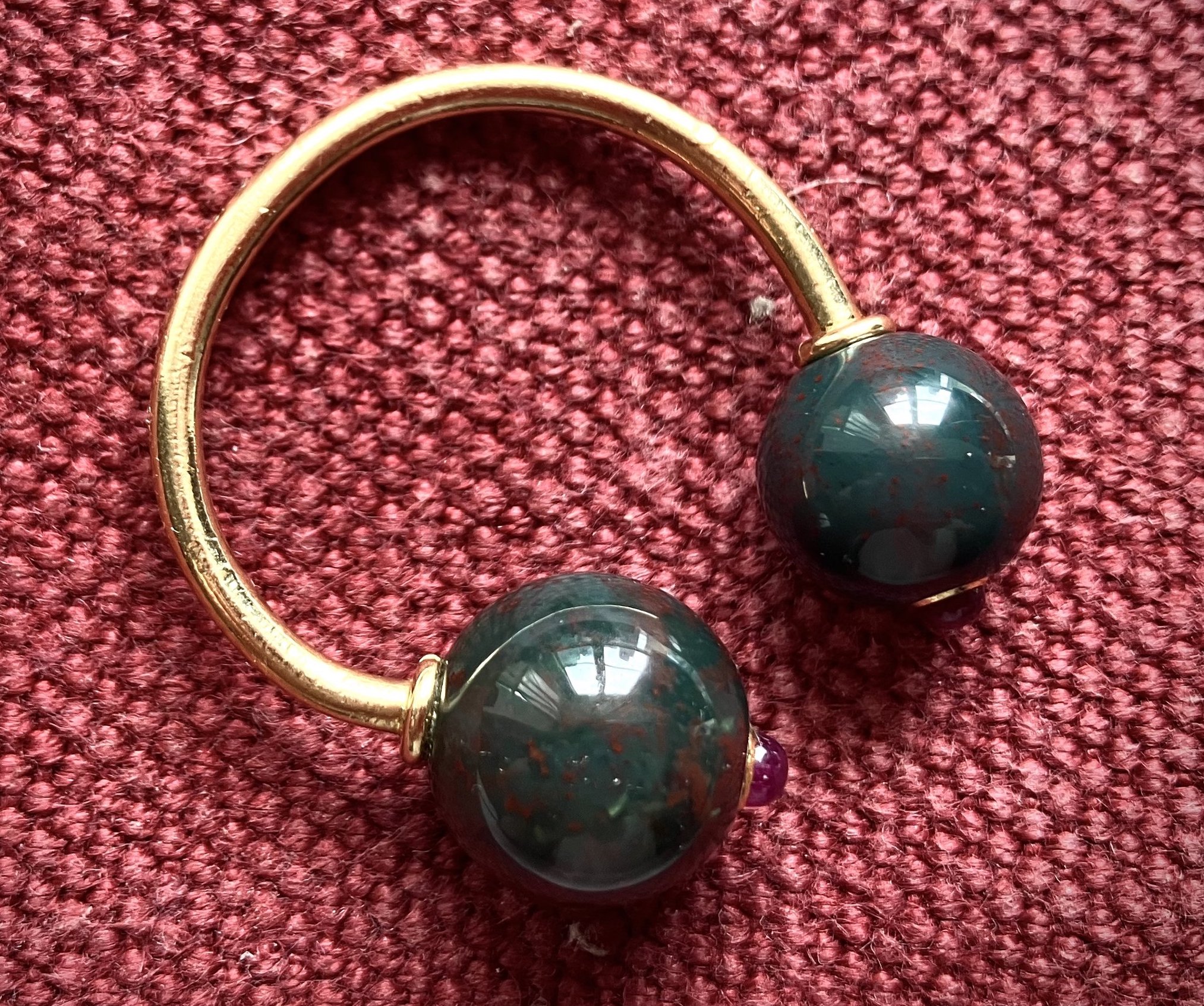
Sulka gold keyring

$550

Le Combray is a small vintage shop in Hong Kong, known for the very high-end pieces they have from French makers, such as Arnys and Charvet. But while the supply of those has slowed down, it’s still worth keeping an eye on. Following them on Instagram is probably the best way. 

This keyring, from the legendary Parisian house Sulka, looks ingenious, simple and beautiful. If I didn’t already have a keyring, I’d buy it. In fact I’m going to guess there’s a good chance it will have sold by the time you read this, given the enthusiasm of readers for such things. But you never know. 

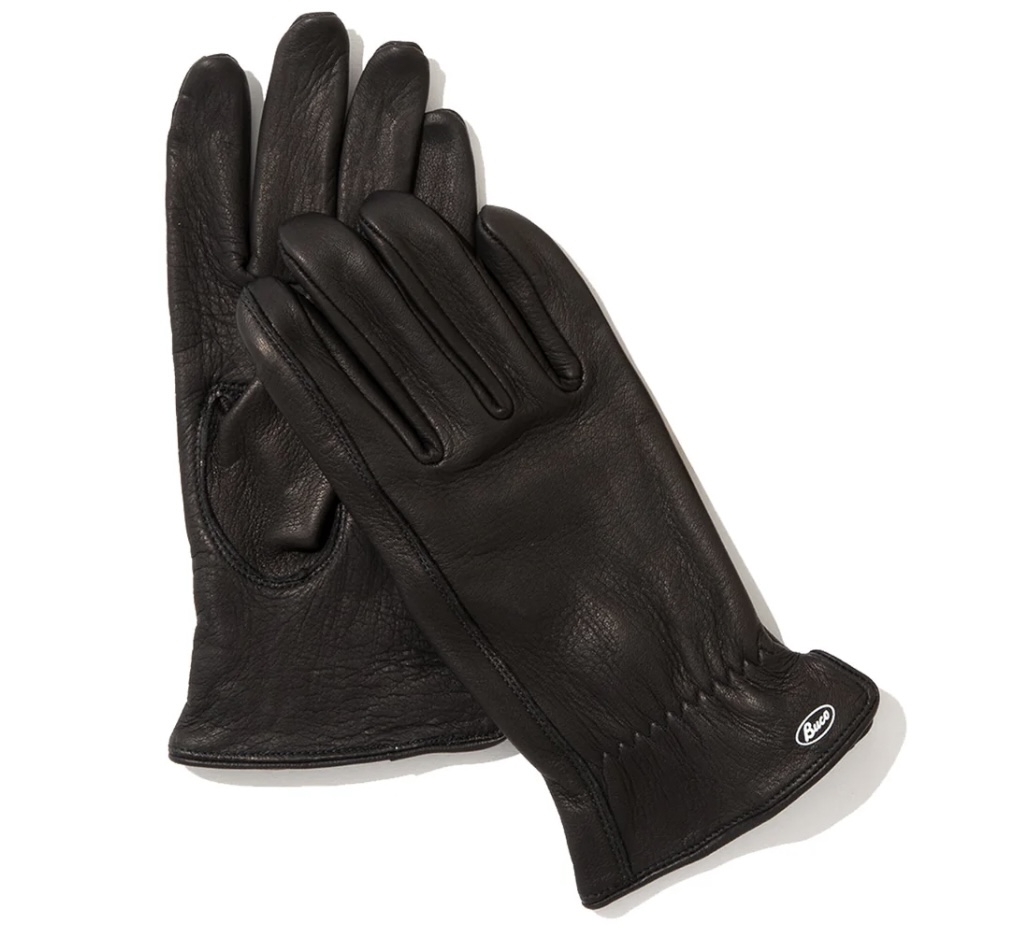
The Real McCoy’s deerskin gloves

£180

We’ve covered makers of fine, smart gloves fairly extensively, but little that’s heavy duty. And just like I don’t wear my flannel trousers to the park at the weekend, I don’t put on hand-sewn peccary to take my daughter to the playground. There’s too great a chance I’ll be given a pile of wet leaves to hold as part of some inscrutable game. 

These Real McCoy’s ones are what I wear, because they’re still high quality but made to be tougher than dress gloves. They’re described as motorcycle gear but they don’t really look it, and anyone that knows leathers will appreciate how nice deerskin could be on the skin. 

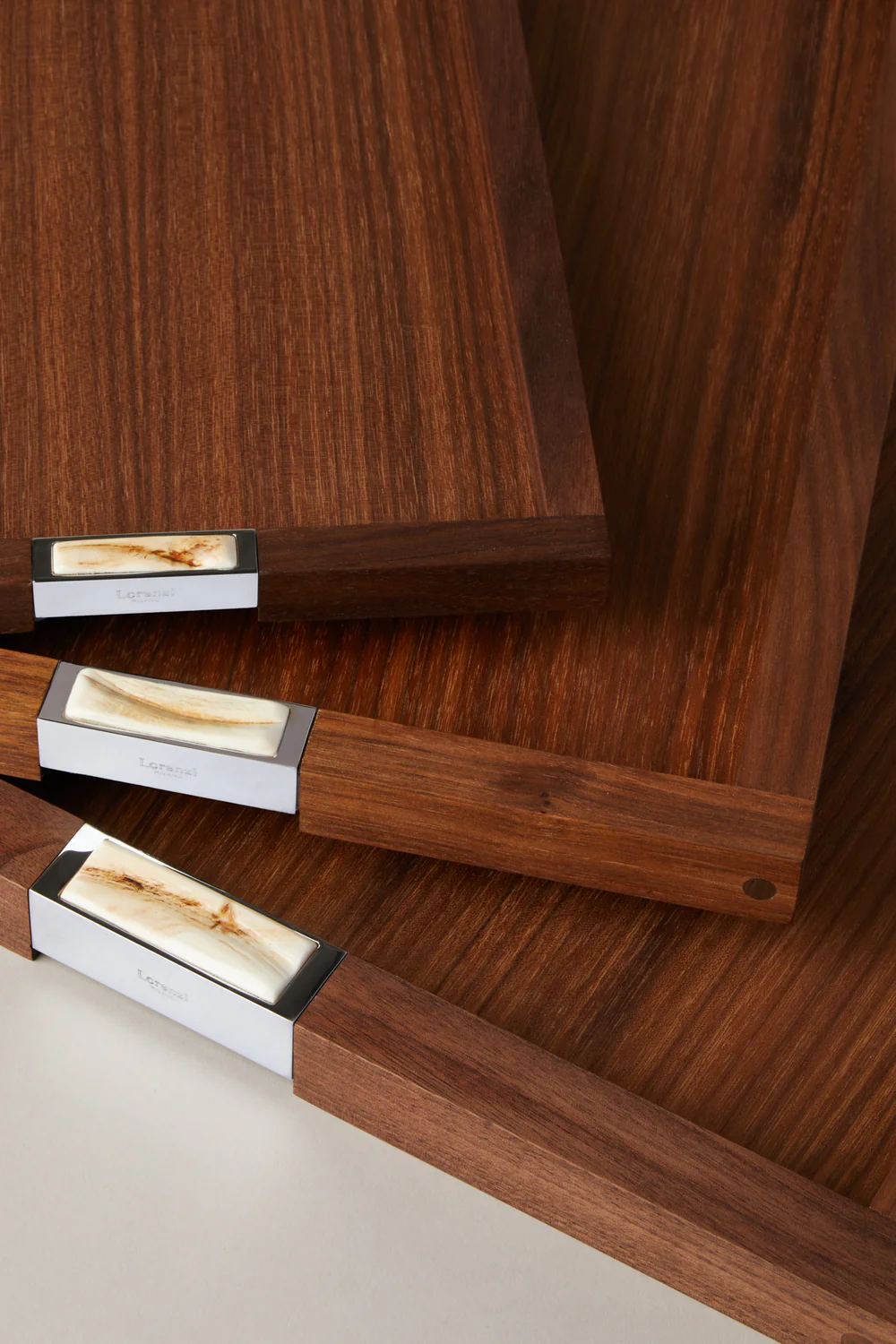
Lorenzi Milano warthog tray

€525

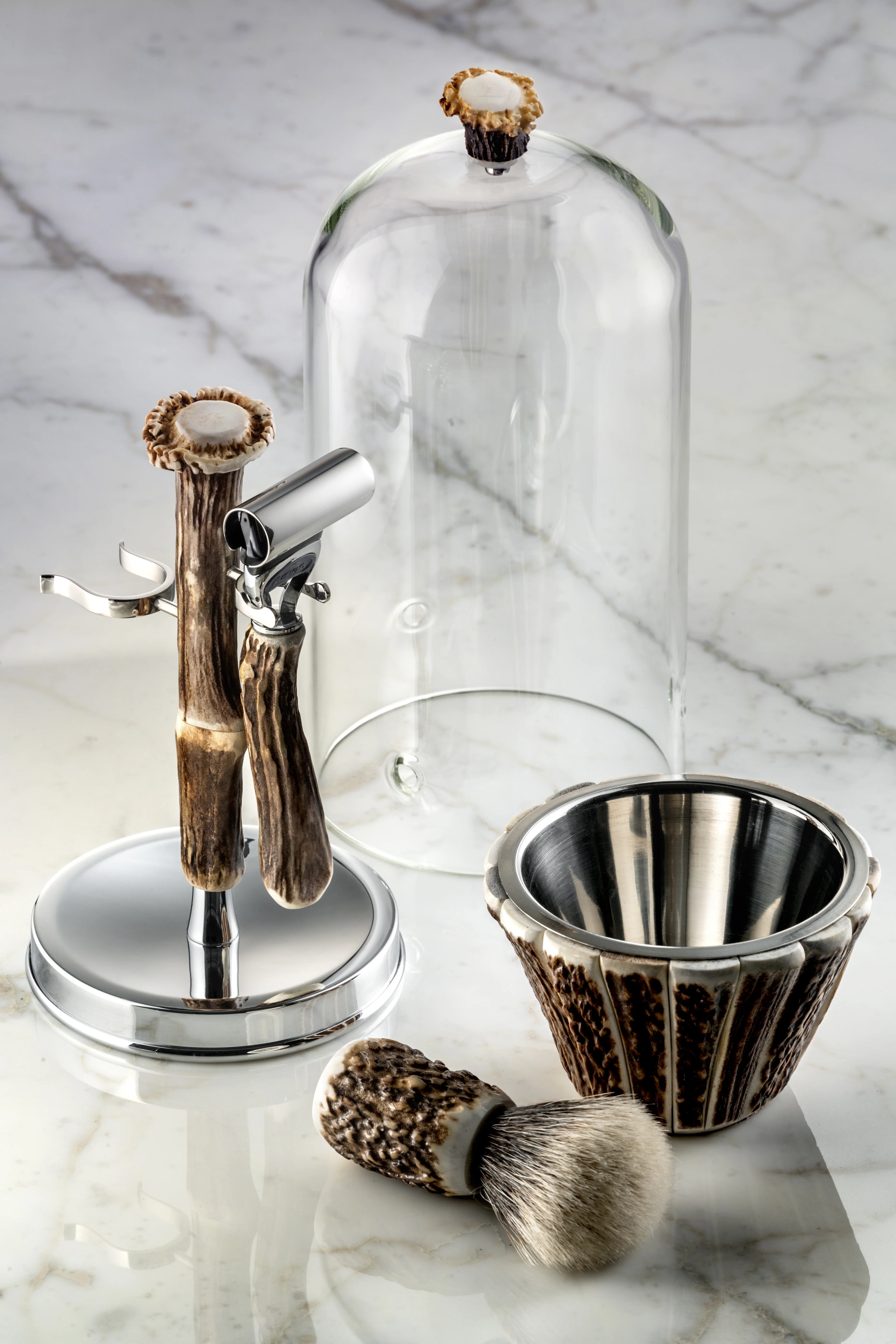
Lorenzi is probably be the perfect place to source luxurious presents for a PS reader. Everything is beautiful, responsibly sourced, made in Milan, and the sheer size of the range means there will be something they don’t already have. That shaving kit shown at top is one of theirs.

My eye is on one of these trays though, as we need one for taking food or drinks into the living room or bedroom. You can go for a simple shaving brush though, or something weird and just plain evil-looking, like the oryx shoehorn

Métier wine-bottle carrier

£590

We’re going to be covering Métier in detail soon, but the thing that I like about them is the combination of quality and functionality, in what could appear to be a pure fashion brand. 

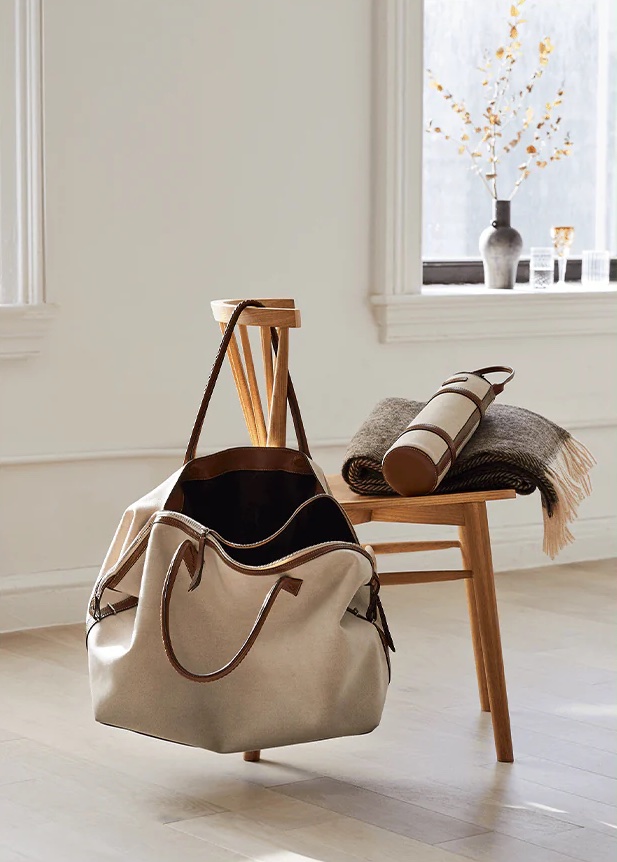
This wine-bottle carrier has all those qualities - top-quality materials (calf leather, alcantara, water-resistant linen) in a functional design, designed to meet a particular need. One for the guy that already has everything (probably a fair few PS readers).

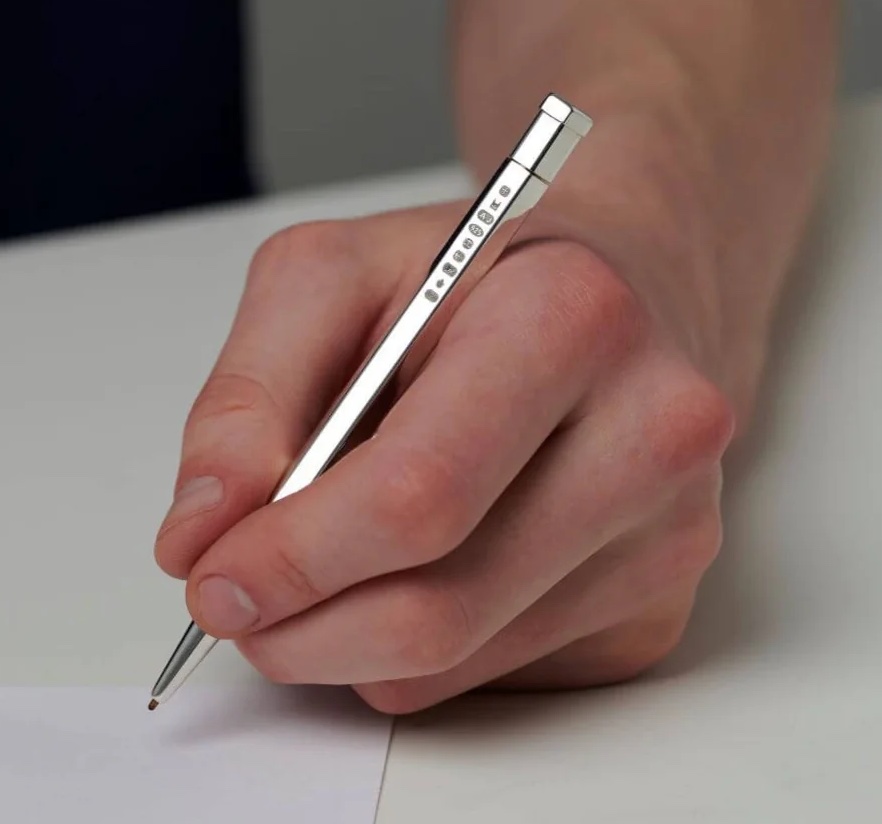
Royal Mint ballpoint pen

£395

The Royal Mint - the actual company that makes coins in the UK - has shifted focus since people largely stopped using coins. Now it sells collectibles and has a jewellery company, 886 (the year the Mint was founded). There’s a shop in the Burlington Arcade. 

This all feels rather weird - like the Prime Minister selling you earrings - but one advantage the Mint has is its machinery, which allows it to forge silver rather than casting it, as most companies would. This makes the metal 30% denser and harder wearing (like a coin). If the jewellery appeals, that’s a nice point of difference. If not, this pen they did with Yad-O-Led is something I have and also a nice gift. 

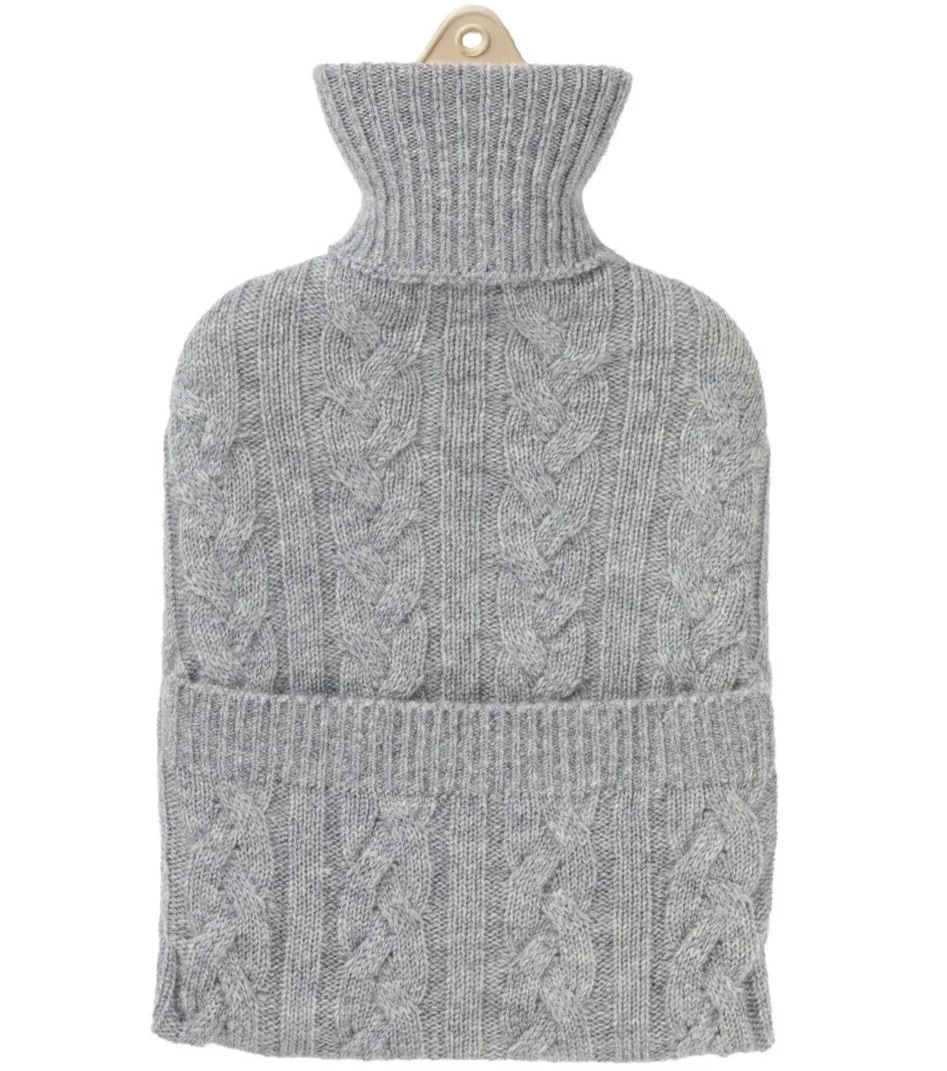
Johnston’s cashmere hot-water bottle

£225

I don’t really use hot-water bottles, but everyone else in my household does, and a good cover is apparently crucial. They’d never buy a cashmere one like this, but if I can afford it maybe I’ll get one for them. Something you’d never buy yourself is always a nice reason for a present. 

Johnston’s has just opened a new shop in the Burlington Arcade too by the way, which is welcome, as the previous one was way up at the top of Bond Street. 

La Bowtique bow tie

£190

Something else I can imagine a reader not buying for themselves is a really good bow tie. After all, they’re unlikely to wear black tie that often, and everyone else will be making do with a cheap ready-tied one. 

I’d argue a one-piece, well-tied bow tie really makes an outfit, however, given its prominence. A good one would be from La Bowtique, particularly if the style is picked to suit the face of the receiver (perhaps include a gift receipt so they can swap for another size or style if they want to).

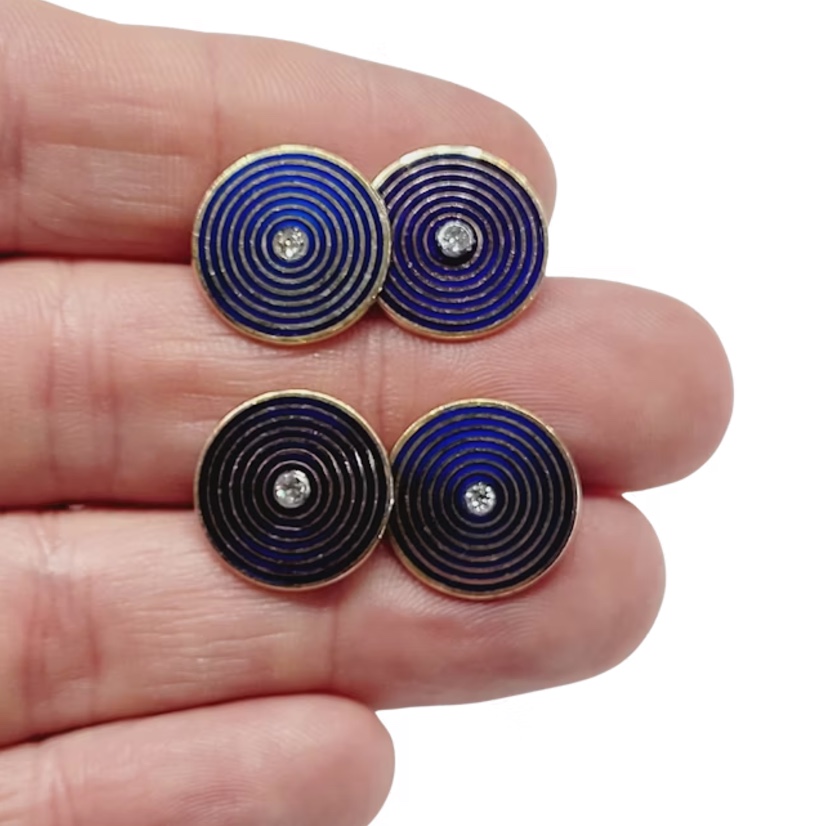
Edwardian diamond and enamel cufflinks

£1,650

One way to get really precious, unique and often good value jewellery is to buy it vintage. My favourite place in central London for this is Gray's Antiques Market, just by Bond Street station. It feels incredible that this kind of place still exists so centrally - that it hasn't been developed already into anonymous flats or an LVMH brand.

This is a lot of money to spend on cufflinks of course, but surely cufflinks these days are special-event jewellery, no day-to-day accessories. If so, they should be this special. Most men won't wear more jewellery than a watch, cufflinks and a wedding ring, so they can be special.

What Frasier could teach us about dressing today

What Frasier could teach us about dressing today

Wednesday, December 4th 2024
||- Begin Content -||

Every evening, our family goes to the living room after dinner and watches an episode of a sitcom together. My wife, me, and my two eldest daughters all on the sofa. It’s lovely family time and now such a tradition that no evening feels complete without it. 

It’s been going for ages - over the years we’ve watched every episode of Friends, Doctor Who, Scrubs, Frasier, Blackadder, Parks & Recreation, Seinfeld and at least a couple more I’m forgetting. We’re currently halfway through Bob’s Burgers. 

It was this that reminded me how much I liked the way Richard dresses in Friends, and wrote about it here. Last year the same thing happened with Frasier, and I meant to write about it at the time - but forgot.

Fortunately, the outfit below I featured recently brought it back. That jacket and trousers with the dark shirt felt very Frasier to me - particularly the shirt, which he wears many dark versions of throughout the series, with and without a tie. 

Frasier - the character, not the series - is an interesting illustration of several menswear styles that I think are very relevant. I’ve explored each one in turn below, with an image each time to illustrate. 

I think it’s good to highlight things that don’t work as well, so I’ve done a shorter list of those. Often the issue is that things are little too unusual or too period. 

I won’t comment on the other characters because Frasier is the most interesting. Niles is more conventional and his interesting points are often repeated by Frasier anyway. The other characters are only occasionally relevant. 

If you want a much fuller breakdown, however, I recommend Ethan Wong’s article here, for which I am also indebted for its trawling of images. Oh, and we’re only talking about the original Frasier series by the way. The new one is nowhere near as good.

1. Brown tailoring

Throughout the seasons, Frasier wears a lot of brown, green and other earthy colours in his tailoring, as well as more sports jackets (in contrast to Niles). This means the outfits are often useful for suggesting ways to pair these earthy separates. 

Sometimes he wears them with grey trousers (top image), which would be my default (though Frasier usually uses sleeker fabrics - no flannel) but other times it’s brown on green, on beige, on taupe, even on a different brown. 

Sometimes this muddiness can go too far, as in the second image above (perhaps deliberately going to a level of caricature) but the shirt, cardigan and trousers are a really interesting combination. Also, note the taupe trousers Niles is wearing. Taupe like this is such an underrated odd trouser. 

2. Red/brown shoes

Frasier doesn’t really dress that formally, at least by the business standards of the time. This is why there is less navy and grey, but less obviously, it’s also why he can wear shoes that often contrast with his trousers. 

The rule of thumb we all know is that shoes should be darker than trousers. That’s a good starting point, it’s smarter as well as easier, but of course it’s not the end of the matter. Shoes that contrast slightly can be interesting and characterful - it’s just harder to pull off. 

Frasier does this well throughout, often pairing his trousers with shoes that are a ruddy shade of mid-brown. In the image above he's wearing them with taupe trousers, but he wears them with trousers that are darker than the shoes as well. 

Given few of us wear ties or handkerchiefs (or indeed cardigans) in the way Frasier does, it’s all the more useful having some interest in the shoes. I did something similar with browns in this outfit, but lighter trousers would be easier and present more options. 

Wearing a belt in the same colour takes the look a step further - it makes it more noticeable. You may or may not want that. 

3. Dark shirts

Frasier’s most striking tendency is to wear dark shirts in a variety of colours - grey, green, brown, burgundy. Well not that dark, but certainly darker than the white, pink or blue we wear most of the time. 

This is not an easy thing to pull off, and looks much more striking with a tie. But if you’re interested in this I’d suggest starting with more muted and easy options (as always). So a mid-grey or a light taupe perhaps. Work through some combinations you like with your existing tailoring (probably start with brown) and only then venture into something more unusual, like the green I’m wearing in that outfit above.

There are interesting parallels here with Lucas’s article about ‘stimulating’ shirts. I think the difference reflects something about the ways we both prefer to dress - Lucas likes to play with a little more colour and pattern, whereas nothing makes me happier than sludgy colours that all play nicely. 

4. Pinstripe shirts

As discussed in the guide to shirt style, a shirt with stripes that are thin and widely spaced apart is usually called a pinstripe. Because, obviously, the pinstripes on a suit are usually a little far apart too. If the stripe is a little thicker, it’s a pencil stripe. 

Frasier and Niles wear a lot of these - it was a big thing at the time, often associated with Armani (which the brothers namecheck fairly often) but sold by many others as well. My father had a few.

I think it’s a nice option with and without a tie. Without a tie, it provides some much-needed interest; with one, it’s easier than a denser or stronger stripe, but it’s still not a plain. 

5. Collared knits with tailoring

Frasier’s casual wardrobe is a little hit and miss (it reminds me of the casual section in Dressing The Man). But one look he does consistently well is collared knits with tailored trousers. It’s instantly more relaxed, a man-at-home look. But because he retains the sharp trousers and leather shoes, it’s smart too - a good example of that casual chic thing we often talk about. 

The knits can be in different colours, and this is an area where it’s easier to wear things like burgundy and shades of green I find. I like the black above, but then I would. 

Also, Frasier clearly knows that things with a collar look better on him, as is often the case with men and particularly those not in amazing shape. So when he’s very casual, he might wear a T-shirt but there’s an overshirt too (images below). The few times he doesn’t wear a collar are when he wants to look depressed and down-and-out (a ratty old sweatshirt, poorly fitting jeans and chunky trainers).

He also does collared knits well with tailoring. 

What I don’t like

Now, in much less detail, here are the things I don’t like, and perhaps readers shouldn’t emulate. Pictures of some of them below the list.

  • Long jackets. The suits are big, but the thing that really makes them stand out is how long they are. Move with the times, of course, but avoid these kinds of extremes.
  • Low buttoning. This is also quite pronounced and makes the lapels longer still. As we trend in that direction, it’s good to have an example of how to go too far.
  • Sloppy trouser hems. Basically, trousers that are too long as well. I can see the appeal of a nice big break at the front and clean drop at the back, but often there’s distinct puddling.
  • High-buttoning cardigans. Sleeveless cardigans make Frasier look most stuffier than anything else, but they can still be nice. The high-buttoning ones look a little too unusual to me and are even less flattering.
  • Mock necks. Not often seen, but he wears these as an alternative to collared knits now and again. The collars look so much better. 
  • Short shorts. The image below obviously exaggerates this, but it’s rarely a flattering combination on someone of Frasier’s build - the large upper torso, with sweater vest, and the shortest shorts. Something just a little fuller and longer would make a big difference. 

The case for the ‘stimulating’ shirt

The case for the ‘stimulating’ shirt

||- Begin Content -||

By Lucas Nicholson.

Whilst nattering away to Simon as I usually do on one of our days working together, I mentioned I had a revelation recently. 

In my past life at Drake’s, I always favoured slightly eccentric tailoring (cream cord suit anyone?). But I’ve recently found my tailoring commissions have become more subdued (bar one fairly lairy Fox Tweed from Fred Nieddu; I am human after all!). My last two commissions were a classic-navy lambswool suit and a khaki cotton-linen.

Maybe it’s not working at a brand anymore, maybe I’m just getting older, but fun tailoring just isn't landing for me as well. 

The same applies to shirts. I’ve settled into a comfortable rotation of OCBDs in PS cloth from either Jake’s or Luca Avitabile. They’re amazing, make getting dressed a breeze, and allow for versatility. As Simon mentioned in The Italian Background this clean, smart uniform is a calling card for anyone trying to navigate the world of style without drawing too much attention to themselves. 

Sometimes, though, there is an itch… For me, that itch has been scratched by experimenting with more interesting shirts instead of suits. It’s fun, an under-explored are in my view, and a lot cheaper than doing the same thing with tailoring. 

It began with the purchase of an old Armani Collezioni blue-striped shirt on Vinted. Subtle in colour but slightly bolder in its stripes, it had a soft collar and quickly proved to be an effective partner for loafers and tailored trousers, for an evening drink or cocktail. I’ve found it has a purposefulness that shows you’ve made an effort, but without going over the top in terms of dandyism or formality. 

The fun shirt, as most menswear enthusiasts will know, is that preppy staple which mixes several patterns together in a single shirt (one more eccentric thing I’m guilty of having, indeed having multiple times, in my life). 

So perhaps we should use the term ‘stimulating shirt’ instead for this idea - for a shirt that makes an outfit, that breathes new life into a classic navy suit. A shirt that can give the same sense of excitement and adventure as bold tailoring, but is easier to tone down and definitely costs a lot less.

Commissioning a suit these days, whether MTM or bespoke, is increasingly expensive. The cost therefore also grows of falling into the trap of getting something that turns out to be too loud. Such pieces also stand out more and you become “the guy in that jacket”. So I’ve been tumbling down the rabbit hole of the stimulating - or simply interesting - shirt. 

Historically, it appears the last time this was really a trend was in the nineties. It had a ‘Cool Britannia’ vibe when worn by Hugh (first image above) but was equally popular with a hellraiser like Peter O’Toole (second image). My thought that this could make a comeback was further stimulated by the recent lookbook from Michael Browne, featuring a blood red shirt with his signature sharp black tailoring (last image).

I’d suggest something can be borrowed from interior designers and their ‘unexpected colour theory’. This advocates “adding something, big or small, to a room where the colour wouldn’t conventionally match. It’s a colour pop, but with a twist of spontaneity…this surprising touch of colour enhances the overall aesthetic, providing a delightful dose of dopamine” (Taylor Simon). I feel we can all do with a top up of dopamine right now! 

A stimulating shirt is less of a risk than a new suit, travels smaller, takes up less room in the wardrobe, and can be easily covered by a jacket if you suddenly stop feeling as confident as when you left the house!

Skin tone is important here of course - as Simon wrote a couple of years ago, colour theory becomes much more relevant when colours are strong and close to the face. 

But everyone can find their own level here, and what fits their own wardrobe. It might be a pop of Yves Klein blue, a deeply saturated red, or unusual but tonal stripes, such as those offered by the Florentine tailors Speciale in Notting Hill (above).

I also find unexpected patterns and colours are a helpful way to transition a formal look to a slightly more laissez faire, laid-back one. And if no one’s wearing a tie anymore, it’s just nice to have something else going on.

The stimulating shirt can also be a cheaper way to create less formal black-tie outfits (oxymoronic as that sounds). I’ve been looking at pale-coloured dress shirts, and imagine my nineties Armani tuxedo with a pleated, lavender shirt and large, floppy bowtie. It would be a way to stand out without splashing thousands on a new smoking jacket. 

Most readers will probably have something in their closet that they commissioned as their more ‘novel’ suit - that, sadly, they tend not to reach for. (Simon, I’m looking at you and your purple Liverano). I imagine the guilt of a wasted commission staring them in the face, goading them into trying it on again, for the umpteenth time, and yet still not quite making it work. To them I say: a shirt stares you in the face a lot less, and is easy to hide in the back of the wardrobe. 

There is one big caveat to all this: taste is still a factor, and you can go too far. This is only my opinion but I think we need to leave the flamboyant Dad shirts of the 90s/00s in the past. You know the ones: floral prints, coloured buttonholes, contrast colours on the inside of the collar. But is this just a British thing? 

In my experience it’s best to start with stripes. I would recommend avoiding florals and checks, at least to start with. It is possible to make these look good, but it’s much harder in my experience, so if you’re interested in this area I would start with stripes in subtle, muted tones and then build upwards.

Below are some examples I’ve found that are available now, and that I think would be a suitable stimulating shirt to elevate a classic wardrobe. From top to bottom:

Let us know whether you wear patterned shirts like this (particularly outside the summer) and with what tailoring.

Is there a ‘crew’?

Is there a ‘crew’?

Friday, November 29th 2024
||- Begin Content -||

Looking back on it, I think I found the first few years of doing PS as a full-time job quite lonely. It’s hard to make friends with anyone in the industry when you’re constantly commenting on them publicly. The kind of person I was interviewing was also generally older than me, and we didn’t have much in common.

I felt quite a lot of personal pressure to make it successful - I’d quit my career of 15 years, and had two children and a mortgage to support. The site had a good foundation, but it always felt as if something (Instagram, TikTok) was threatening to sweep it all away.

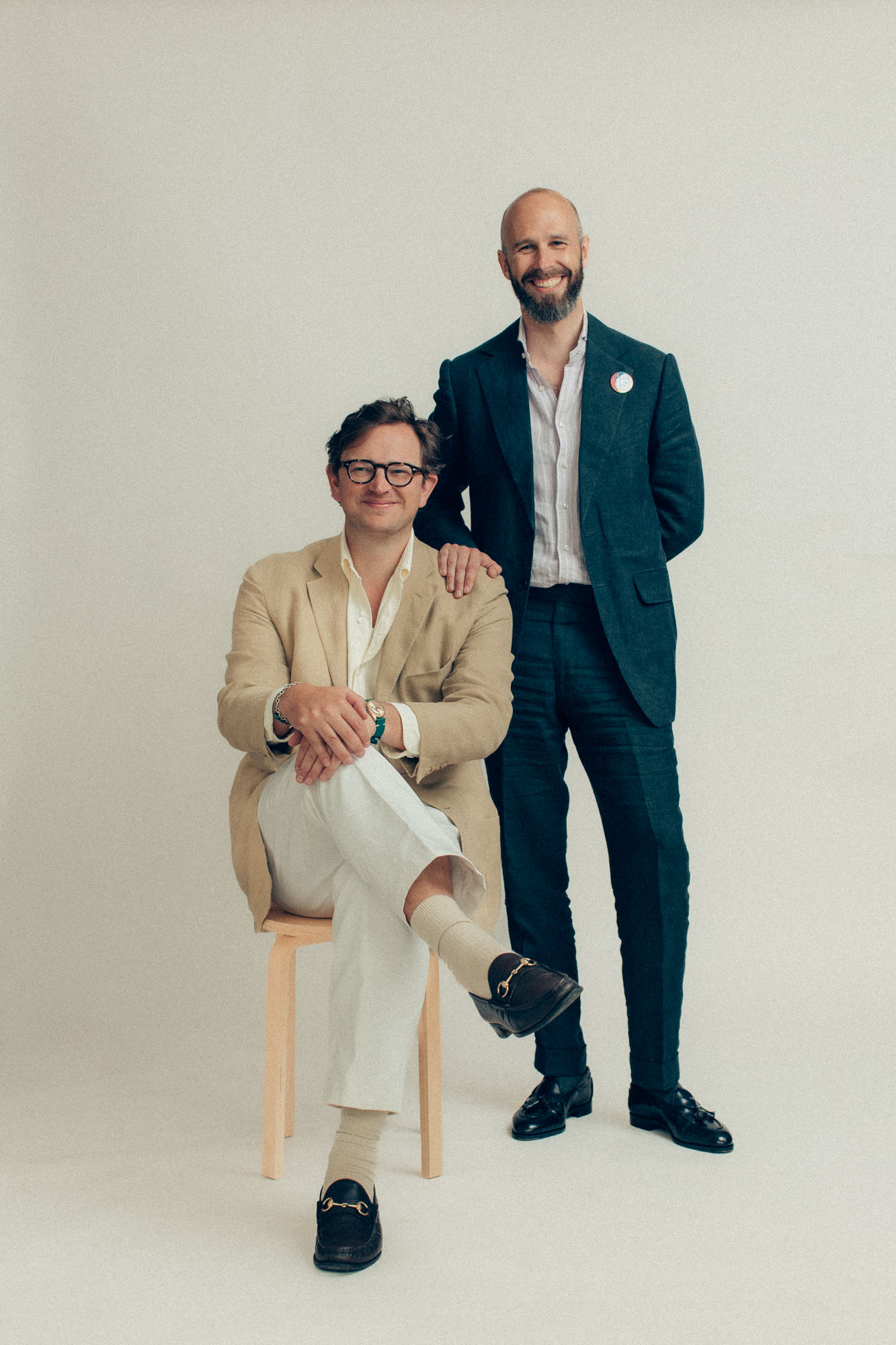
It was really nice, therefore, when Lucas (below left) started working on PS four years ago. It was only part time, but it was lovely to have someone to involve in every decision - as well as to just say everything was going fine (which of course you always know, but it still makes a difference when someone else says so).

Actually, there’s actually an interesting body of research around the benefits of talking to someone - anyone, even an orangutan - about the things that chase themselves round the inside your head. Even if it’s something as sophisticated as a scientific theory, forcing yourself to communicate can spark connections that you would never make on your own.

Lucas has now taken on more days, and Manish is contributing regularly. Manish also runs social media and is involved in a lot of the events.

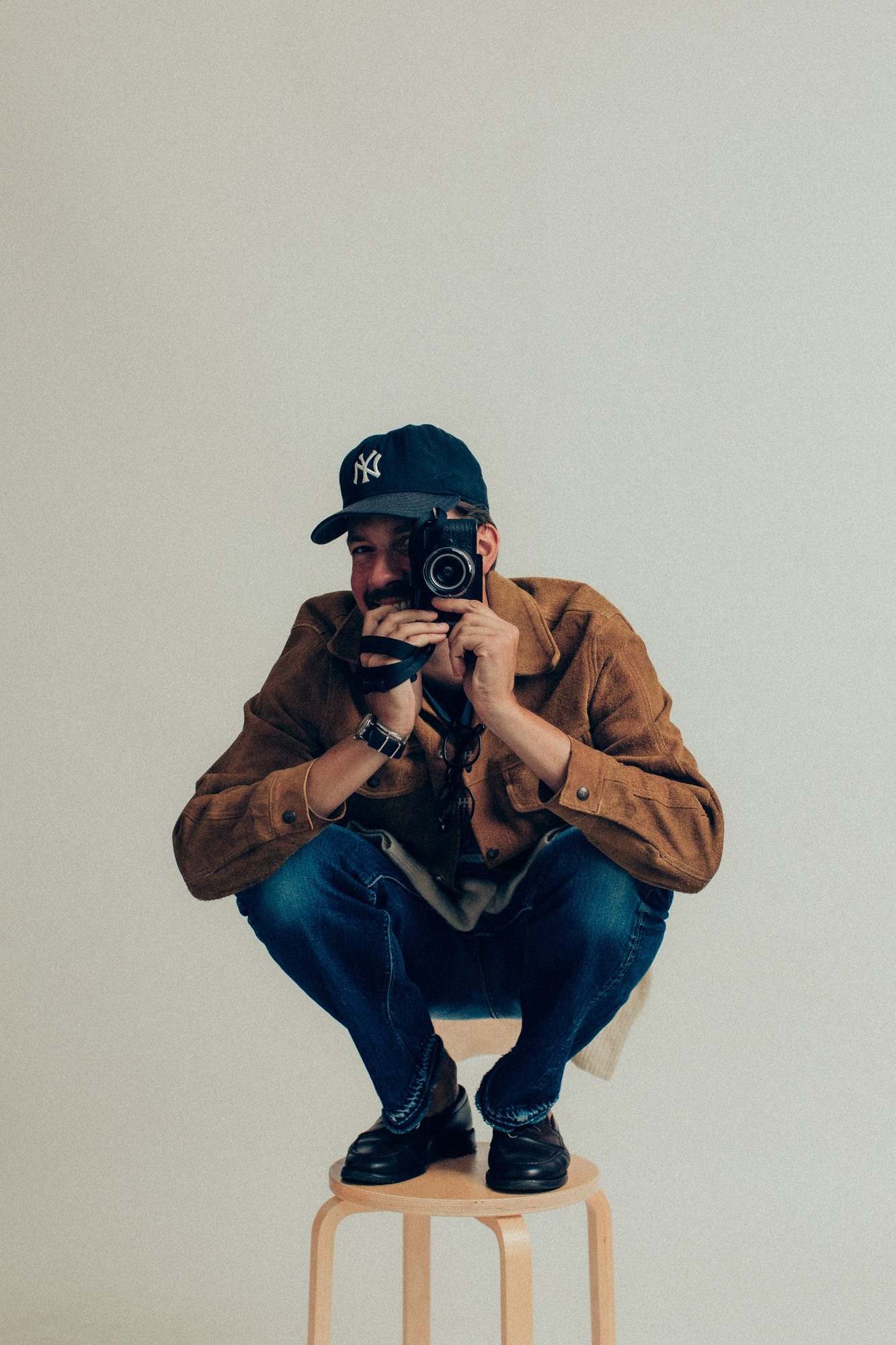
Add to that the regular photographers Alex and Jamie, and other contributors like Aleks (below) and André, and there is something of a ‘crew’ - as one reader put it recently.

I’m closer friends with several brands too. Oliver and Carl from Rubato came up recently, but there are half a dozen others. I’m not sure why that has happened now - maybe because we’re more similar ages, maybe because doing our own products means we have more in common.

It’s been so lovely. I enjoy my job today more than I've ever done. From the outside you often think it’s the nature or profile of someone’s job that makes it enjoyable, but in my experience it’s more the people and the place - the day-to-day experience.

I rarely do trips on my own anymore. When we go to Pitti, Lucas and Alex and I usually stay together. When we do the pop-up in New York, it’s with Oliver and Carl. It makes the trip actually, really enjoyable. Not just tiring and a bit lonely (missing my family) but ‘worthwhile’. Actually fun.

After 17 years of doing Permanent Style, I don’t think I can thrash myself in the same way I used to. I can’t take cheap flights at bad times, eat cheaply, never take a taxi. Maybe I don’t have the stamina for it; maybe I’m finally giving myself a break.

Today I’m appreciating all these things that make me happy. Going for a run during Pitti rather than feeling I have to socialise every night. Learning how good Swedish people are at table tennis, as Oliver (below, centre) and Carl casually suggested a game at Cellar Dog in New York and then utterly destroy us.

A more substantial point here is that PS still remains as independent as always. Friends know what PS is - as a service, as a business - and they respect me and it too much to ask me to cover something I wouldn’t otherwise, or cover it more favourably.

They know that I will like some things they make, and not others. They know that that’s how PS works, and what so many readers find valuable about it.

From the outside this could seem like a hard balance to strike, as you want your friends to do well. But I find good friends always have that kind of honesty and understanding.

Interestingly, I find friends also appreciate how the PS business model has evolved over the years. They know we promote hundreds of brands for free, and that advertising is a harder revenue source to generate than ever - as big brands prioritise ‘influencers’ and small ones go direct to the consumer.

Selling our own products - which will always be sometimes adjacent to theirs - could be an awkward topic, but I’ve consistently found that people who know and understand PS also get the dynamic.

Until the day we start selling every basic known to man, shouting about 'cutting out the middle man', and conducting Black Friday sales, I think that’s likely to continue.

Much has changed in the 17 years since PS began. I’ve gone from being someone very much on the outside of menswear to someone on the inside, not just as a journalist but as a designer too.

But the loveliest aspect of all of it has been the group of intelligent, interesting, kind - and yes, very stylish - people I’ve got to know. I dearly hope I get to carry on working with them for many years to come.

Colour images: Jamie Ferguson, from our Anniversary Open day. Black and white: Milad Abedi, from our Anniversary Dinner

The versatility of olive: Anthology MTM in PS/Fox flannel

The versatility of olive: Anthology MTM in PS/Fox flannel

Wednesday, November 27th 2024
||- Begin Content -||

By Manish Puri.

I’ve had my eye on a dark green suit for a long time. So when Simon very kindly offered me a length of the olive flannel that he’d collaborated on with Fox Brothers, I jumped at the chance.

To give me an idea of what I was in for, Fox Brothers sent me a large swatch alongside ones of the black and brown houndstooth and the navy chalk stripe for good measure. I’m going to be honest with you - as Simon would expect me to be for any product - the green swatch was slightly underwhelming.

It didn’t help that the chalk stripe is essentially my platonic ideal of what a navy version should look like, or that I’m a sucker for houndstooth - particularly one in such an easy combination of colours. Even then, the green - despite having the lovely finish of Fox’s classic flannel - looked a bit flat in comparison to the other two.

O ye of little faith.

The final suit delivered by The Anthology is superb, and I’ve found myself reaching for it every chance I get - on the recent WM Brown Tweed Rally (where it was the garment of mine that attracted the most interest), Saturday night drinks with friends, and even dinner with my lovely ex-wife (it has her seal of approval, even if I don’t).

The colour is spot-on. More than one person has said it’s a “perfect green” - neither too bright and jewel-toned, nor too rustic. Another friend described it as a “city green”, which I like. As Simon said when the cloth was launched, it is a little “muddy” but, without wanting to start the menswear equivalent of “the dress”, I don’t think it contains quite as much brown as you might think based on close-up shots like the one below - especially when you see it fully made up and worn in natural light.

The cloth excels as either a suit or a pair of trousers. I don’t think it works quite as well as a standalone jacket, but I find that to be true of most flannels. The depth and darkness of the green makes it really versatile - adaptable to both day and evening wear and to different styles of dress.

In the daytime, I wear it more classically: with a pale-blue shirt, a crisp white shirt or (as shown here) a pale blue-and-white stripe, finished with a navy or grey tie. (Forgive me if it looks like my tie was hastily tied in a pub toilet with no mirror, it’s because it was). Finished with some black shoes, I think the suit is sober enough to wear to an office - apart from those that still adhere to the strictest of business codes.

For a little more personality, and a smidge less formality, the green also plays well with denim and chambray shirts and autumnal colours like rusty orange, burnished red and ochre. And perhaps a switch to chestnut brown shoes or boots to keep everything earthy.

However, what’s surprised me most is how well this cloth works for evening wear. I would go so far as to say the green is quite chic and a little unexpected for a night out; more interesting than navy and less clichéd than black (with no offence intended to those that wear black - I sport it in the evenings plenty too).

I love pairing it with a fine black knit polo - the one shown is cashmere and silk from Saman Amel. As the polo has quite a soft collar I tend to wear it buttoned up so I don’t lose it under my lapels during the course of an evening. 

That’s not something I do very often, but, along with the belted trousers, I think it nods toward the 80s/90s Armani vibe that is so en vogue without mimicking it wholesale - my suit isn’t soft or louche enough to be confused with that look.

While hunting for an Armani reference image, I came across this screengrab in an old PS article by Simon about the style of Richard Burke (a character played by Tom Selleck in the sitcom Friends). The look is almost identical (although Selleck’s suit is more grey-green), and Simon notes “without the belt it would all be a little plain, but that belt draws it together”.

I’d say the same is true of my look too. The belt (an embossed croc with a polished brass buckle from Dylan & Sons) brings a little texture and shine to the sunken green. It’s one of the reasons that I went for belt loops - to allow me to wear the suit more simply (no tie, no pocket square) without sacrificing all points of interest.

Which brings me to the maker of the suit, The Anthology. Regular readers will know that I’ve been a happy customer of theirs since their formation. After some changes in physique and taste over the past couple of years, we’re updating my bespoke pattern which won’t be firmed up until their next London trunk show in early 2025. 

However, given how keen I was to get my hands on this suit, Buzz (a co-founder of The Anthology) suggested I try their made-to-measure. Indeed, that’s one of the key features of their MTM: the relative speed of service for trunk show customers. Where a new bespoke commission will take a minimum of eight months - three trunk show appointments, which take place every four months - a finished MTM garment is delivered at the second trunk show, i.e. after four months.

For readers that are really pressed for time and have relatively straightforward requirements, the finished garment could be delivered directly to you eight weeks after the measuring appointment.

This is something I took advantage of given how well The Anthology knows my body and preferences. However, the team were eager to stress that they would still request that the client book an appointment at their next trunk show so they could assess the fit and make any alterations to the garments or adjustments to the pattern - which is precisely what I did with my green suit on their recent London visit.

Return clients can then order future commissions remotely and expect delivery in around six weeks. In those cases, The Anthology team is happy to advise on cloth choice, and that’s something I think they do really well - not just what bunches they recommend, but what specific cloths suit your style and existing wardrobe.

The MTM fitting process begins by trying fitting garments that are broadly the same as their RTW single-breasted offering and typical of The Anthology house style: slightly extended and gently roped shoulders with a lower gorge on the lapel.

There are small differences between the RTW and the MTM fitting jackets. The latter is slightly bigger in the waist, as it’s more instructive to pin something closer to a customer than to have to imagine letting it out. Interestingly, the fitting garments also vary slightly by region: Asian fitting jackets are a touch shorter in the sleeve for example.

Having tried a lot of The Anthology’s RTW (my preferred jacket size is UK40/IT50), and recommended it to anyone that’s looking for a suit that’s a level up from my suits under £1000 article, I was pretty confident we’d get a good result. Having tried the fitting jacket (also a size 40) I became very confident. You can see from the photo how clean the front looked without any pinning.

And that’s a good barometer of whether to opt for MTM or bespoke: how does a fitting jacket (assuming one exists) feel? If there appears to be a lot of issues - collar gap, fit through the shoulders, balance, comfort - then bespoke might be safest. However, if the house block passes muster as a respectable fit then MTM could well be a good option. 

With the benefit of experience, I look back on my Suit Supply MTM days and realise now that the fitting jackets weren’t good templates for me. We’d size up significantly as my regular size was too slim, but that meant other elements were too big and imbalanced. They'd try and fix everything through the MTM system which (understandably) had limits on what could be changed, and while the final results weren’t terrible, it was also never quite right - like trying to ward off an invasion of fit issues with a potato gun.

Of course, it’s not always easy as a customer to make that assessment in the moment - especially if you’re new to custom tailoring. In those circumstances you’re really looking to the tailor to steer you in the right direction. Here I think it helps that The Anthology’s MTM programme is run by the same people that fit and cut patterns for bespoke customers - so they know exactly what their MTM can and can’t deliver. 

I’ve written before about the importance of trust in a client-tailor relationship, and how that trust can sometimes be cemented by being told “no”. I used The Anthology as an example of a tailor that I felt would give me the right long-term advice, even if it cost them a sale in the short-term. So, I’d have faith in them to guide me on choosing between MTM and bespoke too.

The Anthology’s MTM starts at £1750, and my suit is £1980. For reference, the bespoke starting price is £2850, and that price difference reflects, among other things, the extra handwork that goes into their bespoke garments.

So, having tried the MTM programme would I continue to use it, or would I go back to bespoke?

Had the MTM offering been available when I started commissioning clothes from The Anthology in 2018 I undoubtedly would have started with that. Today, however, I think I’d stick to their bespoke trousers - I’m supremely fussy about the fit through the crotch and seat, and the bespoke trousers have always been superb and well-priced.

In terms of jackets, it's not as straightforward because the MTM version is excellent - clean across the shoulders, comfortable in the back and elbows (two areas where ill-fitting jackets always bother me) and with nice shape through the waist. Having spent quite a bit of time and money refining my jacket pattern I’m minded to stick with bespoke, but it’s a very tough call.

The PS x Fox Brothers olive flannel is available here.

Manish is @the_daily_mirror on Instagram

All pictures of the finished suit in the main article by @JKF_Man, shot at The Torridon. Other images courtesy of The Anthology.

Other clothes not mentioned:

As I mentioned at the top of the article, I’ve wanted a dark green suit for a long time so I’ve added a few images from my “look book” below to serve as inspiration. 

Please note, none of these suits are made from the PS x Fox Brothers flannel.

Reader profile: Pedro

||- Begin Content -||

Pedro is a reader in New York - one I’ve known to say hello to, but never really had a long conversation with. It was lovely doing so a couple of weeks ago. He’s thoughtful about clothes and his relationship to them, self-aware yet also a real menswear guy in terms of knowledge and research.

We talked about his family in Puerto Rico and how their approach to clothing affected him growing up - plus what his mum thinks about his Sagans when he goes back! He's also definitely the only reader to have told me Permanent Style reminds him of Roland Barthes. 

I hope, as ever, that you enjoy the conversation and find it both interesting and useful. A quick search can bring up the rest of the reader profiles if you want more.  

Outfit 1

  • Suede overshirt: Drake’s/Hodinkee
  • Cotton overshirt: 18 East
  • Jeans: J Crew
  • T-shirt: Lady White
  • Boots: RM WIlliams
  • Cap: Western Hydrodynamic Research
  • Sunglasses: Lesca

What do you do for a living Pedro?

I work at Hodinkee, selling watch and jewellery insurance. But I come from a film and video background - I studied it at grad school and one of my favourite previous jobs was transferring Super-8 and 16mm film to digital. 

I came to New York hoping to be an artist I guess, but there’s a connection there with watches, in that the relationship between analogue and digital always fascinated me. Even though my career has changed quite a bit in the past 15 years, I think that’s carried over. 

What did you do when you first came to New York?

I worked in a restaurant to earn money while I was doing other film jobs. The pizzeria I worked at is where I met my wife, who's now a full-time photographer. Eventually the needs of a modern life caught up with me though and I needed to earn more - I’m 40 next year, and we have a three-year-old son. 

When did you first get into clothes? 

That’s hard to say, it’s been a while. But certainly I started looking into it more in the 2000s, back when silhouettes were much slimmer! I remember going back to Puerto Rico to see my parents around 2004, when I was still in college, and finding this amazing suit in a department store called Marshalls. 

I think I talked about this once on Permanent Style actually. The suit was a tweed three-piece from Ralph Lauren Purple Label, grey herringbone with a subtle purple overcheck. It had patch pockets, swelled seams, and was reduced to something like $99. 

It looked so cool, and I remember saying to my mum it was what I wanted for Christmas. She didn’t believe I’d wear it, but it did so well - I wore all three pieces separately, the jacket with slim selvedge denim and black Converse, that kind of thing. I wore the hell out of it for 10 years. 

When did you start spending more money on clothing, and tailoring in particular?

That was when I got married, in 2017. J Crew was the main place, for their clothes but also they had brands I got into like Alden, Red Wing. Though I was never really a big Red Wing guy; RM Williams was more my chunky boot. 

In fact there’s a specific origin story there. When I was in a film class in college - in Appalachian State in North Carolina - we had this professor called Leon Lewis. He grew up in the seventies and was originally from Buffalo, New York. He was a great beatnik character. 

You could always hear him coming to class because he wore these RM Williams that clip-clapped down the corridor. He wore perfectly fitting jeans with a crease down the middle, tortoiseshell glasses, a little moustache and a kind of weird mullet thing. It sounds odd but trust me he pulled it off.

So he got you into RM Williams?

Yes and I remember him talking about them actually. He boasted that he walked 20 blocks in New York City one day in the rain, in these leather-soled Goodyear-welted shoes, and no water got in. I’m not entirely sure that's true, but the way the boots embodied how he projected himself really stayed with me. 

As I get older I think about these things more - about how I want to project myself. I'd like to be someone that clearly cares about finer things but isn't too stuffy about it.

What are you wearing in this first outfit? 

So that’s the Drake’s suede chore they did with Hodinkee, worn over an 18 East overshirt and a white tee from Lady White Co. Lady White are my T-shirt of choice at this point, they’re good quality, don’t shrink, and are very consistent from season to season.

18 East is a company I really appreciate for their fabric choices, but the style is more streetwear generally. I saw this overshirt on a colleague though and I thought the style and the fit was very wearable. 

And what is Western Hydrodynamic Research? Sounds like a biolab!

Ah, yeah it’s this surf company from California, they’ve done a few collaborations with streetwear brands, the name is a reference to surfing I guess. I liked the five panel construction with that little pinch at the top, it felt rather vintage. 

Outfit 2

  • Jacket: Proper Cloth
  • Shirt: Wythe
  • Trousers: Natalino
  • Shoes: Berwick
  • Sunglasses: Lesca
  • Sweater: J Crew
  • Watch: Serica

You mentioned your family are from Puerto Rico. What was clothing like there, was your Dad an inspiration?

Yes my interest in clothes definitely owes a lot to my parents. My father’s a banker and when I was younger he wore a suit every day. Now he wears separate pants, maybe a crisp white shirt; in Puerto Rico you don’t need a blazer or suit necessarily, but he’d put one on for a meeting etc. 

When I was younger he always looked great: high-waisted trousers, pleats on everything, but also loafers without socks. He’d take me to Joseph A Bank and buy Cole Haan loafers, that kind of thing, and I’d think they looked great. 

My parents tease me about it today, but it all came from them. They love to get dressed up. I’m not sure if it’s a Puerto Rican thing or a Hispanic thing, but people there definitely like to dress up for an occasion - not necessarily formal, but just look nice for going out for a cocktail, or for a meal with their family. 

That’s certainly something that seems to have been lost culturally in a lot of places. 

Absolutely. I think a lot of it is around events - it was certainly a Roman Catholic thing, as we would all go to church on Saturdays, all dressed up for that, and then either go our or come home. But even at home it was an event, all of us around the table. I have very fond memories of that. 

Do you overdress a little, maybe reaching for that kind of thing?

Like a lot of menswear guys I guess. I’ll ask my mum when I’m coming back to Puerto Rico whether I can wear a double-breasted blazer to something and she’ll say no, that would look odd. And when I go out with my wife, I like to get dressed up and she has to rein me in, saying we’re not going to a gala!

It’s definitely a case of looking in the mirror before I go out and thinking what’s one thing I can take off, that I don’t need. 

Where is this jacket from?

The jacket was from Proper Cloth, the first thing they made for me. It's wool and linen; I thought it would be a kind of summer tweed, but it ended up a little heavier than I expected, so I wear it more in spring and autumn. It's nice, breathable and with some good natural stretch.

My only regret there is I didn't make the lapels wider, which I didn't realise I could do at the time. They're still good, three-and-a-half inches I think, but I'd like them wider.

And you're a pretty broad-chested guy, so three-and-a-half inches is less on you proportionally.

Yeah, true. Then I'm wearing a Wythe chambray shirt and trousers from Natalino - they fit me really well. The tote bag is an LL Bean and the watch is from Serica. I got my first Serica in 2019, after having vintage Seikos in the past but getting frustrated at vintage, the time and cost of looking after it.

I liked the fact the Serica was manual wound, I like that connection to the mechanism. They're all automatic now.

Outfit 3

  • Jacket: Drake’s 
  • Shirt: Wythe
  • Jeans: J Crew
  • Shoes: Berwick
  • Belt: Velasca
  • Sunglasses: Lesca

What do you wear for work?

I work from home quite a lot, but make sure I go into the office two or three days a week. At home I wear leather slippers, jeans or drawstring trousers in like a heavy cotton from this US company called Battenwear. 

Then I’ll wear a T-shirt, an overshirt, and put on some Belgian loafers if I’m going out. I’m perfectly comfortable doing that. Although this relaxed look can definitely go too far - I remember once going out to the neighbourhood in a Camber hoodie and sweatpants, and it felt so odd, like wearing my pyjamas outside. 

It was around the time Aimé Leon Dore started becoming big and their ads were so good, with that look and New Balance. It made me think about it again, want to experiment, but no it did not work for me.

Do you wear a lot of Belgians?

I do now, yes. I used to wear loafers a lot but I’ve gradually switched. The first ones I had were from Crown Northampton, I couldn’t ever stretch to the original Belgian Loafers. But then Baudoin & Lange came out with their ones and they were a bit more accessible. And I have since bought Berwicks - those are my default now - as well as Yanko

I wear them all the time, even when I go back to Puerto Rico - my mother asked what they were the first time and I was like ‘they’re Belgian loafers - Dad wears loafers, they’re just like them’. My wife doesn’t mind them, but she definitely thinks I have too many at this point! 

Berwick is sold through the UK site A Fine Pair of Shoes. They’re great value, with a good leather/rubber sole that I’ve found is very resilient. Yanko is another Spanish brand, and probably made in the same factory - they have the same codes inside. 

Unfortunately I fell over in the Yanko once and thrashed the outside of them, taking off a lot of that top layer of deerskin. Fortunately I seem to have brought them back to something decent with Saphir Renovateur. 

So this outfit with the Belgians is pretty typical?

Yes, those are the Berwicks, worn with a Drake’s Games Blazer, a chambray shirt from Wythe and jeans from J Crew. The chambrays from Wythe fit me perfectly in large, even the sleeve length, so I have several of them. Once you get something that really works for you, it’s worth having a few. 

I like the combination with all the blues - is that a common combination for you?

Yeah it’s pretty common. Before I got into menswear I was very much a navy-blue kind of guy, and I don’t wear black that often, so blues work well. It’s nice to do something a bit more interesting and have different shades. This is the kind of outfit you could wear anywhere in New York City and not feel underdressed or overdressed. 

I know the Instagram account you run, Studied Carelessness - is that just a personal account for outfits and things, or are you trying to do something different with it?

It started it in 2018. I actually had an Instagram account before that was little videos based on two artistic ideas: Kino-Eye, from the film director Dziga Vertov, and Readymade, from the artist Marcel Duchamp. I called it Kino-made. It was films about that idea of living in a ready-made environment. 

Anyway, that didn’t really take off, but I’ve always been interested in the theory. In fact some of the inspiration came from the French writer and photographer Roland Barthes as well, and I think Permanent Style has done something like that - taken an academic approach to clothing but in a contemporary way. 

The problem with Style Forum and other sites is that they’re rarely looking forward, only to the past, and so they become archaic and then costumey. You don’t want to step out of your house in New York in 2024 and look like a character from a Dickens novel. You want to look like a contemporary person, just one who knows clothes and has his own sense of identity.  

Pedro is @studied.carelessness on Instagram

He also occasionally writes on his Substack

Simon’s sizing advice (winter)

Simon’s sizing advice (winter)

Friday, November 22nd 2024
||- Begin Content -||

Every six months, I forget what it’s like to run the pop-up shops. They’re only four days each (London and New York) but they’re so intense, just talking to people non-stop for eight hours, giving advice and fetching sizes. I don’t know how salespeople do it.

I also find I repeat the same advice again and again. People’s main concern is sizing - usually they understand the product itself, but they want to come in and check the size. So I repeat the same things about sizing up or down, what I wear personally, and when the choice is about style rather than being right or wrong. 

I thought it would be helpful to write all of this advice down while it’s still fresh in my mind. Some of it is already on the shop pages of the various products, but not all. And it will be useful to have it all collected in one place. 

If you have any other questions that you think I haven’t answered here, please do ask and I’ll include the answers. As ever, PS pieces never get old. They just mature. 

For reference, I am six foot (183cm) tall, with a 39-inch (99cm) chest and am relatively slim (34 inch/86cm waist). Manish, the other person pictured, is wearing the same size as me. 

Donegal coats

Size I take: 4 (Medium)

The Donegal coat - our take on a classic raglan-shouldered overcoat - is designed to flow and drape. It’s worse to have it too tight than too loose. If readers are between sizes, I advise them to size up, especially as it’s easy to shorten the sleeves or the body, but pretty much impossible to reduce the shoulders. 

Having said that, I often find people can wear two sizes. One will be a more traditional cut - looser, can be thrown over anything - and the other will be contemporary, cleaner and neater. It’s a style choice. I’d still say size up if in doubt, and I’m a solid 4 (a 5 is OK but a little too much towards big and loose) but remember there is a style element here as well. 

English Tweed

Size in take: 4 (Medium)

The English Tweed coat is modelled off a 1980s belted DB, and is meant to be loose and low slung. A different style to the Donegals, but the advice is similar: if between sizes, size up. You want it to feel roomy, to be able to layer big knits, and be able to button up under the chin. 

Interestingly, I can wear a 5 in this. The reason is that the waist can be cinched, unlike the Donegal, so even if it’s roomy on the shoulders, it doesn’t have to be that much bigger in the waist. 

Wax Walker

Size I take: 4 (Medium) 

This is probably the most straightforward of the coats. Anyone around my chest size, who would wear a 40-inch jacket (50 in European sizing) will be a 4/Medium, and then each size up is equivalent to two inches (42 is Large, 44 X-Large and so on). 

The only complication with the Wax Walker is that you have a removable flannel liner, which you will sometimes use, sometimes not. If you find the jacket a little snug with the liner in, that’s OK, as some of the time you’ll take it out. 

Also, like the English Tweed, the waist can be cinched (this time with an internal cord), so you can use that to make the coat a little smaller when you take the liner out - or wear it with a knit rather than a jacket. In the shop, people rarely realise this and we also make them try it cinched and uncinched. 

Bridge Coat

Size I take: 5 (Large)

And this one is the hardest to fit. Basically, the Bridge Coat can look amazing because it is made with a slim waist and wide shoulders; if you’re slim it works really well. But if you’re not it can be tricky. 

Most of the time we advise people to size up, and I do these days. I used to be able to get into a 4, and that’s what the original photos show, but I’m a little bigger now and prefer a little more space as well. Check the measurements, as always, but you’ll probably want a size up from your other coats. 

Rider’s Raincoat

Size I take: Medium/38

This is the opposite shape to the Bridge Coat: slightly narrow in the shoulders, big and A-line in the body. The mistake people often make in the pop-up shop, is they don’t use the belt to cinch the waist in the back. This is how you give the coat shape, and give it that lovely flattering silhouette. 

Even with this cinch, I effectively size down, taking a 38, but we call this the Medium in order to align the sizes across the shop. The only reason I would say there is to size up, is if you will be only wearing it over a tailored jacket or suit. 

The Court Jacket

Size I take: 4 (Medium)

The Court Jacket is a bomber or blouson-style shape. This means it’s big in the chest but gathered tight at the waist. So you get a great silhouette and lots of freedom of movement in the upper body. 

The chest measurement looks large as as result, but that size in the medium is the intended style for someone of my size. Go up two inches for every size, roughly, as with the other coats. 

The Reversible Bomber

Size I take: 4 (Medium)

This is another one where style is a factor. The traditional bomber jacket (and later the Valstarino and other flight jacket-inspired styles) was big in the body, to go over everything and allow layering. This is the style I prefer today, and I wear a Medium as a result. 

But, the Valstarino jacket was most popular as a slim fit - something that was much cleaner than the traditional style. This is what I used to wear, 10 years ago, in that jacket, and for that look Small is the size. To try and illustrate this difference, the launch article had shots of me wearing both. 

The Cashmere Crewneck

Size I take: Large

On to knitwear. This wardrobe classic has a fairly slim body and it’s not the kind of thing you want to be clingy, especially if you ever want to wear it over a shirt. So despite me being pictured in all the launch articles wearing a Medium, I actually wear a Large now. 

Interestingly, historically I think a Medium would have been fine for me and it would have been the look I wanted - as with the slim Valstarino point above. It’s not a huge difference, but it’s a style choice between really showing how slim you are in the body, and emphasising the face, the shoulders, with comfort elsewhere. Fortunately these trends take about 20 years to change in menswear. 

The Cashmere Rugby

Size I take: Large

This is more straightforward, as I’ve always suggested a Large in these for me. They came up a little small when we made them - perhaps because of that double-thick cashmere - and I think they’re nicest when they’re comfy and roomy. So I take a Large and that’s definitely the right size. 

Interestingly, another thing I say all the time in the pop-up shop is that this is the one PS piece that I think can go with everything from jogging bottoms to tailored trousers at the office. And actually smarten up most people’s office clothing as well. It’s the king of versatility. The only other piece that does anything like it is the cream/black Donegal. 

The Indulgent Shawl-Collar Cardigan

Size I take: Medium

Few people appreciate how indulgent this one is until they try it on. You just want to wrap yourself up in it and fall asleep in the corner. Yet it’s not densely knitted, so it’s not that heavy. 

I’ve included pictures of me wearing this in both a Medium and a Small, and both are OK. I think the biggest issue for most people is actually length (body and sleeves) rather than body. Don’t worry too much about the body fit, just make sure the sleeves and body aren’t too long on you when deciding between two sizes. It’s long already, and will grow a little bit rather than get any smaller. 

All shirts

Size I take: Medium

So, the question everyone always asks with the shirts is, do they all fit the same? Yes, they are made to fit the same, but the oxfords are the only ones with some shrinkage, so they are cut initially a little bit larger. After a couple of washes, they will be the same size as the Denims and the Chambray. 

The steps between the sizes are fairly large, so we can cater to a lot of people across only four sizes. The fit is also relatively slim. My key piece of advice to everyone is, get the fit you like in the collar, the shoulders and the chest. Because everything from the armpit down can be easily altered by a tailor - using darts or by changing the side seams. 

It’s not ideal to have to alter RTW things, but if you’re as attentive to fit as most PS readers are, no RTW is going to be perfect. And just like altering a RTW suit, it’s a small change for a big difference. We have ‘clothing resources’ articles on London and New York with lists of places we recommend for alterations.

Hermes Sac a Depeches: How Great Things Age

We haven’t one of these for a while – the last was Lucas’s canvas bag from Charlie Borrow – so I thought it would be good to do one on a recent acquisition of mine. 

I loved Lucas’s bag; I even prefer the way the canvas has aged to my Filson. But it’s really the way leather ages that gets me the most: it was with those Filson handles, and it has been with other things we’ve covered in this How Great Things Age series, like my Chapal leather jacket, Dunhill box and Edward Green shoes

In fact, it’s no coincidence that many of those are tan leather, as this colour shows off a really big range of colour. The darker the brown, the less shade range it has to play with. And black has no colour at all.

Today’s piece is a 1980s Sac a Depeches from Hermes – their iconic briefcase. It was a gift from a vintage dealer friend last year, who picked it up relatively cheap and knew how much I would appreciate it. I already have one I bought for myself 10 years ago, but I feel there I chose the wrong leather – this is much better. 

The bag has been used extensively, and is a tapestry of scratches and scuffs. 

It’s this that I love so much – the recent scratches that show up bright and fresh, but then the hundreds of others that surround them, having slowly darkened over time. The recent ones will gradually do that too, softening and becoming part of the texture.

This bag also has some rain damage, as you can see in the picture below. I don’t mind this mottling effect too much, as it’s not that dissimilar to the other ageing. But the second time I used the bag it was raining and the damage seemed to get worse. 

I didn’t want the damage to get too extreme or, more importantly, not look after the bag properly, so I took it to Tim Bent. Tim is a friend and leather expert who runs Bentley’s on Lower Sloane Street in London.

Tim’s advice was to first try using a little leather cream on it. Although the bag didn’t look too dry, there was a chance the leather had dried out over time just sitting around, and the fibres were therefore sucking up any moisture that fell on them. 

The cream would stop that, and provide some level of protection. The only alternatives were to use a protective spray – but that would effectively create a layer of plastic over the top, and stop it ageing at all; or to take it to someone who would clean it more thoroughly – but that could be risky, as you wouldn’t quite know what the leather would end up looking like. 

The cream he recommended was Lord Sheraton Leather Balsam, which is pretty widely available. You can use shoe creams, but ones that are specifically for thicker leathers like bags and furniture are better. 

Interestingly, Tim showed me how he uses it and he only applied a tiny amount. He took a pea-sized blob and then rubbed it into the cap of the cream, so most of it came off and what was left worked its way into the cloth. 

That cloth had also been used before, so it had cream already worked into it. This is useful for shoe polishing as well – reusing the same cloth means polish is already embedded, and the material has been worked smooth and free from any stray fibres. 

Tim rubbed the cream in using small circles, starting on the bottom of the bag to be on the safe sied. Once it had been worked in, he buffed the area with the cloth to bring up a shine. 

I’ve since done the same myself at home, all over the bag, and it has a really healthy glow. I haven’t tried it in the rain yet, but it feels like it should be better protected as well as simply well looked after. 

I do have a similar case from Peter Nitz, which we covered here two years ago. Were this Hermes one not a gift, I would never have bought it as I’d never justify two. 

But now I do, I have to say I prefer the Hermes version, largely for the way it has aged. Although Barenia leather ages quickly, it would be a long time before the Nitz one got to this stage – particularly as I’m not going to use it every day, as someone might have done in the past. 

Which leads to the topic of how smart the bag is, and what I therefore wear it with. In that article about the Nitz briefcase, I said I liked carrying it with suits but that a tote was really my default. I’d say that’s been borne out by time, and so it doesn’t get used very frequently. 

But I’ve also found that I like a smarter case when I’m not wearing tailoring, because it doesn’t seem like classic office attire. In these pictures I was wearing a Rubato knit, black jeans, boots and the English Tweed coat. It just about qualifies as casual chic but nothing smarter. The briefcase seemed to be a nice, luxurious addition – something that elevated the outfit without being too formal or traditional. 

The clothes shown are: PS English Tweed overcoat (just restocked), Rubato Standard Crewneck in Earth, PS Undershirt, Bryceland’s 933 black jeans, and Edward Green Galway boots.

Hermes Sac a Depeches can normally be found second-hand on Vestiaire Collective and similar sites. They cost anywhere from £1-4,000. Keep an eye out for ones that are as worn as this, as they often aren’t valued as highly as new ones.

The unique shoe tradition of Austro-Hungary – and where to get them today

The unique shoe tradition of Austro-Hungary – and where to get them today

||- Begin Content -||

The Austro-Hungarian tradition of shoemaking is a significant one - until fairly recently it was the most influential in Europe, after the English. It is also a type of shoe (rounder, larger, more comfortable) that is perhaps a little more fashionable today. 

I've tried a few such makers, including Vass, Saint Crispin's and Petru & Claymoor, but I don't know anything about the history or the various other small makers. So I asked our contributor Bernhard Roetzel to give us a breakdown. 

By Bernhard Roetzel

Until the late 1980s there were two major schools of last making in the world of welted shoes: English and Austro-Hungarian.

A good example of the English shape is Church’s 73 last (now called 173) which was used for the famous Chetwynd brogue and many other styles. Most other makers from Northampton used similar shapes for their dress shoes.

Italy played almost no role in this market until a few companies started producing shoes (both Goodyear-welted and Blake-stitched) using English-looking lasts in the 1990s.

The English last shape also influenced American makers of Goodyear-welted shoes, even though American dress shoes usually had rounder caps and were often wider in the front to make them more comfortable.

The Austro-Hungarian school and its shapes are perfectly represented today by the styles named ‘Alt Wien’ and ‘Budapest’ by shoemaker Vass in Budapest, Hungary.

The Budapest (above) shows the typical Austro-Hungarian profile, with a rather high toe cap resembling the bow of a ship. There is more room around the arch and the shoe is also wider in the front, which makes the Budapest very comfortable, particularly for men with strong feet.

The Alt Wien style has a less pronounced cap yet offers more room than the English toe. Seen from above the cap is rounded and little wider, which gives the toes a little more freedom and overall a bit more comfort.

The shoemaker Alexandru Maftei has similar looking samples in his collection. These very traditional styles are made less today but this is what Austro-Hungarian shoes were all about, and what always set them apart.

Ludwig Reiter looked more like these shoes back in the late 1980s. Their current styles are going more in the direction of Italian-trying-to-look-English.

Generally speaking both the Budapest and the Viennese styles are intended to be more masculine, in the sense of being not too narrow or pointed. As a result, they look best when worn with trousers that are not too narrow or too short.

If you compare these three styles with the Chetwynd from Church’s (below), or the Piccadilly from Tricker’s, you can immediately see the differences.

Since the early 2000s the difference between Anglo-American and Austro-Hungarian shoes has  slowly disappeared, with the latter becoming more English (or English in the sense of Italian-makers-trying-to-look-English!).

The old Austro-Hungarian shape has been kept alive by a few manufacturers, such as Vass and Handmacher, and by more conservative bespoke shoemakers like Materna in Vienna.

Below I run through these makers. There are some local brands I decided not to include because they are not made where the style originated. This applies to the wonderful brand Alt Wien, whose shoes are made in England. And also to Roberto & Sons, a collection that includes classic Viennese styles that are made in southern Europe.

Vass

László Vass (above) has been making shoes in Budapest since 1978. The small shoe workshop has grown into a pretty big operation with a wide range of shoes. The core of the collection is quintessentially Austro-Hungarian shoes both in style and make.

Vass shoes were featured in the very successful book about handmade shoes by the German publisher Könemann in the late 1990s, which brought the brand international attention. The story goes that the publisher Ludwig Könemann met László Vass by chance in Budapest and the idea for the book was born over a few glasses of red wine.

Vass shoes are sold online and the website gives lots of advice on choosing the right size and fit.

They come either hand welted or as ‘goyser’ which is a Bavarian name for the construction that the Italians call ‘norvegese’. In Austria this make is called ‘zwiegenäht’.

  • RTW, MTO and MTM shoes and boots
  • Starting at €550, €660 and €840 respectively
  • www.vass-shoes.com

Materna

Considered as very Viennese by many of his customers, it is clear that Materna is strongly influenced by Hungarian style if you look at the samples on display.

Many of them were made by the famous cobbler Bela Nagy, whose business was taken over in 1973 by Georg Materna. Georg was the grandson of the founder who started the business in 1907. In 2008 he was succeeded by Martin Dellantonio, who was trained by Georg and worked for him until he took over.

The present owner has tried to inject some Italian elegance into the shoes but many customers stick to the old Materna style, which is very Austro-Hungarian in the sense that the shoe is less elongated with a higher and roomier toe box.

In the glass cabinet with the samples you will find all styles that are popular with Austrian gentlemen: the cap-toe derby, the plain front derby with four-eyelets (Spitzderby), the split-toe Derby (Norweger). Materna also offers the sturdy Norvegian welt called ‘zwiegenäht’.

A small range of handmade RTW shoes is also available, they are made in the workshop in the same way like they bespoke shoes. Materna shows these shoes only on request because he prefers to sell the bespoke.

  • Bespoke and a small collection of RTW
  • Bespoke is around €3000, with no trial shoe. RTW around €1800
  • www.materna-schuhe.at

Scheer

Vienna’s most renowned and expensive bespoke shoemaker was founded in 1816. Presently it is under the direction of Markus Scheer, who is the seventh generation. He makes all lasts, designs every shoe and conducts the fittings. If need be he will help out in the workshop.

Scheer was once purveyor to the Imperial court and some lasts and shoes from those days are on display. In the 1950s Markus Scheer’s grandfather realised that the only way to win against the rising ready-to-wear industry was to offer supreme fit, individuality of style and the best handwork. This is still the house’s formula.

Markus Scheer insists on not offering styles with names because each customer will get a very personal pair of shoes. The samples shown on their website are meant as a first inspiration, a starting point.

Nevertheless their style with a middle seam is the most recognisable shape they offer. It is frequently copied by other shoemakers in Vienna but Scheer claims invention of the design.

Ludwig Reiter

Austria’s most renowned and successful manufacturer of Goodyear-welted shoes looks back on a history full of changes. It started when Ludwig Reiter I opened a shoemakers’ workshop with his wife Anna in 1885.

His son Ludwig Reiter II trained in his father’s workshop. In order to learn more modern methods of shoemaking he travelled to the US and stayed there from 1902 to 1908.The factory grew in the 1920-1930s to be one of the biggest in Vienna, selling shoes under the brand names Piccadilly and Fox.

In the 1970s many makers closed their factories but Ludwig Reiter kept producing Goodwear-welted shoes. When Til Reiter (above) took over in 1985 the company was able to profit from the new interest in Goodyear-welted shoes.

Ludwig Reiter has regularly updated their lasts and shoe designs, giving their shoes more appeal to buyers used to contemporary English and Italian looks. Nevertheless the classic derbys are still available.

I have personally worn their shoes since 1990. I personally like the Hungarian last best because it offers what I expect from an Austrian manufacturer. It is less elongated and it comes in two widths. Compared to English Goodyear welted shoes Ludwig Reiter makes a slightly lighter shoe.

Handmacher

This Austrian manufacturer of wood-pegged shoes is well known in Austria and Germany. The company was founded in 1995 by Franz Bammer and Bernhard Kovar in the small town of Viechtwang in Austria.

Woodpegging is a traditional method of shoemaking that was common all over Europe for work boots and military footwear. Manual woodpegging was frequently used by makers of handmade shoes in Austria, Hungary, Romania, the Czech Republic and Slovakia and some craftsmen still use it today.

The shoes are made in the company’s factory in the Czech Republic. There each pair is made-to-order on RTW lasts in three widths. Customers can choose from 60 different types of leather for the uppers and from eight options for the sole and the finish. It is possible to order the right and the left shoe in different lengths or widths, which allows for a very individual fit.

I have worn Handmacher shoes and expected them, being wood-pegged, to be heavier and stiffer than they turned out to be. It does take some time to break them in but no more than a Goodyear-welted shoe with a double leather sole.

What I like best about this brand is the options for customising the fit. I ordered a G fitting for the right foot and F for the left, which makes a huge difference on my feet.

  • MTO only. Matching belts can be ordered with the shoes.
  • Around €330. Small additional costs for pairs with different sizes for right and left feet
  • www.handmacher.at

Saint Crispin’s

Maybe the most sophisticated version of Austro-Hungarian style is offered by Saint Crispin’s. The company is family owned and the shoes are made in Brasov, Romania. According to them some 28 craftsmen make around 1500 pairs of shoes per year.

The workshop has existed since the mid 1980s but the brand was founded in Austria in 1992. It went through a couple of ups and downs but the image of delivering very well made and outstandingly beautiful shoes was never harmed.

In 2003 Phillip Car joined the company as partner. Today he is the owner and the face of the brand, travelling extensively. Saint Crispin’s has created a style that offers the best of the Viennese, the English and the Italian worlds of shoemaking. This applies mainly to the look of the shoes which is very ‘bespoke’ in appearance with a very slim, more elegant silhouette than other RTW makers.

  • RTW and MTO, existing last or personalised last. MTO shoes can be configured online
  • RTW costs around €1700
  • www.saintcrispins.com
  • Trunk shows around the world (see website). Where no trunk shows are mentioned in this list, makers do not do them

Lawart

The Czech bespoke shoemaker Erik Martin Lawart is well known in Prague and also a little  outside his country.

His workshop is located in the first district in Prague in an Art Noveau house with windows facing the courtyard. He informed me that all customers are asked to make an appointment by telephone.

Erik Martin Lawart is self-taught because “real socialism killed bespoke production in Czechoslovakia”. He says that he makes his shoes entirely by hand. He makes a trial pair of shoes which the customers are supposed to wear for three days before proceeding to the final pair.

Judging by the shoes shown, his taste is inspired by Italian shoemakers, though on request he shows shoes that look very traditionally Austro-Hungarian. In his words he is “heavily influenced by shoemaking in the Czech Kingdom 1890-1918”.

  • Only bespoke
  • Starting at €3000
  • www.lawart.cz

Michal Pavlas

Bespoke shoemakers often like to surround their craft with a mythical air. Not so Michal Pavlas from Prague. He is very down to earth. When I met him in his showroom I was offered cake made his wife and homemade slivovitz. The workshop lies in the back of a building in a residential area. Customers need to know the place but they only come by appointment.

Michal Pavlas was trained as an orthopaedic shoemaker, which is typical of continental Europe. In his workshop orthopaedic shoes are still being made as one part of his business, but his main passion is shoes made for men who prefer perfectly fitting handmade footwear over luxury brands.

When I say that Michal Pavlas is down to earth I mean to suggest that he is open to the suggestions and tastes of customers. If you want white alligator boots with high heels he will make them for you. If you want something classic he will be even happier to oblige.

  • Only bespoke
  • Starting at €2000
  • www.michalpavlas.cz

Maftei

When you speak to wearers of bespoke shoes in Vienna and you drop the name Maftei (pronounced ‘mufftay’) chances are that at least one person will wear shoes made by someone of that name. I know four shoemakers from this family: Alexandru, his son Lucian, and his young nephews Raz and Stefan.

Maftei Vienna

Alexandru Maftei (above) came to Vienna from Romania in the late 1980s. He had worked as shoemaker there since his youth. I remember him telling me how he made MTM officer’s boots in Communist times. He makes handwelted, hand woodpegged and hand-made Norvegese (‘zwiegenäht’).

Alexandru Maftei found work at Scheer’s, the most prestigious company at the time. He ran their workshop until he left and opened his own business in 1996. I’ve heard that the owner of Scheer was desperate when he heard that his employee was leaving but there was no way to change his mind.

Alexandru Maftei owns a little shop at Kühnplatz in Vienna but is rarely there because he travels a lot. It is absolutely necessary to make an appointment by e-mail if you want to meet him. You can find the dates of his international trunk shows on his website. There is no workshop, the shoes are made in Romania.

His son Lucian is also a shoemaker, he lives in Romania near the workshop. Lucian travels too, he covers the northern half of Germany while his father travels to the southern parts. Father and son make all styles typical of Vienna and Budapest. Their personal taste seems to be less traditional - they tend to make an elongated last if you don’t ask for something else.

I have a pair of shoes from Lucian Maftei - he measured me in Hamburg and came with a trial pair about two months later. They fitted well, and the workmanship on the finished shoe is very good, especially in relation to the price.

  • Bespoke and a few pairs of RTW now and then
  • €1400 + €200 for the lasts at the first order. €400 extra for cordovan
  • www.maftei.at
  • Trunk shows in Germany (Hamburg, Berlin, Munich), Switzerland (Zürich) and Denmark (Copenhagen)

Raz Maftei

Stefan was very talented and he made a very good start after leaving Scheer. I remember customers praising him as offering the same quality as Scheer at a lower price. Unfortunately he has quit shoemaking and is now living in the country as a farmer, to the chagrin of many.

His brother Raz keeps up the excellent work in the tiny historic workshop in Dorotheergasse. His brother Stefan was taller than him and the workshop upstairs from the shop had a very low ceiling, which caused Stefan back problems.

Raz Maftei makes shoes in the traditional Viennese way by hand. He has a very good taste and as he is still pretty young he is the hope of many younger Viennese gentlemen. He will make all styles you expect in Vienna but lighter and more elegant than many of the old makers.

  • Only bespoke
  • €3600. For the first pair €1200 extra for lasts and trial shoes
  • No website. Appointments by e-mail: [email protected]

László Budapest

Germany is the biggest market for shoes built on Austrian or Hungarian lasts. In the past there were a couple of German brands successfully selling shoes that were made in Budapest. Some of them don’t exist anymore or they have moved their production from Hungary to southern Europe.

László Budapest is a younger member of this family of brands. It was created by the Bavaria based company Schwangau Schuh. They own three brands, two of which offer traditional Bavarian shoes while the third is László Budapest.

László Budapest offers three last shapes representing three schools of shoemaking and three tastes: English, Italian, and Viennese/Hungarian. The latter is either Goodyear welted or Norvegese. The Austrian-inspired styles are named Johannes and Julian, the very traditional Hungarian model is Istvan.

Istvan offers all typical traits of a classic Budapest derby brogue: a wider, slightly roomier G fitting with a rounded toe, the boat-shaped toe box, the double-leather sole made in the Norvegese construction with the handmade braided welt.

Petru & Claymoor

This Bucharest-based brand and shop was founded in 2018 by Mircea Cioponea and Petru Coca, two shoe enthusiasts wanting to revive the old Romanian tradition of bespoke shoemaking.

Petru & Claymoor offer bespoke shoes (including the fitting of a trial pair) and also a small selection of RTW. The shoes look similar to those made by Saint Crispin’s, the style could be described as middle European with a dash of Italian influence.

Romania and the region Transylvania in particular is home to many exceptional cobblers. The Maftei family in Vienna is rooted there and Saint Crispin’s runs their workshop in this region.

Skilled craftsmen are not as easy to find there as 0 years ago but there still seem to be enough to operate a couple of workshops. The low cost of labour in Romania is of course an important factor.

  • Bespoke only for the moment but RTW soon
  • €1750 for pair of calfskin shoes + €600 Euro for the lasts and trial shoes on the first order
  • www.petru-claymoor.com

Denim and tweed: My Scotland travel capsule 

Denim and tweed: My Scotland travel capsule 

||- Begin Content -||

I usually find packing for work trips quite straightforward. I know what I’ll be doing, in what kinds of places, and therefore what clothing will be appropriate. The challenge is smaller things like a summer jacket that will go with both tailoring and jeans - as with my Japan capsule

But the recent ‘tweed rally’ I was invited to was a bit of an unknown. There would be a brief visit to a shop (Campbell’s, to be covered separately) but otherwise it was all driving round the countryside, presumably with a fair bit of grass, heather and (as it turned out) sand.

Would tailored flannels and loafers be too smart? The emphasis on tweed was obvious, but would smarter shirts or accessories really work?

In the end I settled on a capsule wardrobe that basically consisted of tweed and denim, and it worked out well. Other people were smarter generally, but the two materials felt sartorial enough while also being fitting to the landscape and activities. 

As always with these capsules, I also found it interesting simply as a sartorial exercise - whether (and how) a capsule of just tweed and denim could work. 

I took two tweed jackets, which ended up being alternated on the four days. They were:

I then took three pairs of jeans. I would have been fine with two, and were this a tight packing situation I would have done that. But having three enabled more experimentation with more and less showy looks. The jeans were:

Now, the first question for any efficient capsule is: do all the tops go with all the bottoms? The answer here was yes: both jackets go with all the trousers. So potentially six different combinations. 

The most useful were probably the light blue and black - they were the easiest to combine, and you want two that are quite different to each other, so if I had had to drop one it would have been the indigo. 

I then packed a cream sweater as a third top, as it would go with all three pairs of jeans and could be worn round the shoulders as an extra layer that stopped short of an overcoat. 

Now, for the shirts I could have packed a few oxfords (blue, blue/white stripe, maybe pink) and they would have been easy and simple, great with everything. 

But I liked the idea of taking heavy denim shirts - because it was a more interesting look (and let’s face it, you want to be a bit interesting when people are taking lots of photos of you) and because I felt those heavy denims would suit the rugged landscape. 

So I packed three heavy denim shirts:

This meant on any given day I could do ‘matchy’ double denim (light blue shirt with light blue jeans, black with black, indigo with indigo) or something more subtle by not matching (light blue shirt with the black or indigo jeans). 

For shoes, I packed both boots and loafers, trying to strike a balance between smart and rough (no calf leather, but no waxed suede either). 

I also took a pair of velvet slippers. These were originally intended for evening wear (which I’ll get to in a second) but proved very useful for just being around the hotel, with some of the denims above. It’s something I might try and do again in the future - they’re easy, lightweight and instantly make you feel relaxed, without being obviously just house shoes. 

The shoes were:

Then three belts to go with those - brown suede and black alligator from Rubato, and an old burgundy lizard from Ralph Lauren. Not ideal carrying three, but hey, these days it’s one of my few accessories. 

In the photos above and below you can see the combinations I went with on three of the days. I ended up doing ‘matchy’ double denim on those days (blue on blue, black on black), with a slightly more subtle one (light blue shirt with black jeans) for the journey on the last day. 

A few accessories gave me things to play with each day. They were:

The only coat I took was my Liverano ulster in PS Tweed. It didn’t go perfectly with everything, but it's good with jeans and most of the time it was buttoned up with a scarf anyway. 

Luggage was my big check-in Rimowa (always required for trips like these and Pitti) and my old Filson briefcase. I never take a suit bag as I can fold all my tailoring into the suitcase without creating creases (video here).

Then the evening. Tuesday night was black tie, so for that I took my Bryceland’s Tuxedo Lounge Jacket, a pleated shirt from D’Avino, and my La Bowtique

Were this a proper capsule, I could easily have worn one of the tweed jackets with a smart shirt and tailored trousers on the other two evenings. But given it was a menswear event I took my DB chalkstripe suit instead, and wore it with a black knit one night, the sawtooth shirt the other. 

Below you can see the capsule laid out. There were a few last-minute changes:

  • I decided not to take the waxed-suede boots (middle pair) and didn’t miss them. Fortunately it wasn't that rugged
  • I panicked and put in a pair of charcoal flannels, but never wore them
  • I replaced the cream shawl cardigan (top, middle) with a V-neck, as it was lighter and could go on the shoulders more easily

The Hermes silk scarf in the bottom left was also a nice option to have (so light, takes up no space), but I didn’t end up wearing it.

So the denim-and-tweed capsule worked out pretty well, and it’s something I think I’ll repeat in the future - maybe not with so many shirts and jeans, but certainly two of each. 

The volume of clothes ended up being quite large given the dinner events, but I think there are still some quite useful travel-capsule tips here. And if I hadn’t been so efficient with some packing, the volume would probably have been larger still. 

The second image below, by the way, is myself and Robb Report editor Paul Croughton. I include it as Paul also has a jacket in the PSxFox houndstooth, which readers might find useful to see. 

Thank you very much to Jamie, Matt and John for organising the trip, and to the wonderful Torridon hotel for having us. I’ve been to a few places in Scotland for menswear (Borders, Harris, Edinburgh, Glasgow) but never this part of the Highlands, and it was absolutely stunning. 

All photography: Jamie Ferguson and Lorenzo Sodi

What does a green shirt (and a brown stripe) go with?

What does a green shirt (and a brown stripe) go with?

Wednesday, November 13th 2024
||- Begin Content -||

I really love playing with new colours in clothing. It’s like a fun little exercise in how much you know about what goes with what - how far you’ve come in your menswear journey. 

Yet at the same time, I also find it consistently throws up surprises. You try the combinations that you think will work first, and then somewhere along the line an entirely new one suggests itself - you try that too, and like it more than you thought you would. 

As readers will know, I also don’t wear much colour, at least strong colour. Compare my wardrobe to most of the lookbooks of Drake’s or J Press, and I look extremely sober. So perhaps I enjoy these exercises because it’s a particular challenge to find ways I do like colours.

The new green oxford shirt we’ve done this winter is a case in point. I’ve never owned one because I thought the colour was more suited to those brighter styles - perhaps more straight preppy wardrobes. 

But so many readers asked for a green in the PS cloth (our exclusive one - vintage, tough, made to emulate old Brooks Brothers) that I made a sample earlier this year and had great fun playing with it. 

The most famous reference for a green oxford shirt is Miles Davis, on the cover of the album Milestones (shown above, and also one of my favourite jazz albums - the first great quintet going hard). 

Miles looks great of course, but I was never sure that colour would work on me - being a different skin tone, not sitting in a studio, and most of all not Miles Davis.

But it turns out yes, it can work, particularly in the very muted green of the PS ones (the same as the stripe used previously). Perhaps it’s best to call the colour ‘mint’, as that suggests something of its faded look. 

So what does the mint work well with? Well, first off, it’s great with blue denim. Always helpful given how much we wear it, and nearly always the case with colours like this. It’s my favourite thing to wear with yellow oxfords as well. 

The mint is good with blue and darker denim, but lighter tones work especially well. 

That shot above also shows how good these colours are with tan, like that vintage lizard belt (bought recently at Stella Dallas in New York). Mid-browns are good as well, but again like denims, lighter browns and tan are particularly pleasing.

But what on top? Well, first the green is great with textured greys, like my grey herringbone tweed jacket above. 

And it’s good with navy, like the cashmere jacket in the second image. So navy and grey - two menswear staples, that’s helpful. 

How about the less formal and more rural colours, like brown or green? Green is obviously going to be a challenge, and this does struggle. I tried some tonal green combinations but it always looks rather sickly - browns are a lot easier for that kind of thing. 

But the green is nice with dark browns, like the knit above. I think it helps that the green is so pale and the brown so dark. 

This green is also good with faded black jeans, but perhaps that belongs in the grey category above. 

Lastly, I love this green shade with pops of bright yellow, such as the old Trunk tote I’m carrying in the second image above. Other bright colours like red and purple are nice too, but yellow is my favourite. 

It’s such fun playing with these combinations - and so much easier experimenting with something cheaper like a shirt, rather than a jacket or a cashmere sweater. Men’s outfits often look more elegant this way - with the colour on the inner layer rather than the outer - but it’s also helpful that it’s a cheaper way to experiment. 

The other new oxford colour - the brown stripe above - is more straightforward, but still it’s more useful than I had thought.

(If it seems, by the way, like all our product experiments work out well, that’s only because we don’t write about the failures. After all it’s only the ones that work which people can buy. Although I guess looking at the failures might make for an interesting article some day.)

A brown-striped oxford is not a common or obvious choice, but when you wear a lot of ‘cold colour’ combinations, containing a lot of charcoal, black, cream, dark olive and so on, a brown stripe is useful. 

I often wear black jeans with jackets in dark navy, grey or murky green, for instance. In that combination a white shirt works well, but it’s a little stark against the black jeans (particularly when I take the jacket off). 

So a brown stripe is great, softening the white as well as providing some pattern - something I often lack in such outfits.

That’s what I’m wearing in the outfit shots above, and it’s become a bit of a default for me with black jeans. 

The brown is not a strong colour, like all the PS oxfords. In fact it could even read as a grey - just one with a touch of richness, like a dark navy jacket compared to a black one. 

Of course a pale-blue stripe would work as well, but the brown is a little more interesting and unusual. In fact, the green/mint is the same - a pale blue would always be easier in those colour combinations I listed, but it would also be more normal and everyday. 

I would always recommend a reader to have a blue or blue/white oxford shirt in their wardrobe first, but when they want something different, these are both great options. 

The green and brown-stripe oxford shirts are available here. There will be cloth available in both too, but not for a few weeks, that's arriving separately. 

Other clothes shown are:

  • Assisi grey-tweed jacket
  • Assisi navy-cashmere jacket
  • Permanent Style cashmere rugby, brown
  • Vintage Levi’s 501 jeans
  • Vintage lizard belt
  • Ludens alligator belt
  • Trunk tote bag (colour no longer sold)

Pictured below: the new 'natural' colours in the Arran Scarf and Indulgent Shawl-Collar Cardigan, which were also added to the shop recently

A Guide to Shawl-Collar Cardigans

A Guide to Shawl-Collar Cardigans

||- Begin Content -||

By Manish Puri.

Unless you’re a complete newcomer to classic menswear (welcome, take a seat wherever you like) you're unlikely to need me preaching to you about the elegance of a shawl-collar cardigan. You’re already a member of the choir and sound fabulous.

What you might need is some reassurance about making the investment and guidance on which cardigan is best for you. 

On the former point, I have a Drake’s lambswool shawl-collar cardigan; purchased seven years ago, it was the first quality menswear garment I had to save for, and psyche myself up to buy, as it was (and remains) an expensive proposition. However, it’s become one of my most frequently worn pieces, and one of the easiest ways to quietly elevate even the most casual looks.

On the latter point, I’ve picked out five cardigans today (and a few alternatives) that I think the PS reader will like. They cover all the main options, with a few points here and there making them distinct.

Anderson & Sheppard shorter cardigan (£395)

They say a great design is arrived at not when there’s nothing left to add, but when there’s nothing left to takeaway. I suspect this maxim might be pinned up on the walls of the Anderson & Sheppard design studio as I find it applies to a lot of their ready-to-wear.

Just look at how simple - almost austere - this cardigan is in comparison to the others in the guide. It’s the only cardigan with a plain knit - everything else has a rib or cable knit. It’s only one of two cardigans with no pockets. It’s trim (the only cardigan in the guide I’d even consider layering under a coat or roomy jacket) but not tight. And in proportion to the rest of the cardigan, the shawl lapels are cut slimmer - good for any reader that feels swallowed by a thicker and wider lapel.

Even the number of buttons have been cut back - most of the cardigans are five-button whereas the A&S has only four, which helps to lengthen the slimmer lapel and give it more of a jacket-like silhouette. The button colour is also a subtle point of difference: most brands are using dark horn, but A&S often opt for lighter buttons which gives a nice contrast.

The A&S colour selection is among my favourite of all the brands in this guide. Grey and blue is fairly standard across most makers, but the dark green and mocha brown are particularly nice and a bit different to the olives and dark chocolate browns found elsewhere.

I find Anderson & Sheppard knitwear can sometimes be a little small-to-size, so here I tried medium and large - both felt good with little to choose between them. 

The cardigan is cropped and designed to sit around the hip bone; as I was wearing particularly high-waisted trousers that day (and generally prefer a higher rise) the medium sat really nicely. However, any readers that prefer a mid-rise might want to size up.

Other options: The Colhay's painters shawl (£595) is similarly aimed at going under a jacket, but is longer and, as it's made from cashmere, finer and a little lightweight. If you like a cropped cardigan, I've had a Speciale cardigan (cotton £395 and cashmere £695) for a year and it's been a really useful addition to my winter wardrobe. It's not a shawl collar, but it's similar enough to the A&S model to warrant a mention.

Drake’s lambswool cardigan (£475)

Now, I know some readers will sigh at yet another inclusion of Drake’s in one of these guides (when they stop making nice versions of classics, I’ll stop including them), but even those suffering from a particularly acute case of Drake’s-fatigue have to acknowledge that the shawl-collar cardigan is something they’ve done very well for a very long time.

For acolytes of a certain era of ‘hashtag menswear’, the Drake’s shawl cardigan (and the lookbooks in which it was presented) was the first time we’d seen the style worn in a cool and contemporary manner. Most other presentations were quite countrified: a tattersall check shirt, a roaring log fire and a model with the smug, satisfied air of a man that’s paid his mortgage off by the age of 40.

And that Drake’s styling was so helpful, because, at heart, their cardigan is probably the most traditional one in this guide: a chunky rib knit with leather football buttons.

The pockets are welted which means the cardigan won’t lose shape or bag if you like to stuff your pockets. That said, they are also the smallest of the pockets here so you won’t get much in them beyond a cardholder, a set of keys and a small tree’s worth of snotty tissues (just me?).

Drake’s probably use the hardiest wool in the guide too. It isn’t quite as soft as the Colhay’s or Thom Sweeney, although mine has definitely softened over the years. However that also means it’s arguably more robust - I only got my first elbow hole (easily repaired) after six years of regular wear. 

Other options: Simon and I recently paid a visit to Campbell's of Beauly and I was very impressed with their range of Scottish knitwear. Their 4-ply shawl collar cardigan (£345) was very similar in style to the Drake's model and they had a couple of really lovely colours - a bordeaux red and a duck egg green. I tried the size 40 and it was great. For even more colour choices, you could also try the William Lockie Windsor Shawl Jacket (£279).

Colhay’s lambswool cardigan (£595)

If there’s one brand in this guide that has a special affinity for the shawl collar, it’s surely Colhay’s, whose current knitwear range has five different shawl collar knits (in multiple colours).

I’ve focused here on the superfine lambswool cardigan as it’s the Colhay’s style I’d recommend to readers when choosing their first shawl cardigan. However, for anyone contemplating becoming a two-cardigan family, the aforementioned painter’s cardigan and the shawl coat (a statement piece for knitwear lovers) are definitely worth considering. 

I tried both the small and the medium, and while they both looked good my preference was the small. Even after sizing down, it’s a generous garment - the longest in the guide, with ample space to wrap the front panels over one another in a manner akin to a double-breasted jacket.

Even the patch pockets are big, and could comfortably hold a paperback or mini tablet. This might mean the pockets bag a bit more over time, but I can live with that - it’s a cardigan, not a dinner jacket.

My earlier comparison to a jacket is more perceptive than I realised, as Colhay’s founder Ronnie Chiu explained: “Our shawl collar emulates the lapels of a tailored jacket, and the buttoning point sits around the same point as the buttoning point of a tailored jacket. These aspects combine to create a nice V-shape I think - framing the face, broadening the shoulders, nipping in the waist - emulating the flattering effect of a tailored jacket.”

The cardigan is the softest of any of the wool models in this guide - partly because of the finishing, but mainly because the wool is superfine (c 18.5 microns). However, it’s not a delicate piece, the yarn is six-ply and Colhay’s knit more than a kilogram of it into a thick, defined rib-stitch which is very soothing to run your hands along.

I’d also like to make a special mention of the website copy - which is among the best I’ve encountered. I know many PS readers aren’t averse to paying for quality goods, but we expect to be told what makes something worth the money. Sticking a description of “100% wool” next to a garment with a steep price tag just doesn’t cut it - especially when Colhay’s will tell you what sort of yarn they use, where they get it from, who knits it, how they finish it, and how to care for it.

My only reservation with the Colhay’s cardigan is that it might be too cosy. I’d genuinely hesitate to wear it to an office, lest it rouse suspicions that I’m only there to book a meeting room and curl up with a good book and a glass of brandy.

It’s just a lot of wool, especially around the collar where you’ve effectively got two layers sitting atop one another - so if you run hot, or have a shorter neck or just don’t want anything too close to your face, you might want to look at something less beefy. But, the Colhay’s cardigan was my favourite of the wool shawl cardigans in this guide.

Other options: The Scott & Charters cardigan had a similar silhouette to the Colhay's model, but I can't find any stockists this winter (readers please shout if you know otherwise). They used to be sold by No Man Walks Alone, but they've told me they're working on a new shawl design with William Lockie. The closest cardigan in terms of style is our PS Indulgent Cardigan (£995 excl. VAT), which is made in a sumptuous 12-ply cashmere - I've spent a lot of time looking at cardigans recently, and there's nothing as luxurious as this on the market.

Thom Sweeney merino cardigan (£725) 

The Thom Sweeney model is the most contemporary style of the cardigans in this guide, which perhaps lends it more versatility than the more traditional designs. One might quip that this is a shawl collar made by Italians - and then you learn that it is actually made in Italy (every other cardigan in the guide is Scottish made) and it all starts to make sense.

The first thing you’ll notice is the wool. It’s not as hardy or heavy as the other cardigans I’ve discussed; it’s made of a smooth and slinky merino with an almost silken finish. It’s still plenty cosy without being smothering. 

I spent most of a mild Sunday wearing the wonderful Colhay’s cardigan around the house, before switching to the Thom Sweeney. It was like I’d cracked open a window just a fraction - I was still warm, but there was a renewed freshness to me. This makes it a great choice for readers who run hot or live in milder climates.

Because it’s not as chunky as the other cardigans (having a slimmer shawl helps here too), I also think it’s an ideal travel companion. On most cold-weather getaways, I harbour snuggly fantasies of settling into the corner of a bar with a glass of the local tipple - the shawl collar cardigan draped around my shoulders quietly signifying to everyone just how at home I am. 

Of course, then I try to pack the thing in a suitcase, realise it takes up half the space and abandon the fantasy altogether - thwarted, once again, by Ryanair’s baggage policy. However, the Thom Sweeney cardigan should fold down nicely, and even fit in hand luggage without feeling too cumbersome.

There are only three buttons on the front - one less than the A&S and two less than everything else - which gives a clean finish. The effect is amplified by the choice of very dark (almost black) buttons on the classic navy colour - in contrast to most brands who use more traditional dark brown.

Having fewer buttons means you can’t secure the cardigan high around the chest and neck, but it also means that, regardless of how you button it, you’ll always have a flattering, deep v-shape line through the lapels.

The sharper finish (both in terms of design and wool) lends the Thom Sweeney cardigan a smarter air - verging on dressy - which makes it the best choice for readers that want something they can wear to a more formal office. I also think it would carry you into the evening for dinner or drinks without emitting too many old-man vibes. (Not that there’s anything wrong with that! I should know, I am an old man).

I tried the medium and large and could see both working, but my preference would be a large just to give myself that little extra room and length. The arms are relatively slim compared to the other brands in the guide, so the iron pumpers out there might want to try a size up - sadly, not a consideration I have to make.

Other options: The Buck Mason Herdsman cardigan ($298) also has a slim lapel, fewer buttons than the standard five and squared off pockets. It's not the same quality and slightly more cropped than the Thom Sweeney, but a good budget option.

Begg & Co Aspen cashmere cardigan (£1200)

I met Simon for a coffee in the spring, and (not the first time) came away with severe outfit envy. 

He was wearing a pair of charcoal flannels and a washed denim shirt. Nothing particularly remarkable here, although the fit of the trousers and the texture of the shirt were still a cut above the orphaned-suit-trousers and open collar dress shirt ensemble that’s become the hallmark of business casual.

However, the point of focus, the provider of shape, the texture magnet for curious, foraging menswear hands was this beautiful cashmere cardigan from Begg & Co.

Simon has written extensively about Begg in the past, and has consistently highlighted the quality of their raw materials as one of their strengths. Here they use an 8-ply cashmere in a cable knit, which is a style more commonly found on fishermen’s crewnecks (and, as it happens, Begg have a fabulous version of that too).

While the 8-ply cashmere feels fantastic against the body (quelle surprise), it’s also less bulky than the heavyweight 6-ply lambswool from Colhay’s - which makes sense as the cashmere used by Begg is finer and lighter than even superfine wool.

I tried both the small and medium and, to be honest, there wasn’t much difference between the two. If I had to make a choice, I’d stay true-to-size and opt for the medium.

The small, as you’d expect, was a little closer in the arms and chest, but I couldn’t really perceive a difference in length - even though the website indicates there should be a 1.5cm increase everytime you go up a size. 

The very helpful sales assistant Ly noted that the small had been hanging on a rail so it may have stretched just a little bit over time. A useful reminder that knitwear (perhaps more than any other type of garment) will give with regular wear - and for a product as lovely and as expensive as this, I insist you wear it every bloody chance you get.

Like the A&S cardigan, the Begg model doesn’t have any pockets. Another feature  in common is they’re both relatively cropped - although the Begg is a centimetre or two longer.

In terms of colours, Begg has lent into a cold palette with hard names like pacific and asphalt - a case of nominative indeterminisim given how warm and soft the product is. However, the colour I’d unhesitatingly select for myself is the bare undyed, where the natural colour of the cashmere is allowed to shine untouched by dye. Interestingly, this also helps the cashmere feel ever-so-slightly softer than the dyed equivalents. 

Other options: Ralph Lauren have an Aran-knit shawl collar cardigan (£269). The pattern is more prominent than the Begg model, and it's a cotton cardigan so won't be anywhere near as cosy. However, this is a good option if you're looking for a cheaper cable knit.

Manish is @the_daily_mirror on Instagram

The rules and how to break them #12: Don’t use your pockets

The ‘Rules’ section on PS is a repository for all those conventions that have built up over the years around classic menswear and which people quote too much, often without thinking what they mean, why they exist, or why in fact they should be followed.

We’ve addressed a fair number them over the years, including wearing white after Labor Day and wearing brown in town, buttoning your jacket and specifically which button to button (always the hardest one). The intention each time is to answer those questions: why did these rules or conventions come into existence, how relevant are they today, and therefore should you care?

Today it is the turn of pockets, specifically putting your hands in your pockets. Most of us will remember someone telling us this was uncouth, but surely even with tailoring, those days have gone? Well, yes and no. 

First, why would this convention come to exist in the first place?

Well, tailoring is a beautiful, fine piece of structure. It is precisely cut to render clean, uninterrupted lines that are both elegant and flattering. Spoiling that by shoving your hands in the trouser pockets, pushing up and rumpling the jacket everywhere, is a bit of a shame. 

This happens when you move your arms around as well of course. Also when you sit – the jacket isn’t necessarily going to look its best then. But those things are unavoidable. Using trouser pockets is not. 

Really? I mean wouldn’t it be weird to just stand there all the time with your hands rigid at your side? 

No, not necessarily. After all, the military have been told not to use their pockets for a long time. Just this year, the US Navy finally relaxed its rules on pocket use, saying they could “have hands in their pockets, when doing so does not compromise safety nor prohibit the proper rendering of honours and courtesies”. (Those who have served, do as ever please pitch in.)

I think the two reasons given by the Navy there are significant: having your hands in your pockets seems impractical, as a sailor would be less ready to perform its duties; and it would be discourteous, a question of propriety and respect. 

The latter is the main factor when it comes to tailoring. A businessman who always stood slouched, their fists deep in their pockets, would look a little unprofessional. It’s part of the impression you give to those around you – just as much as whether your tie is askew or your shirt untucked. 

So the first things to bear in mind when considering whether the hell to care about this convention is, who are you and where are you? Having a beer in the pub or making a client presentation? It may not really matter much in this day and age, when dress codes have gone out the window, but those are the key points. 

Now the flip side of this is that you might use your pockets to deliberately subvert the formal impression of a suit. Perhaps you want to casualise it – so wear it with casual shirts, with casual boots, with the jacket open most of the time. Using the trouser pockets is part of the same attitude. 

Jacket pockets as well. This became a bit of a fad when #menswear first became popular 15-odd years ago. Every stylish Italian seemed to have their hands plunged into their jacket pockets, and it looked so damn cool. The guys at The Armoury in Hong Kong started doing it, so did everybody else, and before you knew it, it was a thing. 

You still see echoes of that today. I still have a faint echo of it ringing in my head when I do it. And it can look cool, it can be a significant part of the way we’re re-contextualising tailoring today. But it can also be pushed too far – usually when it looks forced, like so many things in menswear. 

Things that make it look unnatural include doing it with jackets that are too short, or way too tight, so the vents are splaying all over the place. A slouchy jacket helps, as does doing it all the time, so it feels instinctive. 

Something that rarely looks natural, to me, is having one hand in the jacket pocket and a thumb hooked over the top (below). It might spoil the ones of the jacket less, but it always looks awkward and fussy. 

If you did want to give a smarter impression – with your jacket buttoned up and your tie sprung to attention – it is still possible to use your trouser pockets, just keep it to one.  

That way one half of the jacket is still perfectly sharp and elegant, but you don’t feel you’re standing to attention either. If you look at a lot of old imagery of tailoring in the 30s and 40s, this is very common (above). Although it’s also not hard to find images of men – at least in more casual settings – with both hands in their pockets too. 

Interestingly, this is despite jackets often being ventless. And to me, using your trouser pockets with a ventless jacket looks plain awful. Back of the jacket all over the place. 

The occasion when this is most relevant today is with black tie, because it’s the time most men are likely to wear a ventless jacket, if they wear one at all. In that case, however, it’s a formal occasion and you should be paying more attention to propriety anyway.

The biggest disadvantage of a single vent, for me, has also always been the way it opens when you put your hands in your trouser pockets. Your bum is revealed like the curtains opening on a stage; not the effect most of us want. 

So if was wearing a single-vent jacket – perhaps a tweed hacking one – I’d probably push the jacket back with my hand before using the trouser pocket, rather than raising it at the side (eg below).

Conventions build up because they give certain effects, produce a certain impression. Using your trouser pockets is no exception, and jacket pockets even more so. 

But the final question always is – do you care? Who are you, where are you, and what impression do you want to give? You’re going to give one – there’s no choice there – but you can very much decide what it is. 

So please, let’s avoid the the knee-jerk reaction of “it’s just damned awful”, “not in my day” and so on. Nothing is as simple or as boring as that. 

How to do double denim, and mixing rough and smooth

How to do double denim, and mixing rough and smooth

Wednesday, November 6th 2024
||- Begin Content -||

One of the things Jamie and I were keen to do with The Casual Style Guide was bring in comments from some of the people featured - what they thought about the outfits, rather than just us.

So we approached five people, and asked them to give us a couple of hundred words - roughly the same that we wrote each time - about what the style meant to them. I think they're interesting, both for the content and for the different voices that I, at least, can hear each time.

So I thought it would be nice to reproduce three of them here: Luke Walker of L.E.J, Ethan Newton from Bryceland's and the photographer James Harvey-Kelly.

Ethan:

"I like double denim as a look; there's a bit of a stigma around it, but I think that's dumb. It looks great when the denims are both really dark and raw - there's something of a 90s hip-hop vibe to it then - and when they're really beaten down, like here.

It helps if the denims have a similar cast. They'll start to look strange if one has a really green cast, or a red one, and the other doesn't. Or if one's a right-hand twill and the other a left hand, like a Levi's jacket and a Lee jean. That's more important than whether they're faded the same. Usually denims from the same brand - like these from us at Bryceland's - won't have those issues.

This is a good example of colour blocking too, which I do a lot, with just a little point of colour. All denim (or it could be all navy) with a touch of red in the Papa Nui hat. Oh and velvet slippers really appeal to me here because of the textural contrast between the beaten denim and that smooth, dark velvet."

James:

"For me, most good outfits combine something fresh and even delicate with something more rustic and masculine.

That's nothing profound or new, but it is a way of dressing up the dressing down, or dressing down the dressing up - and when they meet somewhere in the middle the clothes start to feel more like yours.

Here this is about the urbane-ness of the Belgian loafers and Bate's hat, played against the classic sportiness of the Barbour and the Polo rugby shirt that I love."

Luke:

"I think it's interesting you've put this outfit in the workwear section of the book, because it very much is workwear, even if it doesn't look it.

Jeans obviously have workwear origins and I think most people can relate to that – they're clearly still a tough pair of trousers, and have that association. But the jacket is actually an old French waiter's uniform, something that would have been mass produced and then mass laundered. It's not what people associate with workwear, but it is as much as any pair of trousers.

The bag over my shoulder is unfortunately out of shot, but that's another example. It's a Noé bag from Louis Vuitton, a bucket style with a drawstring that was apparently originally made for champagne salesmen, to hulk around town. It's tough, even if the modern association is luxe.

So many clothes are like this – like tweeds, which were real utility clothing but just seem refined today because they're made into smart jackets.

My go-to style is mixing workwear pieces with finer ones, like a silk shirt. I love that high/low, the rich and don't-give-a-fuck look. I like old jeans like this with elongated, French calf shoes in the same way."

Unmilled Coarser Heavier Worsted Wool Twill Trousers

Unmilled Coarser Heavier Worsted Wool Twill Trousers

||- Begin Content -||

Not everyone likes flannels. They can bag a bit, at least more than the worsteds guys are used to wearing to the office. That just means a press now and again, but hey some people are very lazy busy. 

If flannels aren’t an option, and it’s too cold for high-twists, men can be at a bit of a loss for what smart trousers to wear with their tailored jackets. They often turn to things like whipcord, covert or cavalry twill. 

But these are quite niche categories. Cav twill is a tight twill with a double line rather than a single - which isn’t necessarily what people want. What they’re actually striving for is a broader category of cloth that doesn’t have a name: worsted trouser fabric that doesn’t feel part of a suit. 

Readers often ask about this. So many articles like this come from repeated inquiries. The question is basically: “I don’t like flannel; what else should I wear with my jacket that’s sharp but doesn’t look half of my old suit?”

This type of cloth does exist, but it doesn’t have a common label, a tag. Language is often like that - it’s rarely the kind of cohesive, consistent taxonomy you get with an area of scientific study, for example. It’s usually a mess of industry terms and common usage, constantly evolving with the needs of the speakers. 

If there were to be a taxonomic rank of cloth, it might be something like:

  • Fibre: wool (mostly anyway)
  • Fineness: not super fine (too shiny) or super coarse (too hairy)
  • Yarn: worsted (not woollen)
  • Weave: twill (probably; it’s the densest)
  • Finish: Not milled (like flannel is) or super pressed (shiny)
  • Weight: Heavier (otherwise we go to high-twists)

I used to have a pair of trousers like this; Elia Caliendo made them in 2012. They were a charcoal twill from Zegna if I recall. Sometimes readers would ask about them, or ask what I would wear for this kind of trouser, and I’d refer to them. 

But I wouldn’t have a name. Perhaps we could create one - the Non-Suit Worsted (NSW). If anyone has the reach to make a term common enough to enter the language, it’s Permanent Style. But still I doubt it will. 

And that name isn’t that good, as it implies the cloth can’t be used for a suit, when it can - it’s just that it can also be used as a separate trouser. Any other suggestions that aren’t unusably complicated, do let me know. 

Anyway.

The point of this is that I do have a cloth of this type to recommend, having recently replaced those Caliendo trousers. 

In the photo above are three worsted-wool bunches. Left to right they are: 

  • Universal from Harrison’s
  • Botany from Smith’s 
  • Oyster from Harrison’s
  • And out of shot, Classic Worsteds from Holland & Sherry*

These represent a rough spectrum of coarseness and finish. Classic Worsteds is lighter, finer and has more of a press, feeling very much like a suit fabric. My suit below from Whitcomb was made in it. 

At the other end of the spectrum Universal is heavier, coarser and less pressed. You could definitely make a suit out of it, and historically it was the kind of thing that was commonly used, but it’s not associated with suits today, which tend to be lighter, smoother, shinier. 

I used Universal for my trousers (74202), and it’s worked out well. That’s them below, made up by Whitcomb & Shaftesbury, worn with my Ciardi jacket in Anglo-Italian cloth, Yohei Fukuda shoes, a PS Yellow Oxford and PS Bullskin Tote

Universal is not light - it’s 15/16 ounce. But it doesn’t really feel that heavy. You can always wear more weight on the legs than on the torso, and the smoothness of worsteds means they feel cooler than tweeds or flannels. 

There is a necessary connection between weight and this type of cloth. Heavier cloths tend to produce a coarser finish, which is what you want - it gives texture without the milling of flannel. The amount of press then pushes that texture down or doesn’t. 

I should also give credit to Manish, who had a pair of trousers made up in this material - in black, at Bryceland’s 0- and it was admiring them that led me down this rabbit hole. I think he’ll cover the Bryceland’s MTO trousers offering at a later date. 

I’d recommend this type of material to all those readers that have asked. There’s nothing wrong with whipcord, cavalry twill or covert cloth, but often it will have colour variation you don’t want, or few business/city/formal colours. These are all suiting bunches, and the range of colours and patterns reflects that. 

There are some other options worth mentioning too. I’ve never really liked worsted flannel, because it’s usually designed to be a lightweight version of flannel and as a result loses most of the characteristics (the combination of softness and body) that make flannel appealing in the first place. 

But, if worsted flannel is the same weight as woollen (normal) flannel, it can actually be a nice option, as it’s similar to flannel but not as textured and harder wearing. Fox has a nice 12/13oz option that I had made last year and included in my page of favourite Fox fabrics

Let everyone know if you’d had something made in this area that you like, though. I’ve only had a couple of pairs in the past 12 years, so it’s hardly a wide experience. 

What have you used that works well? 

If you’d like more explanation of any terms in this article, have a look at The Guide to Cloth

*Classic Worsteds has recently been discontinued as a bunch. The closest from H&S would be the City of London bunch

Unmilled Coarser Heavier Worsted Wool Twill Trousers

||- Begin Content -||

Furuki Yo-Kimono: London’s vintage kimono collection

Furuki Yo-Kimono: London’s vintage kimono collection

||- Begin Content -||
Men's Kimono with Haori (jacket) and Hakama (pants)

By Ben St George. Ben is a freelance menswear writer and has been exploring some unusual brands and shops for us. 

I wasn’t aware of Furuki Yo-Kimono, a small kimono specialist tucked away at the back of The Factory creative hub in Dalston (East London) until Simon put it on my radar. But when he suggested investigating it, I was intrigued. There are (perhaps unsurprisingly) few dedicated vintage-kimono retailers in Britain as far as I know - Kimono Kimono in Bristol being a notable exception. 

I’ll admit to having been something of a Japanophile growing up. I was a nerd (no surprise there, I’m sure) and the country of katsu, kaiju and Kurosawa captured my imagination in a way that has always stayed with me.

That included the kimono, and while it obviously falls outside the normal coverage of Permanent Style, it is still very much traditional tailoring – and with as rich a history as any of the major Western codes. 

Kimono with a family crest printed onto the lining. Interestingly, this was added after it was made, suggesting it had a previous owner
Woven obi belts

Another admission – I have at one point owned a kimono, purchased many years ago during a trip to Tokyo. It never saw wear outside of the house, but I loved it as a dressing gown. Traditional British gowns have often felt a little staid and overcooked on me, but the long, straight lines of the kimono and its ‘wrapability’ sat on my lanky frame in a manner that I found both flattering and comfortable. 

An unfortunate cooking oil incident saw that piece prematurely laid to rest – and as the cultural conversation around such things has evolved over the past few years, I did begin to feel a nagging sensation that perhaps kimono were not something for me

No small amount of ink has been spilled celebrating Japan’s remarkable assumption and evolution of British and American dress – generally considered an unalloyed good – but can a non-Japanese consumer do the reverse? Are kimono something that I could (or should) wear, as a white guy? 

“As long as we can see people love them and enjoy wearing them, that’s fine,” says Furuki Yo-Kimono’s founder, Sonoe Sugawara, when I put this to her. “In fact I’d like my shop to be a gateway to kimono fashion for non-Japanese people. We’ve been wearing kimono for thousands of years, but our style has been influenced by non-Japanese people's fashion as well.”

Women's festival kimono
A 19th century firefigher's kimono. Made of thick cotton, it would have been soaked in water to help make it flame-retardant.

Sonoe trained as a traditional kimono fitter in Japan in her twenties. Following a career in London as a vintage fashion buyer, she started Furuki Yo-Kimono after her husband’s family discovered an enormous horde of antique kimono in their attic. 

“There were so, so many – and everything was being packed up for Korea,” says Sonoe. “They didn't know what to do, and tried to get rid of them. So I just said, ‘I’ll take everything!’” 

Kimono translates plainly as ‘things to wear’. Whilst some kimono do have a ceremonial function, most are just “general clothes”, as Sonoe puts it – what we might call workwear, loungewear or sleepwear, all sharing the same fundamental shape. 

Sonoe points out the hand patching on a 19th century boro jacket
A heavily hand-patched boro jacket.

That shape has remained almost unchanged since the eighth century – straight cut, with a rectangular body and square sleeves, fastened with a sash or obi – but the details have always been in flux.

“We’ve had a lot of influence from foreign people, like Chinese, Korean, Indian people, through the Silk Road. In the 16th century, the Portuguese and the English. Rulers and samurai loved foreign culture, so they adapted it into our traditional style, [which became] fashion.” 

Sonoe’s menswear customers – the majority are men, mostly American and British – often come looking for statement pieces: something to wear for special occasions and parties, or as a dressing gown at home. But Japanese denim-heads seek her out as well, keen to shop the selection of 19th century boro pieces - indigo-dyed worker’s coats, distressed and hand-patched over decades of wear (above). 

She also has a significant following of architects. “LOTS of architects,” laughs Sonoe. “I think because they like structured design and those repeated geometric patterns.”

A kimono promoting the Hanshin Tigers baseball team
Sonoe shows the design on the inside of a Haori jacket

Whilst some of Sonoe’s rarest pieces sell for up to £2000, the vast majority are surprisingly affordable, ranging between £150 and £250. Sonoe is also extensively knowledgeable about the collection – a treat in and of itself, as so many pieces have unique and fascinating stories to them. 

Much of her collection focuses on pieces from the 1920s and 1930s – a vibrant pre-war period when Art Deco mixed with traditional Japanese design. The full-length house kimono from this period are particularly elegant, woven from hefty and lustrous jacquard silk that has a svelte yet substantial feel in the hand, and drapes beautifully. 

Haori – shorter ‘jacket-style’ kimono, traditionally worn over top of a full kimono – are some of Sonoe’s best-selling pieces (above). You may have seen them reinterpreted by the likes of Kapital, Universal Works or Maharishi, but the real deal is quite special. Traditional haori often hide resplendent embroidered landscapes or motifs symbolising luck, like tigers or dragons, that only the wearer might see. 

Universal Works 'Kyoto' work jacket
Scott Simpson in a kimono-like design by designer Oleg Cassini
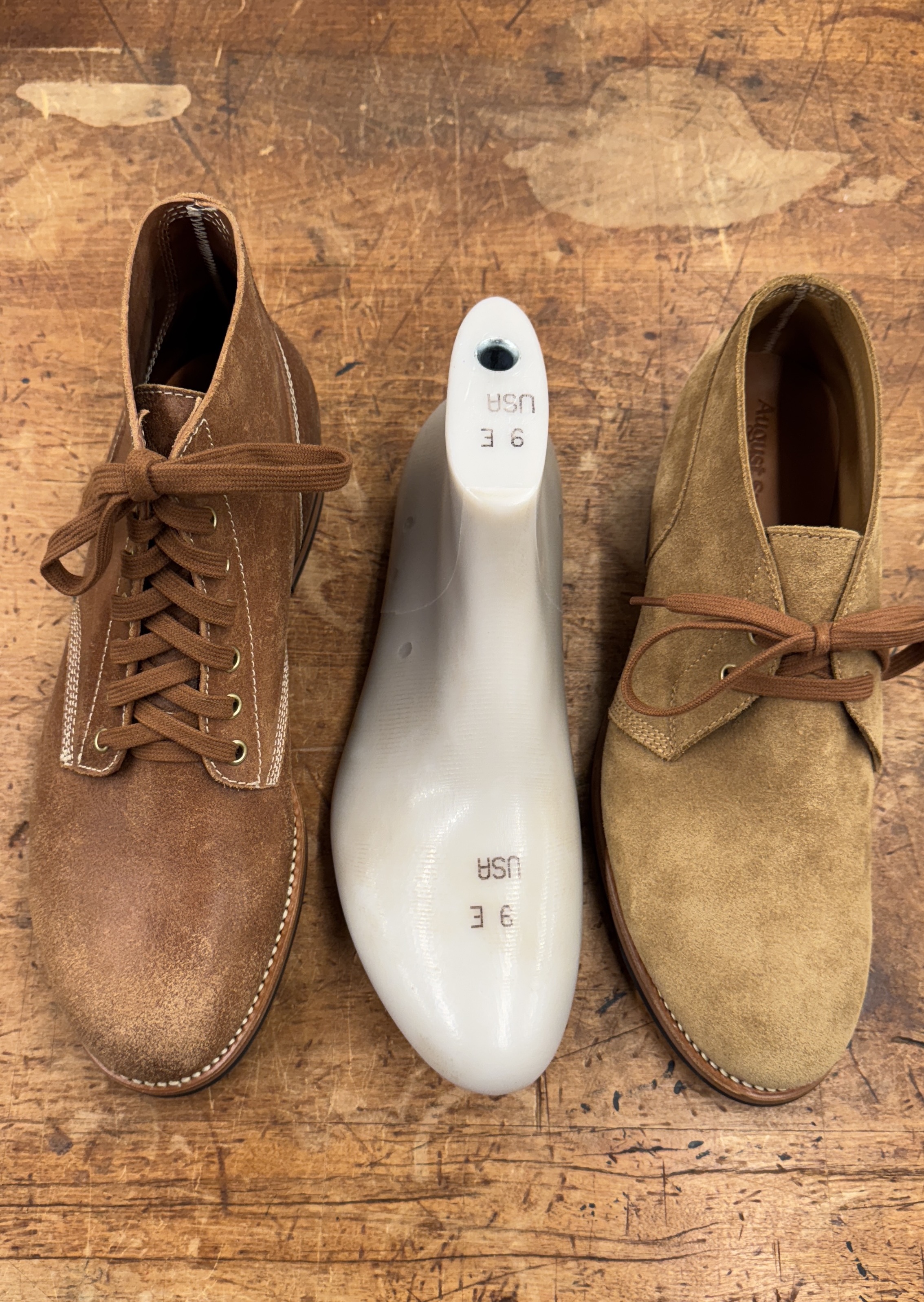
Many of Sonoe’s menswear clients like these haori particularly. I’m not my style is bold enough to make one work, but I love the way a more playful dresser like Scott Fraser Simpson (above) can incorporate one into an outfit alongside Western clothing, layering it over a shirt or knitted tee with high-waisted trousers.
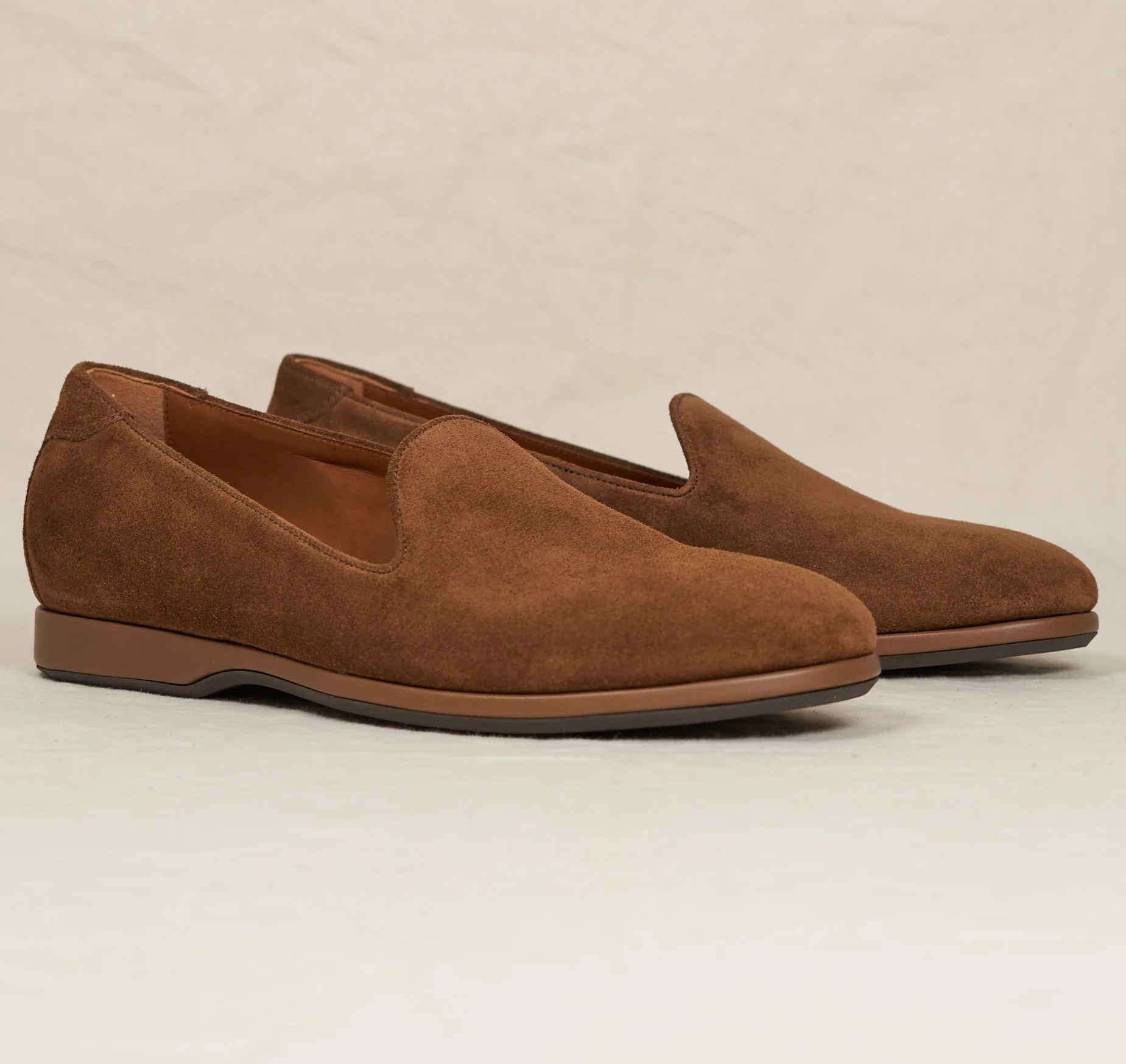
For me, Sonoe’s encouragement has made me imagine a world where I would wear a kimono again at home – I find them elegant and eminently wearable, especially some of the more somber, Deco-influenced pieces. Their sense of history and one-of-one, hand-crafted nature also speak to me. 

Out of the house I’m not so sure, but however it’s going to be worn, this collection is a treasure trove of kimono. And it's hard to deny that these beautiful pieces deserve to be worn. “They’re still clothes,” as Sonoe says, “and clothes have to be worn with joy”.

Sonoe works primarily by appointment - you can contact her via Instagram or directly at the email address below if you’d like to visit. She also has a limited ecommerce presence, though for remote customers she more often conducts consultations via Facetime and WhatsApp. 

Sonoe Sugawara, owner of Furuki Yo-Kimono Vintage.

FURUKI YO-KIMONO VINTAGE

Pod 15, The FACTORY,  21-31 Shacklewell Lane, London E8 2DA

[email protected] @furukiyokimonovintage 

www.furukiyokimono.com